
September, 2025… a sitting United States Senator, Tim Kaine (VA), says plainly that rights come from government. He did not hint, didn’t wrap it in careful phrasing, he just said it. Outright. And if you listen closely, you can almost hear the sound of 1776 shifting uncomfortably in its chair.



Because that statement does not just disagree with the American founding. It walks straight through the front door, looks around, and rearranges the furniture.
The tension is immediate, and it is not subtle.
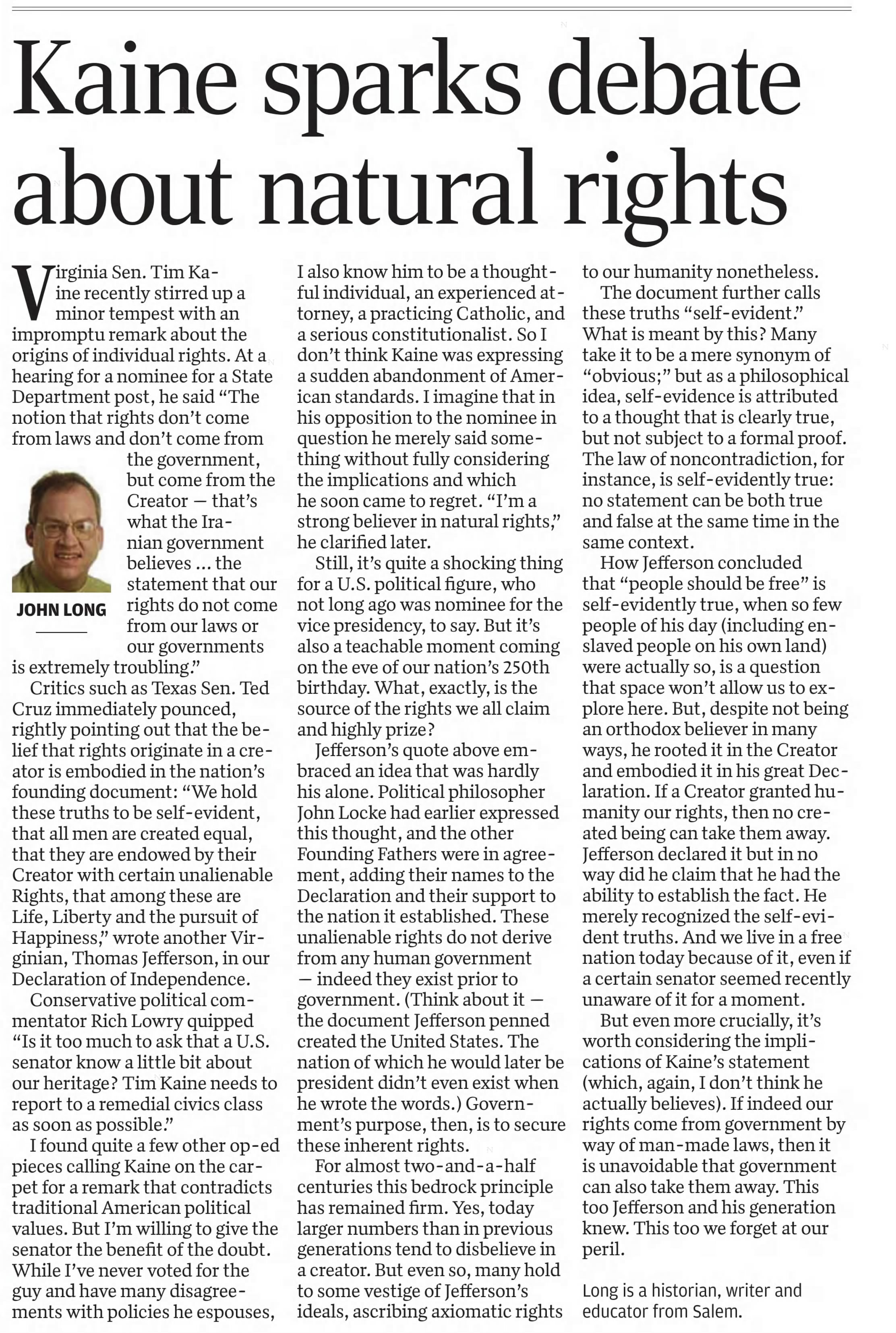
If rights come from government, then government stands at the top of the ladder. It hands them out, adjusts them, takes them back when it decides the moment calls for it. Rights become permissions. Temporary, conditional, and subject to revision. The word right begins to lose its backbone.
If that sounds familiar, it should. It is how most of the world operated for most of human history.
Which is precisely what the American Revolution rejected.
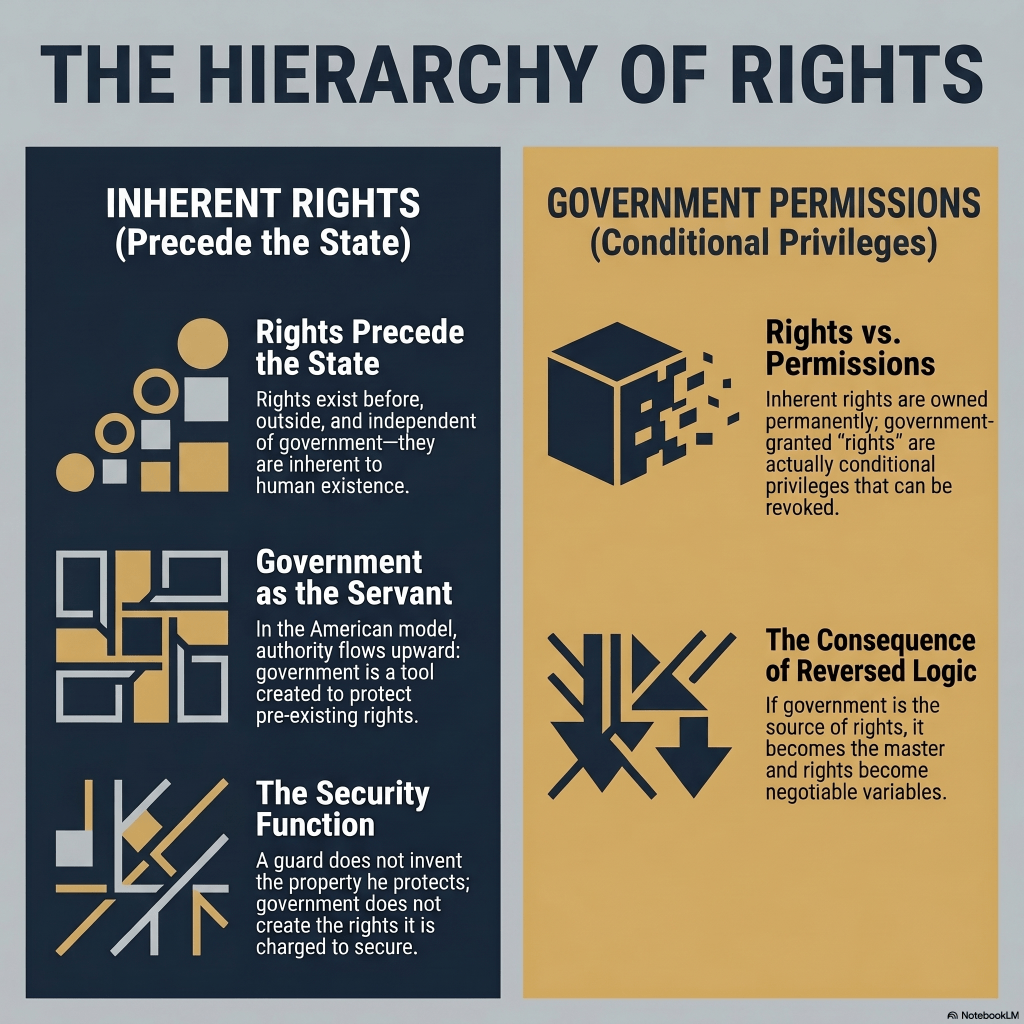
Now before we go any further, it is worth asking a question that sounds simple but carries more weight than it lets on. Why do we study history at all? The standard answer rolls off the tongue. So we do not repeat mistakes. That is tidy. It is also incomplete.
History is not just a warning system. It is a transmission system.
We study it to pass something along, something that does not survive on its own. Values, assumptions, the quiet agreements about how the world is supposed to work. You do not inherit those automatically. They have to be taught.
If you do not teach them, they do not sit patiently waiting to be rediscovered. They get replaced. Usually by whatever is easiest to understand in the moment. And when it comes to power, the easiest answer is almost always the most dangerous one.
That is where confusion begins to creep in.
When someone – in this case a sitting United States Senator – says rights come from government, it tells you a good deal about their intent and even more about what has been forgotten by the people. Because the founding generation did not leave this question open. They answered it, clearly, deliberately, and in a way that defined everything that followed.
When Thomas Jefferson put pen to paper in 1776, he was not inventing a clever phrase to impress European audiences. He was laying out a structure. A sequence. A hierarchy.
“We hold these truths to be self-evident…”
That phrase does more work than most people realize. It does not argue. It does not persuade. It asserts. It says these things are obvious, not because they have been proven, but because they can be recognized.
And what comes next is the heart of it.
Rights come first.
Government comes second.
That order is not decorative. It is the entire design.
Jefferson is not saying that governments grant rights. He is saying the opposite. Rights exist before government, outside of it, independent of it. They come from what he calls a Creator, though he leaves enough room that you could just as easily call it nature, or human dignity, or the simple fact that you exist.
Pick your language. The structure stays the same. You have rights because you are. Government exists because of that fact, not the other way around.
Now follow that logic for just a moment, because this is where things get interesting in a way that is not comfortable.
If rights come from government, then government can remove them. Not as an abuse, but as a function. It gave them, it can take them. Your freedom of speech lasts until someone in authority decides it does not. Your freedom to worship, or not worship, depends entirely on who holds office this year.
That is not paranoia. That is math.
And history is full of examples that prove the equation.
Kings believed it. Empires ran on it. Even modern regimes, dressed up in the language of elections and representation, sometimes drift back toward it. They rarely announce it so plainly. Which is why, when someone does, it is worth paying attention.
Because if Jefferson is wrong, if rights really do come from government, then the American Revolution becomes something awkward to explain.
If King George was the source of colonial rights, then his alteration of those rights, his restrictions, his policies, all of it falls within his authority. It may be unfair. It may be foolish. But it is not illegitimate.
And if that is true, then 1776 is not a declaration of principle. It is a misunderstanding. A rather large one.
Jefferson understood that problem. Which is why he framed the argument the way he did. Not as a request for new privileges, but as a recognition of existing rights that had been violated. The Declaration reads less like a wish list and more like a legal complaint.
You violated something that already existed. You failed to protect what was not yours to define. That is the case.
It is also the foundation of everything that followed.
Because once you accept that rights are inherent, government changes shape. It becomes limited. Not weak, not irrelevant, but bounded. It has a purpose, and that purpose is not to create rights but to secure them. To stand between the individual and the forces that would take those rights away.
Flip that order, and the entire structure flips with it.
Government becomes the source. Authority flows downward. Rights become negotiable. Temporary. Political. Something that can be expanded when convenient and reduced when necessary.
That is not a different version of the American system. That is a different system entirely.
Which brings us back to the present, and the quiet question that sits underneath all of this.
Do we still believe what Jefferson wrote?
Not in a ceremonial sense. Not in the way we quote it on holidays or engrave it on walls. In the practical sense. In the way we think about power, about law, about the relationship between the individual and the state.
Because the answer to that question determines everything else.
If rights are inherent, then government must justify itself constantly. It must explain its actions, defend its limits, and accept that there are lines it cannot cross without losing legitimacy.
If rights are granted, then government does not need to justify in the same way. It defines the terms. It sets the boundaries. It becomes, quietly but unmistakably, the master rather than the servant.
The founders made their choice.
They chose a system that begins with the individual, not the state. A system that assumes rights exist first and power follows. A system that places limits on authority not as a courtesy, but as a necessity.
That choice is what made the Revolution possible. Take it away, and the whole thing begins to wobble.
That is the stake here, whether anyone says it out loud or not. Not a passing comment in a hearing room. Not a political disagreement that will fade with the next news cycle. Something deeper.
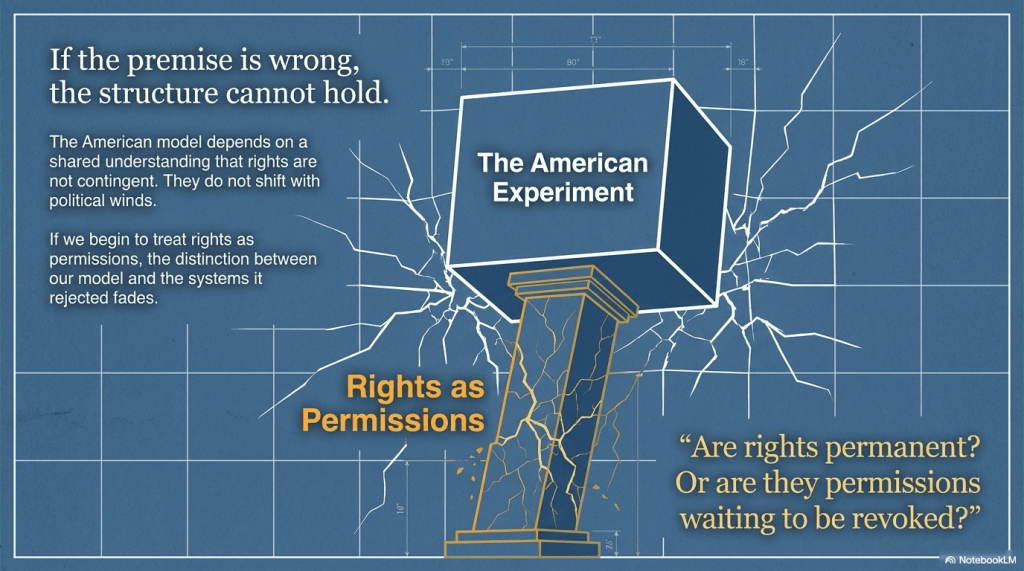
If the premise is wrong, the structure cannot hold. And if the structure does not hold, then what we have is not the American experiment. It is something else, wearing its clothes, speaking its language, but built on a very different foundation.
There is a habit in modern conversation that would have puzzled the men of 1776. We tend to treat rights and government as if they arrived together, as if one simply grew out of the other, like branches from the same tree. Jefferson would have shaken his head at that. Not angrily, not dramatically, but with the quiet certainty of someone who has already worked the problem through and found the answer.
He would have said you have it backwards. The order matters, and it is not negotiable. Rights exist first. Government comes later.
That is not poetry. It is logic. It is structure. It is the spine of the argument that holds everything else upright. When Jefferson wrote that governments are instituted among men to secure rights, he was not offering a suggestion. He was defining a relationship. Rights are the reason government exists. They are not the product of it.
Once you understand that, the rest of the system begins to make sense in a way that it otherwise cannot.
Think about it in plain terms. If something exists before a thing, that thing cannot be its source. A lock does not create the door it secures. A guard does not invent the property he protects. Government, in Jefferson’s view, is the lock, the guard, the mechanism. The rights are the thing being protected.
Reverse that order, and the logic collapses.
If government creates rights, then rights are no longer fundamental. They become permissions. They exist at the pleasure of authority. They can be expanded, reduced, or eliminated depending on who is in charge and what they believe the moment requires.
At that point, the word right starts to lose its meaning. It becomes a softer word. A weaker word.
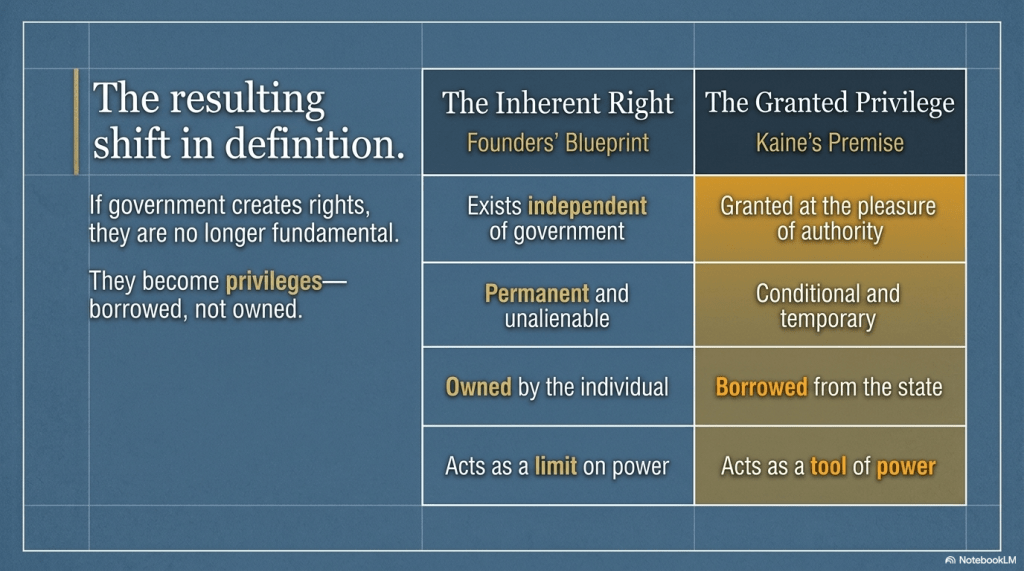
Privilege.
And privileges are, by definition, conditional.
They are granted under certain terms. They can be revoked when those terms change. They do not belong to you in any permanent sense. They are borrowed, not owned. If you have ever dealt with a license, a permit, or a temporary allowance, you already understand the concept. You have it, until you do not.
Jefferson understood that distinction with uncomfortable clarity.
He had lived under a system where rights behaved very much like privileges. Colonial assemblies could pass laws, but they could be vetoed or ignored. Trade could be allowed, then restricted. Representation could be promised, then denied. The pattern was not subtle once you looked at it closely.
Authority gave. Authority took away. And it always reserved the right to do both. The Revolution was, at its core, a rejection of that arrangement. Not just politically, but philosophically.
Jefferson did not stop with the Declaration. He carried the argument forward, refining it, testing it, applying it in places where its implications became even more personal. One of the clearest examples comes in his work on the Virginia Statute for Religious Freedom, a document that does not get the same public attention but may reveal more about his thinking than the Declaration itself.
There, he makes a statement that cuts deeper than most people expect.
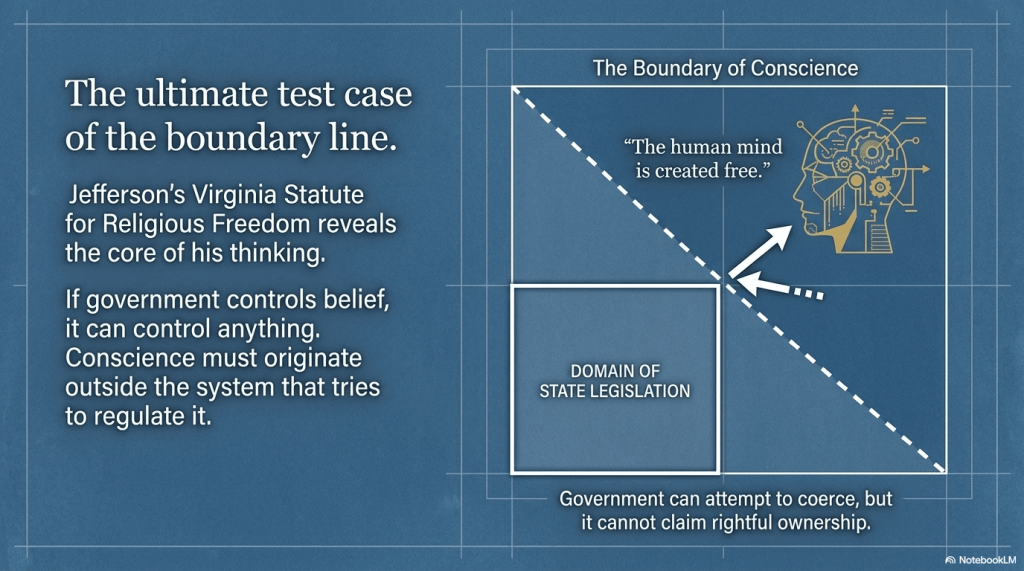
The human mind is created free.
Pause on that for a moment.
If the mind is created free, then it is not the property of the state. It is not subject to its authority in the way that property or behavior might be. Thought, belief, conscience, these things exist outside the reach of legislation, at least in any legitimate sense. Government can attempt to influence them. It can try to coerce them. But it cannot claim rightful ownership over them.
That is a dangerous idea, depending on where you sit.
For the individual, it is liberating. For the state, it is limiting.
Jefferson takes it further. If belief is free by nature, then forcing it becomes not just unwise, but unjust. You are not merely imposing a policy. You are violating something that was never yours to control. That is why he insists that rights of conscience are unalienable. Not because they are convenient, but because they originate outside the system that might try to regulate them.
James Madison stands alongside him in this, arguing with equal force that religion, belief, and thought must remain beyond the authority of government. Not because religion deserves special treatment, but because it serves as the clearest test case.
If government can control what you believe, it can control anything. That is not theory. That is history.
Look at the pattern, and it repeats with unsettling consistency. Governments that claim to grant rights inevitably reshape them to fit their needs. The names change, the language evolves, but the structure remains familiar.
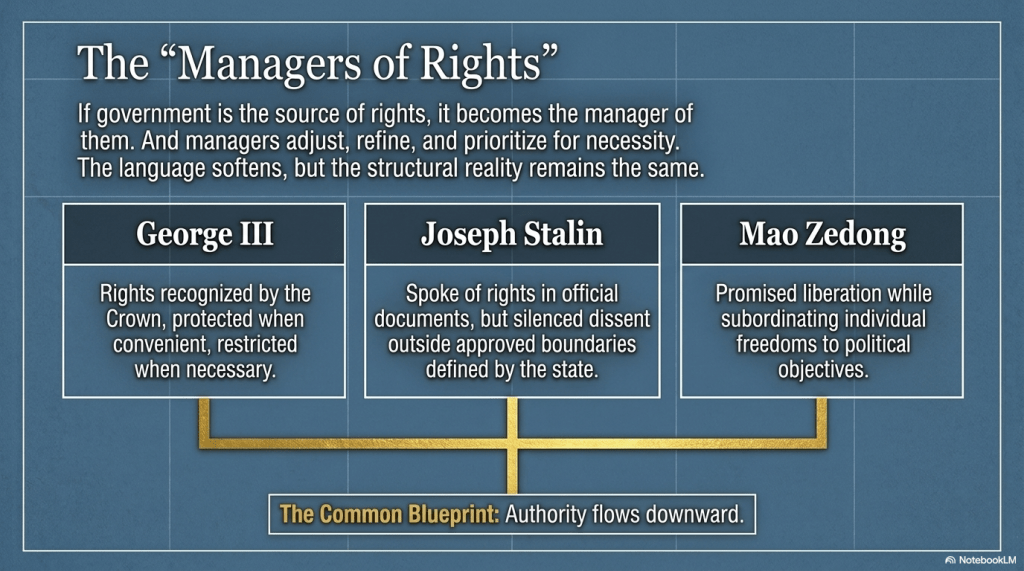
Joseph Stalin presided over a system that spoke of rights in official documents, even as it silenced dissent, controlled speech, and punished those who stepped outside approved boundaries. Rights existed, but only within the framework defined by the state.
Mao Zedong did the same, promising equality and liberation while constructing a system in which individual freedoms were subordinate to political objectives. The language of rights remained. The reality shifted.
And long before either of them, George III operated within a tradition that assumed authority flowed downward. Rights were understood as something recognized by the Crown, protected when convenient, restricted when necessary. The colonists experienced that system directly, not as an abstract theory, but as a daily reality.
In each case, the pattern holds. If government is the source of rights, it becomes the manager of them. And managers adjust.
They refine. They limit. They prioritize. They decide which rights matter more, which can be set aside, which can be postponed for the greater good. It is rarely framed as oppression. It is framed as necessity. Stability. Progress.
The language softens. The effect does not.
This is why Jefferson and Madison insisted on drawing the line where they did. Not out of stubbornness, not out of a desire to win an argument, but out of an understanding that once the line moves, it rarely moves back.
Religious freedom becomes the proving ground.
If government controls rights, then it controls belief. It decides which faiths are acceptable, which practices are permitted, which expressions are allowed. History offers no shortage of examples. Established churches, enforced doctrines, penalties for dissent. It is not confined to one culture or one era. It appears wherever authority claims the right to shape conscience.
Jefferson’s answer is to remove that power entirely. Not to regulate it more carefully. Not to distribute it more fairly.
To deny its legitimacy.
Belief belongs to the individual. It exists prior to government. It cannot be created by law, and it cannot be extinguished by it, at least not in any moral sense. Government can interfere. It can punish. It can attempt to coerce. But in doing so, it reveals itself as overstepping, as reaching beyond its proper bounds.
That is the point.
Rights must be universal, or they are not rights at all. They must apply regardless of who is in power, regardless of what that power prefers, regardless of how inconvenient they might be in a given moment. If they depend on authority, they become tools. If they exist outside it, they become limits.
And limits, for those who hold power, are always uncomfortable.
Jefferson knew that.
Madison knew that.
The question is whether we still do?
Because the argument has not gone away. It has simply changed its clothing. It appears in new forms, new debates, new contexts, but the underlying issue remains exactly the same.
Does government create rights? Or does it protect something that already exists?
Answer that one way, and you build a system where power is constrained, where authority must justify itself, where individuals possess something that cannot be casually removed.
Answer it the other, and you build something very different. A system where rights are granted, adjusted, and withdrawn. A system where the line between right and privilege begins to blur. And once that line blurs, it becomes very difficult to draw it again.
There is a question that sits quietly underneath almost every political argument in this country, and it does not get asked nearly as often as it should.
Do we still believe what we said in 1776?
Not ceremonially. Not in the way we recite familiar phrases or nod along when the Declaration is quoted. The real question is whether we still believe it in the practical sense, the way it shapes how we think about law, authority, and the limits of power.
Because if you listen closely, you can hear the shift.
It does not announce itself. It rarely does. It shows up in assumptions, in phrasing, in the way people talk about what government can do and what it should do. It appears when rights are described as something that can be adjusted, balanced, or even granted, depending on the needs of the moment.
And that raises a simple but uncomfortable possibility. Have we moved, quietly, from the language of natural rights to the language of permission?
That is the larger question.
The American Revolution was not just a break from Britain. It was a break from an idea. The idea that rulers, whether kings or parliaments, stand as the source of authority and the distributors of rights. The colonists did not simply object to how power was being used. They rejected the premise that gave that power its legitimacy.
That is the part that tends to get lost.
We remember the taxes, the protests, the battles. We remember the personalities, the drama, the moments that feel cinematic. But the real revolution took place at a deeper level. It was a reordering of the relationship between the individual and the state.
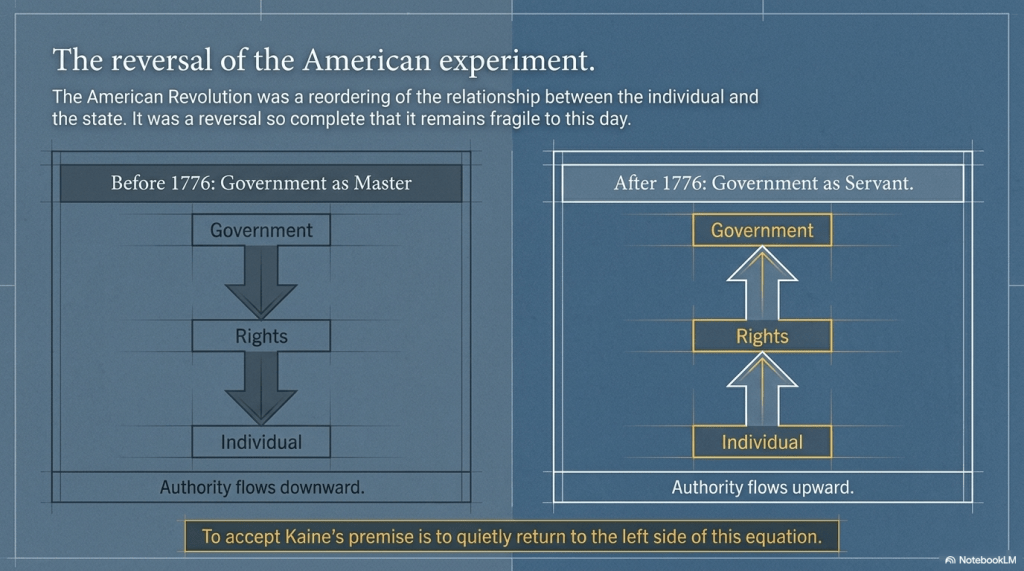
Before 1776, the prevailing model looked something like this.
Government as master.
Authority flows downward. Rights are recognized, defined, and enforced by those in power. The individual exists within that structure, protected to the extent that the system allows.
After 1776, at least in theory, the model changes.
Government as servant.
Authority flows upward. Rights exist prior to government. The individual stands first, and government is created to secure what already belongs to that individual.
It is a reversal so complete that it can be difficult to appreciate just how radical it was.
And how fragile it remains.
Because that reversal depends on belief. Not blind belief, not unthinking acceptance, but a shared understanding that rights are not contingent. That they do not shift with the political winds. That they are not granted as favors and withdrawn as punishments.
If that belief weakens, the structure begins to tilt.
Consider what happens if we accept the idea that rights come from government.
At first, it sounds manageable. Government defines the scope of speech, the boundaries of religious expression, the protections of property. It sets rules, establishes limits, balances competing interests. All of that sounds reasonable, even necessary.
Until you follow the logic through.
If government defines rights, it can redefine them. If it can redefine them, it can narrow them. If it can narrow them, it can remove them. Not necessarily all at once, not in a dramatic sweep, but gradually, carefully, always with a justification that sounds persuasive in the moment.
Speech becomes something that must be regulated for safety or stability. Religion becomes something that must be aligned with broader social goals. Property becomes something that can be reallocated in the name of fairness or necessity.
Each step can be explained. Each adjustment can be defended. And over time, the cumulative effect is that rights begin to look less like foundations and more like variables.
Negotiable.
Now turn it around.
If rights come from nature, or from a Creator, or from the simple fact of being human, then government operates under a different set of constraints. It cannot legitimately remove what it did not create. It can regulate the exercise of rights in certain contexts, but it must always do so with the understanding that the underlying right remains.
That creates tension.
It forces government to justify itself, to explain why a restriction is necessary, to demonstrate that it is not simply acting out of convenience or preference. It places a burden on authority, one that does not exist in the same way when rights are seen as granted.
That burden is the point. It is what keeps power in check.
This is where the modern parallels begin to matter, not as political arguments, but as reflections of the underlying principle. When Americans criticize regimes that suppress speech, restrict religion, or seize property without recourse, they are not just expressing disapproval. They are making a claim, whether they realize it or not.
They are saying those actions are wrong, not just inconvenient.
But that claim only holds if rights are universal.
If rights come from government, then other governments have the same authority to define them differently. A regime that limits speech can argue that it is simply exercising its prerogative. A system that controls religious practice can claim it is maintaining order. A state that restricts property can say it is pursuing a different vision of justice.
Without the concept of inherent rights, those criticisms lose their foundation. They become preferences. And preferences are difficult to defend across borders.
This is the quiet contradiction that sometimes appears in modern discourse. We insist that rights are universal when we look outward, when we evaluate the actions of other nations, but we speak of them as flexible when we look inward, when we consider how our own system operates.
The tension is not always acknowledged. But it is there. And it leads back to the same question, the one that has been present from the beginning.
Where do rights come from?
The faces in that debate have changed. The language has evolved. The context is different. But the argument itself is remarkably consistent. It has been carried forward from the Enlightenment, through the Revolution, into the present, reshaped but not resolved.
Jefferson answered it one way.
Others have answered it differently.
The country that emerged from that moment was built on the assumption that rights are permanent, that they exist independent of government, and that government must be structured in a way that recognizes that fact.
That assumption is not self-sustaining.
It requires reinforcement. It requires understanding. It requires, at times, a willingness to revisit the original argument and examine whether it still holds, not just in theory, but in practice.
Because if it does not, if we begin to treat rights as permissions, as something that can be adjusted or withdrawn based on circumstance, then the distinction between the American model and the systems it rejected begins to blur.
Not all at once. But gradually. Quietly.
And once that distinction fades, it becomes harder to explain what made the Revolution necessary in the first place.
Which brings us back, once again, to the question that does not go away.
Are rights permanent? Or are they just permissions, waiting to be revoked?
Originally published September 9, 2025
Republished May 2, 2026



 DAVE DOES HISTORY
Leave a comment