
If you want to understand why Jefferson would later take such careful aim at kings, you have to go back to a time when the idea of questioning a king was not just dangerous, it was almost unthinkable. England in the seventeenth century was not a quiet place. It was a nation arguing with itself about power, about God, about who actually held authority when the crown and Parliament looked at each other and said, “No, you first.”
The argument did not stay polite.



It turned into war. Armies raised in the King’s name faced armies raised in Parliament’s name. Villages chose sides. Families split. And in the end, something happened that still feels almost shocking when you say it out loud. Charles I walked into that moment at about five foot six and left it, as it was once said, somewhat shorter.
That sort of thing tends to concentrate the mind.
What followed was not stability. It rarely is. England experimented with a republic under Cromwell, found that experiment lacking, and then restored the monarchy. But the question did not go away. If a king could be tried and executed, what did that say about his authority? Was he truly appointed by God, or merely tolerated by men?
Into that uncertainty stepped Sir Robert Filmer.
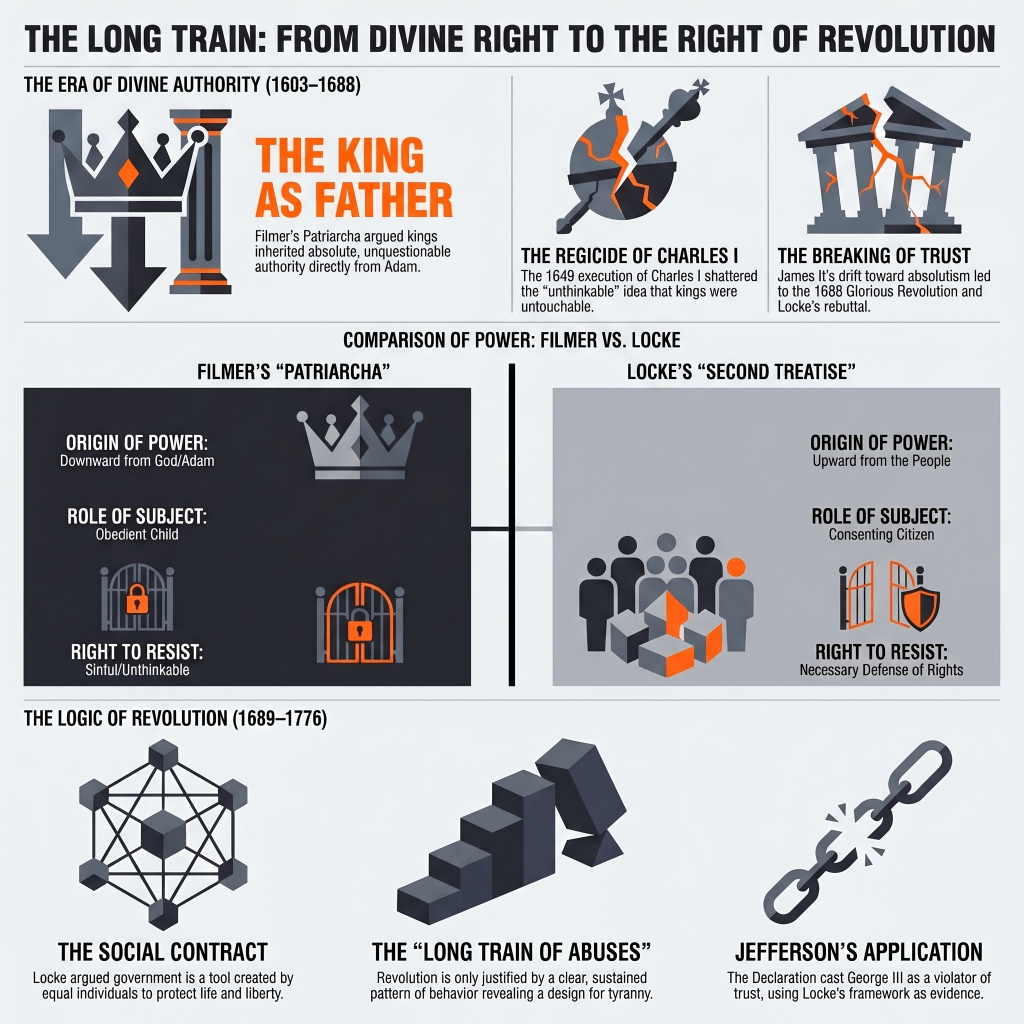
Filmer was not a man trying to split the difference. He was not interested in compromise or nuance. He saw the chaos of civil war and concluded that the problem was not too much power in the crown, but too little. His answer was to go back, not just to earlier English tradition, but all the way back to the beginning. Not to Magna Carta. Not to Saxon customs. Back to Genesis.
His great work, Patriarcha, written earlier but published in 1680, laid out a theory that was as sweeping as it was simple. Kings, Filmer argued, derived their authority from Adam. Not metaphorically. Literally. Adam, as the first father, had authority over his children. That authority, according to Filmer, passed down through generations. Through Noah, through the patriarchs, through the long, tangled branches of human history, until it landed in the hands of modern kings.
It is a bold claim, and it carries a certain internal logic, if you are willing to accept the premise.
Political power, in this view, is nothing more than fatherhood extended. The king is the father of his people. His authority is natural, unquestioned, ordained by G-d. And if that is true, then the rest follows with a kind of relentless clarity. Subjects are like children. Children do not vote on household rules. They do not negotiate with their father. They obey.
To resist the king, then, is not merely political disagreement. It is rebellion against the natural order. Worse than that, it is rebellion against G-d himself.
Filmer did not bother with arguments about efficiency or good governance. He did not need to. In his system, the king’s authority did not depend on performance. It did not depend on consent. It did not even depend on competence. It depended on origin. If the king stood in that long line of paternal authority, then his right to rule was beyond question.
That is a powerful idea, especially in a world where religion and politics are not separate conversations.
And in the England of Charles II and James II, it found an eager audience. The monarchy had been restored, but it was not secure. Parliament had tasted power. The memory of regicide still lingered. Loyalists needed something more than tradition to defend the crown. They needed an argument that could not be easily dismantled by politics.
Filmer gave them one.
Here, they could say, is the proof. Not in statutes or precedents, but in Scripture. The king rules because G-d ordained it so. Parliament exists at his pleasure. Dissent is not just inconvenient. It is sinful.
For those who feared the return of instability, it must have felt reassuring. A fixed order. A clear hierarchy. No ambiguity about who answers to whom.
To modern ears, it sounds almost medieval. A great chain of authority stretching from Eden to Whitehall, with every king claiming his place somewhere along that line. It feels less like political theory and more like something you might find woven into a tapestry hanging in a cathedral, all golden threads and unquestioned assumptions.
But it would be a mistake to dismiss it too quickly.
Because in its own time, it made sense to people who had watched their world collapse into violence. If the alternative to absolute authority was civil war, then absolute authority began to look less like tyranny and more like stability.
And yet, even as Filmer’s ideas were being printed and praised, they were already beginning to feel out of step with reality.
England had, after all, executed a king. It had lived under a republic. It had restored the monarchy, but not without conditions. Parliament had not disappeared. It had grown stronger. The idea that the king could simply rule as a father over obedient children was becoming harder to square with a society that had already demonstrated a willingness to say no.
That tension is what makes Filmer so important.
He represents the old world, not in the sense of being ancient, but in the sense of being rooted in a way of thinking that was about to be challenged at its core. A world where authority flows downward, from G-d to king to subject, with no meaningful interruption. A world where questioning that flow is not just political dissent, but moral failure.
And standing on the other side, not yet fully formed but gathering strength, was a different idea. One that would argue that authority does not descend from Adam, but rises from the people. That rulers are not fathers, but servants. That power is not inherited, but granted, and can be taken back.
That argument had not yet fully taken hold in Filmer’s time. But it was coming.
You can almost feel it in the air of late seventeenth century England. The unease. The sense that something fundamental was shifting. That the old explanations, however comforting, were no longer sufficient.
Filmer tried to nail those explanations in place, to anchor the monarchy in something eternal and unquestionable. In doing so, he clarified the stakes. If he was right, then resistance was unthinkable. If he was wrong, then the entire structure of authority could be reimagined.
That is not a small disagreement.
It is the kind of disagreement that does not stay confined to books.
And as we will see, it did not.
If Filmer built a world where kings stood at the top of a great family tree, rooted all the way back in Eden, then John Locke walked into that same forest, looked around, and said, in effect, “This is not how any of this works.”
He did not shout it. He did not lead an army. He did something more dangerous. He wrote it down.
Locke’s Second Treatise of Government, published in 1690, was not just another political pamphlet tossed into the noise of English debate. It was a deliberate answer to Filmer, a point by point dismantling of the idea that political authority could be traced back to Adam, handed down like an heirloom, and worn by kings as a divine birthright.
And it came at exactly the right moment.
England, by the late seventeenth century, was tired. Tired of religious whiplash. Tired of kings who pushed too far. Tired of Parliament that pushed back. Charles II had played his games with power, sometimes subtle, sometimes not. His brother, James II, was less subtle. Catholic, determined, and convinced of his own authority, James seemed ready to press the logic of Filmer’s world to its conclusion. A standing army. Manipulated institutions. A quiet but unmistakable drift toward absolutism.
For men like Locke, that was not a theory. That was a warning.
Locke spent part of this period in exile, not because he enjoyed travel, but because the political climate made staying in England unwise. That tends to sharpen a man’s thinking. When you are looking at your own country from a distance, wondering whether it is about to slip into something you cannot accept, you start asking harder questions.
Where does power come from?
Who gives it?
And perhaps most unsettling of all, who has the right to take it away?
Locke’s answer begins in a place that would have made Filmer deeply uncomfortable. Not in Genesis. Not in royal lineage. In what he called the state of nature.
Now, that phrase has been misunderstood so often that it is worth pausing on it for a moment. Locke was not describing a jungle. He was not imagining men running around with clubs, waiting for civilization to arrive. He was describing a condition, a way of understanding human beings before any formal government exists.
And in that condition, Locke says something that would have sounded almost radical at the time.
All men are naturally free. All men are naturally equal.
Not equal in talent, not equal in fortune, but equal in the sense that no one is born with a natural right to rule over another. No one carries a crown out of the womb. No one inherits authority simply by existing. Each person stands on the same ground, governed by what Locke calls reason, the law of nature that teaches, among other things, that one ought not to harm another in his life, liberty, or possessions.
That is the first crack in Filmer’s foundation.
If men are naturally equal, then the idea that one man can claim authority over all others because of a distant ancestor begins to look less like divine order and more like a convenient story.
From there, Locke moves to something even more practical.
Property.
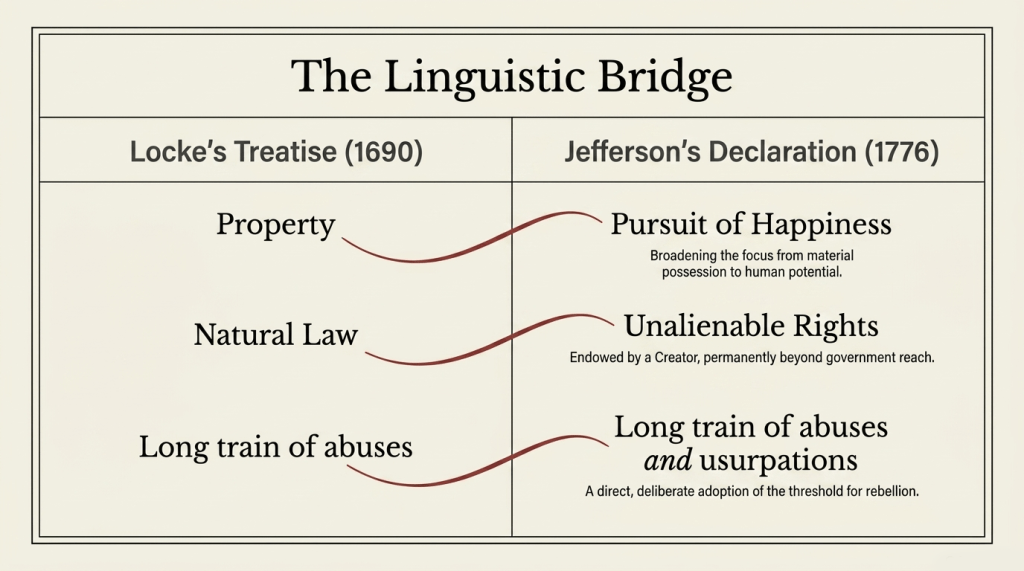
Now, when modern ears hear that word, they tend to think of land, houses, accounts, the things that can be bought and sold. Locke means something broader. He begins with the individual. Every man, he writes, has a property in his own person. His labor, the work of his hands, belongs to him.
That simple idea carries enormous weight.
Because if your labor belongs to you, then the things you produce with that labor, the crops you grow, the goods you make, the value you create, have a claim that does not come from a king’s grant. It comes from you. Property, in Locke’s system, is not handed down by divine favor. It is built. Earned. Rooted in effort rather than inheritance.
That turns Filmer upside down.
In Filmer’s world, authority flows downward, from G-d to king to subject. In Locke’s world, rights begin at the individual and move outward. Government does not create those rights. It exists to protect them.
And that leads to the heart of Locke’s argument, the idea that would echo across oceans and decades until Jefferson picked it up and gave it new life.
Consent.
If men are free and equal, then no one can rightfully rule over them without their agreement. Government, in this view, is not a natural extension of fatherhood. It is a constructed thing, formed by what Locke calls a social contract. People come together, recognizing that life without a common authority can be uncertain, even dangerous, and they agree to establish a government to secure their rights more effectively.
But, and this is where Locke becomes particularly careful, that agreement has limits.
The legislature, the body that makes laws, holds a central place in this system, but it is not unlimited. It is bound by the same natural law that governs individuals. It cannot arbitrarily take life, liberty, or property. It cannot act simply because it can. It is held to a standard that exists outside of itself.
The executive, the one who enforces the laws, operates under a kind of trust. Power is given, not owned. It is exercised on behalf of the people, not over them in the paternal sense Filmer imagined.
You can see the shift.
Where Filmer saw a family, Locke saw a contract. Where Filmer saw obedience, Locke saw agreement. Where Filmer saw divine right, Locke saw human responsibility.
And then Locke takes the final step, the one that makes everything else matter.
If government is formed by consent, and if it exists to protect rights, then what happens when it fails to do that?
What happens when it becomes destructive of those ends?
Locke does not hedge.
He says that the people retain the right to alter or abolish it. Not lightly. Not for trivial reasons. He speaks of a “long train of abuses,” a pattern of behavior that shows a settled design to reduce the people under arbitrary power. But when that pattern is clear, when the trust has been broken, the authority that government once held dissolves.
That is the antidote to Filmer.
Filmer said resistance is rebellion against G-d. Locke says resistance can be the defense of natural law. Filmer said kings are fathers who cannot be questioned. Locke says rulers are agents who can be dismissed when they violate the terms of their authority.
It is a quiet revolution on paper.
And like most revolutions that begin in ink, it did not stay there.
The Glorious Revolution of 1688, which saw James II removed and William and Mary brought to the throne, did not unfold as a neat application of Locke’s theory. History rarely cooperates so cleanly. But Locke’s ideas provided something that England desperately needed at that moment, a way to explain what had happened without descending into chaos.
The king had not been overthrown simply because he was unpopular. He had violated the trust placed in him. He had acted in ways that threatened the rights of his subjects. Therefore, the people, through their representatives, had the right to replace him.
That is a powerful justification.
It allows change without admitting anarchy. It preserves order while redefining authority. It says, in effect, that the system can correct itself, not because kings are infallible, but because they are not.
From there, Locke’s ideas begin to travel.
They move through pamphlets and conversations, through universities and coffeehouses, across the Atlantic to colonies that are already beginning to ask their own questions about authority and rights. By the time Jefferson sits down to write, Locke’s language is not foreign. It is familiar. Almost assumed.
“All men are created equal.”
“Governments derive their just powers from the consent of the governed.”
“A long train of abuses.”
Those phrases do not appear out of nowhere. They carry Locke’s fingerprints, even when his name is not mentioned.
And that is the real measure of his impact.
He did not just answer Filmer. He replaced him.
He offered a different way of seeing the world, one in which power is not inherited but granted, not absolute but conditional, not permanent but accountable. A world where rulers are not fathers, but servants.
It is a cleaner idea. More appealing. It is also more demanding.
Because if power comes from the people, then the people bear a responsibility that Filmer’s subjects never had to consider. They must give that power thoughtfully. They must watch how it is used. They must decide when it has been abused.
That is not as comfortable as obedience.
But it is far more durable.
And as the next chapter in this story unfolds, we will see exactly how those ideas, born in the political struggles of England, found their way into a document that would declare, in no uncertain terms, that the old world of kings by divine right was finished, at least on one side of the Atlantic.
By the time Thomas Jefferson sat down with pen in hand in the summer of 1776, he was not writing in a vacuum. He was writing at the far end of an argument that had been building for more than a century, an argument carried through civil war, regicide, restoration, and revolution. The colonists liked to think of themselves as practical people, and they were, but they were also deeply read, steeped in the political thought of their time. And among those influences, John Locke stood not just as a voice, but almost as a kind of intellectual authority, quoted, debated, absorbed, and, when necessary, translated into something new.
To understand the preamble to the Declaration of Independence, you have to understand that Jefferson was not inventing a philosophy. He was drawing from one, shaping it, sharpening it, and placing it into a moment where it could no longer remain theoretical. The colonists did not wake up one morning and decide to become revolutionaries. They had spent years, even decades, thinking about rights, authority, and the limits of power. Locke had given them a language for that thinking. Jefferson gave it a voice.
The echoes are not subtle.
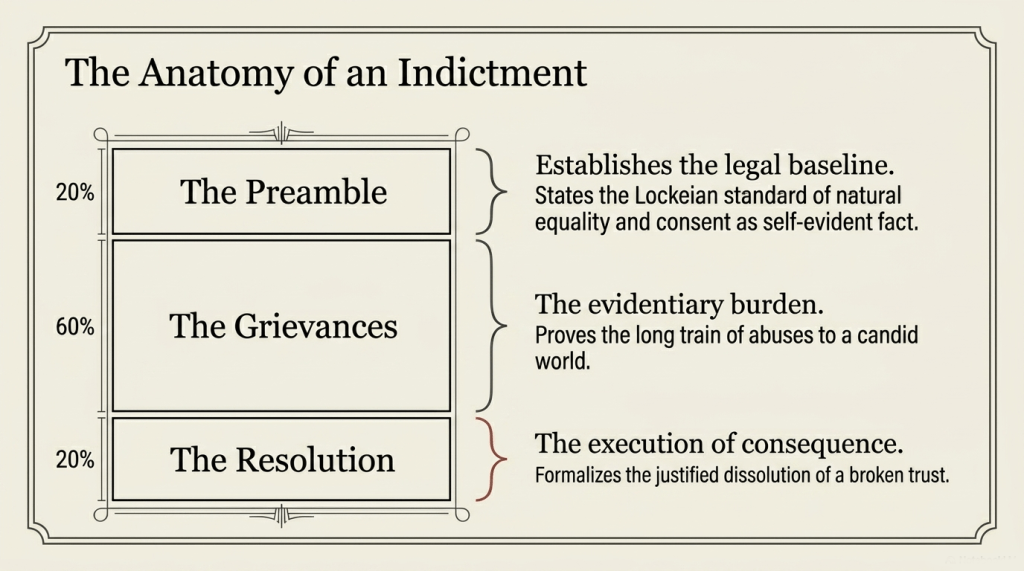
“All men are created equal.”
That line has been quoted so often it risks losing its edge, but in 1776 it carried the full force of Locke’s state of nature. The idea that men are naturally free and equal, not because a government says so, not because a king grants it, but because it is inherent in their existence. Locke had argued it carefully, building his case through reason and natural law. Jefferson did something slightly different. He stated it as fact, self-evident, as though the argument had already been won.
That is not carelessness. That is strategy.
By the time Jefferson wrote those words, the argument for natural equality had been circulating long enough that he could treat it as settled ground, at least for the audience he was addressing. He was not trying to convince a hostile king. He was speaking to what he called “a candid world,” and to a population that had already begun to see itself through that lens.
Then comes the next layer.
“Endowed by their Creator with certain unalienable Rights.”
Locke’s influence is unmistakable here, though Jefferson adjusts the tone. Locke spoke of natural law, of rights that exist independent of government. Jefferson wraps that idea in language that appeals both to reason and to a broadly shared sense of divine order. It is a careful balance. He does not ground rights in the authority of a church or a monarch, but neither does he strip them entirely of their moral weight. The Creator, in this context, is less about doctrine and more about universality. Rights are not granted. They are given in a way that no human authority can revoke.
That is the key.
Because if rights cannot be revoked, then government cannot legitimately take them away. It can violate them, certainly. History is full of that. But it cannot justify doing so. And that distinction, between what is done and what is justified, is where revolutions find their footing.
Jefferson then moves to a phrase that has sparked more discussion than almost any other in the document.
“Life, Liberty, and the pursuit of Happiness.”
Locke had written of life, liberty, and property. It is a neat triad, logical and grounded in his broader argument about labor and ownership. Jefferson changes it. Not dramatically, but deliberately. Property becomes the pursuit of happiness.
Why?
Part of the answer is practical. Property, in the eighteenth century, carried specific legal and economic connotations. It was tied to land, to wealth, to a system that not everyone equally benefited from. Happiness, on the other hand, is broader. It includes property, certainly, but it is not limited to it. It speaks to a more expansive idea of human flourishing, something that could resonate across different classes and conditions.
But there is also a philosophical shift.
By framing the right as the pursuit of happiness, Jefferson emphasizes not just what people have, but what they seek. It turns the focus outward, toward opportunity and potential, rather than inward, toward possession. It suggests that government’s role is not simply to protect what exists, but to allow individuals the space to strive, to improve, to define their own sense of fulfillment.
It is Locke, translated into a slightly different key.
And then, perhaps most strikingly, Jefferson reaches for a phrase that might as well have been lifted directly from Locke’s pages.
“A long train of abuses and usurpations.”
There is no mistaking the lineage there. Locke had used similar language to describe the conditions under which a people might justly dissolve their government. Not a single act. Not a momentary grievance. A pattern. A sustained course of conduct that reveals a design, a purpose, to reduce the people under arbitrary power.
Jefferson adopts that framework and applies it to the actions of George III. The grievances that follow are not random complaints. They are arranged to demonstrate exactly what Locke described, a pattern that justifies not just protest, but separation.
This is where the preamble does its real work.
It is not there to sound noble, though it does. It is there to establish the standard by which the King will be judged. Once that standard is set, the rest of the document becomes evidence. Each grievance is another piece of the case, another step in showing that the relationship between ruler and ruled has been fundamentally broken.
And that brings us to the purpose behind all of this.
The Declaration is not merely announcing independence. It is justifying it. It is explaining to the world why this act, which could easily be dismissed as rebellion, is in fact something else. Something grounded in principle, in established thought, in a tradition that the colonists could claim as their own.
Because that is the other piece of this puzzle that often gets overlooked.
The colonists did not see themselves as inventing something entirely new. They saw themselves as defending something old. The rights of Englishmen. The constitutional balance that had been fought over in the seventeenth century. The idea that even a king could be held accountable when he violated the trust placed in him.
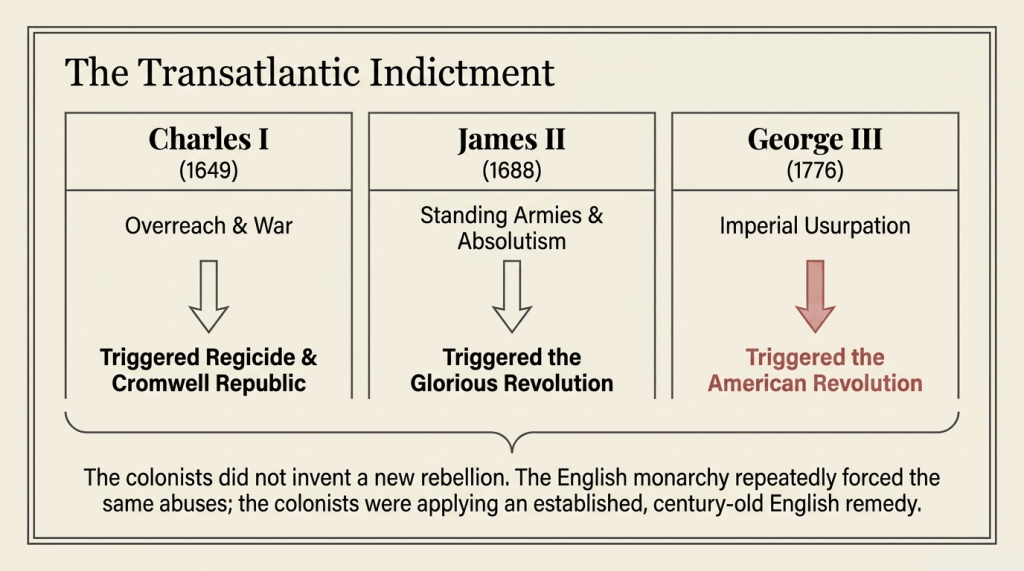
In that sense, George III was not just a distant monarch. He was being cast in a familiar role, one that English history had already grappled with. Not identical to James II, but close enough in behavior to draw the comparison. A ruler who had, in the eyes of his critics, pushed beyond the limits of legitimate authority and thereby forfeited his claim to obedience.
That is a powerful narrative.
It allows the colonists to argue that they are not abandoning English tradition, but fulfilling it. Not rejecting their heritage, but applying its lessons. The Glorious Revolution had established that a king could be removed for violating the rights of his people. The Declaration extends that logic across the Atlantic and applies it to a new context.
This is where the continuity becomes clear.
Filmer had argued for absolute monarchy, rooted in divine right and paternal authority. Locke had dismantled that argument, replacing it with a system based on natural rights and consent. Jefferson takes Locke’s framework and uses it to justify a break not just with a particular king, but with the entire structure of imperial rule.
It is a progression, not a rupture.
And that is why the preamble matters so much. It is not just an introduction. It is the bridge between theory and action, between the intellectual battles of England and the political reality of America. It carries the weight of that history, even as it points toward something new.
You might think of it, if you are inclined toward metaphor, as a kind of transatlantic child. Born of English debates, raised in colonial experience, and brought to maturity in a moment that demanded clarity. It speaks with a voice that is both familiar and distinct, drawing on the past while refusing to be bound by it.
Jefferson was not making it up.
He was channeling an argument that had already been fought, already been refined, already been tested in the crucible of English history. He was taking Locke’s answer to Filmer and applying it in a way that Locke himself might not have fully anticipated.
And in doing so, he gave that argument a new home.
Not in the halls of Parliament, not in the courts of kings, but in a document that would declare, to anyone willing to read it, that authority rests not in lineage or divine claim, but in the consent of the governed, and that when that consent is betrayed, the people have both the right and the responsibility to act.
That is not a new idea.
But in 1776, it became a new reality.
“Declaration of Independence.” July 4, 1776.
Armitage, David. The Declaration of Independence: A Global History. Cambridge, MA: Harvard University Press, 2007.
Bailyn, Bernard. The Ideological Origins of the American Revolution. Cambridge, MA: Harvard University Press, 1967.
Becker, Carl L. The Declaration of Independence: A Study in the History of Political Ideas. New York: Vintage Books, 1942.
Ellis, Joseph J. American Creation: Triumphs and Tragedies at the Founding of the Republic. New York: Alfred A. Knopf, 2007.
Jefferson, Thomas. “Rough Draft of the Declaration of Independence.” June 1776.
Locke, John. Two Treatises of Government. London, 1689.
Maier, Pauline. American Scripture: Making the Declaration of Independence. New York: Alfred A. Knopf, 1997.
Rakove, Jack N. Revolutionaries: A New History of the Invention of America. Boston: Houghton Mifflin Harcourt, 2010.
Wills, Garry. Inventing America: Jefferson’s Declaration of Independence. New York: Vintage Books, 1978.
Wood, Gordon S. The Radicalism of the American Revolution. New York: Alfred A. Knopf, 1992.
Originally published August 26, 2025
Republished April 30, 2026


 DAVE DOES HISTORY
Leave a comment