
The autumn of 1775 did not arrive quietly. It came in with the smell of powder still hanging over Massachusetts, with stories that had already begun to harden into something like legend. Lexington and Concord were no longer just events. They were markers, lines drawn in memory. Bunker Hill, though technically a British victory, had unsettled the men who claimed it. Victories are not supposed to cost that much. The redcoats had taken the ground, yes, but they had paid dearly for it, and there was a growing sense that if that was what winning looked like, then winning might not be enough.



And still, for all of that, many colonists clung to a familiar language. Loyalty. Rights. Englishmen. The words tasted increasingly stale, but they were hard to let go. It is not easy to stop being something you have always been, even when the evidence begins to pile up that you already have.
By late summer, the Crown had made its own position unmistakably clear. George III issued a proclamation that stripped away any lingering ambiguity. The colonies were in open and avowed rebellion. Not aggrieved. Not misunderstood. In rebellion. That distinction carried weight. It meant that compromise was no longer a matter of negotiation. It was a matter of submission. And anyone who chose the other path would be treated accordingly.
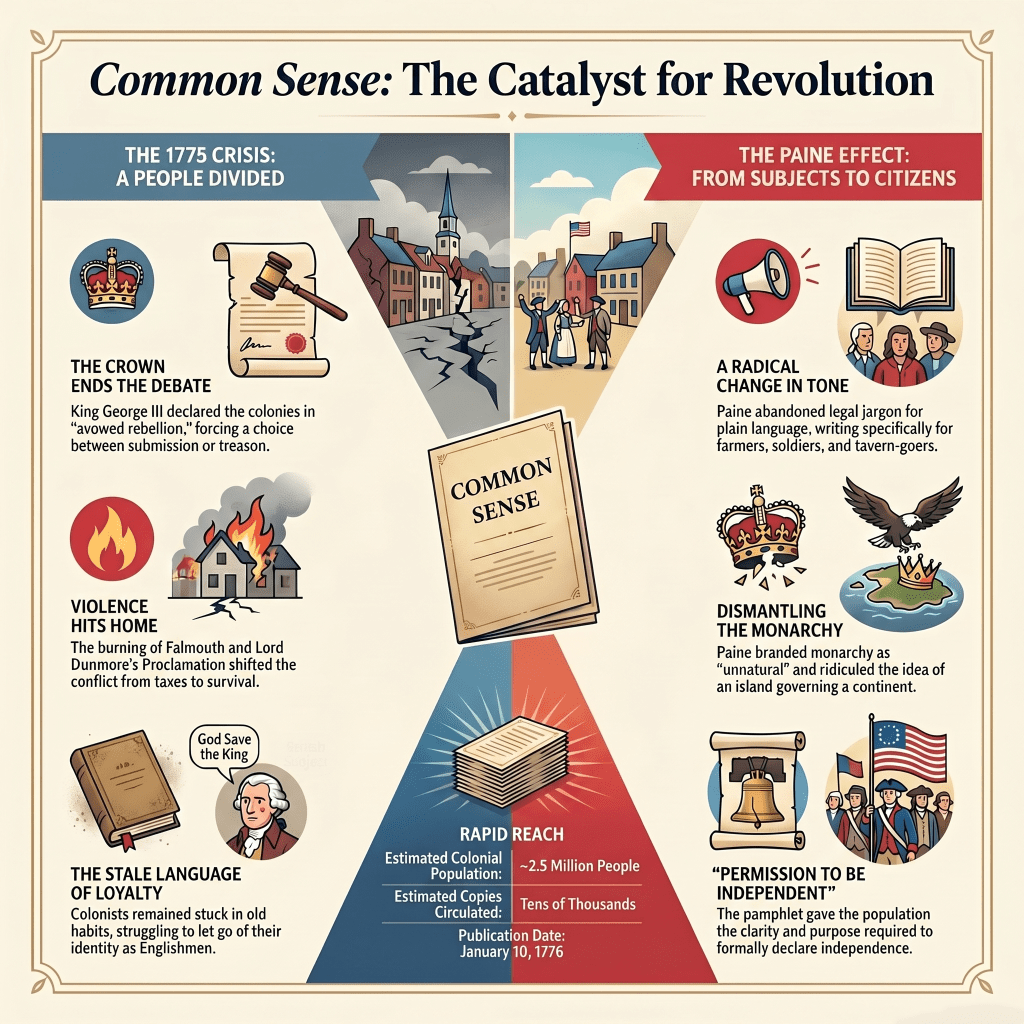
That message crossed the Atlantic and settled into the colonies like a hard frost. It did not end the debate, not immediately, but it narrowed it. You can argue about policy. It is harder to argue about being declared a traitor.
In Virginia, the war took on a different shape, one that cut closer to the bone. Lord Dunmore, driven from Williamsburg and reduced to governing from the deck of a British warship, decided to use the tools available to him. His proclamation in November promised freedom to enslaved people who would escape their patriot masters and join the British cause. It was, in one sense, a military move, an attempt to weaken the rebellion by undermining its social foundation. It was also something more volatile. It exposed contradictions that had been easier to ignore when the argument was about taxes and representation. Now it was about lives, property, and the structure of society itself.
For the planter class, the message was received as a direct threat. For others, it raised questions that would not be easily put aside. War has a way of doing that. It pulls issues into the open that peace allows people to step around.
At the same time, the conflict refused to stay contained. To the north, American forces moved into Canada, a decision that would have seemed unthinkable not long before. Richard Montgomery took Montreal, while Benedict Arnold forced his way through the Maine wilderness toward Quebec in a campaign that felt as much like endurance as strategy. The results would be mixed at best, but the intent mattered. The colonies were no longer simply defending their homes. They were acting, projecting force, thinking beyond their immediate boundaries.
Closer to home, the British made a decision that would echo louder than they intended. In October, the Royal Navy turned its guns on Falmouth, a coastal town with little military value and even less capacity to defend itself. The bombardment was thorough. Buildings burned. Lives were upended. The message was meant to be clear, a demonstration of what rebellion would bring.
It was clear, just not in the way it was intended.
To many colonists, this was not the measured hand of justice. It was destruction for its own sake, a punishment that did not distinguish between combatant and civilian. If the Crown was willing to burn Falmouth, then no town was beyond reach. The effect was not fear so much as anger. It is difficult to remain loyal to a system that appears willing to treat you as expendable.
Congress, for all its debates and hesitations, understood at least that much. In October, it authorized the creation of a navy, a small one by any reasonable standard, but significant in what it represented. A navy is not a local defense. It is a national statement. It requires coordination, resources, and a sense of shared purpose that goes beyond individual colonies. Around the same time, the first Marines were organized, men intended to fight both at sea and on land, an acknowledgment that this conflict would not be confined to neat categories.
These were not the actions of a group expecting to return quietly to the fold.
And yet, in Philadelphia, the arguments continued. Some delegates still held out hope that something might shift in London, that reason might prevail if given enough time. Others had moved past that point, convinced that the line had already been crossed. Between them stood men like George Washington, not in Congress but outside Boston, holding together an army that was more an idea than a finished instrument.
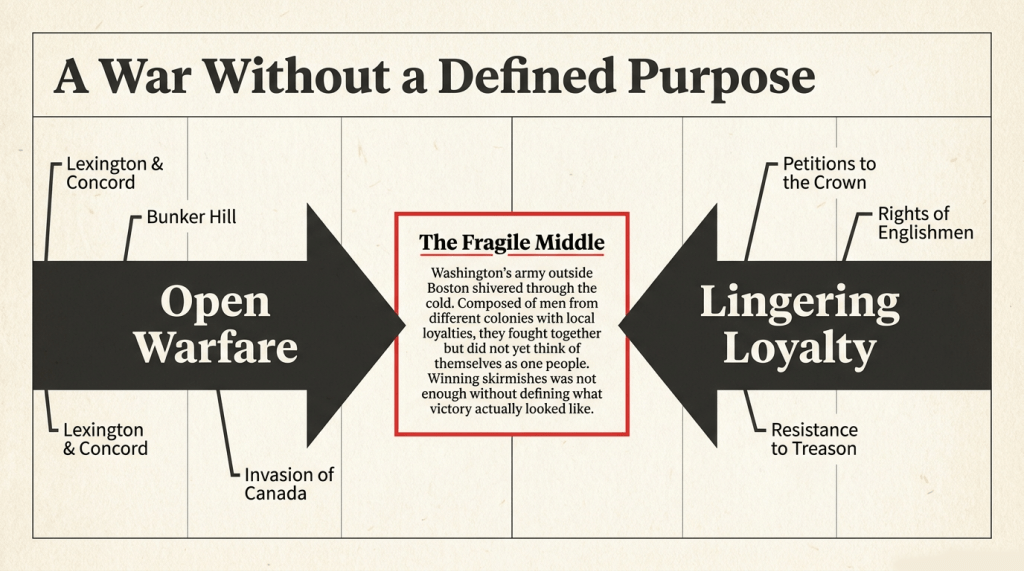
The siege dragged on through the cold. There were no grand battles, just the steady pressure of two forces waiting for the other to make a mistake. Washington wrote constantly, about supplies, about discipline, about the need for unity that did not yet fully exist. His army was composed of men from different colonies, each with their own loyalties and expectations. They fought together, but they did not yet think of themselves as one people.
That, more than any shortage of powder or provisions, was the fragile point.
By the end of the year, something had begun to shift in the wider population. It did not happen in a single moment. It spread, slowly at first, then with more confidence, through taverns, town meetings, and quiet conversations where men tested ideas they would not yet say in public. If we are in rebellion, some began to say, then perhaps we should stop pretending otherwise. If we are to be treated as traitors, then perhaps we should decide what we are willing to be.
It is not a comfortable transition, that movement from grievance to identity. It requires letting go of something familiar without yet having a clear sense of what replaces it.
But by the winter of 1775, the ground was already shifting under their feet. The arguments about taxes and representation had not disappeared, but they no longer felt sufficient to explain what was happening. The war had taken on a different shape. It had become political, social, and personal all at once.
And somewhere in that unsettled landscape, a new idea was waiting to be heard.
Not polished. Not cautious. Not particularly patient.
Just clear enough to give a name to what people were already beginning to feel.
He did not arrive with fanfare. No escort, no title, no waiting office. Thomas Paine stepped off the ship in Philadelphia with little more than a letter of introduction from Benjamin Franklin, a restless mind, and a talent that would prove far more dangerous than a musket. He was, by any polite standard of the eighteenth century, an unlikely figure to reshape a continent. He had failed at more trades than most men would admit to attempting. Corset maker, excise officer, schoolteacher, each chapter ending in disappointment. England had not found much use for him. That, in hindsight, may have been its mistake.
What Paine carried across the Atlantic was not wealth or influence, but a certain impatience with how things had always been done. The colonies, still half-formed and unsure of themselves, proved to be fertile ground for that kind of thinking. Franklin saw it early, not necessarily as refinement, but as potential. Give a man like Paine an audience, and he will not whisper.
He will speak plainly.
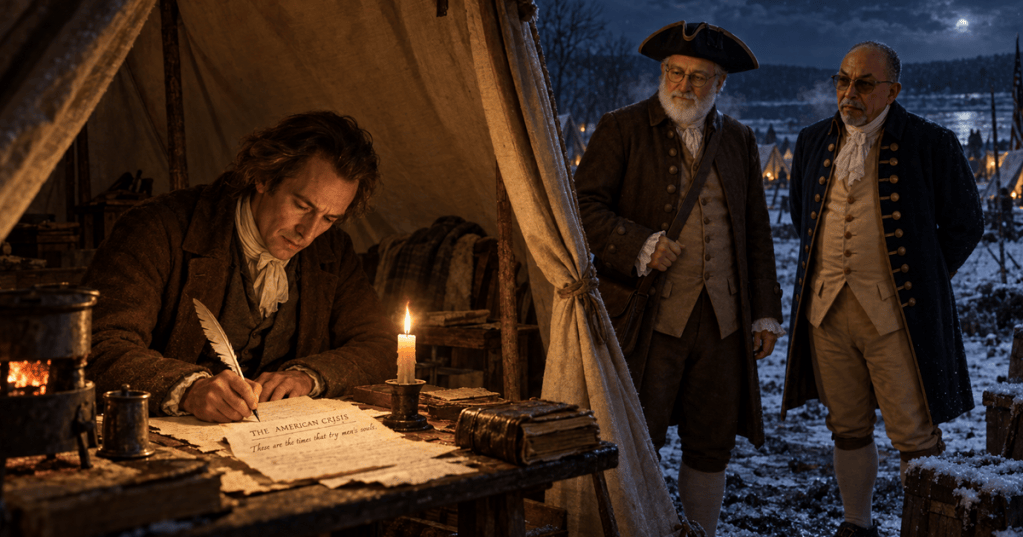
By the winter of 1775, while Washington’s army shivered outside Boston and Congress argued itself in circles, Paine was writing. Not for scholars, not for Parliament, not for the careful men who preferred their arguments dressed in legal robes. He was writing for everyone else. For the men in taverns who could follow a straight line of thought. For the farmers who did not have time for philosophical gymnastics. For soldiers who needed something more than vague assurances that their cause was just.
On January 10, 1776, that writing appeared under a title that almost feels like a challenge. Common Sense.
There was nothing ornate about it. No attempt to impress with complexity. It did not read like a petition or a speech to be debated clause by clause. It read like a man speaking directly to you, insisting that you look at something you had been avoiding. Paine opened with a warning that habits have a way of disguising themselves as truth. Just because something has always been done does not make it right. In a society that had spent months clinging to the idea of reconciliation, that was not a gentle nudge. It was a shove.
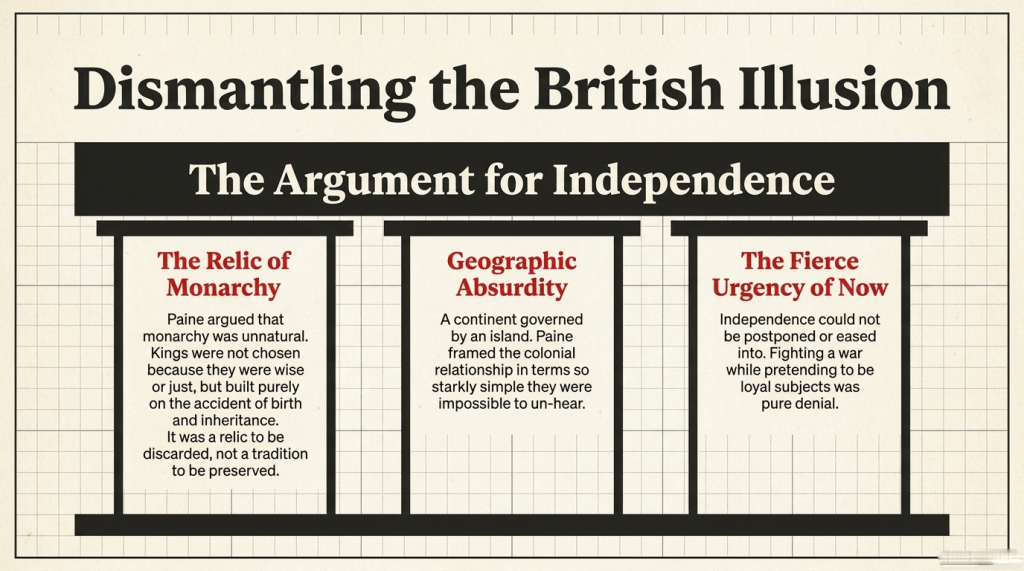
His arguments were not subtle, and that was precisely the point. Monarchy, he said, was unnatural, a system built not on reason but on accident, on inheritance rather than merit. Kings were not chosen because they were wise or just, but because they happened to be born into the right family. That, to Paine, was not tradition worth preserving. It was a relic that deserved to be discarded.
He went further. The relationship between Britain and the colonies, long defended as natural and necessary, was recast in terms so simple they were difficult to refute. A continent governed by an island. It sounded absurd when spoken aloud, and Paine made sure it was spoken aloud, again and again. If the war was already being fought, if blood had already been spilled, then continuing to pretend that the colonies were loyal British subjects was not prudence. It was denial.
And then came the part that many had felt but few had dared to state so clearly. Independence was not something to be postponed, negotiated, or slowly eased into. It was necessary, and it was necessary now. Anything less, Paine argued, would leave the colonies trapped in a conflict without purpose, fighting without ever defining what victory would look like.
It is easy, from a distance, to call that propaganda. There is truth in that. But it was also something more difficult to dismiss. It was clarity.
The reaction was immediate and, by the standards of the time, astonishing. Copies of Common Sense moved through the colonies with a speed that outpaced official proclamations. Print shops struggled to keep up with demand. The pamphlet was read aloud in taverns, in churches, in camps where soldiers passed it from hand to hand. Even those who could not read heard its arguments carried on the voices of others.
In a population of roughly two and a half million, tens of thousands of copies circulated, perhaps more, and the number alone does not capture its reach. It became part of the conversation, part of the way people explained to themselves what was happening and what might come next. The debate shifted. Where once the question had been how to secure rights within the empire, it began to turn toward whether the empire itself had any place in their future.
Even cautious men felt the effect. Washington, not given to flights of rhetoric, recognized what Paine had done. The pamphlet did not supply his army with powder or provisions, but it gave something that had been in short supply. Purpose. His officers read it. His soldiers absorbed it. In the cold outside Boston, where uncertainty could be as dangerous as any British advance, that clarity mattered.
Congress, for its part, could not ignore it. Some found Paine’s tone unsettling, too blunt, too dismissive of traditions they were not yet ready to abandon. But even those who disagreed with him had to contend with the fact that he had reached an audience they could not easily command. He had taken an argument that had lived in the chambers of debate and carried it into the streets.
That is where revolutions are decided.
By the early months of 1776, something had shifted. It was not yet universal, not yet complete, but it was unmistakable. The language of loyalty began to fade, replaced by a different vocabulary, one that spoke of rights not as inherited privileges but as inherent claims. The idea of being British, once central to colonial identity, began to loosen its grip.
In its place, something else was forming.
Not fully defined. Not yet formalized.
But present enough that when people began to speak of independence, it no longer sounded like madness. It sounded, in a way that would have been difficult to imagine only months before, like common sense.
By the spring of 1776, the argument was no longer theoretical. It had begun to take shape in law, in policy, in decisions that could not be easily undone. Words had carried the colonies this far, but now those words were being tested against action.
The shift did not come all at once. It came colony by colony, decision by decision, like a tide that does not announce itself but is unmistakable once you notice the water rising.
South Carolina moved early. Royal authority there had been weakening for months, worn down by events and by the simple fact that it no longer functioned. By the time the calendar turned into 1776, it was little more than a formality waiting to be removed. Patriots stepped in, formed their own government, and drafted a constitution that made no serious effort to disguise what was happening. They were no longer waiting for permission.
Rhode Island followed with a quieter hand, but no less decisive. In May, its legislature removed any reference to the King from its laws. No speeches meant for posterity. No grand ceremony. Just a deliberate act, clean and unmistakable. The old authority was gone because they chose to remove it. That is how revolutions often look in practice, less like thunder, more like a door closing firmly behind you.
Taken together, these actions said something Congress had not yet formally declared. The relationship with Britain was not merely strained. It was ending.
Then came April, and with it a decision that pushed the colonies further into unfamiliar territory. The Second Continental Congress opened American ports to trade with the world, excluding Britain. On its face, it was an economic measure. In reality, it was something sharper. It signaled that the colonies were beginning to act like an independent nation whether they had said so aloud or not.
Trade is not neutral. It defines relationships. By inviting French, Dutch, and Spanish merchants to do business directly, Congress was doing more than seeking supplies. It was announcing itself to Europe as a player in its own right. That is not something a set of loyal colonies does. That is something a nation in waiting does, even if it has not yet found the courage to use the word.
And then, on June 7, the word was spoken.
Richard Henry Lee rose and offered a resolution that cut through months of hesitation with a kind of blunt clarity. “Resolved, that these United Colonies are, and of right ought to be, free and independent States…”
The room did not celebrate. It quieted.
Everyone there understood what had just been placed before them. This was not another petition, not another attempt to adjust the relationship with Britain. This was an end. A separation that could not be walked back. A decision that would carry consequences none of them could fully predict.
And yet, even then, they hesitated.
Not because the idea was new. It had been growing for months, fed by events, sharpened by arguments like those in Common Sense. But because the colonies were not all ready at the same pace. Some delegates lacked instructions. Some lacked conviction. The debate continued, as debates tend to do when the stakes are this high. Voices rose. Positions hardened. But beneath it all was a recognition that the moment had arrived whether they were comfortable with it or not.
While Congress argued, something else began to take shape, quieter but no less important. A committee was formed, five men tasked with putting into words what the resolution implied. Among them was Thomas Jefferson, who would carry the burden of turning a political decision into a document that could justify it to the world.
The machinery of independence had begun to move.
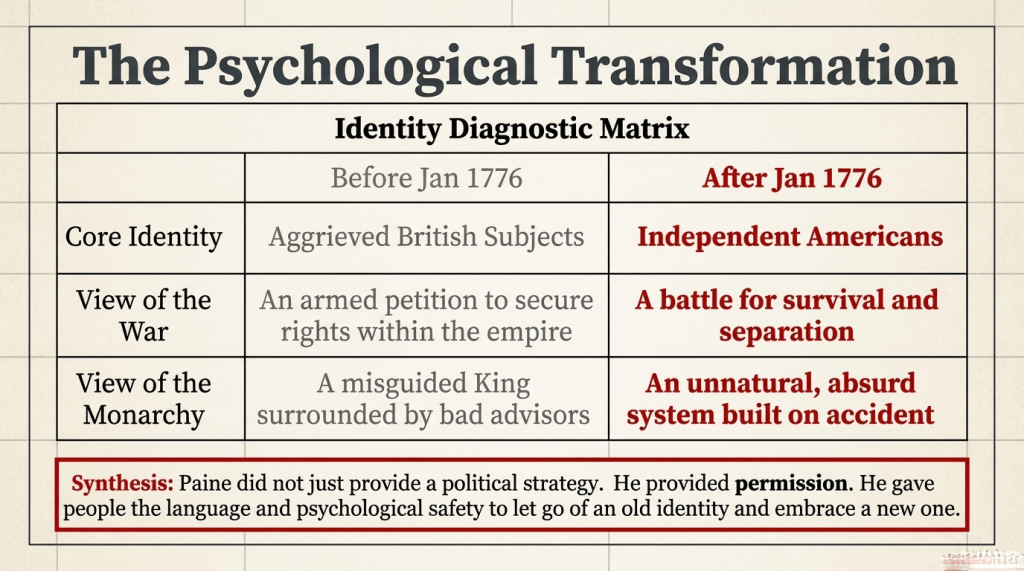
It is tempting to say that Thomas Paine made this inevitable, and there is truth in that, but it is not the whole truth. Common Sense did not create the desire for independence out of nothing. It gave it language. It gave it shape. More importantly, it gave it permission.
Paine did something that Congress, for all its talent, struggled to do. He spoke to people as they were, not as they were supposed to be. He did not ask them to think like lawyers or philosophers. He asked them to look at their situation and name it honestly. In doing so, he helped create a shift that went beyond politics. It touched identity.
People who had thought of themselves as British subjects began, slowly and unevenly, to think of themselves as something else.
That is not propaganda. That is transformation.
You know, revolutions do not run on theory alone. They run on long nights, cold mornings, and decisions made before the sun comes up. If you are going to stand on the edge of something this big, you might as well be awake for it. Midnight Riders Blend, strong enough to keep you steady when history starts moving faster than comfort allows. Brew it bold. Drink it like you mean it. Because some mornings are not meant for hesitation.
And now, back to the edge.
By the time June turned toward July, the pieces were in place, even if the final step had not yet been taken. Congress was divided but moving. The colonies were acting, even as they debated. The war was underway, whether or not it had been formally declared.
The question was no longer whether something had changed.
The question was what it meant to say it out loud.
What does it mean to declare independence? Not as an idea, not as a pamphlet, but as a formal act that cannot be withdrawn. It means accepting the consequences that follow, the war, the uncertainty, the possibility of failure. It means stepping out of one identity without any guarantee that the new one will hold.
That is the moment they were approaching.
And it leaves a question worth asking, even now. Was Common Sense the real declaration of independence, the moment when the idea became unavoidable? Could this have happened without it, or would the colonies have found their way there eventually, through slower, more cautious steps?
Was Paine ahead of his time, or did he simply arrive at exactly the moment when people were ready to hear what he had to say?
Next time, the question will no longer be theoretical.
Because the document is coming.
And when it arrives, it will not ask politely. It will declare something that the most powerful empire in the world will not accept.
The birth of the most dangerous document in British America is just over the horizon.
Originally published July 29, 2025
Republished April 29, 2026
Bailyn, Bernard. The Ideological Origins of the American Revolution. Cambridge, MA: Harvard University Press, 1967.
Ellis, Joseph J. Revolutionary Summer: The Birth of American Independence. New York: Alfred A. Knopf, 2013.
Jensen, Merrill. The Founding of a Nation: A History of the American Revolution, 1763–1776. New York: Oxford University Press, 1968.
Lee, Richard Henry. “Lee Resolution.” June 7, 1776.
Maier, Pauline. American Scripture: Making the Declaration of Independence. New York: Alfred A. Knopf, 1997.
Middlekauff, Robert. The Glorious Cause: The American Revolution, 1763–1789. New York: Oxford University Press, 1982.
Paine, Thomas. Common Sense. Philadelphia, January 10, 1776.
“Proclamation of Lord Dunmore.” November 7, 1775.
“Proclamation for Suppressing Rebellion and Sedition.” August 23, 1775. Issued by George III.
Rakove, Jack N. Revolutionaries: A New History of the Invention of America. Boston: Houghton Mifflin Harcourt, 2010.
“Resolutions of the Continental Congress Opening American Ports to Foreign Trade.” April 6, 1776.
Wood, Gordon S. The Radicalism of the American Revolution. New York: Alfred A. Knopf, 1992.



 DAVE DOES HISTORY
Leave a comment