
Before they pledged their lives, their fortunes, and their sacred honor, they tried something far less dramatic and far more human. They asked. Not Parliament, not the men who had been passing laws like hammers swinging in the dark, but the King himself. The hope, stubborn and not entirely foolish, was that somewhere above the noise of politics there stood a man who could still hear them.



That hope had a name, though most colonists would not have recognized it as such. Back in 1738, a man with the unfortunate burden of too many titles, Henry St. John, sat down and wrote what amounted to a political daydream. It was called The Idea of a Patriot King, and it was less a blueprint than a wish, the sort of thing one writes when reality has grown tiresome, and one begins to imagine what might fix it.
Bolingbroke’s king was not supposed to behave like other kings. He would rise above factions, ignore petty party squabbles, and rule not for personal gain or political allies but for the good of the whole nation. He would be, in the old language, the father of his people. Not Parliament’s creature. Not a pawn of ministers. A moral center, steady and disinterested, capable of healing what politics had broken.
It is a beautiful idea. It is also, as even some of Bolingbroke’s contemporaries suspected, a bit of a fantasy.
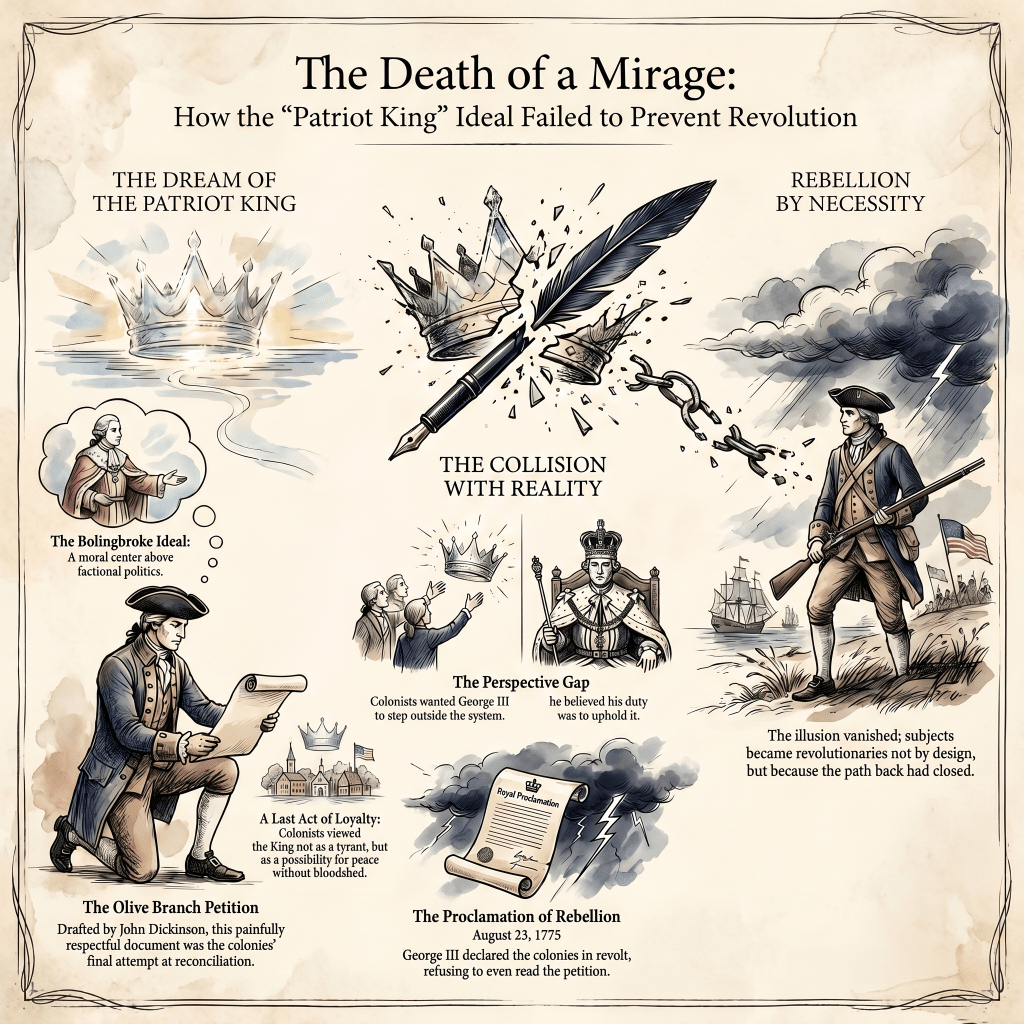
Ideas like that do not stay in London. They travel, quietly at first, then with purpose. By the time tensions in the American colonies began to harden into something more dangerous, this notion of a Patriot King had crossed the Atlantic and taken root among men who were looking for a way out that did not involve war. Enlightenment thinking had already primed them to believe that systems could be improved, that authority could be corrected, that a wise ruler might step in and restore balance where it had been lost.
So, they looked at George III and saw, not a tyrant, but a possibility.
Men like John Dickinson held onto that possibility with both hands. Dickinson was no radical. He was careful, measured, the kind of man who reads the law twice before acting on it. To him, the problem was not the King. The problem was Parliament, or more precisely, the ministers whispering in Parliament’s ear, feeding it bad information and worse advice. If the King could be reached directly, if he could be persuaded to act as that Patriot King Bolingbroke had imagined, then perhaps the whole mess could be untangled without bloodshed.
It was, in its own way, a last act of loyalty.
The trouble is that ideas do not always survive contact with the people they are supposed to describe.
There is no evidence that George III ever read Bolingbroke’s essay. That does not mean he lacked a sense of his own role. Quite the opposite. He believed, firmly and without much hesitation, that he was already fulfilling his duty as king. Not in the abstract, philosophical sense that colonists might have preferred, but in the very real, constitutional framework of Britain as it actually functioned.
That framework matters. The English had fought their civil wars, removed kings, restored them, and then constrained them. By the time George III sat on the throne, the monarch was not an independent force floating above politics. He was, in practice, bound to work through Parliament, to support it, to guide it, but not to simply overrule it because distant subjects found its policies inconvenient.
From George’s perspective, being a Patriot King meant upholding that system, not dismantling it.
From Dickinson’s perspective, it meant stepping outside it.
That gap is where the whole idea began to collapse.
By the summer of 1775, the situation had already outrun theory. Blood had been spilled at Lexington and Concord. The Second Continental Congress had convened on May 10, not in calm deliberation but in the shadow of a war that had already begun. They were, in effect, trying to steer a ship that had already struck the reef.
And yet, even then, they tried.
The Olive Branch Petition, drafted largely by Dickinson, was a remarkable document, not because it changed anything, but because of what it reveals. It is almost painfully respectful, filled with language that leans toward affection rather than accusation. The colonies affirm their loyalty, insist that they still consider themselves subjects, and appeal directly to the King’s sense of justice, his magnanimity, his willingness to correct what had gone wrong.
It is the Patriot King, in paper form, being handed one last chance to exist.
While that petition made its slow journey across the Atlantic, reality moved faster. The Congress that sent it was already acting like a government. It was raising armies, appointing generals, directing resistance. George Washington had been named commander in chief. The siege of Boston was tightening. Men were digging in, not waiting for a reply.
And the reply, when it came, was not what Dickinson had hoped for.
George III never read the petition.
Instead, on August 23, 1775, he issued the Proclamation of Rebellion, declaring the colonies to be in open revolt. There is a certain finality in that kind of language. It does not invite negotiation. It defines the situation and closes the door behind it.
In that moment, the Patriot King died.
Not as a person, because he had never truly lived in that form, but as an idea that had sustained a great many people longer than it probably should have. The illusion that the King stood apart from Parliament, that he might intervene, that he might restore the balance, vanished almost overnight.
Even men like Dickinson, who had invested heavily in that belief, were forced to confront what it meant. There would be no rescue from above. No correction from within the system. Whatever came next would have to come from somewhere else.
That is the quiet turning point, the one that does not always get the attention it deserves. Not the battles, not the declarations, but the moment when hope changes shape. When a people stops asking to be heard and begins to act as though it already has its answer.
The Patriot King was always a kind of mirage, shimmering just far enough ahead to keep men moving toward it. For a time, it served a purpose. It delayed the inevitable, gave space for argument, allowed men to believe that reconciliation was still possible.
But mirages do not hold up when you finally reach them. And by the end of 1775, the colonies had reached it. What they found was not a king who would stand above the fight. It was a king who had already chosen his side.
And so the illusion fades, not all at once, but the way fog lifts off a field, slow, uneven, leaving behind shapes that were always there but easier to ignore when the air was thick.
April 19, 1775 had already settled the question that men in Philadelphia were still debating. Blood had been spilled at Lexington and Concord, and it was not theoretical blood, not ink on parchment or rhetoric in a hall, but men lying on the ground where they had stood only moments before. War, in the most literal sense, had begun.
Yet when the delegates gathered on May 10, the mood was not unified, not even close. The Second Continental Congress came together in a strange moment, a moment where reality and intention were moving in different directions. One could walk into that room and hear arguments for independence spoken with conviction, and then turn slightly and hear equally earnest arguments for reconciliation. It was not indecision so much as a refusal to accept that the path forward had narrowed as much as it had.
This is what might be called the awkward interval, though that phrase does not quite capture the tension of it. It was a time when men were preparing for war with one hand and reaching for peace with the other, hoping, perhaps, that one would cancel out the other before the cost became too high.
On June 15, they took a step that could not easily be undone. George Washington was appointed Commander in Chief of a Continental Army that did not yet fully exist but was already very real in its consequences. That decision carried weight. Armies do not get appointed for philosophical discussions. They are appointed because someone expects them to fight.
And still, almost in the same breath, they tried to avoid that fight.
The task fell, as it almost inevitably would, to John Dickinson. He drafted what became known as the Olive Branch Petition, a document that reads today like a man trying to hold together something that is already coming apart in his hands. It was adopted on July 5, signed on July 8, and sent across the Atlantic with all the hope that ink and paper can carry.
The language is striking, not for its argument, but for its tone. This is not a declaration of defiance. It is an appeal, direct and almost intimate, to the King’s sense of himself. It speaks of loyalty, of affection, of a desire not to break away but to be heard. “Our breasts retain too tender a regard…” the petition says, as if reminding the King that whatever has happened, whatever has gone wrong, there is still something worth saving if only he will act.
You can hear Bolingbroke’s ghost in those words, whether Dickinson intended it or not. The Patriot King is still there, still being called upon, still being asked to step into a role that perhaps never truly existed.
Dickinson believed, or at least hoped, that this might be enough. That the King, presented with the truth stripped of ministerial distortion, would recognize the danger and move to prevent further bloodshed. It was not foolish in the sense of being baseless. It was foolish in the sense that it depended on a man being something he had already shown himself not to be.
Not everyone in Congress shared that hope.
John Adams saw the petition for what it was, or what he believed it would become. To him, it was a delay, a gesture that might soothe consciences but would not change outcomes. He did not oppose it loudly, not always, because unity still mattered, and because even those against the idea understood the need to show that every avenue had been tried.
But there was a growing sense, quiet at first, then harder to ignore, that this was a last appeal rather than a real strategy.
That is the nature of the awkward interval. It exists because people are not ready to let go of what they once believed, even when events have begun to strip that belief away. They hedge. They prepare for one outcome while asking for another. They act as though the future might still split in two different directions, even when the road has already begun to narrow.
While the petition made its way toward London, carried by distance and time that felt almost merciful in their delay, the colonies did not stand still. Men drilled. Positions were fortified. The siege around Boston tightened, not with dramatic gestures but with steady, persistent pressure.
In other words, they prepared for the answer they feared, even as they waited for the one they hoped for.
There is something deeply human in that. The reluctance to accept that a line has been crossed, the instinct to try one more time, to say one more thing, to believe that reason might still prevail if only it is given the chance.
But history has a way of answering those moments with a kind of blunt clarity.
The petition would arrive. The King would respond.
And when he did, the awkward interval would end, not with a compromise, but with a declaration that left very little room for anything but the path the colonies were already beginning to walk.
The answer, when it came, did not arrive with ceremony. It arrived with a kind of cold efficiency that leaves little room for interpretation. The Olive Branch Petition crossed the Atlantic slowly, as messages did in that age, carrying with it the last carefully worded hope that something might yet be repaired. It never reached the man it was meant to move.
George III did not read it.
Instead, on August 23, 1775, he issued a proclamation that spoke in a language far removed from Dickinson’s careful appeals. The colonies, he declared, were in open and avowed rebellion. Not mistaken. Not misled. Not temporarily agitated. In rebellion. The distinction matters, because once a thing is named that way, the response follows naturally. Rebellion is not negotiated with. It is put down.
That was the answer.
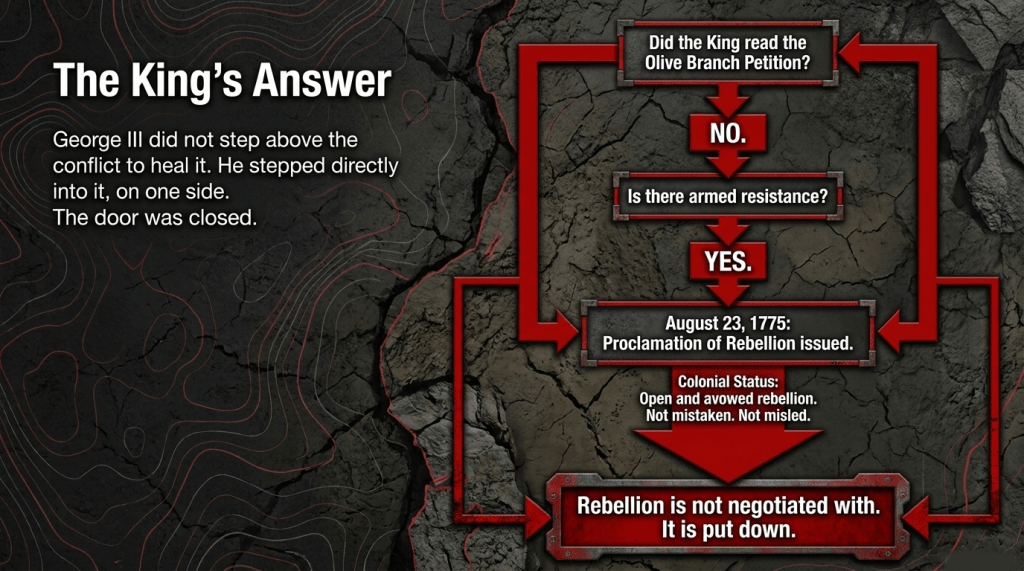
There is a moment, sometimes, when an idea does not simply weaken but collapses outright. The Patriot King had lingered longer than it should have, sustained by men who needed it to be true. Now it had nowhere left to stand. The King had not stepped above the conflict to heal it. He had stepped directly into it, on one side, and made his position unmistakably clear.
For men like John Dickinson, that realization carried a particular weight. He had argued, reasoned, written, and appealed. He had taken the path of moderation not because it was easy, but because he believed it was right. And now the ground beneath that position gave way. It is one thing to be opposed by radicals. It is another to be answered by the very authority you had hoped would intervene, only to find that it has already judged you.
There would be no peaceful resolution. Not because no one had tried, but because the structure they had been trying to work within no longer allowed for it.
The irony, if one wishes to call it that, is that while the petition was making its way across the ocean, events in America were already rendering it obsolete. Around Boston, the lines were being drawn, not on paper, but in earth and timber. Militia gathered, positions strengthened, the city slowly encircled by men who were no longer waiting for instructions from London.
On June 17, 1775, before the King’s proclamation had even been issued, the situation came to a head on the heights overlooking Boston. The Battle of Bunker Hill, though fought largely on Breed’s Hill, did not resemble the clean engagements of European warfare. It was brutal, close, and costly. The British took the ground, which allows historians to call it a victory. But it was a victory that came at a price high enough to unsettle even those who claimed it.
The colonists, for their part, lost the position but proved something far more important. They could stand. They could hold. They could inflict damage on a professional army and not simply scatter at the first volley. It was not a triumph in the conventional sense, but it was a revelation.
War, real war, was no longer a possibility. It was the condition.
By the time news of the King’s proclamation and the reality of Bunker Hill settled into the same conversation, the transformation was complete. The colonies had not leapt into revolution with enthusiasm. They had been pushed, step by step, from petition to resistance, from resistance to armed defense, and from there into something that would soon take on a name of its own.
The Patriot King, that elegant idea born in the mind of Bolingbroke, had dissolved under the weight of events it was never meant to bear. It had offered a vision of unity, of a monarch who could stand above faction and guide his people with impartial wisdom. It had never accounted for distance, for misunderstanding, for the stubborn reality that power, once exercised in a certain way, tends to continue in that direction.
What remained, after the illusion fell away, was something less comforting and far more consequential.
A people who had once defined themselves as loyal subjects found themselves acting as something else entirely. Not all at once. Not with a single declaration or a single decision. But through a series of moments that, taken together, left them no longer where they had been.
They had asked. They had waited. They had hoped.
And then, when the answer came, they changed.
That is the real legacy of this moment. Not simply that a petition was rejected, or that a proclamation was issued, but that the men who had written that petition understood, perhaps reluctantly, what that rejection meant. The path back had closed. The path forward, uncertain and dangerous as it was, had become the only one left.
From loyal petitioners to revolutionaries, not by design, but by necessity.
And once that change takes hold, it does not easily reverse itself.
Originally published July 22, 2025
Republished April 29, 2026
Bolingbroke, Henry St. John, Viscount. The Idea of a Patriot King. London, 1738.
Dickinson, John. The Olive Branch Petition. July 5, 1775.
Ellis, Joseph J. Revolutionary Summer: The Birth of American Independence. New York: Alfred A. Knopf, 2013.
“Journal of the Second Continental Congress, 1775.” In The Papers of the Continental Congress, Library of Congress.
Maier, Pauline. American Scripture: Making the Declaration of Independence. New York: Alfred A. Knopf, 1997.
Middlekauff, Robert. The Glorious Cause: The American Revolution, 1763–1789. New York: Oxford University Press, 1982.
“Proclamation for Suppressing Rebellion and Sedition.” August 23, 1775. Issued by George III.
Rakove, Jack N. Revolutionaries: A New History of the Invention of America. Boston: Houghton Mifflin Harcourt, 2010.
Wood, Gordon S. The Radicalism of the American Revolution. New York: Alfred A. Knopf, 1992.




Leave a Reply