
There is an old story, and like most old stories it carries more truth than Parliament was willing to admit in 1774. It begins not in Boston, but in Cornwall in 1497, a place that looked like part of England on a map but felt like something else entirely to the people who lived there. When King Henry VII decided he needed money for a war with Scotland, he reached into Cornwall and demanded a tax. Not a crushing tax, not the sort that should bring men to the edge, just enough to remind them who was in charge. The Cornish, who had no interest in Scotland and even less interest in paying for someone else’s war, responded in the only way that made sense to them. They marched. It did not end well. They were defeated, their leaders executed, their rebellion crushed.
But here is the part Parliament should have remembered and did not. Henry learned something. He eased off. He recognized that tightening his grip would not secure loyalty, it would destroy it. He stepped back, restored a measure of local control, and in doing so prevented rebellion from becoming something worse. That lesson sat there, plain as day, for nearly three centuries. And then, as if history had been written in invisible ink, Parliament ignored it completely.
By 1774, Boston had already earned a reputation in London as the problem child of the empire. The Boston Tea Party confirmed every suspicion that British officials had been nursing. Massachusetts, in their view, was not simply unhappy. It was defiant. And defiance, in the logic of empire, demands correction. The result was a series of laws that Parliament called the Coercive Acts, a name that at least had the virtue of honesty. In the colonies, they would be remembered by a different name, one that required no explanation. Intolerable.
The first blow fell on Boston itself. The Boston Port Act closed the harbor beginning in June of 1774, effectively shutting down the city’s economic life. Ships could not load, could not unload, could not conduct business. The stated reasoning spoke of restoring order and protecting commerce, but the practical effect was simpler. No trade, no food, no business. A city that depended on its port was told to sit quietly and consider its behavior.
If that had been the only measure, it might have been absorbed, resented, perhaps even endured. Parliament did not stop there. The Massachusetts Government Act followed, and with it came something more fundamental than economic pressure. It reached into the structure of colonial life and rearranged it. The colony’s charter was effectively rewritten. Local councils were no longer elected in the familiar way but appointed by royal authority. Town meetings, those noisy, argumentative, essential gatherings where colonists worked out their own affairs, were restricted to the point of near extinction. You could meet once a year, perhaps, if permission was granted, and even then only for approved business. Self government, which had been taken for granted, was now treated as a privilege that could be withdrawn.
Then came the Administration of Justice Act, which managed to sound reasonable right up until one considered how it would work in practice. British officials accused of serious crimes in Massachusetts could be sent elsewhere for trial, to another colony or even back to England, on the grounds that local juries might be biased. In London, this could be framed as a matter of fairness. In Boston, it sounded very much like a guarantee that those officials could act with impunity. George Washington would later give it a name that stuck more effectively than its formal title. The Murder Act.
As if that were not enough, Parliament revisited the issue of quartering troops. The Quartering Act of 1774 expanded the authority of colonial governors to house British soldiers wherever space could be found, including unoccupied buildings when barracks were insufficient. It did not necessarily mean soldiers would be sleeping in your bed, but it meant they would be close enough to make their presence felt, in town halls, in public buildings, in places that had once belonged to the community.
And then there was the Quebec Act, which, to British eyes, was not a punishment at all. It reorganized the governance of newly acquired territory and extended protections to French Catholics in Canada. From a certain perspective, it was a pragmatic piece of imperial policy. From the perspective of New England Protestants, it looked like something else entirely. It raised old fears, deep ones, about religion, authority, and the possibility that the Crown might be steering North America in a direction they did not recognize and certainly did not trust.
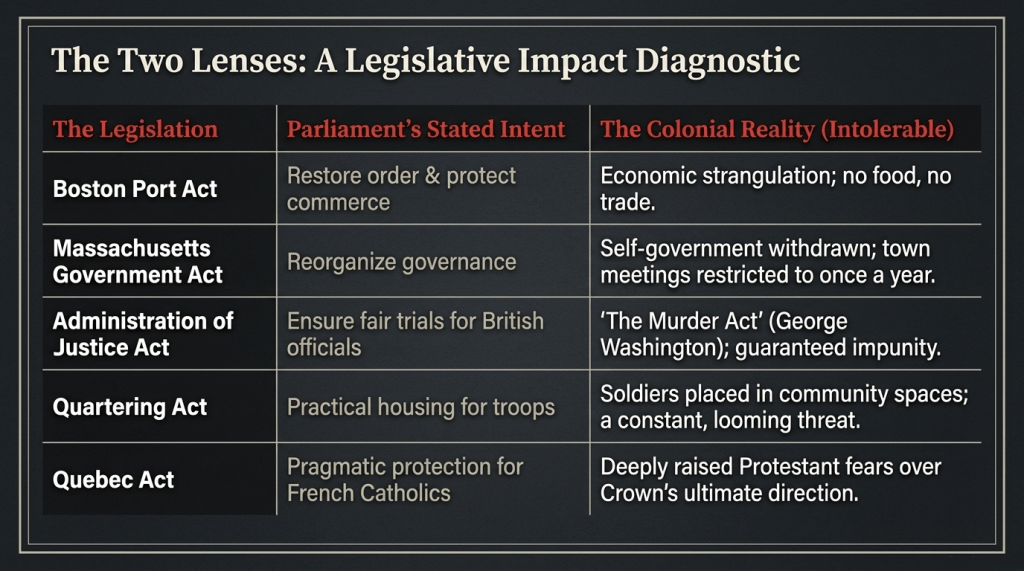
Taken together, these measures were meant to do something very specific. They were designed to isolate Massachusetts, to make an example of Boston, to show the other colonies what happened when resistance went too far. The assumption in Parliament was that the problem was local. Fix Boston, and the rest would fall back into line. It is a neat theory. It is also wrong often enough to be dangerous.
Because what Parliament saw as a surgical strike looked, from the colonies, like something much broader. Boston was not simply being punished. It was being made an example of, and examples have a way of drawing attention. News traveled. Letters circulated. Committees of correspondence, already in place, worked with renewed urgency to ensure that no colony could pretend this was someone else’s problem. They reminded their fellow colonists that Boston did not suffer alone, that this was, in their words, a common cause.
The reaction was not what Parliament expected. Instead of standing apart, the colonies began to lean toward one another. Supplies flowed into Boston from as far north as Nova Scotia and as far south as Georgia. Food, firewood, goods of every kind were sent to a city that had been deliberately cut off. It was not just charity. It was a statement. If Boston could be treated this way, so could any of them.
There is a line from a more modern story that fits here better than it should. The more tightly you grip something, the more likely it is to slip through your fingers. Parliament tightened its grip on Massachusetts, convinced that firmness would restore order. What it did instead was confirm the fears it had hoped to quiet.
By the end of it, the situation had shifted in a way that no one in London had intended. The Intolerable Acts were supposed to put out a fire in Boston. Instead, they did something far more consequential. They lit a fuse, one that would not burn in a single city or even a single colony, but would run, steadily and relentlessly, from one end of British North America to the other.
Massachusetts was supposed to stand alone. That was the theory, neat and orderly in the minds of men who believed geography and fear would do their work for them. Punish Boston, isolate the trouble, and the rest of the colonies would take the hint. Keep your head down, mind your business, and perhaps Parliament will leave you alone. It sounds almost reasonable, if you ignore human nature and the long memory of people who have begun to suspect they are being managed rather than governed.
What happened instead felt less like isolation and more like an echo rolling down the coastline.
Boston’s port closed, its commerce strangled, its people left to stare at empty docks and wonder how long this would last. Parliament expected silence, or perhaps quiet resentment. What it got was movement. Ships that could not enter Boston found other ports, and from those ports came something Parliament had not accounted for. Aid. Food, firewood, supplies, all the ordinary things that keep a city alive began to arrive from places that had no immediate stake in Boston’s quarrel. Nova Scotia sent what it could. So did New York, Philadelphia, Charleston, Savannah. Colony after colony, each with its own concerns and its own reasons to stay out of trouble, chose instead to step in.
It is easy, in hindsight, to dress this up as unity, as though it were inevitable. It was not. These colonies had spent years arguing with each other over trade, boundaries, politics, and pride. They were not in the habit of acting as one. What changed was not their nature. It was their understanding of the situation. Boston’s punishment looked less like a local correction and more like a warning shot. If Parliament could close one port, it could close another. If one colony’s charter could be rewritten, so could the rest.
That realization did what speeches alone could not. It made the problem shared.
The machinery that carried this realization was already in place, though few at the time would have described it in grand terms. The Committees of Correspondence had begun as a way to exchange information, to keep colonial leaders informed about developments that might affect them. In practice, they became something far more dynamic. Letters moved, ideas traveled, and what had once been local grievances took on a broader shape. If you want a modern comparison, you might call it an early network, not of wires and signals, but of ink and intent. News did not simply arrive. It spread, gathered force, and changed as it moved.
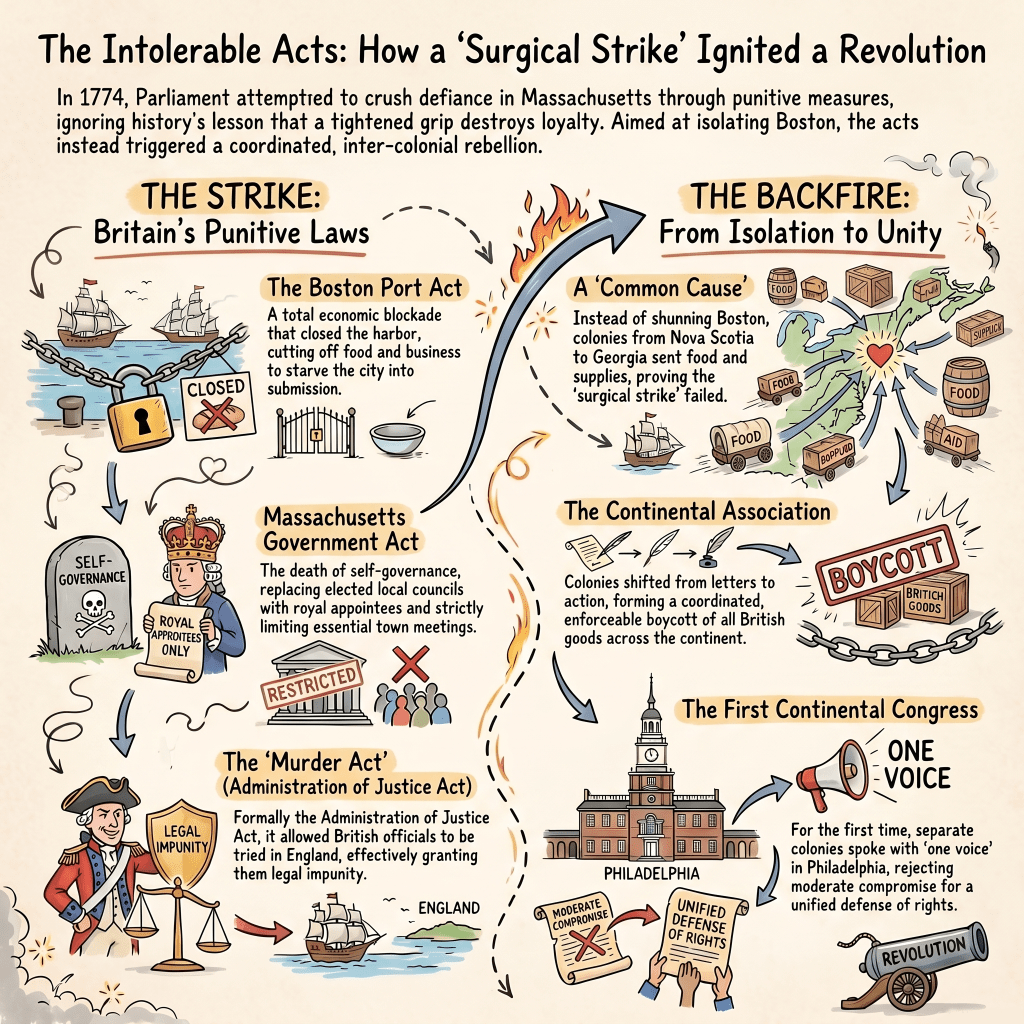
Through these committees, Boston’s situation was not just reported. It was interpreted. It was framed as part of a larger struggle, one that touched every colony whether they wanted it to or not. The language shifted. It moved from complaint to coordination, from concern to something closer to resolve.
Out of that shift came actions that would have seemed improbable only a short time earlier.
The Solemn League and Covenant, with its borrowed echoes of earlier English struggles, called for a boycott of British goods that extended far beyond Massachusetts. This was not a suggestion. It was a commitment, one that carried social as well as economic weight. Merchants were expected to comply. Consumers were expected to follow. Those who did not could expect to find themselves on the wrong side of public opinion, which in those days could be as persuasive as any formal law. The boycott spread with a speed that would have surprised the very people organizing it. What began as a response to one set of acts became a test of loyalty across the colonies.
Further south, in Virginia, a man who had once worn the uniform of the British Empire began to reconsider his place within it. George Washington had built his early reputation under British command, had learned his trade in a war fought for imperial interests. He was not, by temperament or inclination, a radical. Yet the events of 1774 had a way of clarifying choices. The Fairfax Resolves, which he helped shape, spoke in a language that balanced respect for British tradition with a firm insistence on colonial rights. They condemned the Intolerable Acts, called for a boycott, and, perhaps most importantly, hinted that the colonies would not accept a subordinate role indefinitely.
It was a measured document, but beneath its measured tone was something new. A willingness to move beyond complaint and toward coordinated resistance.
Back in Massachusetts, where the pressure was most immediate, that willingness took on a sharper edge. The Suffolk Resolves did not bother with careful phrasing or diplomatic nuance. They rejected the Intolerable Acts outright. They called on the people to refuse compliance, to reorganize their local governments, and to begin preparing for the possibility that words might not be enough. The suggestion that militias be raised was not made lightly. It was an acknowledgment that the situation had moved into a different category, one where the consequences of inaction might be greater than the risks of resistance.
Taken together, these responses marked a turning point that is easy to miss if you are looking only for dramatic moments. There was no single event, no clear line where everything changed at once. Instead, there was a gradual alignment, a sense that separate colonies were beginning to think in terms of a shared fate.
Parliament had aimed at the head, convinced that by striking Massachusetts it could bring the rest of the body into line. What it did instead was wake that body up. The colonies did not suddenly become a nation, not yet. But they began to act as though what happened in one place mattered in another, as though the distance between Boston and Savannah was not quite as large as it had seemed.
That shift, quiet as it might appear on the surface, carried consequences that would not be easily reversed.
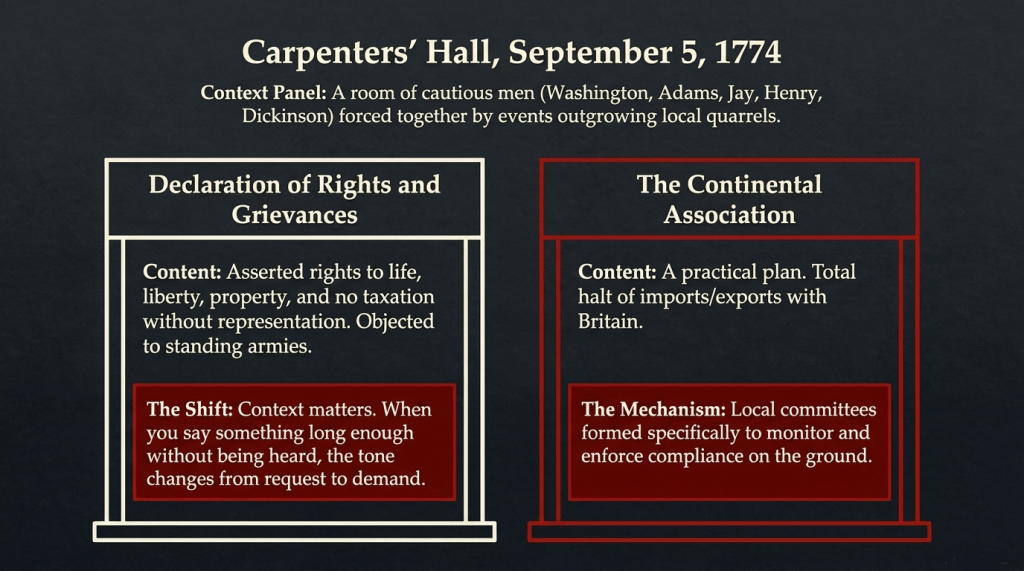
September 5th, 1774. Carpenters’ Hall. The room is warm. The air is close. And the tension? You could cut it with a dull knife and still have some left over.
They came in ones and twos at first, then in clusters, men who had spent most of their lives arguing with each other now forced into the same room by events that had outgrown local quarrels. George Washington arrived from Virginia, quiet, watchful, carrying the weight of a man who did not speak unless he had something worth saying. John Adams came with a sharper edge, already convinced that something fundamental had broken. John Jay, measured and deliberate. Patrick Henry, who did not believe in half measures and rarely bothered to pretend otherwise. John Dickinson, still hoping, perhaps against his better judgment, that reason might yet prevail.
It did not look like a revolution. It looked like a meeting. That is how these things often begin.
The problem, of course, was that no one was entirely sure what the meeting was supposed to accomplish. These were not representatives of a nation. There was no nation yet. They were delegates from separate colonies, each with its own charter, its own interests, its own reasons for being cautious. Some came prepared to push hard. Others came prepared to pull back. All of them came knowing that whatever happened in that room would carry consequences beyond it.
They argued. Of course they argued. About authority, about loyalty, about how far was too far. The language shifted depending on who was speaking. Some spoke of rights as Englishmen, grounded in tradition and law. Others spoke of something broader, less tied to Britain and more tied to the idea that people ought to govern themselves. The difference between those two positions may not sound large, but in 1774 it was the distance between reconciliation and rupture.
Out of that argument came something that tried to bridge the gap, or at least define it.
The Declaration of Rights and Grievances was, on its surface, a familiar document. It asserted what the colonists believed they were owed, life, liberty, property, the protections of law, the right not to be taxed without representation. It objected to standing armies in peacetime, a point that had grown sharper with every redcoat seen on colonial streets. It was, in many ways, a restatement of principles the colonists had been invoking for years.
But context matters. When you say something long enough without being heard, the tone changes. What had once been a request now sounded like a demand.
Alongside that declaration came something more practical, and in its way more powerful. The Continental Association was not a philosophical statement. It was a plan. The colonies agreed to stop importing British goods, to stop exporting goods to Britain, and to enforce those agreements within their own communities. This was not left to chance. Committees would be formed in towns and counties to monitor compliance, to ensure that the agreement was not just words on paper but action on the ground.
It was coordination on a scale the colonies had never attempted before.
And then there was the moment that showed just how narrow the middle ground had become.
Joseph Galloway offered a plan that, in another time, might have carried the day. It proposed a kind of union within the empire, a colonial legislature that would work alongside Parliament, preserving the connection while addressing colonial concerns. It was, in many respects, a reasonable attempt to hold things together.
It failed.
Not by a wide margin, which is telling in itself, but it failed nonetheless. The delegates were no longer convinced that adjustment within the empire would solve the problem. Too much had happened. Too much trust had been worn away. Galloway’s plan did not collapse because it was absurd. It collapsed because the moment for it had passed.
That is how you know the center is giving way. Not when extreme ideas appear, but when moderate ones stop working.
Before they adjourned, the Congress set a date. May 10th, 1775. If Parliament did not respond, if the grievances went unanswered, if the situation did not change, they would meet again. It was, on paper, a simple decision. In reality, it was something more. It was a recognition that this was not a one time gathering, not a temporary response, but the beginning of an ongoing effort to act together.
The colonies had spent years speaking over one another, each convinced of its own importance, each wary of being drawn too far into someone else’s fight. Now, in that room in Philadelphia, they had done something different. Not perfectly, not without disagreement, but unmistakably.
They had spoken with one voice.
And that voice, for all its measured language and careful phrasing, carried a message that was becoming harder to ignore.
Enough.
So, the question lingers, as it should. Was Parliament trying to restore order, or was it, intentionally or not, crushing liberty in the process? And if you had been there in 1774, sitting in that room or standing outside it, what would you have done? Would you have stood with Boston, taken the risk, accepted the uncertainty? Or would you have played it safe, trusted that the storm might pass if you kept your head down?
History does not allow us to answer those questions with consequences. It only allows us to ask them, and to consider what the answers might say about us.
Originally published July 1, 2025
Republished April 28, 2026
Bailyn, Bernard. The Ideological Origins of the American Revolution. Cambridge, MA: Harvard University Press, 1967.
Carp, Benjamin L. Defiance of the Patriots: The Boston Tea Party and the Making of America. New Haven: Yale University Press, 2010.
Ellis, Joseph J. Revolutionary Summer: The Birth of American Independence. New York: Alfred A. Knopf, 2013.
Great Britain. Parliament. The Boston Port Act. 1774.
Great Britain. Parliament. The Massachusetts Government Act. May 20, 1774.
Great Britain. Parliament. The Administration of Justice Act. 1774.
Great Britain. Parliament. The Quartering Act. 1774.
Great Britain. Parliament. The Quebec Act. 1774.
Jensen, Merrill. The Founding of a Nation: A History of the American Revolution, 1763–1776. New York: Oxford University Press, 1968.
Maier, Pauline. From Resistance to Revolution: Colonial Radicals and the Development of American Opposition to Britain, 1765–1776. New York: W.W. Norton, 1991.
Rakove, Jack N. The Beginnings of National Politics: An Interpretive History of the Continental Congress. New York: Alfred A. Knopf, 1979.
“Declaration and Resolves of the First Continental Congress.” October 14, 1774.
“The Suffolk Resolves.” September 9, 1774.
“The Fairfax Resolves.” July 18, 1774.
Wood, Gordon S. The Radicalism of the American Revolution. New York: Alfred A. Knopf, 1992.






Leave a Reply