
Boston in the winter of 1770 was not a city at peace. It was a city pretending to be at peace, which is a far more dangerous condition. On the surface, life continued. Ships came and went. Shops were open and closed. Men argued about prices, politics, and the weather. Beneath that surface, something tighter was forming, like a rope being slowly twisted until it could no longer hold without snapping.



The trouble did not begin with gunfire. It rarely does. It began, as these things tend to begin, with policy, pride, and a failure to understand how ordinary people respond when they believe someone else is making decisions for them. The Townshend Acts of 1767 were meant, in the clean logic of Parliament, to raise revenue and assert authority. Duties on glass, paper, paint, lead, and tea do not sound like the sort of measures that start revolutions. Yet they landed in Boston like a dare. The colonists did not see a tax. They saw a pattern, another step in what they believed was a steady march toward control without consent.
Boston responded the way Boston had learned to respond. Not quietly. Not politely.
Nonimportation agreements spread through the city, and then beyond it. Merchants pledged not to bring in British goods. Customers were expected to follow suit. This was not enforced by some distant authority with a seal and a signature. It was enforced by neighbors, by reputation, by the uncomfortable knowledge that someone was always watching. If you broke the agreement, you were not simply making a business decision. You were making a statement, and not the kind that earned applause.
“Blood On the Snow”
Words and Music by David Ray Bowman
We Hold These Truths – (c) 2026 – Slippery Fish Entertainment
ALL RIGHTS RESERVED
Enter the Sons of Liberty, who understood better than most that pressure works best when it is visible. They did not limit themselves to pamphlets and speeches. They filled the streets with broadsides that appeared overnight and spread faster than they could be torn down. They marked shops with graffiti that did not bother with subtlety. Loyalists were named, shamed, and, when necessary, encouraged to reconsider their positions through methods that were more persuasive than polite conversation.
It was not always pretty. It was often effective.
When the Crown decided that Boston required a firmer hand, it sent one. In October 1768, the 14th and 29th Regiments of Foot marched into the city, red coats bright against the gray of New England streets. The intent was order. The effect was something closer to occupation. A standing army in peacetime has a way of raising questions, especially among people already inclined to ask them. The soldiers needed work to supplement their pay. The townspeople needed work to survive. When those needs collided, so did the men.
Arguments became common. Shoves followed. Insults turned into something sharper. The presence of armed troops in a city already simmering with resentment did not calm anything. It gave that resentment a target.
At places like Theophilus Lillie’s shop, the conflict moved from theory to practice. Lillie refused to honor the boycott. That was his right, at least in a legal sense. In a practical sense, it was an invitation. A crowd gathered. A sign appeared, declaring him an enemy to his country. It was not a court judgment, but it carried weight all the same. The message was clear. Compliance was expected, and deviation would be noticed.
The Sons of Liberty did not invent this kind of pressure, but they refined it. They knew how to take an incident and make it stand for something larger. Every confrontation became evidence. Every refusal became a symbol. They did not wait for events to unfold. They shaped them.
Then, in February of 1770, the tension found a victim.
Christopher Seider was twelve years old, which is an age better suited to mischief than martyrdom. He was part of a crowd outside the home of a loyalist when shots were fired by a customs informer named Ebenezer Richardson. The bullet struck the boy, and he died soon after. In a quieter time, it might have been recorded as a tragedy, mourned locally, and then folded into the long list of colonial grievances.
Boston was not in a quiet time.
The funeral that followed was not simply a burial. It was a statement. Thousands turned out, a remarkable number in a city of that size. The procession moved with a kind of solemn purpose that suggested more than grief. Bells tolled. Speeches were given. The language used was not accidental. Seider was not just a boy who had died. He was presented as something else, a victim of tyranny, a symbol of what unchecked authority could do.
One can admire the organization while questioning the intent. The Sons of Liberty saw what had happened and understood immediately what it could become. They did not create the anger, but they gave it direction. They linked Seider’s death to the larger argument about Parliament and power, about rights and representation. They turned a moment into momentum.
Around this time, the language itself began to change. Complaints about taxes gave way to warnings about enslavement. That word, chosen carefully, carried weight far beyond its literal meaning in the colonies. It was meant to provoke, to suggest that submission to Parliamentary authority without representation was not just inconvenient, but degrading. Not everyone was comfortable with the comparison, but it had a way of sticking in the mind.
By the end of that winter, many Bostonians no longer saw British troops as protectors. They saw them as something closer to an occupying force. They did not see customs officials as administrators. They saw them as agents of a system that did not answer to them. Each encounter on the street reinforced that perception. Each argument added another layer to it.
It is tempting to look back and search for the moment when everything became inevitable. History rarely offers that kind of clarity. What it does offer are patterns, and the pattern in Boston was clear enough. Policy led to protest. Protest led to enforcement. Enforcement led to confrontation. Confrontation, sooner or later, leads to blood.
The Sons of Liberty did not cause every clash, but they ensured that no clash went unnoticed or unused. They understood that public opinion is not a static thing. It is shaped, pushed, and sometimes pulled into place. They used every tool available to them, print, rumor, spectacle, and, when necessary, intimidation.
One can call that organization. One can also call it something else. The line between the two depends largely on where one stands.
What cannot be denied is that by early 1770, Boston was no longer simply a colonial city with grievances. It was a place where those grievances had taken on a life of their own. The people had been taught to see each new incident as part of a larger story, one in which they were not just participants, but protagonists.
And stories like that have a way of demanding an ending.
The trouble was no one in Boston quite knew what that ending would look like. They only knew that something was coming, something that would move beyond words and boycotts and into a realm where consequences could not be undone.
Coming up, it would take something as small as a boy’s insult and something as simple as a snowball to set it all in motion.
It started, as these things often do, with something small enough to miss if you were not looking for it. A word, a slight, a bit of street talk tossed out on a cold March evening. No grand speeches, no declarations of principle, just a teenager with a sharp tongue and a soldier who had heard enough of them.
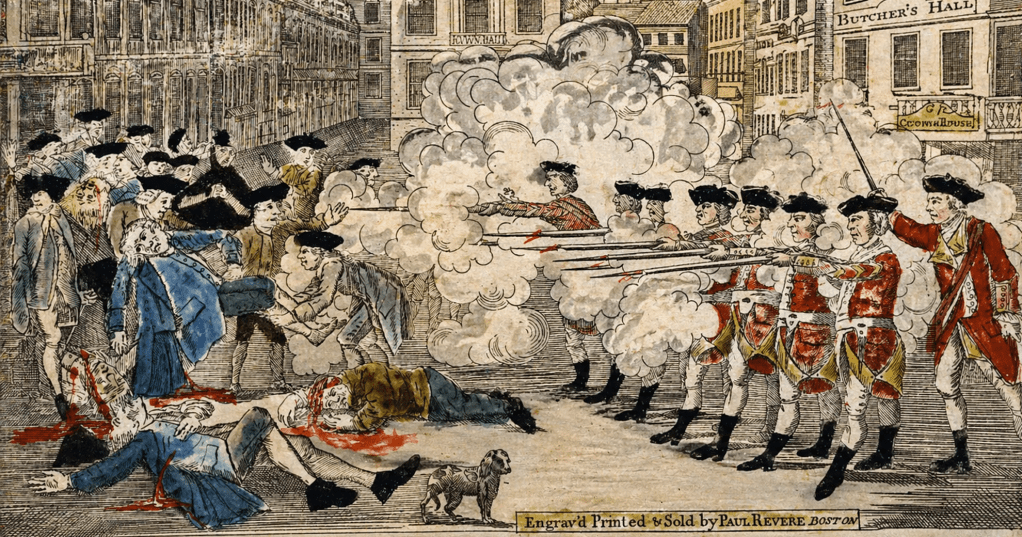
“It started with a wigmaker’s apprentice and ended with blood in the snow. Let us talk about March 5, 1770…”
Edward Garrick was sixteen, which is exactly the age when confidence outruns caution. He passed the Customs House on King Street just before nine o’clock and spotted Private Hugh White standing guard. Garrick accused a British officer of not paying his barber’s bill. It was the sort of insult that had likely been said before in some form and might have been ignored on another night in another city.
Boston was not in the mood to ignore anything.
White responded the way soldiers sometimes do when patience has worn thin. He struck Garrick with the butt of his musket. It was not a fatal blow, not even a particularly unusual one in a city where tempers had been running high for months. What it did was something far more consequential. It drew attention. Passersby slowed. Someone stopped. Someone else asked what had happened. Voices rose. A crowd began to form, not because anyone had planned it, but because Boston had become the kind of place where crowds formed quickly.
That one strike did what years of Parliamentary policy had been trying to do. It brought people together, not in agreement, but in agitation.
Within minutes, the situation began to expand beyond control. Dozens became scores, then hundreds. The church bells started ringing, which in Boston usually meant fire. In a sense, they were not wrong. People poured out of taverns and homes, drawn by instinct and curiosity toward the Custom House, where White now stood with his back to the wall, facing a crowd that was growing louder and less patient by the second.
Somewhere in that confusion, someone went for help. Captain Thomas Preston arrived with a small detachment, seven soldiers, muskets loaded, bayonets fixed. They took position in front of White, forming a defensive line against the mass of bodies pressing toward them. Behind the soldiers stood the solid stone of the Custom House. In front of them stood a city that had spent months convincing itself that it was being pushed too far.
No one in that moment was calm. Not the soldiers, not the crowd, not the officers trying to maintain some semblance of order.
Snowballs were the first projectiles, which sounds almost harmless until one remembers what Boston snow becomes after a day or two on the street. Ice followed. Then whatever else was close at hand. Oyster shells, bits of wood, anything that could be thrown found its way into the air. The soldiers stood their ground, though “stood” may be too steady a word for what was happening. They shifted, flinched, reacted, each man watching the crowd and the men beside him, waiting for something to give.
It did not take long.
Private Hugh Montgomery was struck hard enough to knock him down. In the kind of moment that later generations will try to slow down and analyze, everything happened too quickly for careful thought. He rose, shouted, and fired. Whether he heard the word “Fire” shouted by someone else, whether he acted on instinct, whether it was fear or anger or both, is a question that would be argued for years.
The musket discharged, and with it went whatever fragile control remained.
The first shot triggered others. Not a coordinated volley, not the neat line of disciplined fire that later engravings would suggest, but a series of reactions, each man responding to noise, movement, and the sudden realization that things had gone too far. In a matter of seconds, it was over.
Five men lay dead or dying on the street. Among them was Crispus Attucks, a man of African and Native descent who had been near the front of the crowd and would later be remembered as the first to fall. Samuel Gray, James Caldwell, Samuel Maverick, and Patrick Carr followed him into that grim distinction. Names that, until that night, had belonged to ordinary lives now belonged to something else.
Blood pooled on the cobblestones, dark against the snow. The crowd, so loud a moment before, broke into fragments of shock, anger, and disbelief. Captain Preston shouted for his men to cease fire, though by then there was little left to stop. The damage had been done in the time it takes to draw a breath.
It is tempting, looking back, to search for a single cause, a single decision that turned a confrontation into a killing. History does not always offer that kind of clarity. What it offers instead is accumulation. Weeks of tension. Months of resentment. Years of policy that had convinced one side it was being ignored and the other that it was being defied. Add a cold night, a crowd, a handful of armed men, and the result becomes less surprising, even if it remains tragic.
What happened next may have mattered even more than what happened in those few seconds.
The Crown called it a riot, a situation in which soldiers, surrounded and threatened, acted in self-defense. Boston called it a massacre, a deliberate act of violence by an occupying force against unarmed citizens. Neither description was entirely wrong, and neither was entirely complete.
Into that space stepped Paul Revere, whose famous engraving would present the event in a way that left little room for ambiguity. Soldiers in neat formation, firing on a passive crowd, officers calmly directing the violence. It was powerful. It was persuasive. It was also, in several key respects, an interpretation rather than a photograph. The chaos, the thrown objects, the confusion that marked the actual event were smoothed into something more useful.
On the other side, accounts emphasized the aggression of the crowd, the fear of the soldiers, and the lack of clear orders. These too were shaped by perspective, by the need to explain and justify what had happened.
And then there was John Adams, who would soon step into the story in a way that surprised many and angered more. He would defend the soldiers in court, not because he approved of what had happened, but because he believed that law, if it meant anything, had to apply even in moments like this.
The argument was no longer just about taxes or representation. It was about truth, about how events are understood and remembered. It was about whether a city could look at what had happened on King Street and agree on what it meant.
After the break, that argument moves into a courtroom, where justice, politics, and public opinion collide in ways that would shape the future as surely as any musket shot.
In the hours after the shooting stopped, Boston did something that history does not always give cities credit for. It paused. Not peacefully, not comfortably, but deliberately. There were calls for revenge, there were whispers of wider violence, and there were men who understood that one wrong move could turn a terrible night into something far worse. The bodies had not yet been buried, and already the question hung in the air, not what happened, but what would be done about it.
The soldiers were arrested. That alone was no small thing. In a city that had just watched five of its own fall, there were many who would have preferred a quicker form of justice, something immediate and final. Instead, the decision was made to proceed with trials. Law would answer blood. That sounds noble when written down. It feels far less certain when a crowd is still angry and the memory of gunfire is fresh.
Into that moment stepped John Adams, who made a choice that did not win him popularity and did not seek it. He agreed to defend the British soldiers. Not because he admired them, not because he dismissed what had happened, but because he believed something stubborn and unfashionable in that moment, that the law either applies to everyone or it applies to no one. If the colonists claimed rights as Englishmen, then those rights had to extend even to the men in red coats who had fired into the crowd.
It was not a comfortable position. Adams would later write that it was one of the most difficult decisions of his life, and one of the ones he was most proud of. There is a kind of moral clarity in that, though it comes at a cost. Defending the unpopular is rarely a path to applause.
The trials themselves became a stage of a different kind. Witnesses were called. Testimony conflicted. Memory, as it tends to do, proved unreliable under pressure. Some swore the soldiers had fired without provocation. Others described a crowd that had pressed too close, thrown too much, shouted too loudly. The truth, like the smoke from those muskets, did not settle neatly.
Adams did not argue that the deaths were justified. He argued that they were not murder. That distinction mattered in law, even if it felt thin to those who had lost friends and neighbors. He emphasized confusion, fear, the absence of clear orders. He reminded the jury that men surrounded by a hostile crowd might act in ways that seem unreasonable only when viewed from a distance.
The verdict reflected that complexity. Six of the soldiers were acquitted. Two were found guilty of manslaughter, not murder, and branded on the thumb, a mark that served both as punishment and as a permanent reminder. It was not the outcome many in Boston had hoped for. It was not the outcome that British authorities might have quietly preferred either. It was, in its way, an attempt to balance law and circumstance, to acknowledge that something had gone wrong without declaring it wholly one sided.
Outside the courtroom, the argument continued.
The Sons of Liberty did not wait for the legal process to shape public opinion. They had already begun that work. Eyewitness accounts were gathered, printed, and circulated. Pamphlets appeared that told the story in terms that left little room for ambiguity. The word “massacre” was not chosen by accident. It carried weight. It suggested intent, cruelty, a deliberate act rather than a chaotic moment. Once attached to the event, it proved difficult to remove.
On the other side, British officials and their supporters pushed back with their own interpretations. They spoke of a riot, of soldiers under attack, of self-defense in the face of a mob. These accounts were less dramatic, less memorable, and perhaps less effective. There is a reason certain words survive while others fade. “Massacre” has a way of sticking.
Meanwhile, the British government took a step that spoke louder than its statements. Troops were withdrawn from the center of Boston and moved to Castle Island in the harbor. Officially, this was a measure to reduce tension. Unofficially, it was an acknowledgment that the situation in the city had become untenable. The presence of soldiers had been meant to enforce order. It had instead become a source of disorder.
That decision revealed something important. The empire was beginning to recognize that control was slipping, not entirely, not yet, but enough to require adjustment. The colonists, for their part, saw the withdrawal as a victory, a sign that pressure worked, that resistance produced results.
And so the event on King Street moved from incident to symbol.
The Boston Massacre, as it came to be known, entered the language of the colonies not as a single night of violence, but as part of a larger story. It was invoked in speeches, printed in newspapers, remembered in conversations. It became a reference point, a way of explaining what was at stake. Not in abstract terms, but in blood, in names, in the image of men lying in the snow.
It would be easy, perhaps even comforting, to separate truth from propaganda, to decide which version of events was correct and which was distorted. History resists that kind of simplicity. What happened that night was both chaotic and consequential. The accounts that followed were shaped by perspective, by purpose, by the need to make sense of something that did not fit neatly into any single narrative.
What matters is not only what happened, but how it was understood.
The law had spoken, in its measured, imperfect way. The public had spoken as well, louder, less restrained, and often more persuasive. Between them lay a gap that would not easily be closed.
Was it a riot, or a massacre?
It is the sort of question that invites debate, and perhaps that is the point. Did the Sons of Liberty push events toward that violent moment, knowing that any bloodshed would serve their cause? Was John Adams right to stand in defense of men his neighbors despised? Could a steadier hand, on either side, have prevented the escalation?
There are no easy answers waiting at the end of those questions. Only the recognition that the path to revolution is rarely straight, and almost never clean.
What can be said is this. On a cold night in March, words gave way to gunfire. In the days that followed, gunfire gave way to argument. Between the two, something shifted. The distance between colony and Crown, once measured in miles and misunderstandings, began to be measured in something harder to repair.
Truth, propaganda, and law met in the snow that night. None of them left unchanged.
Originally published June 17, 2025
Republished April 26, 2026
Adams, John. The Works of John Adams, Second President of the United States. Vol. 3. Boston: Little, Brown and Company, 1851.
Archer, Richard. As If an Enemy’s Country: The British Occupation of Boston and the Origins of Revolution. New York: Oxford University Press, 2010.
Bailyn, Bernard. The Ideological Origins of the American Revolution. Cambridge, MA: Harvard University Press, 1967.
Boston Gazette. “Account of the Late Massacre in King Street.” March 12, 1770.
Dickerson, Oliver M. The Navigation Acts and the American Revolution. Philadelphia: University of Pennsylvania Press, 1951.
Fischer, David Hackett. Paul Revere’s Ride. New York: Oxford University Press, 1994.
Maier, Pauline. From Resistance to Revolution: Colonial Radicals and the Development of American Opposition to Britain, 1765–1776. New York: W.W. Norton, 1991.
Revere, Paul. The Bloody Massacre Perpetrated in King Street, Boston. Engraving, 1770.
Zobel, Hiller B. The Boston Massacre. New York: W.W. Norton, 1970.
Young, Alfred F. The Shoemaker and the Tea Party: Memory and the American Revolution. Boston: Beacon Press, 1999.



Leave a Reply