
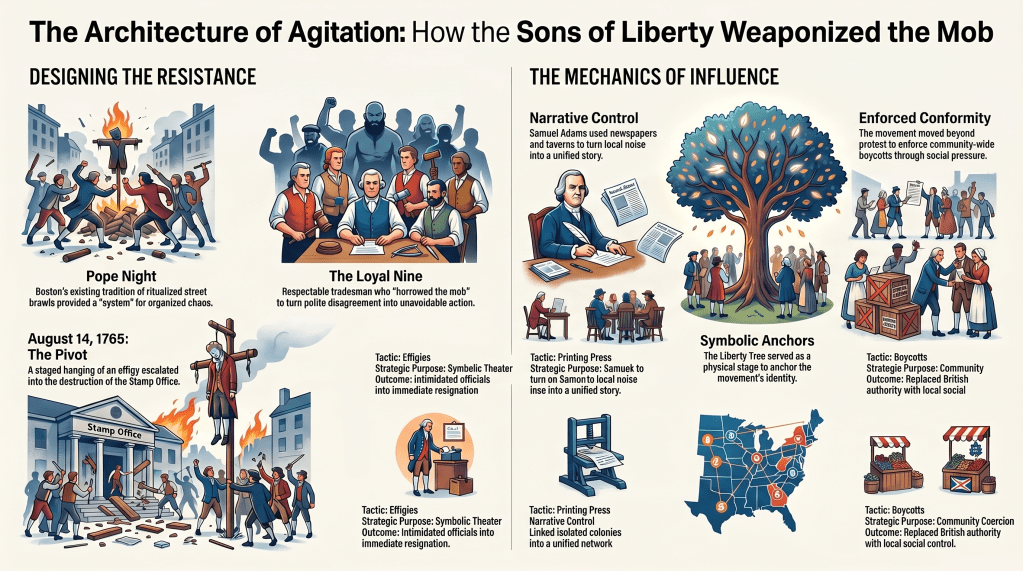
Boston did not invent mob violence, but it refined it into something almost theatrical. Long before anyone was shouting about liberty or Parliament, the city had already developed a taste for organized chaos. Every November 5, the streets filled with noise, fire, and rivalry in a tradition known as Pope Night. Effigies were paraded, gangs clashed, and the North End and South End treated the whole affair like a civic holiday mixed with a barroom brawl. It was loud, it was messy, and it followed rules that only the participants seemed to understand. What looked like disorder from a distance had its own internal logic. It was, in its own rough way, a system.
That system would prove useful.



When Parliament passed the Stamp Act in 1765, the reaction in the colonies was not immediate revolution. It was frustration, confusion, and a sense that something had shifted in a way that did not favor the people who lived there. Printed materials, everything from legal documents to newspapers to playing cards, would now require stamped paper purchased from British authorities. It was not the size of the tax that stung so much as the principle behind it. A direct, internal tax, imposed by a body in which the colonists had no representation, felt less like governance and more like instruction from a distant landlord.
Now here is where Boston’s peculiar talents enter the story.
There existed in that city a group of respectable men known quietly as the Loyal Nine. They were not rabble. They were tradesmen, printers, men with reputations to maintain and businesses to protect. They understood politics, and more importantly, they understood people. What they lacked was a way to turn polite disagreement into something that could not be ignored.
So they borrowed the mob.
Among the figures who moved between these worlds was Ebenezer Mackintosh, a man who had built his reputation leading Pope Night crowds and navigating the volatile rivalries of Boston’s streets. He was not the sort of individual who would be invited to a formal debate, but he was precisely the sort of man who could gather a crowd, hold its attention, and direct its energy. The Loyal Nine did not try to tame that energy. They aimed it.
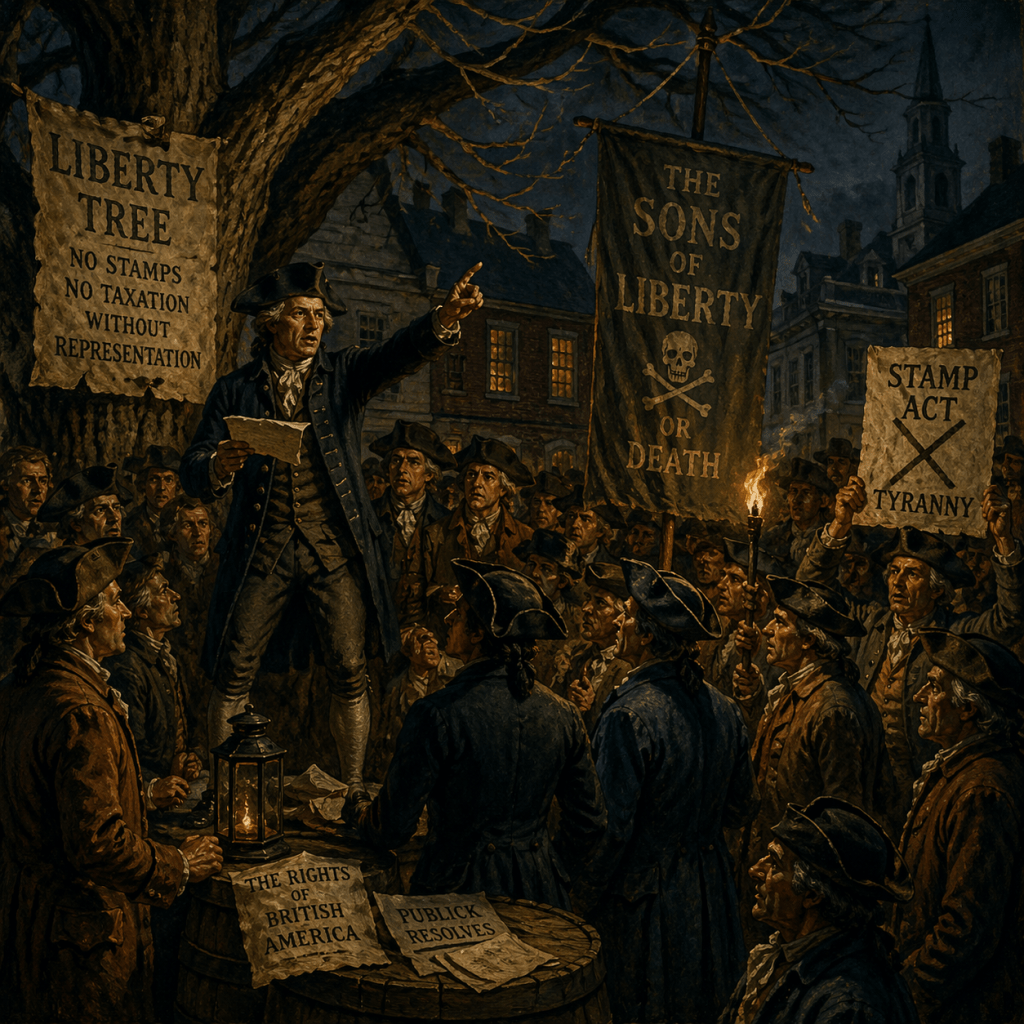
On the morning of August 14, 1765, Boston woke to a spectacle that felt familiar in form and entirely new in purpose. An effigy hung from a tree, marked clearly so there could be no confusion about its target. It represented Andrew Oliver, the man appointed to enforce the Stamp Act in Massachusetts. The display was not subtle. It did not intend to be. As one account notes, the effigy was accompanied by signs accusing Oliver of betraying his country and warning that anyone who interfered would be considered an enemy.
At first glance, this looked like Pope Night come early, another round of street theater with a political edge. Farmers entering town were even made to have their goods “stamped” by the effigy, a bit of dark humor that managed to be both amusing and pointed. But as the day wore on, the crowd grew, and the tone shifted. What began as spectacle edged toward something more serious.
By evening, the performance had become action.
The effigy was cut down, placed on a makeshift bier, and carried through the streets in a mock funeral procession. The crowd shouted, cheered, and passed directly by the Town House, where colonial officials were still trying to decide how to respond. It was not subtle. It was not meant to be. The message was delivered with volume and clarity. “Liberty, Property, and No Stamps” was not a polite petition. It was a declaration of intent.
Then came the destruction.
A building believed to be intended as the stamp office was torn down in minutes. Oliver’s home was attacked, its windows shattered, its doors broken, its contents destroyed. The mob did not find Oliver himself, which may have spared him a far worse fate, but the message was unmistakable. Accept this position, enforce this law, and you do so at your own risk.
Here is the part that deserves careful attention, because it reveals something both effective and troubling.
The violence worked.
Oliver, shaken and fearful, announced that he would not take the position. Similar scenes unfolded across the colonies, sometimes less dramatic, sometimes more so. Stamp distributors resigned one after another, until the machinery required to enforce the law simply did not exist. As one historian observed, without distributors the Stamp Act could not function, which made the coercion of those officials seem, in a cold and practical sense, efficient.
The Loyal Nine understood exactly what they had done, and just as importantly, what they had not done. When the violence escalated beyond its intended target, when the home of Lieutenant Governor Thomas Hutchinson was later sacked in a display that shocked even some supporters of resistance, they stepped back. They disavowed the excess. Publicly, they were men of order. Privately, they had proven that disorder could be useful.
It is a fine line, and history rarely draws it neatly.
What began in Boston did not remain in Boston. News of the events spread quickly, carried by newspapers, letters, and the same word of mouth that had always moved information through the colonies. The effect was immediate. Similar groups formed elsewhere, adopting the same methods, the same symbols, and often the same name. The Sons of Liberty emerged not as a centralized organization, but as a network of local movements, each drawing from the same playbook.
They met under trees that became symbols, most famously the Liberty Tree in Boston. They organized protests, circulated petitions, and, when they deemed it necessary, applied pressure in ways that could not be ignored. To British officials, this looked like mob rule, a breakdown of order that threatened the stability of the empire. To many colonists, it looked like something else entirely, a form of political expression that finally matched the seriousness of the issue at hand.
It would be comforting to say that the transformation from Pope Night to Patriot Night was inevitable, that the energy of those street rituals was always destined to find a political outlet. That gives too much credit to destiny and not enough to design. What happened in 1765 was not an accident. It was a decision, made by men who understood both the risks and the potential of the tools they were using.
They did not create the mob. They gave it a purpose.
And once a crowd learns that it can change outcomes, once it sees that its actions can force a government to retreat, it does not easily return to being a mere spectator. The habits of resistance, like any habit, grow stronger with use.
From tar barrels to torchlit effigies, the mob had found a new target. Not a rival gang, not a religious symbol, but Parliament itself. The noise was louder now, the stakes higher, and the line between protest and power was beginning to blur. When the Sons of Liberty stepped forward, they were no longer just loud. They were becoming something far more consequential.
If Boston taught the colonies how to make noise, Samuel Adams taught them how to make it mean something. That distinction matters more than it sounds. Noise gets attention. Meaning keeps it.
Samuel Adams has been saddled, over the years, with the image of a tavern-haunting agitator, the sort of fellow who stirs up trouble and then disappears before the bill comes due. It is a colorful picture, and like most colorful pictures, it is not quite right. Adams did not stumble into influence. He built it, patiently, deliberately, with a craftsman’s understanding of how ideas move and how people respond to them.
He understood something that Parliament did not. Power is not only exercised through laws and soldiers. It is exercised through narrative. Whoever tells the story, and persuades others to repeat it, holds a kind of authority that is difficult to measure and even harder to counter.
Adams worked that ground with care. He moved through Boston’s institutions, not as an outsider, but as a connector. Churches, print shops, town meetings, these were not separate arenas to him. They were parts of a single system. Messages delivered from a pulpit could be echoed in a newspaper. Articles printed in a newspaper could be debated in a tavern. Debates in a tavern could become resolutions in a town meeting. The flow was not accidental. It was guided.
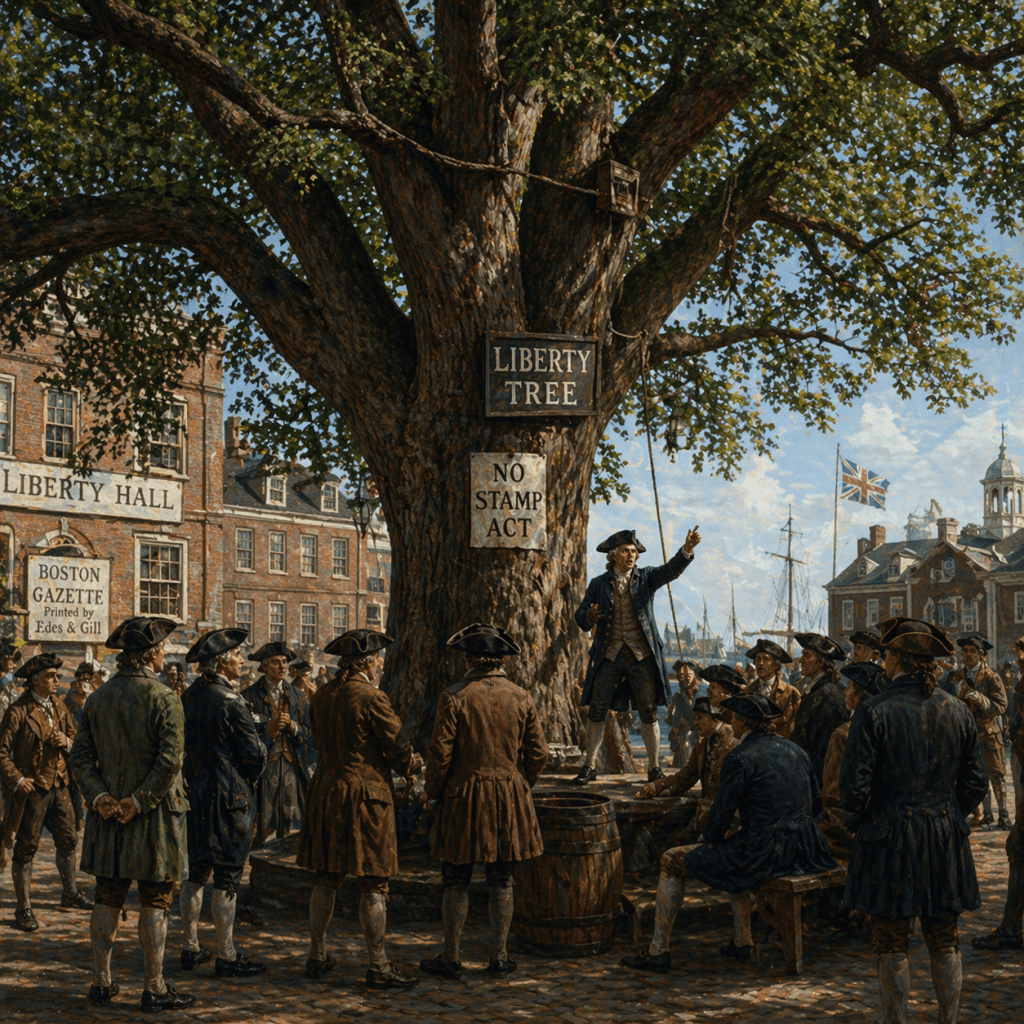
The Liberty Tree became the stage where this system came into view. It was, at its simplest, an elm tree in Boston, but like most powerful symbols, it gathered meaning through use. Meetings were held there. Effigies were displayed there. Declarations were made beneath its branches. It turned public space into political space, and in doing so, it gave the movement a physical center that people could see, visit, and remember.
Symbols like that do more than decorate a cause. They anchor it.
From Boston, the message spread outward, carried not just by travelers but by ink and intention. Newspapers played a central role, and not by accident. Several of the men involved in the movement were printers or closely tied to the printing trade, which meant they had unusual influence over what people read and how they read it. Stories of resistance, especially the dramatic ones, were given prominence. Accounts of protests were written with a certain flair, emphasizing courage, unity, and purpose.
It was not fabrication. It was selection.
The effect was powerful. Readers in New York, Charleston, and smaller ports in between began to see themselves as part of a larger story. What had happened in Boston did not remain a local incident. It became a model. Groups formed in other colonies, often under the same name, the Sons of Liberty, though without a central command or formal structure. They were, as one account puts it, an informal network of autonomous societies, linked more by shared purpose than by any rigid hierarchy.
That looseness was not a weakness. It was a kind of strength. It allowed the movement to adapt to local conditions while maintaining a recognizable identity. A protest in New York might look different from one in Boston, but the underlying message would be familiar. The language of liberty, property, and resistance to unjust taxation traveled well.
Adams and his allies also understood the value of spectacle, though they would not have used that word. They knew that people remember what they can see, and they built their actions accordingly. Mock funerals for liberty, processions through city streets, the hanging and burning of effigies, these were not random acts of anger. They were performances, carefully staged to convey meaning to a wide audience.
Even the destruction, when it came, carried a message.
The Boston Tea Party would later stand as the most famous example, but it was part of a pattern rather than an exception. Acts of defiance were designed to be seen, to be talked about, to be printed and reprinted until they became part of the shared memory of the colonies. A crate of tea tossed into the harbor was not just a protest. It was a story waiting to be told, and retold, in a way that emphasized principle over disorder.
This is where perspective becomes important.
From London, these events often looked like chaos, like mobs overrunning authority and threatening the stability of the empire. There was truth in that view. Crowds can be unpredictable, and the line between protest and violence is not always clear. British officials saw broken windows, burned effigies, and frightened loyalists, and they drew conclusions that were not unreasonable from where they stood.
From the colonial side, the same events were experienced differently. They were not seen as random outbreaks of disorder, but as expressions of collective will. The language surrounding them reinforced this perception. Participants spoke of rights, of liberty, of defense against overreach. The acts themselves were framed as necessary, even restrained, given the stakes involved.
It is a curious thing, how the same event can carry two entirely different meanings depending on where one stands.
Adams and the Sons of Liberty did not resolve that contradiction. They used it. They operated in the space between those interpretations, presenting themselves as defenders of order while applying pressure in ways that clearly unsettled it. They condemned excess when it threatened to undermine their position, and they encouraged action when it advanced their cause.
It was a balancing act, and like most balancing acts, it could not be maintained indefinitely without strain.
Yet for a time, it worked. The movement grew, not through formal command but through shared understanding. Colonists who had never met one another began to act in ways that suggested coordination. Messages moved faster than officials could respond. Decisions made in London encountered reactions in the colonies that seemed almost immediate.
The empire was discovering, perhaps too late, that control of territory does not guarantee control of narrative.
And narrative, once it takes hold, is difficult to dislodge.
Coming up, the story takes a darker turn. Because the same tools that can unify a people can also be used to enforce conformity, and the same movement that speaks of liberty can, at times, decide who is allowed to enjoy it. The Sons of Liberty were learning how to take hold of cities, not with armies, but with pressure that left little room for dissent.
There comes a point in any movement when it has to decide what it is willing to become. Up to now, the Sons of Liberty had been noisy, clever, and effective. They knew how to stage a protest, how to shape a story, how to push just hard enough to get results. The Stamp Act had been broken not by a vote, but by pressure, and that lesson settled in like a habit. Once you discover that something works, you tend to use it again.
The difficulty is that success does not come with instructions on where to stop.
Across the colonies, the Sons of Liberty began to take on a role that went beyond protest. They did not wait for authority to act. They began to act in its place. In port cities and towns, they enforced boycotts of British goods with a seriousness that rivaled any formal law. Merchants who complied were praised. Those who did not were visited, sometimes politely, sometimes not. Goods were inspected. Agreements were monitored. Decisions were made in meetings that had no official standing, yet carried real weight in the community.
It is one thing to oppose authority. It is another to replace it.
There were instances where British troops found their movements restricted, not by official decree, but by the practical reality of a population that no longer welcomed them. Loyalists, those who remained committed to the Crown, discovered that their position came with consequences. Some were shunned, others threatened, a few subjected to treatment that was meant to be both punishment and warning.
Tarring and feathering has a way of making an impression. It is not subtle, and it is not easily forgotten. A man covered in hot tar and feathers, paraded through the streets, is not simply being punished. He is being made into a message. The question, then as now, is what that message means.
From one perspective, these actions were the defense of a community under pressure, a response to laws and policies imposed without consent. If the formal system would not protect colonial rights, then the people would protect them themselves. There is a certain rough logic to that argument, and it was persuasive to many at the time.
From another perspective, it looked very different. It looked like intimidation, like the suppression of dissent, like the substitution of one form of coercion for another. The line between patriotism and something darker is not always bright, and it was not bright in the streets of Boston, New York, or Charleston.
As Parliament moved forward with new measures, the Townshend Acts, the Tea Act, and others that followed, the pattern repeated and intensified. Resistance was organized more quickly. Networks that had been informal began to take on structure. The Committees of Correspondence emerged, linking colonies in a way that allowed information, and strategy, to move with greater speed and coordination. What had once been a series of local reactions was becoming something closer to a unified response.
The Sons of Liberty did not create this system alone, but they helped make it possible. They demonstrated that coordination could exist without formal hierarchy, that pressure could be applied across distance, and that a shared narrative could bind separate communities into something larger than themselves.
At the same time, they showed how fragile that balance could be. Power exercised outside formal structures is, by its nature, difficult to contain. It depends on trust, on shared purpose, and on a willingness to accept limits that are not always clearly defined. When those limits are tested, or ignored, the results can be unpredictable.
Consider the position of a merchant in one of these cities. He is told that importing British goods will bring consequences. He may agree with the boycott in principle, or he may simply wish to avoid trouble. Either way, his choice is shaped not only by his beliefs, but by the pressure applied by those around him. Is he participating in a collective act of resistance, or is he being compelled to conform? The answer, inconveniently, can be both.
The same can be said of the broader movement. The Sons of Liberty were champions of American rights, in the sense that they pushed back against policies that many colonists viewed as unjust. They were also practitioners of methods that relied on intimidation and public coercion. These two truths do not cancel each other out. They sit side by side, as they often do in history, asking the reader to hold them both at once.
It is tempting to smooth this out, to decide that the ends justified the means, or that the means tainted the ends beyond repair. Both approaches are tidy. Neither is entirely satisfying.
What can be said with some confidence is that without the pressure applied by groups like the Sons of Liberty, the course of events might have been very different. Speeches and pamphlets can shape opinion, but they do not always force change. The actions taken in the streets, disruptive, visible, and sometimes harsh, made it difficult for both colonial and British authorities to ignore the depth of resistance.
Would there have been a revolution without them? It is a fair question, and one that does not lend itself to easy answers. Perhaps the colonies would have found another path. Perhaps tensions would have eased. Or perhaps the absence of that pressure would have delayed the moment when disagreement turned into something more decisive.
As this chapter closes, the question remains open, as it should. Is violent protest ever justified in the defense of liberty? Were the Sons of Liberty guardians of a principle, or early examples of mob rule dressed in patriotic language? The answer depends, in part, on where one stands, and on what one believes about the nature of power and resistance.
What cannot be denied is their impact. They altered the balance between authority and opposition. They showed that a determined group, operating outside formal structures, could influence events on a scale that would have seemed improbable only a few years earlier.
Originally published, June 10, 2025
Republished, April 24, 2026
Archer, Richard. As If an Enemy’s Country: The British Occupation of Boston and the Origins of Revolution. New York: Oxford University Press, 2010.
Bell, J. L. “You Won’t Believe How Samuel Adams Recruited Sons of Liberty.” Journal of the American Revolution, February 5, 2014.
Danver, Steven L., ed. Revolts, Protests, Demonstrations, and Rebellions in American History: An Encyclopedia. Vol. 1. Santa Barbara, CA: ABC-CLIO, 2011.
Kumamoto, Robert. The Historical Origins of Terrorism in America: 1644–1880. New York: Routledge, 2014.
Maier, Pauline. From Resistance to Revolution: Colonial Radicals and the Development of American Opposition to Britain, 1765–1776. New York: W.W. Norton, 1991.
Morgan, Edmund S., and Helen M. Morgan. The Stamp Act Crisis: Prologue to Revolution. 3rd ed. Chapel Hill: University of North Carolina Press, 1995.
Rapoport, David C. “Before the Bombs There Were the Mobs: American Experiences with Terror.” Terrorism and Political Violence 20, no. 2 (2008): 167–194.
Simon, Jeffrey D. “The Sons of Liberty and Mob Terror.” Journal of the American Revolution, December 12, 2019.
“Sons of Liberty.” Encyclopaedia Britannica. May 7, 2025.
Young, Alfred F. “Ebenezer Mackintosh: Boston’s Captain General of the Liberty Tree.” In Revolutionary Founders: Rebels, Radicals, and Reformers in the Making of a Nation, edited by Alfred F. Young, Gary B. Nash, and Ray Raphael. New York: Vintage Books, 2011.



Leave a Reply