
There is an old story about British India and a cobra problem. The government, full of good intentions and very confident in its own cleverness, offered a bounty for every dead cobra. The result was not fewer cobras, but more. People began breeding them. When the bounty ended, the snakes were released. The problem multiplied because the policy misunderstood human nature. It is a tidy little parable, and like most tidy parables, it turns out to be painfully accurate.
Decades before that cobra problem, Britain had already run a similar experiment across the Atlantic. In 1733, Parliament passed what became known as the Molasses Act, a six pence per gallon duty on foreign molasses imported into the American colonies. The purpose was not subtle. British sugar planters in the Caribbean were being outcompeted by the French, whose molasses was cheaper and, by most accounts, better. New England merchants, practical men with a keen eye for profit, bought French molasses in large quantities and turned it into rum, which they then traded throughout the Atlantic world.
Parliament looked at this and decided to intervene. If French molasses could be made more expensive through taxation, colonial buyers would be forced back into the arms of British suppliers. It was a classic protectionist move, dressed up in the language of imperial policy. On paper, it seemed straightforward. In practice, it ran headlong into reality.
The colonies did not comply. They adapted.
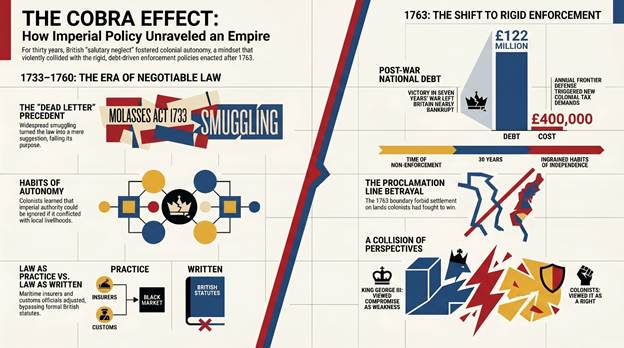
Smuggling became routine, almost respectable in certain circles. Cargoes were misdeclared, routes were adjusted, and customs officials found themselves either outmaneuvered or quietly compensated. The law existed, certainly, but it existed in the way a distant storm exists, visible on the horizon and easy enough to ignore if it never quite reaches shore. Enforcement was inconsistent, often halfhearted, and sometimes deliberately avoided. The result was a thriving black market economy that blurred the line between legality and necessity.
Even London began to accommodate this reality in ways that would have made a moral philosopher wince. Maritime insurers started factoring smuggling losses into their policies. Ships that vanished under suspicious circumstances were written off with a shrug. The system adjusted itself, not to the law as written, but to the law as practiced.
And here is where the real damage was done.
For roughly three decades, Britain allowed this arrangement to continue. Not formally, not openly, but effectively. The Molasses Act remained on the books, but it was what historians like to call a dead letter, a law that exists without consequence. Colonists learned something from this, not in a classroom, but in the marketplace and on the docks. They learned that imperial authority could be negotiated, bent, or quietly ignored. They learned that enforcement depended less on principle and more on convenience. They learned, in short, that the rules were flexible.
That kind of lesson tends to stick.
There is a dangerous habit that forms when laws are passed but not enforced. People begin to treat them not as obligations, but as suggestions. Over time, the suggestion fades into background noise. By the time anyone decides to take the law seriously, the culture around it has already moved on. Trying to reverse that process is like trying to unring a bell.
Britain did not seem to grasp this. Or perhaps it did and simply underestimated the consequences. The Molasses Act was not intended to provoke rebellion. It was meant to protect an economic interest within the empire. Yet in doing so, it created a precedent that would prove far more consequential than the tax itself. It established that Parliament could intervene in colonial trade for its own purposes, and it demonstrated that such intervention could be ignored without immediate penalty.
The colonists, for their part, were not staging a revolution. They were doing what people have always done when faced with a rule that conflicts with their livelihood. They found ways around it. They justified those ways as necessary, even reasonable. Over time, the behavior ceased to feel like defiance and began to feel like normal business practice.
One can almost picture the scene in a New England port. Barrels of molasses being rolled off a ship under the watchful but not overly concerned eye of a customs officer. A ledger adjusted here, a payment made there, a quiet understanding that everyone involved benefits from keeping the system running smoothly. It is not heroic. It is not dramatic. It is simply human.
The problem, as always, comes later.
By the end of the French and Indian War in 1763, Britain found itself in a very different position. The empire had expanded dramatically. The French threat in North America had been removed. The cost of that victory, however, was staggering. Debt had climbed, responsibilities had multiplied, and the need for revenue had become urgent. The same government that had once looked the other way now decided it was time to look very closely indeed.
And there it was, waiting for them, like those released cobras.
For thirty years, colonists had been taught, quietly but effectively, that imperial laws could be ignored. Now those same laws were to be enforced, not as suggestions, but as commands. The mindset behind the Molasses Act, the assumption that colonials would comply simply because Parliament said so, collided with a reality shaped by decades of neglect and accommodation.
It is tempting to view this as a simple failure of policy, a miscalculation that could have been corrected with better planning or clearer communication. That gives too much credit to the idea of control. What Britain faced was not a technical problem. It was a cultural one. The colonists had developed habits, expectations, and a sense of autonomy that could not be easily reversed.
The irony is hard to miss. The empire that prided itself on order had, through its own inconsistency, encouraged disorder. The law that was meant to regulate trade had instead taught people how to evade regulation. When the time came to enforce it, the ground had already shifted.
And while colonial rum runners were getting rich off tax evasion, back in England a shy, studious boy named George III was growing up in a palace with no idea what storm he would inherit.
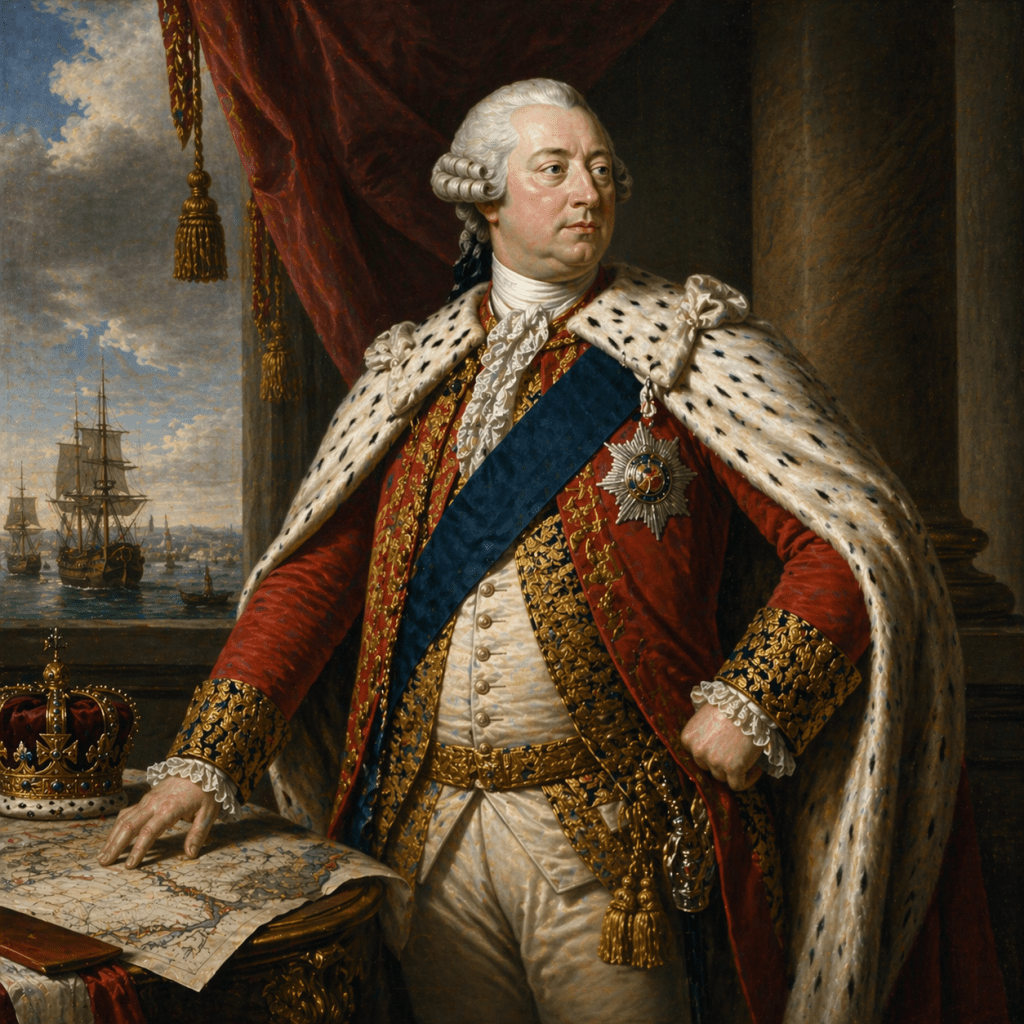
George III was born in 1738 into the Hanoverian line, a dynasty that still felt, even decades after arriving in England, slightly out of place. His grandfather, George II, sat on the throne. His father, Frederick, Prince of Wales, stood between him and that throne, though not comfortably. The relationship between father and son was strained, almost famously so, which meant that young George grew up in a household shaped as much by distance as by duty. When Frederick died unexpectedly in 1751, the path to the crown shifted overnight. George was no longer simply a royal child. He was the future.
Into this environment stepped John Stuart, better known as Lord Bute, who became something of a mentor and guide. Bute reinforced what Augusta had already begun, shaping George’s sense of duty and instilling in him a belief that monarchy was not merely a position but a calling. It was not enough to rule. One had to rule rightly. That word, rightly, would become important later, though not always in ways anyone intended.
George grew into a man who was, by the standards of his time, almost inconveniently upright. He did not drink heavily. He did not chase scandal. He was faithful to his wife in an age when that was more exception than rule. He preferred conversation about farming techniques to the intrigues of court life, which earned him the nickname “Farmer George.” It was not meant entirely as praise, though it was not entirely an insult either. He was earnest, serious, and perhaps a bit rigid. The sort of man who believes that if something is true, it should be followed, and if it is right, it should be enforced.
There is something admirable in that, at least in theory. A king who believes in virtue, who sees his role as a moral responsibility, who takes his duties seriously. It sounds like the beginning of a reformer’s story. The problem is that virtue, when combined with power and certainty, has a way of hardening into something less flexible.
George believed in monarchy by divine right, though not in the careless, indulgent way some of his predecessors had. He believed it with conviction. If the Crown held authority, it was because that authority had been granted by God. Laws were not merely political tools. They were expressions of order, and order was something to be preserved, not negotiated. To compromise a law was not simply to adjust policy. It was to weaken the structure that held everything together.
Now place that mindset across an ocean.
The American colonists, shaped by decades of what historians politely call “salutary neglect,” had grown accustomed to managing their own affairs. They passed their own taxes, enforced their own laws, and treated imperial oversight as something distant and, when necessary, negotiable. They were not anarchists. They still saw themselves as British subjects. But they had developed a habit, quiet and persistent, of independence in practice if not yet in name.
What they would receive in George III was not a king inclined to look the other way.
They would receive a king who believed that laws mattered because they were laws. A king who believed that authority, once established, should be respected. A king who saw compromise not as wisdom but as weakness. When he looked at the colonies, he did not see partners managing their own affairs. He saw subjects drifting from the order they were meant to uphold.
That difference in perspective would prove decisive.
It is worth pausing here, just for a moment, to consider the possibility that George did not set out to become the figure later described in the Declaration of Independence. There is no evidence of a grand plan to oppress the colonies, no early hint of the villain he would later be made into. What there is, instead, is a young man shaped by a particular set of beliefs, stepping into a role at a moment when the empire itself was changing.
Timing, as it often does, made all the difference.
By the time George ascended to the throne in 1760, the Seven Years’ War was reaching its conclusion. Britain stood on the verge of victory, its empire expanded, its rivals diminished. It was, on paper, a moment of triumph. It was also the moment when the costs of that triumph began to come due, when decisions made in London would carry consequences across an ocean that could not be easily ignored.
George was ready to rule an empire, confident in his duty, certain of his purpose.
He was not prepared for an empire that no longer behaved the way it had been taught to behave.
The war was over, at least on paper. The guns fell silent, the treaties were signed, and the maps were redrawn in a way that made Britain the undisputed master of North America. France, which had once threaded its presence through the interior from Canada to Louisiana, was effectively gone east of the Mississippi. The empire had expanded in a way that would have seemed improbable only a decade earlier. It was, by any traditional measure, a victory.
The trouble with victory is that it tends to come with a bill.
The Treaty of Paris in 1763 gave Britain control of Canada and vast stretches of land that had previously been contested or held by France. What had once been a fragile line of coastal colonies now stood behind an empire that reached deep into the continent. The French threat, which had loomed over colonial life for generations, vanished almost overnight. On the surface, this should have been a moment of celebration, and in many places it was. Yet the removal of that threat carried consequences that were not immediately obvious. The colonies no longer needed British protection in quite the same way, and Britain, having secured the continent, now faced the challenge of governing it.
That challenge proved more complicated than the war itself.
The cost of the conflict had been staggering. Britain’s national debt had climbed to roughly £122 million, a figure that pressed heavily on policymakers in London who now had to consider how to sustain an empire that had grown larger and more expensive to maintain. The presence of British troops in North America, which had been essential during the war, did not simply disappear with the signing of peace. Those forces remained, tasked with defending the frontier, maintaining order, and managing relations with Native nations. The annual cost of keeping those troops in place was estimated at £400,000, a significant burden even for a global empire.
From London’s perspective, the situation required practical solutions. The empire had been secured. The colonies had benefited from that security. It followed, in a straightforward and rather unromantic way, that the colonies should contribute to the cost of maintaining it. The logic was simple. The consequences were anything but.
On the ground, the situation was already deteriorating. The end of French power did not bring peace to the frontier. Instead, it removed a balancing force. Native American nations, no longer able to play one European power against another, faced a single dominant empire that showed little inclination to restrain colonial expansion. The result was a series of uprisings, most notably Pontiac’s Rebellion in 1763, in which Native forces attacked British forts and settlements across the Great Lakes and Ohio Valley regions. The violence was swift, coordinated, and deeply unsettling to British officials who had assumed that victory over France would bring stability.
It did not.
The frontier became a zone of tension, where settlers pushed westward in search of land and opportunity, and Native nations resisted with increasing determination. British troops found themselves stretched thin, attempting to hold a line that was as much political as it was geographic. The empire, having won the war, now faced the reality that managing the peace required a different kind of effort, one that involved restraint as much as strength.
It was in this context that the Crown issued the Proclamation of 1763, an attempt to impose order on a situation that was rapidly slipping beyond easy control. The proclamation drew a boundary along the Appalachian Mountains and forbade colonial settlement west of that line. The intention, at least from London’s perspective, was clear. By limiting expansion, the government hoped to reduce conflict with Native nations, stabilize the frontier, and lower the cost of maintaining troops in distant territories.
On paper, it made sense.
In the colonies, it landed like an insult.
Men who had fought in the war, who had marched through the Ohio Valley and risked their lives in its defense, believed that land was part of the reward for their service. Veterans expected grants. Speculators, including figures like George Washington, had invested heavily in western lands with the assumption that victory would open them for settlement. The proclamation cut across those expectations without ceremony or compromise. The land was there, visible, attainable, and now suddenly forbidden.
The reaction was not immediate rebellion. It was something quieter, and in many ways more dangerous. It was resentment, mixed with confusion. Why had they fought, if not for this? Why secure a continent only to be told they could not use it? The answers offered by British officials, practical, measured, and rooted in imperial necessity, did not satisfy men who had experienced the war as a personal struggle for survival and opportunity.
There was also a deeper shift taking place, one that did not announce itself in speeches or declarations. For years, the colonists had lived under what might be called a distant authority. Parliament passed laws, certainly, but enforcement was uneven, and local assemblies managed most aspects of daily life. The empire existed, but it did not press constantly against the boundaries of colonial experience.
After the war, that began to change.
The Proclamation Line was not just a policy. It was a presence. It reached into the lives of colonists in a way that previous imperial decisions had not. It told them where they could and could not go, what opportunities they could and could not pursue. It suggested that decisions about their future would be made elsewhere, by men who had never seen the lands in question and who did not bear the risks associated with them.
For a people who had grown accustomed to a degree of autonomy, this felt like a narrowing of space, not only geographically but politically. The “rights of Englishmen,” long invoked as a source of protection and legitimacy, began to feel less certain. If those rights could be adjusted, limited, or reinterpreted to suit imperial needs, then they were not quite as fixed as many had believed.
That realization did not produce immediate calls for independence. It did something more subtle. It planted doubt. It encouraged colonists to reconsider the nature of their relationship with Britain, to ask whether they were partners in an empire or subjects within it. The questions were not yet answered, but they were no longer unasked.
From London, the Proclamation of 1763 appeared as a reasonable measure, a necessary step in managing a vast and newly acquired territory. From the colonies, it appeared as the first clear sign that the rules were changing, that the habits and expectations built over decades were no longer aligned with imperial policy.
The war had removed one threat and revealed another, less visible but no less significant. The empire had grown, but so had the distance, not in miles, but in understanding.
The war may have been over, but the peace had a cost. And for the American colonists, the bill was about to come due, not just in gold, but in freedom.
Guttmacher, Manfred S. America’s Last King: An Interpretation of the Madness of George III. New York: Charles Scribner’s Sons, 1941.
Calloway, Colin G. The Scratch of a Pen: 1763 and the Transformation of America. New York: Oxford University Press, 2006.
Stark, Peter. “The Young George Washington.” American Heritage 64, no. 5 (Fall 2019).
Dillard, Annie. “The French and Indian War in Pittsburgh: A Memoir.” American Heritage 38, no. 5 (July/August 1987).
“French and Indian War.” Encyclopaedia Britannica. Accessed 2026.
“Seven Years’ War.” Encyclopaedia Britannica. Accessed 2026.
“George III.” Encyclopaedia Britannica. Accessed 2026.
“Proclamation of 1763.” National Archives (UK) / Colonial Records. Accessed 2026.
“Treaty of Paris (1763).” Avalon Project, Yale Law School. Accessed 2026.
“Molasses Act (1733).” British Parliamentary Records.
“Sugar Act (1764).” British Parliamentary Records.
Originally published on May 27, 2025
Redrafted and republished on April 22, 2026



 DAVE DOES HISTORY
Leave a comment