
The question arrived late, almost as an afterthought of history itself. By the 1840s, the smoke of Lexington and Concord had long since drifted into memory, and the men who had stood on that green were nearly all gone. Time had done what time always does, it had softened the edges, polished the story, and handed it back to a younger generation that wanted to understand what, exactly, had happened. Not just the dates and the battles, but the why of it all.[1]



Into that quiet search stepped a young historian named Mellen Chamberlain. He was not unusual for his time. The nineteenth century had developed a taste for explanation, for systems, for the idea that great events must surely have great and orderly causes. Revolutions, after all, ought to have tidy origins. Philosophers, taxes, pamphlets, something that could be traced and diagrammed and neatly labeled. Chamberlain went looking for those answers in the only place they still lived, in the fading recollections of a man who had been there.
Captain Levi Preston was ninety-one years old when Chamberlain found him. He had stood at Lexington and Concord. He had watched farmers and tradesmen, men with no uniforms and little training, face down what was then the most powerful military force on earth. It was not a small thing. It would be like asking a local militia to take on the full weight of a modern army and navy combined and expecting them to hold their ground. So, Chamberlain did what any careful historian would do. He began with the questions he already believed he understood.
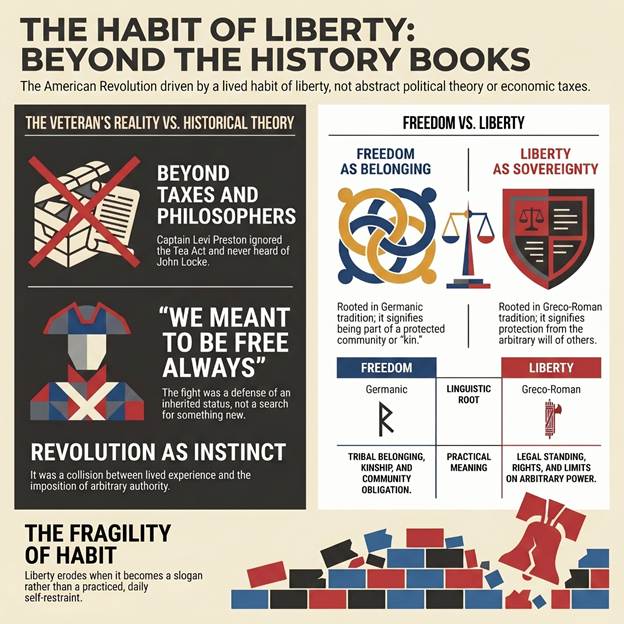
Was it the taxes? The Stamp Act, the Tea Act, those familiar sparks that fill our textbooks. Preston shrugged them off. He had never paid much attention to tea. He preferred coffee, which is not the answer you expect when you are constructing a theory of revolution. Was it the Stamp Act? He had never seen a stamp. Was it the grand sweep of Enlightenment thought, the writings of John Locke and the philosophers who filled the pamphlets of the age? Preston had never heard of Locke. Not once.
At that point, the careful structure begins to wobble. The historian is left standing there, holding a set of answers that do not fit the questions he brought with him. So he asks again, more plainly this time. Why did you go?
Preston’s reply lands with a kind of quiet force that does not announce itself at first. “We had always been free, and we meant to be free always.”
There it is. No theory, no citation, no nod to the intellectual fashions of the eighteenth century. Just a statement, simple enough to fit in a single breath, and heavy enough to carry the entire weight of a revolution. He did not speak as a man who had discovered an idea. He spoke as a man defending something he believed had always belonged to him.
That answer has a way of unsettling modern expectations. We have been trained to look for causes that can be debated in lecture halls. We like our revolutions to be argued into existence by philosophers and pamphleteers. It makes the story feel safer, more controllable. Ideas lead to actions, actions lead to outcomes, and everything follows a neat line of reasoning. Preston’s answer does not cooperate with that. It suggests something older, something less polished.
What he describes is not theory. It is instinct. It is habit. It is inheritance.
He was not fighting to become free in some new and abstract sense. He believed he already was. The problem, as he saw it, was that someone else had decided otherwise. The British, in his words, “did not mean that we should.” That is not a philosophical disagreement. That is a collision between lived experience and imposed authority. One side believes it is exercising control. The other believes something essential is being taken away.
And that leaves us with a question that refuses to sit quietly in the corner. When Preston said “free,” what did he actually mean?
Because whatever he meant, it was strong enough to carry him, and thousands like him, onto a field where the odds were absurd and the consequences permanent. It was strong enough to outlast the taxes, the pamphlets, and the tidy explanations that came later. It was strong enough to become, in time, the foundation of a nation that would write those ideas down and send them echoing into the future.
So the historian’s question, meant to close the case, instead opens it. Not what caused the Revolution. That part is easy enough to argue over. The deeper question is what kind of people could answer as Preston did, with no reference to theory, no appeal to novelty, only the quiet certainty that they had always been something and had no intention of becoming anything less.
That is where the trail leads next, into the uneasy ground between what we think they meant and what they actually lived.
Preston’s answer hangs in the air like a challenge, simple words that refuse to stay simple. “We had always been free.” It sounds familiar, almost comfortable, until you begin to pull at the thread and realize that the word itself does not mean what we think it means. Not to him, not to his world, and certainly not in the way we toss it around today as if it were spare change.
The trouble begins with language, as it often does. We use the words freedom and liberty as if they were interchangeable, twins separated only by preference or style. That is a modern habit, and like most modern habits, it flattens something that used to have shape. In Preston’s time, the two words carried different weights, drawn from different worlds, and they pointed to different ideas about what it meant to live as a human being under authority.
Freedom, the older of the two in English, comes out of the Germanic world. It is a word rooted in belonging. To be free in that sense was to be part of a people, bound by kinship, custom, and shared identity. It was not abstract. It was not universal. It was local, inherited, almost tribal. A free man was one who belonged to the community, who stood within its protection and shared in its obligations. He was not an outsider, not a servant, not a man cut loose from the group. He was of it. His freedom lived in that connection.
Liberty, by contrast, walks in from a different door entirely. It carries the imprint of the Greco Roman world, where the question was not belonging but domination. To have liberty was to stand beyond the arbitrary will of another man. It meant self-determination, the condition of not being subject to the whim of a ruler who could alter your status at a moment’s notice. It was not merely social. It was legal and moral. It required structure, law, and recognition that certain rights could not be taken away simply because someone in power decided to take them.
The difference is not academic. It is the difference between being part of a family and being master of your own fate. One can exist without the other, and history is full of examples that prove the point.
Consider Joseph in Egypt, a story older than either language but sharp enough to cut through the confusion. Sold into slavery by his brothers, he rises in the household of Potiphar to a position of remarkable trust. He manages the estate. He exercises authority. He moves freely, makes decisions, and directs the affairs of the household with confidence that looks, at first glance, like freedom. In a practical sense, he has it. He is not chained. He is not idle. He acts, and others obey.
But he does not have liberty. His position rests entirely on the favor of another. The structure that gives him authority can remove it just as easily. When he is falsely accused, there is no appeal to rights, no protection grounded in law that recognizes his sovereignty as a person. He is thrown into prison because someone with power decides that he should be. The freedom he possessed was real enough in daily life, but it was fragile, contingent, dependent on the goodwill of a master. It could vanish in a moment, and it did.
That is the line Preston was standing on, whether he could have articulated it in those terms or not. Freedom can exist without liberty. A man can move, act, and even prosper, while still lacking any guarantee that his status will endure. Liberty, on the other hand, demands something more. It requires a structure that acknowledges rights, enforces limits on power, and recognizes the individual as something more than a subject to be managed.
And here is where the modern ear begins to mishear the past. When Preston spoke of being free, he was not describing the loose, unbounded idea that floats through our politics today, the notion that freedom means doing whatever one wishes without restraint. He was speaking out of a world where belonging and obligation were assumed, where the community defined the man, and where the deeper concern was whether that way of life could be altered by distant authority without consent.
The men who gathered on village greens and in meeting houses were not chasing freedom as a new discovery. They were defending liberty as a condition they believed had long existed among them, even if they would not have used the word with philosophical precision. They were not trying to invent a new kind of society from whole cloth. They were trying to preserve a structure that allowed them to live without being subject to arbitrary control.
That distinction matters, because it pulls the Revolution out of the realm of abstract theory and plants it firmly in the soil of lived experience. It was not driven by a sudden desire to become something new. It was driven by the fear of losing something old, something that had been practiced, assumed, and handed down without much need for explanation.
Which brings us, whether we are ready or not, to a harder truth. If liberty is not just a word on paper, if it is not merely a legal arrangement, then it must live somewhere. It must be carried, practiced, reinforced in ways that do not always announce themselves. And if that is true, then it can also fade, erode, and disappear long before anyone notices that it is gone.
If liberty is something lived, then it follows, quietly but relentlessly, that it can also be unlived. Habits are like that. They are built over time, reinforced in small ways, carried forward without much ceremony, and then, just as quietly, they begin to slip. No trumpet sounds. No formal declaration announces the loss. One day the thing simply is not there in the same way it once was.
When that happens, liberty does not vanish all at once. It changes form. It becomes a word that is still spoken but no longer understood. It turns into a slogan, something that fits neatly on a banner or into a speech, stripped of the weight it once carried. It drifts into the realm of legal abstraction, discussed in courts and classrooms, defined and redefined until it feels more like a concept than a condition. It becomes a talking point, passed back and forth in political arguments, invoked often, examined rarely.
You can hear the shift if you listen closely enough. Modern language leans heavily on the word freedom. It rolls easily off the tongue, broad and inviting, a word that promises much and demands little in return. Liberty, when it appears at all, is usually tucked into a narrower corner, spoken of as “civil liberties,” as if it were a set of permissions granted and managed by the very structures it was meant to restrain. That alone should raise an eyebrow. A liberty that depends on the favor of authority begins to look suspiciously like the condition Joseph found himself in, functional until it is not.
The older understanding carried a harder edge. Liberty was not something handed down from above. It was not issued, revised, or withdrawn at the discretion of those in power. It was rooted in the idea that there were limits, real limits, on what any ruler could do. And those limits did not enforce themselves. They required a people who understood them, who expected them, who would resist when they were crossed.
That is the part that refuses to be exported. History has tried, more than once, to package liberty and deliver it elsewhere, sometimes at the point of a bayonet, sometimes through carefully drafted constitutions. The results tend to follow a familiar pattern. The forms appear, the language is adopted, the institutions are built, and yet the thing itself does not take root. It cannot. Liberty is not a set of instructions. It is not a document that can be signed and sealed and declared complete. It must be cultivated, modeled, lived until it becomes second nature. Without that, the structure stands empty, a shell waiting to be filled by whatever force is strongest.
And force has a way of stepping in when the internal discipline fades. The men who spoke of liberty in the eighteenth century did not imagine it as a license to indulge every impulse. They understood it as something ordered, something that required restraint. To govern oneself was not a poetic phrase. It was a daily demand. It meant holding one’s own desires in check, honoring obligations to family and community, submitting to laws that one had a hand in shaping. It was not glamorous. It was not easy. It was necessary.
Strip that away, and what remains begins to look less like liberty and more like its unruly cousin. The idea that liberty means doing whatever one pleases sounds appealing, right up to the point where everyone tries it at once. Then the seams begin to split. Order frays. Trust erodes. The shared understanding that holds a society together weakens, and in its place comes something colder. Chaos does not sustain itself for long. It invites correction. It demands control.
There is an old warning, worn smooth by repetition because it keeps proving itself true. A people who cannot govern themselves morally will be governed by force. It is not a threat. It is an observation. When self-restraint disappears, something else steps in to fill the void. Laws multiply. Authority expands. The space where liberty once lived narrows, not always dramatically, but steadily, like a shoreline losing ground to the tide.
The founders understood this, whether they quoted philosophers or not. They knew that rights and responsibilities were not separate categories that could be rearranged at will. They were bound together. To claim one while ignoring the other was to weaken both. Liberty required a kind of character that could not be legislated into existence. It had to be formed, taught, expected.
Which brings us back, inevitably, to Preston and his quiet insistence. He did not march because of a tax he barely noticed or a philosopher he had never read. He marched because he believed something that had been true in his life was about to be taken away. Not in theory, not in some distant future, but in the practical, immediate sense that someone else intended to decide what he would be.
By 1775, that realization had sharpened. The distance between ruler and ruled had grown too wide, the decisions too detached from the people who would live with them. King George the Third, in the minds of men like Preston, had crossed a line that might not have been neatly defined but was clearly felt. He meant to determine their future. That was enough.
The response was not philosophical. It was declarative in the simplest sense. They would decide for themselves. Not as an experiment, not as an act of rebellion for its own sake, but as a defense of what they believed had always been theirs. Liberty, not as an aspiration, but as an inheritance under threat.
That inheritance is the part that lingers, uncomfortably, in the present. It is easy to speak of liberty as something protected by documents and institutions, something preserved by the machinery of government. It is harder to admit that those things are only as strong as the habits that support them. Culture carries it. Character sustains it. Daily practice keeps it alive in ways that no statute can fully capture.
And habits, once broken, are not easily restored. They must be taught, which assumes someone still remembers what to teach. They must be practiced, which requires a willingness to accept limits in a world that increasingly resists them. They can be forgotten, not through a single dramatic failure, but through a long, slow drift into convenience and neglect.
That is the quiet danger. Not that liberty will be seized in some sudden, unmistakable act, but that it will fade into something else while the word itself remains in place. A people can lose the substance and keep the language, and in doing so lose the ability to recognize what has been lost.
If that happens, the loss runs deeper than the word. It reaches into the instincts, the expectations, the very sense of what it means to live as a self-governing people. And once that habit is gone, it is not only liberty that disappears. It is the memory of how to live with it.
[1] David Hackett Fischer. Liberty and Freedom: A Visual History of America’s Founding Ideals. New York: Oxford University Press, 2005
Originally published on May 13, 2025
Updated and Republished April 22, 2026



 DAVE DOES HISTORY
Leave a comment