
In early 1776, most Americans were not trying to leave the British Empire. They were trying to fix it.
That is a detail that tends to get lost once you know how the story ends. We remember July, the signatures, the bold language that sounds inevitable when read backward through time. But January, February, even March of that year did not feel inevitable. They felt uncertain. Fragile. Like a long argument that had not yet decided whether it would end in compromise or collapse.



The men gathered in the Second Continental Congress were cautious, and not without reason. They had already crossed lines that would have been unthinkable a decade earlier. They had organized resistance, raised armies, watched blood spill at places like Battle of Lexington and Concord and Battle of Bunker Hill. Yet even then, many still spoke the language of loyalty. They insisted they were defending their rights as Englishmen, not abandoning them.
Independence, as a word, still carried a kind of weight that made people hesitate before saying it out loud. It sounded less like a solution and more like a point of no return.
And across the colonies, that hesitation was real.
Assemblies debated. Pamphlets circulated. Voices rose and fell in argument. Some pushed forward, others pulled back. It was not a unified movement. It was a conversation, and like most conversations worth having, it was messy. There were no guarantees that it would end the way we now expect it to.
That is the wider stage.
Now let’s narrow our focus to North Carolina… and the tone shifts.
Because in North Carolina, the argument was no longer just political. It had become personal.
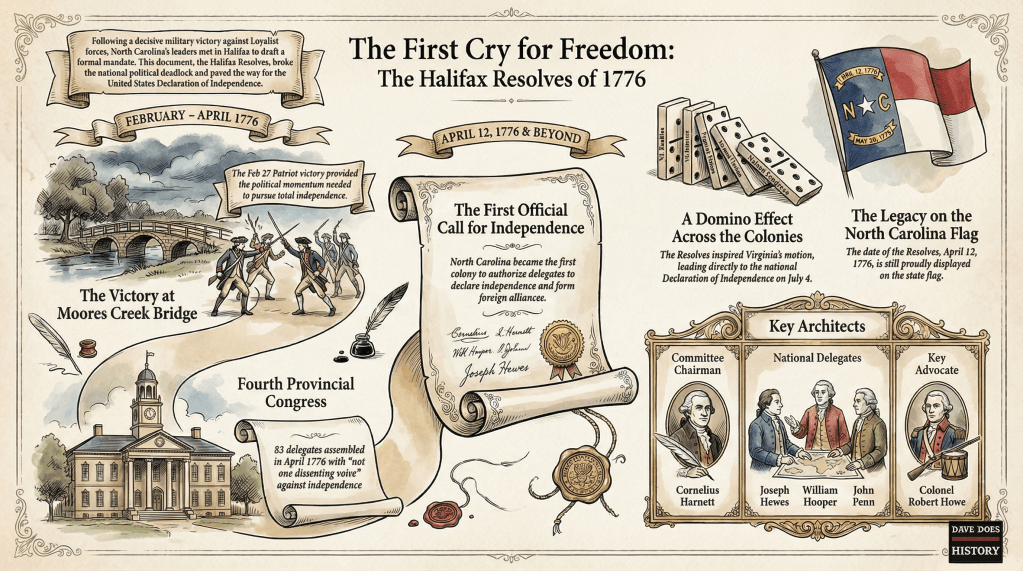
The colony was, in effect, a small civil war waiting for the right spark. The lines were not clean, not ideological in the way we like to imagine history. They were cultural, inherited, shaped by who people were and where they had come from. On one side stood many of the Patriots, often Lowland Scots and Scotch-Irish settlers, people who had brought with them a tradition of independence, sometimes stubborn, sometimes defiant, but always wary of distant authority. On the other side were the Loyalists, anchored in large part by Highland Scots, whose ties to the Crown were not abstract political preferences but something closer to identity.
This was not a debate held at a distance.
It was neighbors watching each other carefully. It was families divided by allegiance. It was a question that did not stay confined to assembly halls but followed people home, into conversations that could not easily be resolved.
Loyalty, in that environment, was not theoretical. It was inherited. Cultural. Emotional. You did not simply choose a side. In many cases, you were born into it.
That is what made North Carolina different.
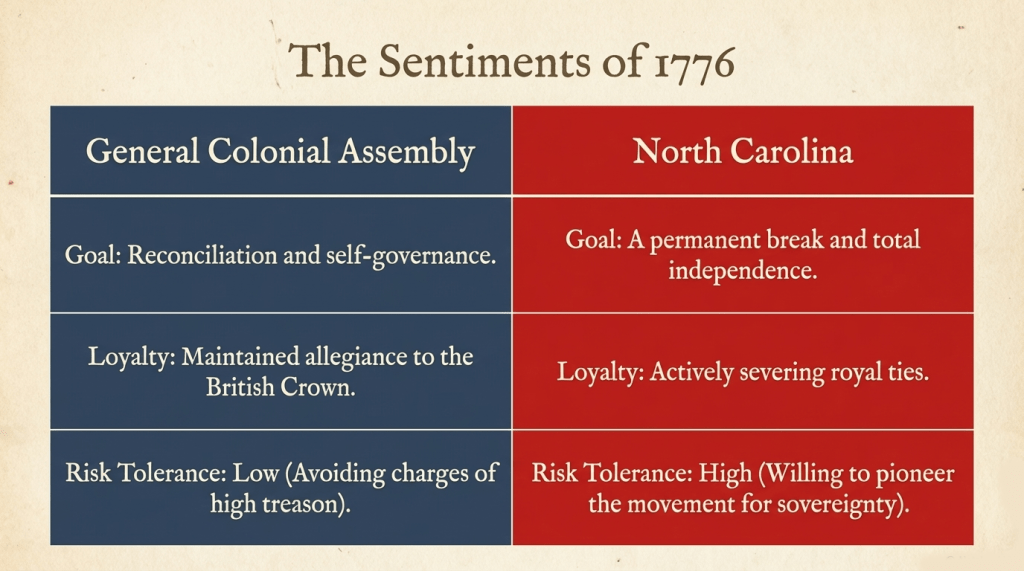
While other colonies argued about rights and representation, North Carolina was already living the consequences of those arguments. The tension had moved beyond words. It had begun to reshape daily life.
And then the structure that was supposed to hold it all together began to give way.
Josiah Martin was, in theory, the embodiment of royal authority in the colony. His job was to govern, to maintain order, to represent the interests of the Crown. In practice, by the middle of 1775, that authority had become more symbolic than real. Patriot resistance had grown strong enough, organized enough, that Martin could no longer safely exercise his office from within the colony itself.
He fled.
Not in ceremony, not with a sense of controlled retreat, but under pressure, forced from New Bern and eventually onto a British warship off the coast. From there, he issued proclamations, made plans, attempted to assert control over a place he could no longer physically reach.
It is an image worth holding onto.
The Crown still existed. Its authority had not vanished on paper. But in North Carolina, it now floated offshore, removed from the people it claimed to govern. The distance was no longer just political. It was literal.
That is a turning point, whether anyone says so at the time or not.
Because once authority leaves the ground, something else begins to take its place. Power does not disappear. It shifts. It settles wherever people are willing to recognize it.
In North Carolina, that meant the Patriots.
Still, even then, independence was not yet a foregone conclusion. There remained those who believed that the situation might be salvaged, that some accommodation could be reached, that the language of loyalty still had meaning. The conflict had sharpened, but it had not yet resolved.
And then came Moores Creek Bridge.
Battle of Moores Creek Bridge does not carry the same weight in popular memory as Lexington or Bunker Hill, but in the context of North Carolina, it was decisive in a way those earlier battles had not been. The British plan for the Southern colonies depended heavily on Loyalist support. The idea was straightforward. Raise Loyalist militias, link them with British regulars, reassert control, and roll back the growing rebellion.
It was a reasonable plan.
It failed.
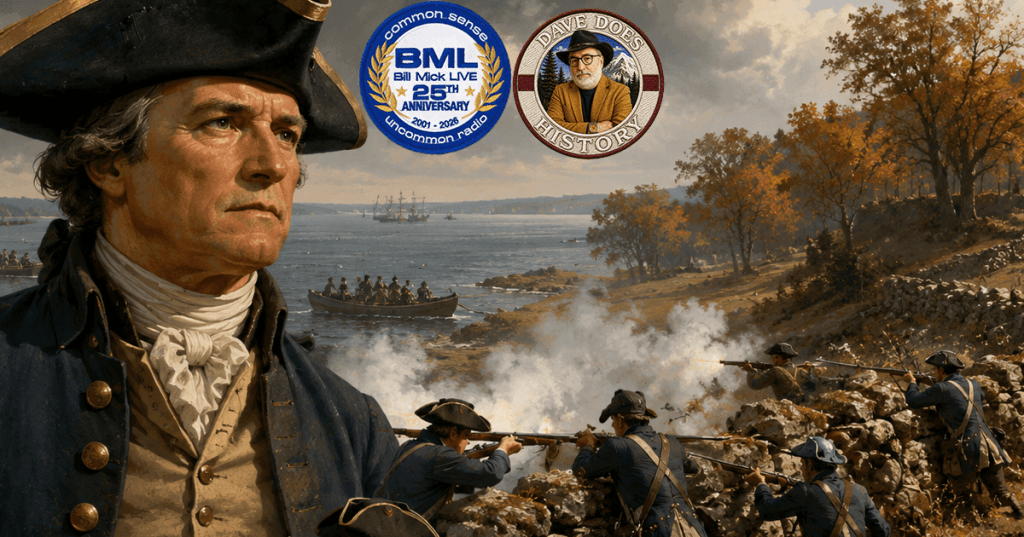
In February 1776, Loyalist forces moved toward the coast, intending to join British troops expected to arrive. Standing in their way were Patriot militias, not professional soldiers, not seasoned veterans, but men who understood the ground and the stakes. They prepared carefully, removing planks from the bridge, greasing the remaining timbers, turning a simple crossing into a trap.
When the Loyalists advanced, they did so into chaos.
The charge broke almost immediately. Men slipped, fell, struggled to maintain footing under fire. The Patriots, positioned and ready, did not need overwhelming numbers. They needed the moment, and they had it. The engagement was brief. The outcome was not.
It was decisive.
Military victories can be measured in territory gained or lost, in casualties inflicted, in strategic advantage. But sometimes their greatest impact is psychological. Moores Creek Bridge did more than stop a Loyalist advance. It shattered the assumption that British authority, backed by local support, could easily reassert itself in the colony.
Before that moment, resistance had been just that, resistance. Reactive. Defensive. Something done in response to perceived injustice.
After that moment, something shifted.
Confidence.
The Patriots in North Carolina had not just held their ground. They had won. They had disrupted a coordinated effort. They had proven, to themselves as much as to anyone else, that the Crown’s reach had limits.
That realization matters.
Because revolutions do not run on grievance alone. They require belief. Not just belief that something is wrong, but belief that it can be changed. That victory is possible. That the future does not have to look like the past.
Moore’s Creek provided that belief.
It did not answer every question. It did not resolve every division. Loyalist sentiment did not vanish overnight. The colony remained fractured in many ways. But the balance had shifted. The Patriots now operated not just from anger, but from experience. They had seen what could happen when they acted decisively.
And that experience carries weight.
It moves conversations forward. It shortens debates. It makes certain arguments harder to sustain. The idea that the colonies were powerless, that resistance was futile, that reconciliation was the only viable path, those ideas became more difficult to defend in the face of a clear, tangible victory.
You can feel the shift in tone, even if no one writes it down in those exact words.
Before Moore’s Creek, independence was something you argued about.
After Moore’s Creek, it was something you began to consider.
Not as a distant possibility. Not as a reckless gamble. But as an option that might actually work.
And that is where North Carolina ran out of doubt first.
While other colonies continued to debate, to hesitate, to weigh the risks, North Carolina had already stepped into a different phase of the story. The argument was still there, but it had lost some of its power. The question was no longer just whether independence was justified.
It was whether it was now within reach.
Before Moore’s Creek, independence was an argument.
After it, it started to feel possible.
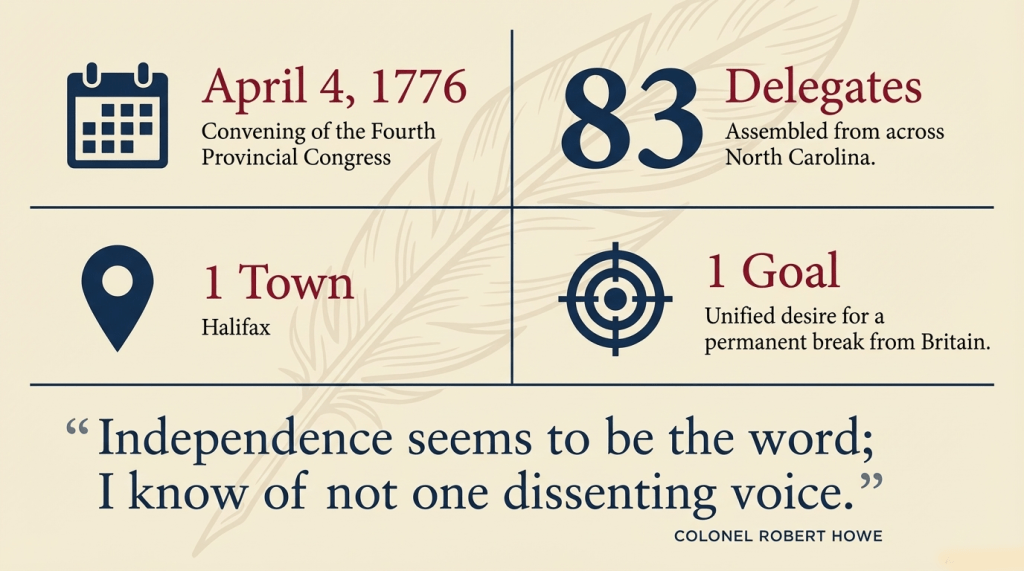
On April 4, 1776, the town of Halifax did not look like the place where history would turn. It was small, practical, a river town used to the steady rhythm of trade and travel along the Roanoke. There were no grand halls waiting to echo with famous speeches, no sense that the eyes of the world were fixed upon it. And yet, for a few days that spring, it became exactly that kind of place, the sort where a quiet decision changes everything that comes after.
The men who arrived there did not come to wonder whether something should be done. That part of the conversation had already run its course. They came to decide what, exactly, they were prepared to do about it.
That difference matters.
Because in most of the colonies, even at this late date, the debate still carried an edge of uncertainty. Independence was discussed, yes, but often with qualifiers, with caution, with the sense that perhaps one more petition, one more appeal, one more attempt at reconciliation might yet pull the situation back from the brink. In Halifax, that tone was fading. Not entirely gone, but replaced by something steadier, something quieter.
Certainty.
Eighty-three delegates gathered, representing communities that had lived through months of tension, weeks of open conflict, and days of sudden clarity brought on by the victory at Moores Creek Bridge. They brought with them not just instructions, but experiences. They had seen authority collapse. They had seen resistance succeed. They had watched the old structure fail to respond, and they had begun to consider what would replace it.
Colonel Robert Howe put it in terms that have survived because they capture the moment so precisely. Independence seems to be the word. I know of not one dissenting voice.
Read that again, and then remember how unusual it is.
Political assemblies, especially in moments of crisis, tend to divide. They fracture. They argue over details, over timing, over language. They hedge. They delay. That is not a flaw. It is how deliberation works. But Halifax did not behave that way. There was no prolonged resistance, no visible faction rising to argue that the colony should wait, should hold back, should see what Congress might do first.
That absence of dissent is the story.
It does not mean every man in that room was free of doubt. It means the doubts no longer had the power to shape the outcome. Something had shifted in the balance between caution and conviction, and conviction had taken the lead.
The delegates did not waste time pretending they were still at the beginning of the argument. They moved to the next step.
On April 8, they formed a committee, not to decide whether independence was desirable, but to determine how to act in light of that conclusion. Cornelius Harnett was placed at its head, joined by Allen Jones, Thomas Burke, Abner Nash, John Kinchen, Thomas Person, and Thomas Jones. Seven men, tasked with taking a broad, emotional, deeply felt sense that something was wrong and turning it into a clear set of instructions.
This is where revolutions either gain traction or stall.
Emotion is powerful. It drives people into the streets, into assemblies, into conflict. But emotion alone cannot sustain a movement. It has to be translated into policy, into language that can be acted upon, defended, and carried beyond the moment that produced it.
That is what the committee set out to do.
They began by assembling the grievances, not as scattered complaints, but as a structured case. They did not speak in abstractions. They spoke in specifics. The Crown, in their view, had exercised power without limit, without regard for the rights the colonists believed were theirs. Military force had been used not simply to maintain order, but to impose control. Towns had been threatened or damaged. The presence of troops had altered daily life in ways that could not be ignored.
They pointed to the seizure of American ships, a practice that struck directly at the economic foundations of the colony. Trade was not a luxury. It was survival. When vessels were taken as prizes of war, the impact was immediate and personal.
And then there was the most unsettling charge of all, the accusation that royal authority had turned inward, using the internal divisions of the colony as a weapon. The actions of governors like Josiah Martin, who had offered protection to enslaved people willing to take up arms against their Patriot masters, were seen not as isolated decisions but as part of a broader strategy. Whether one views those actions as cynical, strategic, or something more complex, the effect within the colony was undeniable. They deepened fear. They sharpened divisions. They made the conflict not just political, but social.
The committee gathered these threads and wove them into something that would sound familiar only a few months later.
Because this was, in many ways, a prototype.
Long before Thomas Jefferson would sit down to draft the grievances of the Declaration, men in Halifax were already assembling the case. Not in the same language, not with the same cadence, but with the same underlying structure. A pattern of behavior. A series of actions that, taken together, revealed something larger than any single complaint.
A design.
That word matters, because it is what transforms dissatisfaction into justification. If grievances are isolated, they can be addressed. If they form a pattern, they demand a response.
By April 12, 1776, the committee had finished its work. The report was presented to the Congress, and what followed was as remarkable as anything that had come before.
It was adopted.
Unanimously.
No prolonged debate. No visible opposition. No last-minute attempt to soften the language or delay the decision. The Halifax Resolves, as they would come to be known, passed with a clarity that stands out precisely because it is so rare.
But here is where precision matters.
The Resolves did not declare independence.
They did something more strategic.
They authorized it.
That distinction can be easy to overlook, but it is critical to understanding what Halifax accomplished. A declaration is a statement. An authorization is an instruction. It tells someone not just what is believed, but what they are empowered to do.
North Carolina’s delegates to the Continental Congress were now authorized to concur with other colonies in declaring independence and forming foreign alliances. They were no longer bound to caution. They were no longer required to wait for clearer signals from home. They carried with them a mandate.
And at the same time, the Resolves made something else clear. North Carolina intended to retain control over its own internal affairs. The right to form its own constitution. The authority to shape its own laws. Independence, in this sense, was not simply a break from Britain. It was an assertion of self-government, of local authority, of the idea that power would no longer flow from a distant crown but from within the colony itself.
This is what makes Halifax so important.
It was not loud. It did not produce a document that would be read aloud in every town square across the continent. It did not immediately change the status of the colonies in the eyes of the world. But it did something quieter, and in the long run, more consequential.
It removed hesitation.
It took a word that had been dangerous to speak and made it acceptable. It took an idea that had been debated and turned it into policy. It gave form to a decision that others could now follow.
The break with Britain was not yet declared nationally. Congress in Philadelphia would still argue, still weigh, still draft and redraft the language that would carry that decision to the world. But after Halifax, the direction was set.
The question was no longer whether independence could be considered.
It was when it would be declared.
In Halifax, independence stopped being dangerous to say.
And it started being necessary.
Big revolutions do not usually begin with explosions. That is how we remember them, how we package them, how we teach them. A shot fired, a crowd surging, a document signed with a flourish. Those are the moments that make for good storytelling. But if you look closely, if you strip away the noise and follow the thread back to its beginning, you often find something quieter.
A decision.
Someone goes first.
In the spring of 1776, that someone was North Carolina.
The Halifax Resolves did not announce independence to the world. They did not send shockwaves across the Atlantic or force an immediate response from London. What they did was more contained, more procedural, and therefore more dangerous in its implications. They authorized it. They took a step that no other colony had yet taken, not in rhetoric, not in pamphlets, but in official action through a representative body.
That distinction matters more than it might seem at first glance.
Colonial resistance had been loud for years. There had been protests, boycotts, speeches that bordered on open defiance. But government action is different. It carries authority. It binds representatives. It signals not just what people feel, but what they are prepared to do. When North Carolina authorized its delegates to pursue independence, it crossed a line that others had approached but not yet stepped over.
This was not symbolic.
It was operational.
And once that step was taken, it could not be easily undone.
The Resolves did not stay in Halifax. They were sent north with urgency, carried to the Second Continental Congress in Philadelphia. There, North Carolina’s delegates, Joseph Hewes, William Hooper, and John Penn, received something that many of their colleagues still lacked.
Clarity.
In most colonies, delegates operated in a kind of gray zone. They knew their constituents were angry. They knew resistance was expected. But on the question of independence, their instructions were often vague, conditional, or absent altogether. They could debate, they could argue, but when it came time to act, they hesitated. Not because they lacked courage, but because they lacked authorization.
Hewes did not have that problem.
When he presented the Resolves to Congress, he was not offering a personal opinion. He was delivering a mandate. North Carolina had spoken. Its government had given its representatives permission to do what, until then, had been considered radical, even reckless.
The effect was immediate, though not in the sense of a sudden vote or dramatic declaration. It was quieter than that, but no less significant.
It changed the tone.
Before Halifax, independence existed in Congress as an idea that hovered at the edge of discussion. It appeared in conversations, in private correspondence, in the more daring pamphlets that circulated beyond the walls of the chamber. But it was not yet something that could be easily addressed in open debate. To speak of it too directly risked alienating more cautious delegates, those who still hoped for reconciliation or feared the consequences of a break they were not yet prepared to make.
After Halifax, that barrier weakened.
If one colony had authorized independence, then the subject itself could no longer be dismissed as fringe. It had moved from the realm of speculation into the realm of policy. It had become, in a word, discussable.
That is the real shift.
Not the vote, not the declaration, but the moment when an idea can be spoken without immediate dismissal. When it can be debated on its merits rather than avoided for its implications. That is where revolutions gain momentum, not in the noise of conflict, but in the quiet permission to consider what had once been unthinkable.
And once that permission exists, it spreads.
Virginia, always attentive to the currents moving through colonial politics, did not take long to respond. On May 15, its convention adopted resolutions that echoed the spirit of Halifax, instructing its delegates to propose independence. This was not imitation so much as confirmation. Another major colony had now stepped onto the same path.
From there, the process accelerated.
On June 7, Richard Henry Lee rose in Congress and introduced a resolution that would have been unthinkable only months earlier.
That these United Colonies are, and of right ought to be, free and independent States.
The words themselves were simple. The implications were not. Congress did not vote immediately. Debate followed, as it had to. Delegates argued, weighed risks, considered the consequences of what they were being asked to do. But the direction was no longer in doubt. The question was not whether independence would be considered. It was how and when it would be formalized.
By July 2, the vote was taken. Twelve colonies in favor, New York abstaining as it awaited instructions. The legal break from Great Britain had occurred. Two days later, on July 4, the Declaration of Independence was approved, its language giving voice to the decision that had already been made.
It is tempting to draw a straight line from Halifax to Philadelphia, to say that one caused the other. That is too simple, and history rarely cooperates with simple explanations.
Halifax did not cause independence.
It made it unavoidable.
It did so by removing one of the final obstacles, the hesitation that lingered even among those who recognized that the old relationship with Britain could not be restored. It provided cover for those who needed it, encouragement for those who were ready, and pressure for those who still wavered.
It was the first domino.
And once it fell, the others did not collapse all at once, but they began to lean in the same direction.
There is something fitting, then, in the way the story returns to Halifax.
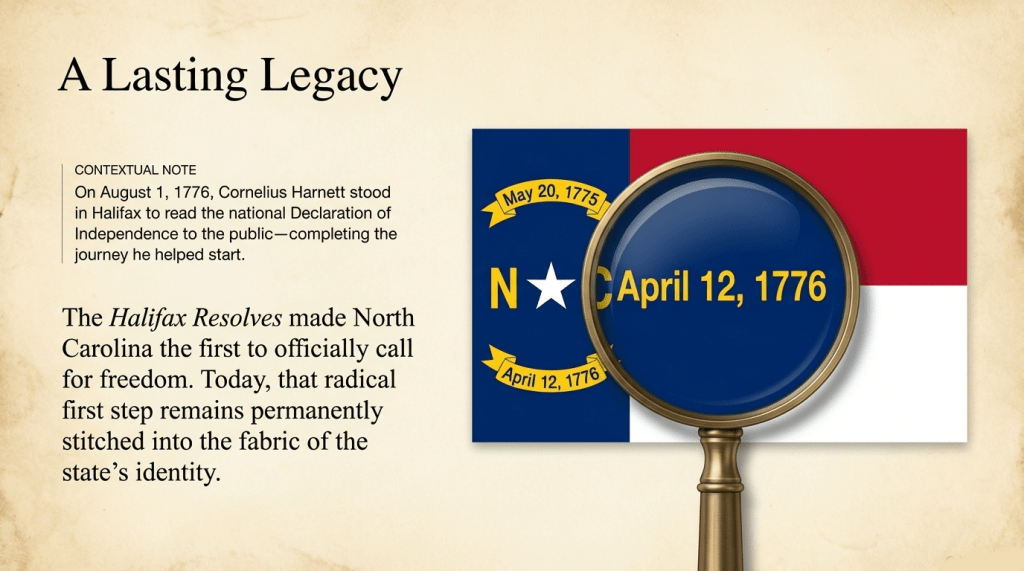
On August 1, 1776, Cornelius Harnett stood before the people of that same small town and read the Declaration of Independence aloud. The words that had been debated, revised, and approved in Philadelphia now echoed along the Roanoke River, carried to a community that had, in its own way, helped to make them possible.
It is a full circle moment, though not in the sentimental sense.
The place that had authorized independence heard it declared. The quiet decision made in April met the public proclamation of August. The local and the national, the procedural and the poetic, came together in a single act.
For the people gathered there, this was not an abstract event. It was the culmination of a process they had witnessed, perhaps even shaped. They had seen authority collapse. They had seen resistance succeed. They had watched their representatives move from hesitation to instruction. And now they heard the result.
The legacy of that moment has endured in ways both large and small.
Nationally, the Declaration overshadows everything that came before it, as it should. It is the document that announced a new nation to the world. But locally, in North Carolina, April 12 has not been forgotten. It is written into the state flag, a date that stands alongside May 20, marking two claims to independence, one debated by historians, the other firmly rooted in the record.
April 12, 1776.
It is not a date that draws crowds or fireworks across the country. It does not carry the same immediate recognition as July 4. But it represents something that the louder date does not.
Decision.
The choice made before the announcement. The step taken before the declaration. The moment when a colony looked at its circumstances, weighed its options, and decided that the path forward would not include a return to what had been.
There is a lesson in that, if you are inclined to look for one.
History tends to celebrate the moment when something is declared, when the world is told what has changed. But the real work often happens earlier, in quieter rooms, in smaller places, in decisions that do not immediately announce themselves as historic.
Halifax was one of those places.
It did not shout. It did not demand attention. It simply acted.
And in doing so, it made everything that followed a little more certain, a little more possible, a little more inevitable.
July 4 is when America told the world.
April 12, 1776, is when one colony decided it was ready to.
Boutilier, James A., ed. The Halifax Resolves: Papers Presented at a Symposium. Raleigh: North Carolina Department of Cultural Resources, 1977.
Clark, Walter, ed. The State Records of North Carolina. Vol. 10. Goldsboro, NC: Nash Brothers, 1890.
Ferling, John. Whirlwind: The American Revolution and the War That Won It. New York: Bloomsbury Press, 2015.
Henderson, Archibald. “The Halifax Resolves.” North Carolina Historical Review 3, no. 3 (1926): 317–339.
Lee, Richard Henry. “Resolution for Independence.” June 7, 1776.
Maier, Pauline. American Scripture: Making the Declaration of Independence. New York: Alfred A. Knopf, 1997.
Middlekauff, Robert. The Glorious Cause: The American Revolution, 1763–1789. New York: Oxford University Press, 1982.
Rankin, Hugh F. The North Carolina Continentals. Chapel Hill: University of North Carolina Press, 1971.
Rankin, Hugh F. The North Carolina Continentals and the War in the South. Chapel Hill: University of North Carolina Press, 1971.
Sirmans, M. Eugene. Colonial South Carolina: A Political History, 1663–1763. Chapel Hill: University of North Carolina Press, 1966.
“Halifax Resolves.” April 12, 1776. In Colonial Records of North Carolina, Vol. 10.




 DAVE DOES HISTORY
Leave a comment