
There is something almost impressive about the modern ability to look directly at a Revolutionary War flag and completely misunderstand it. Not misunderstand it accidentally, mind you. Human beings have always misunderstood things accidentally. That is part of the charm of the species. We build civilizations, write symphonies, walk on the moon, and then spend thirty minutes looking for glasses that are already on our heads. No, this is different. This is the deliberate rewriting of symbols until the original meaning disappears beneath layers of contemporary political varnish.
Which is why the old pine tree matters.
Jefferson warned us about this very instinct in the Declaration of Independence. “Prudence, indeed, will dictate that Governments long established should not be changed for light and transient causes.” He was not describing impulsive radicals eager to burn everything down because somebody hurt their feelings online. He was describing something older and more cautious. Human beings endure a tremendous amount before they finally conclude that the structures around them no longer deserve their loyalty.
That line from the Declaration contains one of the deepest observations ever made about political behavior. Most people do not seek revolution. They seek normalcy. Farmers want to plant crops. Merchants want stable trade. Families want peace and predictability. Most citizens will tolerate frustration, taxes, bureaucracy, corruption, incompetence, and even mild tyranny for years before they seriously consider overturning established systems. Jefferson understood that because the American Revolution itself emerged only after generations of accumulated grievances.
Which brings us, strangely enough, to a fence in Seattle.
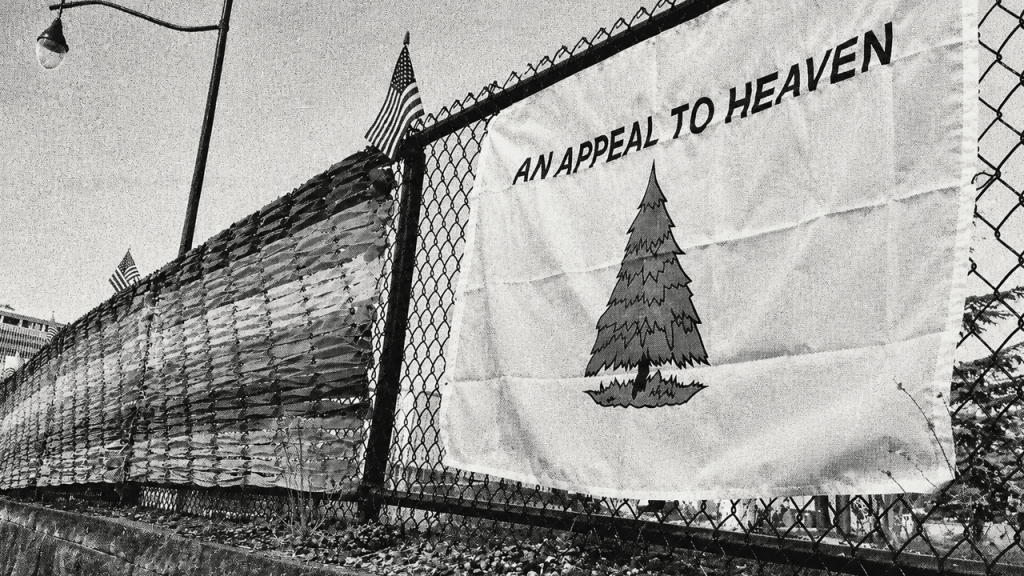
A local news story recently erupted after a self-described queer artist decorated a public fence space with rainbow-themed woven artwork. Another individual later hung an Appeal to Heaven flag nearby, the white flag featuring a green pine tree and the famous motto associated with John Locke and the American Revolution. The controversy exploded when the flag was described publicly as a Christian nationalist hate symbol and anti-LGBTQ emblem, eventually leading city officials to remove everything rather than referee the dispute.
Now pause there for a moment.
The truly revealing part of the story was not the argument itself. Americans argue about symbols the way medieval theologians argued about angels and pinheads. The revealing part was how casually the historical meaning of the symbol itself disappeared beneath modern political assumptions. The story treated the flag almost entirely through the lens of current ideological accusation while barely acknowledging what the thing actually was historically.
That is not merely sloppy history. It is a form of cultural amnesia. And Americans have become remarkably comfortable with it.
Ken Burns once observed, in that mournful documentary tone he uses so effectively, that history is not simply what happened. It is what survives in collective memory. The problem is that collective memory is now increasingly managed by people who often know very little history and seem oddly proud of the fact. Symbols become detached from origins and reassigned new meanings according to present political utility.
The pine tree flag has suffered exactly that fate.
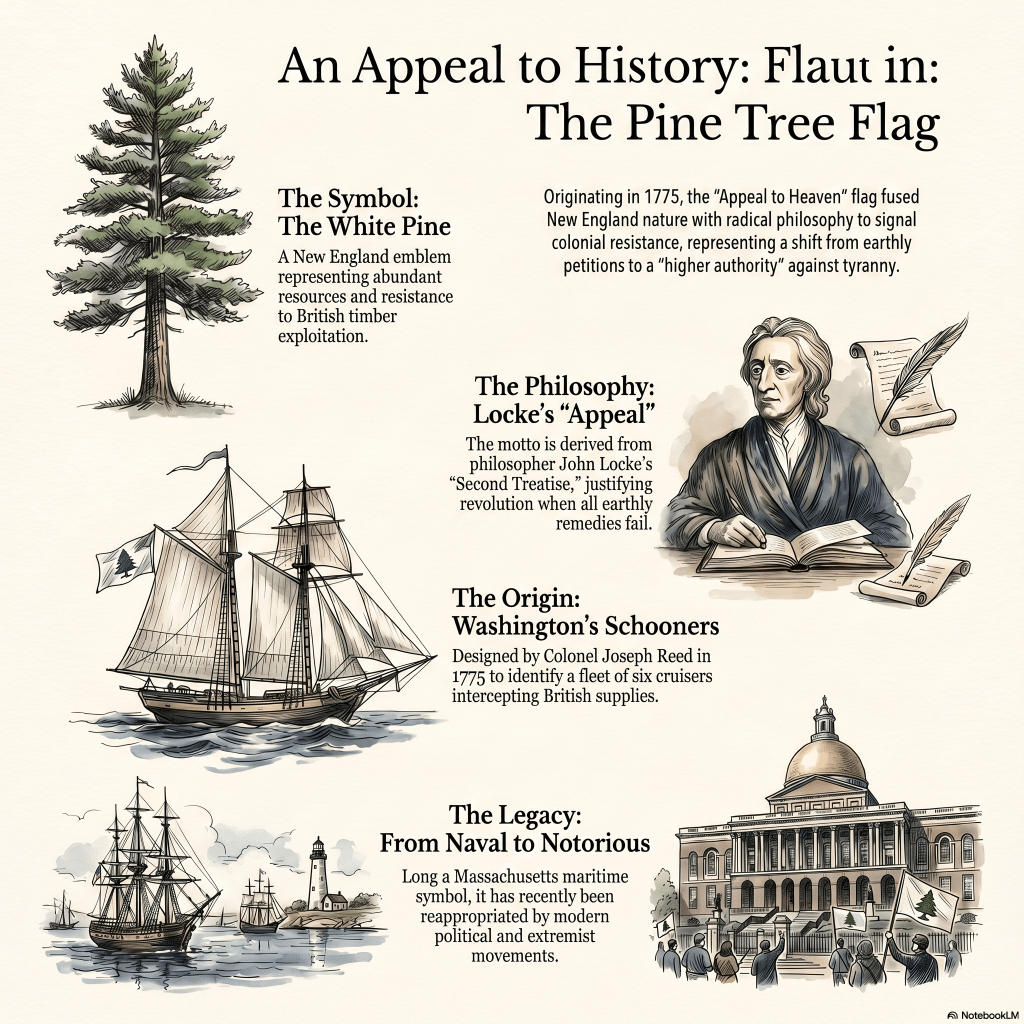
The irony, of course, is that the actual history of the symbol points in almost the opposite direction from the modern accusation. The pine tree emerged as an anti-colonial symbol tied directly to resistance against centralized imperial authority. The people who first rallied beneath it believed they were resisting exploitation by distant power structures that claimed ownership over local resources and local lives. That history becomes awkward if one wishes to portray the flag purely as a symbol of authoritarian oppression.
The pine tree itself carried enormous significance in colonial New England long before the Revolution officially began.
The symbol appeared as early as the colonial Massachusetts seal, where the tree represented the New World itself and the Native peoples inhabiting it. Over time, however, the tree acquired additional meaning because New England’s towering eastern white pines became economically and strategically priceless to the British Empire.
A wooden sailing navy lives or dies by timber.
The British understood that perfectly. The Royal Navy required enormous mast trees capable of supporting the vast sails that powered imperial commerce and military dominance across the globe. New England’s white pines were ideal for this purpose because they grew unusually tall and straight. Even today, the United States Navy maintains preserved groves of these trees specifically for restoration work on USS Constitution.
Without masts, sailing ships become very expensive floating furniture. So Britain moved aggressively to secure control over the resource.
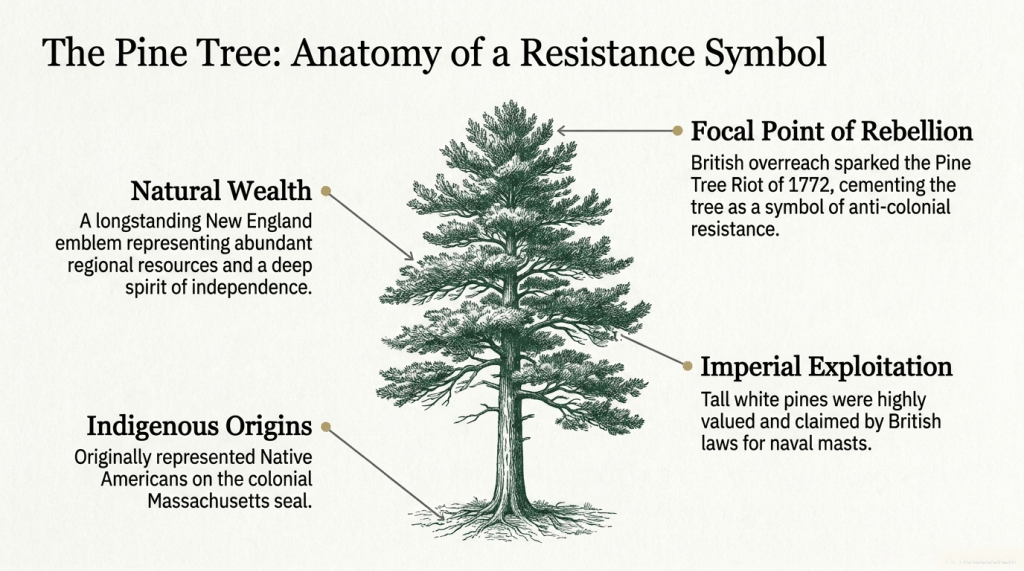
In 1722, the Crown strengthened laws reserving large white pines for royal use. Surveyors traveled through colonial forests marking trees with the “King’s Broad Arrow,” essentially declaring them property of the Crown regardless of whose land they actually stood upon. Colonists were prohibited from cutting certain trees above designated sizes because those trees belonged to imperial naval policy now.
One can imagine how warmly independent New Englanders received that news.
Picture some Massachusetts farmer waking up to discover a British official had walked onto his land, slapped an arrow mark on one of his best trees, and essentially informed him, “Lovely pine you have there. The King owns it now.” History suggests this sort of conversation rarely improves neighborly relations.
At first, the colonists endured it.
That detail matters because it reinforces Jefferson’s point perfectly. The restrictions existed for decades before violence erupted. The colonists grumbled, protested, complained, argued, and tolerated the situation because people generally prefer stability over confrontation. Yet the resentment accumulated steadily because the issue represented something larger than timber.
The Crown was claiming authority over colonial resources while using those same resources to strengthen the imperial system increasingly viewed as oppressive.
The symbolism practically writes itself.
The trees cut from New England forests became masts for British warships. Those ships enforced British trade regulations, projected British military power, and eventually threatened the very communities forced to surrender the timber in the first place. Colonists increasingly understood the arrangement not as mutually beneficial imperial administration but as exploitation.
Then came the Pine Tree Riot of 1772.
Now there is a historical event that deserves far more attention than it receives. Two years after the Boston Massacre and one year before the Boston Tea Party, tensions over enforcement of the pine regulations finally exploded in New Hampshire. Local men attacked royal officials involved in timber enforcement, chasing them out of town and reportedly beating them with switches in one of the more uniquely New England methods of political communication.
There is something wonderfully human about that scene.
Not glorious battlefield heroism. Not polished revolutionary mythology. Just angry colonists chasing royal agents around with sticks because they were tired of outsiders claiming ownership over local life. Revolutions often begin less elegantly than later paintings prefer depicting them.
The important point is that the pine tree became a recognized symbol of resistance precisely because it represented opposition to imperial overreach and economic exploitation. It symbolized local rights against centralized authority. It symbolized resistance to colonization rather than support for it.
Which makes the modern reinterpretation fascinating.
This is where the real usurpation of symbols occurs, though not in the way many people assume. Nobody seriously disputes that symbols can be appropriated by movements later in history. The swastika existed peacefully for centuries across multiple cultures before the Nazis permanently poisoned it. That is what actual symbolic capture looks like. A movement adopts a symbol consistently, publicly, and institutionally until the original meaning is overwhelmed.
That has not truly happened with the Appeal to Heaven flag.
What has happened instead is subtler and perhaps more dangerous. The historical meaning is being displaced not because a dominant movement openly seized the symbol, but because large segments of the public no longer know enough history to resist narrative reassignment.
That distinction matters enormously.
Once historical ignorance becomes widespread enough, symbols can simply be redefined by assertion. People hear repeated claims detached from historical context and gradually accept them because they lack the background necessary to challenge them. Eventually the accusation becomes the reality in public consciousness regardless of whether the underlying history supports it.
And that is where the deeper problem emerges.
The issue is not merely one flag. It is the collapse of historical literacy itself. The Founders understood Locke because they read Locke. They understood classical history because they studied it relentlessly. They recognized symbols because they knew the stories beneath them. Modern Americans increasingly inherit fragments of symbols severed from historical memory, leaving those symbols vulnerable to manipulation by whoever speaks loudest in the present.
That is not healthy for a republic.
A free society depends partly upon shared historical understanding. Once citizens lose the ability to recognize the origins and meaning of their own political language and imagery, public life becomes frighteningly easy to manipulate. The collective memory weakens. Historical continuity dissolves. Eventually people stop arguing about what symbols mean historically and start arguing only about who currently possesses the power to define them.
The pine tree flag reminds us of something older and more unsettling than modern ideological tribalism.
It reminds us that Americans once believed liberty required vigilance against concentrated power. It reminds us that resistance to exploitation was considered honorable rather than extremist. It reminds us that the Revolution itself emerged not from fashionable rebellion but from accumulated frustration after ordinary mechanisms of redress seemed exhausted.
And perhaps most importantly, it reminds us how easily a society can forget its own inheritance.
Jefferson warned that people are naturally disposed to suffer while evils remain sufferable. He understood human caution deeply. But he also understood something else. Once people forget the meaning of their own symbols, they eventually forget the meaning of their own liberty as well.
There is something almost haunting about the phrase itself.
“An Appeal to Heaven.”
It does not sound like a slogan manufactured by consultants in an office tower somewhere between a polling memo and a catered lunch tray. It sounds older than that. Heavier. The phrase carries the emotional weight of people standing at the edge of irreversible decisions. There is desperation in it, but there is restraint too. It does not cry out for chaos. It speaks like a people who believe every ordinary remedy has already failed.
Which is precisely why the phrase mattered in 1775.
The words were not invented by Washington or Jefferson or Samuel Adams. They came from the English philosopher John Locke, whose ideas drift through the Declaration of Independence like smoke through old timber. Jefferson supplied much of the poetry of the American Revolution, but Locke provided a great deal of the skeleton underneath it.
That fact alone should probably complicate modern assumptions a little.
The intellectual foundation of the American Revolution emerged not from wild-eyed radicals screaming incoherently at authority, but from one of the most influential political philosophers in the English speaking world. Locke’s Second Treatise of Government, published in 1689 after England’s Glorious Revolution, became one of the defining texts of the Founding generation. Colonial leaders quoted him, argued about him, absorbed his assumptions, and eventually treated many of his conclusions as obvious truths rather than controversial philosophy.
That can be dangerous, by the way.
When ideas become so familiar that they feel like common sense, people stop asking where they came from. They assume those ideas always existed naturally, floating around civilization like oxygen. But Locke was writing in a Europe where the opposite assumptions dominated political life.
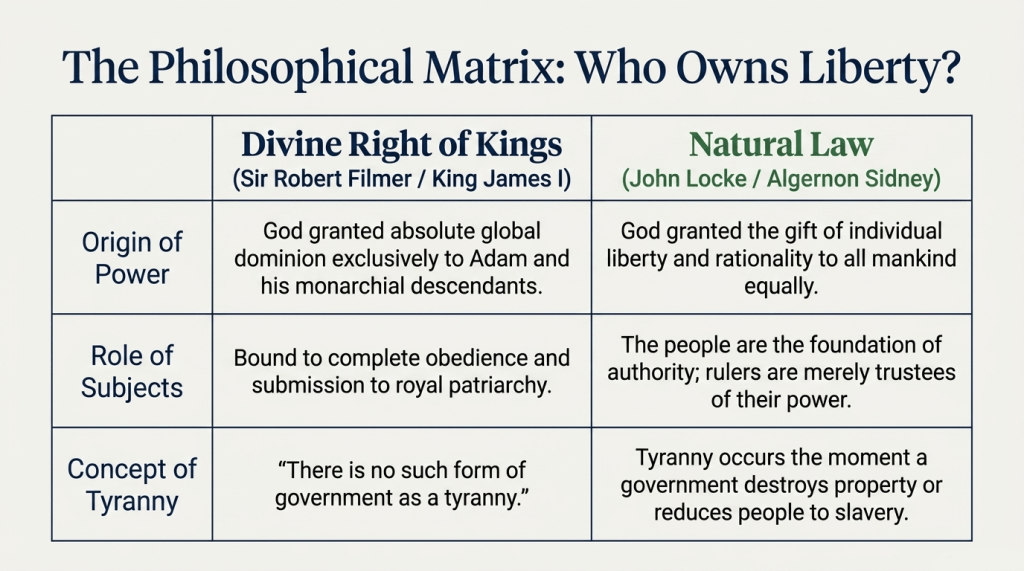
For centuries, much of Europe accepted the doctrine known as the divine right of kings.
Under that theory, monarchs ruled because God Himself had appointed them. Kings were not merely political leaders. They were seen as earthly extensions of divine authority. If a ruler behaved badly, subjects were expected to endure it patiently because resistance was not simply political rebellion. Resistance became rebellion against Heaven itself.
It was a magnificent arrangement if you happened to be the king. Somewhat less magnificent if you were everyone else. As the great man once said, “It’s good to be the king…”
The doctrine carried enormous psychological power because it transformed political obedience into religious obligation. A bad harvest, oppressive taxes, corrupt ministers, arbitrary arrests, censorship, military coercion, all of it could be interpreted as divine punishment rather than governmental failure. The system protected itself by making criticism spiritually dangerous.
Locke looked at this arrangement and essentially said, with remarkable English politeness, “This is nonsense.”
Human beings, Locke argued, possess natural rights simply because they are human beings. Life. Liberty. Property. Those rights do not originate from Parliament, the Crown, or any earthly institution. They come directly from the Creator. Government therefore exists not as humanity’s master but as its servant. Its legitimacy depends entirely upon its willingness to protect those God-given rights.
That distinction changes everything.
If rights come from God to the people rather than from kings to subjects, then political authority suddenly becomes conditional. Governments are no longer sacred objects existing above criticism. They become practical institutions accountable to moral law. When governments fail fundamentally in their duties, citizens possess not merely permission but obligation to alter or abolish them and establish structures better capable of protecting liberty and safety.
Jefferson practically copied the formula into the Declaration.
“We hold these truths to be self-evident…”
There is Locke standing quietly in the background with ink on his fingers.
To eighteenth century monarchies, this was dynamite wrapped in philosophy. Locke understood perfectly how explosive the implications were. No government willingly announces that it has become tyrannical. Kings rarely step onto balconies to declare, “You know, the angry mob outside may actually have a point.” Power tends to defend itself instinctively. Courts become corrupted. Legislatures become manipulated. Petitions are ignored. Elections turn into ceremonial theater. The machinery designed to secure justice slowly transforms into machinery protecting authority from accountability.
Which raises the terrible question. What happens when every ordinary avenue for justice has failed?
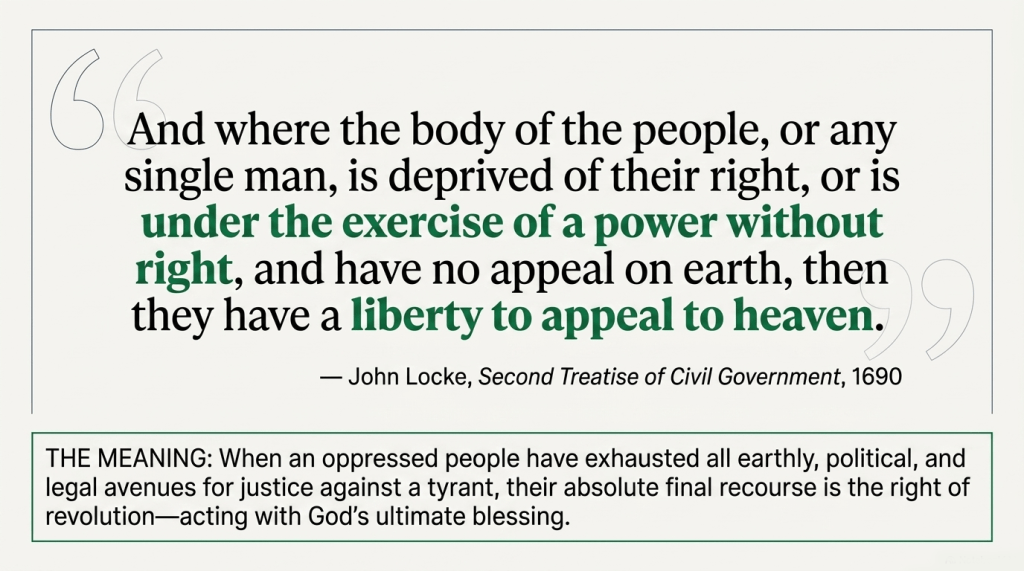
Locke’s answer was “an appeal to heaven.”
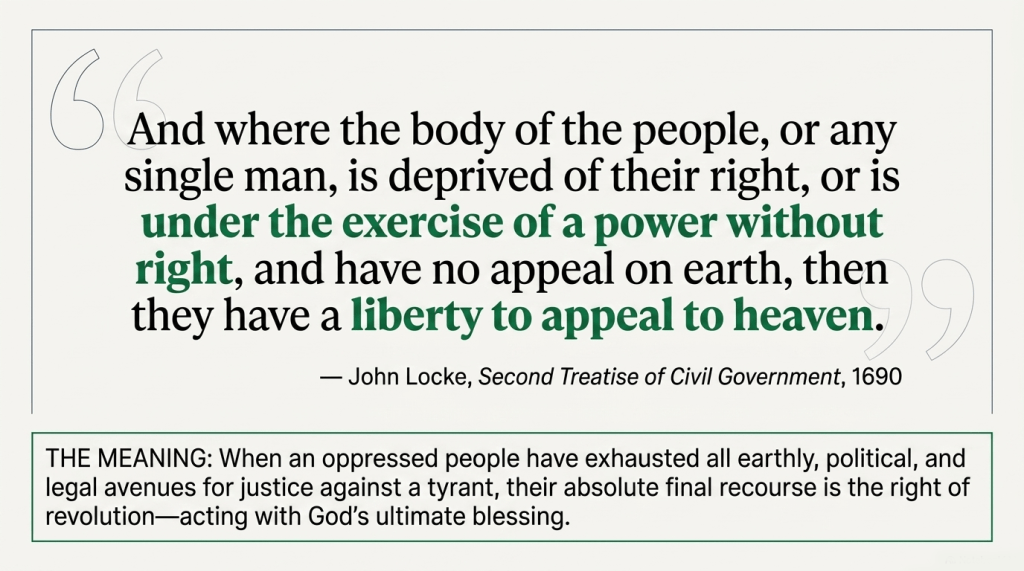
He used the phrase to describe the final recourse available to a people denied justice on earth. If no higher earthly authority remains capable of hearing the case fairly, then the dispute is effectively placed before God Himself, usually through the grim uncertainty of conflict and war.
Now here is the part modern caricatures often miss completely. Locke was not glorifying revolution.
He viewed it as tragic and dangerous. Critics then and now sometimes portray his philosophy as an invitation to endless instability, mobs rampaging through streets every time somebody loses a local election or gets offended at breakfast. Locke believed the opposite. Human beings are naturally cautious about revolution because ordinary people crave stability more than upheaval. Families want peace. Farmers want predictable seasons. Merchants want functioning markets. Clergymen want quiet enough to finish sermons without cannon fire interrupting the middle paragraph.
Most people tolerate far more than later generations realize.
Jefferson understood this deeply when he wrote that mankind is “more disposed to suffer, while evils are sufferable.” Revolutions do not erupt because populations become impatient overnight. They emerge after long periods during which ordinary mechanisms for correcting abuse appear increasingly useless.
That was exactly how many American colonists saw themselves by the 1770s.
They did not initially view themselves as radicals. That part gets lost constantly in modern retellings because hindsight makes independence feel inevitable. It was not inevitable. Separation from Britain terrified enormous numbers of colonists. Britain possessed the most powerful empire on earth. The Royal Navy controlled global trade routes. Rebellion threatened economic ruin, military defeat, and execution for treason. Reasonable people do not gamble casually against such odds.
For years the colonies pursued reconciliation instead.
They petitioned the Crown. They protested taxes. They argued constitutional theory. They sent respectful appeals. Benjamin Franklin crossed the Atlantic repeatedly attempting compromise because many Americans still believed the imperial relationship could be repaired honorably. The colonists saw themselves as loyal Englishmen defending ancient rights, not as revolutionaries inventing something entirely new.
Again and again, however, they felt ignored.
The Stamp Act. The Townshend duties. Standing armies in Boston. The Coercive Acts. Closed ports. Dissolved legislatures. Increasingly many colonists concluded that ordinary political remedies no longer functioned honestly. Worse still, King George III himself gradually appeared aligned with Parliament’s punitive policies rather than serving as protector against them.
That realization hit the colonies with enormous emotional force.
The King mattered psychologically because monarchy carried paternal assumptions. Colonists had long imagined George III as a safeguard against parliamentary excess. Once they concluded the King himself supported the coercive system, the entire constitutional structure seemed closed against them.
And that is where Locke’s phrase suddenly became more than philosophy.
“An Appeal to Heaven” expressed the belief that no earthly authority remained willing to hear the colonial case fairly anymore. Parliament claimed supremacy. The King sided with Parliament. Courts increasingly enforced imperial policy. Petitions achieved little. The colonists therefore argued they had reached the final recourse Locke described generations earlier.
Notice something important here. Each side believed Heaven stood behind its position.
The British accused the colonists of rebellion against lawful God-ordained authority. The Americans responded that resistance to tyranny represented obedience to a higher moral law. The conflict therefore became more than taxation or trade disputes. It became a struggle over the origin of legitimate authority itself.
That tension still matters today because the phrase endures precisely due to its moral seriousness.
“An Appeal to Heaven” is not cheerful revolutionary cosplay. It is not a slogan celebrating permanent unrest. Properly understood, the phrase describes the terrible moment when a people concludes there is nowhere else left to appeal. Locke viewed that threshold with caution because once societies cross it, events become unpredictable and often bloody.
History suggests he was correct.
The American Revolution succeeded partly because its leaders remained deeply conscious of the danger they were unleashing. They did not romanticize disorder endlessly. Washington especially understood that revolution untethered from moral restraint can devour liberty as quickly as tyranny can. That is one reason the Revolutionary generation spoke constantly about virtue, duty, restraint, and accountability alongside freedom.
They knew liberty without discipline eventually collapses into chaos, and chaos usually invites authoritarianism right back through the front door wearing polished boots and promising order.
Which perhaps explains why the phrase still unsettles people.
“An Appeal to Heaven” reminds citizens that government is not ultimate. It insists political authority remains morally accountable. It asserts that liberty originates not from the state but from something higher than the state. That idea remains profoundly disruptive to every form of centralized power that prefers obedience without questions.
And perhaps that is why the old pine tree still casts such a long shadow across American memory.
By the autumn of 1775, the American colonies had already crossed the line between protest and war, though many people still hesitated to admit it aloud. Lexington and Concord were months behind them. Boston remained occupied. Militia companies drilled across New England fields beneath gray skies that smelled of wood smoke and wet earth. Yet psychologically, many colonists still thought of themselves as Englishmen resisting corruption rather than revolutionaries founding a new nation.
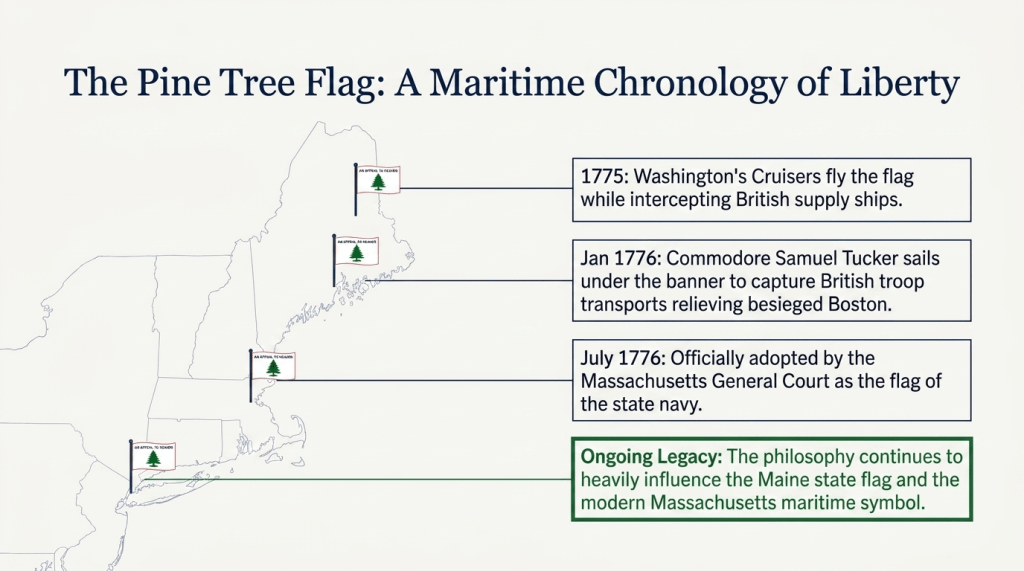
That uncertainty shaped everything, including the flags they carried.
The Continental Army itself barely existed in recognizable form. Washington struggled constantly with enlistments, supplies, gunpowder shortages, smallpox fears, competing colonial interests, and the simple logistical challenge of turning farmers and tradesmen into something approximating an army before the British decided to crush the experiment permanently. Meanwhile, British ships moved freely along the Atlantic coast supplying troops in Boston and projecting imperial power wherever the Crown required it.
Washington needed a way to strike back.
Not with battleships, of course. The colonies possessed no great navy. What Washington envisioned instead was something leaner and more practical, a small improvised fleet of schooners tasked with intercepting British supply vessels moving toward Boston. The mission was partly military and partly psychological. Every captured ship weakened the British position while strengthening the fragile confidence of the rebellion itself.
And that required a flag.
In October 1775, Colonel Joseph Reed, Washington’s secretary and one of his closest advisers, proposed a simple design for this emerging fleet. A white field. A green pine tree. And the words that carried Locke’s thunder through the centuries: “An Appeal to Heaven.”
The choice was remarkably deliberate.
The pine tree immediately connected the flag to New England resistance traditions already familiar throughout the colonies. The motto connected the cause to Locke’s philosophy of natural rights and justified resistance. Together they formed a visual argument. The colonies were not engaging in lawless rebellion. They believed they were defending God-given liberty after exhausting ordinary political remedies.
That distinction mattered enormously to the Revolutionary generation.
Modern political culture often treats revolution as inherently glamorous, the cinematic fantasy of dramatic speeches and triumphant music swelling in the background while attractive actors stare heroically into the middle distance. The actual Founders viewed revolution with much greater caution because they understood the terrifying risks involved. They knew revolutions could collapse into dictatorship, mob violence, civil war, or permanent instability. History provided examples in abundance.
Which is why symbols mattered so deeply.
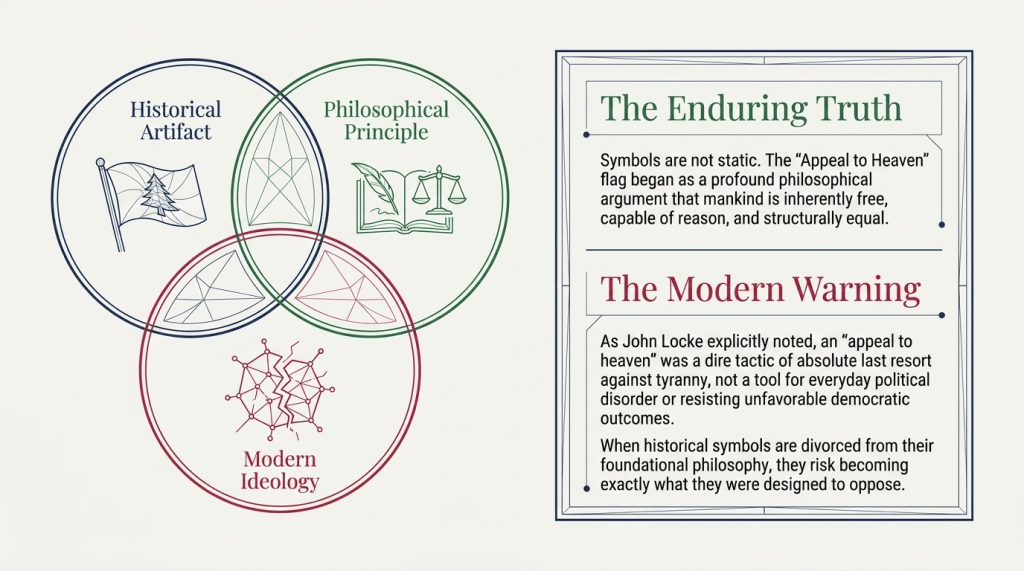
The Appeal to Heaven flag told both the colonies and the wider world that the Americans believed they stood inside a moral tradition rather than outside civilization itself. They were framing their resistance as lawful in the deepest philosophical sense, even while openly defying imperial authority.
And the flag spread quickly.
The Massachusetts Navy adopted versions of the pine tree banner. General Israel Putnam reportedly used a red variation bearing the same motto during the Battle of Bunker Hill. Different colonial units modified designs slightly according to circumstance, but the symbolism remained recognizable. The pine tree and the Appeal to Heaven motto became shorthand for resistance rooted in natural rights and local self government.
This is one of the things modern Americans often miss about Revolutionary symbolism.
The Founders were not inventing random patriotic branding the way corporations invent mascots for breakfast cereal. Symbols carried layered historical meaning because the Founding generation possessed an astonishing level of historical literacy compared to modern standards. They understood Locke. They understood English constitutional history. They understood classical republicanism. They recognized the implications immediately because they knew the stories beneath the words.
Today, many Americans barely recognize the stories at all.
That creates a strange vacuum where symbols become vulnerable to endless reinterpretation detached from historical context. And into that vacuum rush modern political narratives eager to assign meanings that would have bewildered the people who originally carried the flags.
This is where the conversation becomes uncomfortable because it forces a distinction many modern institutions seem increasingly unwilling to make.
A symbol can be used by modern groups without that usage erasing the symbol’s original historical meaning.
That should not be controversial, but apparently we now live in an age where historical literacy has become optional enough that basic distinctions collapse under political pressure. A handful of contemporary individuals displaying a Revolutionary flag does not magically rewrite the entire historical origin of the flag itself any more than someone waving an Italian flag automatically transforms Leonardo da Vinci into a partisan commentator on modern politics.
History is not supposed to work backward like that. Yet increasingly, the media environment behaves as though it does.
The Appeal to Heaven flag has recently been described repeatedly in headlines and commentary as extremist, nationalist, hateful, or inherently connected to modern ideological movements. The actual Revolutionary context often receives only brief mention, if it appears at all. Instead, the symbol becomes flattened into whatever contemporary political controversy currently dominates the news cycle.
And here is the important point: that reinterpretation itself is a political act.
It is not neutral description. It is an attempt to redefine public understanding of the symbol by detaching it from historical origin and reconnecting it primarily to present ideological conflict. The process works only if historical memory becomes weak enough that most people no longer know what the symbol originally meant.
Which brings us back to Jefferson.
“…accordingly all experience hath shewn, that mankind are more disposed to suffer, while evils are sufferable…”
That line from the Declaration cuts deeper than most modern readers realize because Jefferson is describing a permanent feature of human psychology. People do not usually abandon institutions, traditions, or identities casually. They endure tremendous frustration before they finally decide something foundational has broken.
The same principle applies culturally.
Societies generally preserve historical memory until they stop teaching it seriously. Once that happens, reinterpretation accelerates rapidly because fewer citizens possess enough knowledge to challenge false narratives confidently. Symbols lose historical anchors. Meaning becomes fluid. Eventually public understanding depends less upon what a thing originally represented and more upon who currently controls the loudest megaphone.
And that is a dangerous condition for a republic.
The Founders believed self government required historically informed citizens because republics depend heavily upon cultural memory. Citizens need some shared understanding of origins, principles, symbols, and constitutional traditions or public life dissolves into tribal improvisation. John Adams once warned that liberty cannot survive among a people without virtue and knowledge. Modern Americans often quote the liberty part while quietly skipping the knowledge requirement like students hoping the teacher forgot assigned reading.
Unfortunately, history never forgets the reading assignment.
The Appeal to Heaven flag illustrates the problem perfectly because its actual historical meaning is remarkably well documented. We know why Reed proposed it. We know how Washington’s fleet used it. We know the philosophical origins of the motto. We know the pine tree’s connection to colonial resistance against imperial resource control. None of this is mysterious. The evidence exists plainly in the historical record.
Yet enormous numbers of modern Americans encounter the symbol stripped entirely from that context.
Instead, they receive prefabricated interpretations already filtered through contemporary ideological categories. “This symbol means these people.” “That flag represents this movement.” “Those historical associations no longer matter.” The public increasingly inherits conclusions rather than history.
And once that habit becomes normalized, almost any symbol can be rewritten eventually.
Just announce that the symbol is hateful.
Repeat it often enough.
Wait for historical literacy to weaken sufficiently.
Then watch how many people simply accept the reassignment because they lack the historical framework necessary to resist it.
Would anybody believe it?
Increasingly, yes.
That is the unsettling part.
The problem is not merely that Americans disagree politically. Democracies have always contained fierce disagreement. The deeper problem is that Americans increasingly disagree about the historical meaning of the civilization itself because fewer citizens possess the shared historical grounding necessary to evaluate claims independently.
The Founders would have found that situation alarming.
Not because they expected universal agreement, but because they believed republican government depended upon an educated public capable of reasoning historically. Jefferson, Adams, Madison, Washington, these men argued constantly with one another, sometimes bitterly. Yet they still shared an enormous common framework of historical knowledge stretching from Greece and Rome through English constitutional history into Enlightenment philosophy.
That common framework allowed argument to occur inside recognizable boundaries. Once the framework collapses, symbols become raw material for endless ideological repackaging.
And perhaps that is why the old pine tree still matters so much.
Not because it belongs to one modern faction or another. Quite the opposite. It matters because it reminds Americans of a time when symbols carried historical continuity strong enough to unite deeply divided people around shared memory. It reminds us that the Revolution itself emerged from philosophical arguments, constitutional struggle, and accumulated grievance rather than simplistic slogans.
Most of all, it reminds us that liberty depends partly upon memory.
A people who no longer understand their own symbols eventually become vulnerable to anyone willing to redefine those symbols for them.
Bailyn, Bernard. The Ideological Origins of the American Revolution. Cambridge, MA: Belknap Press of Harvard University Press, 1967.
Declaration of Independence. July 4, 1776.
Fischer, David Hackett. Liberty and Freedom: A Visual History of America’s Founding Ideas. Oxford: Oxford University Press, 2005.
Kidder, Frederic. The History of the Boston Massacre, March 5, 1770. Albany, NY: Joel Munsell, 1870.
KING 5 News Seattle. “Seattle Fence Art Dispute Involving ‘Appeal to Heaven’ Flag Sparks Controversy.” KING 5 News, accessed May 26, 2026. KING 5 Seattle report on the Appeal to Heaven flag controversy
Locke, John. Two Treatises of Government. Edited by Peter Laslett. Cambridge: Cambridge University Press, 1988.
Maier, Pauline. American Scripture: Making the Declaration of Independence. New York: Vintage Books, 1998.
Middlekauff, Robert. The Glorious Cause: The American Revolution, 1763–1789. Revised ed. Oxford: Oxford University Press, 2005.
Miller, John C. Origins of the American Revolution. Stanford, CA: Stanford University Press, 1943.
Reid, John Phillip. The Concept of Liberty in the Age of the American Revolution. Chicago: University of Chicago Press, 1988.
Smith, Page. A New Age Now Begins: A People’s History of the American Revolution. New York: McGraw-Hill, 1976.
Stout, Neil R. The Royal Navy in America, 1760–1775: A Study of Enforcement Policies. Annapolis, MD: Naval Institute Press, 1973.
Tuchman, Barbara W. The March of Folly: From Troy to Vietnam. New York: Alfred A. Knopf, 1984.
Washington, George. The Writings of George Washington from the Original Manuscript Sources, 1745–1799. Edited by John C. Fitzpatrick. Washington, DC: Government Printing Office, 1931–1944.
Wood, Gordon S. The Creation of the American Republic, 1776–1787. Chapel Hill: University of North Carolina Press, 1969.
Wood, Gordon S. The Radicalism of the American Revolution. New York: Vintage Books, 1993.
An Appeal to Heaven
Words & Music by David Ray Bowman
© 2026 by Slippery Fish Entertainment
ALL RIGHTS RESERVED





Leave a Reply