
Every breakup has that moment. Somebody sits down, takes a deep breath, and tries to explain that things simply are not working anymore. Sometimes it is honest. Sometimes it is theatrical. Sometimes it is followed by the sort of speech that sounds rehearsed in the shower mirror three hours earlier. “It is not you, it’s me.” Humanity has apparently been delivering variations of that line for thousands of years, usually while avoiding direct eye contact and hoping nobody throws a plate. And nobody who has ever said it, actually meant it. They really meant, “It’s not me… it’s you.”
Near the end of the Declaration of Independence, the Continental Congress does something surprisingly similar.

After pages of accusations against King George III, after the endless rhythm of “He has…” and “He has refused…” and “He has dissolved…,” the tone suddenly shifts. The colonies stop addressing the king and begin speaking directly to the people of Great Britain themselves. The language softens. The pronouns change. The revolutionaries who had spent much of the document building a legal case against royal tyranny suddenly sound almost mournful, even regretful, as they refer to the English people as “our British brethren.”
That transition matters more than most modern readers realize.
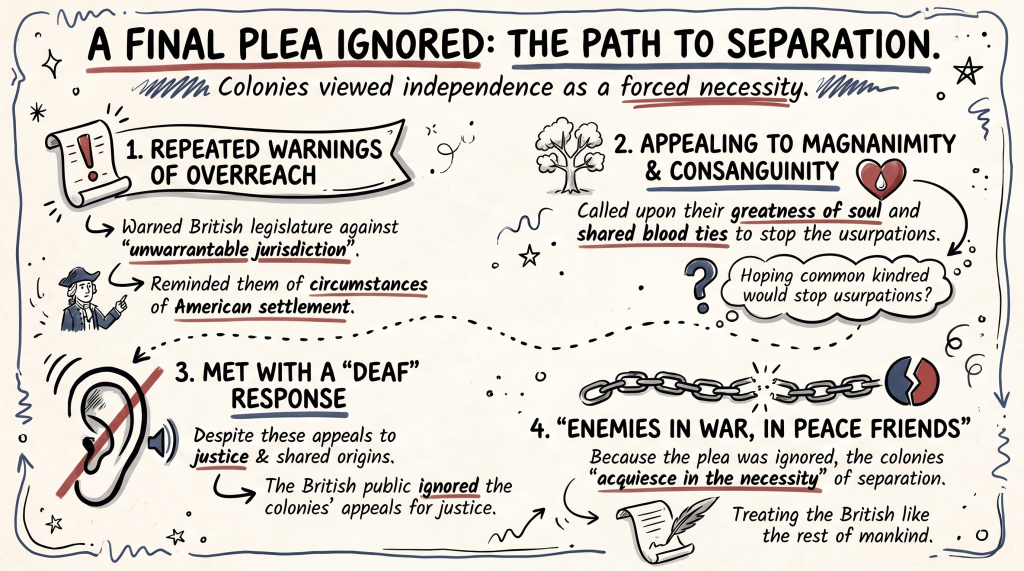
The Declaration is often remembered as a document of fiery rebellion, but in this passage the Congress carefully presents the colonies not as reckless revolutionaries eager for separation, but as a people who exhausted every possible attempt at reconciliation first. The text shifts from “He has” to “We have.” We warned you. We appealed to your justice. We reminded you of our shared blood, our “consanguinity,” one of those wonderfully oversized eighteenth century words that sounds less like political philosophy and more like a disease one catches from drinking questionable water aboard a ship bound for Barbados.

Yet the word carried enormous emotional weight in 1776.
The colonists were not speaking to strangers. They were speaking to cousins, trading partners, former neighbors, family members, and fellow subjects connected by language, law, religion, and history. The Revolution was not merely an anti colonial uprising against a distant empire. It was also a civil war inside the English speaking world itself. The Declaration acknowledges that painful reality directly. The colonies insist they had repeatedly appealed to the “native justice and magnanimity” of the British people, hoping ordinary English citizens would recognize the dangers posed by Parliament and the Crown. Instead, the Congress laments, the British people remained “deaf to the voice of justice.” Separation therefore becomes not desirable, but necessary.
The phrasing was not accidental.
Thomas Jefferson’s original draft had reportedly been far harsher toward the British people themselves. Congress softened the language deliberately during debate because many delegates still hoped to avoid permanently alienating sympathetic voices in Britain. The Revolution depended heavily upon international legitimacy. The colonies wanted to appear measured, rational, and reluctant rather than vengeful. That political caution shaped the final wording throughout the Declaration, especially in this closing appeal.
The result is remarkably polished rhetoric.
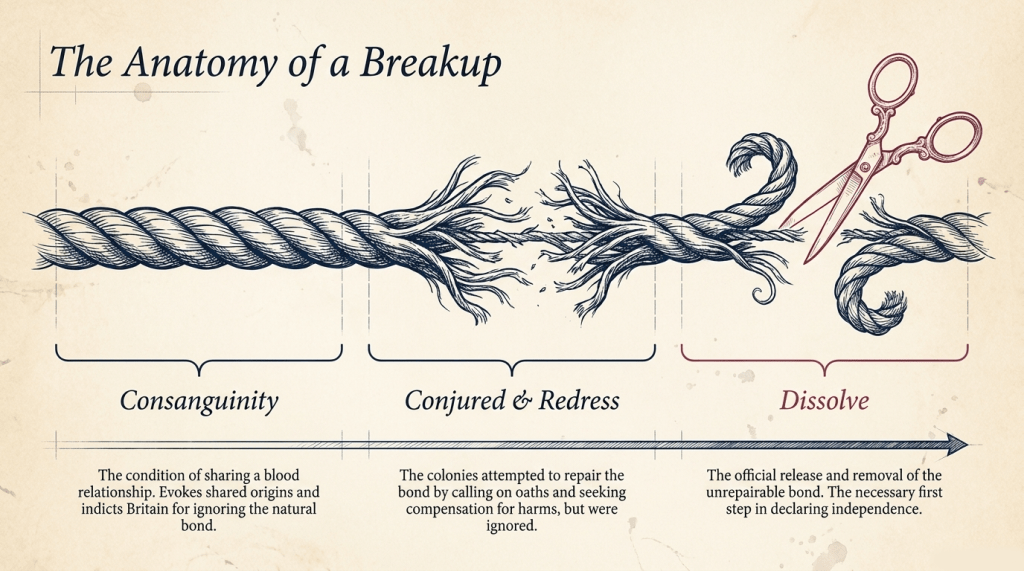
The passage uses alliteration constantly, “British brethren,” “connections and correspondence,” phrases designed to linger in the ear. Then comes the memorable closing line: “Enemies in War, in Peace Friends.” It is a classic chiasmus, balanced and symmetrical, the sort of phrase that sounds almost inevitable once heard aloud. More importantly, it reveals the larger purpose behind the passage. The colonies are drawing a firm political boundary while still leaving open the possibility of future friendship. The break is presented not as eternal hatred, but as painful necessity.
That distinction becomes even clearer when one considers the Declaration’s intended audience.
The document was not written solely for Americans. Jefferson explicitly frames it as an appeal to a “candid world.” The Congress understood that France, Spain, the Dutch Republic, and countless observers across Europe were watching events closely. The colonies needed to prove they had not rushed blindly toward rebellion. They needed to demonstrate that they had petitioned, warned, negotiated, and exhausted peaceful remedies before finally declaring independence. The denunciation of the British people therefore serves a larger philosophical purpose. It transforms the conflict from a domestic dispute into a moral argument about sovereignty itself.
That philosophical argument rests squarely on natural rights.
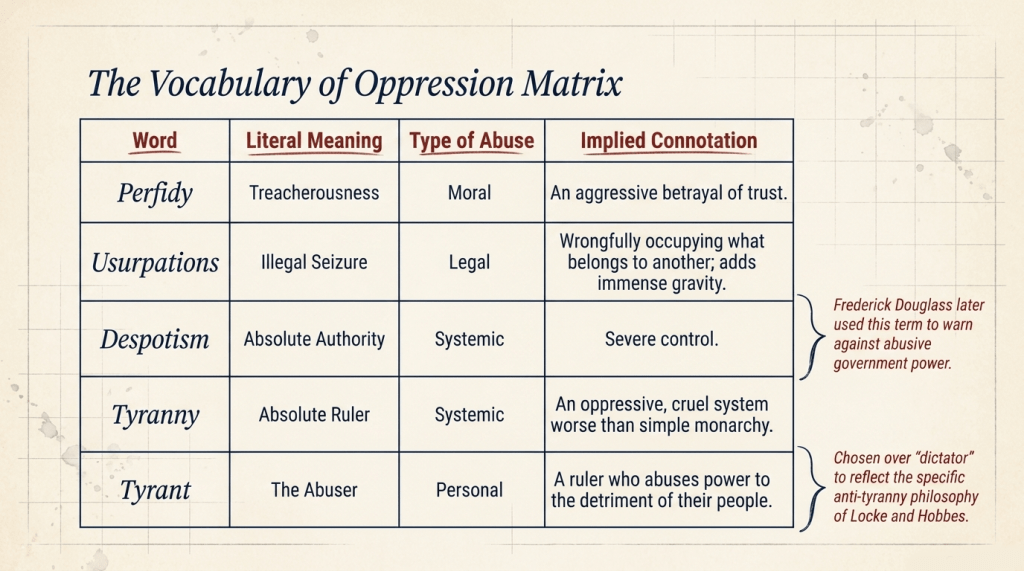
Governments derive “their just powers from the consent of the governed.” They exist to secure “Life, Liberty and the pursuit of Happiness.” Those ideas now sound so familiar that modern Americans often hear them as civic wallpaper, phrases recited mechanically during school assemblies before everybody forgets them five minutes later while checking football scores. In 1776, however, these principles carried explosive implications. If government depends upon consent, then political legitimacy can disappear when rulers systematically violate the rights they were established to protect.
Yet even here, the Declaration masks deep disagreements beneath its elegant language.
Jefferson personally leaned toward the idea that people possessed a natural right to leave political societies entirely, a concept sometimes described as expatriation. In his view, the colonies had effectively become independent states through the simple fact of choosing separation. Other delegates disagreed sharply. Many still saw themselves as defending traditional English constitutional rights rather than inventing entirely new political principles. Some believed Parliament’s authority failed simply because representation across an ocean was impossible, not because monarchy itself lacked legitimacy. The Declaration’s deliberately broad language allowed all these factions to unite behind the same text while quietly interpreting it differently.
That ambiguity partly explains the document’s extraordinary durability.
The British reaction in 1776, however, was largely contemptuous.
Many newspapers in Britain mocked the Declaration outright. Aristocratic society scoffed at the idea that “all men are created equal.” Critics immediately pointed out the obvious contradiction between lofty language about liberty and the continued existence of slavery within the colonies. From London’s perspective, the Americans often looked less like noble philosophers and more like wealthy provincial troublemakers attempting to justify rebellion with inflated rhetoric.
And yet the Declaration survived those criticisms because its language remained deliberately elastic.
That flexibility became one of its greatest strengths. The phrases were broad enough to outlive the immediate circumstances of 1776. Future generations could reinterpret and expand them in ways the original signers themselves may never have imagined. The Declaration became not merely an explanation for American independence but a template for countless later movements demanding political rights and national self determination.
The influence spread rapidly across the world.
The French Declaration of the Rights of Man and Citizen in 1789 echoed its structure and language. Elizabeth Cady Stanton’s Declaration of Sentiments in 1848 borrowed its cadence directly while demanding women’s suffrage. Ho Chi Minh quoted the American Declaration during Vietnam’s declaration of independence from French colonial rule in 1945. Again and again, revolutionary movements reached back toward Jefferson’s phrases because the document’s moral claims extended far beyond the immediate conflict with Britain.
Which brings the story back to that strange emotional turn near the end of the Declaration itself.
The colonies did not want eternal war with Britain. They wanted recognition. Respect. Political equality. Even in separation, the Congress imagined the possibility of future friendship between independent nations sharing common language and history. The final passages read less like a scream of hatred and more like the weary conclusion of a relationship that no longer functions despite repeated attempts to save it.
“It is not us, it is you,” the Declaration essentially says, though with considerably more elegance and several additional references to natural law.
And in the process, the Congress transformed a colonial rebellion into something larger, a universal argument about liberty, legitimacy, and the painful human reality that sometimes even shared blood cannot hold a political union together forever.
The Declaration of Independence was never written only for Americans.
That is one of the easiest things to miss when reading the document today because modern Americans usually encounter it in classrooms, civic ceremonies, and patriotic quotations stitched onto coffee mugs, wall plaques, and social media graphics featuring bald eagles glaring heroically into middle distance. The Declaration feels domestic to us, almost private, as though Jefferson and the Continental Congress were speaking only to the colonies themselves.
In reality, the audience was much larger.
Jefferson says so directly in the opening paragraphs when he explains that “a decent respect to the opinions of mankind requires” the colonies to explain why they are dissolving their political ties with Britain. Later, the Declaration appeals explicitly to a “candid world.” That phrase matters enormously because it reveals the broader purpose of the entire document. The Congress was not merely venting frustration or announcing rebellion. It was building a legal and moral case before the court of international opinion.
The colonies understood they needed legitimacy.
France, Spain, the Dutch Republic, and other European powers watched events in North America carefully. Potential allies would not support what appeared to be an irrational colonial riot. The Americans therefore had to present themselves as disciplined, rational, and reluctant, a people driven toward separation only after exhausting every peaceful and constitutional remedy available to them. That explains why the Declaration spends so much time cataloging grievances and recounting failed appeals. The Congress wanted the world to see that the colonies did not rush eagerly toward war. They petitioned. They protested. They negotiated. They warned. Only after repeated refusals did they conclude that independence had become necessary.
That framing transforms the Revolution from something dangerously close to civil war into something else entirely.
The colonies increasingly present themselves not as rebellious provinces inside the British nation, but as a distinct people asserting their sovereignty after constitutional ties have collapsed. This distinction mattered deeply because civil wars tend to look illegitimate internationally. Nations asserting independence after systematic violations of their rights appear differently. The Declaration therefore works hard to show that the Americans are not reckless instigators of chaos. They are a separate political community forced reluctantly into independence by the actions of the Crown and Parliament.
The emotional shift near the end of the document reinforces that argument.
When the Congress addresses the British people as “our British brethren,” it simultaneously acknowledges shared history while also implying that the relationship has broken beyond repair. The colonies insist they appealed repeatedly to the British people’s “native justice and magnanimity,” hoping ordinary English citizens would recognize the dangers posed by imperial abuses. Instead, the British public remained “deaf to the voice of justice.” Separation therefore becomes not emotional rebellion but constitutional necessity.
Underneath that argument lies the philosophical foundation of the Declaration itself.
Governments, Jefferson writes, derive “their just powers from the consent of the governed.” That single phrase carries enough political dynamite to blow apart centuries of inherited assumptions about monarchy and authority. The Declaration insists that legitimate government exists not because kings possess divine bloodlines or inherited privileges, but because political authority depends upon the consent of those being governed. Government itself exists to secure certain “unalienable Rights,” among them “Life, Liberty and the pursuit of Happiness.”
Modern Americans hear those words constantly, which creates a strange problem. Familiarity drains them of shock. They sound inevitable now because the political culture of the modern West absorbed them so thoroughly. In 1776, however, these ideas represented a profound challenge to traditional systems of authority.
Jefferson drew heavily from natural rights philosophy, especially John Locke, though filtered through colonial experience and Enlightenment language. The essential argument was remarkably simple and remarkably dangerous. Human beings possess rights inherently by nature, not because governments grant them. Governments therefore exist to protect those rights rather than create them. When governments systematically violate the rights they were established to secure, political legitimacy itself begins collapsing.
That principle justifies independence.
If government rests on consent, then consent can theoretically be withdrawn. If rulers become destructive to liberty rather than protective of it, people possess the right to alter or abolish that government and establish new safeguards for their future security and happiness.
At least, that is the clean philosophical version. Reality inside the Continental Congress was far messier.
One of the most fascinating aspects of the Declaration is how effectively it masks deep disagreements among the Founders themselves. The final text presents what appears to be a unified American philosophy, a single coherent “American mind.” Beneath that polished surface, however, delegates often disagreed sharply about what exactly justified independence in the first place.
Jefferson himself leaned toward a fairly radical understanding of political society. He believed people possessed what might be called a “natural right to quit society,” essentially a right of expatriation. In Jefferson’s view, communities could separate from political systems much as individuals might leave social arrangements no longer serving legitimate purposes. He tended to see the colonies as fundamentally self governing from the beginning, possessing political independence inherently rather than receiving it as a grant from Parliament or the Crown.
Other delegates viewed matters very differently.
Many Americans still considered themselves heirs to traditional British constitutional rights. They believed the colonies had remained loyal subjects whose liberties were violated because Parliament could not adequately represent populations separated from Britain by an ocean. Their argument was less revolutionary philosophically than Jefferson’s. They did not necessarily reject monarchy itself or inherited British constitutional traditions. Instead, they believed the imperial system had failed structurally. Representation across such vast distance simply could not function properly.
That distinction mattered enormously.
Jefferson’s theory implied a much broader right of self determination. Other delegates focused more narrowly on constitutional breakdown within the empire itself. Some saw independence as almost inevitable from the beginning. Others viewed it as a tragic but necessary response to British mismanagement. Some grounded their arguments heavily in natural rights philosophy. Others remained deeply attached to older English constitutional traditions.
The brilliance of the Declaration lies partly in how carefully it accommodates all those perspectives simultaneously.
The language remains broad enough, flexible enough, and occasionally vague enough that multiple factions could recognize their own views inside the same document. Jefferson’s soaring philosophical passages satisfied natural rights advocates. The detailed grievances satisfied constitutional traditionalists demanding evidence of specific abuses. Appeals to shared British identity reassured moderates uncomfortable with radical separation. The document fused Enlightenment philosophy, English constitutionalism, colonial experience, and political necessity into a single narrative capable of uniting remarkably diverse viewpoints.
That flexibility also explains why the Declaration endured long beyond the immediate circumstances of 1776.
The language proved elastic enough to survive changing generations, political movements, and historical crises. Different Americans could read different meanings into the same phrases while still treating the document as foundational. Abolitionists later seized upon “all men are created equal.” Women’s rights advocates adapted its structure directly in the Declaration of Sentiments. Anti colonial movements across the world echoed its language while demanding independence from European empires.
The Declaration survived because it never fully locked itself into one narrow interpretation. At the same time, that flexibility creates enduring tension.
Americans still debate what equality means. What rights are truly unalienable. How consent functions. Where government authority begins and ends. Those arguments existed from the founding itself because the Declaration deliberately united people who did not agree entirely on the philosophical details underneath independence.
And perhaps that is fitting.
The Revolution was not born from perfect ideological agreement. It emerged from overlapping convictions, shared frustrations, practical realities, and competing philosophies temporarily woven together by necessity. The Declaration succeeded because it transformed those differences into a common political language broad enough to hold a fragile coalition together long enough for a new nation to emerge.
Which may be the most American thing about the document after all.
The Declaration of Independence is so deeply woven into American life that it is easy to imagine the document arriving in the world already crowned with reverence. Modern Americans tend to picture July 1776 as though lightning struck parchment while choirs sang somewhere overhead and humanity instantly recognized Jefferson’s words as sacred political scripture. Schoolbooks often flatten the moment into inevitability. The Declaration appears, liberty triumphs, cue the fife music.
That is not how the rest of the world saw it in 1776.
To much of Britain, the Declaration looked ridiculous. Worse than ridiculous, it looked dangerous.
The British press reacted with a mixture of contempt, anger, and disbelief. Newspapers mocked the colonies as spoiled ingrates throwing a tantrum after benefiting for generations from imperial protection and trade. Aristocratic society especially scoffed at the philosophical language pouring out of Philadelphia. The notion that “all men are created equal” sounded absurd to a culture still profoundly shaped by hierarchy, inherited privilege, monarchy, class distinction, and established rank. Britain in 1776 was not a democracy in the modern sense. Political power remained concentrated among landowners, aristocrats, and established elites. The social order itself rested on inequality.
From that perspective, the Declaration’s language sounded almost juvenile.
Many British commentators interpreted the document not as serious political philosophy but as inflated colonial rhetoric dressed up in Enlightenment vocabulary. The Americans, in this view, were provincial troublemakers attempting to justify rebellion with grandiose abstractions about liberty and natural rights. Some critics pointed out, not entirely unfairly, that many colonial leaders demanding freedom for themselves seemed considerably less enthusiastic about extending that freedom universally.
That criticism struck at the Declaration’s greatest contradiction almost immediately. How could a society practicing chattel slavery proclaim that all men possess an “unalienable right to liberty”?
British critics seized upon the hypocrisy eagerly. One did not need to support Parliament or George III to recognize the tension. Thomas Jefferson himself owned enslaved people while writing the Declaration’s soaring language about equality and natural rights. The contradiction was real in 1776 and remains real now. The Founders were articulating principles whose implications stretched far beyond the society they themselves fully imagined or achieved.
Yet strangely enough, that contradiction became part of the Declaration’s long term power rather than its destruction. Because the language proved larger than the immediate circumstances of its creation.
That elasticity is one of the most remarkable features of the document. Jefferson and the Continental Congress deliberately wrote in broad philosophical terms rather than narrow legal specifics. The Declaration announces principles without fully defining their future boundaries. “All men are created equal.” “Unalienable Rights.” “Consent of the governed.” These phrases possess enormous moral force precisely because they remain expansive enough for future generations to reinterpret and apply in ways the original signers themselves often did not anticipate.
That vagueness frustrated some critics immediately. It also ensured the document’s survival.
Had the Declaration been written too narrowly, tied entirely to the particular grievances of 1776, it likely would have remained an important historical artifact but not much more. Instead, the language operates almost like a set of moral coordinates rather than a finished blueprint. The document announces ideals while leaving later generations to wrestle with their meaning. In doing so, the Declaration escaped the limits of its own century.
The irony is striking.
British critics mocked the document partly because its principles seemed impractical, overly abstract, and detached from political reality. Yet those same abstractions allowed the Declaration to outlive nearly every criticism aimed at it. The text became adaptable across centuries precisely because it never fully closed its own philosophical doors.
That adaptability transformed the Declaration from a colonial manifesto into a global political document.
The French Revolution provides one of the earliest and most obvious examples. By 1789, French reformers and revolutionaries drew directly from the language and structure of the American Declaration while drafting the Declaration of the Rights of Man and of the Citizen. France, of course, moved in a much darker and more violent direction eventually. The French Revolution lacked many of the stabilizing traditions, colonial experiences, and constitutional habits shaping the American founding. Still, the intellectual influence remained unmistakable. Natural rights. Sovereignty rooted in the people. Government accountable to universal principles rather than inherited privilege. The echoes of Jefferson’s language carried across the Atlantic almost immediately.
The Declaration’s influence did not stop there.
In 1848, Elizabeth Cady Stanton consciously modeled the Declaration of Sentiments after Jefferson’s original structure while advocating for women’s suffrage at Seneca Falls. Stanton understood something crucial about the Declaration’s language. Because the principles were universal in tone, they could be turned back against American society itself. If all men are created equal, what about women? If governments derive just powers from consent, what about citizens excluded politically because of sex? Stanton did not reject the Declaration. She expanded its logic.
That pattern repeated again and again throughout American history.
Abolitionists quoted the Declaration while condemning slavery. Civil rights leaders invoked it during struggles against segregation and racial discrimination. Reformers across generations appealed not away from the Declaration but toward it, insisting the nation live more fully according to its own stated principles. The document became less a static historical artifact than an ongoing moral argument Americans continually revisited.
And not only Americans.
One of the strangest and most historically ironic examples arrived in 1945 when Ho Chi Minh invoked the Declaration while proclaiming Vietnamese independence from French colonial rule. Ho quoted Jefferson’s language directly, appealing to natural rights and self determination against European imperialism. Imagine telling the delegates in Philadelphia in 1776 that their declaration against George III would someday echo through Southeast Asia during the collapse of European colonial empires. One suspects several powdered wigs might have fallen clean off.
Yet the connection makes sense.
The Declaration’s structure possesses extraordinary portability. First comes a statement of universal principles. Then a catalog of grievances demonstrating violations of those principles. Finally, a declaration that political separation has become morally necessary. That framework became a template for countless later independence and reform movements precisely because it transforms political rebellion into ethical argument.
The document does not merely say, “We are angry.” It says, “Here are the principles by which legitimate government must operate, here is how those principles have been violated, and here is why separation follows logically from those violations.”
That structure gives the Declaration enduring force.
At the same time, the document’s ambiguity remains both strength and tension. Different political movements often claim the Declaration simultaneously while meaning radically different things by it. Some emphasize equality. Others emphasize liberty. Some focus on limited government. Others stress universal human rights. The text accommodates all these readings because Jefferson’s language intentionally balances philosophical breadth with political specificity.
That flexibility has advantages. It also creates danger.
Broad language can inspire liberation, but it can also become detached from historical context and practical restraint. The Declaration was never intended as a floating abstraction disconnected from law, constitutional structure, or civic responsibility. The Founders themselves often disagreed profoundly about how its principles should function politically. Modern readers sometimes treat the document as though it emerged from perfect philosophical consensus. In reality, the Declaration papered over numerous disagreements in order to maintain unity during a revolutionary crisis.
Still, its endurance remains extraordinary.
Empires vanished. Monarchies collapsed. Ideologies rose and fell. Yet Jefferson’s phrases survived because they spoke to something deeper than the immediate colonial dispute with Britain. The Declaration articulated the idea that legitimate government rests not simply upon force or tradition but upon moral justification connected to human dignity itself.
Even critics who attacked the document often did so by using its own principles against it.
British observers pointed out slavery because the Declaration’s language about liberty created a moral standard difficult to ignore. Abolitionists later wielded those same principles against the institution more powerfully than Jefferson himself perhaps anticipated. Women’s suffrage advocates did the same. Civil rights leaders did the same. The Declaration repeatedly expanded beyond the intentions of its authors because its moral claims exceeded the limits of eighteenth century political reality.
That may be the document’s greatest achievement.
The Declaration did not solve the human struggle over liberty, equality, rights, or justice. It gave future generations a language for arguing about them.
And perhaps that explains why the document still matters nearly two and a half centuries later.
Not because Americans perfected its ideals. Not because the Founders resolved every contradiction.
But because a group of imperfect men in a hot Philadelphia summer managed to articulate principles broad enough, durable enough, and morally serious enough that people across centuries and continents continue returning to them whenever power grows oppressive and human beings begin demanding the right to govern themselves again.
Bailyn, Bernard. The Ideological Origins of the American Revolution. Cambridge, MA: Belknap Press of Harvard University Press, 1967.
Becker, Carl L. The Declaration of Independence: A Study in the History of Political Ideas. New York: Vintage Books, 1958.
Ellis, Joseph J. American Creation: Triumphs and Tragedies at the Founding of the Republic. New York: Alfred A. Knopf, 2007.
Franklin, Benjamin. The Papers of Benjamin Franklin. Edited by Leonard W. Labaree et al. New Haven, CT: Yale University Press, 1959–.
Jefferson, Thomas. The Papers of Thomas Jefferson. Edited by Julian P. Boyd et al. Princeton, NJ: Princeton University Press, 1950–.
Locke, John. Two Treatises of Government. London, 1689.
Maier, Pauline. American Scripture: Making the Declaration of Independence. New York: Alfred A. Knopf, 1997.
The Declaration of Independence. July 4, 1776.
The French Declaration of the Rights of Man and of the Citizen. August 26, 1789.
The Seneca Falls Declaration of Sentiments. July 19–20, 1848.
Wills, Garry. Inventing America: Jefferson’s Declaration of Independence. Boston: Houghton Mifflin, 1978.
Wood, Gordon S. The Creation of the American Republic, 1776–1787. Chapel Hill: University of North Carolina Press, 1969.
Wood, Gordon S. The Radicalism of the American Revolution. New York: Alfred A. Knopf, 1992.
It’s Not Us, It’s You
Liberty 250 – The Music(al)
Words and Music by David Ray Bowman
© 2026 by Slippery Fish Entertainment




 DAVE DOES HISTORY
Leave a comment