
“Somebody who tries to tell you that the Declaration of Independence was written by a bunch of old white guys 250 years ago doesn’t matter anymore, doesn’t know anything about history. They don’t even know what it says, because anybody that knows what it says knows that it’s Jefferson telling us the same things today that he was telling us in 1776. Read it.” – Dave Bowman
If you imagine it the way Dave laid it out on the air, not as a clean painting but as something you can almost smell. The chamber is full, men packed shoulder to shoulder, arguing for hours in heat that would make a modern committee meeting look like a spa day. Clerks hunched over their desks, ink drying too fast, papers stacked in uneven piles. The galleries crowded, because people cared enough to show up and watch their government work. That is the detail we tend to forget. These were not empty rituals. These were living rooms of power, and the public had a seat in the gallery.
Then the interruption comes.
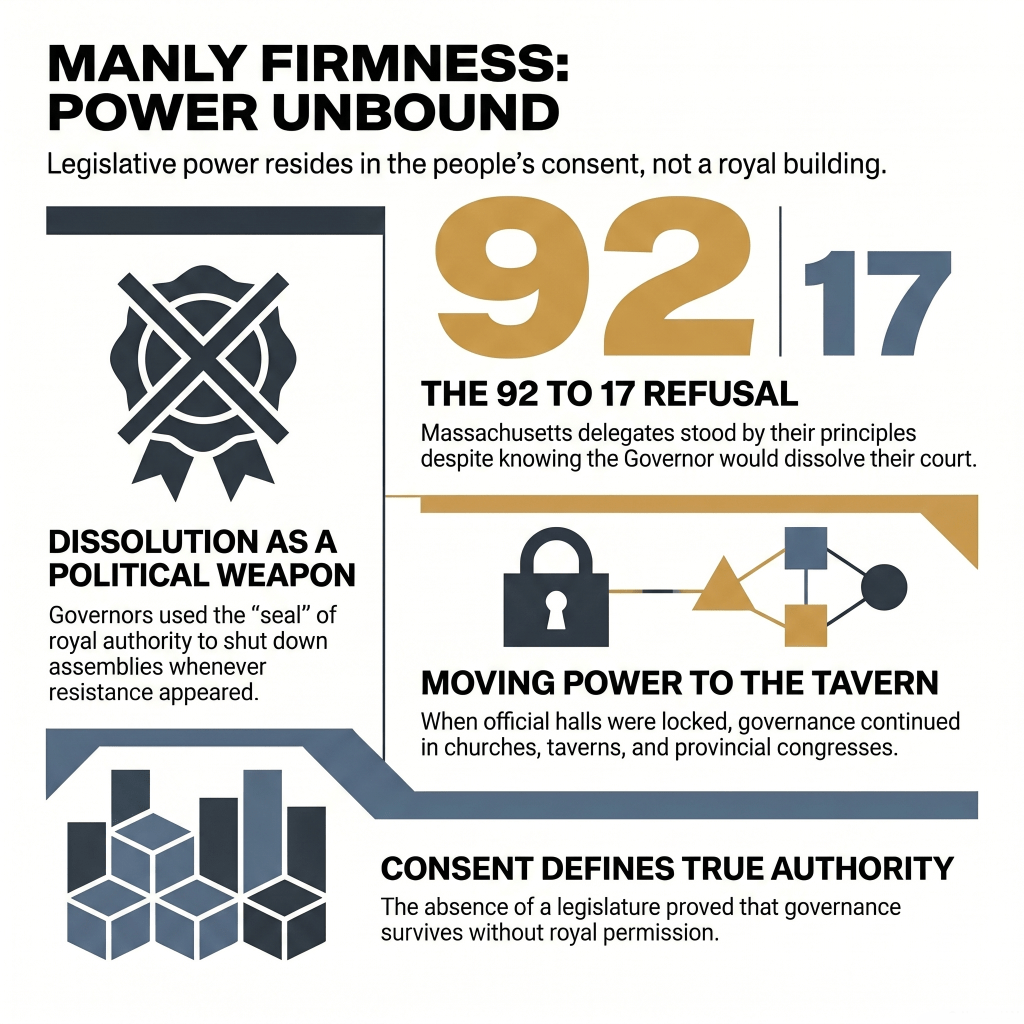
Not a debate, not a vote, not even a raised voice. A messenger steps in, carrying a note sealed with royal authority. It does not ask. It does not explain. It simply declares. The assembly is dissolved. That is it. No appeal, no argument, no chance to say one last word for the record. The seal matters more than every man in that room combined.
And just like that, the machinery of representation is supposed to stop.
You can hear the reaction without anyone needing to describe it. Papers gathered too quickly, chairs scraping across the floor, voices lowered into something between disbelief and anger. The clerks pack their records, because records matter, even when the room does not. The delegates file out into the street, not because they agree, but because they have no choice in that moment.
The doors close behind them.
That is the image Jefferson had in mind when he wrote about dissolving representative houses. It was not theoretical. It was repeated, deliberate, and familiar enough that men across the colonies recognized it immediately when they read the words.
Start in Massachusetts in 1768. The legislature there is not asking for revolution. They are writing a letter, the Massachusetts Circular Letter, complaining about the Townshend duties and suggesting that other colonies might want to think about doing something similar. It is hardly the stuff of insurrection. It is politics, plain and simple, the kind of thing legislatures are supposed to do.
Governor Francis Bernard sees it differently. To him, this is not discussion. It is defiance. He demands that the assembly rescind the letter, take it back, pretend it never happened. The vote that follows is not close. Ninety two to seventeen, they refuse.
Now that number matters. These are not professional revolutionaries. Many of them are farmers, tradesmen, men elevated by their neighbors because they are trusted, not because they are trained. And yet they stand there and say no, knowing full well what the consequence will be.
Bernard does exactly what you expect. He dissolves the General Court. Shuts it down, sends them home, and assumes that ends the problem.
It does not.
The towns send delegates anyway. They meet in an extra legal convention in Boston. No official sanction, no royal approval, just the simple belief that if the formal structure is denied, the function must continue. The governor fumes, the troops arrive, and the tension rises, but the lesson is already written. Shut down a legislature and the people will find another way to assemble.
Move south to Virginia in 1774, and the pattern repeats with a familiar twist. The House of Burgesses calls for a day of fasting and prayer in solidarity with Boston. It is a quiet act, almost gentle in its presentation, but the meaning is unmistakable. Virginia is not standing apart. Virginia is paying attention.
Governor Lord Dunmore responds with the same tool Bernard used. Dissolve the assembly. End the discussion.
If you have been paying attention, you already know what happens next. The Burgesses do not go home. They go to the tavern. They gather in the Apollo Room and continue their work over ale and candlelight. It is not dignified in the traditional sense, but it is effective. In fact, it may be more effective, because now the act of meeting itself becomes a statement.
Dunmore thinks he has ended resistance. What he has actually done is remove the illusion that permission is required.
And then there is New York, which does not even get the courtesy of a governor making the decision locally. Parliament steps in directly with the New York Suspending Act. The issue is the Quartering Act. The assembly objects, not because it hates soldiers, but because it was not asked. Consent matters, and in this case consent was bypassed.
Parliament’s response is simple. No compliance, no assembly. The legislature is suspended until it agrees to do what it is told.
For a time, New York exists without a functioning legislative body. Taxes go uncollected. Decisions stall. Eventually, under pressure, the assembly partially complies, but the damage is already done. The colonists have seen how easily their system can be shut down. They have seen how fragile it looks when authority is treated as something that can be switched off like a lantern.
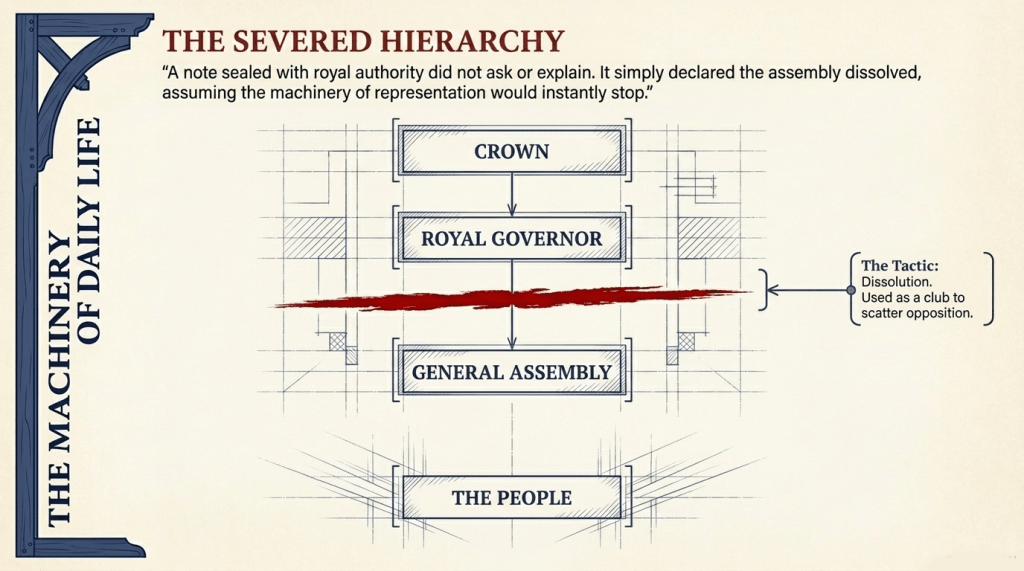
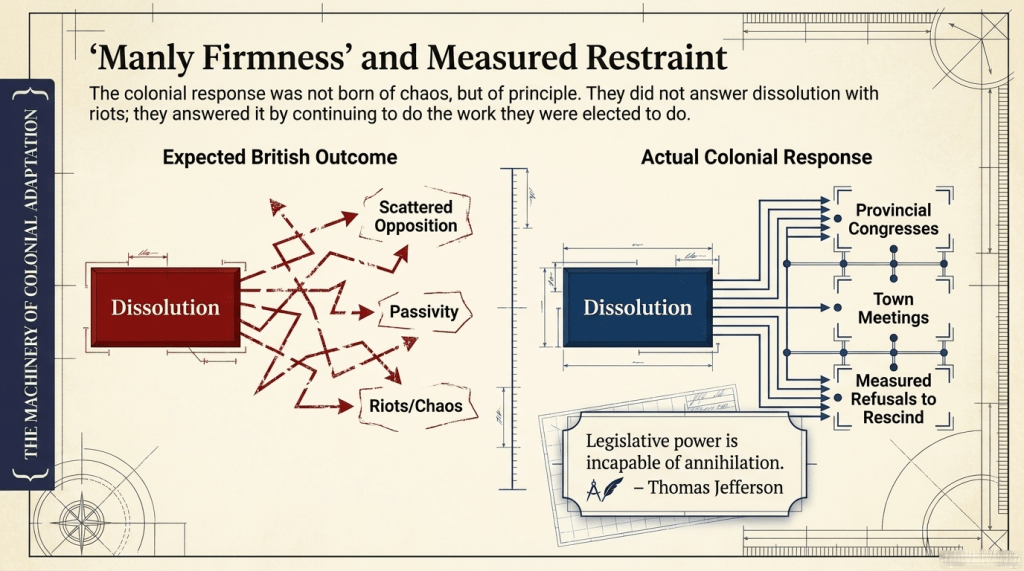
These are not isolated incidents. That is the key, and it is the point Dave kept circling back to on the broadcast. This is a pattern. Governors and Parliament using dissolution the way a man might use a club, striking whenever resistance appears, assuming that the blow will be enough to scatter opposition.
What they underestimate is the response.
Jefferson calls it “manly firmness,” and whatever you think of the phrasing, the idea behind it is unmistakable. These are men who refuse to bend, not because they enjoy conflict, but because they understand what is at stake. If a legislature can be dissolved whenever it becomes inconvenient, then representation is not a right. It is a privilege, and privileges can be taken away.
So they stand.
Not with muskets, not at first. Not with mobs or riots. They stand by continuing to do the work they were elected to do. They meet in taverns, in churches, in whatever space will hold them. They write letters, pass resolutions, and refuse to rescind what they have already decided. It is resistance, but it is measured, almost stubborn in its restraint.
That restraint matters.
Because it shows that the conflict is not born of chaos. It is born of principle. The colonists are not trying to tear down the system. They are trying to preserve the part of it that matters most to them, the ability to govern themselves through representatives of their own choosing.
The irony, and it is a sharp one, is that each dissolution strengthens the very thing it is meant to weaken. Every time a legislature is shut down, the colonists become more aware of how much they value it. Every time they are forced into an “unusual and uncomfortable” place, they prove to themselves that the place does not define the power.
Power moves with them.
That realization spreads, quietly at first, then with growing confidence. Massachusetts, Virginia, New York, different colonies, different circumstances, same conclusion. Authority that ignores the will of the people is not authority worth respecting.
And once that idea takes hold, the rest follows.
Jefferson’s line in the Declaration is not exaggeration. It is summary. A concise statement of something lived over and over again across the colonies. Representative houses dissolved, not once, not twice, but repeatedly, each time for the same reason. They opposed, with what he calls manly firmness, the encroachments on their rights.
To the governors, these men were troublemakers. Obstinate, irritating, unwilling to fall in line. To their neighbors, they were something else entirely. They were proof that representation meant something, that it was worth defending even when the doors were locked and the rules were rewritten.
The king saw assemblies as nuisances. The people saw them as their voice. And voices, once raised often enough, have a way of carrying farther than anyone expects.
The people’s representatives are gone, but the problems remain.
That is the part nobody in London seemed to think through, or perhaps they thought through it and decided it would not matter. Either way, the result on the ground was the same. Doors were locked, assemblies dissolved, clerks sent home with their papers, and for a brief moment it must have looked as though authority had reasserted itself. The governor had spoken, the King’s will had been enforced, and the machinery of resistance had been shut down.
Except the machinery of daily life does not shut down so neatly.
Bills still needed to be paid. Roads still needed to be maintained. Courts still needed to function. Militia still needed direction. Trade did not pause politely to wait for a constitutional crisis to resolve itself. And perhaps most pressing of all, danger did not take a holiday simply because a legislature had been dismissed.
This is where the story takes on a different tone. The earlier dissolutions had been dramatic, even theatrical in their own way. A message delivered, a chamber emptied, a walk to a tavern. There is a certain energy to those moments, a sense that something is happening. What follows is quieter, and in many ways more unsettling.
Nothing happens. Or rather, nothing official happens, which is not the same thing at all.
Take Massachusetts after the arrival of Thomas Gage. Gage is sent to enforce the Coercive Acts, to bring order to a colony that Parliament believes has drifted too far into defiance. He has troops. He has authority. What he does not have, once the General Court is dissolved, is a functioning legislature.
And that absence matters more than he expects.
Gage cancels elections. No new assembly will be formed. No replacement body will take the place of the one he has shut down. The assumption seems to be that removing the legislature removes the problem. What it actually removes is the mechanism by which problems are addressed.
Who collects the taxes? Who allocates resources? Who negotiates with local leaders? Who even defines what policy is supposed to be on a day to day basis?
A governor can issue orders. Soldiers can enforce them. But governance, the slow and often tedious process of managing a society, does not operate well by decree alone.
The result is a kind of paralysis, not total, not complete, but enough to be felt.
Move north to New Hampshire, where John Wentworth decides that the assembly is becoming too cooperative with the growing colonial movement. The colony begins to lean toward supporting a broader intercolonial response, even the idea of a Continental Congress, and Wentworth responds the way others have responded before him.
He blocks the assembly.
No meetings, no elections, no official body to represent the people’s voice. On paper, it is a decisive act. In practice, it creates a vacuum.
New Hampshire is not a quiet backwater. It sits on a frontier that requires constant attention. Relations with Native American tribes are delicate and demand careful handling. The presence of British forces, the uncertainty of French influence to the north, all of these factors require coordination, negotiation, and decision making.
And now there is no recognized body to do any of that.
The governor can act, but he is one man, and his authority, while technically broad, does not translate easily into the kind of local legitimacy needed to manage complex situations. Decisions made without representation carry a different weight. They feel imposed rather than agreed upon, and that distinction matters more than imperial officials seem willing to admit.
Then there is North Carolina, where Josiah Martin dissolves the assembly in 1775 after it expresses support for the Continental Congress. Once again, the pattern repeats. Resistance is met with dissolution. Authority is asserted by removing the body that challenges it.
And once again, the consequences ripple outward.
North Carolina is already tense. Loyalists and Patriots are organizing, forming militias, preparing for conflict that is beginning to look less hypothetical by the day. The colony does not need less coordination. It needs more. It does not need fewer voices. It needs a mechanism to channel the voices it already has.
Instead, it is left with empty chairs.
The phrase from Jefferson’s grievance begins to take on a sharper edge here. “He has refused for a long time, after such dissolutions, to cause others to be elected.” It is one thing to dissolve a legislature. It is another thing entirely to refuse to replace it. The first act can be framed, however thinly, as a correction. The second reveals something closer to contempt.
No elections means no representation. No representation means no consent. And without consent, the entire structure of governance begins to tilt.
Jefferson follows that line with a warning that reads less like rhetoric and more like observation. The colonies, he writes, are exposed “to all the dangers of invasion from without, and convulsions within.” That is not poetic exaggeration. It is a description of the situation on the ground.
External threats do not disappear when a legislature is dissolved. If anything, they become more dangerous, because the colony’s ability to respond is weakened. Internal tensions, already present, begin to rise without a formal outlet. Disputes that might have been handled in a legislative chamber spill out into the open, where they are harder to manage and easier to inflame.
It is, to borrow a phrase Dave used on the broadcast, like a ship without a rudder in storm seas. The ship still moves. The wind still blows. The waves still crash. But there is no clear way to steer, no agreed upon mechanism to decide direction.
That is not stability. That is drift. And drift, in a moment of crisis, is dangerous.
What makes this situation particularly striking is how predictable it should have been. Remove the structures that allow a society to govern itself, and that society does not become orderly. It becomes uncertain. It looks for alternatives. It improvises.
The British authorities seem to have believed that the absence of a legislature would produce compliance. Without a body to organize resistance, the people would simply accept the new reality. It is a reasonable assumption if you believe that authority flows from the top down and that without that authority, nothing else can function.
The colonists, shaped by a different experience, come to a different conclusion.
If the official legislature is gone, the power it exercised does not vanish with it.
It lingers. It waits.
And eventually, it moves.
At first, that movement is hesitant. Town meetings take on greater importance. Committees begin to form, often informally at first, then with increasing confidence. Decisions are made not because they are sanctioned, but because they are necessary. The problems that remained after the dissolutions do not solve themselves. They demand attention, and attention is given, even if the form it takes is no longer recognized by royal authority.
The empty chairs in the legislative chambers become symbols.
To British officials, they represent order restored, a troublesome body removed from the equation. To the colonists, they represent something else entirely. They are reminders that their voices have been dismissed, that their participation has been deemed unnecessary, that the system they believed they were part of no longer recognizes them as partners.
That realization is not immediate, and it is not uniform, but it spreads.
And as it spreads, the question begins to change. It was no longer simply, how do we get our legislature back? It was, what do we do if we cannot?
That is a far more dangerous question, because it opens the door to possibilities that had previously been unthinkable. If representation is denied, if elections are refused, if the structures of government are dismantled, then the people must decide whether they will accept that condition or find another way to govern themselves.
The Crown had attempted to silence the people’s voice by removing the institutions that carried it.
What it discovered, slowly and at great cost, was that the voice did not depend entirely on those institutions.
It could find other channels.
And once it did, the empty chairs of government became less a sign of defeat and more a signal that something new was beginning to take shape.
“If the King will not let them meet, they will meet anyway.”
That line lands with a certain stubborn simplicity, the kind that sounds almost casual until you realize what it implies. It is not a slogan. It is not even particularly dramatic. It is a statement of habit, the quiet confidence of a people who have been governing themselves long enough that they are not inclined to forget how simply because someone in a distant capital has decided to interrupt the process.
By the early 1770s, colonial assemblies were not experimental institutions. They were established, expected, and deeply woven into daily life. These were not abstract bodies debating theoretical questions. They handled taxes, roads, local disputes, militia organization, and a hundred other practical concerns that kept communities functioning. People attended their sessions, read their proceedings, argued about their decisions, and expected them to continue. When those assemblies were dissolved, what disappeared was not just a political forum but the mechanism through which ordinary problems were addressed.
That is why the British strategy, though decisive on paper, began to unravel in practice. Dissolve the legislature, and you remove the formal structure. What you do not remove is the need for governance. Crops still had to move to market. Disputes still had to be settled. External threats still had to be managed. A colony does not pause simply because its official body has been dismissed.
So the colonies adapted, and they did so in ways that were at once improvised and remarkably effective.
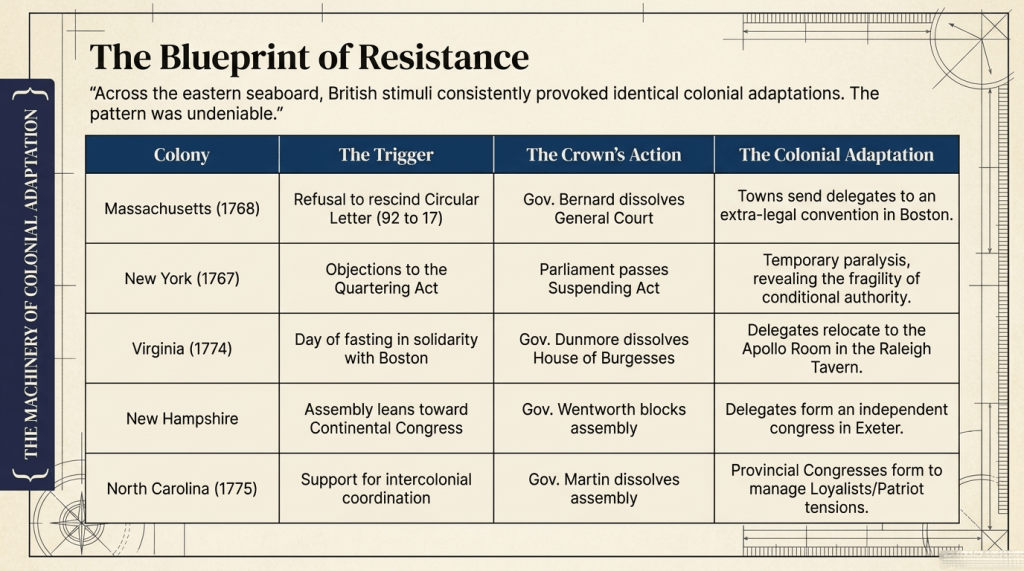
In Massachusetts, when Thomas Gage shut down the General Court and attempted to control the political situation from Boston, the response did not come as a single dramatic act. It came as a reorganization. Delegates met in Concord, outside the immediate reach of the governor’s authority, and formed a Provincial Congress. This was not a symbolic gesture. The body took on real responsibilities, collecting taxes, organizing militia, and coordinating resistance. It functioned as a government, even if it lacked the formal recognition of one.
The choice of Concord was not accidental. It was accessible enough to allow participation but distant enough to avoid direct interference. That balance tells you something about how carefully these men were thinking. They were not simply rebelling. They were constructing an alternative system, one that could operate under pressure and still produce results.
Virginia followed a similar path, though its circumstances gave the story a different tone. When Lord Dunmore dissolved the House of Burgesses, he expected the work of that body to cease. Instead, it relocated. The Burgesses reconvened as a convention at the Raleigh Tavern, and from that meeting came decisions that extended far beyond the immediate crisis. It was in such gatherings that the idea of a Continental Congress began to take shape, a step that moved the colonies from isolated responses toward coordinated action.
The tavern setting is often treated as a charming detail, but it carries deeper significance. It demonstrates that the physical environment of governance is less important than the willingness to govern. Remove the formal chamber, and the work does not stop. It changes location. It adapts. It continues.
In New Hampshire, the pattern repeats with a quieter determination. When John Wentworth blocked the assembly, the colony did not wait for a reversal of that decision. Delegates gathered in Exeter and formed their own congress, assuming the responsibilities that had been denied to them. The setting may have been less dramatic than Boston or Williamsburg, but the principle was the same. Authority did not vanish. It shifted.
North Carolina provides perhaps the most complex example, because the colony was already divided. Loyalists and Patriots were organizing, tensions were rising, and the potential for violence was real. When Josiah Martin dissolved the assembly, he removed one of the few structures capable of managing that tension. The response was the formation of Provincial Congresses that took on legislative and executive functions, attempting to maintain order in a situation that could easily have descended into chaos.
Across these colonies, a pattern emerges that Jefferson would later capture in a single phrase. Legislative power, he writes, is “incapable of annihilation.” The choice of words is deliberate. He is not denying that assemblies can be dissolved. He is asserting that the power those assemblies exercise does not disappear when they are. It returns to the people, waiting to be expressed in whatever form circumstances allow.
That idea marks a turning point in how the colonists understood their relationship to authority. Up to this point, much of the argument had been framed within the structure of the British Empire. The colonists claimed the rights of Englishmen, appealed to precedent, and sought redress within the existing system. The repeated dissolutions and the refusal to call new elections forced a reconsideration. If the system would not accommodate their participation, then participation would have to find another path.
The Provincial Congresses and conventions were that path.
They were not perfect. They lacked the procedural consistency of established legislatures. They operated under pressure, often with limited resources and uncertain legitimacy. Yet they performed the essential functions of governance. They made decisions, enforced them, and expected compliance. In doing so, they demonstrated that authority could be grounded in consent rather than recognition.
This distinction matters, because it shifts the source of legitimacy. If authority depends on royal approval, then its absence is fatal. If it depends on the consent of the governed, then it can survive the loss of official sanction. The colonists, through their actions, began to embrace the latter view.
This is where the connection to the Declaration becomes clear. When Jefferson writes that governments derive their just powers from the consent of the governed, he is not proposing a novel theory. He is describing a reality that has already taken shape in these extra legal bodies. The King’s refusal to allow assemblies to function did not eliminate governance. It forced the colonists to demonstrate that governance could exist without him.
That demonstration carried consequences.
It made independence conceivable in a way it had not been before. As long as the colonists believed that their political life depended entirely on imperial structures, separation would have seemed impractical, even reckless. Once they had experience governing themselves outside those structures, the idea of independence began to look less like a leap into the unknown and more like an extension of what they were already doing.
It is important not to oversimplify this process. There were still divisions, still uncertainties, still those who hoped for reconciliation. The Provincial Congresses did not instantly create a unified vision of the future. What they did was provide a practical foundation for that future, a demonstration that self government was not only desirable but workable.
The King’s actions, intended to assert control, had the opposite effect. By dissolving assemblies and refusing to replace them, he exposed the limits of authority that did not rest on consent. He created a situation in which the colonists had to choose between passivity and initiative. They chose initiative.
That choice did not end the conflict. It intensified it. It set the stage for the events that would follow, from armed confrontation to formal declaration. But it also clarified something that would remain central to the American political tradition.
Power does not reside permanently in institutions. It resides in the people who give those institutions life. When the institutions fail, the power does not vanish. It moves.
The colonists learned that lesson in taverns, in churches, in meeting halls scattered across the landscape. They learned it through necessity rather than theory, through action rather than argument. And once learned, it became part of the foundation on which the new nation would be built.
The question that lingers, then as now, is not whether power can move. It clearly can. The question is what people do when they find themselves holding it.
Originally published October 7, 2025
Republished May 3, 2026



 DAVE DOES HISTORY
Leave a comment