
May of 1774 did not feel like the beginning of a revolution. It felt like irritation, another argument layered on top of years of arguments, the sort of thing that people assumed would eventually settle down once cooler heads prevailed. Most colonists were not talking about independence. They were still trying to make the Empire work, still trying to believe that somewhere, somehow, reason would win out over pride.
Then Lord Dunmore ended the discussion, or at least he thought he did.
He dissolved the House of Burgesses, locked the doors, and made it clear that the body simply would not meet anymore. From his perspective, this was not tyranny. It was authority. The Burgesses had crossed a line when they declared a day of fasting and prayer in sympathy with Boston. That was not some harmless religious observance. It was a political statement, a signal that Virginia was aligning itself with Massachusetts against Parliament. Dunmore recognized it for what it was and responded in the most direct way available to him.
The assumption behind his action was simple. No chamber, no legislature. No legislature, no resistance. If you remove the structure, the function collapses.
The next morning proved how wrong that assumption was.
The Burgesses arrived ready to meet, only to find the doors barred and guarded. Everything that made their work official was locked inside. Their records, their procedures, the physical space that gave their authority its form, all of it denied to them. For a moment, you can almost imagine the pause. This is the point in most stories where people shrug, turn around, and go home.
Instead, they turned down the street.
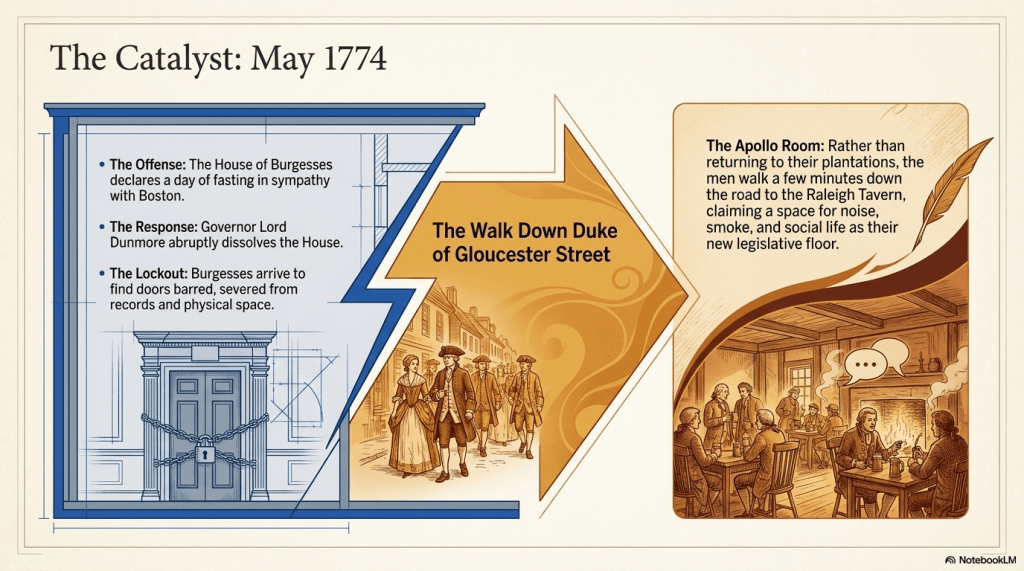
Duke of Gloucester Street is not long, and the walk to the Raleigh Tavern takes only a few minutes. But those few minutes carry more weight than most speeches. They left behind the King’s building and walked into a place that belonged to the people, a tavern filled with noise, smoke, and the kind of activity that has nothing to do with formal governance.
Inside that tavern was the Apollo Room, a place meant for gatherings, celebrations, and the everyday business of social life. It was not designed for legislation, which is precisely what made the decision so powerful. The Burgesses entered, took their places, and gavels themselves back into session as if nothing had happened. No royal permission, no official sanction, no access to their own records. Just the shared understanding that their authority did not vanish simply because a governor said so.
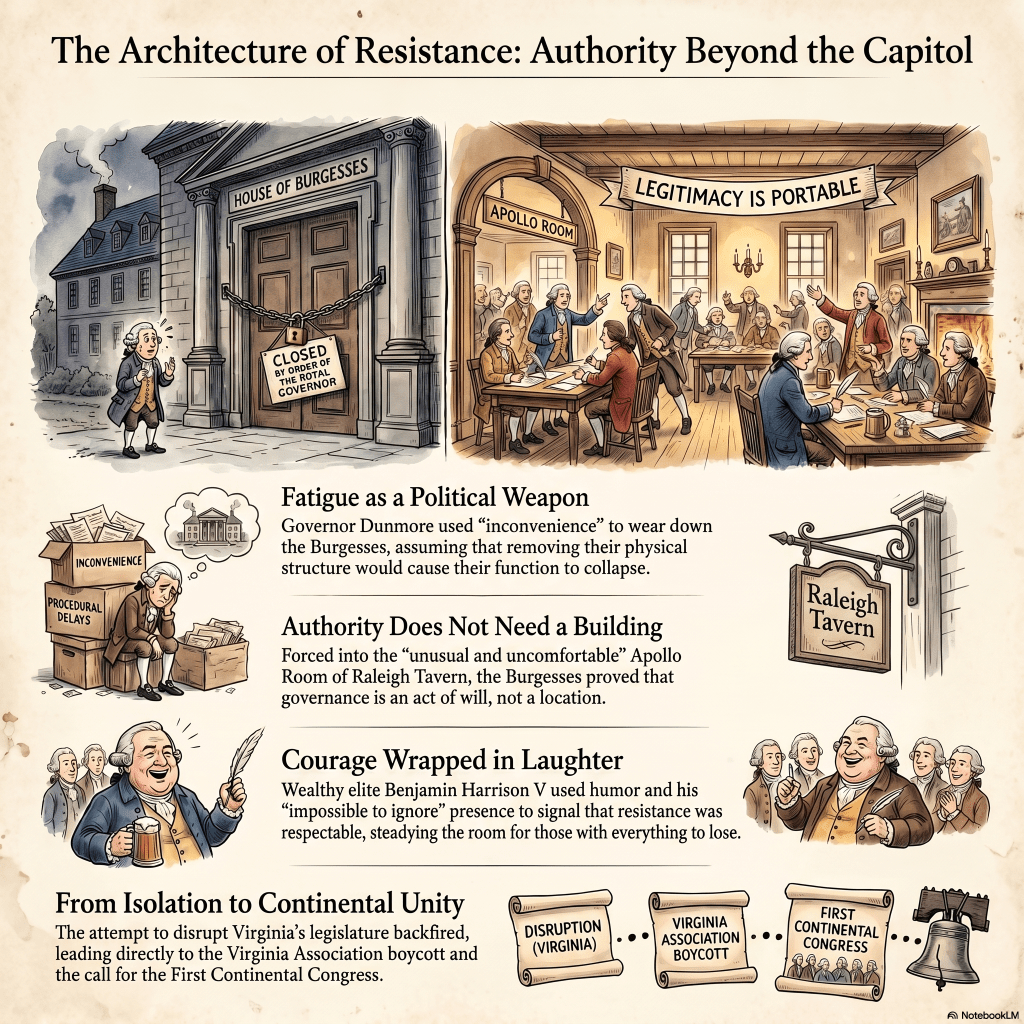
This is where Jefferson’s fourth grievance stops being theory and becomes something you can almost touch. When he later wrote about legislatures being forced into “unusual and uncomfortable” places, he was not crafting rhetoric. He was remembering this moment. He was remembering what it meant to be pushed out of the proper chamber and expected to simply fade away.
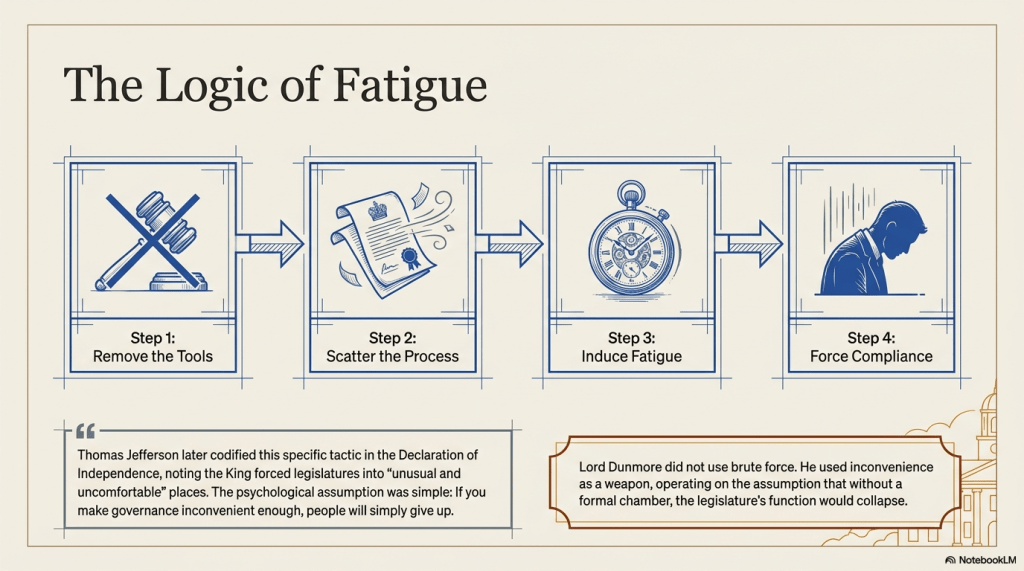
The strategy behind Dunmore’s action was not brute force. It was something quieter, something more insidious. It was inconvenience as a weapon. Remove the tools, scatter the process, make everything just difficult enough that eventually people decide it is not worth the effort. Fatigue becomes compliance.
The problem is that fatigue cuts both ways.
What Dunmore created was not exhaustion, at least not at first. What he created was a test. And sitting in that room, surrounded by candlelight and the low hum of voices, was a man who embodied the answer to that test.
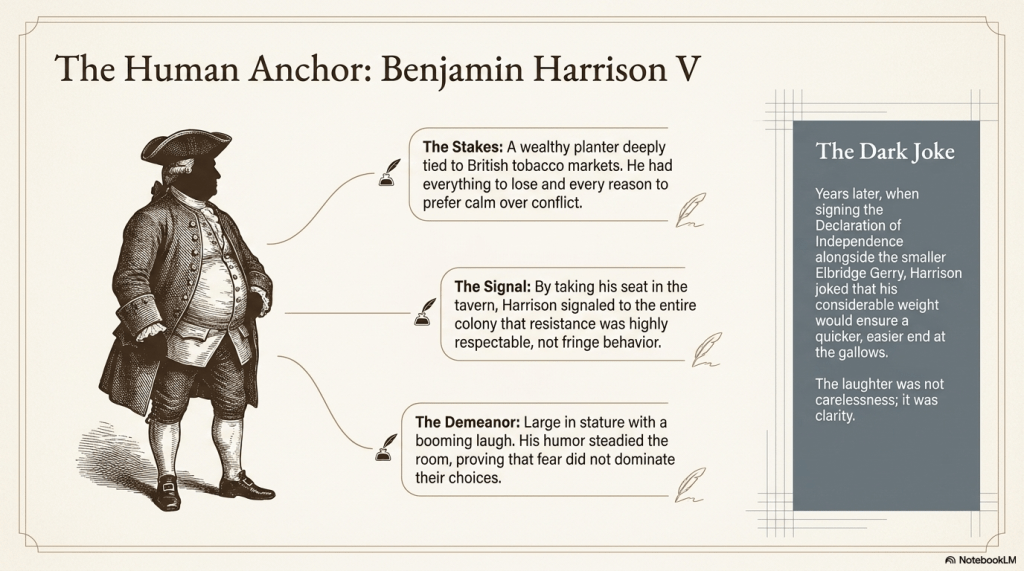
Benjamin Harrison did not look like a revolutionary. He looked like the system working exactly as it was supposed to. He was wealthy, established, tied to the economic structure of the Empire in ways that made stability far more valuable to him than disruption. His livelihood depended on tobacco, and tobacco depended on British markets. If anyone had a reason to prefer calm over conflict, it was Harrison.
He was also, by every account, impossible to ignore. Large in stature, generous in personality, and known for a sense of humor that could cut through tension like a blade. He was not a fiery orator, not the kind of man who would stand and deliver speeches that echoed through history. He was something steadier, and in this moment, something more important.
He stayed.
When Harrison took his seat in the Apollo Room, he did more than participate. He signaled. This was no longer the project of a handful of restless voices. This was now the concern of men who had everything to lose. His presence told everyone in that room, and everyone who would later hear about it, that resistance was not fringe behavior. It was becoming respectable.
The room itself reflected the shift. Tankards clinked against wood. Quills scratched across parchment. Smoke hung in the air, not as an inconvenience but as a reminder that this was not the sanitized environment of official power. This was something raw, something improvised, and yet something undeniably real.
What Dunmore intended as disruption became continuity. The Burgesses did not simply meet. They continued their work. They revisited their call for solidarity with Boston. They began to talk about broader responses, about what it meant if Parliament could do this to one colony and not the others.
That realization crept in slowly but firmly. If Boston could be shut down, so could Norfolk. If Norfolk, then Savannah. If Savannah, then Philadelphia. The pattern was not hard to see once you stopped pretending it was isolated.
And here is where the humor matters.
Harrison’s laughter was not a distraction. It was a signal of confidence. In a moment that could have been defined by uncertainty, by fear of what might come next, his ability to laugh changed the tone of the room. It reminded the men around him that they were not defeated, not yet, and perhaps not at all.
There is something deeply human about that. People do not follow arguments alone. They follow examples. A man willing to risk his wealth, his comfort, and eventually his safety, while still managing to laugh in the face of it, that is a powerful example.
It is easy, from a distance, to see this as inevitable. To assume that of course they would continue, of course they would resist, of course they would move toward independence. But in that room, none of that was guaranteed. What existed was a choice, made in real time, by men who could have chosen differently.
They could have gone home.
They did not.
Instead, they proved something that would echo far beyond Williamsburg. Authority does not reside in a building. It resides in the willingness of people to act together, to recognize that legitimacy comes from more than a seal on a door or a decree from a distant government.
Jefferson would later capture it in a single line, but the line only makes sense if you understand the scene behind it. Fatigue was supposed to break them. Inconvenience was supposed to silence them. Distance from their records and their formal setting was supposed to make governance impossible.
Instead, it made governance adaptable.
The Apollo Room was never meant to hold a legislature. On that day, it held something more significant. It held the realization that the machinery of government could be rebuilt wherever people refused to let it die.
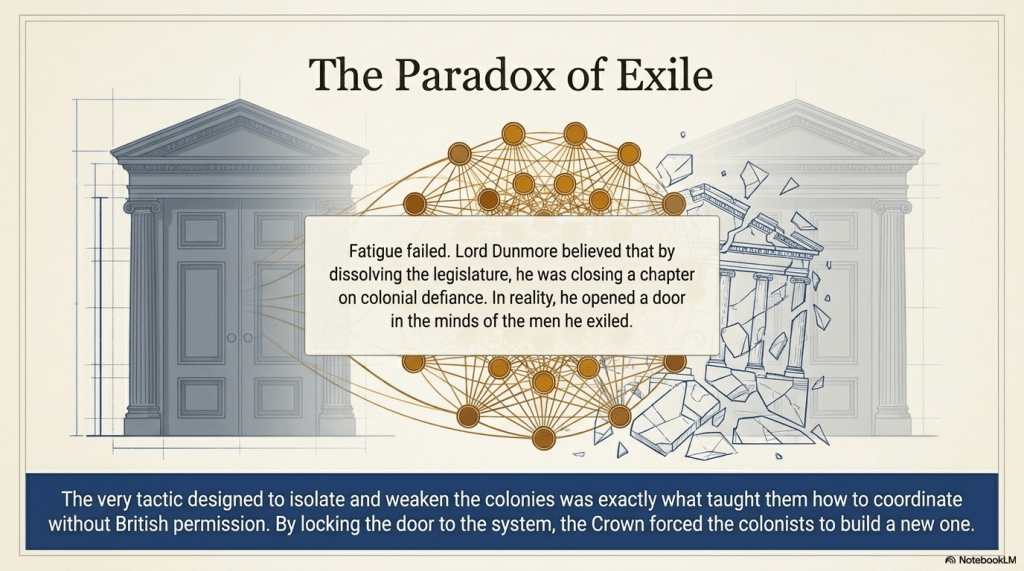
Dunmore believed he was closing a chapter.
What he actually did was open a door, not in the capitol building, but in the minds of the men who walked away from it.
If the walk to the Apollo Room proved that authority could survive without a building, what happened inside that room proved something far more unsettling to British officials. It could act without permission, and once it began to act, it did not intend to stop.
The immediate question before the Burgesses was Boston. The Boston Port Act had landed like a hammer, closing the harbor and effectively strangling the city’s economy. Parliament’s intent was not subtle. Boston had defied imperial authority, and Boston would be made an example of. The expectation, at least in London, was that the other colonies would take note, step back, and decide that discretion was the better part of survival.
For a moment, that expectation was not entirely unreasonable. Virginia was not Massachusetts. Its economy rested on tobacco, its social structure on landed wealth, and its political class on men who had much to lose if trade with Britain faltered. It would have been easy, even rational, to say that Boston had brought this on itself and that Virginia would do well to avoid the same mistake.
That argument did not survive the conversation.
In the Apollo Room sat Edmund Pendleton, a man not given to theatrical declarations but capable of cutting through confusion with a single line. He framed the issue in a way that stripped away all the comfortable distance Virginia might have tried to maintain. An attack on one colony, he argued, was an attack on all. It was not a slogan, not yet. It was a warning. If Parliament could isolate Boston and punish it without consequence, then the same method could be applied anywhere. Today it was Massachusetts. Tomorrow it could be Virginia.
That realization forced a shift in thinking that cannot be overstated. The colonies had long been separate in practice, connected by culture and trade but divided by local interests and priorities. What Pendleton articulated was the beginning of a new perspective, one in which those differences mattered less than the shared risk they now faced. If Parliament had found a way to discipline one colony effectively, then the rest could not afford to stand aside and hope they would be spared.
Once that idea took hold, the discussion moved quickly from sympathy to action. The question was no longer whether Boston deserved support, but what form that support should take. Direct confrontation with British authority remained a step too far for many in the room. War was not yet the goal, and independence was still a word spoken cautiously, if at all. What they needed was a response that would apply pressure without immediately breaking the imperial framework.
The answer they settled on was economic resistance.
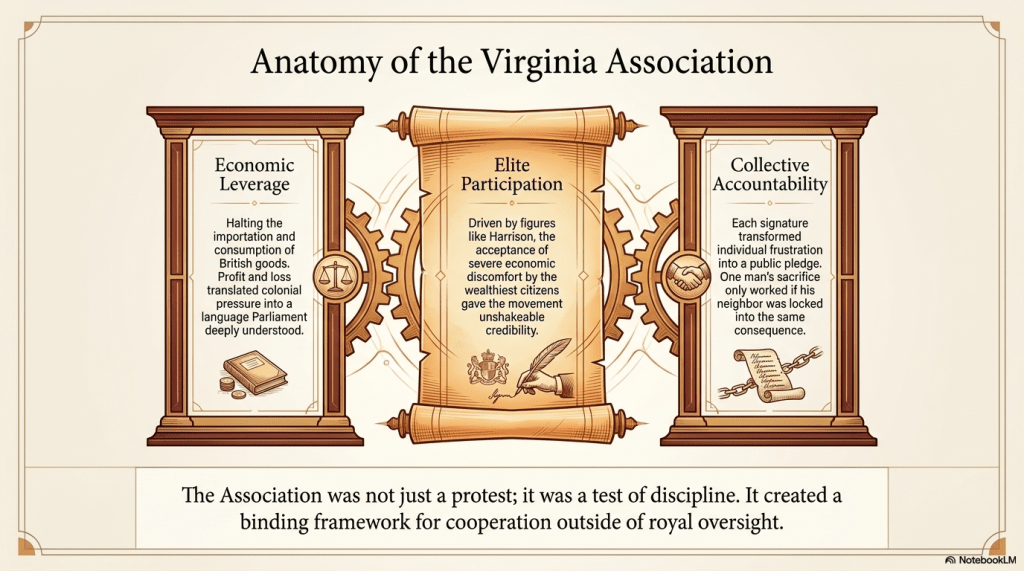
The logic was straightforward, almost cold in its calculation. British merchants depended on colonial markets. If those markets were closed, if imports were refused and consumption halted, then pressure would travel back across the Atlantic in a language Parliament understood very well. Profit and loss have a way of clarifying political questions that abstract arguments cannot resolve.
Turning that idea into reality required more than agreement in principle. It required commitment. The Burgesses began drafting what would become known as the Virginia Association, a document that pledged its signers to stop importing British goods and to cease consuming those already present. It was, on its surface, a boycott. In practice, it was a test of discipline and unity.
Such a pledge asked a great deal of the men who signed it. It meant altering daily habits, accepting inconvenience, and risking economic loss. For planters, merchants, and consumers alike, British goods were not luxuries but part of the fabric of their lives. To refuse them was to accept discomfort as the price of principle. It also meant trusting that others would do the same, because a boycott only works if it is widely observed. One man’s sacrifice means little if his neighbor quietly continues as before.
This is where the presence of Benjamin Harrison V carried weight beyond his signature. Harrison was not a marginal figure. He was a substantial landowner, a man whose wealth and position were tied directly to the system now being challenged. His decision to sign the Association signaled that this was not a gesture confined to the restless or the radical. It was a commitment that reached into the heart of Virginia’s elite.
There is also, as the transcript reminds us, something disarming about the way Harrison carried himself. He was large, physically imposing, and known for a laugh that could fill a room. In a moment charged with tension, his humor did not trivialize the situation. It steadied it. He had every reason to hesitate, every reason to calculate the cost, and yet he chose to act, and to do so without allowing fear to dominate the room. That combination of seriousness and levity mattered, because it made the choice to resist feel not only necessary but possible.
The Virginia Association did more than bind its signers to a course of action. It created a framework for cooperation. It turned individual frustration into collective policy. Each name on the document represented not just agreement but accountability. To sign was to declare publicly that one would abide by the terms, that one would accept the consequences, and that one expected others to do the same.
Even more important, the discussions that produced the Association began to look beyond Virginia’s borders. If the problem was imperial in scope, the response would have to be as well. The idea of intercolonial coordination, hinted at in earlier protests, now took on a more concrete form. The Burgesses recognized that isolated action, however principled, would not be enough to counter a unified imperial policy.
From that recognition came the call for a First Continental Congress. This was not an inevitable development. It required colonies to set aside long-standing differences and agree to send representatives to a common forum. It required trust, or at least the willingness to act as if trust existed. It also required a shift in identity, from Virginians or Massachusetts men or Pennsylvanians to something broader, something not yet fully defined but clearly emerging.
The significance of that call is easy to overlook in hindsight. Knowing where the story leads, it is tempting to see the Continental Congress as the obvious next step. At the time, it was a bold move into uncertain territory. It suggested that the colonies might act together not just in protest but in governance, that they might begin to coordinate their policies and speak with something like a unified voice.
All of this flowed from a moment that began with a locked door. Lord Dunmore believed he could end resistance by dissolving a legislature. Instead, he forced that legislature to redefine itself. In the Apollo Room, the Burgesses discovered that their authority did not depend entirely on official sanction. They could meet without a chamber, act without permission, and commit themselves to a course that reached beyond their own colony.
Pendleton’s principle gave them the reason. Harrison’s presence gave them confidence. The Virginia Association gave them a method. The call for Congress gave them a future.
What began as a response to Boston became something larger, a recognition that the colonies were bound together not only by shared grievances but by shared risk. Once that recognition took hold, the path forward, though still uncertain, pointed in a new direction. It led away from isolated protest and toward collective action, a shift that would, in time, make the idea of unity not just possible but necessary.
Jefferson had a way of choosing words that looked harmless until you sat with them for a while. He did not always thunder. He did not always accuse in language that made men pound tables. Sometimes he slipped a single term into a list of grievances and trusted that anyone paying attention would understand exactly what it meant.
“Fatiguing.”
It does not sound like tyranny. It sounds like inconvenience. It sounds like the sort of thing you complain about after a long day and then forget by morning. But Jefferson knew better, and more importantly, he knew the men who had lived through it would recognize it instantly.
To be fatigued by government is not simply to be made tired. It is to be worn down deliberately, systematically, until resistance begins to feel pointless. It is to have your work made harder than it needs to be, your meetings disrupted, your processes scattered, your ability to function chipped away piece by piece. No single act looks decisive. No single order looks outrageous. But taken together, they create a pressure that is meant to produce one outcome.
Compliance.
When Thomas Jefferson wrote that the King had forced legislatures into “unusual and uncomfortable” places, he was describing a tactic, not an accident. The distance between a proper chamber and a tavern was not just physical. It was psychological. It was meant to remind those men that their authority was conditional, that their ability to govern depended on the tolerance of someone far away.
If you can make governance inconvenient enough, Jefferson understood, you do not need to outlaw it outright. You simply wait for people to give up.
That was the theory.
The practice, as it turned out, did not cooperate.
Because what happened in Virginia did not stay in Virginia. The story of the Burgesses walking out of the capitol and into the Apollo Room traveled, and as it traveled, it changed the way other colonies thought about their own situations. If a legislature could continue in a tavern in Williamsburg, why not in a church in Massachusetts, or a meeting house in Pennsylvania, or a private home in New York?
And so they did.
Assemblies began to meet wherever they could. Taverns, churches, homes, any place with a table and enough light to see by. The formal trappings of authority were stripped away, but the function remained. In some cases, the work became harder. Records had to be reconstructed. Procedures had to be improvised. Messages had to be carried by hand across long distances. Nothing was easy.
But it was possible.
And that was enough.
What Jefferson had identified as a method of control became, almost by accident, a method of adaptation. The more the Crown attempted to disrupt colonial governance, the more the colonists learned how to operate without its approval. Authority, they discovered, did not reside in buildings or seals or official recognition. It resided in the willingness of people to act together and to recognize one another’s legitimacy.
That realization is quiet, but it is profound.
It means that power can be reassembled.
It means that the loss of formal structures does not necessarily mean the loss of function.
And once people understand that, the balance begins to shift.
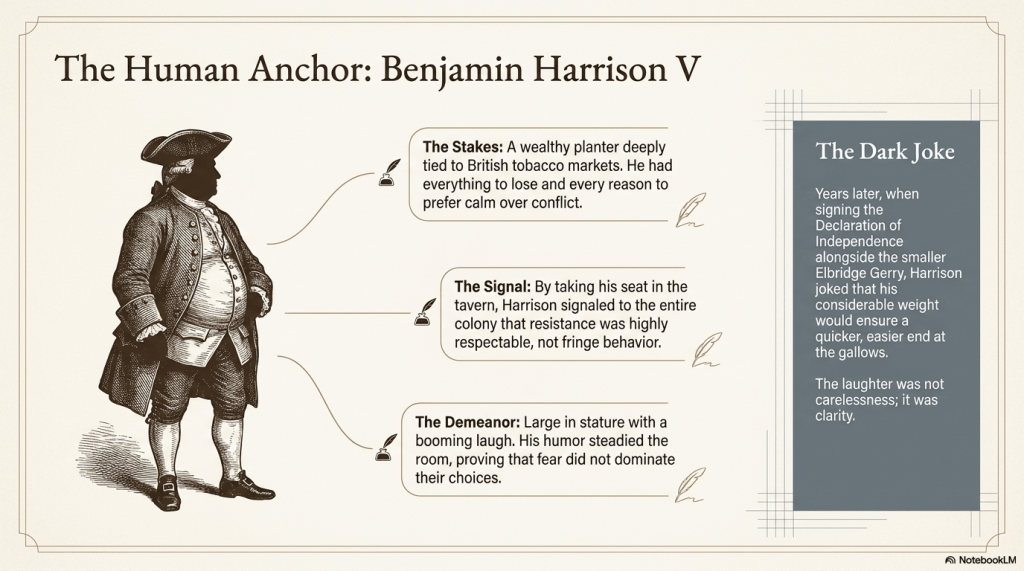
Benjamin Harrison sits at the center of that shift, though he would probably have laughed at the idea of being described that way. In the Apollo Room, he is a presence, a man whose size and personality fill the space as much as his voice. His laughter, which might have seemed out of place in a moment of tension, becomes something else entirely. It becomes a signal that the situation, while serious, is not hopeless.
He does not look like a man preparing for revolution. He looks like a man who has lived comfortably within the system and expects to continue doing so. That is precisely why his choices matter.
From that tavern room, Harrison’s path leads to Philadelphia, to a different room, a different table, and a decision that carries far greater consequences. By the time he arrives there, the argument has evolved. Fatigue has not produced compliance. It has produced something closer to defiance. The inconveniences meant to weaken colonial resistance have instead hardened it.
The man who once signed a non-importation agreement in a tavern now faces a document that declares independence outright.
And he signs that as well.
There is a story, one that has been told often enough to carry the weight of tradition, about Harrison standing beside Elbridge Gerry as the delegates prepared to affix their names to the Declaration. Gerry, smaller and more reserved, expressed concern about what might happen if the British prevailed. Harrison, with that same booming humor, is said to have replied that when the time came, he would have the advantage, as his own considerable weight would ensure a quicker end at the gallows.
It is a dark joke.
It is also a revealing one.
Because it shows that Harrison understood exactly what he was doing. This was not abstract. This was not theoretical. Signing that document was an act of treason in the eyes of the Crown. It carried the possibility of death, not as a distant consequence but as a very real one.
And yet he laughed.
That laughter is not carelessness. It is clarity. It is the recognition that fear, while justified, does not have to dictate action. It is the same quality that filled the Apollo Room years earlier, the same refusal to allow pressure to become paralysis.
When Jefferson writes of fatigue, he is describing a strategy that depends on a certain kind of human response. It assumes that people, when pushed hard enough, will eventually choose the easier path. They will accept inconvenience up to a point, and then they will step back, decide it is not worth it, and return to compliance.
What the Crown misjudged was the nature of the people it was dealing with.
Not that they were uniquely brave or uniquely stubborn, though there was certainly some of that. It was that they had been shaped by a tradition that placed value on participation, on consent, on the idea that government was something they were part of rather than something imposed upon them. When that participation was disrupted, they did not simply wait for it to be restored. They recreated it.
Imperfectly, awkwardly, sometimes inefficiently, but persistently. The result was not exhaustion.
It was cohesion.
Colonies that had once operated independently began to see themselves as part of a larger whole. Shared inconvenience became shared experience. Shared experience became shared purpose. The very tactic designed to isolate and weaken them began to bind them together.
By the time independence is declared, that process is well underway.
It is worth returning, for a moment, to the image of the Apollo Room. Not as a quaint historical detail, but as a symbol of what changed. Candlelight flickers against wooden walls. Papers spread across a table not designed for legislation. Voices rise and fall, arguments made, decisions taken. And in the middle of it all, Harrison’s laughter cuts through the tension.
It is not a grand chamber. It is not a place built for history.
And yet, history happens there.
Because the men in that room decide that the absence of comfort is not the same as the absence of authority. They decide that inconvenience will not dictate their actions. They decide, in ways both large and small, that they will continue.
Jefferson’s word lingers over all of it.
Fatigue.
It was meant to end the conversation. Instead, it extended it.
It forced it into new spaces, new forms, new relationships. It pushed it beyond the limits that had previously contained it. And in doing so, it helped create the conditions under which independence could be imagined, argued, and eventually declared.
Fatigue failed.
Exile did something else entirely.
It bred unity.
Continental Congress. The Declaration of Independence. Philadelphia, July 4, 1776.
Great Britain. Parliament. An Act to Discontinue… the Landing and Discharging, Lading or Shipping, of Goods… at the Town, and within the Harbour, of Boston. 14 Geo. III, c. 19 (Boston Port Act), 1774.
Jefferson, Thomas. The Papers of Thomas Jefferson. Edited by Julian P. Boyd et al. Princeton: Princeton University Press, 1950–.
Pendleton, Edmund. The Letters and Papers of Edmund Pendleton, 1734–1803. Edited by David J. Mays. Charlottesville: University Press of Virginia, 1967.
Virginia House of Burgesses. Journals of the House of Burgesses of Virginia, 1773–1776. Richmond: Virginia State Library.
Virginia House of Burgesses. The Virginia Association. Williamsburg, May 1774.
Washington, George. The Papers of George Washington, Colonial Series. Edited by W. W. Abbot et al. Charlottesville: University Press of Virginia, 1983–.
Williamsburg Printers. The Virginia Gazette. Williamsburg, VA, May–June 1774.
Originally published/broadcast September 30, 2025
Republished May 2, 2026


 DAVE DOES HISTORY
Leave a comment