
It is easy to remember the soaring lines. People quote them on cue, stand for them, teach them to children who may not yet grasp their weight. But Jefferson did not build his case on poetry alone. He built it on complaints, blunt and specific, the kind that sound less like philosophy and more like a man sitting at a table saying, “Here is what you did, and here is why we cannot live with it.”
That was the point.



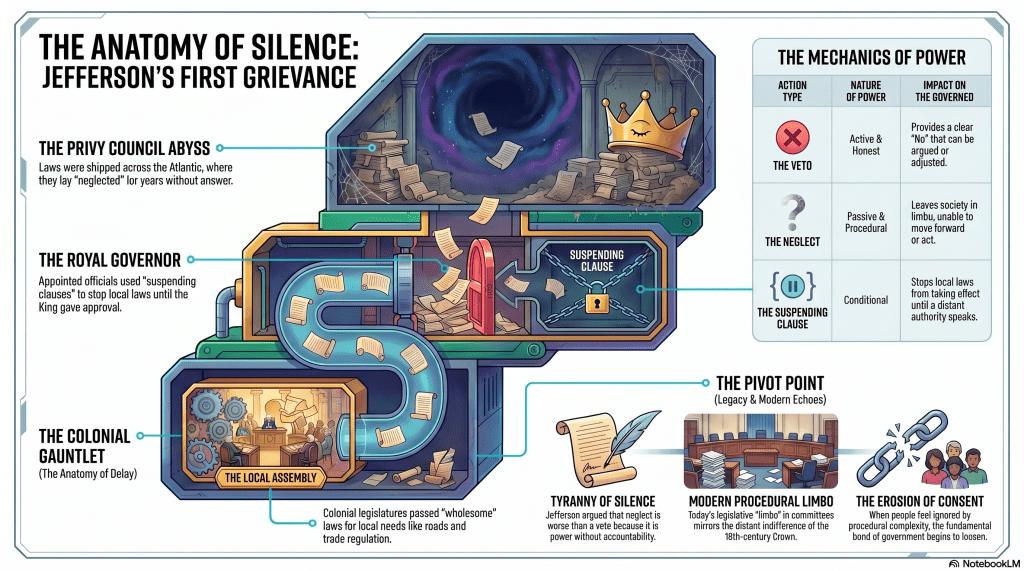
The Declaration, for all its reputation as a document of ideas, spends most of its time doing something else entirely. It lays out a case. Not a theory. Not a wish list. A case. “Let facts be submitted to a candid world.” That line matters more than people tend to notice, because it tells you what Jefferson thought he was doing. He was not inventing a new political system from scratch. He was explaining, in plain terms, why the old one had failed beyond repair.
And so he begins, not with taxes or troops or burned towns, but with something that, at first glance, sounds almost procedural.
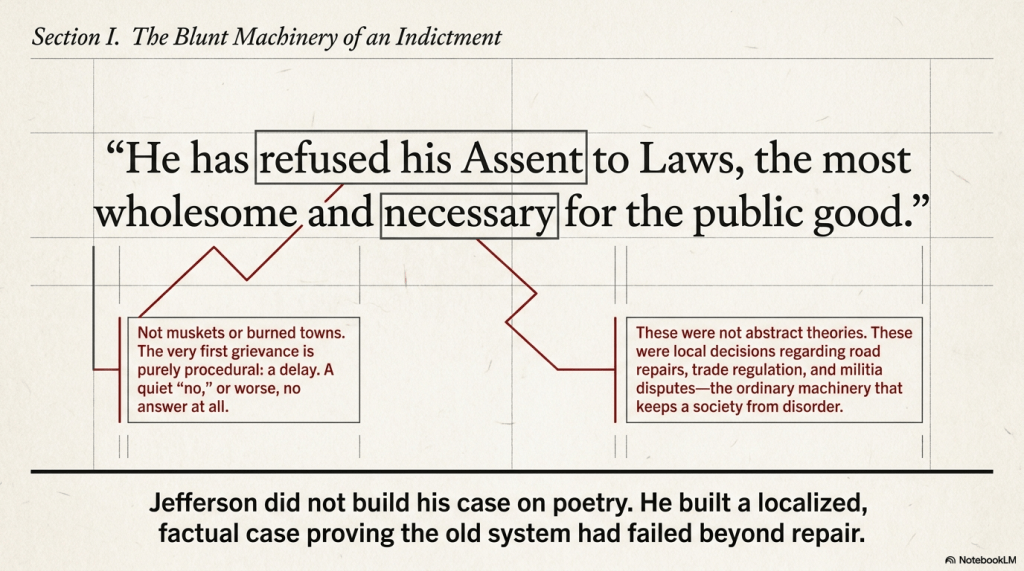
“He has refused his Assent to Laws, the most wholesome and necessary for the public good.”
It does not sound like the stuff of revolution. No muskets. No marching armies. Just a refusal. A delay. A quiet “no,” or worse, no answer at all. But that is precisely why it sits at the top of the list. It cuts to the bone of how a government is supposed to function.
Because those laws were not abstractions. They were local decisions, passed by colonial assemblies that understood their own needs in a way no one in London could. Roads to be repaired. Trade to be regulated. Disputes to be settled. The ordinary machinery of daily life. The kind of things that keep a society from slipping into disorder.
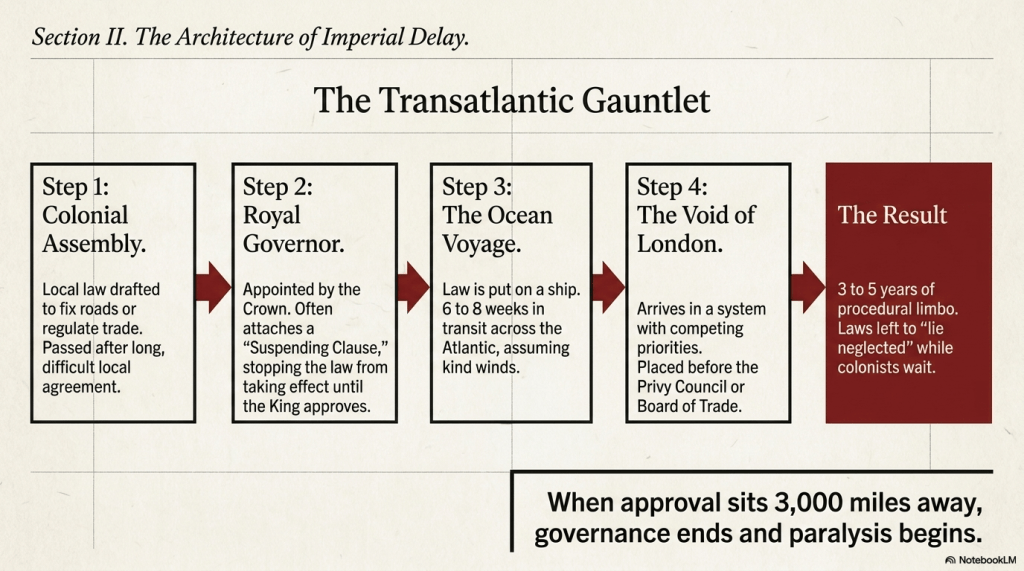
And yet, those laws had to run a gauntlet.
They passed through colonial legislatures, which was no small feat on its own. Then they faced the royal governor, a man appointed by the Crown, who could stop them with a single decision. And even if they survived that, they could be shipped across the Atlantic, weeks in transit, to be examined by officials who had never set foot in the places they were governing. There, in the chambers of the Privy Council, they could be approved, rejected, or simply ignored.
Ignored turns out to be the most dangerous of the three.
Because a veto, however frustrating, is at least an answer. You know where you stand. You can respond. You can argue. You can try again. But neglect is something else entirely. It leaves you suspended, waiting, unable to act, unable to move forward, unsure whether the problem will ever be addressed.
Jefferson had already complained about this years earlier, noting that laws were allowed to “lie neglected in England for years.” That was not inefficiency. That was a signal. It told the colonists that their concerns were not urgent, that their judgment was not trusted, that their ability to govern themselves was conditional at best.
And that is where irritation turns into something sharper.
Because at some point, a people begins to ask a question that is difficult to put back once it is spoken. If we cannot pass laws for our own welfare, if our decisions can be delayed or dismissed by people an ocean away, then what exactly are we?
Subjects, certainly.
Citizens, not quite.
The frustration is not hard to imagine, even now. The transcript makes it plain in a way that feels uncomfortably familiar. When government refuses to act on what people believe are necessary measures, or simply lets them disappear into procedural limbo, it creates that same sense of being ignored, of standing there with something important to say while those in power look the other way.
It is not the noise of tyranny that does the damage. It is the silence.
Jefferson understood that, which is why he put this grievance first. Not because it was the most dramatic, but because it was the most fundamental. A government that will not respond, that will not even engage with the needs of its people, has already begun to fail in its basic purpose.
That is the pivot point.
Everything that follows in the Declaration, every accusation, every example, builds on this idea. The colonists were not rebelling because they disliked authority in the abstract. They were rebelling because the authority they lived under had stopped functioning in a way they could recognize as legitimate.
And that leaves a question hanging in the air, the kind that does not belong neatly to the eighteenth century.
What happens when people believe the laws they need are being blocked, delayed, or quietly buried?
Do they shrug and call it politics?
Or do they start to wonder whether the system itself is no longer answering them?
Jefferson would have had a very clear opinion on that.
The rest of us are still deciding.
The words Jefferson chose sound formal, almost distant, the sort of language that belongs in a law book rather than in the middle of a revolution. “Refusing assent.” “Suspending clauses.” You can read right past them if you are not careful, and if you do, you miss the machinery that turned irritation into rebellion.
Because this was not abstract. It was procedural, which made it worse.
A colonial assembly would meet, sometimes after long argument, sometimes after pressure from towns and merchants and farmers who needed something fixed or funded or clarified. They would pass a law. That alone was not simple. Anyone who has ever watched a legislature work knows that getting agreement is half the battle. But in the colonies, passing the law was only the beginning.
Next came the governor, a man appointed by the Crown, a man who did not answer to the people who lived there. He could approve the law. He could veto it outright. Or, and this is where the trouble deepens, he could attach what was called a suspending clause.
That clause did exactly what it sounds like. It stopped the law from taking effect until the King gave his approval. Not Parliament. Not the local assembly. The King, or more precisely, the King’s machinery in London.
So the law, passed locally for a local need, was put on a ship and sent across the Atlantic. Six to eight weeks on the water if the winds were kind. Then it landed in a system that had its own priorities, none of which included urgency for a colony three thousand miles away.
There it would sit.
The Privy Council would review it, or not. The Board of Trade might examine it, or set it aside. Months would pass. Sometimes years. Three, four, even five years was not unusual before a decision came back, if it came back at all.
Imagine trying to run anything that way. A road project delayed because the approval is somewhere in London. A law about local trade hanging in limbo while merchants wait. A militia regulation that cannot take effect because someone across the ocean has not yet decided whether it is convenient.
At some point, it stops being governance.
It becomes paralysis.
Jefferson’s complaint cuts deeper than a simple veto. A veto, at least, is honest. It tells you no. It forces the issue into the open. You can respond to it. You can fight it. You can adjust. But neglect, the quiet letting of laws “lie neglected,” as he put it, is something else entirely. It is indifference dressed up as procedure. It is power exercised without accountability, because no one ever has to explain a decision that was never made.
That is why he put it first.
And the colonists noticed the pattern. Laws they considered “wholesome and necessary” were the very ones most likely to be delayed or discarded, especially if they conflicted with British interests. What made sense in Massachusetts or Virginia did not necessarily align with what made sense in London, and London held the final word.
There is a telling moment in Massachusetts, one of those small acts that reveals a larger truth. The assembly there simply refused to play along with the suspending clause. They argued that their laws should stand unless the King actively vetoed them. In other words, silence should not count as control. If London wanted to stop a law, it should say so plainly.
Even some royal governors, men who owed their positions to the Crown, found the system difficult to defend. They were expected to govern, to maintain order, to respond to local needs. Yet they were also bound by instructions that required them to delay the very laws that would allow them to do their jobs. It left them in an awkward position, representatives of authority who could not exercise it in any meaningful way.
It is not hard to see why frustration built.
And here is where the past leans uncomfortably into the present.
Because the question Jefferson raises does not belong only to the eighteenth century. It lingers. Is it worse for a government to say no, or to say nothing at all? To veto a law openly, or to let it disappear into committees, reviews, and procedural delays until it is effectively dead without ever being declared so?
The transcript puts it in plain terms. A bill can be introduced, debated, even passed in one chamber, and then simply vanish. Not rejected. Not approved. Just left to sit.
Sound familiar.
It is not the same system. The structures are different. The distances are shorter. But the feeling, that sense of being ignored, of watching something you believe is necessary drift into limbo, that has not changed as much as we might like to think.
Jefferson called that neglect a form of tyranny.
The rest of us are left to decide whether we recognize it when we see it.
If Jefferson had stopped with the complaints, the document might have read like any other list of grievances, sharp, justified, and ultimately limited to its moment. But what gives those complaints their staying power is what came next. The colonists did not simply walk away from the British system. They tried to build something that would make those same failures harder to repeat.
They had learned, painfully, that power without restraint tends to drift. It does not always crash through the door. Sometimes it simply stops answering. Sometimes it delays. Sometimes it lets necessary action rot until the people affected no longer expect a response. That experience left its mark on the system that followed.
When the framers later sat down to shape the Constitution, they did so with those frustrations still fresh. They built checks and balances not as a philosophical exercise, but as a practical safeguard. If one branch refused to act, another could respond. If a president vetoed a law, Congress could override it. If legislation stalled, it did so in the open, subject to debate and, at least in theory, to accountability at the ballot box. Even time limits, the rhythm of elections and sessions, were meant to prevent the kind of indefinite suspension Jefferson had described. No more laws drifting across an ocean to be forgotten. No more silence masquerading as authority.
That was the intent.
But intent has a way of meeting reality, and reality is rarely tidy.
The system we built did not eliminate the problem Jefferson identified. It reshaped it. Instead of a king across the Atlantic, decisions now move through layers of committees, agencies, and offices that can feel just as distant, even if they sit within the same borders. A bill can be introduced with great urgency, debated with great passion, and then quietly stall. Not defeated. Not approved. Just left in a kind of procedural limbo that feels, to the people waiting on it, very much like the neglect Jefferson described.
And then there is the question of power itself, because power rarely disappears. It relocates.
In the eighteenth century, it rested in the Crown and its appointed officials. Today, it is more diffuse, spread across elected offices, regulatory bodies, and, increasingly, institutions that operate with a degree of independence that can be both necessary and unsettling. Regulatory agencies write rules that carry the force of law. Executive actions can shape policy without passing through the full legislative process. Courts interpret, and sometimes redefine, the boundaries of authority. Each of these functions has a rationale. Each can be defended as part of a complex modern state.
But complexity has a cost.
It creates distance between decision and consent. It makes it harder to see who is responsible for what. It allows action to occur without the clear, visible assent or rejection that Jefferson demanded. And when people begin to feel that distance, when they begin to suspect that decisions are being made beyond their reach or without their meaningful input, the old question returns.
Who, exactly, is giving consent?
Layer onto that the influence of wealth, and the picture becomes more complicated still. Jefferson worried about concentrated power in the hands of a monarch. He would likely have had strong opinions about concentrated power in the hands of economic elites. Campaigns require funding. Policies affect industries. Access, in any system, tends to follow influence. When citizens begin to believe that wealth carries more weight than their vote, that access is bought rather than earned, the system begins to look less like a republic of equal citizens and more like something older.
Call it an aristocracy if you like. Not of titles, but of resources.
It is not the same as the world Jefferson knew. But it rhymes.
And then there is the quieter problem, the one that does not make headlines as easily because it does not announce itself with dramatic conflict. It is the slow erosion of participation. Voters who feel unheard stop speaking. Citizens who believe the outcome is predetermined stop engaging. Consent, which Jefferson treated as the foundation of legitimacy, begins to thin out, not because it is formally withdrawn, but because it is no longer actively given.
That is a dangerous place for any system to find itself.
Because once consent becomes assumed rather than earned, the structure begins to shift. It may still function. Laws will still be passed. Courts will still rule. Agencies will still regulate. But the underlying relationship, the one Jefferson insisted upon, starts to loosen.
And history suggests that people notice.
Not always immediately. Not always in a uniform way. But the feeling builds, the same way it did in the colonies, that decisions are being made elsewhere, that necessary actions are being delayed or denied, that the system is no longer responding as it should. When that feeling takes hold, it does not stay contained to polite debate. It moves. It manifests. Sometimes in elections. Sometimes in protest. Occasionally in ways that are far less orderly.
That is the thread that connects Jefferson’s grievances to the present. Not the specific complaints, which belong to their time, but the principle beneath them. Governments derive their just powers from the consent of the governed. That is not a suggestion. It is a condition. When that consent is present, authority holds. When it weakens, authority becomes fragile, no matter how strong it appears on paper.
And when a government stops securing the rights it was meant to protect, the Declaration does not offer a gentle remedy. It offers a stark one. The people retain the right to alter or abolish it, and to institute something new.
That is not a comfortable idea to carry forward. It was not comfortable in 1776, and it is not comfortable now. But it is there, written plainly, part of the blueprint that has never been fully retired.
Which brings us back, inevitably, to the question that sits at the center of all of this.
Are we keeping faith with that principle?
It is easy to answer in the abstract. Harder in the details. Harder when you look at a stalled bill, or a regulation that seems to emerge without clear consent, or a policy shaped by interests that do not feel widely shared. Harder when citizens begin to feel like observers rather than participants.
Do we still have “assent of laws” problems, just dressed in modern language?
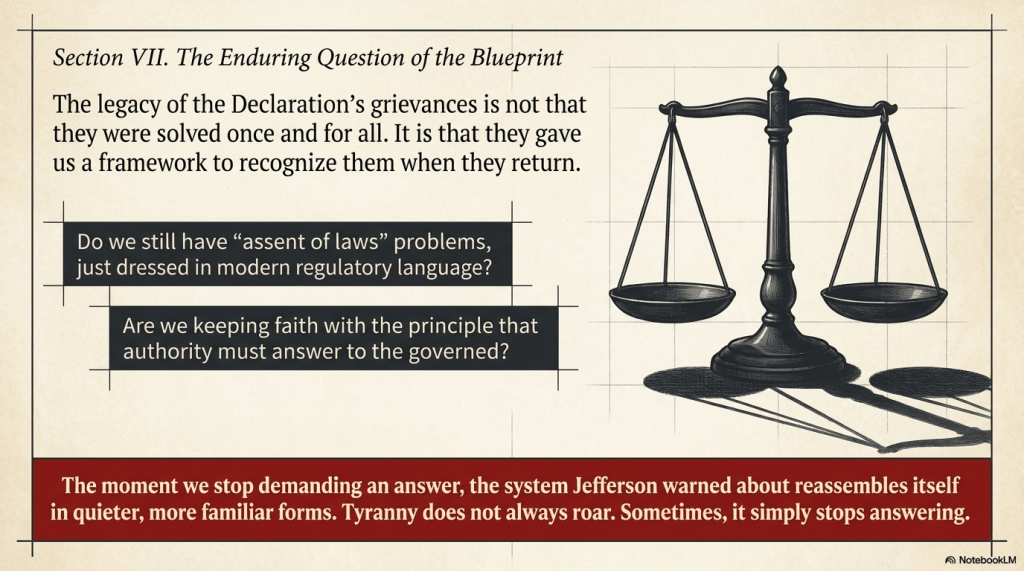
That is not a question with a clean answer. It is not meant to be. It is meant to be asked, again and again, because the moment it stops being asked, the system Jefferson warned about begins to reassemble itself in quieter, more familiar forms.
The legacy of those grievances is not that they were solved once and for all. It is that they gave us a way to recognize them when they return.
And they do return.
The difference, now as then, lies in whether we are willing to see them clearly, and whether we are willing to insist that the system answer.
Originally published on September 2, 2026
Republished April 30, 2026
Amar, Akhil Reed, and Samarth Desai. “The Annotated Declaration of Independence.” National Constitution Center, 2026.
Andrews, Charles M. “The Royal Disallowance.” American Antiquarian Society, October 1914.
Calhoun, Craig. “Public.”.
Compton, John W., and Karen Orren. “Political Theory in Institutional Context: The Case of Patriot Royalism.” American Political Thought 3, no. 1 (Spring 2014): 1-31.
History Stack Exchange Contributors. “What laws did the king ‘refuse to pass… unless those people would relinquish the right of representation’?” History Stack Exchange, May 7, 2017.
Keyser, Richard. “Ch. 2.3. Jefferson’s Charges Against the King, Group I: Eight Charges from his Summary View.” In American Legal History to the 1860s. University of Wisconsin Pressbooks, 2020.
National Humanities Center. “The Declaration of Independence, 4 July 1776, annotated.” America in Class, 2010-2013.
Ranger Val, and Ranger Bill. “The Declaration of Independence: What Were They Thinking?” Fort Stanwix National Monument (U.S. National Park Service), June 30, 2021.
The Claremont Institute. “He has refused his Assent to Laws the most wholesome and necessary for the public Good.” Founding.com, 2016-2021.


 DAVE DOES HISTORY
Leave a comment