
It was a gray November day in 1863, the kind that hangs low over the Pennsylvania hills as if the sky itself is still thinking about what happened there. Battle of Gettysburg had ended months before, but the ground had not yet made peace with it. Fifty thousand casualties have a way of lingering, even when the shooting stops.



They gathered to dedicate a cemetery, which sounds neat and orderly until you remember what that really means. Rows of fresh graves. Families who would never quite be whole again. A nation trying to decide whether any of it made sense.
The main speaker talked for hours that day. He walked through the campaign, every movement, every decision, every turn of the line. It was impressive. It was detailed. It was also forgotten almost as soon as it ended. Then Abraham Lincoln stood up, said a few words, and quietly rearranged the meaning of the entire war.
He did something that was not obvious at first glance. He reached backward.
“Four score and seven years ago,” he said, which is not how most politicians open a speech unless they are trying to send you somewhere specific. Eighty-seven years. Do the math, and you land in 1776. Not 1787. Not the Constitutional Convention. Not the machinery of government, however brilliant it may be. He bypassed all of that and anchored the nation in Declaration of Independence.
That was not an accident. It was a choice, and a sharp one.
Lincoln understood something that people often miss when they get lost in clauses and amendments. Laws tell you how a nation operates. They do not tell you why it exists. By pointing back to 1776, he was saying that the United States was not born in the careful balancing of powers, but in a dangerous idea. An idea that was never entirely safe, never entirely comfortable, and certainly never fully achieved.
“All men are created equal.”
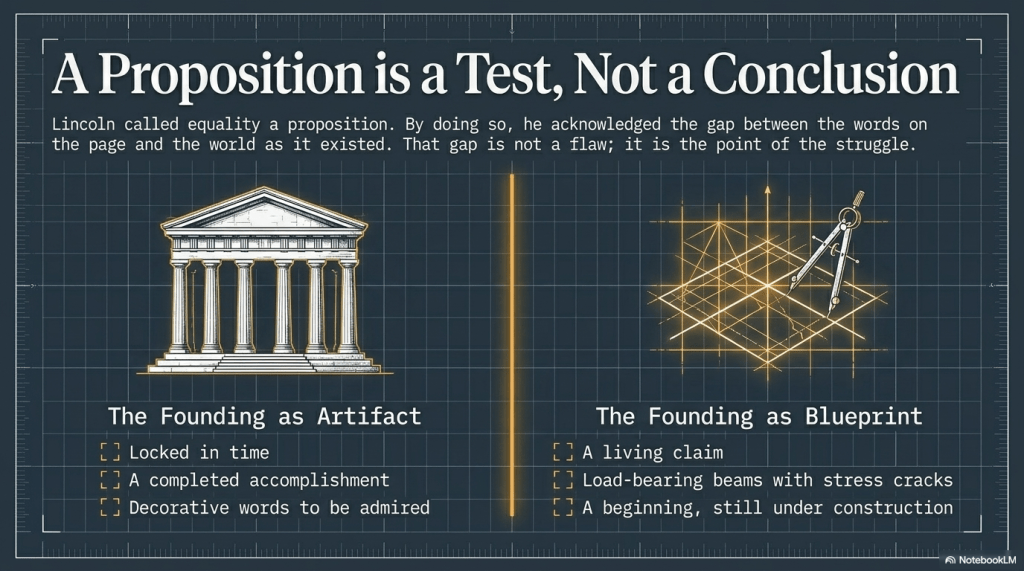
He treated that line not as a historical curiosity, not as something to be admired and then quietly set aside, but as a living claim. A proposition, as he called it. And a proposition is not a conclusion. It is a test.
That matters more than people like to admit.
Because if those words are merely decorative, then the war at Gettysburg was a tragic misunderstanding. If they are real, then the war becomes something else entirely. It becomes a question, asked in blood, about whether a nation built on those principles can survive the strain of its own contradictions.
Lincoln did not pretend the country had lived up to its promise. He was too honest for that, and too aware of the cost being paid in real time. By calling equality a proposition, he acknowledged the gap between the words on the page and the world as it existed. That gap was not a flaw in the document. It was the point of the struggle.
He was telling his audience, and perhaps himself, that the founding was not an accomplishment. It was a beginning.
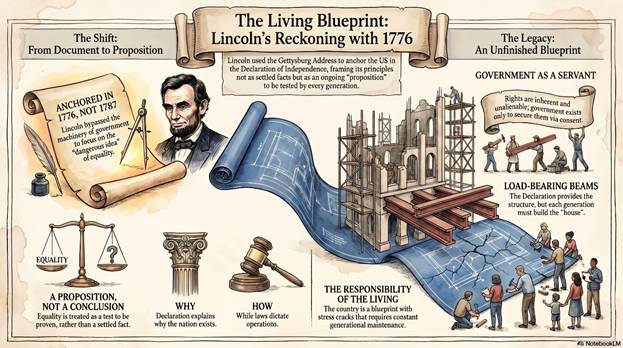
Seen through that lens, the Civil War stops being a fight over territory or even union in the narrow sense. It becomes a reckoning. A test of whether the principles laid down in 1776 were durable enough to endure a crisis they had not resolved. captures this clearly in the transcript, where Lincoln’s framing ties the present conflict directly to the “proposition that all men are created equal,” making the war less about preserving lines on a map and more about preserving the meaning of the nation itself.
There is a hard edge to that idea if you sit with it long enough. It means the country is never finished. It means each generation inherits not a completed structure, but a blueprint with missing pieces and stress cracks already forming. It means the question Lincoln posed at Gettysburg does not stay in 1863.
It walks forward.
And that is why those 272 words outlasted the long speech that preceded them, the monuments that followed, and even some of the arguments that tried to explain them away. Lincoln did not solve the problem. He made it unavoidable.
He reminded a grieving country that its foundation was not a document locked in time, but a claim that demands to be tested again and again.
A nation conceived in liberty, he said, and dedicated to a proposition.
Not a certainty. Not a guarantee.
A proposition.
And propositions, as every honest historian knows, have a way of coming back around until they are either proven true or quietly abandoned.
Once Lincoln had pulled the nation back to 1776, he did not leave it there like a relic under glass. He treated it as a working document, something still under construction, still being tested in the hands of people who did not have the luxury of pretending it was finished. That is where the Declaration begins to reveal itself not as a moment, but as a blueprint.
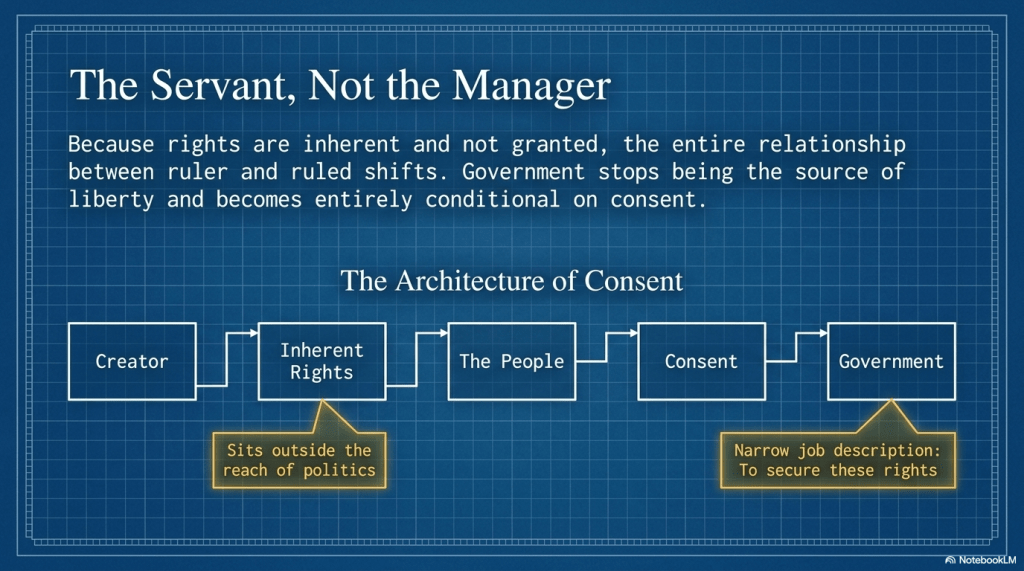
The language is easy to read. That is part of its power. “Endowed by their Creator with certain unalienable rights.” It rolls off the tongue with a kind of quiet confidence, the sort that does not bother to argue because it assumes the argument is already settled. But that calm surface hides a radical claim. Those rights do not come from Parliament, or a king, or even from the careful machinery of law. They exist before any of that. They sit outside the reach of politics, which means they cannot be voted away, negotiated down, or politely ignored when inconvenient.
That idea alone is enough to make any government a little nervous, and it should. Because once you accept that rights are inherent, not granted, you have changed the entire relationship between the ruler and the ruled. Government stops being the source of liberty and becomes its servant. Not its manager, not its distributor, but its servant. That is not how most governments in history have preferred to see themselves.
The next line tightens the screws. Governments, Jefferson writes, are instituted among men “to secure these rights.” Not to define them. Not to expand them when it is politically useful. To secure them. It is a narrow job description, and a demanding one. It also comes with a condition that cannot be quietly set aside. They derive “their just powers from the consent of the governed.”
Consent is a slippery word. It is easy to claim and harder to prove. But Jefferson and the men around him were not speaking in abstractions. They had spent years arguing over representation, taxation, and authority. They had watched a distant government act as if consent were optional, a box to be checked rather than a foundation to be maintained. What they wrote in that moment was not theoretical. It was corrective.
And it was permanent.
This is where the document stops sounding like a complaint and starts sounding like a warning. If government exists to secure rights, and if its authority depends on consent, then what happens when it fails? Jefferson does not hedge. He does not soften the language to make it more palatable. He writes that it is the right of the people to alter or abolish it, and to institute new government in its place.
That is not a polite suggestion. That is a loaded statement, the kind that echoes long after the ink dries.
It is also not limited to 1776. That is the part people often miss, or perhaps prefer not to dwell on. The men who signed that document were not creating a one-time escape clause for their own situation. They were laying down a principle that would apply to any generation that found itself under a government that no longer secured its rights or respected its consent.
There is a tension there, and it never quite resolves. On one hand, you have the need for stability, for order, for a system that can endure. On the other, you have this built-in permission, even encouragement, to tear it down if it fails its purpose. That is not a flaw in the design. It is the design.
The Declaration, in that sense, behaves less like a finished building and more like a set of load-bearing beams. It tells you what must be supported, what cannot be removed without bringing the whole structure down. It does not tell you exactly what the finished house will look like, because it assumes that future generations will have to make those decisions for themselves.
And that is where it becomes uncomfortable again.
Because if those principles are real, if rights are truly unalienable and consent truly required, then each generation inherits not just the benefits of the system, but the responsibility to measure it. To ask whether it still secures what it was meant to secure. To decide, carefully and at great risk, what to do if it does not.
Lincoln understood that when he stood at Gettysburg. He was not just honoring the dead. He was reminding the living that the blueprint had not changed. The question was whether they were still willing to build according to it.
History suggests that question never goes away. It waits, patient as stone, for each new generation to answer it again.
If Jefferson laid the foundation and Lincoln pointed back to it when the house began to shake, then the question that lingers is a simple one, though it refuses to stay comfortable. What is left for the rest of us to do with it?
Jefferson, for all his reputation as a man of fixed ideas, left a door open. Buried in that long, careful sentence about altering or abolishing government is a phrase that often slips past unnoticed. Governments, he wrote, should be organized in such form “as to them shall seem most likely to effect their safety and happiness.” It is not poetic language. It is practical. Almost plainspoken. And it carries an assumption that is easy to miss if you read too quickly.
Safety and happiness are not fixed targets.
They shift. They grow. They change as people change, as circumstances evolve, as new problems emerge that Jefferson could not have imagined and would likely have found unsettling. By framing the purpose of government in those terms, he was not locking the nation into a single design. He was giving it a direction. Forward, not frozen. Measured not by how well it preserves the past, but by how well it serves the living.
That is a dangerous kind of flexibility if you are the sort who prefers neat endings. It means there is no final version, no moment when the work is complete and the tools can be put away. It also means that the principles do not lose their force simply because time has passed. If anything, they become harder to ignore.
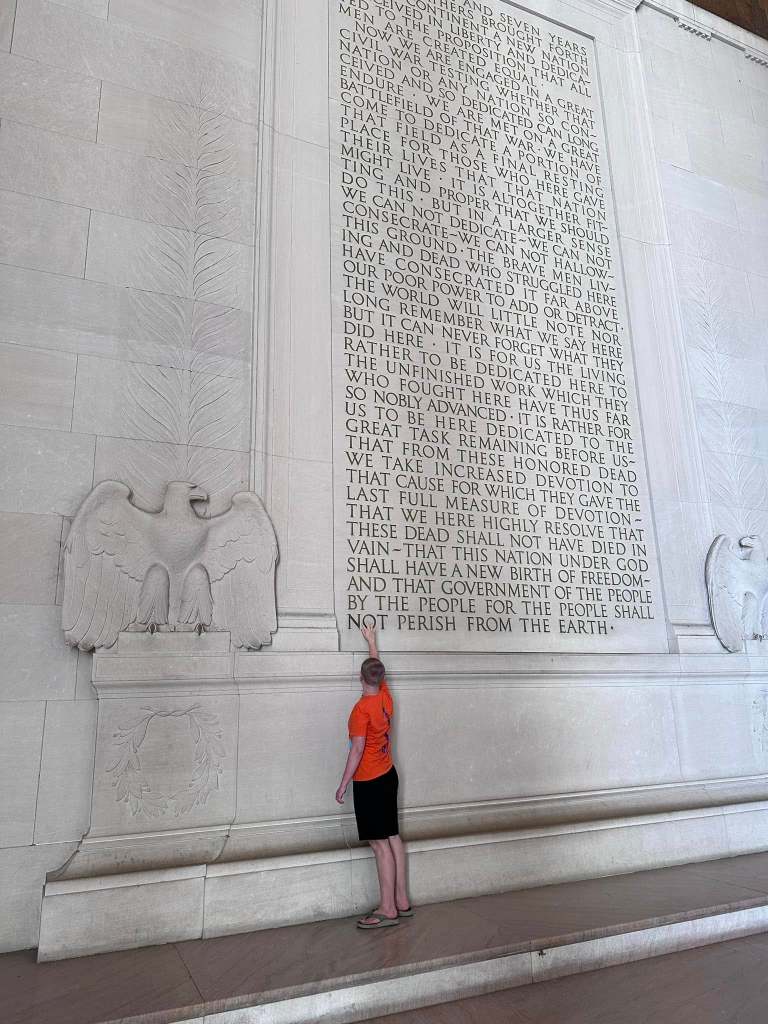
Lincoln understood that, perhaps more clearly than anyone who came before him. Standing in the shadow of a war that threatened to undo the entire experiment, he did not invent something new. He restated what had already been said, but in a way that stripped it down to its essentials. A government “of the people, by the people, for the people.” Three phrases, each reinforcing the other, each echoing that earlier claim about consent and purpose.
It is not a coincidence. It is continuity.
He was not replacing Jefferson. He was translating him, taking the language of 1776 and making it speak to a nation that had nearly torn itself apart trying to decide whether those words meant anything at all. In doing so, he made something clear that tends to get lost when we treat these documents like artifacts instead of arguments.
The promise does not expire.
And that leaves us, which is where the conversation always ends up whether we intend it to or not. It is easy to admire Jefferson’s phrasing or Lincoln’s clarity from a distance. It is harder to recognize that both of them were, in their own ways, handing something forward.
A torch is a familiar metaphor, perhaps overused, but it fits here better than most. It gives light, but it also burns. It demands to be carried, not simply observed. The ideals in the preamble are not self-executing. They do not enforce themselves. They do not correct the course of a nation when it drifts. They sit there, steady and unyielding, waiting for someone to decide whether they still matter.
That is the uncomfortable part of inheriting a blueprint instead of a finished structure.
Each generation is left to ask the same questions, though the details change. Are rights being secured, or merely discussed? Does government still rest on consent, or has it begun to assume it? Are safety and happiness being pursued for the people, or defined for them? There are no permanent answers, only answers that hold for a time until they are tested again.
Jefferson gave the direction. Lincoln reminded the country why it mattered. What remains is the act of walking that path, knowing full well it will not be straight, and that it will require more than admiration to keep it from fading into something decorative.
The idea endures, not because it is easy, but because it refuses to settle.
Perhaps that is the real legacy, not a guarantee of success, but a responsibility to make it succeed.
Originally published on August 19, 2025
Republished April 30, 2026
“Declaration of Independence.” July 4, 1776.
Ellis, Joseph J. American Creation: Triumphs and Tragedies at the Founding of the Republic. New York: Alfred A. Knopf, 2007.
Fischer, David Hackett. Liberty and Freedom: A Visual History of America’s Founding Ideals. New York: Oxford University Press, 2005.
Jefferson, Thomas. Notes on the State of Virginia. 1785.
Lincoln, Abraham. “Gettysburg Address.” November 19, 1863.
McPherson, James M. Battle Cry of Freedom: The Civil War Era. New York: Oxford University Press, 1988.
Wills, Garry. Lincoln at Gettysburg: The Words That Remade America. New York: Simon & Schuster, 1992.
Wood, Gordon S. The Radicalism of the American Revolution. New York: Alfred A. Knopf, 1992.

 DAVE DOES HISTORY
Leave a comment