
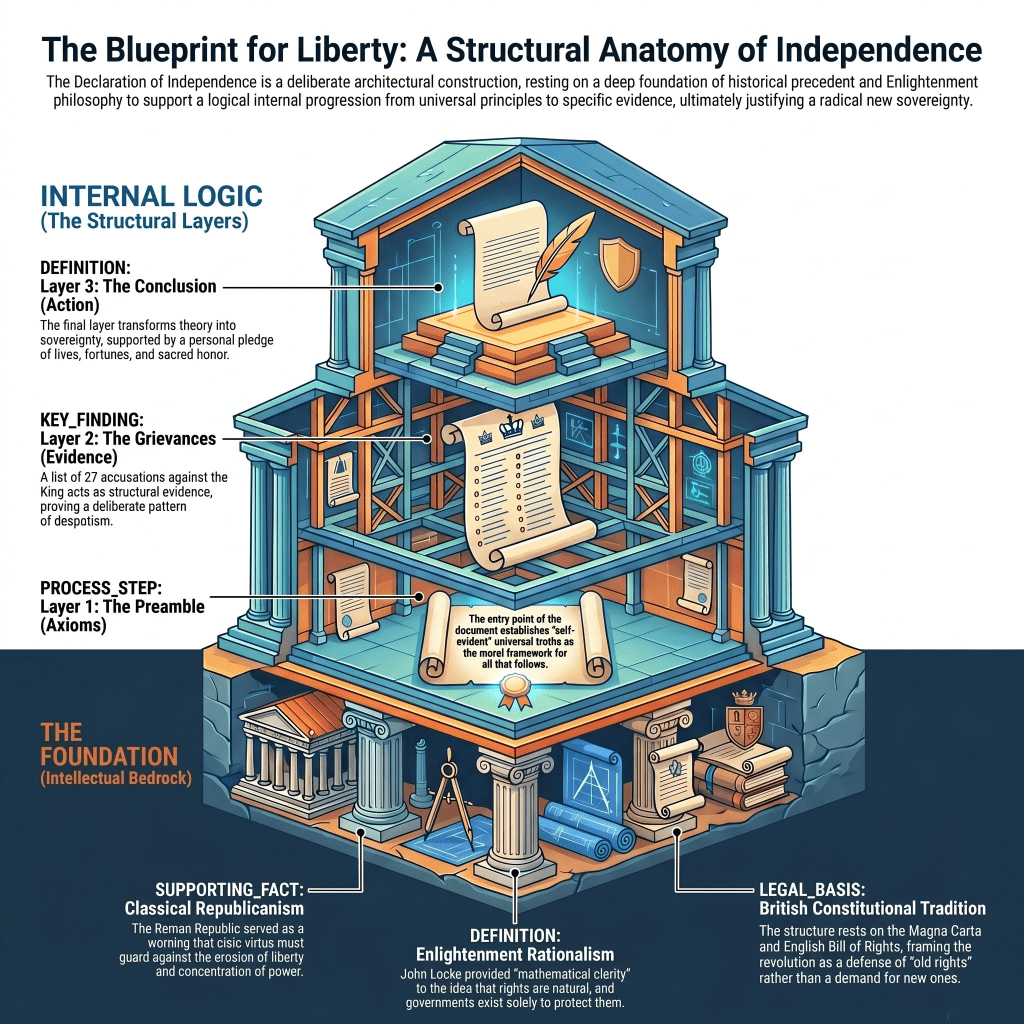
When you hold the Declaration in your mind the way you might hold an old musket or a worn Bible, something used rather than admired, it stops being a relic and starts becoming a structure. That is not poetic flourish. That is exactly how it was built. As the transcript puts it, this is not “a dusty piece of parchment,” but a deliberate construction where “every stone was placed with precision” and every part carries weight for what comes next.



It helps, then, to stop reading it like a speech and start walking through it like a building. The men who wrote it were not improvising. They were assembling something meant to stand, something that could bear not just the moment of 1776 but the strain of years that would test whether any of this was more than words.
The foundation, as with any good structure, was laid long before Jefferson ever dipped his pen in ink. If you want to understand what they were doing, you have to look backward, sometimes uncomfortably far backward, into a world that most modern readers treat like decoration but which the Founders treated as instruction manual. Greece and Rome were not distant curiosities to them. They were living examples, studied, argued over, and absorbed until their language and assumptions seeped into everything.
The Roman Republic, in particular, sat in their imagination like a warning carved in stone. It had risen through civic virtue, through the idea that a citizen owed something to the whole, and it had fallen when ambition outpaced restraint and power concentrated in too few hands. They read Cicero not because he was elegant, though he was, but because he showed how a republic could be defended with words as well as swords. They read Livy and Tacitus not because they were ancient, but because they told a story that felt uncomfortably familiar. Republics do not collapse overnight. They erode. They compromise. They justify small changes until the structure no longer holds.
That lesson mattered. It mattered enough that when the colonists looked at British policy after 1763, they did not see isolated taxes or bureaucratic overreach. They saw a pattern. They saw Rome in its later years, the slow tightening of authority, the quiet assumption that power, once taken, would not be returned.
Layered onto that classical inheritance came something newer, sharper, and in many ways more dangerous. The Enlightenment did not replace the ancient world, it electrified it. John Locke took ideas that had long existed in fragments and gave them a kind of mathematical clarity. People possessed rights by nature, not by permission. Governments existed to protect those rights, not to grant them. And when a government failed in that duty, the people were not merely allowed to change it. They were obligated to.
That is a radical idea, even now. In the eighteenth century, it was something close to dynamite.
The men in Congress did not invent those ideas, but they understood them, and more importantly, they believed them. Not always perfectly, not always consistently, but enough that those principles could be stated without needing to be explained in detail. Leadership circles treated them as common ground, even if the broader public grasped them more by instinct than by formal study.
Then there was the uncomfortable inheritance of being British. Even as the colonies moved toward separation, they carried with them a deep respect for the constitutional traditions of England. The Magna Carta had established, at least in principle, that the king was not above the law. The English Bill of Rights had reinforced limits on authority and strengthened the role of Parliament. Colonial charters promised that these protections traveled across the Atlantic, that an Englishman in Massachusetts or Virginia was still an Englishman in the eyes of the law.
That promise, once broken or even perceived to be broken, carried consequences.
Because by the time the crisis deepened, colonists were not arguing that they deserved new rights. They were arguing that old rights had been violated. There is a difference there, and it is not a small one. It turns protest into something harder, something less negotiable.
Experience did the rest. Theory will only take a man so far before he begins to measure it against what he sees. Taxes imposed without representation, assemblies overridden, troops stationed where they were not wanted, each act on its own could be explained away, perhaps even justified. Together, they formed a pattern that was harder to ignore. Writers like John Trenchard and Thomas Gordon had warned decades earlier that power does not sit still. It expands. It presses. It seeks advantage. Liberty, in that equation, is not self-sustaining. It must be guarded, sometimes jealously, sometimes imperfectly, but always deliberately.
By the time Jefferson began assembling the Declaration, these ideas were not abstract. They had been tested, argued, lived. What appears in the document as a list of grievances is, in truth, something more structured. It is a case. Each complaint is a piece of evidence, and together they build toward a conclusion that the Founders believed was no longer avoidable.
That conclusion is the hardest part to accept, then as now.
Independence was not framed as a preference. It was framed as a necessity.
Once you accept that the actions of the Crown and Parliament represent not isolated mistakes but a deliberate design toward despotism, the range of acceptable responses narrows dramatically. If the system itself has become the problem, then working within that system begins to look less like prudence and more like surrender.
That is the quiet logic beneath the Declaration’s opening structure. It does not begin with rebellion. It begins with principles. It moves to evidence. Only then does it arrive at action.
Like any well-built foundation, it does not draw attention to itself. It simply holds everything else up.
And if you take the time to walk through it, to feel the weight of those ideas and where they came from, you begin to understand that 1776 was not a sudden break. It was the moment when a long-constructed argument finally reached its only possible end.
If the foundation explains why the structure stands, then the next question is how it was built to hold together under pressure. Because this was never meant to be a casual statement. It was meant to persuade, to justify, and if necessary, to survive scrutiny from enemies who would happily tear it apart line by line. What Jefferson and his colleagues produced was not just a declaration in the common sense of the word. It was a carefully assembled argument, something that reads like a legal brief, sounds like a speech, and holds together like architecture.
That combination is not accidental. Each element serves a purpose. The legal structure gives it credibility. The rhetorical structure gives it force. The architectural structure gives it endurance. Remove any one of those and the whole thing weakens. Leave them together and you have something that does not just announce independence, it explains it, defends it, and, perhaps most importantly, makes it feel inevitable.
The entrance to this structure, the part most people remember and quote, is the Preamble. It reads almost like a set of axioms, statements so broadly framed that they carry the weight of self-evidence. All men are created equal. They are endowed with certain rights. Governments exist to protect those rights. And when they fail in that duty, the people may alter or abolish them.
Now, it is easy to read that today and nod along as though it were obvious. It was not obvious. Not in 1776, and certainly not in any classical model the Founders admired. Greece and Rome would have recognized parts of this argument, but not the whole of it. Equality in the sense Jefferson describes would have struck them as, at best, impractical and at worst, absurd. That is where the document quietly steps beyond its influences. It borrows from the past, then reshapes it into something new.
From there, the document does something that feels almost understated but is in fact critical. It explains why it exists at all. Out of “a decent respect to the opinions of mankind,” the colonies will state their reasons. That line matters. It signals that this is not an act of blind rebellion or emotional outburst. It is a case being presented to the world.
There is a certain discipline in that choice. They are not writing only for themselves. They are writing for foreign courts, for potential allies, for anyone who might one day recognize them as something other than a group of troublesome colonies. It is diplomacy wrapped in philosophy. It says, in effect, we are not tearing something down without cause. We are explaining, step by step, why it must be done.
Then comes the heart of the argument, the long and often overlooked middle, the list of grievances. This is where the document shifts from principle to evidence, from what ought to be to what has actually happened. Twenty-seven accusations, each one directed at George III, though in truth many of them reflect broader imperial policy.
What matters is not just the number, but the order.
It begins with interference in the legislative process, the slow undermining of colonial self-government. It moves into the obstruction of justice, courts manipulated or bypassed, legal protections weakened. And then, almost inevitably, it escalates into something harsher, the use of force, the presence of troops, the reality of war being waged against the colonies themselves.
There is a rhythm to it, a repetition that is not lazy but deliberate. “He has…” again and again, like the steady beat of a drum. It builds pressure. It reinforces the idea that these are not isolated incidents but part of a pattern. By the time the reader reaches the end of that list, the conclusion has already begun to form in the mind. The argument does not leap. It accumulates.
And then, finally, it arrives.
The conclusion is not long, but it carries weight because everything before it has done the work. The colonies are, and of right ought to be, free and independent states. They claim the powers that come with that status, to wage war, to make peace, to form alliances, to conduct trade. These are not symbolic gestures. They are the practical realities of sovereignty, stated plainly.
And then comes the pledge, perhaps the most human line in the entire document. Lives, fortunes, and sacred honor. It sounds almost ceremonial, until you stop and consider what it means. These men are not risking embarrassment or political defeat. They are risking everything, including the rope, should this fail. There is an echo here, whether intentional or not, of the old Roman oaths, the idea that a republic is not defended in the abstract but by individuals who bind themselves to it personally.
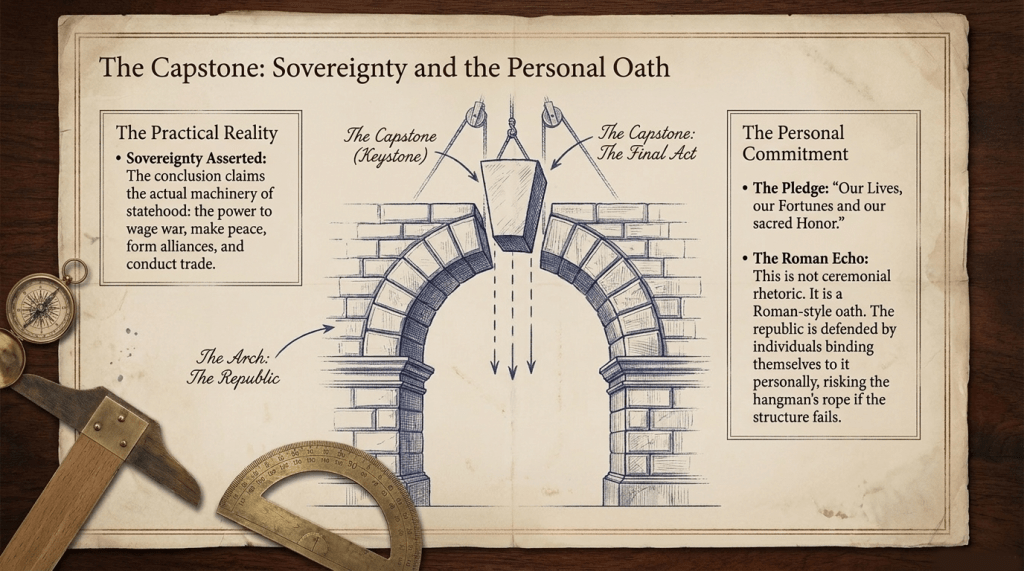
That echo matters. It ties the document back to those earlier traditions even as it pushes beyond them. It reminds the reader that this is not just theory. It is commitment.
What makes the structure remarkable is how seamlessly it moves from one stage to the next. Principle leads to explanation. Explanation leads to evidence. Evidence leads to action. By the time the final words are read, independence does not feel like a leap into the unknown. It feels like the only conclusion that could have been reached.
That is the quiet brilliance of it. Not that it declares something new, but that it convinces you, almost without noticing, that it had to be said.
And once you see the structure for what it is, you begin to understand why it has lasted. Not because it was perfect, and certainly not because it solved every problem it addressed, but because it was built to endure strain. The logic is not decorative. It is load bearing. Principles justify grievances. Grievances justify independence. And independence, once claimed, demands something more than celebration. It demands explanation that can stand up long after the moment has passed.
That is why the Declaration does not feel trapped in 1776. It was written there, yes, but it was not written only for that year. It anticipates argument. It invites it, even. It lays out a chain of reasoning that others can pick up, examine, challenge, and, if they are bold enough, extend.
And extend it they did.
The language of rights and equality did not remain confined to Philadelphia. It traveled, much the way earlier ideas had traveled across the Atlantic in the other direction. In France, within little more than a decade, the Declaration of the Rights of Man and of the Citizen would echo many of the same principles, translated into a different context, shaped by different pressures, but unmistakably connected. Later, abolitionists would take Jefferson’s words and turn them back on a nation that had not fully lived up to them. If all men are created equal, then the existence of slavery becomes not just a political issue, but a contradiction that cannot be ignored.
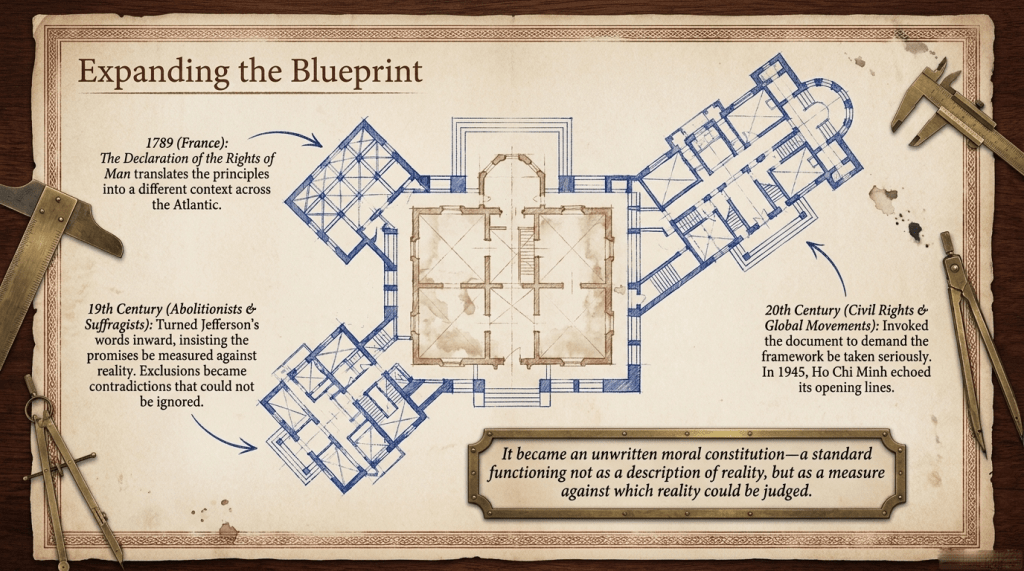
Women, excluded from the political framework the document helped justify, would do the same. They would read the language, measure it against their own experience, and ask questions that the original authors had not fully considered. The civil rights movement would follow, not by discarding the Declaration, but by invoking it, insisting that its promises be taken seriously, not selectively.
Even far beyond American shores, the structure proved adaptable. In 1945, as another empire was being challenged, Ho Chi Minh would echo its opening lines, drawing on its authority to frame a different struggle in terms that had already proven powerful. That is not coincidence. It is what happens when an argument is built clearly enough that others can use it, even when they stand in very different circumstances.
In that sense, the Declaration became something like an unwritten constitution, not in a legal sense, but in a moral one. It planted ideas that could not easily be uprooted. Equality. Liberty. The pursuit of happiness. Simple words, familiar enough that they risk becoming slogans if repeated without thought, but in their original context, they functioned as standards. Not descriptions of reality, but measures against which reality could be judged.
That is where the tension begins.
Because if you read the document honestly, without smoothing over its edges, you run directly into the gap between what it declares and what existed at the time. Slavery did not end in 1776. It continued, entrenched and defended, even by some of the men who signed the document. Women were not brought into the political community the Declaration helped justify. Indigenous peoples were not recognized as partners in the same system, but often treated as obstacles to be removed or managed.
Those are not small oversights. They are structural contradictions.
And yet, they did not destroy the document. In a strange way, they strengthened its long-term impact, because they created pressure points. Places where later generations could press, not from outside the framework, but from within it. If the principles are taken seriously, then the exclusions become harder to defend. If the logic holds, then it can be turned back on those who would limit it.
That is why the structure matters.
It provides a way to argue for change without tearing everything down at once. It allows reform to happen within a shared language, a common set of assumptions that both sides recognize, even if they interpret them differently. It is not a guarantee of justice. It is a mechanism for pursuing it, sometimes slowly, sometimes painfully, but with a coherence that pure upheaval rarely achieves.
Which brings us back to the beginning, and to the simplest way of understanding what the Declaration is.
It is not perfection.
It is aspiration.
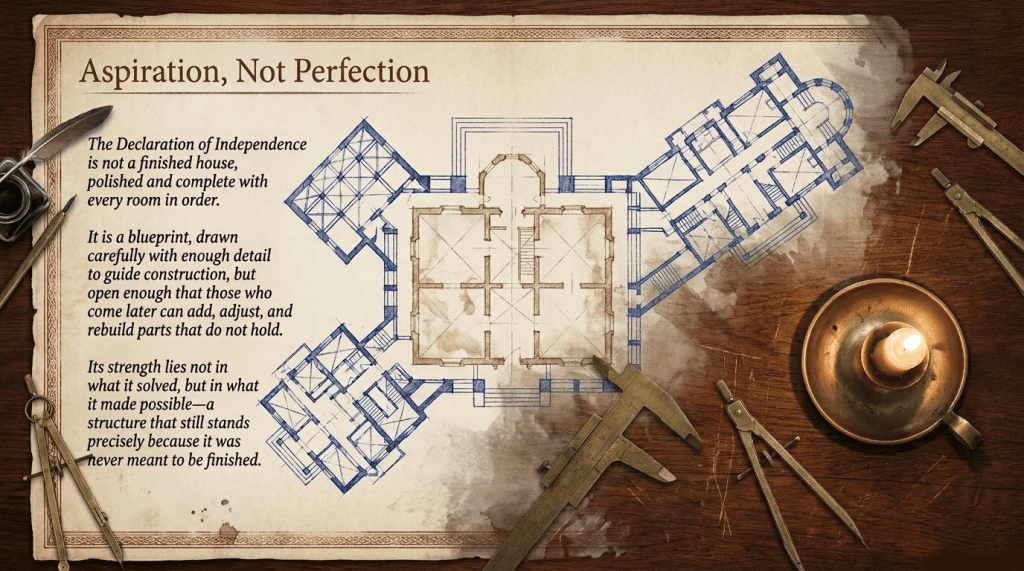
It is not a finished house, polished and complete, with every room in order. It is a blueprint, drawn carefully, with enough detail to guide construction, but open enough that those who come later can add, adjust, and, when necessary, rebuild parts that do not hold.
Its strength lies there, not in what it solved, but in what it made possible. It gave each generation something to measure itself against, something to argue from, something to reach for even when the reality fell short.
And that may be the most honest way to see it. Not as a final answer, but as a beginning that refuses to stay in the past, a structure that still stands because it was never meant to be finished.
Originally Published August 12, 2025
Republished April 29, 2026
Armitage, David. The Declaration of Independence: A Global History. Cambridge, MA: Harvard University Press, 2007.
Bailyn, Bernard. The Ideological Origins of the American Revolution. Cambridge, MA: Harvard University Press, 1967.
Becker, Carl L. The Declaration of Independence: A Study in the History of Political Ideas. New York: Vintage Books, 1942.
“Declaration of Independence.” July 4, 1776.
Fischer, David Hackett. Liberty and Freedom: A Visual History of America’s Founding Ideals. New York: Oxford University Press, 2005.
Locke, John. Two Treatises of Government. London, 1689.
Maier, Pauline. American Scripture: Making the Declaration of Independence. New York: Alfred A. Knopf, 1997.
Rakove, Jack N. Original Meanings: Politics and Ideas in the Making of the Constitution. New York: Alfred A. Knopf, 1996.
Trenchard, John, and Thomas Gordon. Cato’s Letters. London, 1720–1723.
Wood, Gordon S. The Radicalism of the American Revolution. New York: Alfred A. Knopf, 1992.




Leave a Reply