
It was April 18, 1775. The world did not know it yet, but liberty was saddling up. Not with banners and brass bands, not with speeches that echo through marble halls, but quietly, in the cold, in places where men still had to decide whether to open the door or stay inside and hope the storm passed them by.
Massachusetts had been living under a weight that felt less like law and more like a hand pressed firmly on the back of the neck. Parliament, in its wisdom, had decided that Boston needed to be corrected. The Coercive Acts had done their work with the delicacy of a hammer. The port was closed. The government reshaped. Town meetings restricted. Soldiers everywhere, not as guests but as reminders. And over all of it stood General Thomas Gage, a man who knew the colonies well enough to understand what he was being asked to do, and perhaps well enough to suspect how it would end.
His orders were clear, even if his situation was not. Find the weapons. Break the resistance. Move quickly enough that the countryside does not have time to react. Seven hundred British regulars would march on Concord, where colonial supplies had been quietly gathered, with a side objective that was less quiet, the capture of Samuel Adams and John Hancock. On paper, it was a clean operation. On the ground, it was already unraveling.
Because in Massachusetts, nothing stayed secret for long.
You know, if you are going to ride through the night warning half a colony that the world is about to change, you probably do not want to do it half asleep. That is where Midnight Riders Blend comes in. Dark, bold, and just a little rebellious, it is the kind of coffee that keeps you sharp when the stakes are high and the road is long. Brew it strong, drink it fast, and remember, history does not wait for anyone still hitting the snooze button. Midnight Riders Blend. Because sometimes the regulars are out, and you need to be ready.
And now, back to the ride.
The intelligence war had already begun before a single musket was raised. Joseph Warren, a man with a gift for knowing things he was not supposed to know, understood that the British were moving. Whether the information came through formal channels or quieter, more personal ones has been debated ever since. There is a name that surfaces more often than most, Margaret Kemble Gage, the general’s American born wife, who moved comfortably in both worlds and may have decided, at some point, which one mattered more. The truth is tangled there, as it often is, but the result is not. Warren knew. And knowing, he acted.
He did not call a meeting. He did not write a pamphlet. He sent riders.
Paul Revere is the name everyone remembers, and for good reason, but he was not alone. William Dawes rode as well, taking a different path, carrying the same urgency. Later, Samuel Prescott would push the message even farther when others were stopped. This was not a single dramatic dash through the countryside. It was a system, built over time, refined through necessity. Revere was not just a silversmith with a horse. He was a node in a network, a man who understood that information, delivered at the right moment, could change everything.
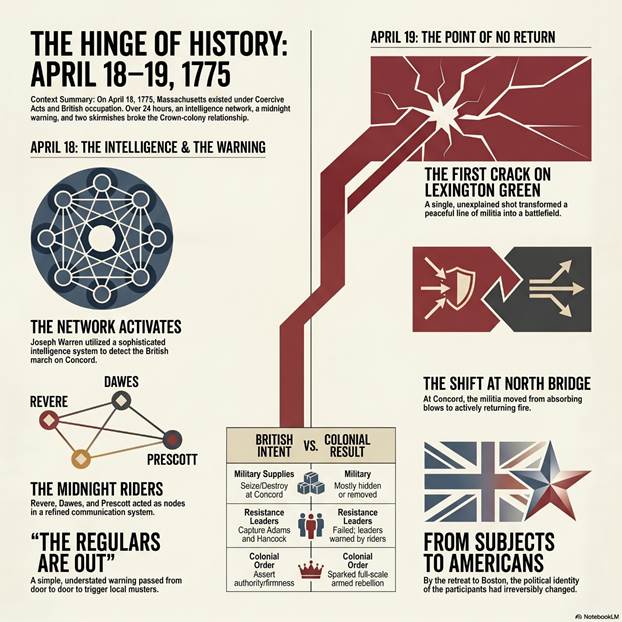
The message itself was simple, almost understated. The regulars are out. No poetry, no grand declarations. Just a warning, passed from door to door, from town to town, until it spread faster than the men who tried to contain it. Bells rang. Drums sounded. Lights flickered to life across the countryside. By the time the British column moved into the night, the night was already watching them.
And so the muster began.
In Lexington, in Concord, in towns that had never expected to become footnotes in history, men stepped out into the dark. Some were farmers. Some were craftsmen. All of them were, until very recently, subjects of the same king whose soldiers now marched toward them. One of them was Ebenezer Bowman, seventeen years old, standing on the edge of adulthood with a musket in his hands and no real way to measure what he was about to face. He was not the youngest there, which should tell you something about the moment.
Why does a man do that? Why step out into the cold, knowing that the men coming toward you are trained, disciplined, and armed with the authority of an empire?
It was not, at least not yet, about independence. That word had not settled into their thinking. It was about something more immediate and, in some ways, more personal. It was about being pushed, again and again, until something in you decides that enough is enough. It was about property, yes, and rights, certainly, but also dignity, the quiet conviction that you are not meant to be managed like a problem.
They were not trying to create a new nation. They were trying to stop being treated as less than full participants in the one they thought they already belonged to.
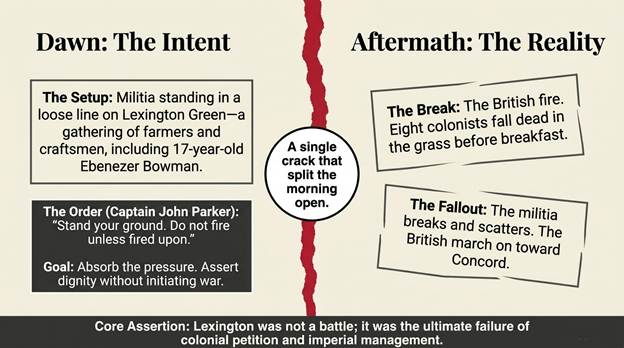
At the center of that small gathering on Lexington Green stood Captain John Parker, a man who understood both the limits and the necessity of the moment. His orders were as careful as they were firm. Stand your ground. Do not fire unless fired upon. But if they mean to have a war, let it begin here.
There is a kind of restraint in those words that often gets overlooked. Parker was not calling for blood. He was preparing for the possibility that it might come, and making it clear that if it did, they would not run from it.
That is the hinge of the story, the quiet point on which everything turns.
On one side of that moment, you have argument, protest, petition. On the other side, you have something else entirely. And in the darkness of April 18, as riders moved and men gathered, no one could say for certain which side they would wake up on.
But they were about to find out.
Dawn came early on April 19, 1775, and it did not arrive gently. It came with boots on frozen ground, breath hanging in the air, and a question no one could quite answer in advance. Why do they fight, and what will it cost?
On Lexington Green, the answer came faster than anyone expected.
The militia stood in a loose line, not a parade formation, not a polished display of discipline, but a gathering of men who had chosen to be there because someone had to be. John Parker had given his orders the night before. Stand your ground. Do not fire unless fired upon. It was the kind of instruction that sounds clear until the moment arrives and clarity becomes a luxury.
The British regulars advanced, trained, precise, carrying with them the authority of an empire that did not expect to be challenged by a handful of farmers and tradesmen. There were words shouted, commands given, warnings issued. And then, in that narrow space between intent and action, something happened that no one could later explain with certainty.
A shot.
Not a volley. Not a command. Just a single crack that split the morning open.
What followed was not confusion so much as reaction. The British fired. Eight colonists fell before breakfast, men who had stood their ground one moment and were lying in the grass the next. It was over almost as quickly as it had begun. Smoke drifted. The militia broke apart, some retreating, some stunned, all of them aware that something irreversible had just taken place.
The British moved on, their orders unchanged, their objective still ahead of them in Concord. If Lexington had been a warning, it was not yet a conclusion.
Concord was different.
By the time the regulars reached the town, the countryside had already begun to close in around them. Supplies had been hidden, moved, scattered. The element of surprise, never as complete as Gage had hoped, was gone entirely now. What they found instead was resistance that had begun to organize itself.
At the North Bridge, the tone shifted. This was no longer a startled encounter on a village green. This was a line forming, men stepping forward with intention rather than hesitation. Among them was Isaac Davis, a blacksmith by trade, a husband, a father, and in that moment, a commander. When the order came to advance, Davis did not hesitate. He led his men forward, into musket fire, into the kind of moment that separates the ordinary from the remembered.
He was killed almost immediately.
There is a tendency to turn men like Davis into symbols, to smooth out the rough edges of their lives until they fit neatly into a narrative. The truth is more complicated and, in some ways, more powerful. He was not a professional soldier. He was a man who had decided that this was where he needed to stand, and when the moment came, he stood there.
The men around him were much the same. Farmers who knew the rhythm of seasons better than the rhythm of battle. Tradesmen who had spent more time at a bench than in a line of fire. Teenagers like Ebenezer Bowman, still close enough to childhood to feel the shock of it all more sharply. And others, like Thaddeus Bowman, who had seen conflict before in earlier colonial wars and understood, perhaps better than most, what it meant when that first shot was followed by another.
They were not an army in the formal sense. They were something less organized and, in its own way, more difficult to predict.
They fired. The British fired back. The exchange at the North Bridge was brief, but it mattered in a way that Lexington had not yet fully revealed. Here, the colonists did not simply absorb the blow. They returned it. The regulars fell back, not in panic, but in recognition that the situation had changed.
And once it changed, it did not change back.
The retreat began, though that word suggests a kind of order that did not entirely exist. The British column turned toward Boston, carrying with it the weight of what had already happened and the growing realization that the road ahead would not be quiet.
The countryside rose.
Militia units, called out by riders and bells and word of mouth, gathered along the roads. They did not form neat ranks. They took positions where they could, behind stone walls, in tree lines, along bends in the road where the column would be forced to slow. They fired, fell back, reformed, and fired again. It was not the kind of war the British had trained for, and it wore them down mile by mile.
In a letter written not long after, Timothy Pickering tried to capture what he had seen. The colonists were brave, he said, but not soldiers in the formal sense. “Every man did that which was right in his own eyes.” It was not meant as praise, exactly. It was an observation, one that carried both admiration and concern.
Because that kind of fighting is difficult to control. It is driven by instinct, by local knowledge, by a sense of purpose that does not always align neatly with orders. It can produce moments of remarkable bravery and moments of near chaos, often in the same stretch of road.
And yet, it worked.
The British fought their way back, step by step, reinforced along the way, holding together through discipline and experience. The colonists pressed them, sometimes too aggressively, sometimes with a restraint that seems surprising given what had happened that morning. There were moments of fury, and moments when men chose not to fire when they could have.
War, even at its beginning, is rarely a single emotion.
By the time the column reached the relative safety of Boston, the cost had become clear. Lives lost on both sides, though more heavily among the British than anyone in London would have expected. More important than the numbers was the realization that the line had been crossed.
On April 18, men had ridden through the night to warn of what might come.
On April 19, they no longer wondered.
They fought.
And once they did, the question was no longer whether the world had changed. It was how far that change would go, and how much it would demand before it was finished.
The news did not travel politely. It did not wait its turn or ask permission. It ran. It ran along roads still marked with powder burns, through towns that had barely finished breakfast, across colonies that had been watching Massachusetts with a mixture of sympathy and caution. By the time the story settled anywhere long enough to be told, it had already moved on again, gathering weight as it went.
New England did not whisper what had happened. It declared it.
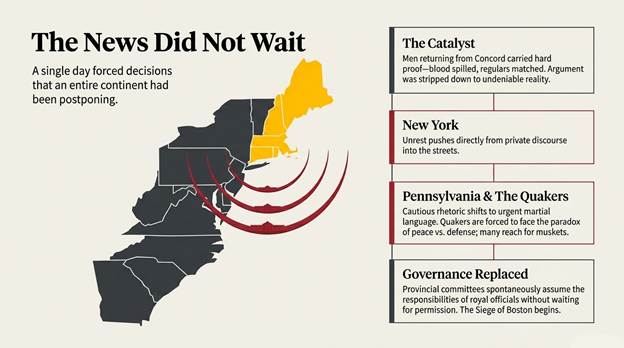
Men who had stood at Lexington and Concord carried more than wounds and exhaustion. They carried proof. The Regulars had marched. The militia had stood. Shots had been fired, and not in theory. Blood had been spilled, and not in some distant place that could be explained away. That changes things. It strips argument down to something harder.
The rest of the colonies heard it, and what they heard was not a local disturbance. It sounded like a call.
New York answered in its own way, not with quiet resolutions but with unrest that pushed into the streets. Pennsylvania, often cautious, began to speak in a language that felt more urgent, more martial, less willing to wait for events to settle themselves. Even communities that had long preferred restraint found themselves reexamining that preference. Quakers, who had built their identity around peace, began to face questions they had hoped never to answer. Some held to their convictions. Others, quietly or not, reached for muskets they had never expected to carry.
This is how a single day becomes something larger. Not because it is planned that way, but because it forces decisions that had been postponed.
Provincial governments, those uneasy hybrids of colonial habit and imperial oversight, began to shift. Authority moved, sometimes formally, often simply by being exercised where it had once been deferred. Committees took on responsibilities that had belonged to royal officials. Orders were given and followed without waiting for approval from across the ocean. In Massachusetts, the siege of Boston began to take shape, not as a dramatic encirclement at first, but as a tightening presence, a recognition that the British army, once the instrument of control, was now something to be contained.
And in the middle of it all stood Thomas Gage, a man who would be easier to understand if he were simpler.
He was not.
Gage had served in America for years. He knew the land, knew the people, had built relationships that did not fit neatly into the categories Parliament preferred. He was loyal to the Crown. That was not in question. But he also understood, in a way that many in London did not, that the colonists were not simply subjects waiting to be directed. They had their own expectations, their own sense of what was right, and they did not abandon those things easily.
His orders had been clear. Enforce the law. Restore order. Show firmness. What he encountered instead was a situation where firmness produced resistance, and resistance produced something he had been trying to avoid from the beginning.
War.
There is a particular kind of tragedy in being the man in the middle when both sides are moving away from the ground you are standing on. Gage did not want this outcome. That is not the same as saying he could have prevented it. The instructions he received from Parliament were shaped by distance, by assumptions, by a belief that authority, once asserted strongly enough, would be accepted.
Gage knew better, or at least suspected. But knowing and acting are not always the same thing, especially when one is bound by orders that leave little room for adjustment.
And so he found himself commanding an army in a city that was no longer fully his, facing a countryside that had begun to act as though it belonged to someone else.
The legacy of April 19 does not rest in a single moment, a single shot, or even a single battle. It rests in what followed, in the way that day forced choices that could no longer be avoided. The war did not begin with a declaration signed in a hall with careful penmanship and measured words. It began with uncertainty, with fear, with conviction that did not yet have a name.
It began with a few dozen men on a village green, standing where they believed they had a right to stand, facing men who believed they had a duty to move them.
Names attach themselves to that moment because we need them to. Paul Revere, who helped carry the warning. Isaac Davis, who stepped forward and paid for it. Bowman, young and untested, standing in the dark because someone had to. And Gage, caught between instruction and understanding, trying to manage something that could no longer be managed.
Each of them made a choice, or had one made for them by circumstance. Together, those choices created something none of them could fully see at the time.
That is the echo of April 19. Not just the sound of musket fire, but the realization that once certain lines are crossed, they do not uncross themselves.
On April 18, they were colonists, arguing about rights, petitioning for change, still believing, in many cases, that the system could be made to work.
On April 19, they became something else.
Americans.
And that leaves the question hanging where it belongs, not in the past, but in the present mind of anyone willing to consider it. What would you have done, standing there with them? Would you have stepped forward, held back, waited to see which way the wind turned?
History does not let us change their answers.
It only asks us to think about our own.
Originally Published July 15, 2025
Republished April 29, 2026
Adams, John. The Works of John Adams, Second President of the United States. Vol. 2–3. Boston: Little, Brown and Company, 1851.
“A Deposition of Colonial Militiamen from the Battle of Lexington and Concord.” American Battlefield Trust.
“Battles of Lexington and Concord.” Encyclopaedia Britannica. Last modified May 31, 2025.
Fischer, David Hackett. Paul Revere’s Ride. New York: Oxford University Press, 1994.
“Paul Revere.” Encyclopaedia Britannica.
Wheeler, Richard, comp. Voices of Lexington and Concord. American Heritage, April 1971.
“The Battles of Lexington and Concord, 1775.” Gilder Lehrman Institute of American History.
Massachusetts Provincial Congress. Resolves on Defense and Militia Preparation. March–April 1775.
Pickering, Timothy. Correspondence on the Lexington Alarm and militia actions, 1775.



Leave a Reply