
Friday, May 10, 1776, does not announce itself as anything special. It does not stride into the record with trumpets or banners. It arrives like any other day in Congress, cluttered with reports, correspondence, and the steady hum of administrative business. If you open the journal for that morning, you will not find poetry. You will find routine. Letters read. Committees assigned. Supplies ordered. Money allocated. The sort of work that keeps an army alive and a government barely moving forward.
It is almost disappointing if you are looking for drama. But the drama is most assuredly there…



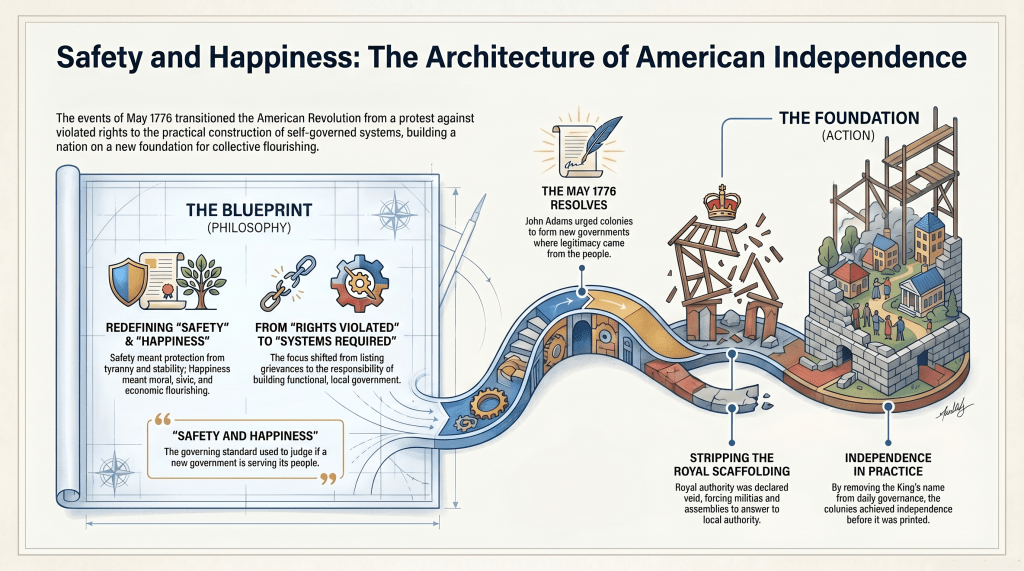
Buried in all that routine, tucked between the mundane and the necessary, is a sentence that changes everything. Congress recommends that where no government sufficient to the exigencies of affairs has been established, the colonies should adopt such government as shall best conduce to the happiness and safety of their people.
There it is. No flourish. No grand speech. No declaration that the world is about to change. Just a recommendation, written in the same steady tone as every other resolution that day.
And that is precisely why it matters.
Because revolutions do not always announce themselves. Sometimes they slip in quietly, disguised as paperwork.
By early May of 1776, the colonies are strained to the breaking point. The war has already begun, whether anyone wants to admit it or not. Lexington and Concord are no longer rumors. They are memories. Blood has been spilled, and once that happens, arguments change. You can still talk about reconciliation, and many do, but the ground under that conversation has shifted. The King had already declared the colonies outside his protection months earlier, and that act alone has severed something fundamental.
The old relationship is not just damaged. It is unraveling.
Inside Congress, the tension is constant. Letters arrive from the colonies demanding action. Not discussion. Not delay. Action. Men like John Adams feel that pressure every day, reading the frustration of their constituents, hearing the same question over and over again. What are you waiting for?
And yet Congress hesitates.
Not because they are blind to what is happening, but because they understand something that is easy to overlook. Declaring rights is one thing. Building a government that can sustain those rights is something else entirely. It is the difference between tearing down a house and constructing one that will not collapse the first time a storm hits.
That is the problem sitting in the room on May 10.
Up to this point, much of the colonial argument has been negative. A list of grievances. A catalog of injuries. A clear and growing case that something is wrong. Parliament has overreached. The Crown has failed. Rights have been violated. The logic is sound, and the anger is justified.
But there is a limit to how far that kind of argument can take you. Eventually, you have to answer a different question. Not what is wrong, but what comes next.
That is where this line about safety and happiness enters the story, and it does so with a kind of quiet authority that almost hides its significance. It is not about rebellion. It is about responsibility. It is not about ending something. It is about beginning something that has never existed before.
When Congress tells the colonies to adopt governments that will best secure their safety and happiness, it is doing more than offering advice. It is transferring legitimacy. It is saying, in effect, that the authority to govern no longer flows from the Crown. It flows from the people themselves.
That is a dangerous idea.
Not dangerous in the sense of chaos, though chaos is always a risk. Dangerous in the sense that it places a burden on the very people who have spent years arguing against authority. It is one thing to say that the King is wrong. It is another thing to say you must now take his place.
And that is exactly what this resolution demands.
John Adams understands this better than most. In the days surrounding May 10, his writing takes on a different tone. There is still urgency, still conviction, but there is also something else. A recognition that this moment is not just about separation. It is about creation. He writes of the opportunity to begin government anew, to construct something from the foundation rather than patching together what remains of the old system.
That sounds inspiring, and it is, but it is also unsettling. Because beginning again means there is no safety net.
The colonies have spent generations operating under the framework of British governance, even as they have argued against parts of it. Courts, assemblies, governors, all of these structures, however flawed, have provided a kind of stability. Remove them, and you are left with possibility, but also with uncertainty.
That uncertainty hangs over Congress like a storm cloud.
You can hear it in the debates. John Dickinson, cautious and deliberate, is deeply uncomfortable with the direction things are taking. He is not blind to the problems. He simply does not trust the solution. Independence, or anything that resembles it, feels premature, even reckless. Adams, on the other hand, sees hesitation as a greater danger. The longer Congress delays, the more the situation deteriorates.
Between them lies the central tension of the moment. How do you move forward without knowing exactly where you are going?
The answer, imperfect and incomplete, arrives in the form of that May 10 resolution. It does not provide a blueprint. It does not outline a constitution. What it does is establish a principle. Government must be constructed in a way that secures safety and happiness. That phrase, simple on its surface, carries a weight that is easy to miss.
Safety does not mean comfort. It means order, law, protection from arbitrary power. It means the assurance that the rules will be applied consistently, that the strong will not simply take what they want because they can. Happiness does not mean pleasure. It means the ability to live, to work, to participate in the life of the community without fear of sudden disruption.
Together, those ideas form a standard.
Not a guarantee, not a promise that everything will work perfectly, but a measure against which government can be judged. If it fails to provide safety, if it undermines the conditions necessary for a stable and productive life, then it fails. If it prevents people from pursuing their own well-being within the bounds of law, then it fails.
That is the shift taking place on May 10, 1776.
The argument is no longer simply that British rule is unjust. The argument is that any government, British or otherwise, must meet a certain standard. And if it does not, it must be altered or replaced.
That is not rebellion. That is a framework for governance. It is also a challenge.
Because anyone can declare rights. Anyone can stand up and say that liberty matters, that tyranny is unacceptable, that people deserve to be treated fairly. Those statements require courage, but they do not require construction. They do not require the slow, often frustrating work of building institutions, balancing competing interests, and creating systems that can endure.
Governing for safety and happiness is different.
It demands discipline. It demands compromise. It demands an understanding that freedom without structure can dissolve into disorder just as easily as structure without freedom can harden into control. The founders are standing at the edge of that tension in May of 1776, aware that whatever they build will carry the weight of their decisions long after they are gone.
And here is the part that does not get enough attention. On the morning of May 10, the authority to do that work does not formally exist.
Congress is still operating under the shadow of the Crown, even as that shadow fades. The colonies are still, at least in theory, part of the British Empire. There has been no declaration of independence. No formal break. No clear moment when one system ends and another begins.
That comes later. But this is where the ground shifts.
Because by telling the colonies to form governments that will best secure their safety and happiness, Congress is effectively saying that waiting is no longer an option. The old authority has failed, whether it admits it or not. The new authority must be created, whether it is fully recognized or not.
That is the moment. Quiet. Almost invisible if you are not looking for it. A single sentence in a long list of resolutions. And yet it carries within it the outline of everything that follows.
If you are going to build for safety and happiness, you need the authority to do it. You need the legitimacy to act, to organize, to command loyalty not because it is demanded, but because it is accepted.
On May 10, 1776, that authority begins to move.
Not all at once. Not with a declaration or a vote that settles the matter. But it moves, from Crown to Congress, from Congress to the colonies, from the colonies to the people.
And once it begins to move, it does not stop.
If May 10, 1776, is the quiet shift, then the days that follow are the moment someone finally realizes what just happened and decides not to let it slip away.
John Adams is that man, and if there is one thing history makes clear about him, it is this. When Adams sees an opening, he does not tap politely on the door. He pushes it wide and dares everyone else to follow him through.
In the early days of May 1776, Adams lived in two worlds at once. In Philadelphia, he sits in Congress, surrounded by hesitation, debate, and the kind of procedural caution that slows everything to a crawl. Back in Massachusetts, his constituents are losing patience. Their letters arrive with increasing urgency, and the message is not subtle. The time for talking has passed. Do something.
That pressure matters, but it is not the only force driving him. Adams understands something deeper than impatience. He understands that the colonies are already in motion. The war has begun. Royal authority is collapsing. Governors are fleeing or being ignored. The machinery of empire is not just failing, it is disappearing.
And into that vacuum, something has to step.
The May 10 resolution gives Adams exactly what he needs. On its surface, it is a recommendation. A polite suggestion that colonies lacking sufficient government should form one that best secures the safety and happiness of their people. But Adams reads it differently. He sees not a suggestion, but an opportunity. If Congress is willing to say this much, then it can be pushed to say more. And that is precisely what he does.
Over the next several days, the debates intensify. John Dickinson, careful and deliberate, pushes back hard. He sees the danger in moving too quickly, in abandoning the last threads of connection to Britain without a clear plan for what comes next. Dickinson is not a coward. He is cautious, and in moments like this, caution can look like resistance.
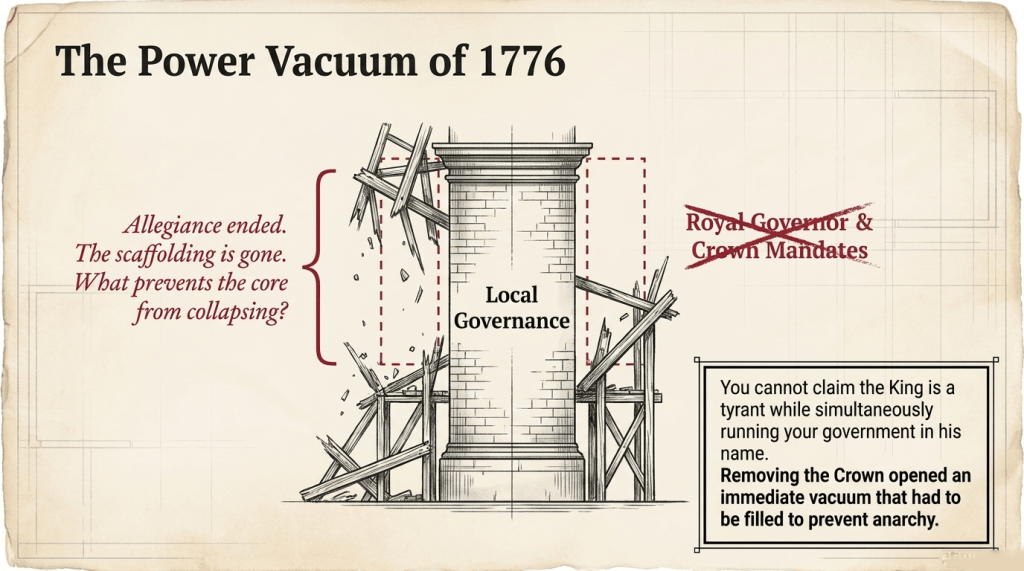
Adams, on the other hand, has no patience left for caution. To him, the contradiction is already unbearable. You cannot claim the King has violated your rights, declared you outside his protection, and is actively waging war against you, and then continue to pretend that his authority still governs your courts, your assemblies, your militias. At some point, that fiction has to end. So, Adams moves to end it.
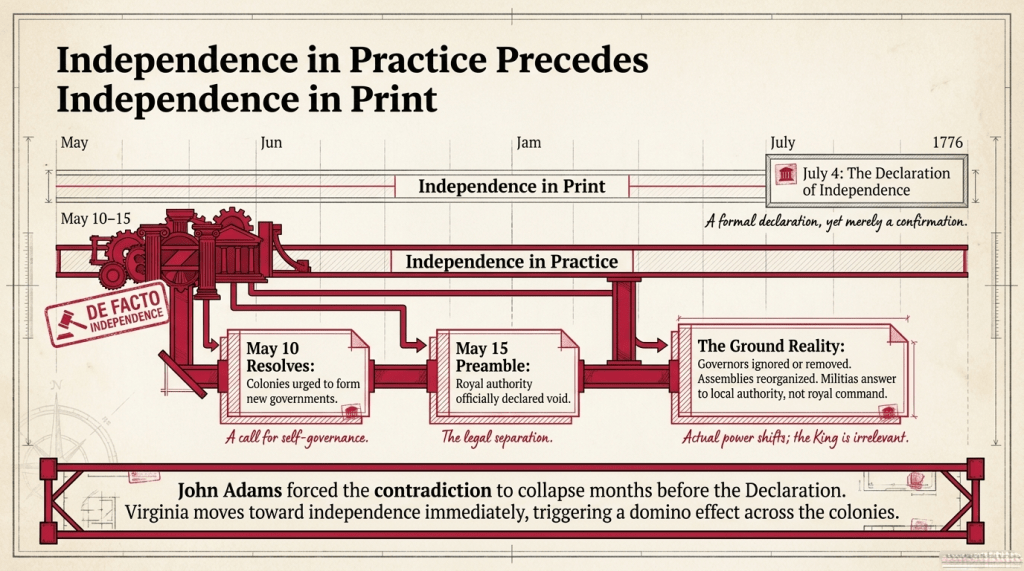
On May 15, with Dickinson absent, worn down by days of argument and perhaps by the realization that the tide has turned against him, Congress adopts a preamble that transforms the May 10 recommendation into something far more decisive. The language is unmistakable. All authority under the Crown is to be suppressed. Allegiance to the King is no longer compatible with the reality the colonies face.
It is difficult to overstate what that means.
This is not yet the Declaration of Independence, at least not in form. There is no grand statement addressed to the world, no carefully constructed list of grievances followed by a ringing conclusion. But in substance, the break has already occurred. The colonies are no longer operating under the assumption that royal authority can be restored. They are instructed, plainly and directly, to replace it.
There is a certain rough humor in that image, but it captures something important. Independence did not arrive in a single dramatic instant. It unfolded, piece by piece, through decisions that made the old system impossible to maintain. May 15 is one of those decisions, perhaps the most decisive of all.
It also introduces a legal and philosophical problem that Adams and his colleagues are willing to accept because they see no alternative. The justification for dissolving allegiance to the Crown rests, in part, on the claim that the King has already broken the relationship by declaring the colonies outside his protection. That argument reaches backward, applying a judgment to an action that has already occurred.
In modern terms, it carries the flavor of an ex-post facto claim. The King acted, and now the colonies define that action as a breach that releases them from their obligations. It is not a clean, orderly process. It is messy, reactive, and shaped by circumstances as much as by theory.
But it works.
Because once you accept that the Crown has failed in its fundamental duty to protect, the entire structure of allegiance collapses. The old contract is broken. What remains is the necessity to build something new. And that necessity is no longer theoretical.
On the ground, the effects are immediate and tangible. Royal governors, already struggling to maintain control, find their position untenable. Some are ignored. Others are driven out. The authority they once exercised, backed by the power of the Crown, now rests on little more than habit and fading recognition.
Assemblies, previously dissolved or suspended, reappear in new forms. Provincial congresses, conventions, committees of safety, all of them step into the space left behind. They do not wait for permission. They act because action is required. Laws are debated, militias organized, resources allocated. Government, in other words, continues, but its source has changed.
Perhaps the most significant shift occurs in the militias. For generations, service in a colonial militia carried with it an oath to the King. That oath is not a formality. It is a statement of allegiance, a recognition of where authority ultimately resides. After May 15, that allegiance begins to move. Militias answer not to royal command, but to local authority, to assemblies and conventions that derive their legitimacy from the people themselves.
That change is more than symbolic. It determines who commands force. And whoever commands force, in practical terms, governs.
Virginia provides one of the clearest examples of how quickly these changes take hold. Already leaning toward independence, the colony moves decisively once Congress has provided the necessary cover. Its leaders begin drafting a new constitution, reimagining the structure of government in a way that reflects the new reality. The old framework, tied to royal authority, is no longer viable. Something else must take its place.
Other colonies follow, some more quickly than others, but the pattern is unmistakable. Once one begins, the rest find it easier to move. What had seemed radical only weeks earlier, now appears necessary. The hesitation that once dominated Congress gives way, slowly but steadily, to action.
This is the domino effect, and like most such effects, it does not require every piece to fall at once. It requires only enough momentum to make stopping impossible.
That is what Adams achieves.
He does not create the conditions that make independence inevitable. Those conditions have been building for years, shaped by policy, conflict, and the slow erosion of trust between the colonies and the Crown. What he does is recognize the moment when those conditions can no longer be contained within the old framework.
And then he forces the issue.
The May 10th resolution opens the door. The May 15th preamble walks through it and leaves it open behind. From that point forward, the colonies are no longer debating whether they will govern themselves. They are doing it. This is independence in practice before it is independence in print.
By the time Jefferson sits down to draft the Declaration, much of the work has already been done. Governments are forming. Allegiances are shifting. Authority is being exercised in new ways. The Declaration will explain, justify, and present these changes to the world, but it does not create them.
They have already begun.
And that may be the most unsettling part of the story. There is no single moment when everyone agrees, no clean break that neatly divides past from future. There is, instead, a series of decisions, each one building on the last, each one making the next more likely.
Adams lights the fuse, but the powder has been laid for a long time. Once it ignites, the explosion is not immediate. It is a burn, steady and relentless, moving through the structure of empire until there is nothing left to hold it together.
You cannot claim the King is a tyrant and still run your government in his name. At some point, the contradiction becomes too large to ignore, and Adams understood that better than anyone in the room. He did not create the tension, but he forced it into the open where it could no longer be managed with careful language or procedural delay. Once exposed, it collapsed under its own weight.
So now the Crown is gone, at least in any meaningful sense. The authority that once framed colonial life has been stripped away, not in a single dramatic act, but through a series of decisions that made its continuation impossible. The scaffolding is gone. The familiar structure, flawed as it was, has been dismantled. What rises in its place determines whether any of this survives.
That is where the real work begins, and it is work of a very different kind. Declaring independence, or something very close to it, is an act of will. Building a government is an act of discipline. It requires patience, compromise, and an understanding that principles alone do not keep a society functioning.
In the months following the May resolves, the colonies find themselves in a position that would make even the most confident reformer hesitate. They are no longer simply resisting authority. They are responsible for creating it. Thirteen colonies, each with their own history, its own priorities, its own internal divisions, now begin the process of governing themselves.
It is not a single experiment. It is thirteen of them, running at the same time, under pressure, with no guarantee of success.
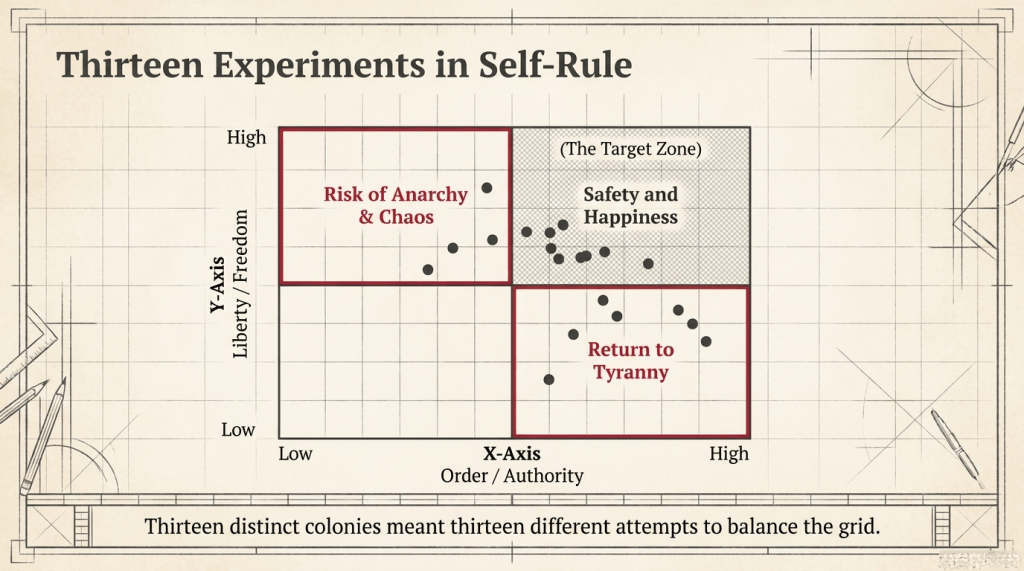
Some move quickly. Virginia, already leaning toward independence, begins drafting a constitution that reflects its understanding of republican government. Pennsylvania struggles, caught between factions that disagree not only on details but on fundamentals. Massachusetts, with its long tradition of town meetings and local control, leans into structures that emphasize participation. South Carolina moves in its own direction, shaped by its unique social and economic realities.
There is no uniformity, and that is both a strength and a weakness.
On one hand, it allows each colony to tailor its government to its circumstances. On the other, it creates a patchwork of systems that do not always align. Different balances of power emerge. Some legislatures dominate. Others attempt to check that dominance with stronger executives. Courts vary in their independence and authority. Voting requirements differ, reflecting local attitudes about who should have a voice.
It is messy. It is also inevitable.
There is no blueprint waiting to be followed. The founders are not working from a finished design. They are drawing as they go, guided by principles but constrained by reality. They are trying to answer a question that sounds simple until you attempt it. How do you create a government that preserves liberty without descending into disorder? That question sits at the heart of everything they do.
Liberty, taken alone, is not enough. It can inspire, it can motivate, it can justify resistance, but it does not organize a society. Without structure, without law, without some agreed upon framework, liberty can fragment into competing claims, each asserting its own right without regard for the whole.
Order, taken alone, is not enough either. It can create stability, it can enforce rules, it can provide a sense of security, but without liberty, it becomes something else. It becomes control, imposed rather than accepted, maintained through force rather than consent. The tension between these two is not a problem to be solved once and then forgotten. It is a condition to be managed constantly.
The founders understand this, even if they do not always agree on how to handle it. When they speak of safety, they are not talking about comfort or ease. They are talking about the conditions necessary for a society to function. Law that is predictable. Authority that is recognized. A system that can respond to threats, both internal and external, without collapsing.
Safety requires restraint. It requires limits on behavior, enforcement of rules, and the willingness to accept that not every action is permissible simply because it is desired.
When they speak of happiness, they are not promising contentment. They are describing the opportunity to pursue a life within that structured environment. To work, to participate, to improve one’s condition without arbitrary interference. Happiness, in this sense, depends on freedom, but it also depends on the stability that makes that freedom meaningful. Put the two together, and you have a framework that is demanding rather than comforting.
A government that secures safety and happiness must balance competing needs. It must be strong enough to enforce the law and limited enough to respect liberty. It must provide order without stifling initiative. It must allow participation without descending into chaos. That balance is not easily achieved.
The early state constitutions reflect this struggle. Some lean too far toward legislative dominance, concentrating power in assemblies that can act quickly but not always wisely. Others attempt to distribute authority more evenly, creating checks that slow decision making but prevent excess. There are successes and failures, adjustments made, lessons learned.
All of it unfolds in real time, under conditions that allow little margin for error. The risk is always present.
Without discipline, liberty can dissolve into disorder. Laws ignored, authority questioned at every turn, decisions delayed or undone by constant disagreement. A society cannot function indefinitely under those conditions. It frays, then breaks.
Without liberty, safety can harden into control. Rules enforced without consent, authority exercised without accountability, order maintained at the cost of participation. That kind of system may appear stable, but it carries within it the seeds of resentment and resistance.
The founders are not naïve about these risks. They have seen both sides. They have lived under a system that, in their view, has tilted too far toward control. They are determined not to recreate that imbalance, even as they recognize the need for structure.
So, they experiment.
They write, revise, argue, and adjust. They build institutions and then test them, sometimes intentionally, sometimes through circumstance. They discover that principles must be translated into practice, and that translation is never perfect.
This is the dangerous work of self-government. It is dangerous not because it invites chaos, but because it demands responsibility. It places the burden of success or failure on the people themselves. There is no distant authority to blame when things go wrong. There is no external power to appeal to when decisions prove difficult.
There is only the system they have created, and their willingness to maintain it. That is a heavier weight than any imposed from above. It is also the point.
The line about safety and happiness, the one that sits quietly in the May resolves and later echoes in the Declaration, is not a promise. It is a standard. It tells the colonies, and eventually the nation, what government is supposed to do. It also tells them what they are responsible for sustaining.
That responsibility does not end in 1776.
The debates that begin in those early constitutions continue, in different forms, in every generation that follows. The balance between liberty and order remains unsettled, because it cannot be settled once and for all. Circumstances change. Challenges evolve. The principles endure, but their application requires constant attention.
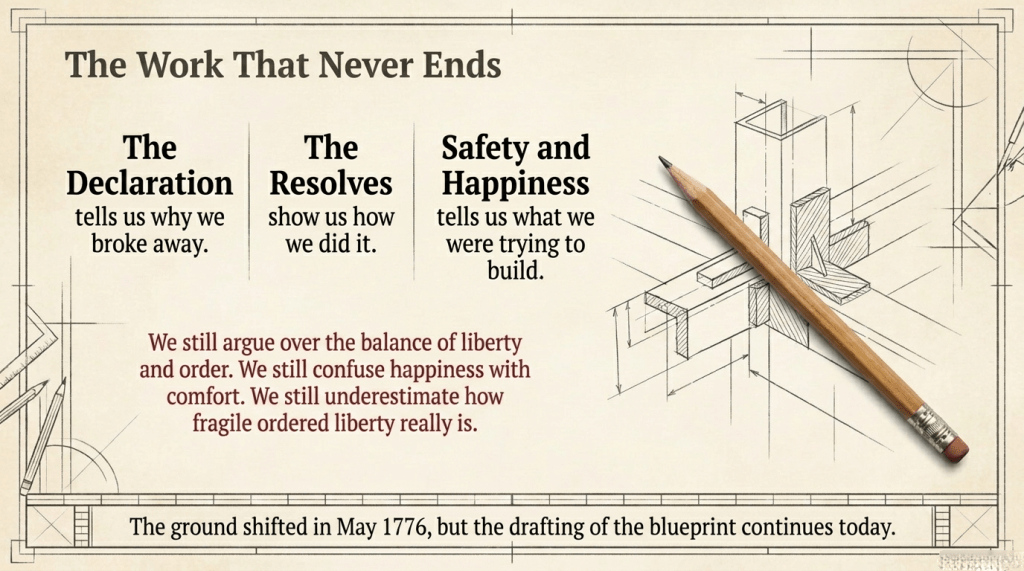
We still argue over the same questions. How much authority is necessary to maintain order? How much liberty is necessary to preserve individuality? Where does one begin to threaten the other? These are not new debates. They are the continuation of a conversation that began long before the Declaration and will continue long after.
We also still misunderstand the language.
Happiness is often reduced to comfort, as if the purpose of government is to remove difficulty rather than to create conditions in which people can navigate it. Safety is sometimes treated as an excuse for control, as if the absence of risk justifies the erosion of freedom.
Those misunderstandings matter because they distort the balance the founders were trying to achieve.
Ordered liberty is fragile. It depends on participation, on restraint, on a shared commitment to principles that are not always convenient. It can be lost slowly, through neglect or misunderstanding, just as easily as it can be lost quickly through force.
That is the modern echo of what began in 1776.
The Declaration tells us why the colonies broke away. It lays out the grievances, the principles, the justification for separation. The resolves of May show how that separation began to take practical form, how authority shifted and new systems emerged.
But the line about safety and happiness, the one that seems so simple at first glance, tells us something more important. It tells us what they were trying to build.
Not a perfect system, because perfection is not available to human institutions. Not a system free from conflict, because conflict is part of any society. But a system grounded in the idea that government exists to serve the people, to protect their rights, and to create the conditions in which they can live and act with a measure of freedom and stability.
That is the goal.
Everything else is the work required to reach it.
Adams, John. Diary and Autobiography of John Adams. Edited by L. H. Butterfield. 4 vols. Cambridge, MA: Belknap Press of Harvard University Press, 1961.
Adams, John. The Works of John Adams, Second President of the United States. Edited by Charles Francis Adams. 10 vols. Boston: Little, Brown and Company, 1850–1856.
Continental Congress. Journals of the Continental Congress, 1774–1789. Edited by Worthington Chauncey Ford et al. 34 vols. Washington, DC: Government Printing Office, 1904–1937.
Dickinson, John. Letters from a Farmer in Pennsylvania. Philadelphia, 1768.
Jefferson, Thomas. The Papers of Thomas Jefferson. Edited by Julian P. Boyd et al. Princeton, NJ: Princeton University Press, 1950–.
Jefferson, Thomas. The Writings of Thomas Jefferson. Edited by Andrew A. Lipscomb. 20 vols. Washington, DC: Thomas Jefferson Memorial Association, 1903–1904.
Maier, Pauline. American Scripture: Making the Declaration of Independence. New York: Knopf, 1997.
McCullough, David. John Adams. New York: Simon & Schuster, 2001.
United States. Declaration of Independence. July 4, 1776.
Virginia Convention. Proceedings of the Virginia Convention of Delegates, 1776. Richmond: Printed by Order of the Convention, 1776.
SAFETY & HAPPINESS
Liberty 250 – The Music(al)
Words and Music by David Ray Bowman
©2026 by Slippery Fish Entertainment




 DAVE DOES HISTORY
Leave a comment