
Ancient ideas have a habit of surviving long after the civilizations that created them have disappeared. They slip quietly into modern life wearing new costumes, speaking new languages, hiding inside movies, novels, political slogans, and television shows most people consume without ever recognizing the older world still breathing underneath them.
Millions of Americans heard the name “Cylon” in September of 1978, while watching Battlestar Galactica and never realized they were hearing an echo from ancient Greece, a shadow of Cylon of Athens, the ambitious aristocrat whose failed coup became one of the earliest warnings about tyranny and the dangerous hunger for absolute power. The irony is almost painfully perfect. Modern audiences instantly understood the Cylons as symbols of domination, control, and the destruction of human freedom, yet most never recognized the historical reference because we no longer receive the kind of classical education our Founders considered essential to citizenship itself.
Jefferson, Adams, and Madison would have caught the connection immediately because they lived in a world saturated with Greek and Roman history. They understood that civilizations carry memory through names, symbols, and stories. We often inherit those same symbols while forgetting the history that gave them meaning in the first place.
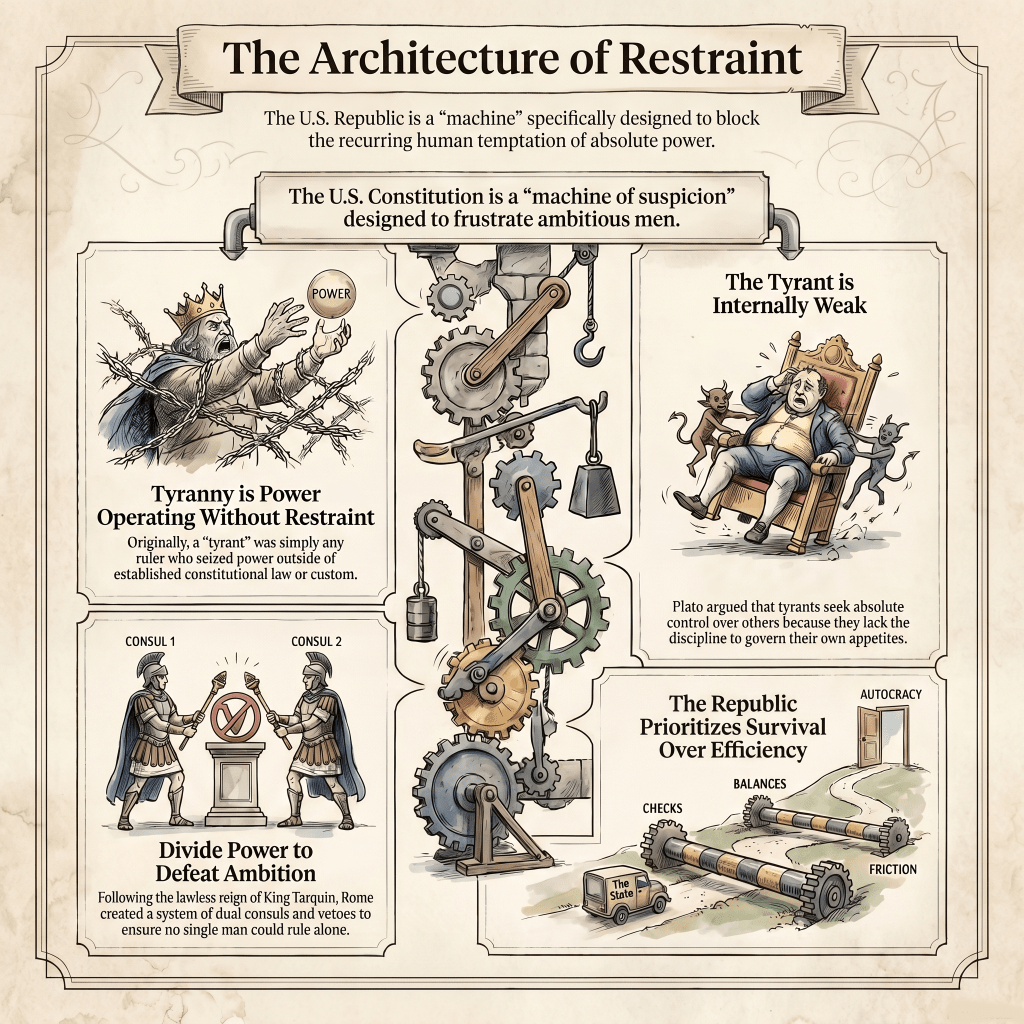
There are certain political words that begin life almost harmlessly and then darken over centuries until they carry the emotional weight of a thunderstorm. “Tyrant” is one of those words. Today the term arrives already loaded with moral judgment. People hear it and immediately imagine dictators in decorated uniforms, surveillance states, secret prisons, giant portraits hanging from concrete buildings, and nervous crowds applauding a little too enthusiastically because history has taught them the health risks of insufficient enthusiasm.
Ancient Greece heard the word differently at first.
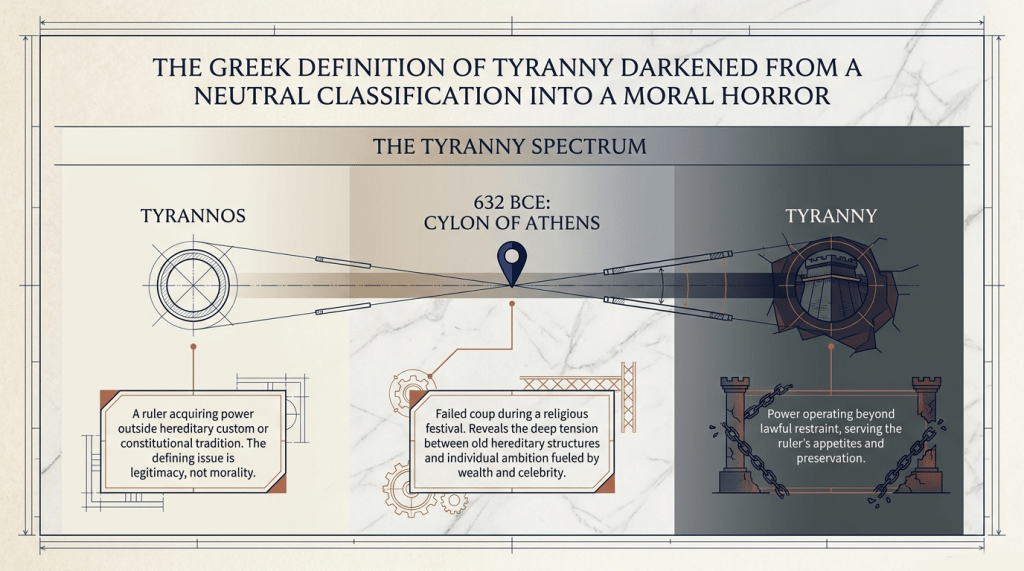
The Greek word tyrannos originally carried a far more neutral meaning. It described a ruler who acquired power outside hereditary custom or constitutional tradition. That was all. A tyrant might govern effectively or disastrously. He might improve a city or plunder it. The defining issue was not morality but legitimacy. He ruled without the inherited legal structure that traditionally justified authority. Only later did the word absorb the philosophical suspicion and moral horror now attached to it.
The Greeks arrived at that darker understanding honestly, through painful experience and repeated political disappointments. Like most civilizations, they discovered that men who seize power outside lawful restraint rarely remain content with limits once they possess authority. The pattern emerged early enough that one of the first famous examples still feels strangely recognizable even after nearly twenty seven centuries.
His name was Cylon.
Cylon lived in seventh century BCE Athens during a period when the old aristocratic order was beginning to strain under political tension and social change. He was wealthy, aristocratic, physically impressive, and already famous throughout Greece as an Olympic victor. In the ancient world, athletic success carried immense prestige. Victorious athletes became symbols of civic glory and personal excellence. Their reputations traveled across the Greek world long before modern celebrity culture discovered how to turn public recognition into political capital. Human nature, it turns out, did not require television to become fascinated with famous people trying to govern society.
Cylon possessed everything ambitious men usually believe entitles them to leadership: status, wealth, public admiration, influential family connections, and confidence bordering on destiny. Around 632 BCE, he attempted to seize control of Athens through a coup.
He was not acting entirely alone. His father in law, Theagenes, already ruled as tyrant of neighboring Megara and reportedly encouraged or supported the effort. That detail matters because ambitious rulers often inspire imitation. Strongmen study neighboring examples and begin imagining themselves stepping into similar roles. One successful autocrat tends to produce imitators the way one casino jackpot convinces thousands of people they are about to become millionaires if they just keep feeding quarters into the machine long enough.
Cylon chose a major religious festival for his coup attempt, likely hoping public distraction and symbolic timing would strengthen his chances. Instead, the effort collapsed quickly. The Athenians resisted. Cylon and his followers found themselves trapped on the Acropolis seeking sanctuary at sacred altars. They became suppliants under religious custom, clinging literally and symbolically to divine protection.
What followed scandalized Athens for generations.
Members of the powerful Alcmaeonid family persuaded many of the trapped conspirators to leave the sanctuary under promises of safe treatment. Once outside, however, numerous followers were killed anyway. The act horrified many Greeks because it combined political violence with sacrilege. Even societies accustomed to bloodshed maintain certain boundaries civilized people are expected not to violate. When politics destroys those boundaries, public trust begins decaying in ways difficult to repair.
The failed coup revealed something deeper than one aristocrat’s ambition. It exposed the growing tension inside the Greek polis itself.
The old hereditary structures no longer operated securely, but stable constitutional government had not fully emerged either. Wealthy ambitious men still imagined they could personally seize power through prestige, military support, and political alliances. At the same time, Greek cities increasingly resisted surrendering authority entirely to individuals. The struggle between civic government and personal ambition was already visible centuries before Rome, centuries before modern constitutions, centuries before microphones and social media taught ambitious personalities how to dominate public attention continuously.
The Greeks gradually recognized that tyranny represented more than isolated political accidents.
It reflected a recurring human temptation.
That realization transformed tyranny from a descriptive political term into a philosophical problem. Greek thinkers began asking not simply how tyrants seized power but why certain men desired absolute authority in the first place and what such power did to the human soul.
Plato approached the issue psychologically.
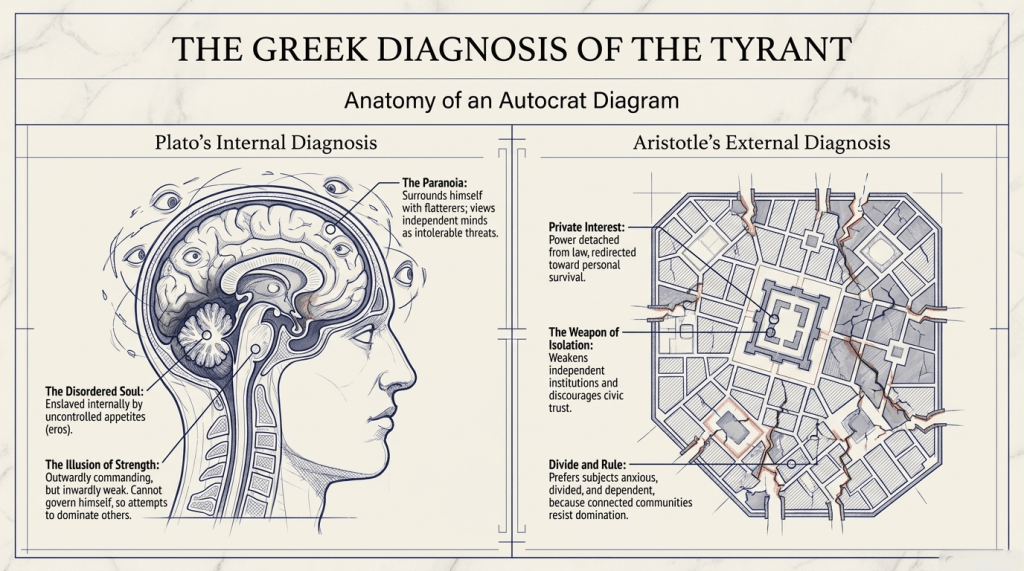
In the Republic, Plato describes the tyrannical soul as fundamentally disordered. The tyrant is not strong in the deepest sense but enslaved internally by his own uncontrolled appetites. Plato uses the concept of eros broadly here, meaning consuming desire generally rather than merely sexual passion. The tyrant becomes driven by endless craving because he lacks inner discipline. Since he cannot govern himself, he attempts to dominate others instead.
That insight remains remarkably unsettling because it reverses common assumptions about power. Tyrants often appear outwardly decisive, forceful, and commanding. Plato argues that beneath the performance lies weakness. The tyrant surrounds himself with flatterers because honest criticism becomes intolerable. He grows suspicious because insecurity naturally fears independent minds. He governs through deceit and violence because trust requires stability he does not possess internally.
In Plato’s telling, the tyrant becomes trapped inside his own desires.
He seeks limitless power precisely because nothing else satisfies him for long. The result is one of the earliest psychological studies of political corruption ever written, and it remains disturbingly recognizable. Different eras produce different ideologies, slogans, uniforms, and technologies, but human ambition continues operating according to remarkably familiar patterns.
Aristotle examined tyranny somewhat differently.
Where Plato focused on the soul, Aristotle focused on political structure. In Politics, he classifies governments according to whether rulers govern for the common good or merely for themselves. Monarchy could theoretically function honorably if a king ruled lawfully for the welfare of his people. Tyranny represented monarchy corrupted, power detached from law and redirected toward the ruler’s private interest and survival.
Aristotle’s tyrant rules through fear because fear preserves control.
He weakens independent institutions. He discourages civic trust. He isolates citizens from one another because connected communities resist domination more effectively than fragmented individuals. Tyrants prefer subjects anxious, divided, and dependent. Aristotle recognized that civic friendship, mutual trust among citizens participating together in public life, forms one of the greatest obstacles to autocratic power.
That realization shaped political thought for centuries afterward.
The Greeks eventually concluded that tyranny was not merely about cruelty or harsh government. It was about power operating beyond lawful restraint. A tyrant might still speak endlessly about justice, security, stability, national greatness, or public necessity. Tyrants nearly always present themselves as guardians of order. The deeper problem lies in the disappearance of limits. Government ceases serving the public welfare and increasingly serves the ruler’s appetites, fears, and preservation.
The American Founders absorbed these lessons deeply.
Jefferson, Adams, Madison, and countless others read Greek and Roman political philosophy as practical guidance rather than academic decoration. When the Declaration of Independence accuses George III of “repeated injuries and usurpations,” the intellectual background includes this classical understanding of tyranny as accumulated arbitrary power escaping constitutional restraint.
The Founders did not imagine tyranny arriving suddenly in dramatic fashion. They believed it emerged gradually through patterns and precedents. Legislatures dissolved. Courts manipulated. Standing armies maintained without consent. Representation hollowed out. Executive power expanded incrementally while citizens grew accustomed to each new violation. To eighteenth century Americans, these developments resembled the same ancient warnings political philosophers had discussed since Greece first wrestled with the dangers of unchecked authority.
That may be the most enduring lesson hidden inside the Greek origins of tyranny itself.
Autocracy rarely introduces itself honestly. It appears promising order, security, restoration, protection from chaos, national renewal, and relief from uncertainty. Cylon almost certainly did not consider himself history’s villain. Most tyrants never do. They believe they alone can stabilize society if inconvenient restraints would stop interfering with necessary action.
The Greeks eventually learned to distrust the man who insists only he can save the city.
Not because such figures always appear monstrous immediately, but because they so often appear persuasive precisely when frightened societies become most willing to surrender restraint in exchange for reassurance.
The Greeks gave the ancient world the philosophical language of tyranny, but the Romans turned tyranny into something colder and more permanent. They transformed it from an abstract political danger into a living historical memory. For Rome, tyranny was not simply a theoretical problem discussed by philosophers beneath shaded colonnades while students nodded thoughtfully and tried not to fall asleep in the Mediterranean heat. Tyranny became a civic trauma, a warning etched directly into the Roman understanding of liberty, law, and political order.
At the center of that memory stood Lucius Tarquinius Superbus, Tarquin the Proud, the final king of Rome and the man Roman tradition blamed for teaching an entire civilization to hate kings.
Even the name feels sharpened by history.
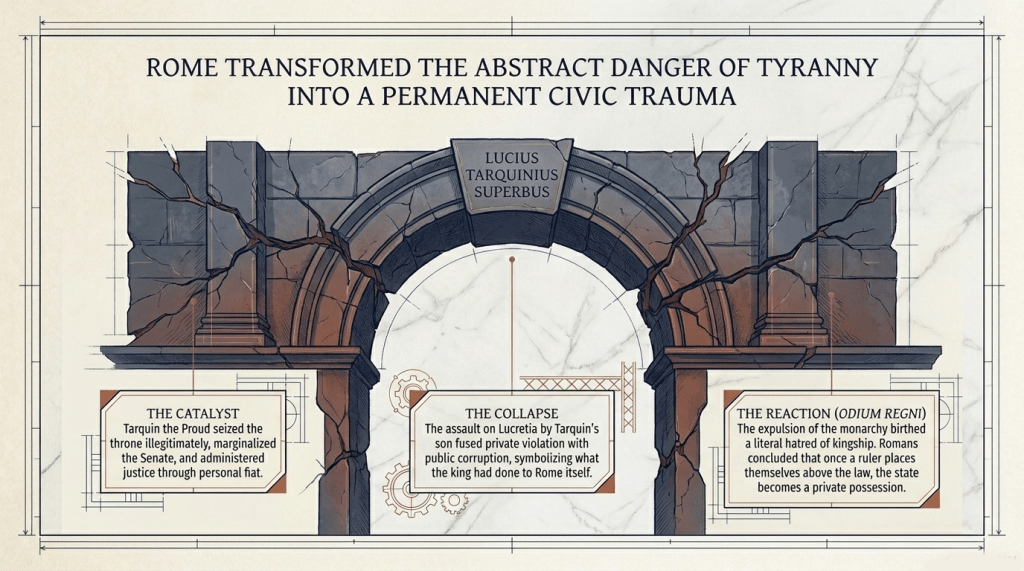
Roman writers remembered Tarquin not merely as a ruler but as the embodiment of lawless power. Whether every detail of the story unfolded exactly as later historians described mattered less than the fact that generations of Romans believed it. Republics often define themselves through political memory as much as through objective chronology. The stories civilizations choose to preserve reveal what they fear becoming again.
According to Roman tradition, Tarquin seized the throne illegitimately after the murder of his predecessor and father in law, Servius Tullius. The transition already carried the smell of conspiracy and blood before Tarquin even began ruling. Earlier Roman kings, whatever their flaws, had generally maintained some relationship with aristocratic institutions and public consultation. Tarquin increasingly discarded those restraints. He marginalized the Senate, bypassed traditional customs, and governed through personal authority rather than civic consensus.
That distinction mattered enormously to Roman political thought because the issue was never simply cruelty. Ancient governments could be harsh without necessarily becoming tyrannical. Rome itself later mastered brutality with the sort of grim efficiency that makes modern bureaucracies seem almost charmingly restrained by comparison. The Roman fear centered instead on arbitrary power detached from law. Tarquin administered justice according to personal fiat. Public authority became increasingly indistinguishable from the king’s private will.
The Romans concluded that once rulers place themselves above law, the state itself begins changing character.
Tarquin’s reign reportedly relied heavily upon fear. Roman historians described executions, confiscations, intimidation, and suppression of political opposition. Senators disappeared or withdrew into silence. Public life narrowed beneath the pressure of royal authority. Rome ceased behaving like a shared political community and increasingly resembled the possession of one dominant family. The old civic balance began collapsing inward around the king personally.
That transformation became central to later republican thought because it revealed how tyranny actually functions in practice. The tyrant does not merely govern aggressively. He absorbs institutions into himself. Loyalty shifts away from law and toward personality. Independent authority becomes threatening because it limits command. Citizens gradually become subjects while public disagreement starts resembling disobedience rather than legitimate participation in civic life.
The final crisis arrived through one of the most famous stories in Roman history, the assault upon Lucretia.
According to tradition, Sextus Tarquinius, the king’s son, raped Lucretia, the wife of the Roman nobleman Collatinus. After publicly revealing the attack and demanding vengeance, Lucretia took her own life rather than live beneath dishonor. The event electrified Roman society because it fused private violation with public corruption. What happened to Lucretia became symbolic of what Romans believed had happened to the city itself under tyranny. The king’s household no longer respected limits, law, dignity, or restraint.
Lucius Junius Brutus emerged as the leader of the revolt that followed. Roman tradition presents him standing before Lucretia’s body, swearing an oath that no king would ever rule Rome again. Whether or not the scene unfolded exactly that way, the symbolism mattered profoundly. The Romans understood the expulsion of Tarquin not simply as regime change but as liberation from domination itself.
The monarchy fell, Tarquin fled, and Rome entered one of the defining transformations in Western political history.
The Roman Republic was born directly from hatred of kingship. The Romans developed what later writers called odium regni, literally the hatred of monarchy. That hatred shaped every major institution the Republic constructed afterward. Rome became obsessed with preventing the return of unchecked personal authority because Romans believed they had already seen what happened when one man stood above law.
The constitutional structure of the Republic reflected that fear everywhere.
Instead of a single ruler, Rome created two consuls elected annually. Each consul possessed significant authority, but each also possessed the ability to veto the other. Time limits prevented permanent accumulation of office. Magistracies divided responsibilities across multiple offices. Civic institutions overlapped deliberately so that no individual could easily dominate the entire system. Even emergency powers carried formal restrictions because Romans feared temporary necessity becoming permanent habit.
The Republic therefore functioned almost like an elaborate machine designed to frustrate ambitious men.
The Romans understood something civilizations repeatedly rediscover the hard way. Concentrated power often appears efficient during moments of instability. A single decisive ruler can seem attractive when institutions feel slow, divided, corrupt, or frustrating. Citizens exhausted by conflict frequently begin valuing order more than restraint. Rome never entirely escaped that temptation. In fact, much of Roman history afterward becomes the story of repeated struggles between republican limits and powerful personalities seeking to rise above them.
The memory of Tarquin haunted all those later conflicts.
Even centuries afterward, accusations of seeking kingship remained politically explosive in Rome. Julius Caesar discovered this with fatal consequences. His enemies portrayed him not merely as ambitious but as aspiring toward monarchy itself. That accusation carried emotional force because Romans still associated kingship with arbitrary domination and civic humiliation. Caesar’s assassins justified murder in explicitly republican terms, presenting themselves as defenders of liberty against a new tyrant. One of those conspirators, Marcus Junius Brutus, even claimed descent from the earlier Brutus who expelled Tarquin. Roman political memory folded back upon itself with almost theatrical symmetry.
Cicero later refined the Roman understanding of tyranny philosophically. To him, tyranny became inseparable from abandonment of the rule of law. Legitimate government existed to preserve justice and protect the commonwealth. Tyrants ruled instead according to appetite, fear, and private interest. Once rulers place themselves above law, they effectively steal sovereignty from the people themselves. The tyrant does not merely govern badly. He governs illegitimately because public authority no longer serves the republic but the ruler personally.
Those Roman ideas shaped the American Founders profoundly. Jefferson, Adams, Madison, Hamilton, and countless others read Roman history almost obsessively because they believed republics remained fragile political achievements vulnerable to corruption and concentrated power. Rome fascinated them not because it represented perfection but because it illustrated how liberty could decay gradually beneath ambitious leadership and civic exhaustion.
The American Revolution inherited Rome’s suspicion of unchecked authority directly.
When the Declaration of Independence accuses George III of pursuing “absolute Tyranny,” the phrase carries deep Roman resonance. The colonists did not believe tyranny meant merely unpopular policies or excessive taxation. They believed tyranny emerged when rulers escaped constitutional restraint, weakened representative institutions, centralized authority, and governed according to personal prerogative rather than established law.
That same fear shaped the United States Constitution later.
Checks and balances, divided powers, federalism, separation of authority, regular elections, civilian control of the military, all of it reflects the ancient republican conviction that liberty survives only where power remains fragmented and accountable. The Founders did not trust concentrated authority because history repeatedly demonstrated what ambitious men eventually do with it.
The deeper Roman lesson remains painfully relevant because republics rarely collapse in dramatic single moments. They weaken gradually as citizens grow frustrated with institutional friction, impatient with constitutional limits, and increasingly willing to trade restraint for efficiency or reassurance. The Romans believed they had already learned that lesson once under Tarquin the Proud.
They spent the next five centuries trying not to learn it again. The American Founders did not believe they were inventing history from scratch.
That point matters because modern people often talk about the Revolution as though Jefferson, Adams, Madison, and the rest simply woke up one morning, looked around the colonies, and spontaneously created an entirely new political philosophy somewhere between breakfast and lunch. The Founders themselves would have found that assumption almost absurd. They saw themselves not as innovators detached from the past but as heirs to a very old conversation about liberty, law, corruption, and power. That conversation began long before America existed.
The men who gathered in Philadelphia in 1776 had been educated in the histories of Greece and Rome so thoroughly that classical references flowed through their political language almost automatically. They read Plato, Aristotle, Cicero, Livy, Sallust, Tacitus, and Plutarch not as decorative intellectual accessories but as practical guides to understanding republics and the dangers threatening them. To the Founders, history functioned less like a museum and more like a warning system.
The ancients, they believed, had already mapped the political terrain.
They had watched republics rise, decay, and collapse beneath ambitious men promising order while concentrating authority. They had studied tyrants who bypassed law, weakened civic institutions, manipulated fear, and slowly transformed public power into personal dominion. The Founders did not think human nature had fundamentally improved since Athens or Rome. If anything, they tended toward deep skepticism about permanent human virtue. That skepticism shaped the entire architecture of the American republic.
Which means the Declaration of Independence was not simply a protest document. It was a classical indictment.
Modern Americans often read the Declaration primarily as a statement of ideals, equality, liberty, natural rights, government by consent. Those elements certainly matter. Yet the largest section of the document consists of twenty seven specific grievances against King George III, and those grievances read unmistakably like the ancient catalogues of tyrannical behavior the Founders had encountered repeatedly in classical history.
Jefferson and the Continental Congress were not merely saying, “We dislike British policy.” They were saying, “We recognize this pattern.”
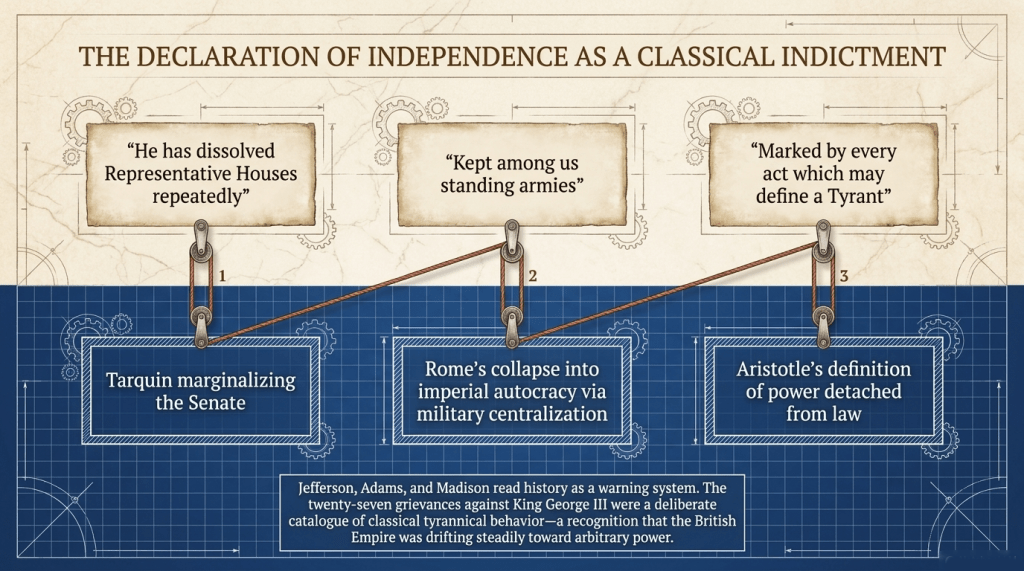
The Declaration accuses George III of bypassing laws, obstructing justice, dissolving representative assemblies, keeping standing armies during peacetime, rendering military power superior to civil authority, manipulating judges, interfering with commerce, taxing without consent, transporting citizens overseas for trial, and repeatedly violating constitutional restraint. The accusations form more than a list of complaints. Together they create a portrait of character. That was deliberate.
Classical political thought focused intensely on the moral character of rulers because the ancients understood government partly as an extension of human nature itself. A corrupt soul produced corrupt rule. Plato’s tyrant enslaved himself to appetite. Aristotle’s tyrant governed for private interest rather than public welfare. Rome remembered Tarquin as the ruler who placed personal authority above law and transformed the state into an instrument of domination. The Founders inherited all those intellectual traditions.
When Jefferson writes that George III’s character is “marked by every act which may define a Tyrant,” he is invoking centuries of classical political philosophy in a single line.
The phrase would have resonated immediately with educated readers in 1776 because they already understood the historical archetype being invoked. Tyranny was not merely harsh government. It was lawless government detached from constitutional restraint. A tyrant governed according to will rather than law, appetite rather than justice, fear rather than civic trust. The colonists believed they saw precisely that pattern unfolding across the British Empire.
Standing armies especially terrified them because classical republicans consistently viewed permanent military power as dangerous to liberty. Rome’s collapse into imperial autocracy remained deeply tied to military centralization around powerful commanders. The Founders therefore viewed British troops stationed in the colonies during peacetime not merely as security forces but as warning signs. Armies separated from civilian control historically tended toward coercion. The Declaration reflects that fear directly by condemning the king for keeping standing armies among the colonies without legislative consent and rendering military authority independent from civil power.
To modern readers, some grievances can initially sound almost procedural, even dry.
“He has dissolved Representative Houses repeatedly.”
“He has obstructed the Administration of Justice.”
“He has refused his Assent to Laws.”
Those phrases lack the cinematic energy of battle scenes or dramatic declarations shouted beneath waving flags. Yet to the Founders, these were among the clearest symptoms of tyranny because they revealed systematic attacks upon constitutional order itself. Free government depended upon representative institutions functioning independently. Once rulers bypassed or weakened those institutions, liberty began eroding from within.
That was the ancient lesson. Cylon attempted to rise above the polis. Tarquin marginalized the Senate and ruled through personal authority. Julius Caesar concentrated military and political power around himself while republican institutions weakened beneath the pressure of crisis and ambition. The Founders saw the same dangers emerging inside the imperial relationship with Britain. The Revolution therefore became, in their minds, an act of preservation rather than destruction.
That distinction is essential for understanding the American founding properly. The colonists did not believe they were abandoning the rule of law. They believed they were defending it against corruption. They did not imagine themselves inventing liberty from nothing. They believed they were rescuing constitutional freedom from a ruler drifting steadily toward arbitrary power.
This explains why the Declaration reads simultaneously revolutionary and conservative.
It announces independence while grounding its argument in ancient principles and inherited rights. The document appeals to natural law, English constitutional tradition, classical republicanism, and historical precedent all at once. The Americans present themselves not as reckless innovators but as a free people reluctantly separating from a ruler who violated the conditions necessary for legitimate government. The remedy they chose reflected those same classical lessons.
The Founders understood that republics rarely collapse all at once. They decay gradually as power concentrates, institutions weaken, and citizens grow accustomed to executive overreach justified by crisis, efficiency, or necessity. The danger was permanent because human ambition was permanent. No constitution could rely safely upon virtue alone. That realization would shape the structure of government in the United States from the beginning.
The architects of the republic turned repeatedly toward the classical concept of the mixed constitution, the idea that stable government emerges through balancing competing powers against one another rather than concentrating authority in a single center. The Greeks explored versions of this idea. Rome institutionalized aspects of it through consuls, assemblies, and the Senate. Political thinkers like Polybius and Cicero argued that mixing elements of monarchy, aristocracy, and democracy produced greater stability because each force restrained the others.
The American Constitution absorbed those lessons deeply. Executive, legislative, and judicial powers became separated deliberately. Congress controlled funding and lawmaking. The president executed laws but did not create them. Courts interpreted constitutional limits. Federalism divided authority between national and state governments. Elections occurred regularly. Terms of office remained limited. Civilian control of the military became foundational. Every major institutional feature reflected the same underlying fear haunting republican thought since Greece and Rome: unchecked power eventually corrupts itself. The Constitution, in many respects, is a machine built from historical suspicion.
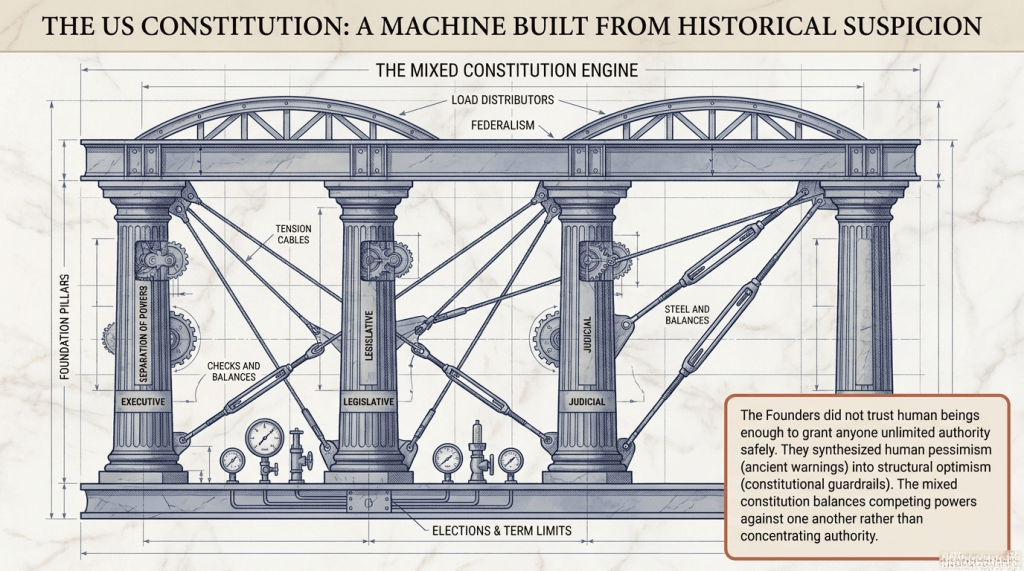
The Founders did not trust human beings enough to grant anyone unlimited authority safely. They especially distrusted charismatic leaders promising stability while gathering extraordinary powers into their own hands. History had already shown them where that road tended to lead. The Republic therefore required guardrails strong enough to restrain not merely bad men but ambitious men generally.
That point sometimes frustrates modern political culture because Americans frequently crave decisive leadership during moments of uncertainty. Institutional friction can feel slow, inefficient, even infuriating. Separation of powers deliberately creates conflict, delay, negotiation, and compromise. Citizens periodically begin wishing government functioned more like a corporation or military chain of command where somebody simply gives orders and obstacles disappear. The Founders would have viewed that impulse nervously.
Efficiency, in republican thought, was never the highest political virtue. Liberty required restraint. Restraint required distributed authority. Distributed authority inevitably created friction. The system was not designed primarily for speed. It was designed for survival.
That does not mean the Founders solved the problem of tyranny permanently.
No constitution can eliminate human ambition or political corruption entirely. The ancients knew that. The Founders knew it too. Republics remain fragile because citizens themselves eventually grow impatient with constitutional limits, especially during fear, crisis, or exhaustion. Rome’s institutions survived centuries before collapsing beneath concentrated military and executive power. The Americans understood their own republic remained vulnerable to similar pressures.
Which may be why the Declaration’s warning still feels uncomfortably alive.
The document insists that tyranny emerges through patterns, through repeated injuries and usurpations accumulating gradually until constitutional liberty weakens beneath them. The danger does not arrive wearing obvious villainy from the beginning. It arrives promising order, stability, necessity, security, national restoration, protection from enemies, relief from chaos.
The Greeks warned about it. The Romans built a republic trying to prevent it. The Americans constructed constitutional guardrails because they feared it would always remain possible.
And perhaps that is the final lesson buried inside the Declaration itself. The Founders did not believe liberty survived automatically. They believed every generation inherited the same permanent human tension between freedom and concentrated power, between constitutional restraint and the seductive promise of strong men claiming they alone can save the republic if only inconvenient limits would step aside.
Aristotle. Politics. Translated by Carnes Lord. Chicago: University of Chicago Press, 1984.
Cicero, Marcus Tullius. On the Republic and On the Laws. Translated by David Fott. Ithaca, NY: Cornell University Press, 2014.
Herodotus. The Histories. Translated by Aubrey de Sélincourt. Revised by John Marincola. London: Penguin Classics, 2003.
Jefferson, Thomas. The Papers of Thomas Jefferson. Edited by Julian P. Boyd et al. Princeton, NJ: Princeton University Press, 1950–.
Livy. The Early History of Rome: Books I–V. Translated by Aubrey de Sélincourt. London: Penguin Classics, 2002.
Madison, James, Alexander Hamilton, and John Jay. The Federalist Papers. Edited by Clinton Rossiter. New York: Signet Classics, 2003.
Plato. The Republic. Translated by Allan Bloom. New York: Basic Books, 1968.
Polybius. The Histories. Translated by Robin Waterfield. Oxford: Oxford University Press, 2010.
Sallust. The Jugurthine War and The Conspiracy of Catiline. Translated by S. A. Handford. London: Penguin Classics, 1963.
Tacitus. The Annals of Imperial Rome. Translated by Michael Grant. London: Penguin Classics, 1996.
Thucydides. History of the Peloponnesian War. Translated by Rex Warner. London: Penguin Classics, 1972.
The Declaration of Independence. July 4, 1776.
Wood, Gordon S. The Creation of the American Republic, 1776–1787. Chapel Hill: University of North Carolina Press, 1969.
Wood, Gordon S. The Radicalism of the American Revolution. New York: Vintage Books, 1993.






Leave a comment