
There are dates that become holidays, wrapped in celebration and memory, and then there are dates that actually change the course of events. The two are not always the same thing.
Americans celebrate July 4, 1776, as the birth of independence, and fairly enough. The Declaration of Independence remains one of the most powerful political documents ever written in the English language. Jefferson’s words still carry the force of thunder nearly two and a half centuries later. But declarations are often the explanation of a decision already made. They are the trumpet blast after the army has already begun to move.



If one wishes to find the true political birth of American independence, one has to look earlier, to Williamsburg and then Philadelphia, between May 15 and June 7 of 1776. That was the moment when the colonies stopped protesting and began committing themselves to nationhood.
The story begins in Williamsburg, Virginia, once one of the proud capitals of royal authority in British North America. For decades the colony had functioned as an extension of the Crown’s political order. Royal governors lived there. British law flowed outward from its chambers. Portraits of kings hung on the walls. Men drank toasts to the empire beneath polished chandeliers while discussing tobacco, trade, and politics.
By the spring of 1776, much of that world had collapsed.
Ride, Rodney, Ride!
Words & Music by David Ray Bowman
© 2026 by Slippery Fish Entertainment
ALL RIGHTS RERSERVED
Virginia’s royal governor, Lord Dunmore, had fled months earlier after tensions spiraled beyond his control. His flight told the colonists something no speech could have communicated more clearly. Royal authority in Virginia no longer rested on consent. It survived only through military force, and even that seemed increasingly uncertain. Dunmore had attempted threats, proclamations, and intimidation, including his explosive promise of freedom to enslaved men willing to join the British cause. Instead of restoring order, his actions deepened the conviction among many Virginians that reconciliation with Britain was becoming impossible.
The old political framework was still standing in appearance, but it was empty inside. Like an abandoned theater after the audience has gone home, the structure remained while the purpose had vanished.
Into that uncertainty came the Fifth Virginia Revolutionary Convention on May 15, 1776.
The delegates gathering in Williamsburg were not wild-eyed revolutionaries in the modern caricature. Many had spent years hoping desperately for reconciliation with Great Britain. Men like Thomas Jefferson, Edmund Pendleton, and Richard Henry Lee still considered themselves heirs to the British constitutional tradition. Even Patrick Henry’s famous cry of “Give me liberty, or give me death!” had originally been framed not as a rejection of British identity, but as a defense of the rights of Englishmen.
That distinction matters because it reminds us how reluctant many colonists had been to embrace outright independence.
For years they had petitioned the king. They had protested taxation policies. They had denounced parliamentary overreach. Yet many still believed the crisis could be repaired within the empire itself. What changed their minds was not merely taxation or trade restrictions. It was the growing realization that King George III himself had chosen coercion over reconciliation.
Lexington and Concord had already been fought. Blood had soaked the ground at Bunker Hill. Boston had endured occupation and siege. Congress’s Olive Branch Petition had been ignored. The king had declared the colonies in rebellion. German mercenaries were being hired to suppress resistance. The illusion that the Crown might intervene as a neutral protector was evaporating by the day.
Then came Common Sense.
Thomas Paine’s pamphlet exploded through the colonies in early 1776 with the force of a political earthquake. Paine did something earlier colonial leaders had hesitated to do. He attacked monarchy itself. He stripped away centuries of inherited reverence and treated kingship not as sacred tradition, but as an absurd and dangerous system. The effect was electric.
Paine transformed independence from an unthinkable gamble into a practical necessity. He gave ordinary colonists permission to imagine a future beyond the British Empire. Once people begin imagining a different political world, the old one begins dying very quickly. Virginia felt that shift intensely.
County meetings and local committees increasingly pushed for decisive action. Public opinion among patriot circles hardened toward separation. By May of 1776, the political atmosphere had changed so dramatically that the delegates meeting in Williamsburg faced a question that could no longer be postponed.
What exactly were they fighting for?
The answer they gave altered history.
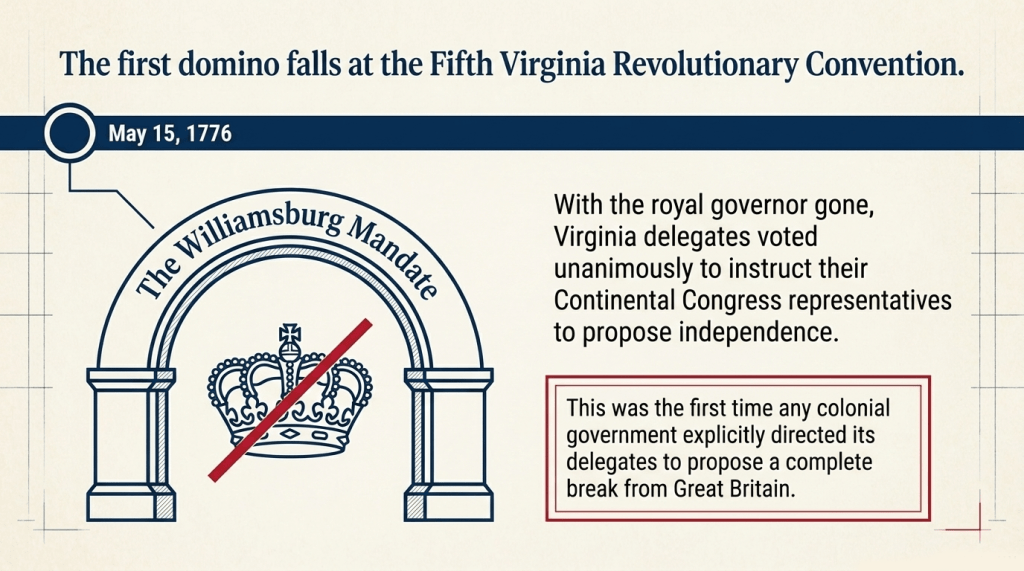
On May 15, the convention voted unanimously to instruct Virginia’s delegates in the Continental Congress to propose independence from Great Britain. The wording carried enormous significance. They were not authorizing discussion. They were not suggesting negotiation tactics. They were issuing direct instructions.
This was the first time any colonial government had formally directed its representatives to seek complete separation from the British Empire. Virginia had crossed the line before the rest of Congress did.
That mattered because Virginia was not some small fringe colony operating at the political margins. Virginia was the largest, wealthiest, and in many ways most influential colony in British North America. If Massachusetts proposed independence, skeptical delegates elsewhere might dismiss it as New England extremism. Massachusetts had already earned a reputation among some colonies as dangerously radical, filled with troublemakers and ideological firebrands.
John Adams understood that perfectly. So did Samuel Adams.
The two Massachusetts leaders had spent years pushing resistance further and further, but they also understood political reality. Many delegates from the middle and southern colonies viewed New Englanders with suspicion. To some, Massachusetts seemed filled with what one critic called “desperate adventurers,” men eager to drag the rest of the colonies into a catastrophic war.
That perception created a strategic problem. If independence appeared to be merely a New England project, it could fracture colonial unity. The solution was political as much as philosophical.
John Adams and Samuel Adams formed a tactical alliance with Virginia’s Richard Henry Lee. Historians later sometimes referred to this coalition as the “Adams-Lee Junto,” though the term carried both admiration and criticism depending on who used it. Together, they recognized an essential truth. The motion for independence had to come from Virginia if it were to succeed.
Richard Henry Lee was uniquely suited for the role. He possessed aristocratic credibility, political experience, and immense respect within Congress. Tall, elegant, eloquent, and deeply committed to colonial rights, he represented the kind of leadership that reassured hesitant delegates. Independence sounded less like reckless rebellion when spoken in Lee’s polished Virginia cadence.
So the stage was set.
On June 7, 1776, Richard Henry Lee rose before the Second Continental Congress in Philadelphia and introduced what became known as the Lee Resolution. John Adams immediately seconded the motion.
Its language was direct and unforgettable: “That these United Colonies are, and of right ought to be, free and independent States.”
No ambiguity remained. No room for misunderstanding lingered. Congress was now openly debating the destruction of British authority in America.
But the Lee Resolution contained far more than a declaration of independence alone. It was a three-part blueprint for creating an entirely new nation.
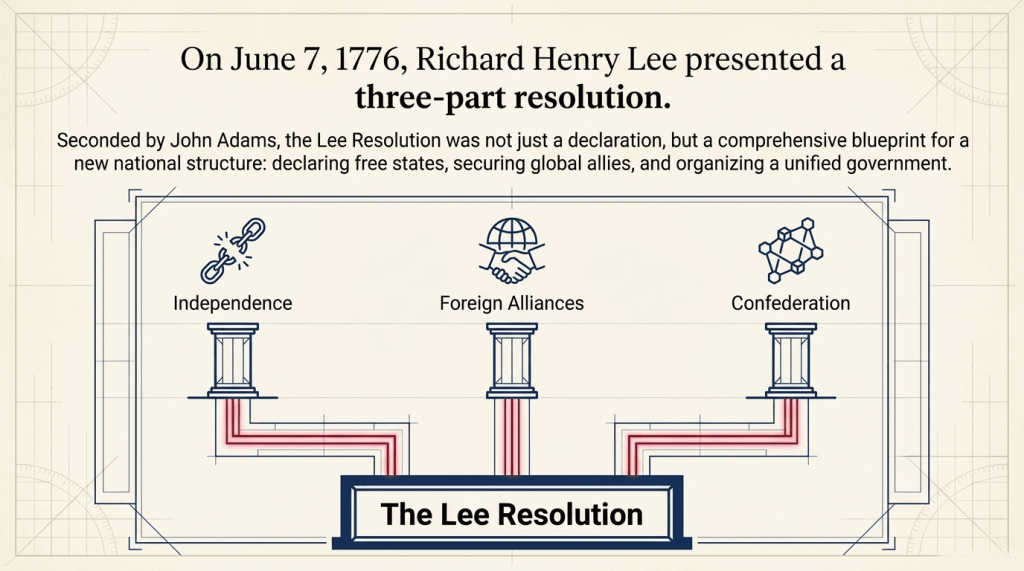
First, the colonies would declare themselves free and independent states.
Second, they would seek foreign alliances.
Third, they would prepare a plan of confederation.
Those latter two points are often overlooked today, but they reveal how serious and practical the revolutionary leadership had become. Declaring independence without foreign support would be suicidal. The colonies needed allies, especially France, if they hoped to survive a prolonged war against the British Empire.
Likewise, independence without some form of unified government would produce chaos. The colonies were already confronting questions about military command, finance, diplomacy, and trade. A confederation framework would become essential to holding the states together long enough to survive.
The Lee Resolution was not merely rhetoric. It was statecraft. It transformed independence from an abstract idea into an operational political program.
Ironically, Congress was not yet fully ready to vote on it. Several colonies still lacked authorization from their home governments to approve independence. Others feared moving too quickly. So debate was postponed for several weeks.
But something critical had already happened. The question was now unavoidable.
Once Lee placed the resolution before Congress, there was no returning quietly to reconciliation. The political center of gravity had shifted permanently. Delegates now had to decide whether they would stand with independence or against it.
Congress appointed committees to address each portion of Lee’s proposal. One committee would draft a declaration explaining the reasons for independence. Thomas Jefferson would become its principal author. Another would begin preparing a framework for confederation. Another would explore foreign alliances.
In other words, the machinery of nationhood had begun operating before the Declaration itself was even approved.
That is why the Lee Resolution deserves far more attention than it usually receives. The Declaration of Independence became the poetic soul of the Revolution. The Lee Resolution was the political act that made the Revolution official.
One might say the Declaration was America’s birth certificate. The Lee Resolution was the moment of conception.
And beneath all of it stood the decision made weeks earlier in Williamsburg, when Virginia’s delegates chose to stop asking for their rights and start claiming their sovereignty.
The men involved could not see the future clearly. They could not know whether independence would lead to triumph or disaster. They could not foresee Yorktown, the Constitution, or the survival of the republic. What they knew was simpler and more dangerous.
The old relationship with Britain was broken beyond repair.
And so, between May 15 and June 7, 1776, the colonies crossed the point of no return.
By June of 1776, the Continental Congress had reached the edge of the cliff. The Lee Resolution now sat openly before them, its language impossible to soften or reinterpret:
“That these United Colonies are, and of right ought to be, free and independent States.”
For years Congress had protested, petitioned, negotiated, and argued. Now the delegates faced a question that could no longer be postponed with carefully worded resolutions or symbolic gestures. Independence was no longer an abstraction discussed over tavern tables or whispered in private correspondence. It had become official business before the Congress of the colonies.
And not everyone was ready to leap.
The debates that erupted on June 8 and continued through June 10 were fierce, emotional, and deeply consequential. Modern Americans sometimes imagine the movement toward independence as a united national uprising, as though all thoughtful men naturally agreed that separation from Britain was inevitable. The reality was far messier. Congress was divided not only by ideology, but by fear, geography, economics, and timing.
Even among men who distrusted British policy, many still worried that independence might become a catastrophe.
At the center of the opposition stood John Dickinson of Pennsylvania, perhaps the most important revolutionary figure Americans rarely discuss today. Dickinson was no loyalist. That distinction matters enormously. He had opposed British overreach for years and had written the influential “Letters from a Farmer in Pennsylvania,” which helped shape colonial resistance before the war. He believed firmly in colonial rights and constitutional liberty.
But Dickinson was also cautious, methodical, and deeply aware of the dangers involved in revolution. Where men like John Adams saw hesitation as weakness, Dickinson saw recklessness as potentially fatal.
During the debates, Dickinson argued that Congress was moving too quickly. Declaring independence before securing foreign alliances and establishing a functioning confederation struck him as dangerously premature. His famous warning cut directly to the heart of the issue. Declaring independence first, he argued, was like “destroying a House before We have got another.”
It was an argument grounded not in cowardice, but in practical statecraft.
Dickinson feared several things at once. First, he worried the colonies lacked the unity necessary to survive independence. The alliance holding the colonies together remained fragile. New England’s interests did not always align with those of the southern colonies. Commercial priorities varied widely. Religious cultures differed sharply. Even the idea of what America might become remained unsettled.
Second, Dickinson feared military disaster. The British Empire remained the most powerful naval force on earth. The Continental Army was underfunded, poorly equipped, and often barely organized. If the colonies formally declared independence and then suffered major defeats, reconciliation might become impossible while victory remained uncertain.
Third, Dickinson worried about diplomacy. France and Spain hated Britain, certainly, but monarchies were often cautious about supporting republican revolutions. Dickinson believed it would be wiser to secure at least tentative foreign support before openly severing ties with the Crown. A failed rebellion frightened European powers more than it inspired them.
There was logic in his caution. One of the great mistakes people make when studying history is assuming that the side which eventually wins must have been obviously correct all along. In truth, independence in 1776 was still an enormous gamble. A reasonable observer at the time could easily conclude the colonies were marching toward disaster.
And yet the advocates for independence pressed forward relentlessly.
John Adams became one of the fiercest voices pushing the resolution ahead. Adams had little patience for endless delay. To him, the colonies were already effectively independent in practice. British authority had collapsed across large portions of America. Blood had already been spilled. Royal governors had fled. Waiting longer only prolonged uncertainty while weakening morale.
Adams also understood something Dickinson perhaps underestimated. Revolutions gain power from momentum. If Congress appeared hesitant or divided, public confidence might begin unraveling. Delay could be just as dangerous as haste. Still, the political reality inside Congress could not be ignored.
Several colonies lacked clear instructions from their home governments authorizing a vote for independence. Delegates from New York, New Jersey, Pennsylvania, Delaware, Maryland, and in some cases South Carolina remained constrained by divided opinion back home. Some delegates personally favored independence but lacked formal authority to approve it. Others genuinely remained undecided.
Congress faced a dilemma. A premature vote risked failure, and failure would be devastating. If the Lee Resolution were defeated openly, the entire independence movement could fracture at the very moment unity mattered most.
So on June 10, Congress made a strategic decision. The vote on independence would be postponed for three weeks, until July 1.
At first glance, the delay may seem anticlimactic, but it was actually one of the most important tactical decisions of the Revolution.
The postponement gave pro-independence factions time to work politically within the hesitant colonies. In modern terms, Congress delayed the final vote while the whip count continued behind the scenes. Supporters of independence understood they needed not merely a majority, but overwhelming unity if the declaration was to carry legitimacy.
And so, while Congress paused publicly, political warfare intensified privately.
In colony after colony, pro-independence leaders worked furiously to shift opinion. Local conventions were pressured to issue new instructions. Hesitant delegates were challenged, replaced, or politically isolated. Newspapers amplified patriotic arguments. Committees of correspondence spread momentum outward like sparks through dry grass.
Pennsylvania became one of the central battlegrounds. Its delegation remained deeply divided, largely because of Dickinson’s influence and the colony’s powerful Quaker tradition, which recoiled from revolutionary violence. Yet radicals within Pennsylvania increasingly pushed for new leadership more aligned with independence.
Maryland’s instructions eventually shifted. Delaware’s delegation remained divided, setting the stage for Caesar Rodney’s legendary overnight ride weeks later. New Jersey replaced several conservative delegates with men favorable to independence. Even New York, though still hesitant, began moving slowly toward acceptance.
The delay was not retreat. It was preparation. And Congress itself did not sit idle while waiting for July. Instead, the delegates began constructing the framework of an entirely new nation before independence had even been officially approved.
On June 11 and 12, Congress established three committees corresponding directly to the three pillars of the Lee Resolution.
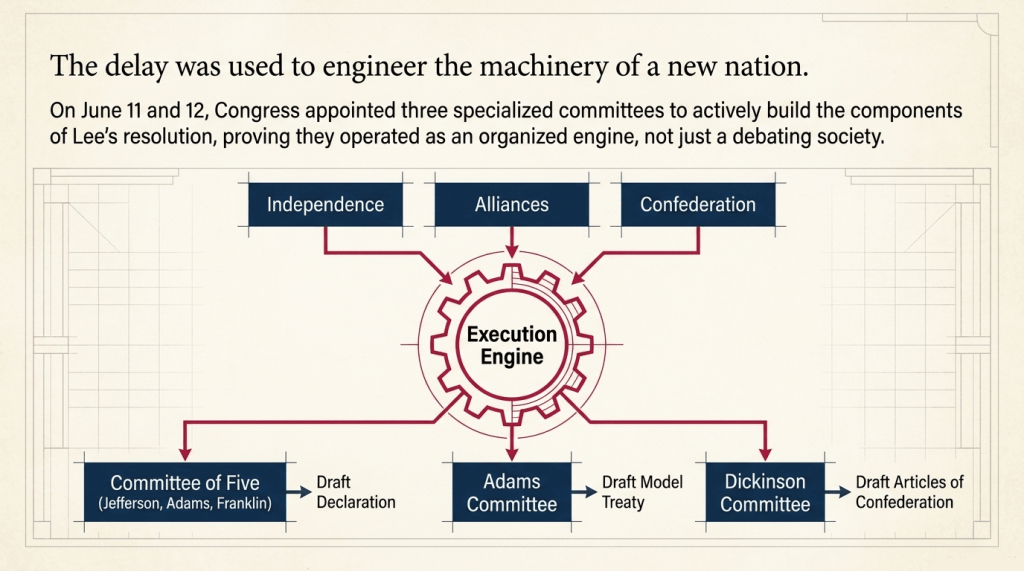
The first committee would draft a formal declaration explaining the reasons for independence to the world. This became the famous “Committee of Five,” composed of Thomas Jefferson, John Adams, Benjamin Franklin, Roger Sherman, and Robert Livingston.
The committee’s composition itself reflected political balance. Jefferson represented Virginia. Adams represented Massachusetts. Franklin brought prestige, diplomacy, and experience. Sherman represented Connecticut’s practical political culture. Livingston represented New York’s cautious but important position.
Jefferson eventually became the principal draftsman largely because Adams pushed the responsibility toward him. Adams later explained with characteristic bluntness that Jefferson was a Virginian, possessed greater literary elegance, and was less personally disliked in Congress than Adams himself.
That last point carried more truth than humor.
The committee’s assignment was extraordinary when one stops to consider it. Congress had not yet voted for independence, yet already a group was preparing the explanation for why independence was justified. In essence, Congress was preparing the intellectual and moral case before the verdict itself had formally been delivered.
The second committee addressed foreign alliances.
This effort fell largely under the leadership of John Adams, who began drafting what became known as the Model Treaty. Adams understood clearly that independence without foreign support might prove impossible to sustain militarily. France stood as the obvious target for diplomacy. French resentment over losses during the Seven Years’ War created opportunity, but Congress needed a coherent diplomatic framework if foreign recognition was to become reality.
The third committee focused on confederation. Ironically, leadership of this task fell to John Dickinson himself.
That detail says something important about the complexity of the moment. Dickinson opposed immediate independence, yet Congress still trusted his intellect and moderation enough to help design the governmental structure that independence would require. History often flattens people into heroes or villains. The reality is usually more complicated.
Dickinson’s committee began work on what would become the Articles of Confederation, America’s first national governing framework. Weak, flawed, and eventually replaced by the Constitution, the Articles nevertheless represented the first serious attempt to bind the colonies into a functioning political union.
Taken together, the three committees reveal something profound about June of 1776. The colonies were no longer merely resisting British authority. They were building a country.
A declaration would explain independence.
A treaty framework would sustain independence.
A confederation would organize independence.
The architecture of nationhood was being assembled piece by piece while Congress still publicly debated whether the house itself should even exist. That tension gives this period its extraordinary human drama.
Nobody knew how the story would end. British armies remained dangerous. Loyalist sentiment still existed. Economic collapse remained possible. Foreign alliances were uncertain. Colonial unity was fragile.
And yet the machinery of revolution continued moving forward.
The delay until July 1 did not weaken the drive toward independence. In many ways, it strengthened it. By postponing the vote, Congress gained time to transform a divided rebellion into something closer to a united national cause.
By late June, the momentum had become difficult to stop. The question was no longer whether independence would be debated. The question was whether Congress possessed the courage to finish what Williamsburg and Richard Henry Lee had already begun.
By July of 1776, the Continental Congress had reached the moment where argument would finally give way to decision. For weeks the delegates had circled around the question of independence like men standing at the edge of a dark river, each understanding that once crossed, there would be no return.
The debates had already consumed Congress through June. Alliances, confederation, military survival, foreign recognition, economic collapse, civil war, treason, execution, and posterity itself all hung over the chamber. Some delegates feared moving too quickly. Others feared waiting too long. Yet by the time Congress reconvened on July 1, the political machinery set in motion by Virginia’s instructions and Richard Henry Lee’s resolution had gathered a momentum that seemed almost impossible to stop.
Still, the outcome was not guaranteed.
That is one of the details modern Americans often forget. Independence now feels inevitable because we know how the story ends. The delegates sitting in Philadelphia in the summer heat of 1776 knew no such thing. They were not reading history. They were trapped inside it.
On July 1, Congress resumed formal debate on the Lee Resolution. The atmosphere inside the Pennsylvania State House, what Americans now call Independence Hall, must have felt almost unbearable. Windows were often shut to preserve secrecy despite the suffocating weather. Horses clattered outside in the streets. Messengers came and went. Delegates argued, sweated, worried, and maneuvered while the British Empire loomed like a storm over everything.
The debate itself stretched for hours.
John Adams threw himself into the argument with characteristic intensity. Adams later claimed that this was perhaps the greatest speech of his life, though no full transcript survives. Those who heard him described a forceful, relentless defense of independence that blended legal reasoning, political necessity, and moral urgency. Across from Adams stood men still deeply uneasy about what Congress was preparing to do.
John Dickinson remained among the strongest voices against immediate separation. Dickinson’s position had not changed. He believed independence without secure alliances and a stable governmental structure remained dangerously premature. Dickinson feared not merely defeat, but fragmentation. A divided rebellion could collapse into regional chaos, leaving the colonies weaker, bloodied, and permanently vulnerable.
His caution was not irrational. British military power remained immense. The Continental Army was fragile. The colonies themselves often distrusted one another almost as much as they distrusted Parliament. Dickinson worried Congress was gambling everything on hope.
But by July 1, the emotional center of gravity inside Congress had shifted. The first trial vote revealed just how close and fragile the situation still was. Nine colonies voted in favor of independence. Pennsylvania and South Carolina voted against it. Delaware’s delegation split evenly. New York abstained entirely because its delegates still lacked updated instructions from home authorizing approval.
The numbers revealed a continent still wrestling with itself.
Pennsylvania’s division reflected the influence of Dickinson and other moderates who feared catastrophe. South Carolina’s hesitation stemmed partly from concerns about military vulnerability and economic disruption. Delaware’s split embodied the broader uncertainty running through the middle colonies.
Even after months of war, Congress still stood only inches away from failure.
The advocates for independence understood that a divided declaration could weaken the legitimacy of the entire revolutionary movement. If Congress fractured openly at the decisive moment, Britain might exploit those divisions politically and militarily. Unity mattered almost as much as the declaration itself.
That was why Edward Rutledge made a crucial request. Hoping unanimity could still be achieved, Rutledge asked Congress to postpone the final vote until the following day.
Congress agreed.
That single night between July 1 and July 2 became one of the most consequential nights in American history. Across Philadelphia, delegates scrambled, negotiated, pressured, and pleaded. Conversations stretched late into the evening in taverns, boarding houses, and private rooms. Men who understood they might be deciding the fate of an entire continent worked desperately to secure the final votes needed for unity.
And then there was Caesar Rodney.
Caesar Rodney had not been present for the July 1 vote. Delaware’s two other delegates had split, with Thomas McKean supporting independence and George Read opposing it. Without Rodney, Delaware remained deadlocked.
Rodney was eighty miles away in Dover when word reached him that his presence was urgently needed in Philadelphia. The situation carried enormous weight. Delaware was small, but every colony mattered symbolically. A tied delegation weakened the appearance of consensus. Rodney understood immediately what was required.
So he mounted his horse and rode through the night.
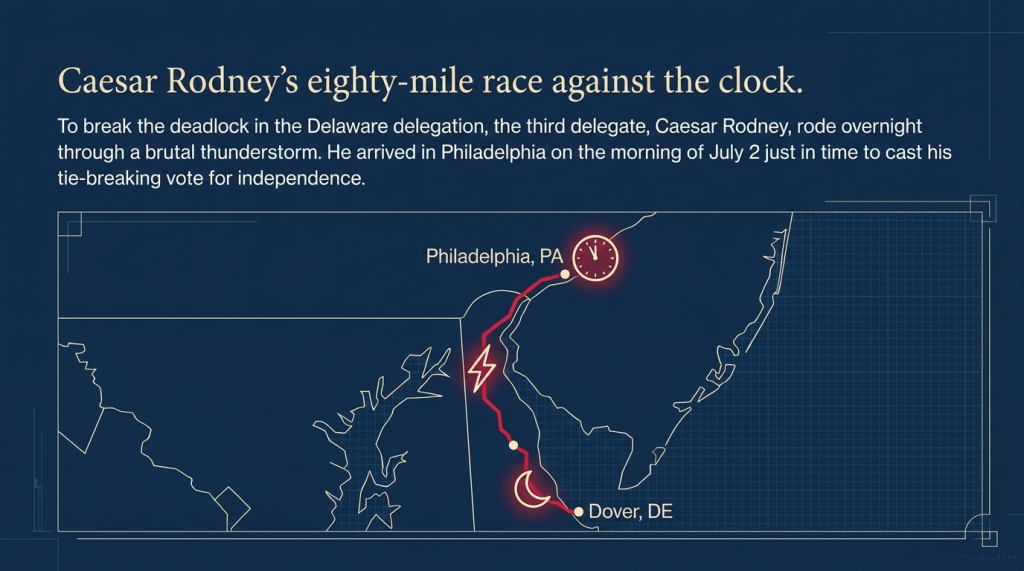
American memory has rightly elevated the ride into legend because it possesses nearly every element of classical drama. Rainstorms lashed the roads. Thunder rolled overhead. The July heat mixed with mud and exhaustion. Rodney already suffered from severe asthma and painful facial cancer that often required him to wear a green silk scarf across his face. Yet through darkness and storm he rode north toward Philadelphia.
There is something almost mythic about it.
History often turns on speeches and documents, but sometimes it turns on a man simply refusing to stop riding.
Rodney arrived in Philadelphia on July 2, exhausted, mud-spattered, and still wearing his riding boots when he entered Congress. His vote broke the Delaware deadlock in favor of independence.
Yet Rodney’s ride was only part of the story.
In Pennsylvania, something equally dramatic happened, though in a quieter and more politically painful form.
Opponents of immediate independence, particularly John Dickinson and Robert Morris, recognized the direction events were moving. Both men still had deep reservations about the timing of independence. Both feared the consequences if the revolution failed.
But they also feared something else. They feared internal division at the very moment unity mattered most.
And so, in one of the most remarkable acts of political sacrifice during the Revolution, Dickinson and Morris chose not to attend the July 2 session. Their absence altered Pennsylvania’s internal balance, allowing the remaining delegates to vote in favor of independence.
It is one of the great forgotten moments of American political history.
Dickinson, especially, deserves far more respect than he often receives in popular memory. Because he opposed immediate independence, later generations sometimes treated him as timid or weak. Yet Dickinson had already risked much for the revolutionary cause. He simply believed the colonies were moving too quickly. When the moment of decision finally arrived, he chose unity over personal victory.
There is an old truth in republican government that the survival of the whole sometimes requires men to surrender their own preferences for the common good. Dickinson understood that.
Meanwhile, South Carolina also reconsidered its position overnight. Leaders there concluded that standing apart from the growing consensus would damage colonial unity more than independence itself. By July 2, the South Carolina delegation reversed course and agreed to support the resolution.
And so the Congress assembled again. This time the outcome changed everything.
Twelve colonies voted in favor of independence.
New York abstained because its delegates still lacked authorization, though even there support for independence was rapidly growing.
The Lee Resolution passed.
At that instant, legally and politically, the United Colonies ceased to be part of the British Empire.
That point cannot be overstated.
The Declaration of Independence had not yet been finalized or approved. Jefferson’s language would still undergo editing over the next two days. The famous parchment signing associated in popular imagination with July 4 would come even later.
But the actual act of separation occurred on July 2, 1776. That was the decisive vote. That was the legal break. That was the birth of the United States.
John Adams understood it immediately.
Writing to his wife Abigail Adams, Adams predicted that July 2 would become the great anniversary of American independence. He wrote that the day would be celebrated by succeeding generations with “Pomp and Parade… Guns, Bells, Bonfires and Illuminations from one End of this Continent to the other.”
In a sense, Adams was only off by forty-eight hours.
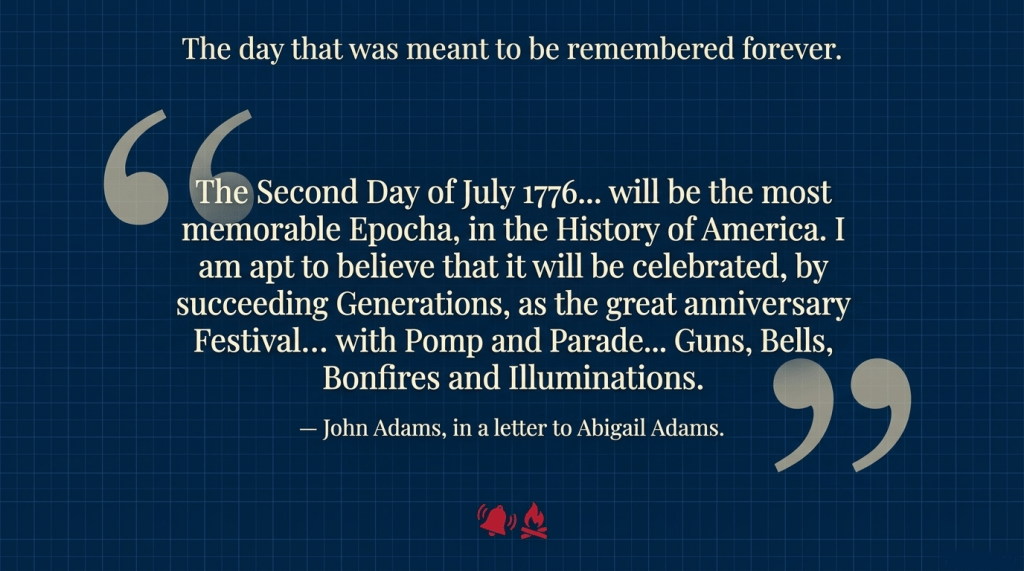
History eventually attached itself to July 4 because that was the day Congress approved the final wording of Jefferson’s Declaration. The document became the enduring symbol of the Revolution because it explained not merely what Americans were doing, but why they believed they had the right to do it.
And Jefferson’s words deserved immortality. Yet words alone do not create nations. Votes do.
The Lee Resolution was the actual instrument that severed ties with Great Britain. It transformed rebellion into sovereignty. It converted colonies into states. It gave legal existence to a new nation before the world.
Everything afterward, the Declaration, the war, the alliances, the Constitution, rested upon the decision made on July 2. The irony is almost poetic. Americans celebrate the explanation more than the decision itself.
But perhaps that is fitting in its own way. Nations are built both by action and by story. The Lee Resolution provided the action. The Declaration provided the story Americans would tell themselves and the world.
Together, they created the United States of America.
Dickinson, John. “Arguments against the Independence of these Colonies.” Teaching American History. Ashbrook Center at Ashland University. Originally published in J.H. Powell, The Pennsylvania Magazine of History and Biography (October 1941): 458-481.
Kaminski, John P., Gaspare J. Saladino, Richard Leffler, Charles H. Schoenleber, and Margaret A. Hogan, eds. “Introduction- The Confederation Period.” In The Documentary History of the Ratification of the Constitution Digital Edition. Charlottesville: University of Virginia Press, 2009.
Sneff, Emily. “Delegate Discussions: The Lee Resolution(s).” Declaration Resources Project. Harvard University, June 7, 2018.
“The Lee Resolution: A Constitutional and Geopolitical Architectural Framework for American Sovereignty.”
“The Lee Resolution: The True Birth of American Independence.”




Leave a Reply