
How the Declaration of Independence Spread Across America and Changed History Forever
In this Independence day episode of Liberty 250 on the Florida Round Table, historian Dave Bowman explores how John Dunlap’s overnight printing operation, the first public readings in Philadelphia, and the celebrations that followed transformed a congressional declaration into the voice of the American people. Along the way, listeners will witness George Washington’s army hearing the Declaration for the first time, the dramatic destruction of King George III’s statue in New York, Boston’s fiery rejection of royal authority, and Savannah’s symbolic funeral for the king’s political power.
The story, however, was never one of universal agreement. Loyalists challenged the Declaration, families found themselves divided, and communities struggled with the costs of choosing independence. Understanding those competing voices provides a fuller picture of the American Revolution and reminds us that the nation’s founding was both inspiring and deeply human.
As America commemorates its Semiquincentennial, this episode invites you to do more than remember history. It encourages you to read the Declaration aloud, participate in the nationwide July 8 synchronized readings, serve your community, and reflect on the enduring promise contained in those unforgettable words: “We hold these truths to be self-evident…”



On July 4, 1776, the Continental Congress approved a document of fewer than 1,400 words. It was not beautifully engrossed on parchment. It had not yet been signed by most of the delegates. It was simply a declaration, written to explain to the world why thirteen British colonies believed they were now “Free and Independent States.” Two hundred and fifty years later, those words still possess an extraordinary ability to command attention.
As Americans gather this Independence Day to watch parades, attend baseball games, enjoy family cookouts, and watch fireworks illuminate the night sky, we are participating in something much larger than another national holiday. We are taking part in a tradition that stretches across two and a half centuries, linking our generation with every generation that has celebrated before us.
That milestone is why the America250 Commission has launched an initiative called Sharing the Spirit of America. The purpose is refreshingly simple. It is not to celebrate political parties or current events. It is to reconnect Americans with the principles expressed in the Declaration of Independence: liberty, equality, self-government, and the enduring belief that governments derive “their just powers from the consent of the governed.”
Many people naturally think of July 4 as the culmination of this anniversary year. In reality, one of its most remarkable commemorations is still to come.
On July 8, 2026, at 6:00 p.m. Eastern Daylight Time, Americans in all fifty states, along with residents of sixteen territories and affiliated jurisdictions, will participate in synchronized public readings of the Declaration of Independence. The time is not arbitrary. It commemorates the approximate hour when the Declaration was first officially read aloud to the public in Philadelphia on July 8, 1776.
Imagine what that moment represented.
News traveled only as fast as a horse could ride or a ship could sail. There was no radio, no television, no internet, and no national newspaper capable of reaching every colony overnight. Yet within days, copies of the Declaration were making their way across British North America. In town squares, outside courthouses, on church greens, and in military camps, crowds gathered to hear words that would forever alter their understanding of who they were.
Many of those listeners had never seen the document itself. Some could not read. Yet they heard its opening declaration that all men are created equal. They heard that governments exist only by the consent of the governed. They heard that the people possessed the right to alter or abolish governments that became destructive of their liberties.
Those ideas were not merely printed. They were spoken. They were heard. They were debated. Before long, they would be defended on battlefields stretching from New England to Georgia.
There is something profoundly fitting about Americans gathering again, exactly 250 years later, to hear those same words read aloud together.
As we reflect on this anniversary, it is impossible not to remember the remarkable prediction made by John Adams. Writing to his wife Abigail on July 3, 1776, Adams believed that the vote for independence taken the previous day would become “the great anniversary Festival” of the American people. He imagined succeeding generations celebrating with “Pomp and Parade… Games, Sports, Guns, Bells, Bonfires and Illuminations from one End of this Continent to the other.”
Adams was mistaken about the date. Americans ultimately chose July 4 rather than July 2 as their national holiday.
He was not mistaken about the celebration.
Look around today. The parades, the concerts, the baseball games, the neighborhood gatherings, the flags flying from front porches, and the fireworks that will light the evening sky are all part of the tradition he envisioned. For 250 years, generation after generation has fulfilled that prophecy.
The Semiquincentennial reminds us that Independence Day is more than a celebration of the past. It is an invitation to participate in a story that continues to unfold. The Declaration of Independence was never intended to gather dust behind museum glass. It was meant to be read, discussed, challenged, and remembered by every generation that inherited its promise.
That is precisely what Americans will do once again on July 8, when the nation pauses to hear those familiar words as they were first heard in the summer of 1776.
The Declaration of Independence did not become one of the most influential documents in history simply because Congress approved it. A vote in Philadelphia, no matter how significant, meant little if the people scattered across thirteen colonies never learned what had happened. The delegates understood that independence would only become real when ordinary Americans heard the news for themselves.
That challenge fell not to a statesman or a soldier, but to a printer.
Late on the evening of July 4, 1776, after the Continental Congress approved Jefferson’s revised text, the document was carried through the streets of Philadelphia to the print shop of John Dunlap. Most of the city had already gone to sleep. Dunlap and his apprentices, however, were just beginning their work.
Printing in the eighteenth century was a painstaking craft. Every individual letter had to be selected by hand from trays of lead type. Every punctuation mark had to be placed in exactly the right position. Every line had to be assembled, locked into a press, inked, and carefully transferred to paper. There were no corrections with the click of a mouse. A single misplaced letter could change the meaning of the most important political document yet produced in America.
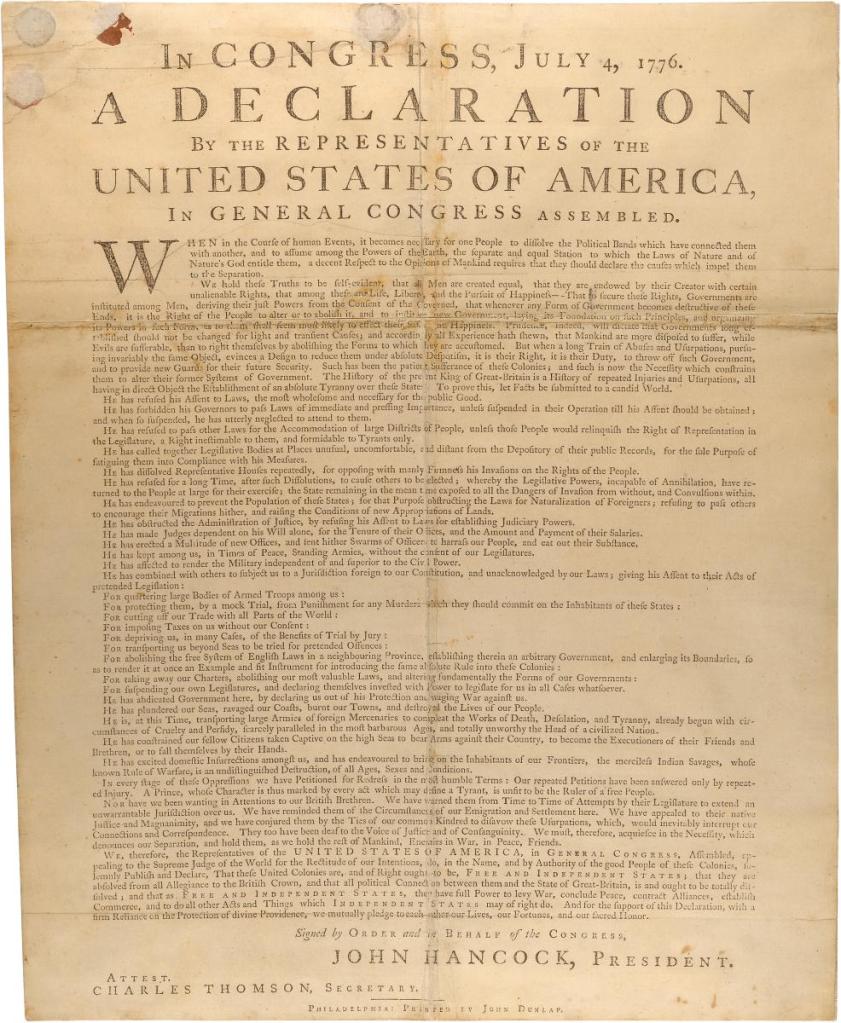
Working through the night by candlelight, Dunlap produced approximately two hundred printed copies of the Declaration before sunrise on July 5. Today historians know them as the Dunlap Broadsides. Only a handful survive, making them among the rarest and most valuable documents in American history.
Yet they were never intended to become museum pieces.
They were working copies, tools of a revolution. Congress immediately dispatched them by horseback, carriage, and ship to colonial governments, military commanders, newspapers, committees of safety, and local officials. In a matter of hours, the Declaration ceased to be an internal congressional resolution and became public property.
It was the first great act of democratizing the Revolution.
For months, debates over independence had taken place largely among delegates meeting behind closed doors. Now the people themselves would hear the arguments. The Revolution was no longer something happening in Philadelphia. It belonged to every American willing to defend it.
Most history books begin the story of the public readings on July 8, and that is correct if one is speaking of official readings authorized by Congress. There is, however, another moment that deserves attention.
Even on the evening of July 4, before the ink on Dunlap’s presses had fully dried, Philadelphia buzzed with rumors. News traveled quickly despite the absence of modern communications. Crowds gathered outside the Pennsylvania State House, eager to discover whether Congress had finally declared independence.
Inside the building were two men uniquely positioned to satisfy their curiosity. Charles Thomson served as Secretary of the Continental Congress. Timothy Matlack, a gifted penman and clerk, would later prepare the beautifully engrossed parchment that now hangs in the National Archives.
Several contemporary accounts suggest that one of these two men, probably Matlack, stepped outside and read the newly adopted Declaration to those gathered outside.
The audience was not composed of famous statesmen or military officers. They were artisans, laborers, apprentices, dock workers, tradesmen, and ordinary citizens whose lives would be transformed by the decision Congress had just made.
Whether every detail of that tradition can be proven beyond doubt remains uncertain. The surviving evidence is fragmentary, and historians continue to debate the event. Yet the account fits both the circumstances and the spirit of revolutionary Philadelphia. Secrets rarely remained secret for long, and it is difficult to imagine such extraordinary news remaining confined within the walls of the State House.
If the reading occurred, those ordinary working men and women became the first Americans to hear the Declaration spoken aloud.
Imagine hearing those words without knowing how history would unfold.
“We hold these truths to be self-evident…”
“That all men are created equal…”
“That whenever any Form of Government becomes destructive of these ends, it is the Right of the People to alter or abolish it…”
Those were not abstract philosophical observations. They were revolutionary claims, publicly declaring that the colonies had severed their allegiance to the most powerful empire on earth.
Four days later came the first official public proclamation.
At noon on July 8, 1776, thousands assembled in the State House Yard behind Independence Hall. Congress selected Colonel John Nixon, a respected Philadelphia militia officer known for his commanding voice, to read the Declaration aloud. Without microphones or amplifiers, every sentence depended upon Nixon’s ability to project across the assembled crowd.
As he read, the audience heard not merely a list of grievances against King George III, but a justification for creating an entirely new nation. They heard Congress declare that the United Colonies “are, and of Right ought to be, Free and Independent States.”
When Nixon finished, Philadelphia erupted.
Church bells rang throughout the city. Cheers echoed across the square. Militia companies celebrated while citizens embraced one another. What had begun as the decision of fifty-six delegates suddenly became the cause of an entire people.
The Revolution had crossed an invisible threshold.
Before July 8, independence existed as a congressional resolution. After July 8, it belonged to the American public.
Philadelphia was not alone.
That same day, citizens gathered in Easton, Pennsylvania, where one of the earliest public readings outside Philadelphia took place in the town square. In Trenton, New Jersey, crowds likewise assembled to hear the astonishing announcement that the colonies had formally declared themselves independent of Great Britain.
Within days, similar scenes unfolded throughout the continent.
Courthouse lawns became civic forums. Churchyards became meeting places. Town squares became stages upon which a new nation announced itself to its own people.
Not every listener reacted with celebration. Patriots heard freedom. Loyalists heard rebellion. Some envisioned opportunity. Others foresaw war, uncertainty, and economic upheaval.
Yet regardless of whether they applauded or objected, every listener understood one thing. There would be no easy return to the British Empire.
The journey of the Declaration from Congress to the public also reminds us of a truth that is too often forgotten. The American Revolution was not accomplished by a handful of famous men meeting in Philadelphia. Washington could not have succeeded without thousands willing to follow him. Jefferson’s words would have meant little had printers failed to print them, riders failed to carry them, and ordinary Americans failed to embrace them.
The Declaration became America’s founding document because it passed from the hands of its authors into the voices of its people. That transformation, more than any signature on parchment, marked the birth of a nation.
As the Declaration of Independence spread from colony to colony during the summer of 1776, it did more than announce a political decision. It changed the way Americans thought about themselves. Independence was no longer an abstract resolution debated inside the Continental Congress. It became something ordinary people celebrated, argued over, and acted upon.
Nowhere was that transformation more dramatic than in New York City.
In July 1776, New York stood on the edge of catastrophe. The largest British military expedition ever assembled in North America was gathering offshore. General George Washington’s Continental Army occupied the city, hastily constructing fortifications while awaiting an attack everyone knew was coming. Many of Washington’s soldiers had enlisted to defend the rights of their individual colonies. Some still struggled with the idea of complete independence. Washington understood that if his army was to endure what lay ahead, his men needed to understand precisely what they were fighting for.
On July 9, the day after the Declaration’s first official public reading in Philadelphia, Washington ordered the document read aloud throughout his army.
Nearly thirty thousand officers and soldiers assembled to hear the words approved by Congress. Many had never seen the Declaration. Few could have afforded a printed copy. Instead, they listened as officers proclaimed the grievances against King George III and declared that the united colonies “are, and of Right ought to be, Free and Independent States.”
The effect was immediate.
Observers recorded that the troops received the reading with tremendous enthusiasm. What had begun as a dispute over taxation and parliamentary authority had become something altogether different. The war was no longer being fought merely to secure colonial rights within the British Empire. It was now a struggle to establish an independent nation.
That evening, the excitement spread beyond the ranks of the Continental Army.
At the southern tip of Manhattan stood Bowling Green Park. There, since 1770, a massive gilded equestrian statue of King George III dominated the landscape. The monument weighed nearly four thousand pounds and had originally been erected by grateful colonists after the repeal of the Stamp Act. Ironically, the king was portrayed not in British royal robes but dressed as a Roman emperor, emphasizing the imperial authority he claimed over his subjects.
As relations between Britain and the colonies deteriorated, the statue became an increasingly unpopular symbol of royal power. Protesters gathered around it. Authorities eventually surrounded it with an iron fence to discourage demonstrations. Portions of that fence still stand today.
Following the reading of the Declaration, a crowd of soldiers, members of the Sons of Liberty, and ordinary citizens marched to Bowling Green. They tore apart sections of the protective fence. Ropes were fastened around the statue, and with determined effort the monument crashed to the ground. As the great figure struck the earth, the crowd erupted in cheers. The head was severed. The body was hacked apart with axes and tools.
The destruction of the statue was not simply vandalism.
Throughout history, revolutions have often announced themselves by attacking symbols of authority. Statues represent legitimacy. They embody political power. When King George III’s monument fell, New Yorkers were making a public declaration that his authority over them had ended.
The story, however, did not end in Bowling Green.
The shattered pieces of the statue were transported to Connecticut, where Patriot craftsmen melted the lead and cast it into musket balls for the Continental Army. Historians estimate that more than forty-two thousand musket balls were produced from the fallen monument. Archaeological and chemical analysis has confirmed that musket balls recovered from Revolutionary War battlefields were indeed manufactured from the lead of King George’s statue.
There is a remarkable symbolism in that transformation.
A monument erected to honor the king became ammunition used against his own army. The very image intended to proclaim imperial authority was literally converted into weapons for the Revolution.
The spirit that swept through New York also spread rapidly throughout New England.
Boston required little encouragement. For more than a decade its citizens had resisted British policies. They had endured the Stamp Act, the Townshend Duties, the Boston Massacre, the Tea Party, military occupation, and the closing of their harbor. The arrival of the Declaration simply confirmed what many Bostonians had believed for years.
On July 18, Colonel Thomas Crafts stood upon the balcony of the State House and read the Declaration to the assembled crowd.
The response was immediate and dramatic. Citizens surged through the streets searching for every visible reminder of royal government. Signs displaying the royal coat of arms were torn from buildings. Official emblems were ripped down. Symbols bearing the crown disappeared from public view. Contemporary observers described what followed as a “general conflagration.”
The phrase referred to more than a series of bonfires. Throughout Boston, royal insignia and Tory symbols were gathered together and consumed in flames. The destruction was remarkably deliberate. The crowds did not burn indiscriminately. Their target was the visible authority of the Crown. The city that had ignited resistance in 1765 now publicly celebrated independence in 1776.
As copies of the Declaration continued moving southward, each community celebrated in its own distinctive fashion.
Some fired cannon salutes. Others organized public feasts, militia parades, or civic festivals. Every colony found ways to express the profound political transformation taking place before their eyes.
Perhaps the most memorable celebration occurred in Savannah, Georgia.
On August 10, nearly a month after the Declaration’s first official reading in Philadelphia, Savannah staged one of the Revolution’s most theatrical public ceremonies.
The town held a funeral. It was not a funeral for King George III as a man. Rather, it was a solemn mock funeral for his political authority over Georgia.
Participants marched through the streets in deliberate procession before symbolically burying the king’s “political existence.” Contemporary accounts emphasized that what was being interred was not the monarch himself but the relationship between the American colonies and the British Crown.
The symbolism was unmistakable.
Across Europe, monarchs justified their rule through inherited legitimacy and divine sanction. In Savannah, Americans publicly declared that such authority no longer governed them. A colony named in honor of King George II now ceremonially buried the political power of his grandson.
These celebrations remind us that the American Revolution was never solely a military conflict. It was a transformation of political identity.
For generations, the colonists had thought of themselves as loyal British subjects who happened to live in America. During the summer of 1776, that identity began to disappear. Through public readings, celebrations, symbolic acts, and shared experiences, they slowly came to see themselves as something entirely new.
They were becoming Americans.
The celebrations that swept across the colonies during the summer of 1776 are among the most memorable images of the American Revolution. Bells rang, crowds cheered, statues fell, and bonfires consumed the symbols of royal authority. It is easy to look back and imagine a united people standing shoulder to shoulder in support of independence.
History is rarely that simple.
For every Patriot celebrating in a town square, there was another American who viewed the Declaration of Independence very differently. To them, it was not a proclamation of liberty. It was a declaration of rebellion. It represented the destruction of a political system that had provided stability, prosperity, and protection for generations.
The Revolution did not simply separate America from Great Britain. It divided neighbors. It divided churches. It divided communities. It even divided families.
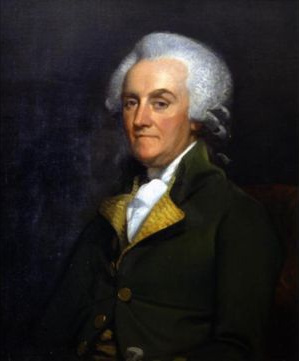
Perhaps the most famous example was Benjamin Franklin and his son, William. While Benjamin became one of the principal architects of American independence, William Franklin remained loyal to the Crown as the Royal Governor of New Jersey. Their disagreement became permanent. Father and son would never reconcile.
The Declaration did not create these divisions, but it made them impossible to ignore.
Historians have long debated the political makeup of the colonies in 1776. A commonly repeated estimate suggests that roughly one-third of Americans supported independence, one-third remained loyal to Britain, and one-third attempted to stay neutral. The precise numbers remain open to debate, but the broader point is undeniable.
There was no unanimous American opinion. Ordinary people suddenly found themselves forced to answer a question they had hoped to avoid. Where does your loyalty lie?
Among the most articulate critics of the Declaration was Thomas Hutchinson, the former royal governor of Massachusetts. Hutchinson was no distant observer unfamiliar with colonial life. He had spent decades serving in Massachusetts politics before being driven into exile by growing Patriot resistance.
When he read Jefferson’s Declaration, he rejected it outright.
Hutchinson argued that the famous list of grievances against King George III was exaggerated, distorted, and in many cases entirely imaginary. From his perspective, the colonies already enjoyed remarkable freedom under British rule. Colonial legislatures governed local affairs. Property rights were protected. Trial by jury remained a fundamental right. Compared with much of Europe, British America was prosperous and remarkably self-governing.
To Hutchinson, the Revolution represented not liberation but overreaction. He believed Americans had mistaken political disagreements for tyranny and were recklessly destroying a constitutional system that had served them well.
Another influential Loyalist challenged the Declaration from a different direction.
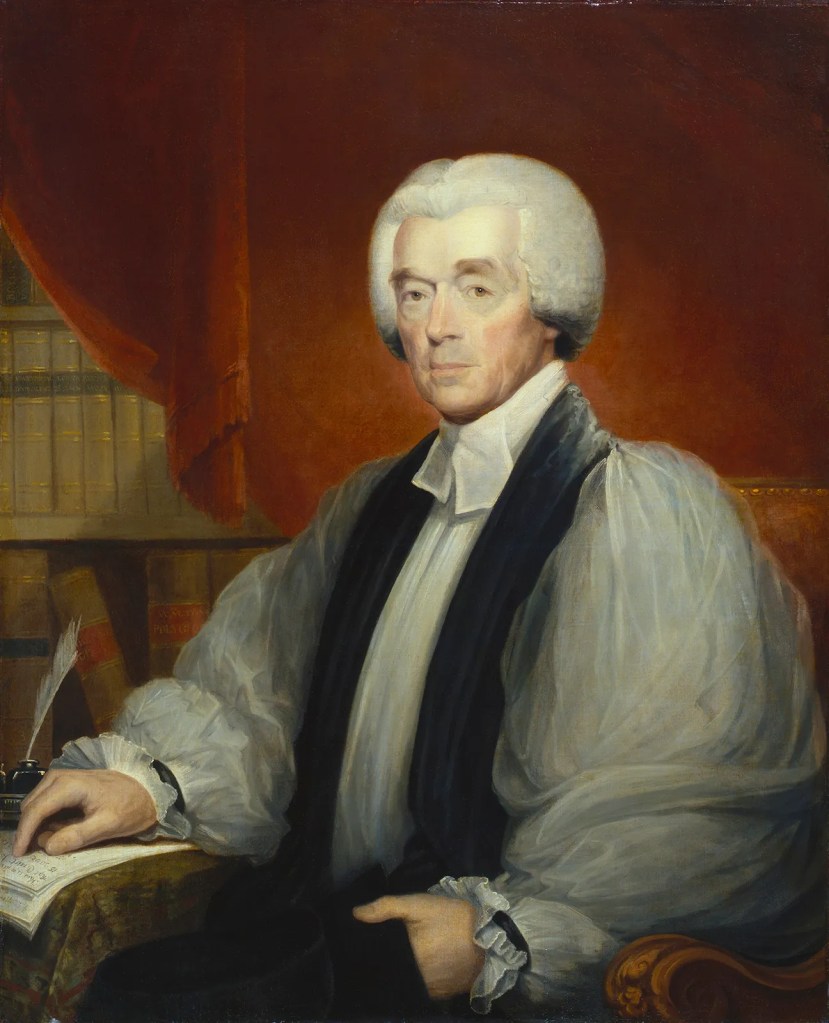
The Reverend Charles Inglis, an Anglican minister serving in New York, accepted neither Jefferson’s political philosophy nor the Patriots’ conclusions. Inglis argued that genuine liberty already existed within the framework of the English Constitution. Americans, he insisted, possessed representative assemblies, protection of private property, trial by jury, and many of the liberties that people elsewhere could only dream of enjoying.
His concern was not merely theoretical. He feared that independence might destroy those very liberties. What if revolution produced anarchy rather than freedom? What if the colonies exchanged constitutional order for civil war? What if the collapse of British authority gave way to dictatorship, economic ruin, or endless political instability?
These were not unreasonable questions.
Indeed, many of the dangers Loyalists feared came frighteningly close to becoming reality during the difficult years that followed. In 1776, no one knew whether the American experiment would succeed. Patriots believed they were creating a freer society. Loyalists believed they were preserving one.
Both claimed to be defending liberty. They simply defined liberty differently.
Nowhere were the consequences of those competing loyalties more personal than among the Scottish Highland communities of North Carolina.
Many Highland Scots had arrived in America after the failed Jacobite uprisings of the eighteenth century. Having endured years of hardship and displacement, many accepted land grants from the British Crown and swore oaths of loyalty to King George III. Their allegiance was not merely political. It was deeply personal, shaped by memory, gratitude, and a desire for stability after decades of turmoil.
When revolution arrived, many Highland families remained faithful to the King. Among the most famous were Allan MacDonald and his wife, Flora MacDonald.
Flora had already become a legend throughout the British world for helping Bonnie Prince Charles escape after the Battle of Culloden in 1746. Decades later, she once again found herself caught in the middle of history.
The MacDonalds chose loyalty to the Crown. Their decision came at an enormous cost.
Following Patriot victories in North Carolina, Allan MacDonald was imprisoned. Their estates suffered confiscation and destruction. Eventually the family was forced into exile, returning to Scotland where they spent the remainder of their lives far from the colony they had hoped would become their permanent home.
They were hardly alone.
Across the colonies, Loyalist families saw their property seized, their businesses ruined, and their homes burned. Many fled to Canada, Britain, or the Caribbean. Others attempted to survive by withdrawing from public life altogether.
Contemporary observers described many of them as retreating into a “pensive silence.” Open support for the Crown had become dangerous.
Some concealed their political beliefs. Others publicly professed neutrality while privately hoping events would somehow restore the old order. Many simply remained silent, waiting to discover which side would ultimately prevail.
Their stories remind us that revolutions are never experienced equally by everyone who lives through them.
For Patriots, the Declaration represented hope.
For Loyalists, it often represented loss.
Both groups were Americans. Both believed they were acting honorably. Both believed they were defending the future of their communities. The difference lay not in their love of liberty, but in where they believed liberty could best be found.
Understanding those competing perspectives does not diminish the achievements of the American Revolution.
Instead, it reminds us that the nation’s founding was neither simple nor inevitable. It was the product of difficult choices made by ordinary people living through extraordinary times, many of whom paid a profound personal price regardless of which side they chose.
For the past year we have traced the road that led to American independence. We have followed the debates in Congress, examined the ideas that shaped Jefferson’s words, watched the Declaration spread from printer to public square, and witnessed the celebrations and divisions that followed. The story, however, does not end in 1776.
One of the remarkable qualities of the Declaration of Independence is that every generation has had the opportunity to rediscover it for itself. That is precisely what the United States is doing during the Semiquincentennial.
The 250th anniversary of American independence is more than a birthday celebration. It is an opportunity for Americans to reflect upon the ideals that have shaped the nation for two and a half centuries and to consider the responsibility each generation bears for preserving them.
To encourage that reflection, the America250 Commission has launched a nationwide series of commemorative events designed to involve Americans wherever they live.
Perhaps the most ambitious is America’s Block Party.
Rather than concentrating the anniversary in a handful of major cities, organizers have encouraged neighborhoods, civic organizations, churches, veterans’ groups, historical societies, schools, and families to celebrate in their own communities. Between July 1 and July 5, Americans across the country have been invited to host local gatherings that celebrate not only the nation’s founding but also the people and traditions that have sustained it for 250 years.
The goal is simple: create the largest synchronized Independence Day celebration in American history.
Alongside those local celebrations are a series of national programs known as July 4 Moments. These initiatives invite Americans to participate in ways that extend beyond fireworks and parades.
Through America’s Time Capsule, citizens are encouraged to preserve photographs, letters, memories, and artifacts that capture what life in America looks like during this historic anniversary.
America’s Soundtrack invites participants to share the music that best reflects their communities, families, and experiences, recognizing that America’s story has always been told through song as well as through speeches and documents.
Meanwhile, Our American Story encourages individuals to reflect upon the people, places, and events that have shaped their own understanding of the nation.
Taken together, these programs remind us that American history is not merely the story of famous presidents, generals, or founding fathers.
It is also the story of ordinary citizens whose lives have collectively written the nation’s history.
Yet perhaps the most meaningful event of the entire Semiquincentennial takes place after Independence Day itself.
On July 8, 2026, at exactly 6:00 p.m. Eastern Daylight Time, Americans in all fifty states, along with residents of sixteen territories and affiliated jurisdictions, will gather to participate in synchronized public readings of the Declaration of Independence.
The timing is intentional.
It commemorates the approximate hour when Colonel John Nixon first publicly read the Declaration in the State House Yard in Philadelphia on July 8, 1776, allowing ordinary Americans to hear, for the first time, the words that explained why their colonies had declared themselves free and independent states. Exactly 250 years later, those words will once again be spoken aloud from coast to coast.
Many communities are organizing public readings in parks, libraries, museums, courthouses, schools, churches, and historical sites. Local governments and historical societies are sponsoring events that invite citizens to gather just as their predecessors did during the summer of 1776.
If no public reading is available nearby, participation requires nothing more than opening a copy of the Declaration and reading it aloud with family or friends.
There is something uniquely powerful about hearing those familiar words spoken rather than simply reading them silently on a page.
That is how most Americans first encountered the Declaration. They did not read it. They heard it.
The Semiquincentennial also reminds us that citizenship requires more than remembrance. The America250 Commission has paired celebration with service through an initiative known as America Gives.
Americans are encouraged to volunteer in their communities throughout the anniversary year and record those hours as part of a nationwide effort to make the nation’s 250th birthday the largest year of volunteer service in American history.
The connection between service and the Declaration is not accidental.
Jefferson’s words established a promise.
The Constitution later provided the framework through which that promise could be pursued.
Neither document can preserve liberty on its own. Both depend upon citizens willing to accept the responsibilities that accompany freedom.
The Declaration of Independence is often admired as one of history’s greatest political documents. It certainly deserves that reputation. But it was never intended to be admired from a distance.
It was written to be lived.
As we conclude this journey through the first public readings of the Declaration, perhaps the greatest tribute we can offer those who gathered in Philadelphia, New York, Boston, Savannah, and countless other communities in the summer of 1776 is simply this:
Read the Declaration.
Hear its words.
Reflect upon its principles.
Serve your community.
Remember that the story of America did not end when Congress approved a document on July 4, 1776.
That story has continued for 250 years.
The next chapter belongs to us.
Declaration of Independence Text – https://www.archives.gov/founding-docs/declaration
American Block Party Initiative – https://www.usa.gov/independence-day
History of the American Revolution (Podcast) – https://www.history.com/shows/american-revolution
John Dunlap and the Printing of the Declaration – https://www.archives.gov/publications/prologue/2016/summer/dunlap
King George Statue in New York – https://www.nycgovparks.org/parks/bowling-green
The American Revolution Museum at Yorktown – https://www.historyisfun.org/american-revolution-museum/
Benjamin Franklin and his son William – https://www.britannica.com/biography/Benjamin-Franklin
The Role of Symbols in Revolutions – https://www.history.com/topics/revolution
The Declaration of Independence Reading Event – https://www.usa.gov/independence-day
“Liberty 250”
Words & Music by David Ray Bowman
(c) 2026 by Slippery Fish Entertainment
ALL RIGHTS RESERVED



Leave a comment