
When we talk about world wars, our minds drift automatically to the twentieth century, to trenches and tanks and names carved into stone. That is only because we decided to number them that way after the fact. The war that concerns us here, the one Americans have politely labeled the French and Indian War, deserves a different title. It was the first war in human history fought across multiple continents, drawing in Europe, North America, the Caribbean, Africa, and India into a single, sprawling contest for imperial dominance. It was not merely a colonial skirmish. It was a global struggle that forced empires to think in global terms, even if the men on the ground only saw trees, rivers, and the next ridge line.
In North America, the conflict revolved around the Ohio River Valley, a region that was less a settled territory than a question waiting to be answered. Was it British land, open to colonial expansion, or was it French territory, secured through exploration and fortified through alliances with Native nations? The British claimed it through charters that stretched ambitiously from sea to sea. The French claimed it through exploration, trade networks, and a chain of forts linking Canada to the Mississippi. Between these claims stood Native American nations who had their own interests, their own alliances, and their own understanding of the land, which did not always align neatly with European maps.
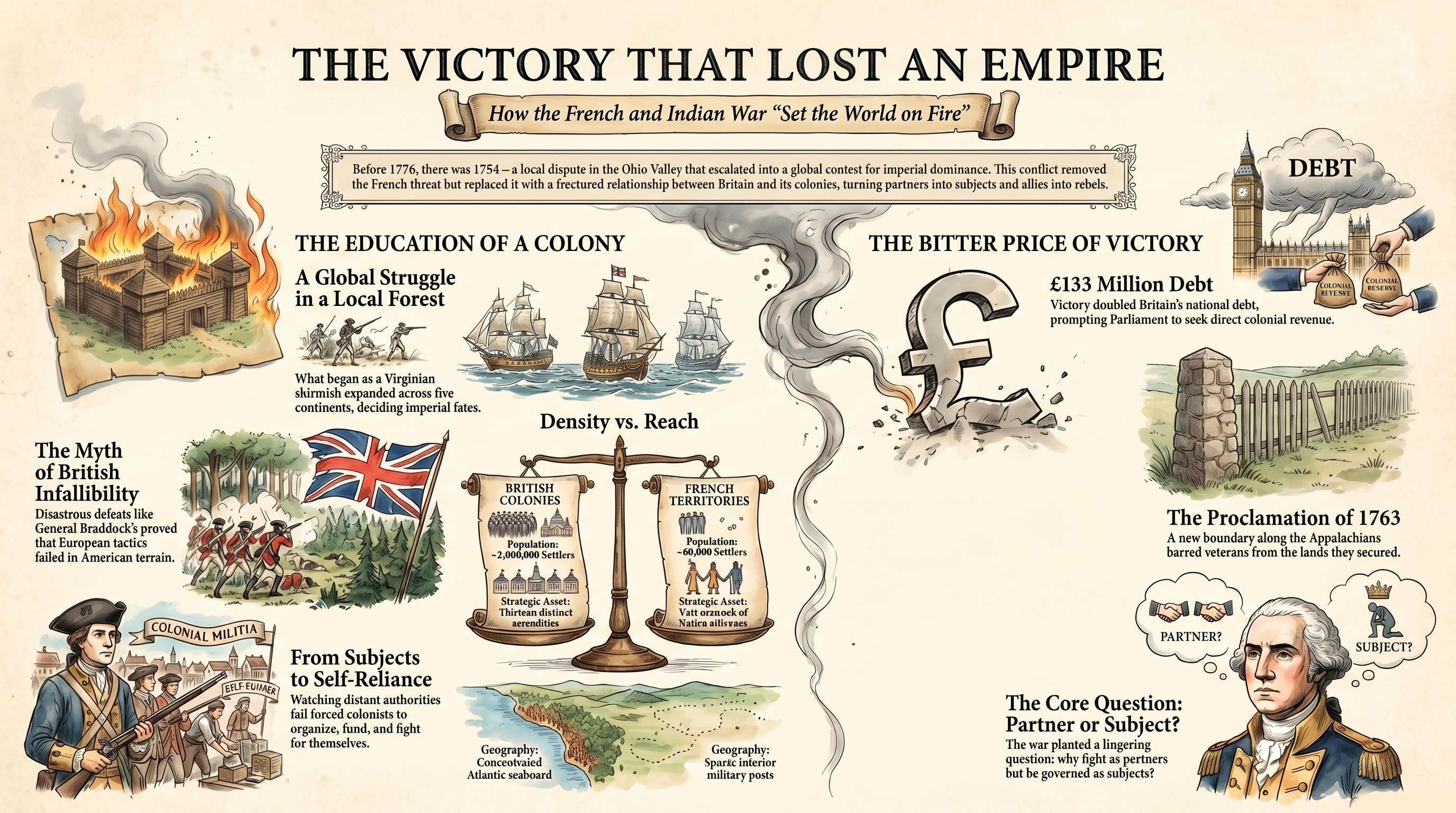
The imbalance between the two colonial powers was striking. The British colonies along the Atlantic seaboard held a population approaching two million settlers, spread across thirteen distinct colonies, each with its own assembly, its own habits, and its own sense of independence. The French presence, by contrast, was sparse, perhaps sixty thousand settlers scattered across a vast interior, supported by military posts and sustained through alliances with Native tribes. It was a classic case of density versus reach, of numbers against networks. The French could not match the British in population, but they could move through the interior with a flexibility the British lacked, aided by Native allies who understood the terrain in ways no European ever could.
Into this environment stepped a twenty-two-year-old Virginian named George Washington, sent in 1753 on a mission that was as much diplomatic as it was military. His task was to deliver a message to the French commander at Fort Le Boeuf, essentially informing him that he was trespassing on British territory and should withdraw. It was the sort of message that sounds decisive when written and unrealistic when delivered. The French officer received Washington politely and ignored him completely. The empire, as it turned out, was not inclined to retreat because a junior colonial officer asked it to.
Washington returned to Virginia with his report, and within months he was back in the field, this time with a small force of militia. What happened next has been debated, dissected, and argued over for generations, but the outline is clear enough. In May 1754, Washington’s men encountered a small French detachment near a place later known as Jumonville Glen. Shots were fired, the French commander was killed, and what had been a tense standoff became open conflict. It was, in the moment, a minor clash. In consequence, it was anything but minor. Horace Walpole would later write that Washington had “set the world on fire,” and while that may carry a touch of literary flourish, it is not entirely inaccurate.
The immediate aftermath did not go well for Washington. He hastily constructed a defensive position known as Fort Necessity, a name that suggests both urgency and a certain lack of planning. The French returned in force, attacked, and compelled Washington to surrender. The terms of that surrender, which Washington signed in French, included language that implied responsibility for the earlier killing of the French officer, a detail that would haunt interpretations of the event for years to come. It was not a promising debut for the man who would later become indispensable to the American cause.
What is often missed in the telling of this story is how quickly a local conflict became something larger. Britain and France had been circling each other for decades, contesting territory and influence across the globe. News of the clash in the Ohio Valley did not create that rivalry, but it sharpened it. Within two years, the conflict had expanded into the Seven Years’ War, drawing in alliances across Europe and spreading to theaters far beyond North America. What began as a skirmish between colonial forces became a war that would decide the fate of empires.
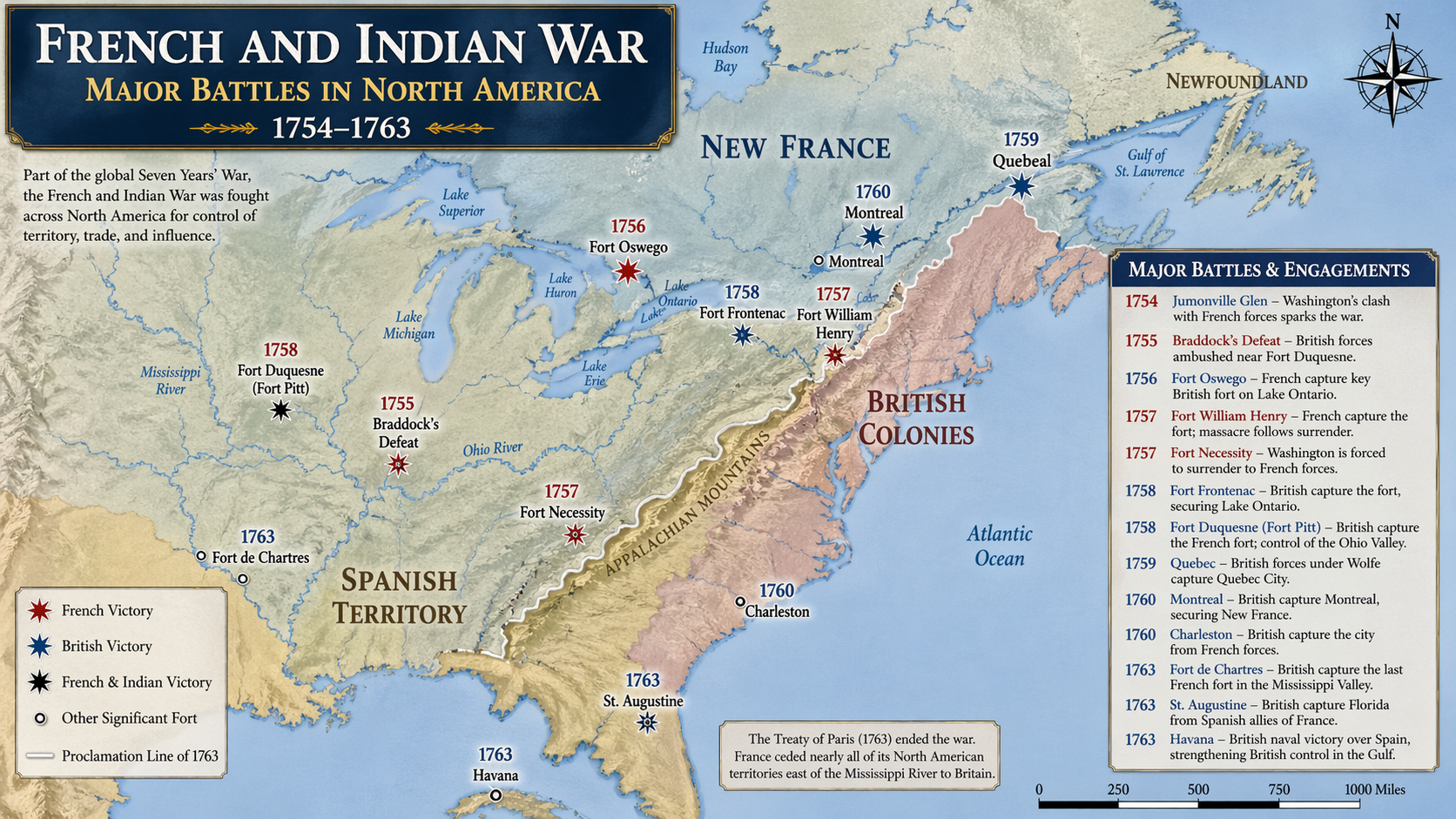
The early years of the war in North America favored the French, not because they were stronger in numbers, but because they were better adapted to the conditions. Their forces, often composed of a mix of regular troops, colonial militia, and Native warriors, fought in a manner suited to the terrain, using cover, mobility, and surprise. British forces, trained in the formal tactics of European warfare, struggled to adjust. The defeat of General Edward Braddock in 1755 stands as a vivid example. Marching toward Fort Duquesne with a large force, Braddock ignored warnings about the nature of the terrain and the tactics of his opponents. His column was ambushed, his army shattered, and he himself mortally wounded.
Colonial soldiers were present at that battle, including Washington, who had advised caution and adaptation. Their warnings went unheeded. The lesson was not lost on them. They had seen firsthand the limits of British leadership and the cost of ignoring local knowledge. It is one thing to be governed from afar. It is another to watch those distant authorities make decisions that get men killed.
While British commanders struggled, the colonists did not remain idle. From Virginia to Massachusetts, they raised militias, organized supplies, and fought where they could. They taxed themselves, borrowed money, and sustained the war effort at the local level. This was not a population waiting to be defended. It was a population defending itself, acting out of necessity and, increasingly, out of a sense that it was capable of doing so.
This matters more than it may appear at first glance. A people that fights for its own survival learns something about itself. It learns what it can endure, what it can organize, what it can achieve. The colonists entered the war as subjects of the British Empire. They emerged from its early stages with a growing awareness that they were more than that, though they did not yet have the language to describe it.
By the mid-1750s, the war in North America was no longer a peripheral conflict. It was one of the central theaters in a global struggle. As the text in *Empires Collide* notes in its opening pages, the violence that began at Jumonville Glen spread rapidly, drawing in forces from across the Atlantic and entangling alliances that extended to Africa and Asia. The scale of the war forced Britain to take the American theater more seriously, even as it strained the resources of the empire.
For the colonists, however, the war remained close to home. It was fought in forests and along rivers, in settlements and on frontiers that blurred the line between civilian and soldier. It involved neighbors, allies, and enemies who were often difficult to distinguish at a distance. The presence of Native American allies on both sides added another layer of complexity, as tribes pursued their own strategic interests, sometimes aligning with the French, sometimes with the British, always with an eye toward preserving their own autonomy in a contest between empires.
By the time the war expanded fully into a global conflict, the essential pattern had been established. A local dispute over land had drawn in imperial powers, exposed weaknesses in British command, and forced the colonists to act on their own behalf. It had revealed that the relationship between colony and empire was not as simple as it had once seemed.
The colonists did not yet speak of independence. That idea would take time to form, and it would require a series of additional provocations to bring it into the open. What they did begin to understand, slowly and unevenly, was that they were not merely passive participants in an imperial system. They had fought, they had organized, and they had paid a price that was both immediate and personal.
The war that began in the Ohio Valley did not end in 1754, and it did not end the relationship between Britain and its colonies. It did something more subtle and more consequential. It altered how the colonists saw themselves within that relationship. It planted a question that would grow more difficult to ignore with each passing year.
If we can fight as partners, why are we treated as subjects?
That question did not yet demand an answer, but it lingered. It followed the war as it expanded, as it consumed resources, and as it reshaped the empire. It would be asked again, in different forms, in different places, until it could no longer be avoided.
The Revolution did not begin here, not in the formal sense. There were no declarations, no unified movement, no clear break. What began here was something quieter, a shift in perception, a crack in the foundation. It would take years for that crack to widen, for events to press upon it, for arguments to sharpen it.
But the first fracture appeared along the banks of the Ohio, in a place where a young officer made a decision, and the world, quite literally, caught fire.
If the opening years of the war revealed the limits of British power, they also exposed something far more unsettling to the American colonists, the realization that the empire they trusted was not nearly as capable as they had assumed. The early campaigns were marked not by steady progress but by a string of failures that shook confidence from the frontier to London. General Edward Braddock’s defeat in 1755 was the most dramatic of these disasters. Marching with confidence toward Fort Duquesne, he led a column of British regulars and colonial troops straight into an ambush. The result was chaos. Officers fell, formations collapsed, and the army disintegrated under fire from French troops and their Native allies who fought from cover in a way British doctrine had not prepared for. Braddock himself was mortally wounded, and what remained of his force retreated in disorder.
This was not an isolated setback. The following years brought further humiliation. The British lost Fort Oswego in 1756, giving the French control over Lake Ontario and strengthening their position in the interior. In 1757, Fort William Henry fell after a siege led by the Marquis de Montcalm, followed by a massacre carried out by Native allies that sent shockwaves through the colonies. These events were not simply military reversals. They created a sense of vulnerability that spread along the colonial frontier. Settlements were abandoned, families fled eastward, and stories of raids and destruction circulated widely, often growing more vivid with each retelling.
The French, though outnumbered in population, demonstrated a mastery of the terrain and a flexibility in tactics that gave them an early advantage. Their alliances with Native American tribes proved decisive, allowing them to strike quickly and unpredictably, often choosing the time and place of engagement. The British, by contrast, struggled to adapt. Their reliance on traditional European formations made them vulnerable in the forests of North America, where visibility was limited and the enemy rarely presented itself in orderly lines.
For the colonists, these early failures carried a deeper meaning. They had entered the war believing that British strength would secure victory. Instead, they found themselves exposed, forced to rely increasingly on their own militias and local defenses. Confidence in imperial leadership did not collapse overnight, but it was shaken, and once shaken, it did not fully recover.
The turning point came not from the frontier but from London. In 1757, William Pitt assumed leadership of British war policy, bringing with him a clarity of purpose and a willingness to commit resources on a scale that had previously been lacking. Pitt understood that North America was not a secondary theater but a decisive one. He poured money, men, and naval power into the conflict, coordinating campaigns across multiple fronts and working more closely with colonial assemblies to secure their cooperation.
The results were not immediate, but they were decisive. British forces began to achieve a series of victories that reversed the momentum of the war. In 1758, key French positions were taken or weakened, including the capture of Fort Frontenac, which disrupted French supply lines. The following year, often called the “year of miracles,” saw the capture of Quebec after a daring assault led by General James Wolfe. The fall of Quebec marked a critical blow to French control in Canada, and in 1760, British forces completed the conquest with the capture of Montreal.
The Treaty of Paris in 1763 formalized the outcome. France ceded nearly all of its North American possessions east of the Mississippi River to Great Britain, effectively ending its presence as a major power on the continent. Spain, allied with France, transferred Florida to Britain, further expanding British control. On paper, the victory was complete. Britain now dominated North America in a way that would have seemed improbable a decade earlier.
And yet, beneath the triumph lay a problem that no battlefield success could resolve.
Victory had come at a staggering cost. The war had nearly doubled Britain’s national debt, pushing it to approximately £133 million, a sum that weighed heavily on the government’s finances. Maintaining the expanded empire would require ongoing expenditures, including the cost of garrisoning troops in North America to defend newly acquired territories and manage relations with Native nations. From the perspective of British officials, the conclusion was unavoidable. The colonies, now safer and more prosperous as a result of the war, would need to contribute more directly to the cost of their own defense.
This is where the victory began to unravel.
The colonists did not see themselves as beneficiaries of British protection in the way London imagined. They had raised their own militias, funded their own campaigns, and borne the immediate burdens of the war. They had fought alongside British forces, not under them in any subordinate sense, at least in their own understanding. The idea that they now owed additional financial support, determined by a Parliament in which they had no representation, struck many as both unjust and dismissive.
At the same time, the continued presence of British troops in North America created a new source of tension. These forces, intended to secure the frontier and maintain order, remained in place even after the war had ended. To British policymakers, this was a practical necessity. To many colonists, it felt like something else. A standing army in peacetime, stationed among civilian populations, raised uncomfortable questions about the nature of imperial authority and the limits of local autonomy.
Economic policy reinforced these concerns. The shift toward stricter enforcement of trade regulations and the introduction of new revenue measures signaled that Britain intended to exercise more direct control over colonial affairs. What had once been a relatively loose system, characterized by local governance and flexible enforcement, was becoming more centralized and more assertive.
The change was subtle at first, but it was unmistakable.
Before the war, the colonies had operated with a significant degree of independence. Their assemblies managed local taxation, their militias handled defense, and their economies functioned within a framework that, while tied to Britain, allowed for considerable autonomy. After the war, that framework began to tighten. Decisions were increasingly made in London, often without meaningful input from those most affected.
For the colonists, this shift did not immediately translate into a desire for independence. Loyalty to the Crown remained strong in many quarters, and the benefits of empire were still recognized. What did emerge, however, was a growing sense of unease, a perception that the relationship between Britain and its colonies was changing in ways that threatened long-standing assumptions about rights and responsibilities.
The war had removed the French threat from North America, a development that, ironically, reduced the colonists’ dependence on British military protection. At the same time, it increased Britain’s determination to assert control over its expanded empire. These two developments, moving in opposite directions, created a tension that would define the years to come.
What had been a partnership, at least in perception, was beginning to look more like a hierarchy.
The colonists did not yet know where this path would lead. They did not speak openly of rebellion, nor did they organize themselves against the Crown. But the seeds of discontent had been planted. The experience of the war had changed how they saw themselves, and the policies that followed were beginning to change how they saw Britain.
It is often said that Britain won the war but lost the peace. That phrase, while familiar, captures something essential. The victory over France secured the continent, but it also set in motion a series of decisions that would strain the bonds of empire. The cost of that victory, measured in debt and in policy, would be borne not only in pounds and shillings but in trust and allegiance.
As the empire moved to consolidate its gains, the colonies began, slowly and almost reluctantly, to question the terms of their place within it. The war had ended in triumph, but the peace that followed carried within it the quiet beginnings of a much larger conflict, one that would not be settled on distant battlefields but in the relationship between a people and the power that claimed to govern them.
War has a way of teaching lessons that no classroom ever could, and for George Washington the French and Indian War was not simply an early chapter in a long career. It was his education, his proving ground, and at times his humiliation. He entered the conflict as an ambitious young officer, eager for distinction and convinced, like many of his colonial peers, that service to the Crown would bring recognition and advancement. What he encountered instead was something far more complicated. He learned how to move men through wilderness, how to build supply lines where none existed, and how to survive defeat without losing purpose. He also learned, perhaps more importantly, how the British Army viewed colonial officers. They were useful, certainly, but rarely respected. Washington chafed under this reality. He sought a commission in the regular British Army and was denied. He watched British officers with less experience outrank him as a matter of course. He saw colonial troops paid less, supplied less, and treated as auxiliaries rather than equals. These were not abstract slights. They were daily reminders that, in the eyes of the empire, a colonial gentleman was not quite a gentleman at all.
Those experiences left their mark. Washington did not emerge from the war as a rebel. He remained loyal to the Crown, at least outwardly, and continued to see himself as part of the British world. Yet the seeds of something else had been planted. He had seen British command fail in the forests of America. He had watched decisions made from afar produce disaster on the ground. He had learned to trust his own judgment, and that of his fellow colonists, over the assumptions of distant authority. When the time came, years later, for him to take command of a Continental Army, he would draw not only on his successes but on these earlier frustrations, the memory of what had not worked, and the determination to do it differently.
If Washington’s personal journey reflected the lessons of war, the broader colonial experience after 1763 revealed the cost of victory in a more immediate way. The Treaty of Paris had removed France from the map of North America east of the Mississippi, leaving Britain in undisputed control of a vast territory. For the colonists, this seemed to confirm what they had believed throughout the conflict, that their efforts had secured not only safety but opportunity. The interior of the continent lay open before them, rich in land and promise. Veterans expected grants. Speculators anticipated profits. Families looked westward with the same restless energy that had carried them across the Atlantic in the first place.
Then came the line.
In October 1763, George III issued the Royal Proclamation that established a boundary along the crest of the Appalachian Mountains, forbidding settlement beyond it. The decision was not made lightly. The frontier had erupted in violence, most notably in what came to be known as Pontiac’s Rebellion, a coordinated uprising of Native nations determined to resist British expansion into their lands. British officials, already strained by the cost of war, saw the proclamation as a necessary measure to stabilize the situation, reduce military expenses, and avoid further conflict. It was, from their perspective, a practical solution to a volatile problem.
To the colonists, it felt like a betrayal.
Men who had fought in the Ohio Valley, who had marched through its forests and bled in its clearings, now found themselves barred from the very lands they believed they had secured. Washington himself, deeply invested in western land speculation, reacted with frustration and anger. He was not alone. Across the colonies, particularly in Virginia and Pennsylvania, the proclamation was seen as an arbitrary restriction imposed by a distant authority that neither understood nor respected colonial interests. The land was there. The opportunity was there. The Crown, it seemed, was simply saying no.
The timing could not have been worse. The war had already altered the colonial mindset, teaching men to rely on themselves and to question the competence of imperial leadership. The proclamation added a new dimension to that unease. It suggested that even in victory, the colonies would not be allowed to determine their own future. Expansion, which had long been an outlet for ambition and a solution to economic pressure, was now subject to imperial control.
Meanwhile, the frontier did not grow quiet. Pontiac’s Rebellion, which had prompted the proclamation, demonstrated that the removal of French power did not bring immediate peace. Native nations, no longer balancing between two European empires, faced a single dominant power and responded with resistance. Forts were attacked, settlements threatened, and British forces stretched thin across a vast and often hostile landscape. The empire that had just won a global war found itself struggling to maintain order in the very territories it had acquired. The cost of empire, measured not only in pounds but in men and effort, continued to mount.
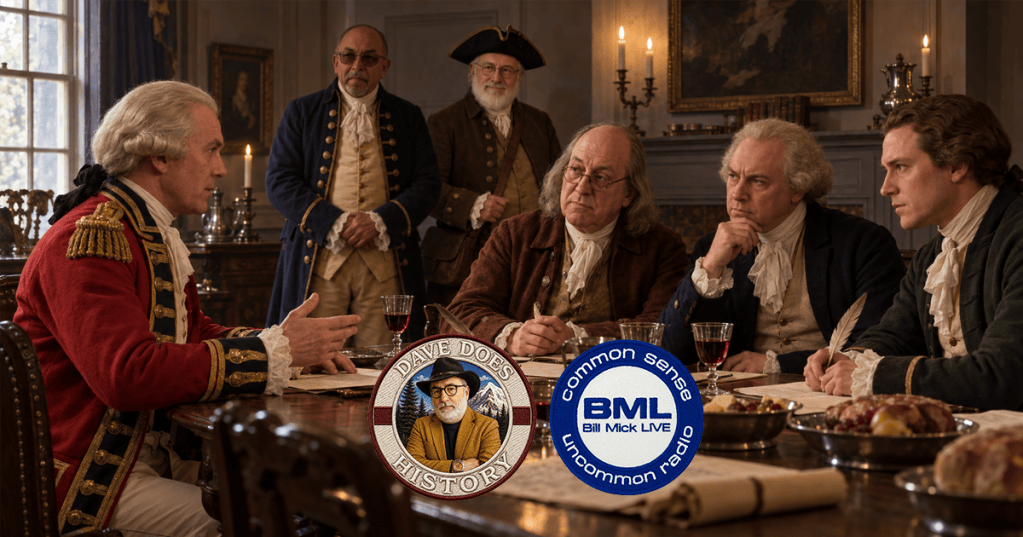
It is at this point in the story where one might pause and imagine the conversation, not in a grand hall or a formal assembly, but in the quieter spaces where opinions are formed. A tavern in Boston. A plantation house in Virginia. A dockside in Philadelphia. The question would not have been framed in lofty terms. It would have sounded more like this. Was this war worth it? Was this what victory was supposed to look like?
One can almost hear the answers, not unified, not yet, but circling around a shared discomfort. Some would argue that the war had been necessary, that French power had to be removed, that the empire remained a source of strength. Others would point to the debt, the restrictions, the presence of British troops, and wonder whether the balance had shifted too far. Could Britain have managed its victory differently? Could it have treated the colonies as partners rather than as sources of revenue and subjects of control? Those questions would not be resolved in a single conversation, but they would be asked again and again, in different forms, as events unfolded.
And then there is Washington, standing at the edge of this moment, not yet the figure he would become, but already shaped by what he had seen. His early failures had taught him caution. His frustrations had taught him skepticism. His experiences had given him a practical understanding of war that no theory could match. When he later took command of the Continental Army, he would carry those lessons with him, the memory of Braddock’s defeat, the knowledge of how quickly confidence can collapse, and the quiet conviction that success would require patience, adaptability, and a willingness to endure.
The road to 1776 did not begin with a tax, or a speech, or a single act of defiance. It began with a war for empire, a war that taught the colonists who they were and what they could do, even as it revealed how they were seen by those who governed them. The French and Indian War did not create the American desire for independence, but it gave that desire a context, a set of experiences, and a growing list of grievances that would, in time, become impossible to ignore.
By the time the first formal protests over taxation emerged, the ground had already shifted. The colonists had fought, they had paid, and they had been told, in effect, to wait their turn. The empire they had helped to expand now stood between them and the future they had imagined.
That is where revolutions take root, not in sudden anger, but in the slow realization that the promises made and the reality delivered are no longer the same thing.
Guttmacher, Manfred S. America’s Last King: An Interpretation of the Madness of George III. New York: Charles Scribner’s Sons, 1941.
Calloway, Colin G. The Scratch of a Pen: 1763 and the Transformation of America. New York: Oxford University Press, 2006.
“French and Indian War.” Encyclopaedia Britannica. Accessed 2025.
“George Washington.” Encyclopaedia Britannica. Accessed 2025.
Dillard, Annie. “The French and Indian War in Pittsburgh: A Memoir.” American Heritage 38, no. 5 (July/August 1987).
Stark, Peter. “The Young George Washington.” American Heritage 64, no. 5 (Fall 2019).
Originally published on May 20, 2025
Redrafted and republished on April 22, 2026



Leave a Reply