
“The most dangerous threats are not the loud ones. They are the ones people barely understand.”
That is not just a clever line, it is a pattern that repeats itself through history. Loud threats rally people. They clarify sides. They give you something to point at, something to argue against. Quiet threats do something else entirely. They seep in. They sit just beyond the edge of comprehension, unsettling without fully explaining why. And that kind of threat, the one that cannot be easily named, has a way of burrowing deeper than any shouted grievance ever could.
That is where this grievance lives.



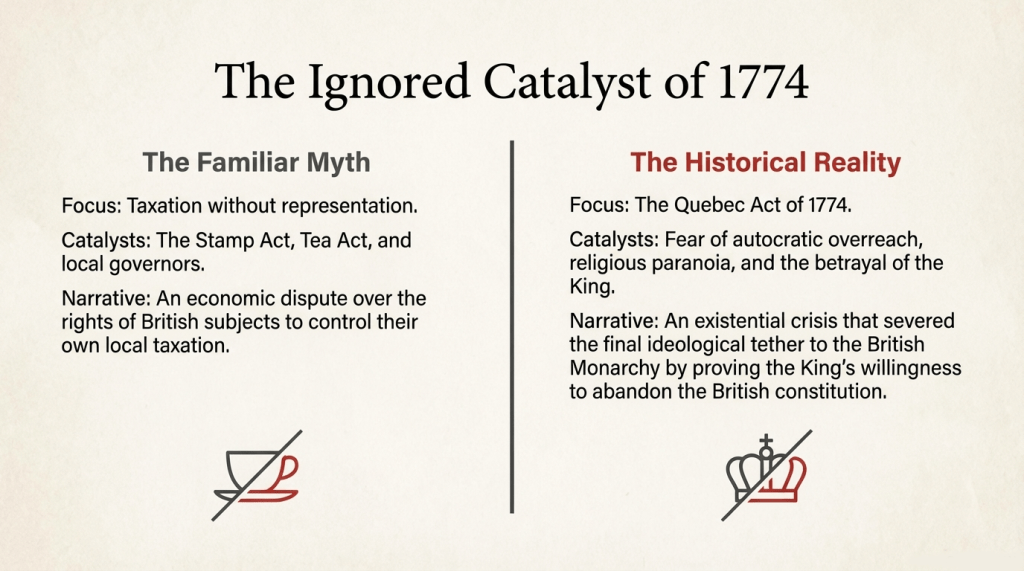
When Thomas Jefferson drafted the Declaration, he laid out a long list of complaints against the Crown. Taxes without representation, standing armies, interference with colonial governments. Most of them are familiar, almost comfortable in their repetition. They sound like arguments. They provoke irritation, even anger. You can debate them, measure them, argue their fairness.
And then there is one that feels different.
“Abolishing the free System of English Laws in a neighbouring Province, establishing therein an arbitrary Government, and enlarging its Boundaries so as to render it at once an Example and fit Instrument for introducing the same absolute Rule into these Colonies.”
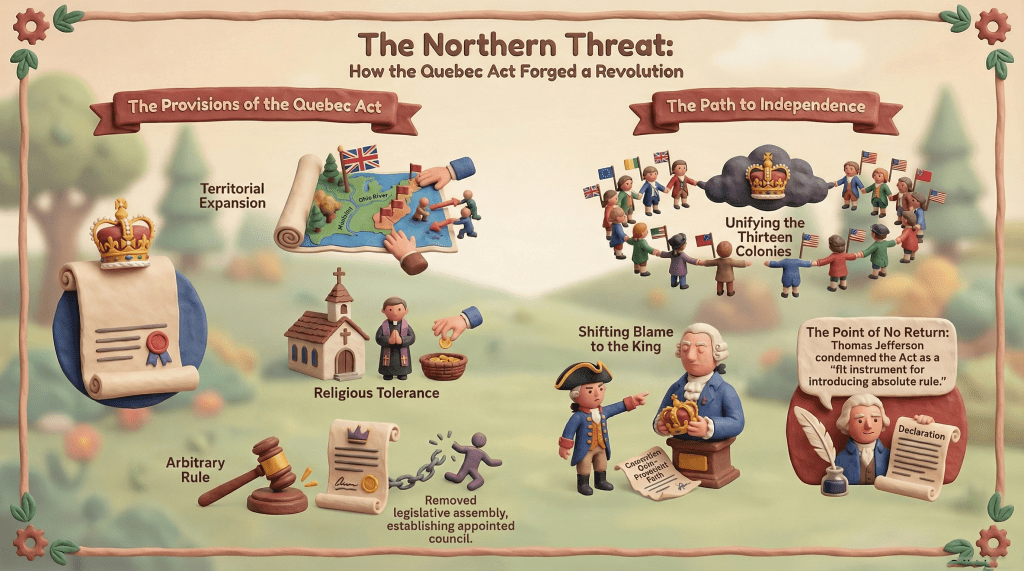
That is not a complaint about inconvenience. That is not a quarrel over policy.
That is a warning.
It points north, to Canada, and suggests that what is happening there is not contained. It is not isolated. It is a model. A preview. A test case for something larger.
If you read the rest of the grievances, you hear anger. If you read this one carefully, you hear fear.
The colonists were not simply frustrated with British policy. They were increasingly convinced that those policies were part of a deliberate pattern, a design that aimed at something more permanent than a tax or a regulation. They feared that the system itself, the framework that had governed them as English subjects, was being altered in ways that would strip away the protections they believed were their birthright.
And in Canada, they thought they could see it happening in real time.
This is where the Quebec Act enters the story, though the colonists would not have used that neat label. To them, it was not a single act among many. It was the piece that made the rest make sense.
Parliament, in 1774, passed legislation designed to stabilize its newly acquired province of Quebec. On paper, it was administrative. Practical. It aimed to govern a largely French-speaking, Catholic population in a way that would maintain order and loyalty. It expanded Quebec’s boundaries, restructured its government, and adjusted its legal and religious framework to fit the realities on the ground.
From London, it may have looked like good governance.
From the colonies, it looked like something else entirely.
The Act abolished the existing system of English civil law in Quebec and restored French civil law in matters of property and private rights. It established a government that answered directly to the Crown, with a governor and appointed council, and no elected assembly to speak for the people. describes this clearly, noting that governance would rest in officials “appointed by the Crown,” with no provision for representative institutions.
That alone was enough to raise eyebrows.
But it did not stop there.
The Act also expanded Quebec’s territory dramatically, pushing its boundaries south and west into lands that many colonists believed were theirs, lands tied to earlier charters and hard-fought victories in the Seven Years’ War. shows that this expansion extended Quebec into the Ohio Valley and beyond, effectively placing vast tracts of contested land under a different legal and political system.
Now the picture sharpens.
A neighboring province, governed without representation, operating under a different legal tradition, expanded to the very edge of the colonies, and controlled directly by the Crown.
If you are a colonial observer in 1774 or 1775, you do not see a distant administrative adjustment. You see a model being built next door.
And models, once built, can be copied.
That is the part that unsettled people.
Other grievances made colonists angry because they affected daily life. Taxes cost money. Troops in cities caused friction. Trade restrictions limited opportunity. These were immediate, tangible problems. They could be protested, resisted, negotiated.
This grievance did something else.
It suggested a future.
Writers of the time did not hesitate to draw the connection. The Quebec system, they argued, could be imposed elsewhere. If Parliament could restructure governance in Canada, why not in Massachusetts, or Virginia, or Pennsylvania? If it could remove representative institutions there, what prevented it from doing the same in the colonies that had grown accustomed to them?
The fear was not that Britain had already done this everywhere.
The fear was that it could.
And once that possibility takes hold, everything else begins to look different. Policies that might have been seen as isolated start to appear coordinated. Decisions that once seemed reactive begin to look intentional. A pattern emerges, whether it was designed that way or not.
That is how suspicion becomes conviction.
Some colonial voices made the point with blunt clarity. The Quebec system, they argued, was not simply foreign to English tradition, it was hostile to it. It represented arbitrary government, rule without consent, law without representation. In their minds, it was the very thing they had been taught to fear, now established not across an ocean, but right next door.
One contemporary observer warned that the Act revealed “a systematic project of absolute power.” That phrase matters. It captures the shift from individual grievance to overarching suspicion. Once you believe there is a system, every action reinforces it.
And here is the uncomfortable truth.
It did not matter whether that system actually existed in the form the colonists imagined. What mattered was that they believed it did.
History is full of moments where perception outruns intent. Governments act for one set of reasons. Subjects interpret those actions through a different lens. The gap between the two can become as consequential as any deliberate policy.
The Quebec Act was meant, at least in part, to secure loyalty in Canada. To stabilize a region that had only recently come under British control. To accommodate a population with different traditions and expectations.
But to the colonies, it looked like preparation.
Preparation for a new kind of empire, one less bound by the traditions of English liberty and more comfortable with centralized authority. An empire that could adapt its methods depending on the region, and, if necessary, impose those methods elsewhere.
That is why this grievance hit differently.
It was not about what had already happened. It was about what might happen next.
Anger can be negotiated. It can be cooled, redirected, even satisfied. Fear is harder to manage. It lingers. It spreads. It looks for confirmation and finds it in unexpected places.
By the time Jefferson put pen to paper, that fear had matured into something close to certainty. The grievance about Canada was not placed in the Declaration by accident. It was included because it encapsulated a broader anxiety, one that tied together many of the other complaints.
If the system of English law could be abolished in one province, it could be abolished in another.
If arbitrary government could be established there, it could be established here.
If boundaries could be expanded to support that system, they could be expanded further.
Remove everything else, the taxes, the quartering, the trade disputes, and this fear would still remain. It would still push in the same direction, because it speaks to the fundamental question of what kind of government the colonists believed they were living under.
And what kind they might soon be living under if nothing changed.
So when we talk about the road to independence, it is easy to focus on the loud moments, the protests, the battles, the declarations. They deserve that attention. But beneath them, running quietly through the narrative, is this deeper current.
A fear that the future was being built just out of reach, in a place close enough to observe but distant enough to deny.
And the colonists, watching Canada, began to wonder whether they were not looking at someone else’s experiment.
But their own.
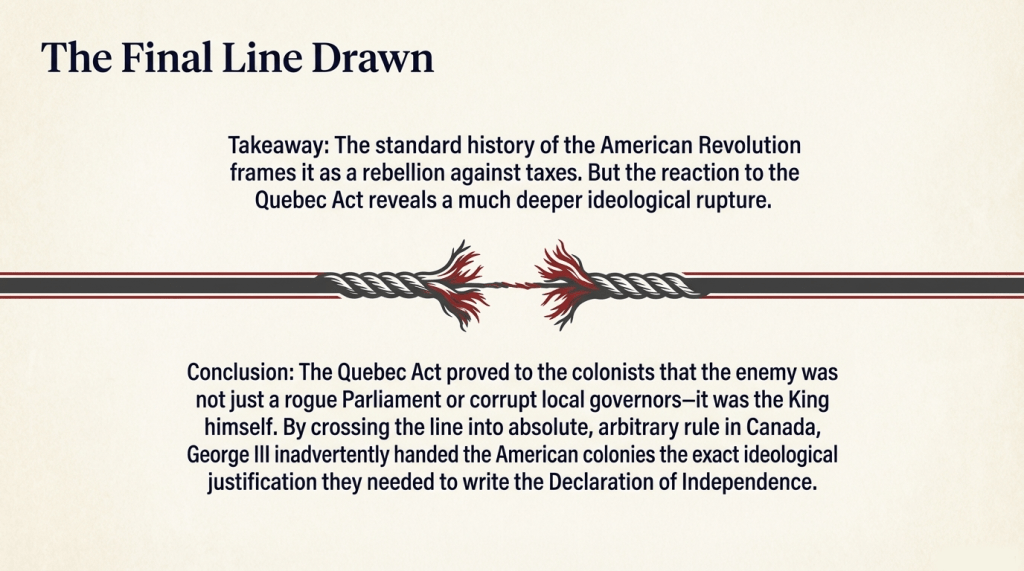
There are moments in history when a law is passed for one purpose and received for another. The men who write it believe they are solving a problem. The people who read it believe they are being warned.
The Quebec Act was one of those moments.
In London, it was administrative. Practical. Even, in a certain light, tolerant. Parliament had acquired a vast, unfamiliar province after the Seven Years’ War, populated largely by French-speaking Catholics who did not fit neatly into the British system. The question was not whether to govern Quebec, but how to do so without constant unrest. The answer, as Parliament saw it, was adaptation. Adjust the system. Allow local customs. Keep the peace.
And so the Act was passed in 1774, in the same season as the laws aimed directly at punishing Massachusetts for the Boston Tea Party. Those other laws, the ones colonists would call the Intolerable Acts, were loud. They closed ports, altered charters, made their intentions plain. They were meant to hurt, and they did.
The Quebec Act did not.
That was precisely the problem.
Because it did not punish the colonies, it could not be easily dismissed as retaliation. It did not come with the heat of anger. It came with the calm of policy. And calm policy, when it moves in a direction you do not trust, can be far more unsettling than open hostility.
It felt deliberate.
And when the colonists began to look closely, what they saw unsettled them more than any closed harbor ever could.
Start with the map.
The Act did not simply reorganize Quebec. It expanded it, dramatically, pushing its boundaries south and west into lands that stretched toward the Ohio River and beyond. makes this plain, describing how the province grew to include vast territories that colonists had long believed were theirs by right, by charter, or by conquest.
Those lands were not empty in the colonial imagination. They represented opportunity, expansion, the future. Men had speculated in them, fought for them, dreamed of them. The Proclamation Line of 1763 had already frustrated those ambitions, placing limits on westward settlement. Now, with a stroke of the pen, much of that contested territory was placed under a different authority entirely.
Not held in reserve. Not left unsettled.
Given away.
You can call that an administrative decision. The colonists called it something else.
They saw it as a theft of potential, a closing of doors that had not yet been opened. They had fought alongside British forces in the French and Indian War with the understanding that victory would bring access to the interior. Instead, they watched as those lands were folded into a province governed under rules they did not recognize.
That is the territorial shock.
But territory alone does not create fear. It is what happens within that territory that gives it shape.
The political structure established by the Act was, to colonial eyes, deeply unsettling. Quebec would not have an elected assembly. There would be no representative body chosen by the people to speak for their interests. Instead, governance would rest in a governor appointed by the Crown, assisted by a council that served at royal pleasure. outlines this clearly, a system where authority flows downward, not upward.
That might have been workable in a newly acquired province with different traditions. But the colonists did not see it that way.
They saw a system stripped of what they considered essential protections. No elected representation. Limited recourse. A structure that looked, in their minds, less like English liberty and more like something imposed, something controlled.
And they asked the obvious question.
If this system works in Quebec, why not elsewhere?
The legal structure added another layer to the unease. English common law, which colonists saw as one of their fundamental inheritances, was not fully extended into Quebec. French civil law was restored in matters of property and private rights, while English law remained in criminal cases. explains this hybrid system, a compromise designed to accommodate local conditions.
Compromise, however, depends on perspective.
To the colonists, this was not accommodation. It was inconsistency. It suggested that the legal traditions they valued were not fixed, not guaranteed, but subject to alteration depending on circumstance. If Parliament could adjust the legal framework in Quebec, it could adjust it elsewhere.
Law, in that sense, became flexible.
And flexible law, when combined with centralized authority, begins to look like something closer to arbitrary power.
Then there was religion.
Here the Act was, by modern standards, remarkably tolerant. It allowed the free exercise of Catholicism, removed certain oaths that had previously excluded Catholics from public office, and permitted the Church to collect tithes. describes how Catholic subjects could now “hold and enjoy” their religious practices without renouncing their faith.
In Quebec, this made sense. The population was overwhelmingly Catholic. Stability required recognition of that reality.
In the colonies, it triggered alarm.
Not because tolerance itself was offensive, but because of what it seemed to imply. Many colonists were Protestants who had grown up with deep suspicions of Catholic authority, shaped by centuries of European conflict and political tension. To them, the establishment of Catholic structures in a neighboring province, backed by British law, looked less like tolerance and more like endorsement.
They worried about influence. About proximity. About the possibility that religious and political authority might merge in ways they could not control.
And they looked at a map that now placed that system not far from their own borders.
North and west lay Quebec, governed without representation, structured under a different legal tradition, and openly accommodating a religious system many colonists distrusted. To the south lay Spanish territories, also Catholic, also governed under centralized authority.
It is not difficult to see how the picture formed in their minds.
They felt surrounded.
Not militarily, at least not yet. But ideologically. Structurally. They imagined a ring of power closing in, systems of governance that did not reflect their own traditions pressing closer from multiple directions.
And in that environment, the Quebec Act ceased to be a Canadian issue.
It became an American one.
Colonial writers did not hesitate to draw the line. They argued that Quebec was not simply a province being managed, but an example being constructed. A place where Parliament could experiment with forms of governance that might later be extended elsewhere. captures this fear, noting that colonists saw the Act as evidence of a broader design toward “absolute Despotism.”
Whether that design existed in the minds of British policymakers is almost beside the point.
The colonists believed it did.
And belief, once it takes hold, drives action.
At first, they tried diplomacy.
If Quebec represented a potential ally, or at least a neutral ground, then perhaps it could be drawn into the colonial orbit. The Second Continental Congress reached out, sending a delegation that included Benjamin Franklin and Charles Carroll of Carrollton. The goal was simple, at least in theory. Persuade the Canadians to join in resistance, to see their interests aligned with those of the colonies to the south.
It did not work.
The Canadians, influenced by their own clergy, their own traditions, and perhaps wary of exchanging one distant authority for another uncertain alliance, did not respond as the Americans had hoped. The invitation to join in resistance fell flat. suggests that local conditions, loyalties, and structures made such alignment unlikely.
Diplomacy had reached its limit.
And when diplomacy fails in a moment already charged with suspicion, the alternatives tend to narrow quickly.
If they will not join us, then what?
For some in Congress, the answer became unavoidable.
We go to them.
The decision to invade Canada did not emerge from a vacuum. It grew out of this entire context, the fear of what Quebec represented, the failure to secure its cooperation, and the strategic reality that leaving British forces unchallenged to the north posed its own risks. notes that Congress, weighing these concerns, authorized military action to secure key positions in Canada.
What began as a policy meant to stabilize a province had now contributed to the expansion of the war.
There is a kind of irony in that.
Britain sought to secure Canada, to integrate it into the empire in a way that would ensure loyalty and order. In doing so, it introduced a set of changes that, while logical from one perspective, appeared threatening from another. The colonies, already uneasy, interpreted those changes as a signal of what might come next.
And in reacting to that perceived threat, they moved closer to the very outcome Britain had hoped to avoid.
Unity.
Not perfect unity. Not immediate. But a convergence of concern, a shared sense that something larger was at stake than individual grievances. The Quebec Act did not cause the Revolution on its own. But it helped knit together a narrative, one in which disparate complaints could be seen as parts of a single pattern.
A shadow, stretching from Canada down through the colonies.
And once that shadow was noticed, it became difficult to ignore.
The march north began with confidence and ended in snow, hunger, and silence.
That is not how it was supposed to go.
In the autumn of 1775, as the conflict between the colonies and Britain sharpened into open war, the leadership of the Second Continental Congress faced a problem that was as much strategic as it was psychological. To the north lay Canada, recently secured by Britain and reshaped by the Quebec Act into something the colonists barely recognized. A province without an elected assembly, governed by Crown authority, structured under a legal and religious system that felt alien to colonial expectations.
It was not just a neighbor.
It was a warning.
If that system held, if Canada remained firmly under British control, it could become a base for military operations, a staging ground for pressure on the colonies, and perhaps most unsettling of all, a living example of what the empire might impose elsewhere. The fear was not abstract. It had already been written into the grievances that would later appear in the Declaration.
So Congress made a decision that, at the time, seemed both bold and necessary.
They would take the fight to Canada.
The campaign would be led in part by Richard Montgomery, a former British officer turned Patriot commander, and Benedict Arnold, a man whose name would later carry a very different weight, but who at this moment stood as one of the more daring figures in the American cause. Together, they represented a combination of experience and audacity that seemed suited to the task.
At first, the plan appeared to work.
Montgomery moved north from New York, advancing along the familiar routes of the Richelieu River. Forts fell. Positions were taken. By November 1775, Montreal was in American hands, a significant early success that suggested the broader strategy might hold. The idea that Canada could be drawn into the revolutionary orbit, either by persuasion or by presence, did not seem entirely unrealistic.
At the same time, Arnold undertook a different kind of march, one that would become legendary for reasons that have little to do with success. He led a force through the wilderness of Maine, a journey that tested endurance more than tactics. Men starved. Supplies ran out. The landscape itself seemed determined to resist them. By the time Arnold reached the outskirts of Quebec, his force was diminished, exhausted, but still moving.
It is the kind of effort that looks heroic on paper.
In reality, it was desperate.
The two forces converged outside the city of Quebec, the prize that would determine whether the campaign succeeded or failed. If Quebec fell, the entire province might follow. If it held, everything that had come before would begin to unravel.
The attack came on December 31, 1775.
It came in the dark, in a snowstorm, against a fortified city held by British forces under Guy Carleton. The conditions alone would have been enough to give pause. Visibility was poor. Coordination was difficult. The element of surprise, so often the ally of attacking forces, was compromised by the environment itself.
It did not go well.
Montgomery was killed early in the assault, struck down as he led his men forward. Arnold was wounded. The attack faltered, then collapsed. What had begun as a coordinated effort dissolved into confusion and retreat. The Americans, who had pushed so far under such difficult conditions, found themselves repulsed at the moment that mattered most.
The campaign did not end immediately, but its outcome was no longer in doubt.
Through the winter and into the spring of 1776, American forces lingered, weakened by disease, short on supplies, unable to mount another serious assault. British reinforcements arrived. Pressure increased. By June, the Americans were in full retreat, moving back down the same routes they had fought so hard to advance along months earlier.
In military terms, it was a failure.
Clear, undeniable, and costly.
Canada remained in British hands. The hoped-for alliance with the Canadiens never materialized. The northern front, which had briefly seemed promising, became a reminder of the limits of American reach in the early stages of the war.
And yet, like so many moments in this conflict, the story does not end with the battlefield.
Because failure, especially when it is close enough to feel like it might have been success, has a way of reshaping perception in ways victory sometimes cannot.
The invasion of Canada did not achieve its immediate objectives. But it did something else.
It confirmed the fears that had driven it.
The colonists had looked at the Quebec Act and seen a model of arbitrary government, a system imposed without representation, sustained by military power, and indifferent to the traditions they held dear. They had worried that such a system might spread, that what had been established in Canada could be extended into the colonies themselves.
The campaign made that fear tangible.
They had seen British authority in Canada up close. They had encountered its structures, its defenses, its determination to hold. They had tested it, and it had not yielded. Whatever illusions remained about the possibility of a soft or negotiated arrangement in that province began to fade.
At the same time, the campaign revealed something about British priorities.
Canada mattered.
It mattered enough to defend. Enough to reinforce. Enough to hold at all costs. That realization fed into a broader conclusion that was already forming in colonial minds. The Crown was not merely reacting to events in the colonies. It was pursuing a strategy, one that involved maintaining control over key regions and using them to project power where necessary.
That is where the shift begins.
Earlier in the conflict, much of the colonial anger had been directed at Parliament. The taxes, the trade regulations, the series of acts that seemed to pile one upon another, these were seen as the work of legislators who either misunderstood or ignored colonial concerns. The King, for many, remained a distant figure, someone who might yet intervene, who might yet restore balance if properly informed.
That belief did not survive long.
As the war progressed, and particularly as campaigns like the one in Canada unfolded, the distinction between Parliament and Crown began to blur. Authority flowed from both. Decisions were backed by both. Responsibility, in the colonial mind, shifted upward.
Toward George III.
If the system in Canada was being maintained, if military force was being applied, if policies that threatened colonial rights were being upheld, then the King himself could no longer be seen as separate from those actions. He became, in the language of the Declaration, the central figure, the one against whom the grievances would ultimately be directed.
The failure in Canada, then, did not weaken the case for independence.
It strengthened it.
Not by proving that the colonies could defeat Britain everywhere, but by demonstrating that they could not rely on anything else. Not on negotiation. Not on shared tradition. Not on the hope that misunderstandings could be resolved.
The system they feared was real.
And it would be imposed, if given the chance.
There was, however, one strategic benefit to the campaign, though it was not immediately apparent. By forcing the British to focus resources on defending Canada, the Americans disrupted what might have been a more coordinated offensive in the southern colonies. Time was bought, not by victory, but by engagement. British attention was divided. Plans were delayed.
That delay would matter later, as the war shifted and new opportunities emerged, including the campaigns that would culminate in moments like Battle of Saratoga, where timing and positioning proved critical.
It is an indirect line, but a real one.
And it underscores a larger truth about this war. Success was not always found in winning battles. Sometimes it was found in changing conditions, in forcing the enemy to react, in creating space for other events to unfold.
More important than any of that, however, was the unifying effect of the experience.
The Quebec Act, once a distant policy affecting a distant province, had become a litmus test. Support for it, or even tolerance of it, began to mark one as aligned with a system the colonists increasingly rejected. Opposition to it became part of a broader identity, one that defined itself not just in terms of specific grievances, but in terms of what kind of government was acceptable.
The lines sharpened.
You were either for a system that allowed arbitrary authority, or you were against it. You either accepted the model represented by Canada, or you rejected it.
There was less room in between.
And that narrowing of options is what pushes a movement forward.
By the time the campaign in Canada ended in retreat, the question of reconciliation had already begun to fade. Too much had happened. Too many assumptions had been tested and found wanting. The hope that the empire could be reformed from within, that rights could be secured without a break, that balance could be restored, all of that began to feel less like prudence and more like denial.
Independence, which had once been one option among many, now stood apart.
Not as the most desirable outcome, perhaps. Not as the easiest.
But as the only one left that made sense.
Britain had tried to secure Canada, to stabilize it, to integrate it into a system that would ensure loyalty and control.
In doing so, it cast a shadow over the colonies, a shadow that grew darker as events unfolded.
And in that shadow, the colonies made their choice.
Britain held Canada.
But in the process, it lost America.
Allison, Robert J. The American Revolution: A Concise History. Oxford: Oxford University Press, 2011.
Anderson, Fred. Crucible of War: The Seven Years’ War and the Fate of Empire in British North America, 1754–1766. New York: Vintage Books, 2001.
Billias, George Athan. George Washington’s Opponents: British Generals and Admirals in the American Revolution. New York: William Morrow, 1969.
Calloway, Colin G. The Scratch of a Pen: 1763 and the Transformation of North America. Oxford: Oxford University Press, 2006.
Ellis, Joseph J. Revolutionary Summer: The Birth of American Independence. New York: Alfred A. Knopf, 2013.
Ferling, John. Almost a Miracle: The American Victory in the War of Independence. New York: Oxford University Press, 2007.
Gipson, Lawrence Henry. The British Empire Before the American Revolution. Vols. 11–12. Caldwell, ID: Caxton Printers, 1962–1970.
Middlekauff, Robert. The Glorious Cause: The American Revolution, 1763–1789. New York: Oxford University Press, 1982.
Montgomery, Richard. Correspondence and military reports, 1775–1776.
Arnold, Benedict. Journals of the Quebec Expedition, 1775.
Paine, Thomas. Common Sense. Philadelphia, 1776.
“The Quebec Act.” 14 Geo. III c.83 (1774).
“The Declaration of Independence.” July 4, 1776.
U.S. Continental Congress. Journals of the Continental Congress, 1775–1776.
Ward, Christopher. The War of the Revolution. New York: Macmillan, 1952.






Leave a comment