
He never thought of himself as the villain. So Why Do Americans See Him as the Bad Guy?
That is the part that tends to get lost once the story hardens into something clean and easy to repeat. We grow up with a version of King George III that fits neatly into the role assigned to him. The tyrant. The oppressor. The man the Declaration was written against. It is a useful image, simple and effective, the kind of thing that holds together a national story. But it is not how the man saw himself, and it is not how much of the world saw him either.
From his own vantage point, George III was doing his duty.



That word matters more than anything else if you want to understand him. Duty, not ambition. Obligation, not indulgence. He did not inherit a quiet throne. He stepped into a system already under strain, an empire stretched across oceans, tied together by trade, power, and a fragile sense of order that depended on constant management. Communication moved at the speed of wind and tide. Decisions made in London echoed months later in Boston or Charleston, often distorted by distance and delay.
He understood the weight of that.
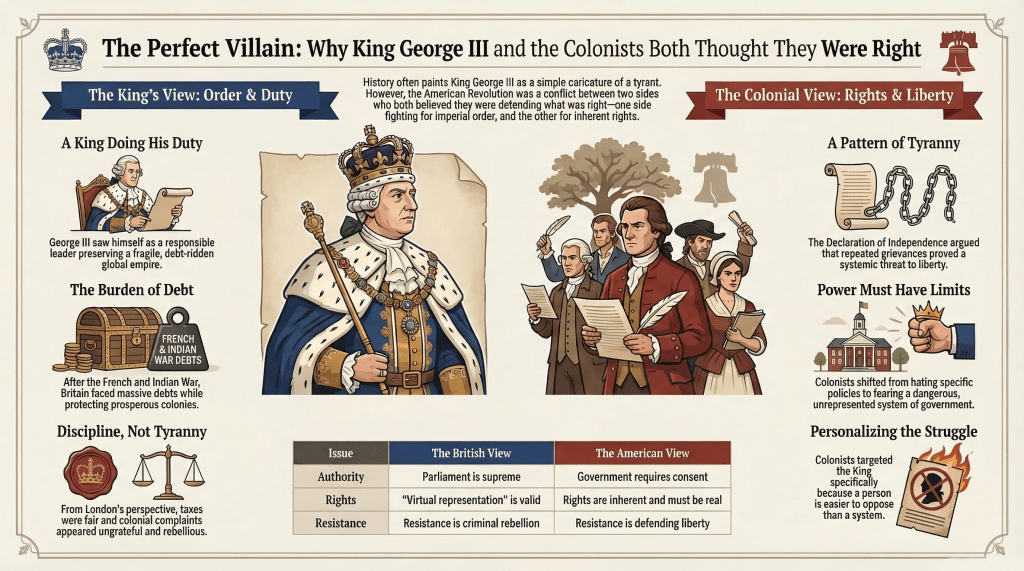
George III was not careless about his role. By all accounts, he took it seriously, almost to a fault. He saw the crown not as a privilege to be enjoyed, but as a responsibility to be carried. Stability was his measure of success. If the empire held together, if order was maintained, then he believed he had done what was required of him.
That is not the caricature most people expect.
There is no wild-eyed despot pacing the halls of Buckingham Palace, dreaming up ways to torment distant colonists. What you find instead is a man who believed deeply in the system he represented, and who felt compelled to defend it. When he looked across the Atlantic, he did not see a group of oppressed subjects struggling under injustice. He saw colonies that were thriving under British protection, benefiting from the reach of the Royal Navy and the structure of imperial trade.
And he saw a problem.
The French and Indian War had ended not long before, and it had done more than redraw maps. It had drained the treasury. Britain emerged victorious, but victory came at a cost that could not be ignored. Debt hung over the government like a storm cloud, and the empire itself had grown more complex, more difficult to manage. New territories required defense. Trade routes required protection. Administration required coordination.
None of that was free.
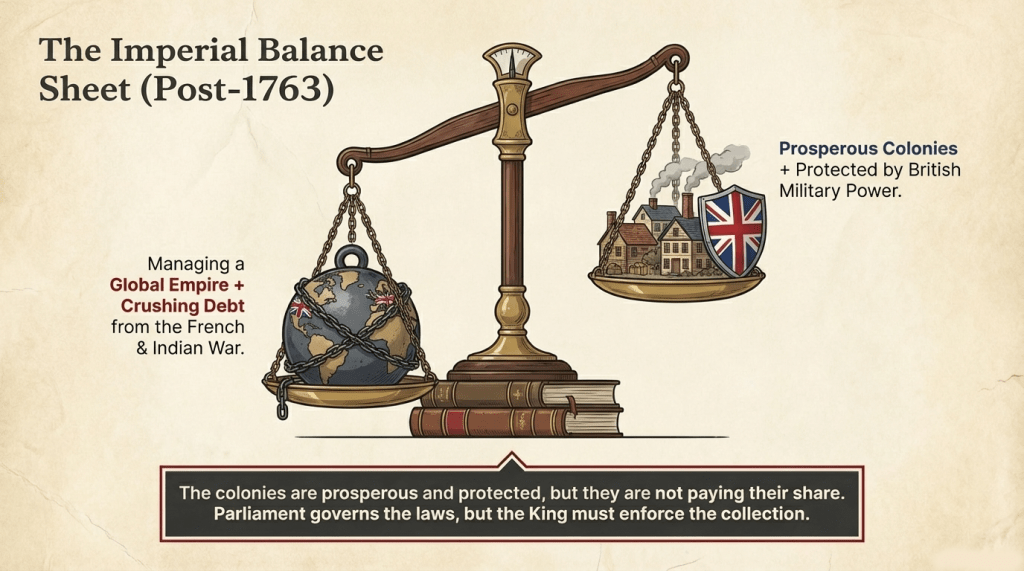
From London, the equation looked straightforward. The colonies had benefited from the war. They were safer, more secure, more prosperous than before. It seemed only reasonable that they should contribute to the cost of maintaining that system. That was not oppression in his mind. It was fairness.
Parliament, of course, handled the mechanics. Laws were debated, taxes proposed, policies shaped in that chamber. But the king was not a distant observer. He supported enforcement. He believed in the legitimacy of what Parliament was doing, and more importantly, he believed in the principle behind it.
Parliamentary supremacy was not a suggestion.
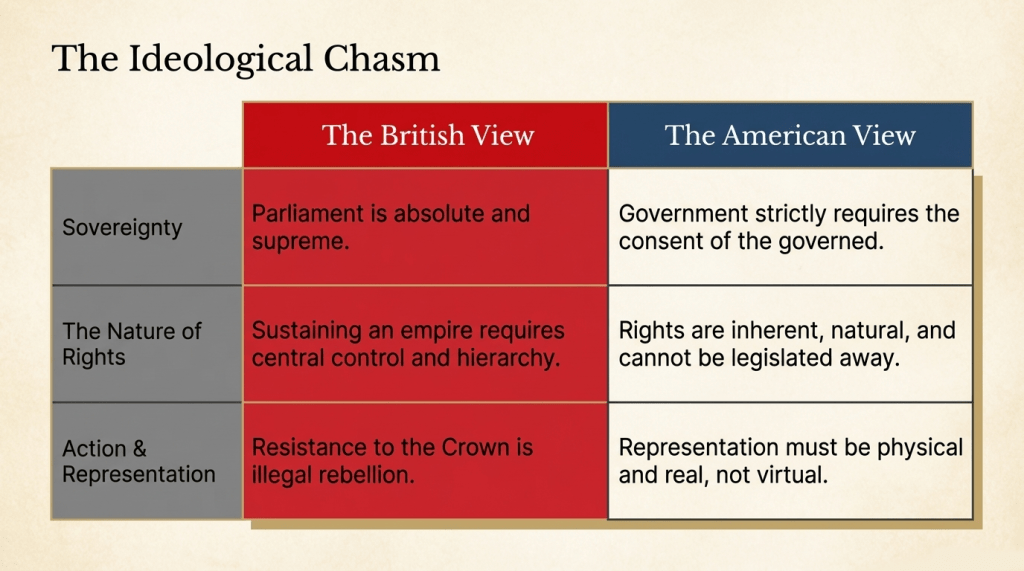
It was the foundation of the British system as it had developed over the previous century. The turmoil of the English Civil War, the execution of Charles I, the uneasy years that followed, all of it had led to a settlement in which Parliament stood at the center of authority. That lesson had been learned at great cost, and it was not one the British were inclined to abandon.
To them, it worked.
And if it worked, then it applied everywhere within the empire. That included the American colonies, whether those colonies agreed or not. The concept that supported this, the idea of virtual representation, sounds strange now, almost absurd. But at the time, it was not fringe thinking. It was accepted, even assumed. Parliament represented the entire empire, not just those who voted directly for its members. That was the theory, and it had been sufficient for years.
Which is why colonial complaints sounded different in London than they did in Boston.
The average British citizen paid higher taxes than most colonists. That was a simple fact. They bore the burden of supporting the government, the military, the infrastructure of the empire. When they heard Americans protesting new duties or restrictions, it did not sound like a defense of liberty. It sounded like evasion. Like a refusal to carry a fair share of the load.
Unfair, even ungrateful. That is how it was often framed. These colonies, prosperous and growing, protected by British power, now pushing back against measures that seemed, from that perspective, entirely reasonable. It is not difficult to see how the divide began to widen. Each side was working from a different set of assumptions, a different understanding of what the system was supposed to do.
And at the center of it all stood the king, convinced that he was holding things together.
When resistance in the colonies began to intensify, he did not interpret it as a warning sign that the system itself might be flawed. He saw it as a challenge to order, a threat to stability that needed to be addressed. Discipline, not concession, became the response. If laws were being ignored, they had to be enforced. If authority was being questioned, it had to be reaffirmed.
From his perspective, anything less would invite chaos.
Empires do not survive by allowing each part to decide which rules it will follow. That was the logic, and it was not unreasonable within its own framework. The problem was that the framework itself was no longer shared. What looked like discipline in London felt like coercion in America. What seemed like fairness on one side of the Atlantic felt like overreach on the other.
The same actions, seen through different lenses. That is where the story begins to turn.
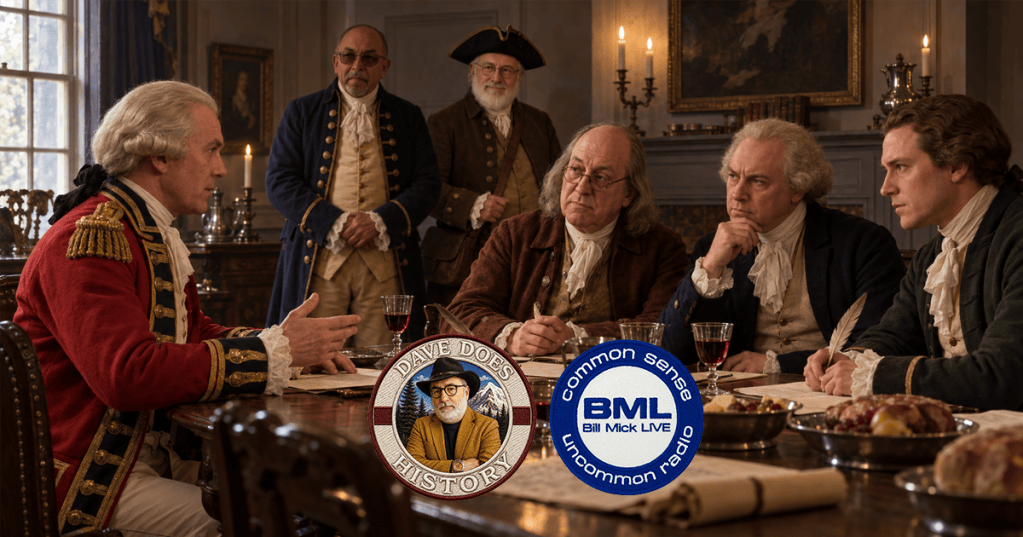
Because once those perceptions harden, once each side becomes convinced that it understands the situation correctly, compromise becomes harder to achieve. George III did not wake up one morning and decide to be the villain in someone else’s revolution. He followed a line of reasoning that made sense to him, grounded in the system he believed in and the responsibilities he felt he could not abandon.
The colonists followed a different line. They began to see those same actions not as the maintenance of order, but as the expansion of power beyond its proper limits. Laws were not simply being enforced. They were being imposed without consent. Authority was not simply being exercised. It was being extended into areas where it did not belong.
The gap between those interpretations grew.
And as it grew, so did the difficulty of bridging it. Each new measure, each new response, reinforced the existing beliefs on both sides. The king saw resistance and concluded that stronger enforcement was necessary. The colonists saw stronger enforcement and concluded that their fears were justified.
A cycle, tightening with each turn. From London, it remained discipline. From America, it was becoming something else entirely.
And that is the tension that sits at the heart of the story. Not a simple clash between good and evil, but a conflict between two understandings of how power should operate. George III believed he was preserving a system that had proven its worth. The colonists believed that same system was being used against them.
Both sides could explain their position. Both sides could justify their actions. And both sides, in their own way, believed they were right.
That is what makes the situation so difficult to untangle. It is also what makes it so human. The king was not acting out of malice for its own sake. He was acting out of conviction, shaped by his experience, his education, and his responsibilities. He saw himself as a guardian of order, a stabilizing force in a world that did not easily hold together.
The colonists saw something different. They saw a pattern, a series of actions that suggested not just enforcement, but control. They began to question not just individual policies, but the structure behind them. And once that question takes hold, once the system itself is placed under scrutiny, the conversation changes.
It is no longer about taxes or trade. It is about limits.
From London, that shift was difficult to grasp. The king continued to view the situation through the lens that had guided him from the beginning. An empire under strain, requiring firm management. Subjects resisting lawful authority, requiring correction.
From America, the same actions confirmed a growing suspicion. That power, left unchecked, would continue to expand.
And that is where the lines begin to harden, where discipline becomes, in the eyes of those on the receiving end, something much closer to tyranny.
By the time 1776 arrives, the argument has moved past the point of polite disagreement. That is the part that tends to get flattened when the story is told too quickly. We like to imagine a clean line, a moment when everyone suddenly agrees that something has gone wrong. That is not how it unfolded. It built, slowly and unevenly, over years of frustration, hesitation, and second guessing.
At the beginning, it really was about taxes, or at least it looked that way from the outside. Duties on paper, tea in the harbor, stamps on documents. The kind of issues that can be debated, negotiated, adjusted. But the colonists themselves kept insisting that those things were symptoms, not the disease. That distinction is easy to miss if you are not looking for it, and the King, sitting in London, never quite sees it the same way they do.
What the colonists begin to understand, gradually and then all at once, is that the real question is not how much power is being used, but whether that power has limits at all.
Once that question takes hold, everything changes.
You can argue about a tax rate. You can compromise on trade regulations. But if the underlying system allows one side to impose its will without meaningful restraint, then every individual dispute becomes part of something larger. It stops being a policy debate and becomes a structural problem.
That realization does not appear overnight. It develops through experience. Each new act, each new response, each new attempt to resolve a dispute within the existing framework begins to feel less like a disagreement and more like a pattern.
And patterns are harder to ignore.
By the time the Declaration of Independence is drafted, the colonists are no longer content to list complaints. They are building a case. That document, often read for its opening lines, is in many ways a legal brief. It is a formal accusation, laid out in a way designed to persuade not only their own people, but the wider world. It is also a justification, an explanation of why breaking away is not an act of rebellion in the reckless sense, but a necessary response to a sustained problem.
They are careful about that.
“Let facts be submitted to a candid world,” Jefferson writes, and that phrase does a great deal of work. It signals that what follows is not intended as rhetoric alone. It is meant to be evidence. The colonists are not asking the reader to take their word for it. They are presenting a series of actions and inviting judgment.
What emerges from that list is not a collection of isolated incidents. It is a pattern.
They begin with the legislative sphere, because that is where the conflict is most visible. Laws passed by colonial assemblies are blocked or ignored. Governors, acting in the name of the Crown, dissolve those assemblies when they become inconvenient. Meetings are postponed, relocated, or prevented altogether. The effect is not just frustration. It is paralysis. A people that cannot legislate cannot govern themselves in any meaningful way.
That alone would be troubling.
But it does not stop there. The colonists point to the judiciary, noting that judges are made dependent on the Crown for their positions and their salaries. In a system that claims to value the rule of law, that dependence raises an obvious question. If a judge owes his livelihood to the authority he is meant to check, how independent can he be?
The answer, in their view, is not very.
Then there is the military presence. Standing armies, maintained in peacetime, stationed among the population. This is not a neutral fact in the eighteenth century. It carries a long history of suspicion. In the English tradition, a standing army without the consent of the people is seen as a potential instrument of control rather than protection.
Add to that the issue of taxation. Not simply that taxes are imposed, but that they are imposed without representation. Without consent. It is not the amount that matters as much as the principle. If taxes can be levied in this way, what else can be done without input from those affected?
Trade restrictions follow, tightening the economic grip of the empire. Goods must move through approved channels. Markets are controlled. Opportunities are limited not by local conditions, but by decisions made far away.
And when resistance appears, the response escalates.
Troops are deployed. Force is used. Incidents like the Boston Tea Party do not exist in isolation. They become markers, points along a line that seems to be moving in one direction. The colonists begin to interpret each new action not as a response to a specific event, but as part of a broader effort to assert control.
That is the pattern they see. It is not one act. It is a sequence. And once you see it that way, it is difficult to unsee.
The emotional shift that follows is as important as the factual one. At first, there is disagreement. Policies are challenged, arguments made, petitions sent. The tone is still one of engagement within the system. The colonists are not yet trying to break away. They are trying to be heard.
When that does not produce the desired result, disagreement turns into distrust. Motives are questioned. Actions are interpreted more harshly. The assumption that the system can correct itself begins to weaken.
From there, the move to accusation is almost inevitable.
By 1776, the language has changed. The colonists are no longer saying that specific policies are wrong. They are saying that the system itself is dangerous. That it is structured in a way that allows power to expand without sufficient restraint. That the actions they have experienced are not anomalies, but expressions of that structure.
That is a serious charge.
It is also a risky one. To accuse a king of tyranny is not a casual act. It carries consequences, legal and otherwise. The colonists are aware of that. They understand that once the accusation is made publicly, there is no easy way to step back from it. Which is why they take care to support it.
The Declaration does not rely on a single grievance. It does not hinge on one decisive moment. It builds, point by point, creating a cumulative effect. Each example reinforces the others. Each action adds weight to the argument. The goal is not to prove that any one measure is intolerable on its own, but to show that taken together, they form a consistent pattern of overreach.
That is how they move from complaint to conclusion. And that conclusion, from their perspective, is unavoidable.
If a government repeatedly acts in ways that undermine the ability of the people to govern themselves, if it concentrates power without meaningful checks, if it responds to resistance with force rather than adjustment, then it begins to resemble something other than the system it claims to be.
It begins to look like tyranny.
That word is not used lightly. It carries with it a history, a set of associations drawn from the same classical sources that shaped their thinking. A tyrant is not simply a ruler who makes unpopular decisions. A tyrant is one who exercises power without regard to limits, without accountability, without the consent of those affected.
The colonists come to believe that this is what they are facing. And once they reach that belief, the path forward narrows. If the system is dangerous, if it cannot be trusted to correct itself, then remaining within it becomes a risk. Breaking away, once unthinkable, begins to appear as the only viable option.
From their vantage point, the logic is clear. But clarity is not shared.
Because on the other side of the Atlantic, the King does not recognize himself in that description. He does not see a pattern of tyranny. He sees a series of necessary actions taken to maintain order in a complex and fragile system. He sees resistance that must be addressed, not because it is unreasonable in every instance, but because allowing it to go unchecked threatens the stability of the whole.
The same events interpreted differently. That is the heart of the conflict.
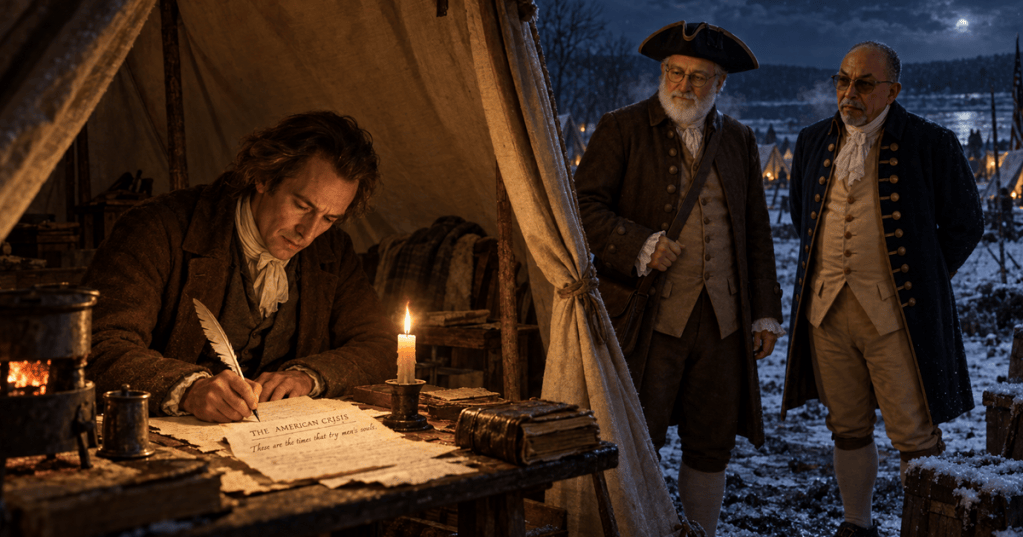
The colonists construct their case carefully, drawing on experience, on history, on a growing sense that something fundamental is at stake. The King continues to operate within a framework that has served him and his predecessors, convinced that he is fulfilling his duty.
Both sides can explain themselves. Both sides can point to reasons. Winston Churchill notwithstanding, they are no longer speaking the same language.
And when that happens, when agreement on basic principles breaks down, the space for compromise shrinks. What one side sees as discipline, the other sees as oppression. What one side sees as necessary authority, the other sees as unchecked power.
By the time the Declaration is signed, the argument has been made as clearly as the colonists can make it.
To them, the conclusion is obvious. This is tyranny. The difficulty is that the man they are accusing does not see it that way and he never will.
When two sides define liberty differently, conflict does not drift in like bad weather. It sets in like winter. You can feel it coming long before the first frost, and once it arrives, you do not argue it away. You endure it, or you break under it.
By 1776, that winter has settled across the Atlantic.
It is tempting to look for a single moment when everything turns, a clean break where misunderstanding gives way to clarity. That moment does not exist. What exists instead is a widening gap in how two societies understand the same words. Liberty. Authority. Representation. Each side uses them. Each side believes it understands them. And each side is certain the other has it wrong.
From London, the picture remains grounded in a system that has already survived its own crises. Parliament stands at the center of that system, not as an experiment, but as a hard won solution to earlier chaos. The memory of civil war is not distant. The execution of a king, the instability that followed, the uneasy restoration, all of it lingers in the political imagination. The lesson drawn from that history is not subtle. Authority must be clear, and it must be capable of acting. Without it, disorder follows.
Parliamentary supremacy answers that need. If Parliament speaks for the empire, then its decisions carry weight everywhere within that empire. That is not seen as overreach. It is seen as coherence. A system that allows each part to decide for itself which rules apply is not a system at all. It is a collection of fragments waiting to come apart. From that perspective, control is not oppression. It is maintenance.
Resistance, then, takes on a different meaning.
It is not a debate over policy. It is a challenge to the structure itself. When colonists push back, when they refuse to comply, when they organize against the laws passed in London, it does not register as a legitimate disagreement. It registers as rebellion. Not because every complaint is baseless, but because the act of resisting undermines the authority that holds the system together.
That is the British view, and within its own framework, it holds together.
Across the ocean, the same events are filtered through a different set of assumptions.
The colonists do not begin by rejecting the idea of authority. They begin by questioning its source. Rights, in their understanding, are not granted by government. They exist prior to it. They are inherent, rooted in nature or in something beyond the reach of political institutions. Government, then, does not create rights. It protects them.
That distinction is not academic.
If rights come first, then government must be limited. It must operate within boundaries that it does not define for itself. It must derive its legitimacy from the consent of those it governs. Without that consent, its authority is suspect, no matter how orderly its actions may appear.
Representation becomes the mechanism that ties those ideas together.
It is not enough, in the colonial view, to claim that Parliament represents the empire in a broad sense. Representation must be real. It must involve a direct connection between those who make decisions and those who are affected by them. Without that connection, laws may be efficient, even well intentioned, but they lack legitimacy.
Consent, then, is not a courtesy. It is a requirement.
Set those two perspectives side by side, and the tension becomes obvious. One side prioritizes structure and coherence, trusting that a strong central authority will maintain stability. The other prioritizes limits and participation, trusting that a government rooted in consent will preserve liberty.
Neither side sees itself as unreasonable. Neither side is entirely wrong within its own framework. That is what makes the situation so difficult.
Because when both sides can justify their position, when both can point to principles that seem sound, compromise becomes more than a matter of negotiation. It becomes a question of identity. To give ground is not simply to adjust a policy. It is to concede something fundamental about how the world is supposed to work.
That kind of concession is rare. And so the divide deepens.
As it does, the colonists begin to shape their argument in a way that reflects both strategic thinking and a growing sense of urgency. They are not just trying to win a debate. They are trying to unify a collection of colonies that do not always see eye to eye. New England, the middle colonies, the South, each has its own priorities, its own concerns, its own reasons for hesitation.
A system is hard to oppose. It is abstract, diffuse, difficult to pin down. You can argue against its policies, its structure, its effects, but it remains something that can be adjusted, reformed, negotiated. A person is different. A person can be held accountable. A person can be named, described, judged.
So, the focus shifts. The King becomes the face of everything the colonists oppose. This is not entirely fair, in the sense that Parliament plays a central role in the decisions being made. But fairness is not the only consideration. Clarity matters. Unity matters. A single figure, standing at the center of the system, provides both.
It turns politics into something more immediate. Instead of arguing about the nuances of parliamentary authority, the colonists can frame their struggle as a moral conflict. People defending their rights against a ruler who has violated them. It simplifies the narrative without necessarily distorting the underlying concerns.
It also creates a focal point.
When the Declaration lists its grievances, it directs them at George III. “He has…” the document repeats, again and again, tying each complaint to the person of the King. It is a rhetorical strategy, but it is also a practical one. It gives the colonies a common adversary, something to rally against, something that transcends regional differences. They make him the face of everything they oppose.
That does not mean they misunderstand the system. It means they understand how to communicate their position effectively. A shared opposition is easier to maintain than a shared analysis. The King, whether he intends it or not, becomes the symbol of the problem.
From his perspective, that transformation is almost incomprehensible. George III continues to see himself as preserving order. The measures he supports, the actions he endorses, all of them fit within a framework that he believes is necessary for the survival of the empire. He does not wake up and decide to become the villain in someone else’s story. He follows a line of reasoning that has guided him from the beginning.
The colonists follow a different line.
They interpret those same actions as evidence that their fears are justified. That power, left unchecked, expands. That authority, once asserted, does not easily retreat. That a system that allows decisions to be made without their consent cannot be trusted to protect their rights.
Both sides can point to evidence. Both sides can construct arguments that make sense within their own understanding. That is what makes the conflict unavoidable.
It is not simply a failure of communication, though communication certainly fails. It is a clash of principles, of assumptions about how power should operate and where it should be located. When those assumptions diverge too far, there is no easy bridge between them.
The Revolution does not happen because one side is irrational and the other is not. It happens because both sides are certain.
Certain that they are defending something essential. Certain that giving way would mean losing more than a single dispute. Certain that the stakes justify the risk.
That certainty hardens positions. It reduces the space for compromise. It turns disagreements into lines that cannot be crossed without abandoning the very principles that define each side’s view of the world.
By the time the shooting starts, much of this has already been decided in the minds of those involved.
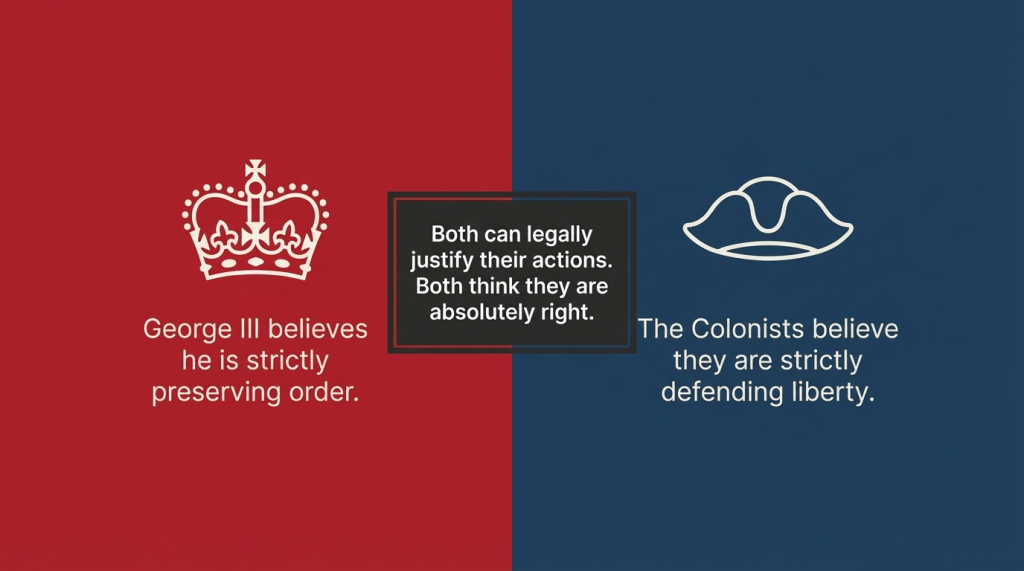
The King believes he is preserving order. The colonists believe they are defending liberty. Those two beliefs are not easily reconciled.
They move past each other, like ships in the night, each following its own course, each convinced it is heading in the right direction. The distance between them grows, not because either side intends it to, but because neither is willing to abandon the principles that guide it.
And so, the conflict becomes inevitable.
Not in the sense that it could never have been avoided, but in the sense that given the beliefs held by those involved, it becomes the most likely outcome. When both sides see themselves as acting rightly, when both believe that the alternative is unacceptable, the path toward confrontation narrows until it is the only one left.
That is the moment the Revolution occupies.
It is not clean. It is not simple. It is not a story of one side discovering the truth while the other clings to error. It is a story of two sides, each grounded in its own understanding, each moving toward a conclusion it believes is justified.
George III does not recognize himself in the accusations made against him. The colonists cannot see their situation any other way. And in that gap, that space between perception and reality, between intention and interpretation, the conflict takes shape.
Which brings us, finally, to the uncomfortable conclusion.
George III becomes the perfect villain, not because he set out to be one, and not because he reveled in the role. He becomes the perfect villain because he fits the needs of the story the colonists must tell, and because he never fully understands that he has been cast in it.
He believes he is right. The Colonists believe that they are right. And that is what makes the outcome not just possible, but almost unavoidable.
Not because he knew he was wrong. But because he never believed he was.
Adams, John. The Works of John Adams, Second President of the United States. Edited by Charles Francis Adams. 10 vols. Boston: Little, Brown and Company, 1850–1856.
Bailyn, Bernard. The Ideological Origins of the American Revolution. Cambridge, MA: Belknap Press of Harvard University Press, 1967.
Black, Jeremy. George III: America’s Last King. New Haven, CT: Yale University Press, 2006.
Continental Congress. Journals of the Continental Congress, 1774–1789. Edited by Worthington Chauncey Ford et al. 34 vols. Washington, DC: Government Printing Office, 1904–1937.
Dickinson, John. Letters from a Farmer in Pennsylvania. Philadelphia, 1768.
Greene, Jack P. Peripheries and Center: Constitutional Development in the Extended Polities of the British Empire and the United States, 1607–1788. Athens: University of Georgia Press, 1986.
Hume, David. The History of England. 6 vols. London, 1754–1762.
Jefferson, Thomas. The Papers of Thomas Jefferson. Edited by Julian P. Boyd et al. Princeton, NJ: Princeton University Press, 1950–.
Middlekauff, Robert. The Glorious Cause: The American Revolution, 1763–1789. New York: Oxford University Press, 1982.
United States. Declaration of Independence. July 4, 1776.
Wood, Gordon S. The Radicalism of the American Revolution. New York: Alfred A. Knopf, 1992.


 DAVE DOES HISTORY
Leave a comment