
There are moments in history when governments make decisions that seem perfectly sensible inside a conference room and utterly catastrophic everywhere else. Someone studies the numbers. Someone reviews the reports. Someone decides that a practical solution has been found. Then reality arrives, often carrying a bill far larger than anyone expected.
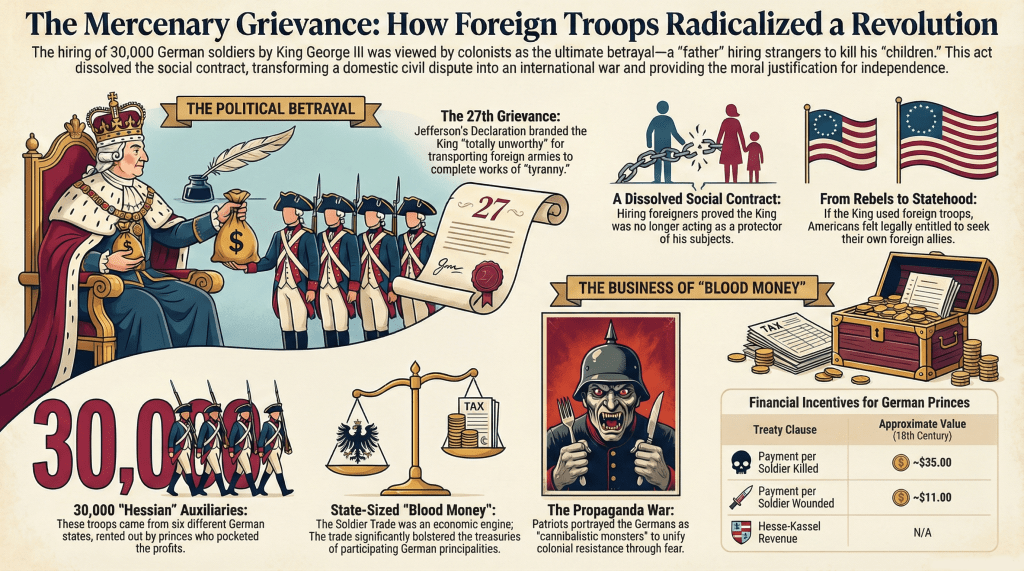
The arrival of German troops in America during the Revolutionary War was one of those moments.
From London’s perspective, it was a manpower solution. From the American perspective, it was proof that the King had abandoned his people. Between those two interpretations lay an ocean, a revolution, and eventually the loss of an empire.
When most Americans think about the Declaration of Independence, they remember the soaring language near the beginning. “All men are created equal.” “Life, Liberty and the pursuit of Happiness.” Those phrases have become part of the national vocabulary. Schoolchildren memorize them. Politicians quote them. They appear on monuments and in speeches.
Yet the Declaration is not merely a statement of ideals. It is also a prosecutor’s brief. Jefferson and the Continental Congress were not simply announcing a new nation. They were explaining why that nation had become necessary. The bulk of the document is devoted to a long list of grievances, each one intended to demonstrate that George III had violated his obligations as a ruler.
Most of those grievances are familiar. Taxes. Armies. Courts. Legislatures. Then, near the end of the list, comes a charge so angry that it almost leaps off the parchment.
“He is at this time transporting large Armies of foreign Mercenaries to compleat the works of death, desolation and tyranny, already begun with circumstances of Cruelty & perfidy scarcely paralleled in the most barbarous ages, and totally unworthy the Head of a civilized nation.”
That is not the language of compromise. It is not the language of negotiation, constitutional reform, or even political disagreement. It is the language of people who believe a line has been crossed. One can almost hear the grinding teeth behind the words. Death. Desolation. Tyranny. Cruelty. Perfidy. Barbarous ages. Totally unworthy. Jefferson and Congress were not trying to persuade the King. They were rendering judgment.
The fascinating thing is that Congress actually made this grievance harsher than Jefferson originally wrote it. We often imagine Congress softening Jefferson’s prose, trimming away excess emotion and making the document more diplomatic. In many places that is exactly what happened. Here, however, the opposite occurred.
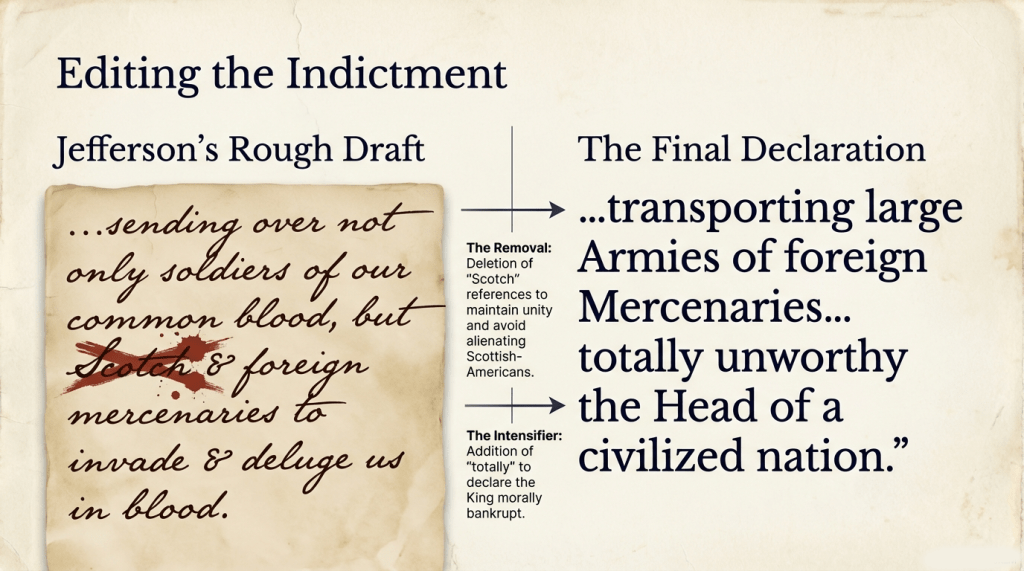
Jefferson’s rough draft accused the King of unleashing “Scotch & foreign mercenaries” to invade America and “deluge us in blood.” Congress removed the reference to the Scots, not because they suddenly developed warm feelings toward British policy, but because they understood politics. Scottish-Americans were fighting throughout the colonies, and there was little wisdom in insulting potential allies. Yet while Congress softened that particular reference, it strengthened the overall accusation. The delegates added the phrase “scarcely paralleled in the most barbarous ages.” They inserted the word “totally” before “unworthy the Head of a civilized nation.” The result was an even more devastating condemnation of George III’s character.
That distinction matters because the grievance is not fundamentally about military policy. It is about legitimacy.
To understand why, one must step into the political world of the eighteenth century. Modern governments routinely hire foreign contractors, employ multinational forces, and cooperate with allies in military operations. We may debate the wisdom of those arrangements, but we generally accept them as normal features of international politics.
The eighteenth century viewed the situation differently. A king was not simply a chief executive or commander-in-chief. He occupied a paternal role within the political imagination of the age. Even philosophers who criticized monarchy often assumed that rulers possessed obligations toward their subjects. Government rested upon reciprocal duties. Subjects owed loyalty. Kings owed protection. The arrangement could become strained. It could become abusive. It could even become tyrannical. Yet the underlying relationship remained recognizable.
The arrival of foreign troops changed that relationship fundamentally.
From the colonial perspective, George III was no longer treating Americans as subjects requiring governance. He was treating them as enemies requiring conquest. That distinction carried enormous legal and philosophical weight. If the King was using foreigners to suppress his own people, then he had effectively abandoned his role as protector. The social contract had been broken. Allegiance no longer flowed in only one direction because obligation no longer flowed in only one direction.
This is why the grievance became so important to the argument for independence.
Taxes could be repealed. Trade regulations could be modified. Parliamentary overreach could theoretically be corrected. Even bloodshed might be explained away as tragic excess. But hiring foreign soldiers altered the nature of the conflict itself. The colonists could now argue that Britain was no longer managing a domestic dispute. Britain was waging war against a people it regarded as foreign.
That claim transformed the entire legal landscape.
If Britain viewed the colonies as an enemy nation, then the colonies could legitimately behave like one. They could declare independence. They could negotiate treaties. They could seek alliances. They could ask France for assistance without appearing to invite foreign intervention into a domestic quarrel. George III’s decision unintentionally supplied the strongest argument the revolutionaries possessed.
John Adams understood this immediately. Adams recognized that diplomacy often depends upon framing. European powers were reluctant to interfere in what appeared to be Britain’s internal affair. Once foreign troops entered the picture, however, the argument changed. If the King could import armies from abroad, then Americans could seek help abroad. The war ceased being merely British. It became international.
The emotional impact may have been even greater than the legal one. For years many colonists had blamed Parliament for the imperial crisis. Parliament passed the taxes. Parliament approved the regulations. Parliament appeared to be the principal source of trouble. George III remained, in the minds of many Americans, a distant figure who might still be persuaded to intervene on behalf of his loyal subjects.
The German troops shattered that illusion. Now the King himself stood at the center of the controversy. The grievance does not accuse Parliament. It does not attack ministers. It does not blame advisers. It points directly at George III. He is transporting foreign armies. He is responsible. He is totally unworthy.
The shift is subtle but profound. The Revolution ceased being a protest against bad policies and became a judgment against a ruler.
That is why the language feels so final. The delegates were no longer petitioning. They were no longer warning. They were no longer asking for redress. They were declaring that the relationship itself had become impossible to maintain. A king who hired foreigners to kill his own subjects had forfeited the moral authority upon which his government rested.
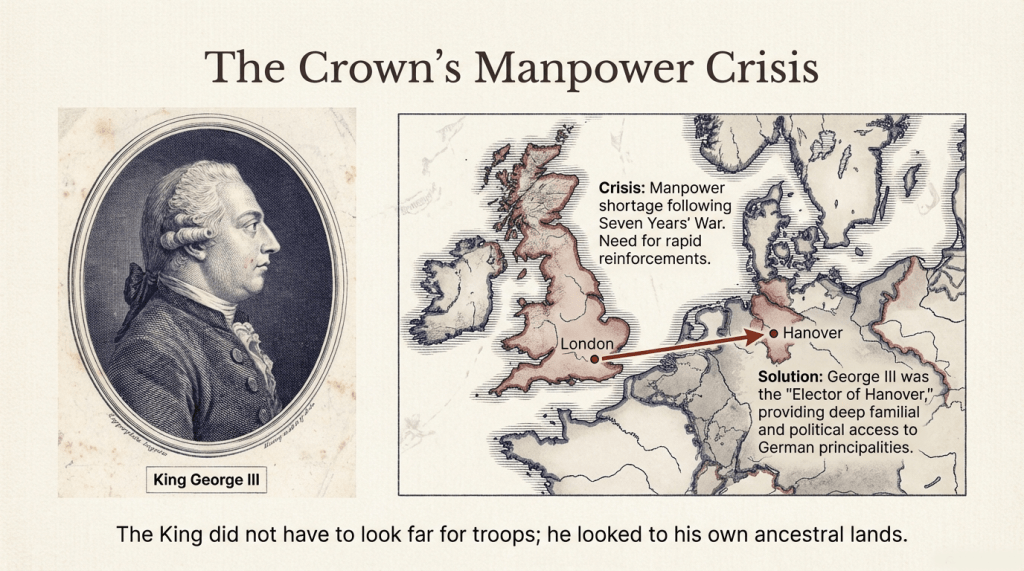
Viewed from London, the decision probably appeared practical. Britain faced a manpower shortage. The empire needed troops. The rebellion had grown larger than expected. German soldiers were available. The solution seemed obvious. Viewed from Philadelphia, the same decision looked like betrayal.
History often turns on moments exactly like this. One side sees logistics. The other sees meaning. One side sees a military necessity. The other sees a moral revelation. The practical solution becomes the political disaster.
By July of 1776, that disaster had already unfolded. The words preserved in the Declaration are not the opening argument of a revolution. They are the closing argument. The verdict has already been reached. The jury has already deliberated. Congress is simply explaining the decision to the world.
George III may have believed he was solving a manpower problem. The men gathered in Philadelphia believed he had destroyed the last remaining basis for reconciliation. Once that belief took hold, independence ceased being a radical possibility and became, in their minds, the only remaining option.
The accusation contained in the Declaration of Independence was emotionally devastating because it touched something deeper than military strategy. Americans had spent more than a decade arguing with Parliament over taxes, representation, customs enforcement, and constitutional authority. Those disputes were bitter, but they still existed within a framework that assumed a common political community. Colonists might disagree with British policy, but many continued to believe they remained part of the British family. The grievance against foreign mercenaries struck at that assumption directly. Once Americans became convinced that the King was importing foreign soldiers to suppress his own subjects, the conflict ceased to resemble a constitutional disagreement and began to resemble a war between separate peoples. The practical military decision made in London therefore carried consequences far beyond the battlefield. It transformed perceptions of the entire relationship between Britain and its colonies.
To understand why the arrival of the so-called Hessians provoked such outrage, one must first understand Britain’s strategic position during the early years of the Revolution. The Seven Years’ War had left Britain with a vast global empire and equally vast obligations. Garrisons had to be maintained across North America. The Caribbean required protection. India demanded troops and resources. Ireland remained a constant security concern. The empire stretched across multiple continents, and every new possession created additional military commitments. When rebellion erupted in America, British leaders suddenly faced the prospect of suppressing an armed uprising while simultaneously defending imperial interests around the globe. Recruiting enough new British soldiers to meet these demands would require time, money, and political support that the government did not readily possess. Parliament could authorize additional regiments, but turning civilians into trained soldiers could not happen overnight.
George III possessed one advantage that made an alternative solution possible. In addition to being King of Great Britain, he also served as Elector of Hanover, placing him within the dense web of dynastic relationships that connected the German states of the Holy Roman Empire. Eighteenth-century Germany was not a unified nation but a collection of principalities, duchies, electorates, and small kingdoms, each ruled by its own prince or noble family. Many of these states maintained standing armies that exceeded their immediate defensive needs. Military service was often compulsory, and the rulers viewed their armies not merely as instruments of security but as valuable political and economic assets. Britain’s manpower shortage therefore coincided with the existence of governments that possessed large numbers of trained soldiers and strong incentives to place them into service abroad.
Americans eventually referred to all of these troops as Hessians, but the term concealed considerable diversity. Roughly thirty thousand German soldiers served alongside British forces during the Revolutionary War, yet they originated from six different states. The largest contingent came from Hesse-Kassel, which explains how the collective nickname emerged, but substantial numbers also arrived from Hesse-Hanau, Brunswick, Anspach-Bayreuth, Waldeck, and Anhalt-Zerbst. The men spoke different dialects, wore different uniforms, and served under different command structures. To American eyes, however, these distinctions mattered very little. Colonists tended to view them collectively as foreign soldiers imported to enforce British authority, and that perception would prove far more important politically than the complicated realities of German statecraft.
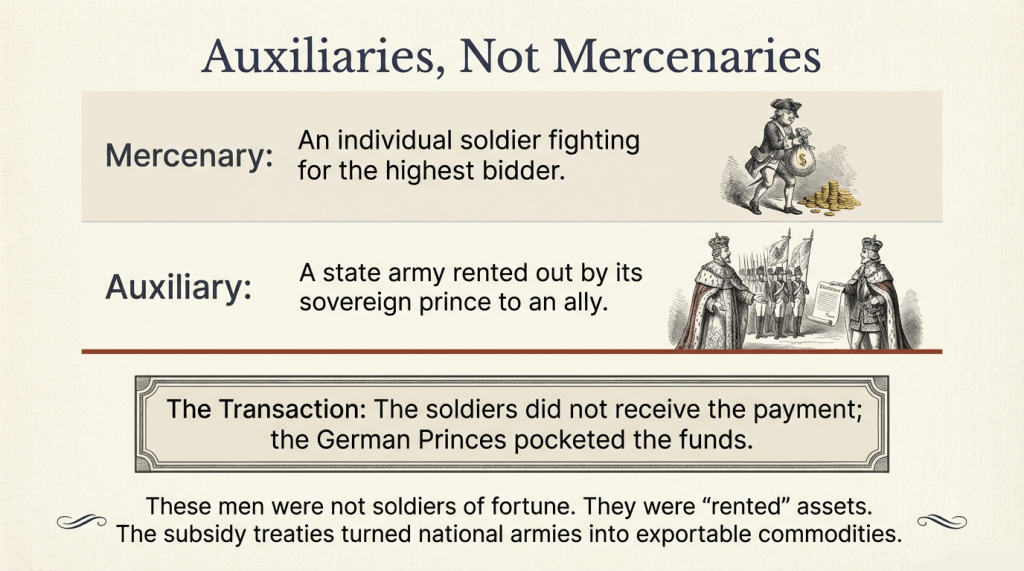
The terminology surrounding these troops deserves careful attention because it reveals the unusual nature of the arrangement. Technically speaking, the Germans were not mercenaries in the modern sense of the word. A true mercenary contracts directly for military service and receives personal payment in exchange. The German troops who crossed the Atlantic did nothing of the sort. They served as auxiliaries, meaning they remained members of their own national armies and fought under agreements negotiated between governments. Individual soldiers did not negotiate contracts with Britain, nor did they receive British payments directly. The treaties were signed by princes and kings, not by the men who would eventually carry muskets across American battlefields. From a legal perspective, Britain was not hiring individuals. It was leasing entire military establishments.
That distinction mattered greatly to diplomats and lawyers, but it meant very little to the colonists confronting the reality of foreign troops on American soil. To Patriot leaders, the practical result was what counted. Foreign soldiers were being transported across the ocean and deployed against people who still considered themselves British subjects. Whether the arrangement technically involved auxiliaries or mercenaries did not change the fundamental political message Americans received. The Crown had decided that its own military resources were insufficient and had therefore sought assistance from outsiders. That decision suggested a ruler who no longer viewed the conflict as a domestic disagreement capable of resolution through political means.
The economic structure underlying these agreements made the situation appear even more troubling. Britain secured the troops through a series of subsidy treaties that provided generous payments to the German rulers supplying soldiers. For states such as Hesse-Kassel, military leasing became one of the most lucrative sources of government revenue. Historians estimate that the income generated through these arrangements approached the equivalent of thirteen years of ordinary tax collections. The rulers received substantial compensation, while the soldiers themselves saw little direct financial benefit. From the American perspective, the arrangement appeared to reduce military service to a commercial transaction in which rulers profited from exporting the labor and risks of their own populations.
The most controversial aspect of the subsidy system involved provisions compensating rulers for casualties sustained during the war. Under one agreement involving Brunswick, the British government agreed to provide payments for soldiers killed and wounded during service. Americans quickly labeled these provisions “blood money” because they seemed to place a financial value upon human lives. Whether such clauses actually influenced military decisions remains a subject of historical debate, and there is little evidence that commanders deliberately endangered troops for financial gain. Nevertheless, the existence of the payments proved politically explosive. Patriot newspapers and pamphlets portrayed them as evidence that European monarchs were literally profiting from death and suffering. The image was powerful because it fit neatly into the broader Revolutionary argument that monarchy encouraged corruption, privilege, and the treatment of ordinary people as expendable resources.
Lost amid the outrage was the reality that many of the German soldiers possessed little agency in the matter. Military service in several of the participating states was compulsory, and many of the men arriving in America had never volunteered for overseas service. They were conscripts following orders issued by governments over which they exercised virtually no control. Most knew little about American constitutional disputes, parliamentary taxation, or colonial grievances. They boarded ships because their rulers instructed them to do so, and they crossed the Atlantic because international agreements required it. Yet revolutions are driven by perceptions as much as realities. Americans did not encounter these men as unwilling participants in a distant political system. They encountered them as visible symbols of a king who had chosen foreign force over reconciliation.
The arrival of the German troops therefore carried a significance far beyond their actual military value. Britain viewed them as a practical solution to an immediate manpower problem. Americans viewed them as proof that the Crown had fundamentally changed the nature of the conflict. The distinction proved decisive because political legitimacy depends as much upon perception as upon law. Once large numbers of colonists concluded that George III was willing to import foreign armies to impose obedience, every remaining argument for reconciliation became harder to sustain. What appeared in London as a sensible logistical decision appeared in America as evidence of betrayal, and that perception would shape the course of the Revolution far more profoundly than the actual number of soldiers who crossed the Atlantic.
If the mercenary grievance explained why independence could be justified, the reaction to the arrival of the German troops explains why independence became emotionally unavoidable. Revolutions are rarely sustained by legal arguments alone. Constitutional theories may provide intellectual foundations, but human beings do not endure hardship, uncertainty, and war because of footnotes to political philosophy. They endure those things because they become convinced that something essential has been violated. The arrival of the German auxiliaries transformed an already bitter political conflict into something far more personal. For many Americans, it represented the moment when the King ceased to be a misguided ruler and became an active enemy.
For years, colonial resistance had operated within a framework that still allowed room for reconciliation. Patriot leaders frequently distinguished between Parliament and the Crown. Parliament imposed taxes. Parliament passed coercive legislation. Parliament interfered with colonial self-government. George III, however, often remained a distant figure, a monarch who might eventually recognize the justice of colonial complaints if only he could be separated from bad ministers and poor advisers. This distinction appears repeatedly in petitions, pamphlets, and political speeches during the decade before independence. Many colonists preferred to believe that the constitutional crisis resulted from corruption around the throne rather than corruption within the throne itself.
The arrival of German troops shattered that comforting illusion. Once Americans learned that the King himself had approved the transportation of foreign soldiers to suppress resistance in the colonies, the emotional center of the conflict shifted dramatically. The issue was no longer merely taxation or representation. It was loyalty and betrayal. Patriot writers increasingly described the relationship in familial terms because those terms carried enormous emotional force. A king was often imagined as the father of his people. Subjects owed obedience, but a father also owed protection. When George III imported foreign troops, many colonists concluded that he had abandoned that obligation. In their minds, a father had hired strangers to punish his own children. The language was dramatic, but it reflected a genuine sense of shock. The relationship that many Americans had spent years trying to preserve suddenly appeared irreparably broken.
That feeling of betrayal became one of the most powerful political weapons available to the Patriot cause. Anger that had previously been directed toward Parliament now focused directly upon George III. The Declaration itself reflects this shift. Earlier colonial documents often criticized ministers, customs officials, or legislative acts. The Declaration places the King at the center of the indictment. He has done these things. He has caused these injuries. He has made reconciliation impossible. The mercenary grievance became one of the strongest pieces of evidence supporting that argument because it seemed to reveal the King’s true intentions. If he was willing to hire foreigners to enforce obedience, then he no longer viewed Americans as members of a shared political community.
Patriot leaders understood immediately that emotion could accomplish what constitutional theory alone could not. Newspapers, pamphlets, broadsides, sermons, and public speeches launched an aggressive campaign designed to magnify fears about the German troops. The Germans were rarely described as professional soldiers performing their duties. Instead, they were portrayed as bloodthirsty monsters unleashed upon a defenseless population. Writers emphasized their foreignness, their language, their unfamiliar customs, and their supposed brutality. Every rumor found an audience. Every frightening story gained circulation. The goal was not merely to inform the public. The goal was to persuade Americans that the arrival of these troops represented an existential threat.
Some of the rumors seem absurd today, but they reveal the intensity of the fear. Stories circulated claiming that the Hessians were cannibals who would eat American children. Others described them as barely civilized barbarians who delighted in cruelty. Tales of atrocities spread long before most colonists had ever encountered a German soldier. Fear filled the gaps where knowledge was absent. The result was a caricature that bore little resemblance to reality but proved remarkably effective politically. Americans who had never seen a Hessian nevertheless felt they knew exactly what one represented.
The language used to describe these troops often became racialized in ways that modern readers may find uncomfortable. The term Hessian evolved into a generalized insult. Germans were grouped together with Native Americans and other groups portrayed as alien threats to civilization. Patriot propaganda frequently emphasized that these soldiers were outsiders who lacked any connection to the communities they had been sent to suppress. The implication was clear. Britain had not merely sent soldiers. Britain had unleashed foreign savages upon its own subjects. The fact that the Germans were overwhelmingly European Christians mattered less than the political usefulness of portraying them as fundamentally different and dangerous.
Fear, however, has a curious habit of changing when confronted with reality. The dramatic image created by Patriot propaganda began to weaken as Americans actually encountered German soldiers in large numbers. The most famous example came after the Battle of Trenton in December 1776. Washington’s victory produced hundreds of German prisoners. Americans expecting to find bloodthirsty monsters instead found ordinary men. Many were tired, hungry, homesick, and deeply confused about the conflict in which they found themselves. They were not ideological crusaders. They were soldiers following orders issued by governments over which they possessed little control.
The discovery created an opportunity. American leaders quickly realized that demonization had limited strategic value once these men were in custody. Recruitment offered greater benefits than continued fearmongering. Congress and state governments gradually shifted their approach. Rather than portraying every German soldier as an irredeemable enemy, they began encouraging desertion. The offer was remarkably attractive. German soldiers who abandoned British service could receive land, livestock, protection, and the opportunity to build a new life in America. In some cases, enlisted men were promised fifty acres of land. Additional incentives varied by state and locality, but the message remained consistent. The new republic would offer opportunities unavailable in Europe.
This policy reflected a deeper understanding of the men Britain had imported. Many of the German soldiers had never volunteered for service in America. They had been conscripted into armies controlled by rulers who leased military manpower for profit. They had crossed the Atlantic because treaties required it, not because they possessed strong opinions about British imperial policy. Once they discovered the possibility of remaining in America rather than returning to Europe, many found the idea appealing. The colonies offered land, economic opportunity, and a degree of social mobility that often seemed unimaginable in the rigid hierarchies of the German principalities.
The results surprised everyone. Thousands of German soldiers deserted during the war. Others remained after hostilities ended. Historians generally estimate that between five thousand and six thousand German troops eventually settled permanently in North America. They married, farmed, opened businesses, raised families, and became citizens of the very nation they had been sent to suppress. Communities throughout the United States still contain descendants of men once condemned in the Declaration of Independence as foreign mercenaries. History possesses a remarkable sense of irony, and few examples illustrate that irony more clearly than this transformation from feared invader to immigrant neighbor.
The diplomatic consequences proved equally significant. John Adams and other American leaders recognized that the mercenary grievance offered more than emotional power. It also supplied a powerful legal and diplomatic argument. If George III could employ foreign troops, then the colonies could seek foreign assistance of their own. The logic was straightforward and difficult to refute. Britain could no longer insist that the conflict remained a purely domestic matter while simultaneously importing armies from abroad. The war had become international in character, and that change opened important diplomatic doors.
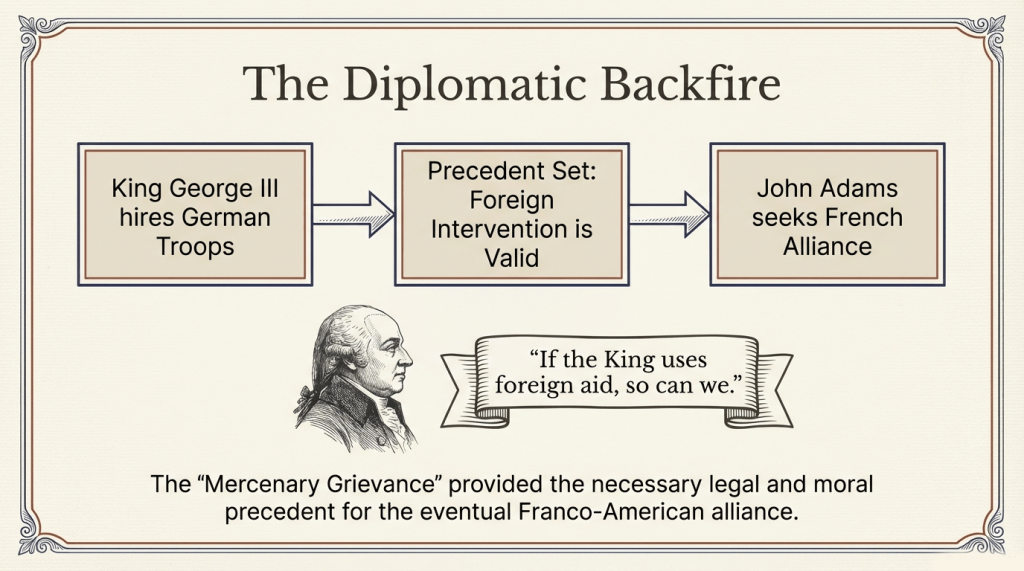
France paid close attention to these developments. French leaders had little desire to interfere in what appeared to be an internal British dispute. Supporting an outright rebellion carried significant risks. The arrival of the German auxiliaries helped alter that calculation. Britain itself had internationalized the conflict. If foreign troops could be employed on one side, foreign alliances became easier to justify on the other. The path that eventually led to French recognition, French military assistance, and ultimately Yorktown became easier to travel because Britain had undermined its own argument that the colonies remained merely rebellious subjects.
The greatest irony of the entire episode is that the mercenary grievance ultimately produced outcomes directly opposite to those Britain intended. The German troops were supposed to strengthen imperial authority. Instead, they strengthened the case for independence. They were supposed to intimidate the colonies into submission. Instead, they hardened resistance. They were supposed to help isolate the rebellion. Instead, they helped legitimize foreign alliances. They were supposed to crush the new nation before it could emerge. Instead, thousands of them became part of that nation after the war ended.
What began as a symbol of tyranny eventually became an immigration story. The grievance that helped justify independence also helped populate the republic that independence created. The men Americans once feared as hired destroyers became farmers, craftsmen, laborers, and citizens. Their descendants blended into the American population so completely that most people today have no idea how many family histories trace back to the German auxiliaries of the Revolutionary War.
The Declaration preserved the anger of the moment, and that anger was genuine. Yet history allows us to see something the delegates in Philadelphia could not. The arrival of the Hessians did not simply help sever the colonial relationship with Britain. It also helped shape the population of the nation that emerged afterward. George III believed he was solving a military problem. Instead, he accelerated a revolution, strengthened the case for foreign alliances, and unintentionally contributed thousands of future Americans to the republic he was trying to defeat.
Adams, John. The Works of John Adams, Second President of the United States. Edited by Charles Francis Adams. 10 vols. Boston: Little, Brown and Company, 1850–1856.
Atwood, Rodney. The Hessians: Mercenaries from Hessen-Kassel in the American Revolution. Cambridge: Cambridge University Press, 1980.
Boatner, Mark M., III. Encyclopedia of the American Revolution. New York: David McKay Company, 1966.
Declaration of Independence. July 4, 1776. In The Papers of Thomas Jefferson, Vol. 1, edited by Julian P. Boyd. Princeton, NJ: Princeton University Press, 1950.
Ferling, John. Almost a Miracle: The American Victory in the War of Independence. New York: Oxford University Press, 2007.
Fischer, David Hackett. Washington’s Crossing. New York: Oxford University Press, 2004.
Ketchum, Richard M. The Winter Soldiers: The Battles for Trenton and Princeton. New York: Henry Holt and Company, 1973.
Locke, John. Two Treatises of Government. Edited by Peter Laslett. Cambridge: Cambridge University Press, 1988.
Middlekauff, Robert. The Glorious Cause: The American Revolution, 1763–1789. Rev. ed. New York: Oxford University Press, 2005.
Raphael, Ray. Founding Myths: Stories That Hide Our Patriotic Past. New York: The New Press, 2004.
Showman, Richard K., and Dennis M. Conrad, eds. The Papers of General Nathanael Greene. Vol. 4. Chapel Hill: University of North Carolina Press, 1980.
Smith, Clifford Neal, ed. Brunswick Deserter-Immigrants of the American Revolution. McNeal, AZ: Westland Publications, 1973.
Taylor, Alan. American Revolutions: A Continental History, 1750–1804. New York: W. W. Norton & Company, 2016.
United States Department of State, Office of the Historian. “The Franco-American Alliance, 1778.” Washington, DC. Accessed May 29, 2026.
Van Doren, Carl. Secret History of the American Revolution. New York: Viking Press, 1941.
Weintraub, Stanley. Iron Tears: America’s Battle for Freedom, Britain’s Quagmire, 1775–1783. New York: Free Press, 2005.
Wilson, Peter H. Heart of Europe: A History of the Holy Roman Empire. Cambridge, MA: Belknap Press of Harvard University Press, 2016.
Other Sources Specifically Supporting the Mercenary Grievance
Force, Peter, ed. American Archives. 4th ser., vols. 5–6. Washington, DC: M. St. Clair Clarke and Peter Force, 1837–1846.
Jefferson, Thomas. The Papers of Thomas Jefferson. Vol. 1. Edited by Julian P. Boyd. Princeton, NJ: Princeton University Press, 1950.
Journals of the Continental Congress, 1774–1789. Edited by Worthington Chauncey Ford et al. Washington, DC: Government Printing Office, 1904–1937.
The inclusion of the Hessian grievance, Congress’s editing of Jefferson’s draft, the removal of the reference to “Scotch” mercenaries, and the strengthening of the phrase “totally unworthy the Head of a civilized nation” are best documented through Jefferson’s draft manuscripts, the Journals of the Continental Congress, and the editorial notes in The Papers of Thomas Jefferson. These should be considered your strongest authorities for that section of the chapter.

 DAVE DOES HISTORY
Leave a comment