
When delegates gathered in Philadelphia during the spring and summer of 1776, few men carried greater political influence than John Dickinson. His reputation stretched from New Hampshire to Georgia. Newspapers published his essays, colonial assemblies debated his arguments, and ordinary Americans quoted his words in taverns, meeting houses, and public squares. Long before Thomas Jefferson would become associated with the written expression of American independence, Dickinson was widely known as the foremost political writer in British North America. Admirers called him the “Penman of the Revolution,” a title that reflected both the power of his ideas and the extraordinary reach of his publications.



Yet Dickinson occupied a curious position in the revolutionary movement. He was a passionate defender of colonial rights and a relentless critic of parliamentary overreach, but he remained deeply skeptical of independence. As many Americans moved steadily toward separation from Great Britain, Dickinson stood at the center of a growing effort to preserve the empire while reforming it. His story illustrates one of the great forgotten truths of the American Revolution: many of the men who opposed independence were not loyalists, cowards, or opponents of liberty. They were patriots who feared that independence would bring consequences far more dangerous than continued resistance within the British constitutional system.
John Dickinson was born in 1732 on his family’s tobacco plantation in Talbot County, Maryland. While he was still a child, the family relocated to Delaware, where his father, Samuel Dickinson, became one of the colony’s most prominent landowners and public officials. The Dickinson household enjoyed considerable wealth and social standing, but it was also shaped by the values of the Religious Society of Friends, commonly known as the Quakers. Although Dickinson would never become a strict adherent to every Quaker practice, their influence remained visible throughout his life. The Quaker emphasis on peace, moderation, moral responsibility, and the avoidance of unnecessary conflict profoundly affected his political outlook.
His privileged circumstances provided educational opportunities unavailable to most colonists. After studying law in Philadelphia, Dickinson traveled to England in the 1750s to continue his legal training at the Middle Temple, one of the prestigious Inns of Court responsible for educating Britain’s legal elite. For four years he immersed himself in English constitutional history, common law traditions, and parliamentary theory. Unlike many colonial leaders whose understanding of British government came primarily through books, Dickinson studied directly within the legal culture that had shaped the empire itself.
The experience left a lasting impression. He admired the British constitution and regarded it as one of humanity’s greatest achievements in balancing liberty and authority. Rather than viewing Britain as an oppressor, he saw the empire as a constitutional partnership whose fundamental principles protected the rights of Englishmen on both sides of the Atlantic. This conviction would later place him at odds with many fellow revolutionaries. While others gradually concluded that the imperial relationship was beyond repair, Dickinson continued to believe that reconciliation remained possible if Britain could be persuaded to return to its constitutional foundations.
Upon returning to America, Dickinson quickly established himself as one of the colonies’ most respected attorneys and public figures. His legal expertise, polished writing style, and calm temperament made him a natural leader during the growing disputes between Parliament and the colonies. The first major test came with the Stamp Act crisis of 1765. Parliament’s decision to impose direct taxes on printed materials throughout the colonies sparked outrage and resistance. Colonial leaders assembled in New York for the Stamp Act Congress, an unprecedented gathering designed to coordinate a unified response.
Dickinson emerged from the meeting as one of its most important figures. He played a central role in drafting the Congress’s Declaration of Rights and Resolves, a document that carefully articulated the constitutional objections to parliamentary taxation. The declaration did not reject British authority outright. Instead, it argued that colonists possessed the same rights as subjects living in Britain, including the principle that taxes could only be imposed through representatives chosen by the people being taxed. The document struck a careful balance between firmness and loyalty, a balance that would characterize Dickinson’s political philosophy for the next decade.
The success of the Stamp Act Congress elevated Dickinson’s standing throughout the colonies. His reputation grew even larger during the controversy surrounding the Townshend Acts. Beginning in 1767, he published a series of newspaper essays under the pseudonym “A Farmer in Pennsylvania.” These Letters from a Farmer in Pennsylvania became one of the most influential political writings of the revolutionary era.
“The Liberty Song”
Words by John Dickinson (1768)
Music by David Ray Bowman (2026)
The letters achieved something remarkable. At a time when individual colonies often focused primarily on their own interests, Dickinson provided a constitutional argument that resonated across regional boundaries. He acknowledged Parliament’s authority to regulate imperial trade but drew a sharp distinction between regulation and taxation. Revenue measures designed primarily to raise money from the colonies, he argued, violated constitutional principles and threatened the liberties of all Americans. Written in clear and accessible language, the essays transformed complex legal questions into arguments that ordinary readers could understand and discuss.
Their impact was immediate and profound. Newspapers throughout the colonies reprinted the letters, sometimes multiple times. Political leaders cited them in debates and resolutions. Merchants used them to justify non-importation agreements. For many Americans, Dickinson became the intellectual architect of colonial resistance. Even future advocates of independence, including Thomas Jefferson and John Adams, acknowledged the extraordinary influence of his writings.
By the early 1770s, Dickinson had become one of the most recognizable political figures in North America. Yet his growing prominence coincided with a widening crisis between Britain and the colonies. The Boston Tea Party, the Coercive Acts, and the increasing use of military force convinced many Americans that reconciliation was becoming impossible. Dickinson disagreed. While he condemned British policies and supported organized resistance, he remained convinced that independence represented a dangerous leap into uncertainty.
This position placed him at the center of the Continental Congress. During both the First and Second Continental Congresses, Dickinson consistently advocated a strategy of resistance combined with negotiation. He supported economic pressure against Britain and endorsed preparations for defense, but he also worked tirelessly to preserve avenues for peace. His influence was evident in the drafting of the Olive Branch Petition in 1775, one final appeal to King George III seeking reconciliation. The petition reflected Dickinson’s belief that Americans could defend their rights while remaining loyal subjects of the Crown.
As military conflict expanded following Lexington and Concord, however, the political landscape shifted rapidly. Public opinion moved steadily toward independence. Radical leaders such as John Adams increasingly argued that separation was not only desirable but inevitable. Dickinson watched these developments with growing concern. He feared that independence would trigger a prolonged war, invite foreign intervention, destabilize colonial governments, and expose the fragile union of colonies to internal division.
Despite these concerns, Dickinson remained one of the most powerful men in American politics. His authority extended beyond Congress into Pennsylvania’s provincial government, where he possessed significant influence over legislative decisions. Recognizing the growing momentum behind independence, he used that influence to slow the process whenever possible. Working through allies in the Pennsylvania Assembly, Dickinson helped secure instructions directing Pennsylvania’s delegates to oppose any proposal for separation from Great Britain. These instructions effectively tied the hands of several delegates and reflected Dickinson’s determination to prevent what he viewed as a catastrophic mistake.
By the opening months of 1776, a remarkable paradox had emerged. The most celebrated writer of the revolutionary movement had become its most prominent opponent of independence. No other American had done more to articulate the constitutional case against British policies. No other political author had contributed more to colonial unity. Yet as Congress approached its momentous decision, Dickinson stood firmly against the course that many of his fellow patriots now embraced.
His opposition did not arise from fear, personal ambition, or loyalty to the Crown. It emerged from deeply held principles rooted in law, constitutionalism, and a lifetime of political reflection. Dickinson believed he was defending the very liberties that others claimed independence would secure. As the summer of 1776 approached and the debate intensified, the Penman of the Revolution prepared to make the most controversial stand of his career.
The Crucible of 1776
By the beginning of 1776, John Dickinson found himself in an increasingly lonely position. Across the colonies, the momentum toward independence seemed unstoppable. Thomas Paine’s Common Sense had electrified public opinion, transforming what had once been a radical proposal into a mainstream political objective. Provincial assemblies began replacing royal authority with revolutionary governments. Militia companies drilled openly. Congress was already functioning as a de facto national government. To many Americans, independence appeared not merely desirable but inevitable.
Dickinson remained unconvinced.
His opposition was not rooted in sentimentality toward Britain or affection for King George III. Few men in America had spent more than a decade publicly opposing parliamentary overreach. Few had sacrificed more political capital in defense of colonial rights. His concerns were practical, strategic, and deeply informed by information unavailable to most of his contemporaries.
As a leading member of Congress’s Committee of Secret Correspondence, Dickinson occupied a privileged position within the emerging machinery of American diplomacy. The committee maintained discreet communications with sympathetic figures in Europe and explored the possibility of foreign assistance should war continue. Through these efforts Dickinson gained a clearer understanding of the international situation than most delegates possessed.
Many advocates of independence assumed that France and Spain eagerly awaited an American declaration before rushing to provide military aid. Dickinson knew otherwise. European powers viewed the colonial rebellion through the cold lens of national interest. They welcomed British difficulties, but they were not prepared to commit themselves to a risky and uncertain conflict merely because Congress declared itself independent. France, in particular, remained cautious. The humiliations of the Seven Years’ War had created a desire for revenge against Britain, but French ministers wanted evidence that the Americans could survive before investing men, money, and naval resources.
Dickinson feared that many of his colleagues misunderstood this reality. They spoke as though foreign recognition would naturally follow independence. He believed they were confusing hope with strategy. From his perspective, declaring independence before securing alliances risked isolating the colonies at the very moment they faced the world’s most powerful military empire.
His concerns extended beyond foreign affairs. The colonies were fighting a war without a true national government. Congress possessed authority largely because the states voluntarily cooperated. It had no reliable power to raise revenue, regulate commerce, or enforce its decisions. The Continental Army existed, but its supply system was chaotic. State governments often pursued their own priorities. Communications remained slow, and regional rivalries remained strong.
To Dickinson, these weaknesses represented a serious danger. Independence would sever the constitutional ties that had united the colonies under the British Crown. What would replace them? No one could yet answer that question with confidence.
The irony was striking. While Dickinson publicly argued against declaring independence, he was simultaneously helping prepare the colonies for the possibility that independence might occur. On June 12, 1776, Congress appointed three committees to address the issues that would arise if separation became reality. One committee would draft a declaration explaining the reasons for independence. Another would develop plans for foreign alliances. The third would design a framework for national government.
Congress selected Dickinson to chair that third committee.
The choice revealed the extraordinary respect he still commanded among his fellow delegates. Even many men who disagreed with him trusted his judgment, constitutional knowledge, and political experience. If a new nation emerged, they wanted Dickinson involved in constructing its institutions.
Throughout June, as the debate intensified, Dickinson worked on what would eventually become the Articles of Confederation. His participation reflected an important aspect of his character. He opposed independence, but he never allowed opposition to become obstruction. Rather than withdrawing from the process, he sought to ensure that if independence came, it would rest upon a stable political foundation.
Meanwhile, events moved rapidly toward a final decision.
On June 7, Richard Henry Lee of Virginia formally introduced a resolution declaring that the colonies “are, and of right ought to be, free and independent States.” The proposal immediately triggered one of the most consequential debates in American history. Congress postponed a final vote for several weeks, allowing delegates time to consult their colonies and seek instructions.
As June turned to July, the pressure increased. Public opinion increasingly favored separation. Several colonies revised their instructions to support independence. Political leaders who had once hesitated began to change their positions. Yet Dickinson remained steadfast.
He understood that his stance was becoming politically hazardous. The revolutionary movement had developed its own momentum, and men who questioned independence increasingly found themselves portrayed as obstacles to liberty. Dickinson recognized the danger to his reputation, but he believed that abandoning his convictions for the sake of popularity would represent a betrayal of public trust.
The decisive moment arrived on July 1, 1776.
That morning, Congress assembled to begin formal debate on Lee’s resolution. The atmosphere inside the Pennsylvania State House was tense and emotionally charged. Delegates understood that they stood on the threshold of a decision that would reshape history. Outside the building, Philadelphia buzzed with anticipation. Inside, the future remained uncertain.
Dickinson entered the chamber physically exhausted. Years of political conflict and the strain of recent debates had taken a toll on his health. Witnesses described him as pale and worn. Yet when he rose to speak, he delivered one of the most remarkable addresses of his career.
His argument did not focus on abstract theories of loyalty or allegiance. Instead, he presented a careful assessment of the practical challenges facing the colonies. He warned that independence was being pursued without adequate preparation. The colonies lacked a completed framework of government. Foreign alliances remained uncertain. Military victory was far from assured.
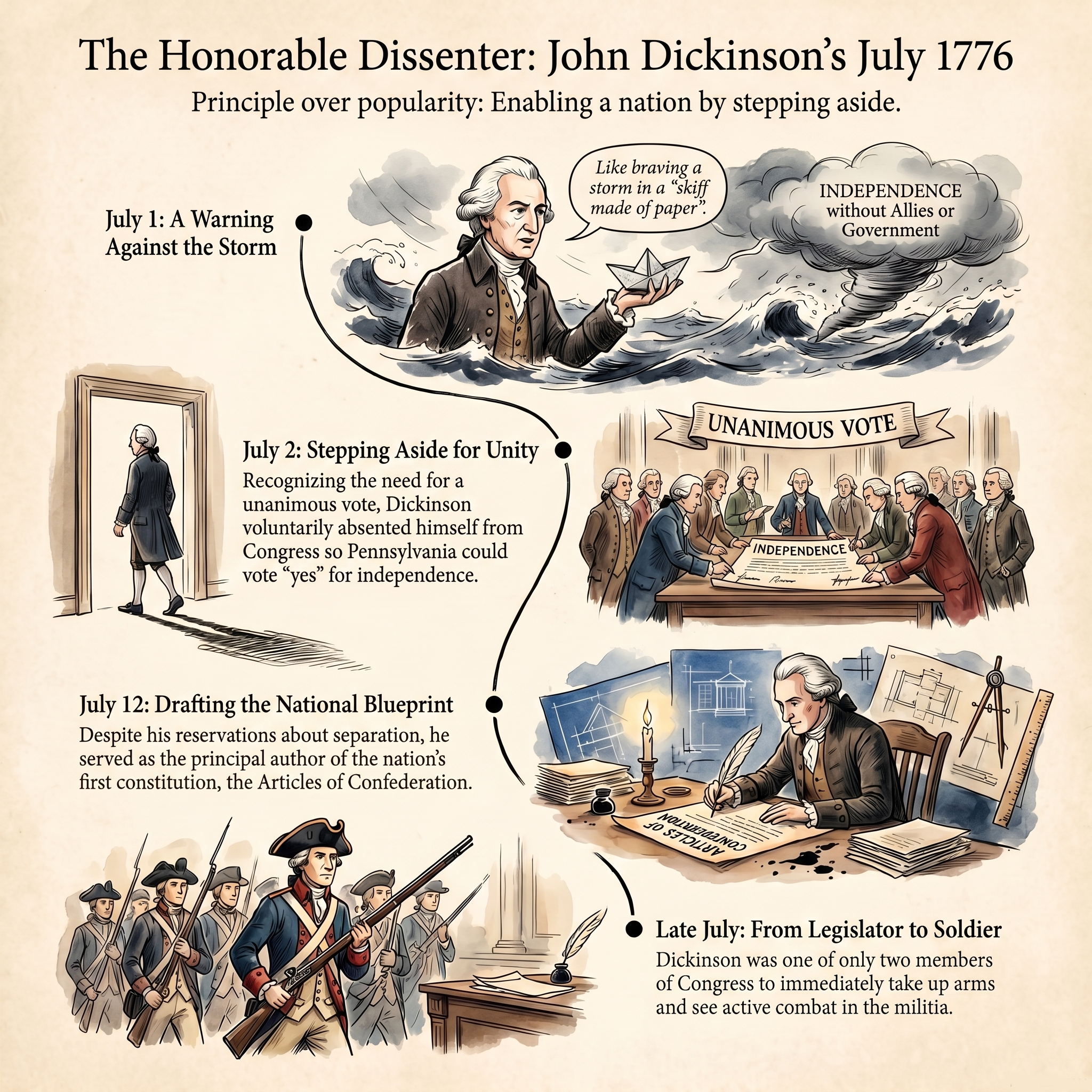
To illustrate the danger, Dickinson employed a metaphor that captured the essence of his concern. Declaring independence before securing alternative structures of support, he argued, was like “Destroying a House before We have got another, In Winter, with a small Family.”

The image was powerful because it appealed to common experience. Every delegate understood the vulnerability of a family left homeless during a harsh winter. Dickinson was not arguing that the old house was perfect. He was arguing that one should not demolish existing shelter until a replacement was ready.
He followed with an even more vivid warning. To launch the colonies into independence under current conditions, he cautioned, was to “brave the Storm in a Skiff made of Paper.”
The metaphor revealed the heart of his political philosophy. Dickinson was not afraid of storms. He had spent years challenging British authority. What concerned him was the fragility of the vessel. Courage alone could not overcome structural weakness. A paper boat might carry noble intentions, but it would not survive rough seas.
Many delegates disagreed with his conclusions, yet even political opponents admired the quality of his reasoning. John Adams, who vigorously supported independence, later acknowledged Dickinson’s talents as a speaker and statesman. The debate represented a clash between two visions of how best to secure American liberty, not a conflict between patriots and loyalists.
Perhaps the most moving moment came when Dickinson openly acknowledged the personal consequences of his stand. He understood that history might judge him harshly. He knew that public opinion was shifting against him. Yet he refused to abandon his convictions merely to preserve his reputation.
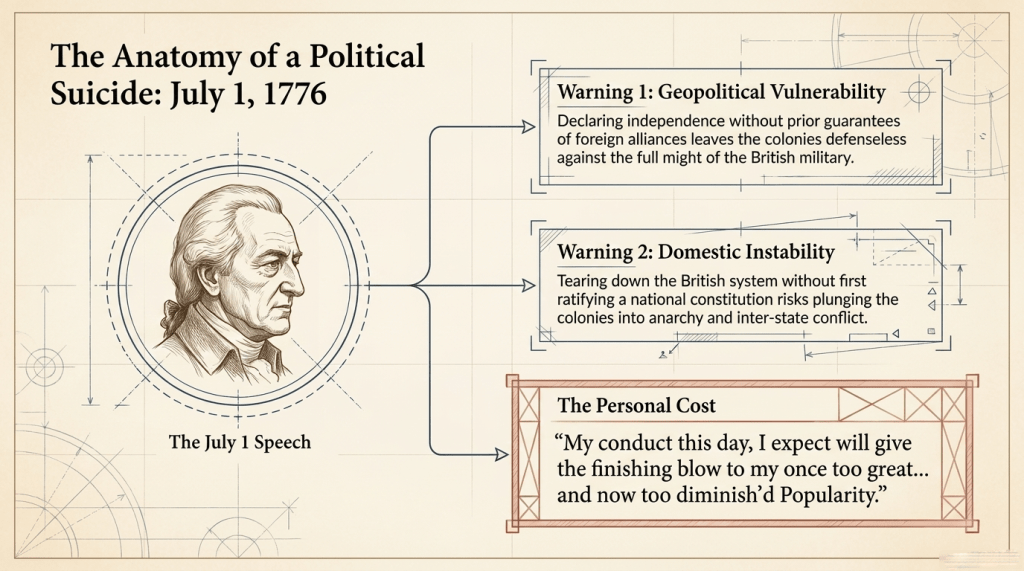
“My conduct this day,” he declared, “I expect will give the finishing blow to my once too great… and now too diminish’d Popularity.”
The statement revealed a man willing to sacrifice political standing in service to principle. Whether right or wrong, Dickinson was prepared to accept the consequences of dissent.
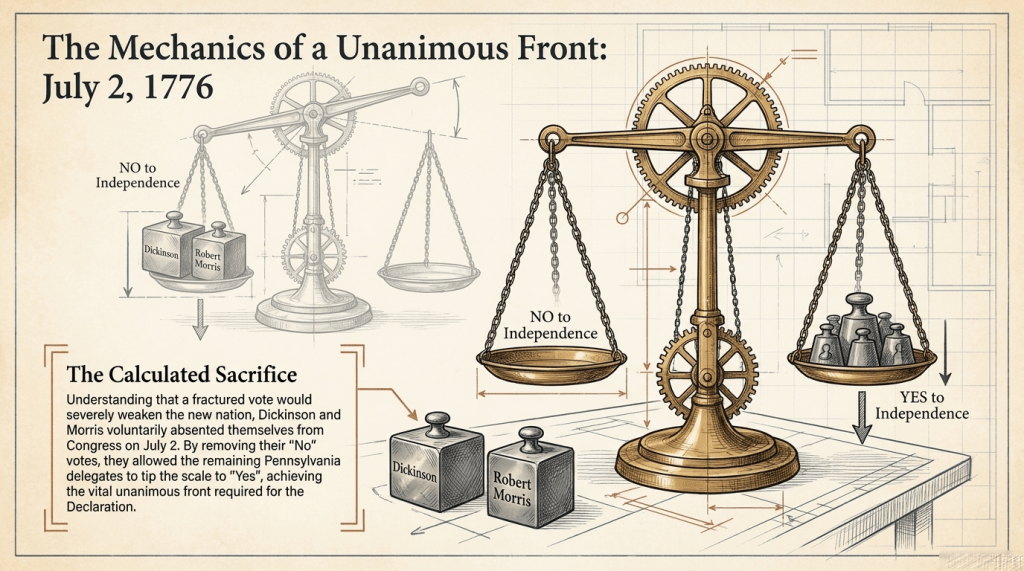
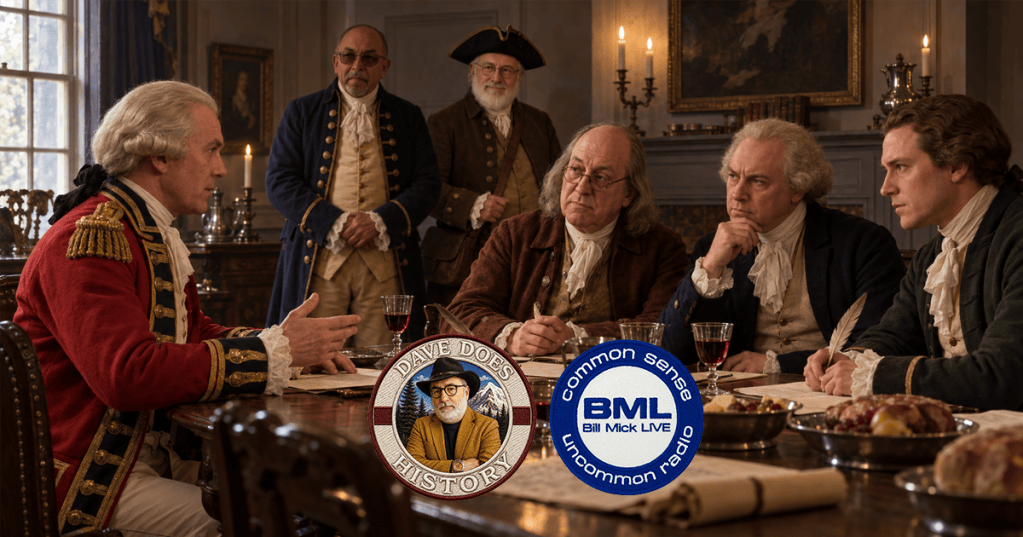
When the preliminary vote occurred on July 1, Pennsylvania remained divided. Dickinson and several colleagues voted against independence, helping keep the colony’s delegation from joining the majority. The result created a potentially serious problem. Congress desperately wanted unity. A declaration issued amid visible internal division would weaken the new nation’s credibility both at home and abroad.
Overnight, Dickinson confronted a painful reality. The momentum toward independence could no longer be stopped. Continued resistance would not alter the outcome. It would only highlight divisions at the very moment unity was most needed.
The following day, Dickinson made one of the most selfless decisions of his political career.
Together with fellow Pennsylvania delegate Robert Morris, another moderate who harbored serious reservations about independence, Dickinson voluntarily absented himself from Congress. Their absence altered the balance within Pennsylvania’s delegation, allowing the remaining delegates to support independence. As a result, Pennsylvania joined the majority, helping create the appearance of overwhelming colonial unity.
The significance of this act is often overlooked. Dickinson did not change his mind. He did not suddenly embrace independence. Instead, he subordinated his personal position to what he believed the national interest required. Having lost the argument, he chose not to become an obstacle to collective action.
Even as Congress moved toward the Declaration of Independence, Dickinson continued his work on the Articles of Confederation. While others celebrated separation from Britain, he concentrated on the practical task that had concerned him all along: creating a government capable of holding thirteen diverse states together.
In many ways, that effort represented the continuation of the debate he had been waging throughout 1776. If independence was to survive, the paper skiff would need stronger timbers. The house that replaced the old imperial structure would need solid foundations. Dickinson had lost the battle over independence itself, but he remained determined to help build the nation that would emerge from it.
The story of John Dickinson after July 1776 is one of the most remarkable and frequently overlooked chapters of the American founding. History often remembers him as the man who opposed independence, the cautious moderate who warned against severing ties with Britain before the colonies were prepared. Yet that description captures only a single moment in a long public life. If Dickinson’s opposition to independence demonstrated his commitment to principle, his actions afterward revealed something equally important: his commitment to duty.
Once Congress made its decision, Dickinson accepted the verdict without reservation. He did not sulk in defeat. He did not retreat into private life. He did not seek vindication by criticizing the new nation whenever difficulties arose. Instead, he did what relatively few political leaders are willing to do. He subordinated his personal judgment to the collective decision of the country and devoted himself to making that decision succeed.
The contrast between words and deeds became apparent almost immediately.
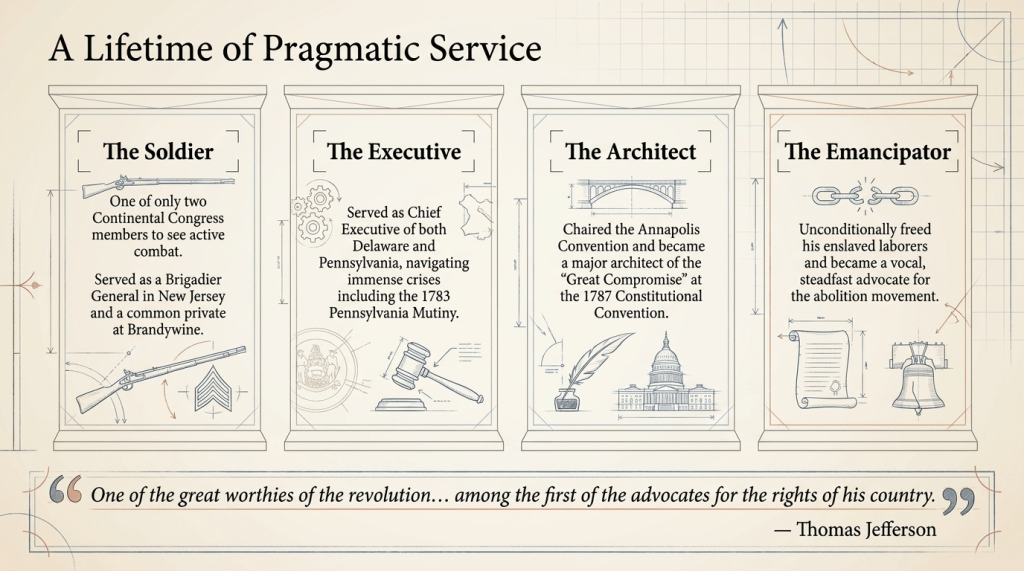
Many delegates who had enthusiastically voted for independence never came close to a battlefield. They served their country in important political and diplomatic capacities, but they remained far from the dangers of combat. Dickinson chose a different path. Despite having argued passionately against declaring independence, he became one of only two members of the Continental Congress who would personally take up arms and see active military service during the war.
His actions reflected a deeply rooted sense of honor. Once independence had been declared, the issue was settled. The colonies were now engaged in a struggle for survival, and Dickinson believed every citizen had a responsibility to contribute. Personal disagreements about the wisdom of the decision no longer mattered. The cause had become the cause of his country.
He resigned from Congress and entered military service.
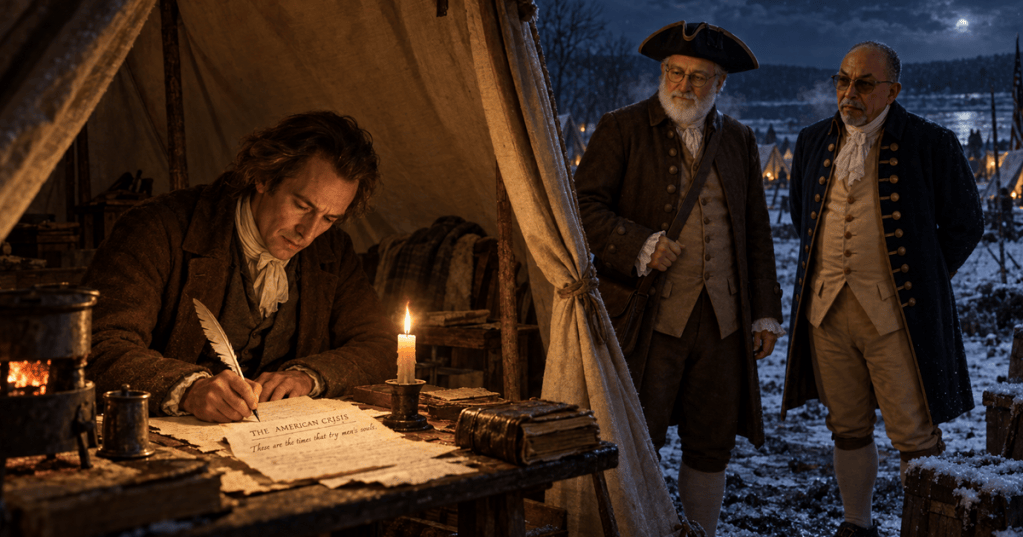
Initially, Dickinson accepted command of the Philadelphia Associators, a militia brigade organized for the defense of Pennsylvania. Holding the rank of brigadier general, he led troops into New Jersey during a period when the American military situation appeared increasingly desperate. British forces had driven George Washington from New York and threatened to crush the rebellion before it could gain momentum. Throughout the autumn and winter of 1776, American soldiers confronted shortages of food, equipment, and manpower while facing one of the most powerful armies in the world.
Dickinson’s military service was not a symbolic gesture designed to burnish his reputation. He placed himself in genuine danger and endured the same hardships faced by countless citizen soldiers. Although he lacked the military experience of professional officers, he approached the responsibility with the same seriousness that had characterized his political career.
His commitment became even more evident the following year.
After resigning his commission, Dickinson returned to Delaware and enlisted as a common soldier in the state’s militia. The image is striking. Here was one of the most famous political leaders in America, a man whose writings had helped shape colonial resistance, serving not as a general or government official but as an ordinary private. He participated in the campaign that culminated in the Battle of Brandywine in September 1777, one of the largest engagements of the Revolutionary War.
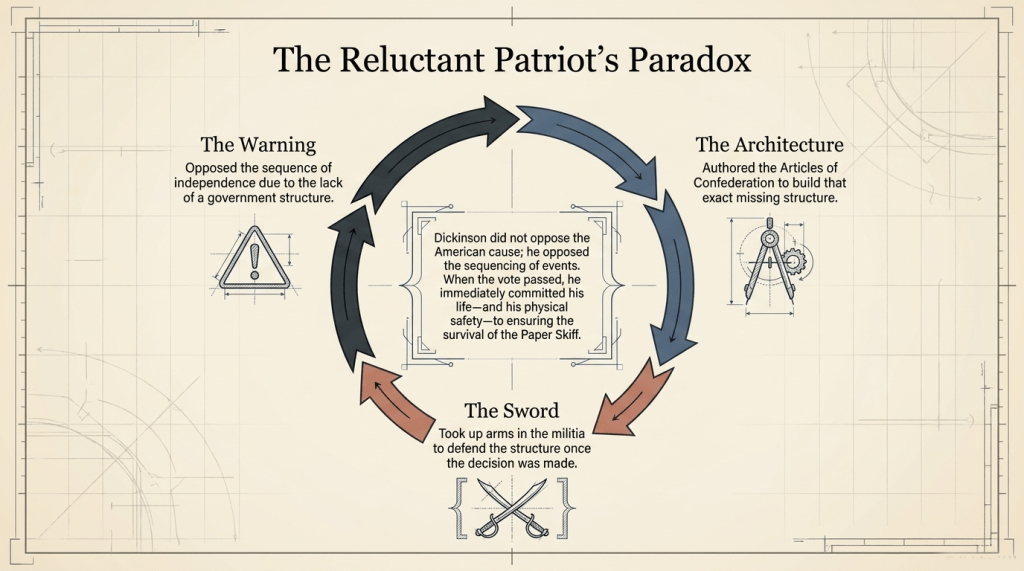
Brandywine ended in an American defeat and opened the road to Philadelphia for British forces, but Dickinson’s participation carried a significance that extended beyond the battle itself. He had demonstrated that his patriotism was never dependent upon agreement. He opposed independence because he believed it was premature, not because he lacked devotion to American liberty. Once the decision had been made, he willingly risked his life to defend it.
The war years also transformed Dickinson’s political thinking in ways that would profoundly influence the future of the United States.
Like many revolutionary leaders, he witnessed firsthand the difficulties created by weak national authority. The Continental Congress struggled to raise money, supply armies, and coordinate military operations. States often prioritized local concerns over national needs. Inflation soared. Critical supplies remained unavailable. Soldiers sometimes went unpaid for months at a time.
These problems confirmed many of the concerns Dickinson had expressed in 1776. Yet they also led him toward conclusions that might have surprised his younger self. The war demonstrated that liberty alone could not sustain a nation. Effective government was equally necessary. Independence had created opportunities, but it had also exposed dangerous weaknesses in the political structure of the emerging republic.
As the conflict drew toward its conclusion, Dickinson returned to public service with renewed determination. In 1781, he was elected President of Delaware, the state’s chief executive under its constitution. During his tenure, he worked to stabilize government institutions, support the war effort, and strengthen public confidence during a difficult transitional period.
His success in Delaware enhanced his reputation, and in 1782 he was elected President of Pennsylvania, making him the chief executive of the most populous and politically influential state in the new nation. The challenges awaiting him were immense.
The Revolutionary War was ending, but peace brought its own crises. Economic disruption, political uncertainty, and lingering wartime grievances created instability throughout the country. Governments struggled to repay debts. Veterans demanded compensation. Citizens questioned the effectiveness of existing institutions.
One of the most serious tests of Dickinson’s leadership came in 1783 during the Pennsylvania Mutiny.
A group of Continental Army soldiers, frustrated by unpaid wages and inadequate support from Congress, marched into Philadelphia to demand redress. The situation quickly escalated into a constitutional crisis. Members of Congress found themselves effectively threatened by armed troops stationed in the city.
The incident exposed the weakness of both state and national authority. Congress requested protection, but local officials hesitated to use force against the soldiers. Unable to guarantee its own safety, Congress fled Philadelphia and temporarily relocated elsewhere.
Dickinson found himself caught between competing obligations. He sympathized with many of the soldiers’ grievances, yet he also understood that civilian government could not permit military intimidation. The episode reinforced a lesson that would shape his later political career. A republic required institutions strong enough to maintain order while preserving liberty. Without that balance, neither freedom nor stability could survive.
By the mid-1780s, concern about the weakness of the Articles of Confederation had become widespread. Ironically, Dickinson now found himself confronting the limitations of the very system he had helped create. The Articles had succeeded in preserving state sovereignty, but they had left the national government too weak to address major economic and political challenges.
Many Americans recognized the problem. Few possessed Dickinson’s unique perspective. He had participated in the debates leading to independence. He had witnessed the difficulties of wartime administration. He had governed two states. His experience gave him a comprehensive understanding of both the strengths and weaknesses of the American experiment.
In 1786, he chaired the Annapolis Convention, a gathering originally intended to address commercial disputes among the states. Although attendance was limited, the convention produced a recommendation for a broader meeting to consider fundamental reforms to the national government. That recommendation led directly to the Constitutional Convention of 1787.
When delegates assembled in Philadelphia, Dickinson attended as a representative of Delaware. His presence symbolized the remarkable evolution of his political thought. The man who had once worried that independence would create instability now sought to ensure that the independent nation possessed sufficient authority to survive.
The Constitutional Convention confronted a seemingly insoluble problem. Large states wanted representation based on population. Smaller states feared domination and insisted upon equal representation. As debate intensified, the convention approached collapse. Some delegates openly discussed abandoning the effort altogether.
Dickinson played a crucial role in preventing that outcome.
Working closely with other delegates, he helped develop and promote the compromise that eventually became the foundation of the new Constitution. The arrangement provided proportional representation in the House of Representatives while granting equal representation to each state in the Senate.
Although later generations often associate the compromise primarily with Roger Sherman and Oliver Ellsworth of Connecticut, Dickinson’s influence was substantial. His advocacy helped persuade delegates that a balanced solution was both necessary and achievable. Without such a compromise, the Constitution might never have been completed.
The significance of this achievement cannot be overstated. The Great Compromise resolved the convention’s most dangerous dispute and established a framework capable of accommodating both large and small states. In many respects, it saved the Constitution itself.
The transformation was extraordinary. Dickinson had entered public life as a defender of local autonomy and colonial rights. By the end of the founding era, he had become a leading advocate for stronger national institutions. Yet the change was not a contradiction. It was the product of experience. He had learned that liberty required structure, just as surely as authority required limits.
In his later years, Dickinson continued to demonstrate a willingness to follow principle wherever it led. Nowhere was this more evident than in his evolving views on slavery.
Like many prominent Americans of his generation, Dickinson had benefited from a system that relied upon enslaved labor. Yet over time he became increasingly troubled by the institution’s moral implications. Unlike many contemporaries who acknowledged slavery’s flaws while preserving their personal interests, Dickinson acted upon his convictions.
He gradually emancipated the enslaved people under his control, making him one of the few major Founders to free his laborers during his lifetime. He also became an outspoken supporter of antislavery efforts and encouraged measures aimed at limiting and ultimately ending the institution.
These actions reflected the same qualities that had defined his career from the beginning. Dickinson was not a man who followed public opinion. He often found himself on the unpopular side of important debates. Whether opposing premature independence, supporting stronger national government, or advocating emancipation, he consistently demonstrated a willingness to accept criticism in pursuit of what he believed was right.
When he died in 1808, the United States had become a very different nation from the collection of colonies he had known as a young lawyer. Independence had been won. The Constitution had been adopted. A new government had survived its uncertain beginnings.
Many of the nation’s most famous founders had overshadowed Dickinson in popular memory. Yet those who knew him best understood the magnitude of his contributions.
Among them was Thomas Jefferson.
No one had disagreed more sharply with Dickinson during the crisis of 1776. Jefferson represented the triumph of independence. Dickinson represented the caution that sought to delay it. Yet with the perspective of history, Jefferson recognized the depth of Dickinson’s service and character.
He remembered him as “one of the great worthies of the revolution” and praised him for having been “among the first of the advocates for the rights of his country.”
The tribute captured the essence of Dickinson’s legacy. He was not the loudest revolutionary, nor the most celebrated founder. He rarely occupied the center of popular memory. Yet throughout the struggle for independence and the difficult years that followed, he displayed a quality that every successful republic requires: the courage to place principle above popularity and service above self.
John Dickinson entered the Revolution as its most reluctant patriot. He emerged as one of its most faithful servants. His life reminds us that devotion to a cause is measured not by how enthusiastically one embraces every decision, but by how faithfully one serves once the decision has been made.
Bailyn, Bernard. The Ideological Origins of the American Revolution. Cambridge, MA: Harvard University Press, 1967.
Beeman, Richard. Plain, Honest Men: The Making of the American Constitution. New York: Random House, 2009.
Boyd, Julian P., ed. The Papers of Thomas Jefferson. Princeton, NJ: Princeton University Press, 1950-.
Dickinson, John. Letters from a Farmer in Pennsylvania, to the Inhabitants of the British Colonies. Philadelphia: David Hall and William Sellers, 1768.
Dickinson, John. The Political Writings of John Dickinson. Edited by Paul Leicester Ford. 2 vols. New York: Privately Printed, 1895.
Flower, Milton E. John Dickinson: Conservative Revolutionary. Charlottesville: University Press of Virginia, 1983.
Hastings, Hugh, and J. A. Holden, eds. The Public Papers of George Clinton, First Governor of New York, 1777-1795. Albany: State of New York, 1899.
Jensen, Merrill. The Articles of Confederation: An Interpretation of the Social-Constitutional History of the American Revolution, 1774-1781. Madison: University of Wisconsin Press, 1940.
Jensen, Merrill. The New Nation: A History of the United States During the Confederation, 1781-1789. New York: Vintage Books, 1950.
Ketcham, Ralph. James Madison: A Biography. Charlottesville: University Press of Virginia, 1990.
McDonald, Forrest. Novus Ordo Seclorum: The Intellectual Origins of the Constitution. Lawrence: University Press of Kansas, 1985.
Middlekauff, Robert. The Glorious Cause: The American Revolution, 1763-1789. Rev. ed. New York: Oxford University Press, 2005.
Morgan, Edmund S. The Birth of the Republic, 1763-89. 4th ed. Chicago: University of Chicago Press, 2012.
Rakove, Jack N. Original Meanings: Politics and Ideas in the Making of the Constitution. New York: Vintage Books, 1997.
Stillé, Charles J. The Life and Times of John Dickinson, 1732-1808. Philadelphia: Historical Society of Pennsylvania, 1891.
The Library of Congress. Letters of Delegates to Congress, 1774-1789. Edited by Paul H. Smith. 26 vols. Washington, DC: Library of Congress, 1976-2000.
The Records of the Federal Convention of 1787. Edited by Max Farrand. 4 vols. New Haven, CT: Yale University Press, 1911.
The Revolutionary Diplomatic Correspondence of the United States. Edited by Francis Wharton. 6 vols. Washington, DC: Government Printing Office, 1889.
The Writings of Thomas Jefferson. Edited by Paul Leicester Ford. 10 vols. New York: G. P. Putnam’s Sons, 1892-1899.
Wood, Gordon S. The Creation of the American Republic, 1776-1787. Chapel Hill: University of North Carolina Press, 1969.
Wood, Gordon S. Revolutionary Characters: What Made the Founders Different. New York: Penguin Press, 2006.



Leave a Reply