
By the spring of 1776, the British Empire was searching for a way to change the conversation. New England had become a costly frustration. The rebellion that ministers in London had expected to suppress with a firm display of authority had instead hardened into armed resistance. Boston remained under British control, but controlling a city and controlling a continent are very different things. Every dispatch crossing the Atlantic seemed to bring another reminder that Massachusetts was consuming soldiers, ships, money, and political attention without producing the decisive victory everyone expected. The British government needed success somewhere, and preferably somewhere that looked less stubborn than New England.
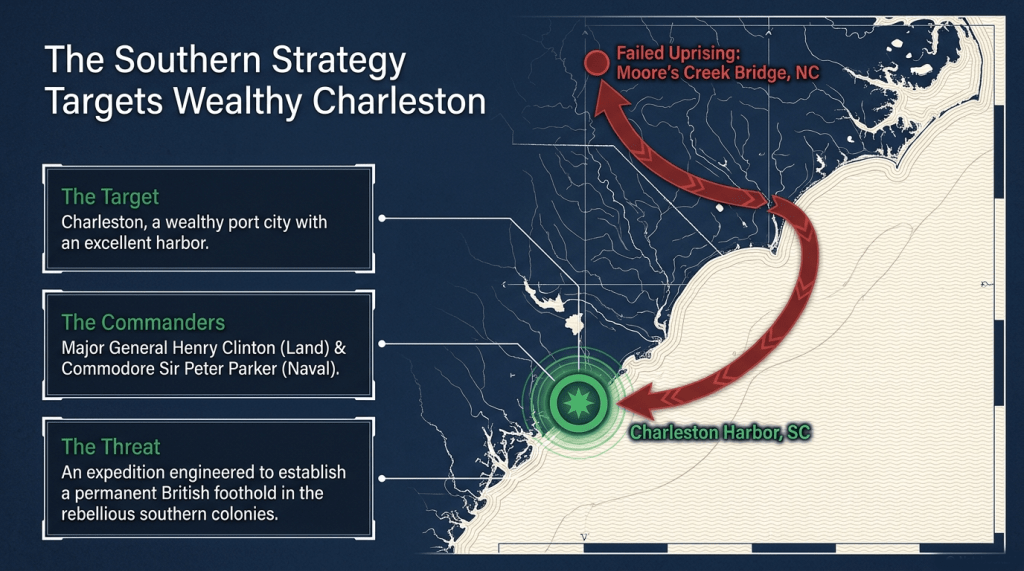
The southern colonies appeared to offer precisely that opportunity. British officials convinced themselves that large numbers of Loyalists remained ready to support the Crown if only regular troops could establish a secure foothold. There was some evidence for this belief. Royal governors reported continuing support for the monarchy. Merchants worried about the disruption of trade. Wealthy planters often possessed deep economic ties to Britain. Looking at maps in London, Charleston seemed particularly attractive. It was one of the wealthiest cities in North America, the center of South Carolina’s commercial life, and the owner of one of the finest natural harbors on the continent. If the British could seize Charleston, they would gain a valuable naval base, encourage Loyalist support throughout the South, and perhaps split the rebellion geographically before it grew any stronger.
That strategy suffered its first serious blow before the British fleet even approached South Carolina. In February 1776, Loyalist forces in North Carolina attempted to join British troops as part of a coordinated campaign to restore royal authority. Instead, they encountered Patriot militia at Moore’s Creek Bridge. The resulting battle was brief, but the consequences extended far beyond the battlefield. The Loyalists were defeated before they could unite with British forces, exposing a problem that would haunt British strategy throughout the war. Loyalist sentiment certainly existed in the colonies, but translating private loyalty into public action proved extraordinarily difficult. Supporting the Crown in conversation required far less courage than marching into battle on its behalf. The defeat at Moore’s Creek Bridge forced British commanders to reconsider their immediate plans while simultaneously revealing that the southern colonies might not be as eager to return to royal control as London believed.
Major General Henry Clinton and Commodore Sir Peter Parker responded by shifting their attention directly toward Charleston. If the countryside would not rise for the Crown on its own, perhaps a successful military operation would provide the necessary encouragement. The force assembled for the expedition reflected the importance of the objective. Clinton brought roughly 2,500 troops. Parker commanded a fleet mounting nearly 300 naval guns. The Royal Navy remained the most powerful maritime force in the world, and British officers had every reason to feel confident. Their ships had shattered European fleets, projected imperial power across oceans, and helped build an empire spanning multiple continents. Looking at the balance of forces on paper, few observers would have predicted serious difficulties.
The Americans understood the danger. Charleston represented too important a prize to leave undefended, yet the city’s position created challenges that could not be solved simply by enthusiasm or patriotism. The harbor entrance wound through channels and shoals that offered opportunities for defense, but those opportunities had to be developed quickly. Responsibility for one of the most critical positions fell to Colonel William Moultrie, a veteran soldier whose practical judgment would soon prove more valuable than many people realized. Moultrie received orders to construct a fortification on Sullivan’s Island, a sandy barrier island guarding the approaches to Charleston Harbor. The assignment sounded straightforward until one considered the practical realities. Time was limited. Resources were scarce. The British fleet was already on its way.
Necessity forced improvisation. South Carolina possessed no convenient supply of stone suitable for constructing massive European-style fortifications. What the region did possess was an abundance of palmetto trees. These trees had long been a familiar part of the coastal landscape, useful for shade and local construction but hardly celebrated as military assets. Moultrie had little choice but to work with the materials available. His men cut palmetto logs, stacked them into thick walls, and packed the spaces between them with sand. The resulting structure was substantial enough in size, with walls approximately sixteen feet thick, but it lacked the visual authority associated with great fortresses. To visitors accustomed to stone ramparts and elaborate bastions, it appeared unfinished, improvised, and perhaps even fragile.
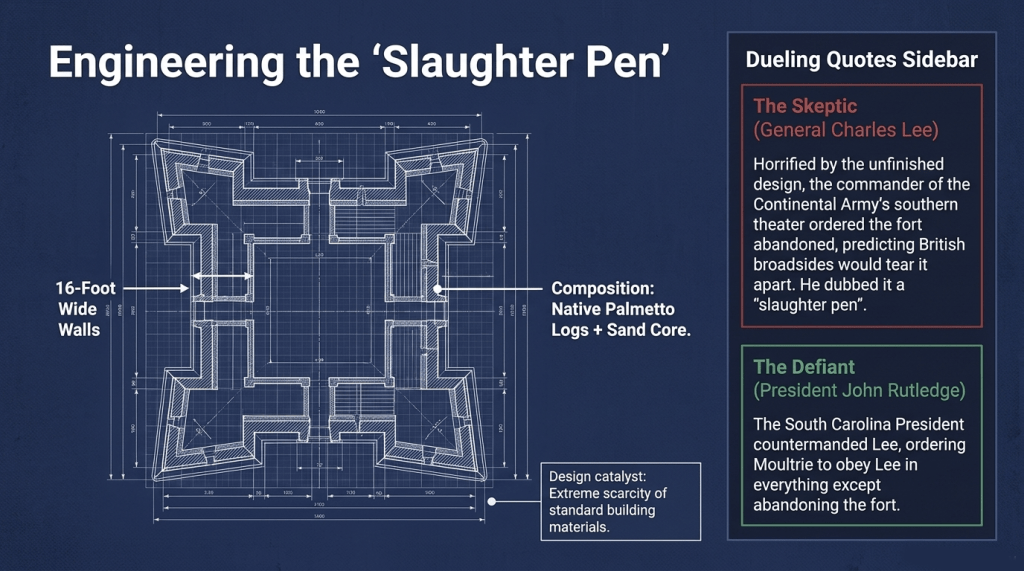
The fort’s appearance immediately raised concerns among experienced military observers. None expressed those concerns more forcefully than General Charles Lee. Lee was among the most colorful figures in the Continental Army, a veteran of European campaigns who possessed strong opinions on nearly every subject and little reluctance about sharing them. He had seen what naval artillery could accomplish. He understood the destructive power carried aboard British warships. When he inspected the fort on Sullivan’s Island, he reached a conclusion that seemed entirely logical. The structure would never survive a determined bombardment by the Royal Navy.
Lee’s criticism was neither mild nor private. He described the fort as a “slaughter pen,” a phrase that captured both his assessment of the position and his fear for the men assigned to defend it. From his perspective, the British fleet would simply sail into range and unleash a storm of cannon fire. The unfinished walls would collapse, the defenders would be trapped, and the garrison would be sacrificed for no meaningful military purpose. Lee repeatedly urged that the position be abandoned. Preserving trained soldiers, he argued, made more sense than losing them in what appeared to be a hopeless defense. His recommendations carried considerable weight because he outranked Moultrie and possessed substantial military experience. Many officers would have deferred to his judgment.
The fate of the fort ultimately depended upon a man who was not a soldier at all. John Rutledge, president of South Carolina, understood that the debate involved more than military calculations. He recognized the fort’s weaknesses and appreciated the danger posed by the approaching British fleet. At the same time, he understood the political and strategic consequences of abandoning the position. Sullivan’s Island guarded the entrance to Charleston Harbor. If the fort were surrendered without a fight, the British would gain access to the harbor and potentially to the city itself. The psychological impact alone could be devastating. Citizens watching their defenders retreat before the battle began might conclude that resistance was futile.
Rutledge therefore made one of the most consequential decisions of the campaign. He informed Moultrie that he was to obey General Lee in every matter except one. Under no circumstances was he to abandon the fort. The instruction reflected both courage and calculation. Rutledge was effectively overruling the judgment of a senior military commander, accepting responsibility for whatever consequences followed. If Lee proved correct and the fort was destroyed, criticism would fall heavily upon South Carolina’s leadership. Rutledge nevertheless concluded that some positions are too important to surrender merely because they appear vulnerable.
The disagreement revealed a deeper tension running throughout the Revolution. Military logic and political necessity frequently pointed in different directions. Lee evaluated the fort as a professional soldier concerned with battlefield outcomes. Rutledge evaluated it as a political leader responsible for the defense and morale of an entire colony. Neither man was irrational. Neither man was acting recklessly. They simply measured risk differently. Lee feared the destruction of a garrison. Rutledge feared the collapse of confidence that might follow a retreat. History would soon decide which danger mattered more.
Caught between these competing perspectives, William Moultrie concentrated on the tasks immediately before him. There was little value in debating decisions that had already been made. The fort had to be defended, and every remaining day before the British arrival offered an opportunity to improve its condition. Cannon were mounted. Ammunition was gathered. Defensive positions were strengthened wherever possible. Men labored under difficult conditions, fully aware that some experienced officers considered their efforts futile. The work continued because there was no alternative. If the British reached Charleston Harbor, the fort would stand between them and the city whether it was ready or not.
The soldiers performing that labor were not merely defending a military position. They were defending their homes, their families, and their colony’s future. Many lacked extensive military training. Few had ever experienced the kind of naval bombardment the British fleet could deliver. Yet uncertainty has a curious effect on human beings. Sometimes it produces fear. Sometimes it produces determination. On Sullivan’s Island it produced both. The men understood that powerful forces were moving toward them, but they also understood that retreat would place Charleston directly in danger.
As June approached, confidence varied dramatically depending upon whom one consulted. British commanders expected victory because every conventional measure suggested they should win. General Lee expected disaster because his military experience told him the fort could not survive prolonged bombardment. Rutledge hoped that determination and preparation might compensate for material shortcomings. Moultrie focused on practical matters and left predictions to others. Hidden within those thick walls of palmetto logs and sand was a quality that none of the participants fully appreciated. The British believed they were approaching an unfinished fortification. Lee believed he was looking at a future battlefield tragedy. Within days, both sides would discover that the strange fortress on Sullivan’s Island possessed strengths no military textbook had prepared them to expect.

What appeared to be the weakest point in Charleston’s defenses was about to become the strongest. The fort that looked improvised, unfinished, and vulnerable would soon face one of the most powerful naval assaults of the Revolutionary War. The outcome would save Charleston, elevate William Moultrie into the ranks of American heroes, and give South Carolina a symbol so enduring that the palmetto tree remains on the state flag nearly two and a half centuries later. The British arrived expecting a straightforward victory. The defenders waited inside a fort many experts believed could not survive. History, as it often does, had prepared a very different result.
By the final week of June 1776, the British expedition against Charleston appeared to possess every advantage except an accurate understanding of the battlefield. The fleet under Commodore Sir Peter Parker carried enough firepower to devastate most colonial defenses. General Henry Clinton commanded professional soldiers who had been trained for precisely the sort of operation now unfolding. The Americans, by contrast, occupied an unfinished fort built from an unconventional material and defended by men whose military experience varied widely. Looking strictly at numbers, training, and firepower, the outcome seemed almost predetermined.
The difficulty was that wars are rarely decided by numbers alone. Geography, weather, local knowledge, and simple human miscalculation often prove just as important as cannons and muskets. At Charleston, those factors combined to create a disaster for British planning and an opportunity for American defenders. While history remembers the Battle of Sullivan’s Island primarily for the remarkable performance of Fort Moultrie, the battle was actually fought on two fronts. One struggle unfolded at sea between British warships and the fort’s defenders. The other unfolded on land, where General Clinton discovered that the maps and assumptions guiding his operation were dangerously incomplete.
Clinton’s role in the battle depended upon a coordinated assault. While Parker’s fleet bombarded the fort from the harbor side, British troops would cross Breach Inlet and attack Sullivan’s Island from the rear. The plan possessed considerable logic. Even a strong fortification can become vulnerable when attacked from multiple directions. If the British army and navy struck simultaneously, the defenders would be forced to divide their attention and resources. Moultrie’s garrison might hold against the fleet or the army individually, but resisting both at once would be far more difficult. The key to the entire operation rested upon Clinton’s ability to move his troops from nearby Long Island, known today as the Isle of Palms, across the narrow body of water separating it from Sullivan’s Island.
Before the battle, British officers examined Breach Inlet and concluded that the crossing would present little difficulty. Local tides and shifting coastal conditions made precise measurements challenging, but Clinton and his subordinates believed the water could be forded by disciplined troops. Their confidence was understandable. The distance appeared manageable. Reports suggested that the water was relatively shallow. Once the crossing began, British soldiers could advance against the rear of the fort while Parker’s ships maintained pressure from the front.
The problem with assumptions is that nature rarely feels obligated to honor them.
When British officers conducted their inspections, they failed to account fully for the tides that governed movement throughout the Charleston harbor system. The inlet they expected to cross proved far deeper than anticipated. In some areas the water reached shoulder height. In others it approached seven feet. Strong currents complicated movement even further. What had appeared on paper to be a straightforward military maneuver suddenly became a dangerous obstacle. Soldiers burdened with muskets, ammunition, equipment, and uniforms could not simply wade through deep water while maintaining military formation. The crossing that formed the foundation of Clinton’s plan was effectively impossible.
This discovery created an immediate crisis. The naval attack depended upon coordination with the army. Without a successful crossing, Clinton’s troops would remain stranded on Long Island while the fleet fought alone. The British commander explored alternatives, but none proved practical. Amphibious operations were notoriously difficult even under favorable circumstances. Attempting to force troops across deep water under enemy fire would invite disaster. Every hour spent searching for solutions allowed the Americans additional time to prepare.
The defenders on Sullivan’s Island understood exactly what was happening. Opposing Clinton’s force was a contingent of approximately 780 Patriot soldiers commanded by Colonel William Thomson. Most belonged to the Third South Carolina Regiment, commonly known as the South Carolina Rangers. Thomson’s men had established defensive positions specifically to prevent a British crossing. They possessed the advantage of local knowledge, familiarity with the terrain, and a clear understanding of where the enemy would likely attempt to move. Unlike the British, they did not need to guess how the tides behaved.
As Clinton struggled with the inlet, Thomson’s soldiers stood ready behind their defenses. Any attempt to force a crossing would expose British troops to concentrated fire while they remained trapped in water too deep for effective maneuvering. The situation grew even more dangerous when Thomson’s men opened fire with rifles, muskets, and artillery loaded with grape shot. Grape shot transformed a cannon into a giant shotgun, scattering deadly projectiles across a wide area. Against troops attempting to cross an inlet, it could be devastating.
The British found themselves in an unenviable position. They could neither advance nor withdraw without acknowledging the failure of the plan. Every effort to probe the defenses encountered determined resistance. Every attempt to identify a viable crossing point produced disappointment. Thomson’s relatively small force accomplished something remarkable. By combining strong defensive positions with favorable terrain, they effectively neutralized a much larger British contingent. Clinton spent the day watching the main battle unfold while possessing little ability to influence its outcome.
The frustration must have been immense. Professional soldiers had crossed the Atlantic expecting to play a decisive role in one of Britain’s most important operations of the war. Instead, they spent much of the battle pinned in place by geography and a force of American defenders who refused to cooperate with British expectations. The failure of the land assault meant that Parker’s fleet would have to accomplish the mission alone.
Out in the harbor, Commodore Parker remained confident. The Royal Navy had reduced fortifications all over the world. Naval artillery represented one of the most destructive forces available in eighteenth-century warfare. British warships carried heavy guns capable of smashing masonry walls and wooden defenses alike. When the bombardment began on June 28, Parker expected the fort to suffer the same fate as countless other defensive positions that had faced concentrated naval fire.
The opening cannonade was spectacular. British ships unleashed broadside after broadside against the fort. Hundreds of cannonballs screamed through the air and slammed into the walls. The noise alone was overwhelming. Smoke drifted across the harbor. The concussion of the guns echoed for miles. Observers on both sides understood that they were witnessing one of the largest bombardments yet seen in the American Revolution.
What happened next stunned the British. Instead of shattering under the impact, the walls absorbed it.

The palmetto logs behaved in ways no European military engineer would have predicted. Traditional wooden walls often produced deadly splinters when struck by cannon fire. Stone walls cracked and collapsed under sustained bombardment. The palmetto walls did neither. Their fibrous structure compressed when struck. Cannonballs buried themselves in the soft wood and sand rather than blasting apart the fortification. In many cases the projectiles simply disappeared into the walls as though swallowed by a giant sponge. The destruction Parker expected failed to materialize.
British sailors and officers watched in disbelief. They could see their cannonballs hitting the target. They could observe the impacts. Yet the fort remained standing. Instead of collapsing into ruin, the walls seemed to absorb punishment almost effortlessly. The very feature that had caused experienced observers like Charles Lee to doubt the fort’s strength now became its greatest advantage. The improvised construction method born from necessity turned out to be perfectly suited for resisting naval artillery.
Inside the fort, Moultrie’s men faced challenges of their own. The garrison suffered from a limited supply of gunpowder. Unlike the British, they could not afford to waste ammunition. Every shot mattered. Every round fired had to justify the powder consumed. This shortage produced a discipline that proved enormously valuable during the battle. Rather than responding to every British broadside with hurried fire, the Americans adopted a deliberate pace. Officers carefully selected targets. Gunners waited until opportunities presented themselves. The result was slower firing, but dramatically greater accuracy.
The contrast between the two sides became increasingly apparent as the battle continued. British ships fired tremendous quantities of ammunition with relatively little effect. American gunners fired fewer rounds, but their shots found vulnerable targets. Masts splintered. Rigging was torn apart. Hulls suffered damage. The British possessed more guns, but the Americans increasingly demonstrated greater efficiency. Each successful hit boosted morale within the fort while raising frustration aboard the attacking ships.
As the hours passed, the battle evolved into something few participants had anticipated. Clinton’s army remained trapped and ineffective. Parker’s fleet continued pouring fire into a fort that refused to collapse. Moultrie’s defenders, operating under severe constraints, maintained a calm and disciplined resistance that steadily eroded British confidence. What had begun as a coordinated operation designed to overwhelm Charleston’s defenses was becoming a test of endurance that favored the defenders.
By late afternoon, it was becoming clear that the assumptions guiding the British attack had all been wrong. The inlet could not be crossed. The fort could not be shattered. The defenders could not be intimidated. The battle was far from over, but the momentum had shifted dramatically. The British arrived expecting to demonstrate the irresistible power of the empire. Instead, they found themselves locked in a struggle against geography, engineering, and determined defenders who refused to behave as predicted. The miracle of the palmetto fort was already taking shape, and before the day ended it would become one of the most celebrated victories of the Revolutionary War.
By the middle of the afternoon on June 28, 1776, it was becoming increasingly clear that the British assault on Sullivan’s Island was not unfolding according to plan. Commodore Sir Peter Parker’s fleet had unleashed thousands of pounds of iron against the fort, yet the walls remained standing. General Henry Clinton’s troops, expected to strike from the rear after crossing Breach Inlet, remained stranded on Long Island, frustrated by geography and pinned in place by determined American defenders. The carefully coordinated operation envisioned by British planners was unraveling piece by piece. Yet despite these mounting setbacks, the battle remained far from decided. Cannon continued to roar across Charleston Harbor, ships maneuvered through smoke and confusion, and both sides understood that a single breakthrough could still alter the course of the day.
Inside the fort, the defenders had endured hours of bombardment under conditions that tested both courage and discipline. The noise alone was overwhelming. Every impact shook the walls. Clouds of smoke drifted across the gun positions, reducing visibility and making communication difficult. Men moved through the fort carrying ammunition, servicing cannon, and replacing damaged equipment while enemy fire continued without interruption. In the midst of this chaos, one of the most dramatic moments of the battle occurred when a British cannonball struck the flagstaff flying above the fort. The blue South Carolina banner, bearing its distinctive white crescent, crashed to the ground outside the protective walls. To British observers, the sight appeared encouraging. In eighteenth-century warfare, the fall of a flag could signal confusion, collapse, or even surrender. To the Americans inside the fort, however, the fallen banner represented something far more dangerous. It threatened morale at precisely the moment when morale mattered most.
Among the defenders was Sergeant William Jasper, a man whose actions that day would secure his place in American legend. Without waiting for orders, Jasper climbed from the relative safety of the fort and moved into an area fully exposed to British fire. Cannonballs continued to strike around him, and musket fire occasionally swept across the position, yet he pressed forward toward the fallen flag. Reaching the banner, he recovered it and returned to the fort. Finding that the original staff had been shattered, he improvised a replacement using a sponge staff from one of the artillery pieces. With the flag secured to its new pole, Jasper raised it once again above the walls. The effect on the defenders was immediate. Cheers erupted throughout the fort as soldiers saw the banner flying once more. What might have become a moment of uncertainty instead became a symbol of determination. The British had knocked the flag down, but they had not broken the spirit of the men defending it.
The significance of Jasper’s act extended beyond the walls of the fort itself. Observers throughout the harbor could see the flag once again waving above the defenses. British sailors expecting signs of weakness instead saw evidence of stubborn resistance. Civilians watching from Charleston received reassurance that the fort still held. In a battle where psychology mattered almost as much as artillery, Jasper’s actions helped transform a potentially discouraging incident into a powerful statement of resolve. The story spread rapidly after the battle, becoming one of the defining moments of the Revolutionary War in the South. More importantly, it reflected a larger truth about the defense of Sullivan’s Island. Again and again throughout the day, the defenders responded to adversity not by yielding but by finding ways to continue the fight.
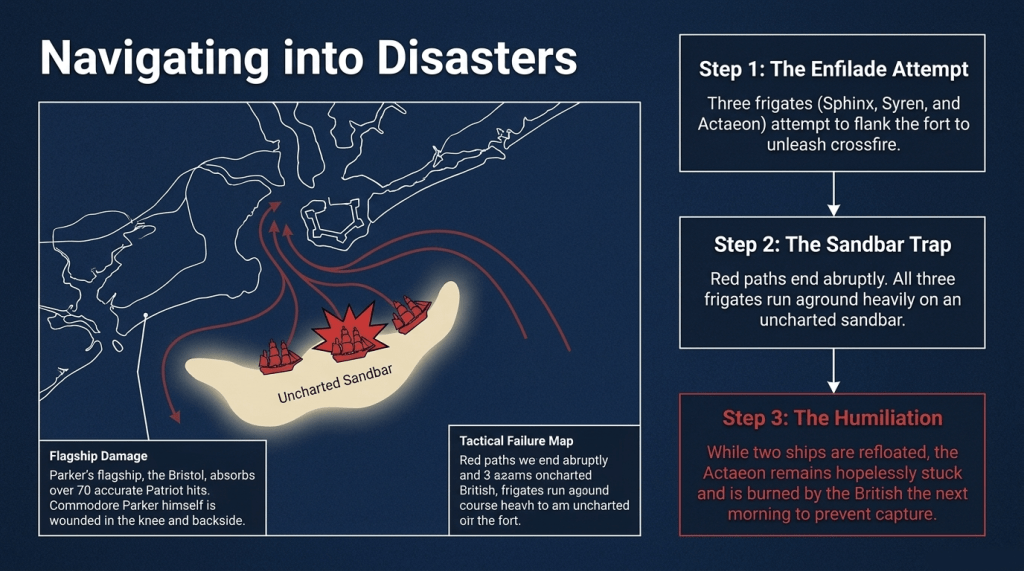
While the Americans celebrated Jasper’s heroism, British commanders searched desperately for some means of regaining the initiative. Commodore Parker understood that his bombardment alone was failing to produce the desired results. The palmetto walls continued to absorb punishment in a manner that defied conventional expectations. If the fort could not be smashed directly, perhaps it could be attacked from a more advantageous angle. British officers identified a channel that appeared to offer an opportunity for several warships to move around the fort and fire into its flank. Such an attack would allow cannonballs to sweep along the length of the defensive works rather than striking them head-on. In military terms, enfilading fire could be devastating. The plan seemed logical, and three frigates, HMS Sphinx, HMS Syren, and HMS Actaeon, received orders to execute the maneuver.
The harbor, however, proved as dangerous an opponent as the Americans themselves. Charleston’s coastal waters were notoriously complex, filled with shifting sandbars, hidden shoals, and channels that changed with tides and storms. Local pilots spent years learning the harbor’s intricacies, and even they occasionally found themselves surprised by changing conditions. British commanders relied upon charts and reconnaissance that proved inadequate for the task. As the frigates advanced toward their assigned positions, they encountered an uncharted sandbar. One vessel ran aground. Then another followed. Soon all three ships found themselves trapped. Instead of positioning themselves to deliver a devastating flanking attack, the frigates became helpless targets. Sailors worked frantically to free the vessels while American gunners watched the unfolding spectacle with growing satisfaction.
The grounding of the three frigates represented more than a simple navigational error. It symbolized the broader problem confronting the British throughout the campaign. Once again, assumptions about local conditions had proven disastrously wrong. The same overconfidence that led Clinton to misjudge Breach Inlet now led naval officers into waters they did not fully understand. Eventually, HMS Sphinx and HMS Syren managed to free themselves and escape. HMS Actaeon proved less fortunate. Repeated efforts to refloat the vessel failed. As darkness approached, British commanders faced an unpleasant reality. If the ship remained stranded, the Americans might capture it. The prospect of surrendering a Royal Navy warship to the rebels was intolerable. The following morning, British sailors removed what equipment they could salvage and set the vessel ablaze. Observers watched as flames consumed the frigate before a tremendous explosion destroyed what remained. The dramatic destruction of Actaeon became one of the most memorable images associated with the battle.
Elsewhere in the harbor, the flagship HMS Bristol endured a punishment nearly as humiliating. Throughout the engagement, American gunners concentrated much of their fire against Parker’s command vessel. Despite shortages of powder and ammunition, the defenders demonstrated remarkable discipline and accuracy. Rather than firing rapidly, they waited for favorable opportunities and carefully selected targets. Their patience paid dividends. Shot after shot struck the Bristol, damaging its rigging, splintering its masts, and battering its hull. By the end of the battle, the ship had absorbed more than seventy hits. Casualties mounted steadily as American fire found its mark. The vessel that was supposed to lead the destruction of the fort instead became one of the most visibly damaged ships in the British fleet.
Commodore Parker personally experienced the consequences of this punishment. During the engagement he suffered wounds that, while not fatal, became the subject of considerable commentary. Debris and enemy fire struck him, causing injuries to his knee and his backside. The injuries themselves were painful enough, but they also carried a certain degree of embarrassment. Parker had expected to command a triumphant operation that would showcase British naval superiority. Instead, he found himself wounded aboard a battered flagship while watching an unfinished fort continue to resist every effort to destroy it. The contrast between expectation and reality could not have been more striking. By the time the firing finally subsided, even the most optimistic British officers recognized that the operation had failed.
The consequences of that failure reached far beyond Charleston Harbor. For the Americans, the victory provided a desperately needed boost to confidence at a critical moment in the Revolution. News of the triumph spread rapidly throughout the colonies, demonstrating that British military power was not invincible. The timing proved especially important because the battle occurred only days before the Declaration of Independence. As delegates in Philadelphia debated the final language of separation from Britain, the victory at Sullivan’s Island provided tangible evidence that resistance could succeed. For the British, the defeat forced a reassessment of southern strategy. Clinton and Parker withdrew, eventually shifting their attention toward operations around New York. More significantly, the battle effectively postponed serious British efforts against Charleston for nearly four years. Not until 1780 would the city again face a major British assault.
Recognition for the defenders came quickly. The fort was renamed Fort Moultrie in honor of the commander whose steady leadership had guided the garrison through the battle. William Jasper became a celebrated hero whose actions entered the folklore of the Revolution. The palmetto tree itself acquired an almost sacred status within South Carolina’s historical memory. What had begun as a practical construction material became a symbol of resistance and victory. Today the palmetto tree occupies the center of the South Carolina state flag, joined by the white crescent that flew above the fort during the battle. Every June 28, South Carolinians continue to celebrate Carolina Day, commemorating the unlikely victory that saved Charleston and preserved the South from British occupation during the crucial early years of the Revolution.

The Battle of Sullivan’s Island remains one of the most remarkable victories of the American Revolution precisely because it defied nearly every expectation. A powerful fleet failed to destroy an unfinished fort. Experienced commanders were defeated by local knowledge and improvised defenses. A structure many experts considered indefensible became the key to a stunning triumph. The victory did not win the war, but it changed the way Americans viewed the struggle. It demonstrated that courage, ingenuity, discipline, and determination could overcome advantages in numbers and firepower. The palmetto fort stood when logic suggested it should fall, and in doing so it secured a place not only in South Carolina history but in the broader story of American independence.
South Carolina Battleground Preservation Trust. “Battle of Fort Sullivan.” Accessed May 31, 2026. [URL].
South Carolina Battleground Preservation Trust. “Battle of Fort Sullivan – South Carolina Battleground Preservation Trust.” Accessed May 31, 2026.
Maring, Charles. “Discovering the Heroism of Sergeant William Jasper in Savannah, Georgia.” Savannah Proper, April 24.
Maring, Charles. “Discovering the Heroism of Sergeant William Jasper in Savannah, Georgia — Savannah Proper.” Savannah Proper, April 24.
National Museum of the United States Army. “First Clash at Charleston: Spring 1776 – National Museum of the United States Army.” Accessed May 31, 2026.
National Museum of the United States Army. “National Museum of the United States Army.” Accessed May 31, 2026.
American Battlefield Trust. “Sullivan’s Island | June 28, 1776 – American Battlefield Trust.” Accessed May 31, 2026.
American Battlefield Trust. “Sullivan’s Island | June 28, 1776 | American Battlefield Trust.” Accessed May 31, 2026.
Bearss, Edwin C. The Battle Of Sullivan’s Island and The Capture Of Fort Moultrie. Washington, DC: National Park Service, Office of Archeology And Historic Preservation, June 30, 1968. [PDF].
Johns, Sarah. “The Personification of the Perfect Citizen: The English Political Cartoon, Colonial Anxiety, and Identity During the American Revolution.” History Summer Fellows Student Research, Ursinus College, July 24, 2020. [PDF].
“The Palmetto Shield: The Miracle at Sullivan’s Island.” [Markdown]. (Note: Generated text artifact).
Johns, Sarah. “The Personification of the Perfect Citizen: The English Political Cartoon, Colonial Anxiety, and Identity During the American Revolution.” History Summer Fellows Student Research, Ursinus College, July 24, 2020.
Bearss, Edwin C. The Battle Of Sullivan’s Island and The Capture Of Fort Moultrie. Washington, DC: National Park Service, Office of Archeology And Historic Preservation, June 30, 1968.



Leave a comment