
July 1776. In a sweltering room in Philadelphia, a group of men approved a document that would change the course of history.
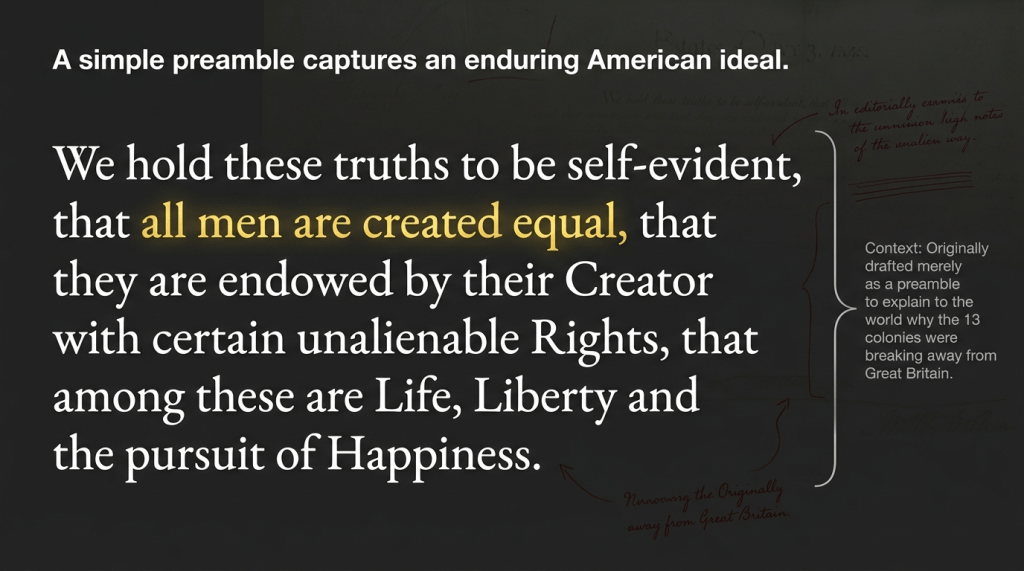
Most Americans can recite at least part of it from memory: “We hold these truths to be self-evident, that all men are created equal, that they are endowed by their Creator with certain unalienable Rights, that among these are Life, Liberty and the pursuit of Happiness.”
Thirty-five words. That is all.
Yet those thirty-five words became the moral foundation of the American experiment.



When Thomas Jefferson drafted the Declaration of Independence, this sentence was never intended to become a national creed. It was part of a preamble. Its immediate purpose was practical. Congress needed to explain to the world why thirteen British colonies believed they possessed the right to dissolve their political bonds with Great Britain and assume “among the powers of the earth” the separate station to which they believed they were entitled.
But Jefferson accomplished something far larger than the task assigned to him.
Drawing upon biblical thought, English common law, Enlightenment philosophy, and generations of political experience, he distilled centuries of human aspiration into a single statement of principle. The Declaration asserted that rights do not come from kings. They do not come from parliaments. They do not come from governments. They come from the Creator.
That claim was revolutionary. For most of human history, rulers granted rights and rulers could withdraw them. Jefferson turned that understanding upside down. Government was no longer the source of liberty. Government existed to protect liberties that already belonged to every human being.
Nearly a century later, another American would recognize the extraordinary significance of those words.
In 1861, as the nation stood on the brink of civil war, Abraham Lincoln reflected on the relationship between the Declaration of Independence and the Constitution. In a brief fragment never developed into a formal speech, Lincoln borrowed an image from Proverbs 25:11: “A word fitly spoken is like apples of gold in pictures of silver.”
Lincoln argued that Jefferson’s assertion of equality was the “apple of gold.” The Constitution and the Union were the “picture of silver” framed around it. The Constitution, Lincoln insisted, was not created to replace the principle found in the Declaration. It was not designed to weaken it, conceal it, or destroy it. The purpose of the constitutional system was to preserve it, protect it, and give it practical form. As Lincoln wrote, “The picture was made for the apple, not the apple for the picture.”
That insight remains one of the most profound observations ever made about the American founding.
The Constitution matters because of the principle it protects. The machinery of government matters because of the truth it was designed to secure. The silver frame exists for the sake of the golden apple.
For two hundred and fifty years Americans have argued about what those thirty-five words mean. They have debated who was included, who was excluded, and how fully the nation has lived up to its promise. Yet generation after generation has returned to the same sentence. Abolitionists cited it. Suffragists cited it. Civil rights leaders cited it. Presidents invoked it in times of crisis.
The reason is simple. The Declaration was written to explain a separation from Great Britain. Instead, it became a statement about the nature of human liberty itself.
At the heart of the American story stands that apple of gold: the proposition that all people are created equal, that their rights come from their Creator, and that freedom is not a gift bestowed by government, but a birthright possessed by every human being.
Everything else is the frame.
If those thirty-five words became the apple of gold at the center of the American experiment, the next question is obvious.
Where did they come from? The answer begins in June 1776.
On June 11, just four days after Richard Henry Lee introduced his resolution declaring that the colonies “are, and of right ought to be, free and independent States,” the Continental Congress appointed a committee to draft a formal declaration explaining that decision to the world.
The committee consisted of five men: John Adams of Massachusetts, Benjamin Franklin of Pennsylvania, Roger Sherman of Connecticut, Robert Livingston of New York, and Thomas Jefferson of Virginia. Of the five, Jefferson was the youngest at just thirty-three years old.
At first glance, he seems an unlikely choice. Franklin was one of the most famous men in the Atlantic world. Adams had become one of the leading advocates for independence. Yet Adams later explained that Jefferson possessed a rare gift for language. He could express complex ideas with a clarity and elegance few others could match.
So Jefferson rented rooms in Philadelphia and went to work. And for seventeen days he wrote.
The document that emerged was not the product of a sudden flash of inspiration. Jefferson was not inventing new ideas. He was gathering together concepts that had circulated for generations through English political thought, colonial declarations, Enlightenment philosophy, classical learning, Protestant theology, and the writings of political theorists such as John Locke.
His achievement was not originality. His achievement was synthesis. He took ideas that had been debated for centuries and expressed them in language so concise and powerful that they became unforgettable.
One of the most important moments in that process involved a change that may be the most consequential edit in American history.
Jefferson originally wrote: “We hold these truths to be sacred and undeniable.” Benjamin Franklin reviewed the draft and crossed out those words.
In their place he wrote: “Self-evident.”
At first glance, the revision seems minor. It changed only two words. In reality, it transformed the philosophical foundation of the Declaration.
A truth described as sacred is accepted because it comes from divine authority. A truth described as self-evident can be recognized through reason itself.
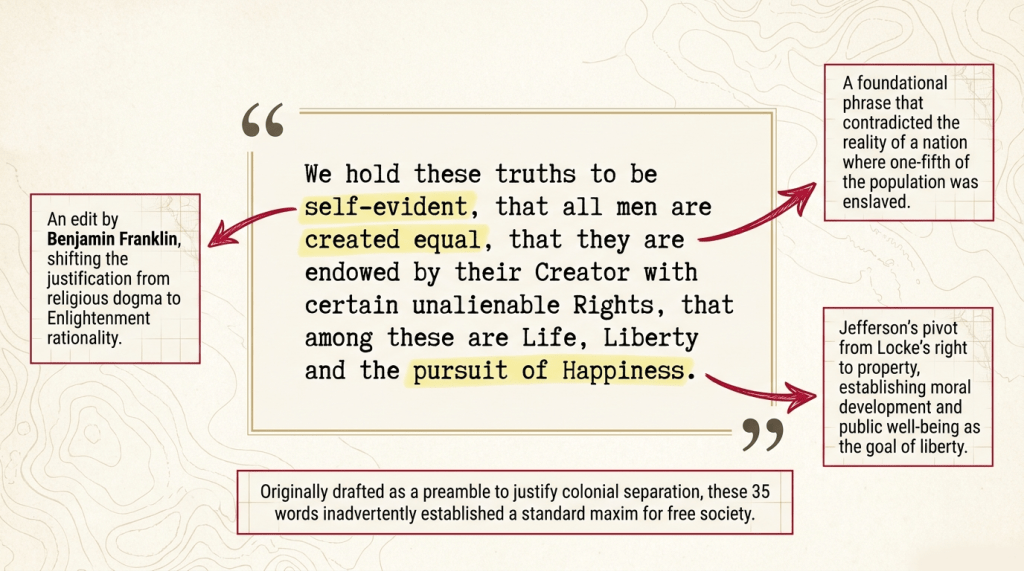
Franklin was not rejecting religion. Like most of the revolutionary generation, he believed in Providence and frequently referred to God’s role in human affairs. Yet he was also a child of the Enlightenment. He believed that certain truths were so obvious, so universal, and so deeply rooted in human experience that they required no priest, church, or king to validate them.
A farmer could recognize them.
A scholar could recognize them.
A merchant, laborer, or statesman could recognize them.
Human rights did not depend upon belonging to a particular denomination or accepting a particular creed. They rested upon principles accessible to all people.
That small edit helped transform the Declaration from an American argument into a universal one.
The influence of English philosopher John Locke appears throughout the document as well. Locke argued that individuals possess natural rights that exist before government. Governments are formed by consent to protect those rights. When governments violate that trust, the people retain the authority to alter or abolish them.
Jefferson borrowed heavily from Locke’s framework. Yet he made one significant alteration. Locke had written of life, liberty, and property.
Jefferson wrote life, liberty, and the pursuit of happiness.
Modern readers often misunderstand the phrase. Happiness in the eighteenth century did not mean pleasure, entertainment, or personal gratification.
It meant human flourishing. It referred to the development of virtue, education, self-discipline, moral character, and participation in a healthy society. The pursuit of happiness was the pursuit of a life worthy of human dignity.
Jefferson believed liberty existed so individuals could improve themselves, support their families, contribute to their communities, and pursue excellence according to their own conscience.
Freedom was not merely personal. It carried, and still carries, civic responsibilities as well. A republic depended upon citizens capable of governing themselves.
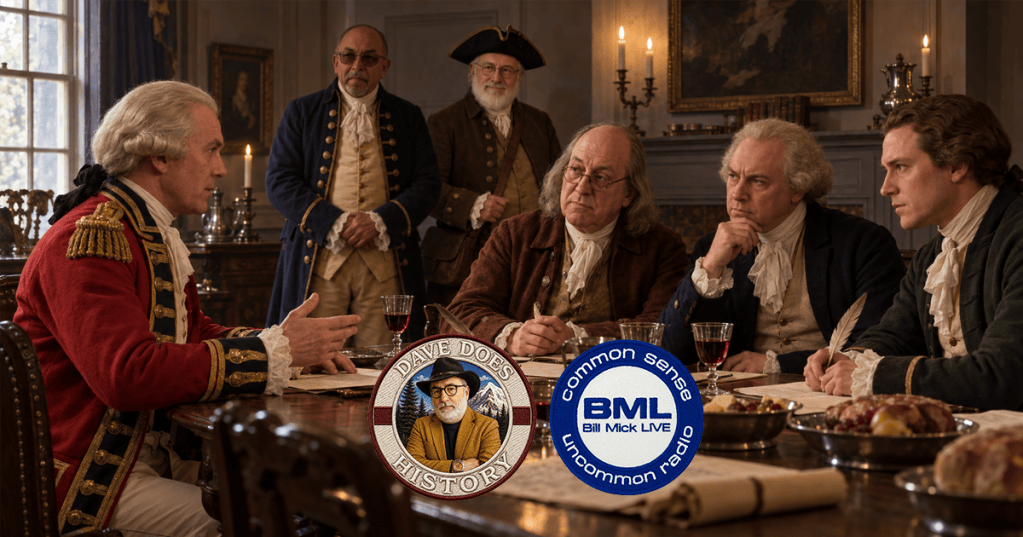
Back in June of 2022, Bill and Dave discuss the ideas behind the “pursuit of Happiness” as a uniquely American understanding and application of Locke’s ideas…
The ideals expressed in the Declaration remain inspiring. Yet any honest examination of the document must confront the profound contradictions that surrounded its creation.
At the very moment Congress approved a declaration proclaiming that all men are created equal, nearly one-fifth of the population living in the colonies was enslaved. Hundreds of thousands of men, women, and children lived as property under a hereditary system of racial slavery. Roughly one-third of the men who ultimately signed the Declaration owned enslaved people. Thomas Jefferson himself enslaved hundreds over the course of his lifetime.
That contradiction is impossible to ignore. The same hand that wrote “all men are created equal” continued to participate in a system that denied equality to others.
For generations historians have struggled with this paradox. Some attempt to excuse it. Others dismiss the Declaration entirely because of it.
Neither response fully captures the reality of what occurred.
The Declaration contained principles far broader than the society that produced it. The men who wrote those principles often failed to live up to them. Yet the principles survived and eventually became weapons against the very injustices many of the founders tolerated.
The contradiction is perhaps most visible in Jefferson’s original draft.
Before Congress edited the document, Jefferson included a lengthy condemnation of the transatlantic slave trade. The passage, nearly 168 words long, accused King George III of waging what Jefferson described as a cruel war against human nature itself. It denounced the buying and selling of human beings and condemned the trade that had brought countless Africans into bondage. The language was passionate. It was forceful.
Congress removed it.
Delegates from South Carolina and Georgia objected immediately. Some northern delegates who benefited directly or indirectly from the trade were equally uncomfortable. The grievance threatened the fragile unity necessary for independence. So it disappeared. One hundred sixty-eight words vanished from the final document.
Independence was preserved. The issue of slavery was postponed.
The consequences of that decision would shape American history for the next eighty-five years and beyond.
The exclusions extended beyond slavery. Women remained legally subordinate under the English common-law doctrine of coverture. A married woman’s legal identity was largely absorbed into that of her husband. Women could not vote, hold office, or exercise many of the rights associated with citizenship.
Native Americans faced a different contradiction. Among the grievances directed against King George III appears a complaint that he had unleashed what the Declaration called “merciless Indian Savages” against the frontier settlements.
The phrase reflected genuine fears and violent conflicts along the colonial frontier. It also revealed a profound inconsistency. A document proclaiming universal human rights simultaneously employed language that denied the full humanity of entire peoples.
The revolutionary generation could articulate universal principles. They found that applying those principles universally proved far more difficult.
That tension became one of the defining features of American history.
The Declaration stands as both an achievement and a challenge. It contains one of humanity’s most powerful statements of political principle. It also exposes the limitations of the society that produced it.
The founders did not fully realize the ideals they proclaimed. Neither did their children. Neither did their grandchildren. What followed was a long national struggle to close the gap between principle and practice.
That struggle would become the central story of the next two hundred and fifty years.
The men who gathered in Philadelphia in 1776 did not fully realize the ideals they proclaimed. Yet once those words entered the world, they became impossible to contain.
The Declaration had been written to justify American independence. Instead, it became a standard by which Americans would judge themselves. The sentence Jefferson drafted escaped the control of its authors and took on a life of its own.
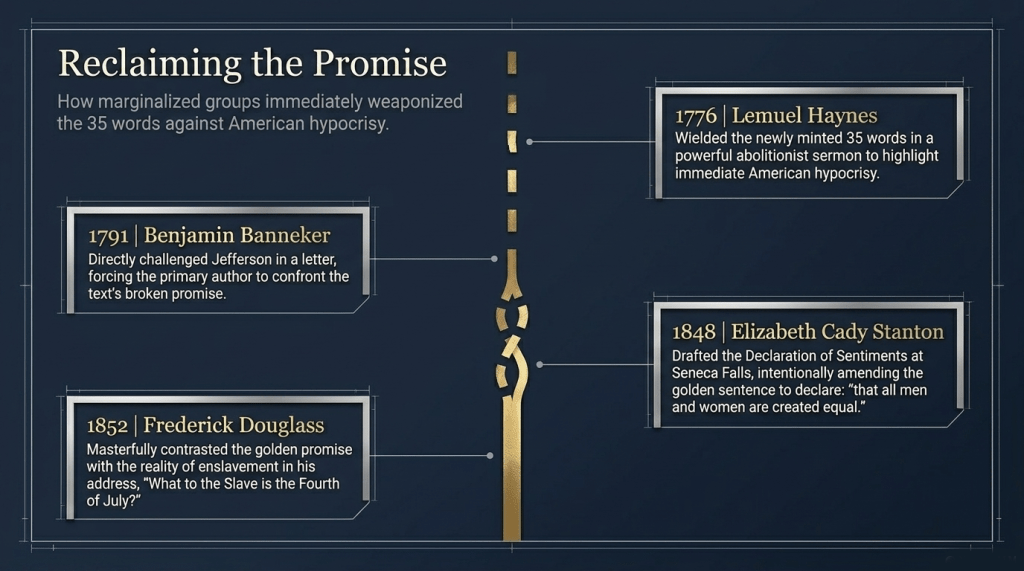
Again and again, people who had been excluded from the promises of 1776 returned to those thirty-five words and asked a simple question:
If these truths are really self-evident, why are they not being applied equally?
The first challenges appeared almost immediately. Among the earliest voices was Lemuel Haynes, a Black minister born in Connecticut in 1753 to a white mother and a Black father. Indentured as a child and later a veteran of the Revolutionary War, Haynes recognized both the promise and the contradiction embedded within the Declaration.
While Americans celebrated their newly proclaimed liberty, Haynes pointed out the obvious inconsistency. If all men were created equal, then Africans possessed the same rights as Europeans. If human rights were universal, slavery could not be justified. If slavery could be justified, then the Declaration itself was false. His argument was remarkably simple: either the principle applied to everyone, or it applied to no one.
A generation later, another Black American carried that challenge directly to Thomas Jefferson himself.
Benjamin Banneker was a mathematician, astronomer, surveyor, and self-taught intellectual whose accomplishments won admiration throughout the young republic. In 1791, he sent Jefferson a copy of his almanac accompanied by a carefully written letter. Banneker reminded Jefferson of the language he had written in the Declaration of Independence. He quoted the assertion that all men are created equal. Then he asked a question that Jefferson could never entirely answer: how could a man who had written such words continue to support a system that denied equality to others?
What makes Banneker’s challenge remarkable is that he did not reject the Declaration.
He embraced it. His argument was not that Jefferson’s principles were wrong. His argument was that Jefferson should believe his own words.
The most powerful confrontation came from Frederick Douglass.
Born into slavery, Douglass escaped bondage and became one of the greatest orators in American history. On July 5, 1852, he delivered a speech in Rochester, New York, that remains one of the most devastating examinations of American hypocrisy ever presented. The title alone is unforgettable.
“What to the Slave is the Fourth of July?”
Douglass began by praising the revolutionary generation. He admired their courage. He celebrated their willingness to challenge tyranny. He described the signers as brave men who risked everything for liberty.
Then he turned toward the America of his own day. How could a nation celebrate freedom while millions remained enslaved? How could Americans praise equality while denying basic humanity to an entire race?
The contrast was devastating.
Yet Douglass never abandoned the Declaration itself. He treated it as a sacred standard by which the nation should be judged. America had failed. The principle had not.
The same pattern emerged in the struggle for women’s rights.
In July 1848, reformers gathered in Seneca Falls, New York, for what became the first major women’s rights convention in American history. Led by Elizabeth Cady Stanton and Lucretia Mott, the participants sought to challenge the legal and political restrictions imposed upon women.
Stanton understood something important. The most powerful argument available to her already existed. Rather than write an entirely new declaration, she deliberately modeled her document on Jefferson’s. The result became known as the Declaration of Sentiments.
Its opening sentence was instantly recognizable:
“We hold these truths to be self-evident: that all men and women are created equal.”
With the addition of two words, Stanton exposed another unfinished promise.
Women had been denied the vote. They were excluded from public office. Their legal rights remained restricted. In many respects they remained subject to the same assumptions about dependency that had existed at the nation’s founding. Like Haynes, Banneker, and Douglass, Stanton did not reject the Declaration. She expanded it.
She argued that equality demanded broader application than Americans had previously been willing to grant.
By the time the nation descended into civil war, Abraham Lincoln recognized that something larger was taking place.
For generations, many Americans had viewed the Constitution as the nation’s primary founding document. Political debates focused on constitutional powers, legal authorities, and competing interpretations of federalism.
Lincoln believed Americans had forgotten something essential.
They had forgotten the apple of gold.
The Constitution provided the machinery of government. The Declaration explained why that government existed.
Throughout his political career Lincoln returned repeatedly to Jefferson’s famous sentence. He argued that equality was not an incidental phrase buried in an old revolutionary document. It was the moral purpose of the republic itself.
That conviction reached its fullest expression at Gettysburg in November of 1863.
In November 1863, Lincoln stood on a Pennsylvania battlefield where thousands had recently died. His address lasted barely two minutes. Its impact transformed American history.
Lincoln began with a date: “Four score and seven years ago.”
Eighty-seven years before 1863 does not lead to 1787, when the Constitution was written.
It leads to 1776.
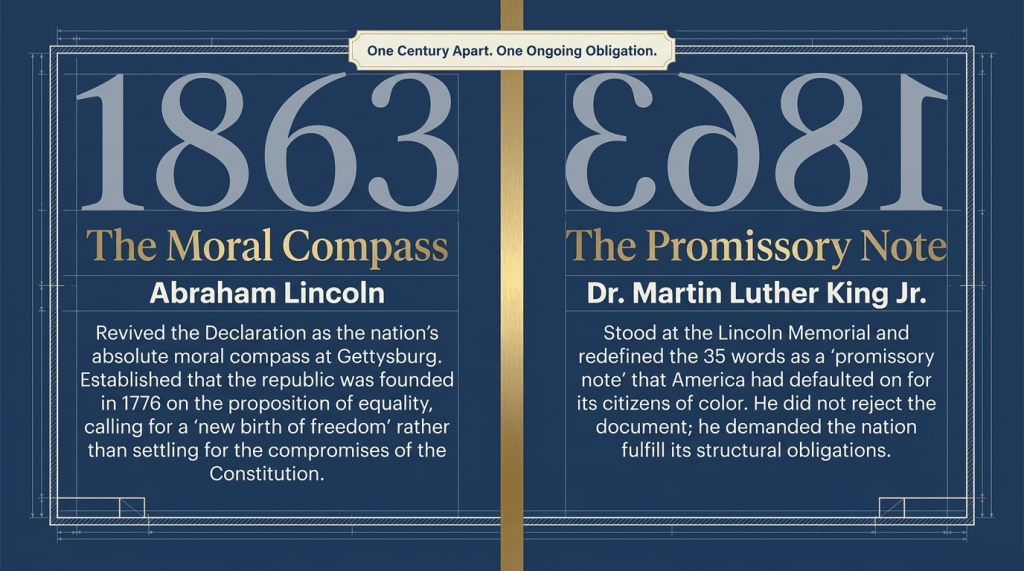
That choice was deliberate. Lincoln anchored the nation’s identity not in the constitutional compromises that had accommodated slavery, but in the Declaration’s promise of equality.
The United States, he argued, had been conceived in liberty and dedicated to a proposition.
Not a law.
Not a treaty.
Not a governmental structure.
A proposition.
That all men are created equal.
The Civil War therefore became more than a struggle to preserve the Union. It became a test of whether a nation founded on that proposition could survive.
Lincoln’s call for a “new birth of freedom” linked emancipation directly to the promise first articulated in 1776. The Declaration’s unfinished work was being renewed through sacrifice and struggle.
A century later, another leader would return to the same words.
On August 28, 1963, hundreds of thousands gathered in Washington, D.C., during the March on Washington for Jobs and Freedom.
Standing before the Lincoln Memorial, Dr. Martin Luther King Jr. placed himself quite consciously within the tradition established by Lincoln, Douglass, Stanton, and countless others.
King did not reject the Declaration. He claimed it.
In one of the most memorable passages of the “I Have a Dream” speech, King described the Declaration of Independence and the Constitution as a promissory note. The founders, he said, had written a check guaranteeing the rights of all Americans.
For Black citizens, that check had been returned marked insufficient funds. Yet King refused to believe the bank of justice was bankrupt.
His demand was not for a new principle. His demand was that America finally honor the principle it had already proclaimed. Like Douglass before him, King insisted that the nation live up to its own promises.
By 1963, the sentence Jefferson had drafted nearly two centuries earlier had traveled a remarkable path.
A Black minister.
A self-taught astronomer.
An escaped slave.
Women’s rights advocates.
A president preserving the Union.
A Baptist preacher confronting segregation.
All of them returned to the same words.
All of them found within the Declaration a source of authority greater than themselves.
That is why the sentence endured. The men who wrote it could not fully contain it. Their society often contradicted it. Their actions frequently fell short of it. Yet the principle proved larger than the generation that created it.
The Declaration became America’s measuring stick.
Whenever the nation failed, reformers pointed back to those thirty-five words and demanded better. A sentence written to justify independence became a challenge to every generation that followed. And for two hundred and fifty years, Americans have continued arguing over what it means, who it includes, and how fully it should be fulfilled.
That argument, more than any single law, election, or institution, is the story of the United States.
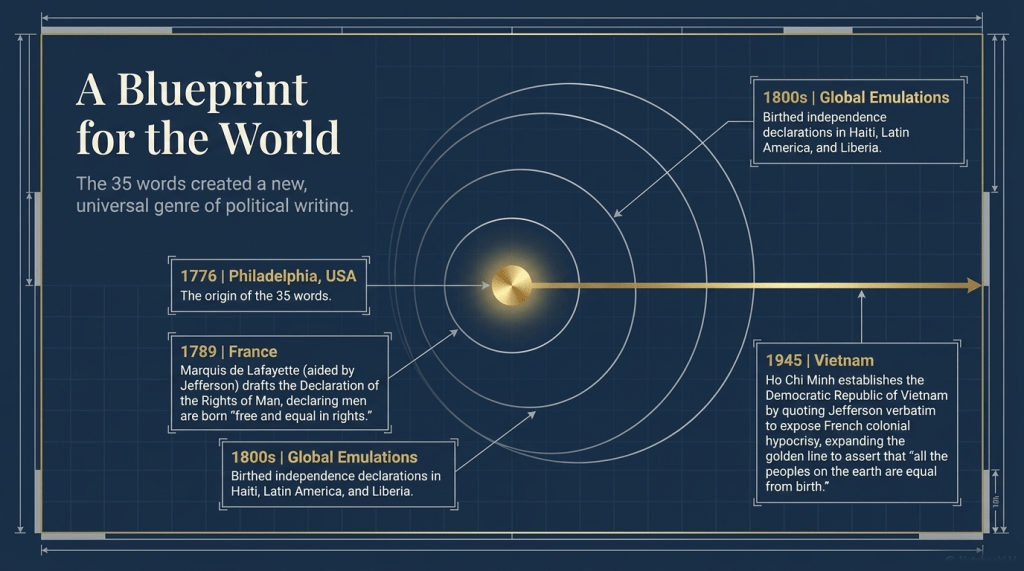
The remarkable story of the Declaration of Independence does not end at America’s borders. In many ways, its international journey is even more surprising than its influence within the United States.
The sentence Jefferson wrote in Philadelphia was intended to justify the independence of thirteen colonies along the Atlantic coast of North America. Yet almost immediately, those words began crossing oceans, entering revolutions, inspiring reformers, and reshaping political movements around the world.
What began as an American argument became a universal language. The first great ripple appeared across the Atlantic.
Among the heroes of the American Revolution was a young French aristocrat named Gilbert du Motier, better known to history as the Marquis de Lafayette. Americans remember him as Washington’s trusted subordinate, a volunteer who crossed the ocean to fight for a cause that was not originally his own.
When Lafayette returned to France after the war, he carried more than memories of military campaigns. He carried ideas.
By 1789, France stood on the edge of its own revolution. The old order was collapsing. Demands for reform were spreading across the kingdom. Lafayette found himself at the center of the political storm and undertook the task of drafting a declaration of rights for the French people.
He sought advice from an old friend. Thomas Jefferson.
Serving as American minister to France, Jefferson reviewed portions of Lafayette’s work and offered suggestions during the drafting process.
The result became the Declaration of the Rights of Man and of the Citizen. Its language differed from Jefferson’s Declaration, but the similarities were unmistakable. The French declaration proclaimed that men are born and remain free and equal in rights.
Governments derive their legitimacy from the nation rather than hereditary rulers. Liberty is a natural condition rather than a privilege granted by monarchs.
The principles were not identical, but they clearly belonged to the same intellectual family. For the first time in history, a revolutionary movement on one side of the Atlantic had directly inspired a revolutionary movement on the other.
The French Revolution would ultimately follow a far different path than the American Revolution. Political violence, the Reign of Terror, and eventually the rise of Napoleon would transform France in ways Jefferson and Lafayette could never have anticipated.
Yet the underlying principle survived. Human beings possessed rights because they were human beings.
That idea had become an international force.
More importantly, the Declaration helped create something entirely new.
Before 1776, nations did not generally announce themselves with formal statements of universal political principles. Kingdoms inherited legitimacy through dynasties. Empires claimed authority through conquest, religion, or tradition.
The Declaration of Independence created a new model. A people seeking self-government would explain not merely who they were, but why they possessed the right to govern themselves. In effect, Jefferson’s document created a new genre of political writing.
The pattern appeared repeatedly over the next two centuries.
In Haiti, revolutionaries fighting against slavery and colonial rule drew upon the language of natural rights and equality.
Throughout Latin America, independence movements led by figures such as Simón Bolívar adapted similar arguments to justify separation from Spain.
In Liberia, founded by formerly enslaved Americans and free Black settlers, the Declaration’s language and structure influenced the nation’s own founding documents.
Different cultures, different continents, different circumstances. Yet the same basic idea kept appearing. Human rights exist before government. Governments exist to secure those rights. When governments fail, people possess the authority to establish new ones.
By the twentieth century, the Declaration’s influence had expanded far beyond the world Jefferson knew. Its language increasingly became associated not simply with American independence, but with opposition to colonial rule itself.
Perhaps the most striking example occurred in Southeast Asia.
On September 2, 1945, a revolutionary leader stood before a crowd gathered in Hanoi and proclaimed the birth of a new nation.
His name was Ho Chi Minh.
The Japanese Empire had collapsed. French colonial authority had been shattered by war. Vietnam stood at a crossroads. To announce the creation of the Democratic Republic of Vietnam, Ho Chi Minh began with words familiar to every American.
“We hold these truths to be self-evident: that all men are created equal.”
The opening of the Vietnamese Declaration of Independence quoted Jefferson directly.
Ho Chi Minh understood the power of those words. He recognized that the principles articulated in 1776 possessed a moral authority that extended far beyond the United States. Yet he did something even more significant. He expanded their scope.
After quoting Jefferson, Ho Chi Minh argued that the principle applied not merely to individuals but to nations and peoples. He declared that all peoples on earth are equal from birth and possess the right to live, to be happy, and to be free. The argument turned the language of the American Revolution back against European colonialism. If governments derive legitimacy from the consent of the governed, how could one nation rule another without consent?
If liberty is a natural right, how could colonial subjects be denied self-government? If all men are created equal, how could entire peoples be treated as permanently subordinate?
Ho Chi Minh used Jefferson’s words to expose what he viewed as the contradiction between European claims of liberty and the reality of imperial rule.
The irony was profound. A sentence written to justify American independence from the British Empire was now being used to justify Vietnamese independence from the French Empire.
Whether Americans agreed with Ho Chi Minh’s politics was beside the point. The significance lay in the fact that he believed Jefferson’s language could support his cause. The Declaration had traveled halfway around the world and become part of a global conversation about freedom.
That may be the most remarkable aspect of the entire story.
The Declaration of Independence was written for a specific political crisis in 1776. Yet its most famous sentence proved adaptable across centuries, continents, religions, languages, and cultures.
French revolutionaries embraced it.
Anti-slavery activists embraced it.
Women’s rights advocates embraced it.
Anti-colonial movements embraced it.
Political leaders who disagreed about almost everything else found themselves returning to the same words.
Again and again, people seeking freedom reached for Jefferson’s sentence because it articulated something larger than the American Revolution itself. It asserted a simple proposition: Human liberty is not granted by governments. Human liberty exists before governments.
And once that idea entered the world, it could never again be confined to Philadelphia, to America, or even to the eighteenth century.
The apple of gold had become a gift to the world.



Leave a comment