
John Adams once described Francis Hopkinson as a “pretty, little, curious, ingenious man” whose head was “not bigger than a large apple.” It sounds like the sort of observation only Adams could make. Most people would have simply called Hopkinson intelligent. Adams, being Adams, felt compelled to comment on the size of the container as well as the contents. Yet buried beneath the joke was a genuine observation. Francis Hopkinson possessed one of those minds that seemed incapable of focusing on a single subject when half a dozen others were available.
That tendency followed him throughout his life. Historians often struggle to describe him because every description feels incomplete. He was a lawyer, certainly. He was also a musician, a political writer, an inventor, a government official, and an artist. One begins listing his accomplishments only to discover another waiting around the corner. The result is a figure who often disappears in the shadow of more famous founders, not because he lacked talent, but because his talents were scattered across so many different fields that no single achievement came to define him.
Born in Philadelphia in 1737, Hopkinson entered a world where ambitious young colonists still looked toward Britain as the center of opportunity, culture, and power. His father, Thomas Hopkinson, was a respected lawyer and civic leader who ensured his son received an excellent education. The younger Hopkinson proved to be an enthusiastic student, although “student” may not be the best word. Curiosity seemed to drive him more than any formal course of study. He was the sort of person who wanted to know how things worked, why they worked, and whether they could be improved.
“With a Firm Reliance”
Words & Music by David Ray Bowman
©2026 by Slippery Fish Entertainment
ALL RIGHTS RESERVED
That curiosity placed him among the first graduating class of the College of Philadelphia in 1757. The institution would eventually become the University of Pennsylvania, but at the time it represented something slightly different from the older colonial colleges. While places such as Harvard and Yale had been founded primarily to train ministers, Philadelphia’s founders envisioned an education suited to commerce, science, law, and public affairs. Looking back, it is difficult to imagine a school better suited to Francis Hopkinson’s temperament. The institution encouraged broad inquiry, and broad inquiry was already becoming his preferred way of life.
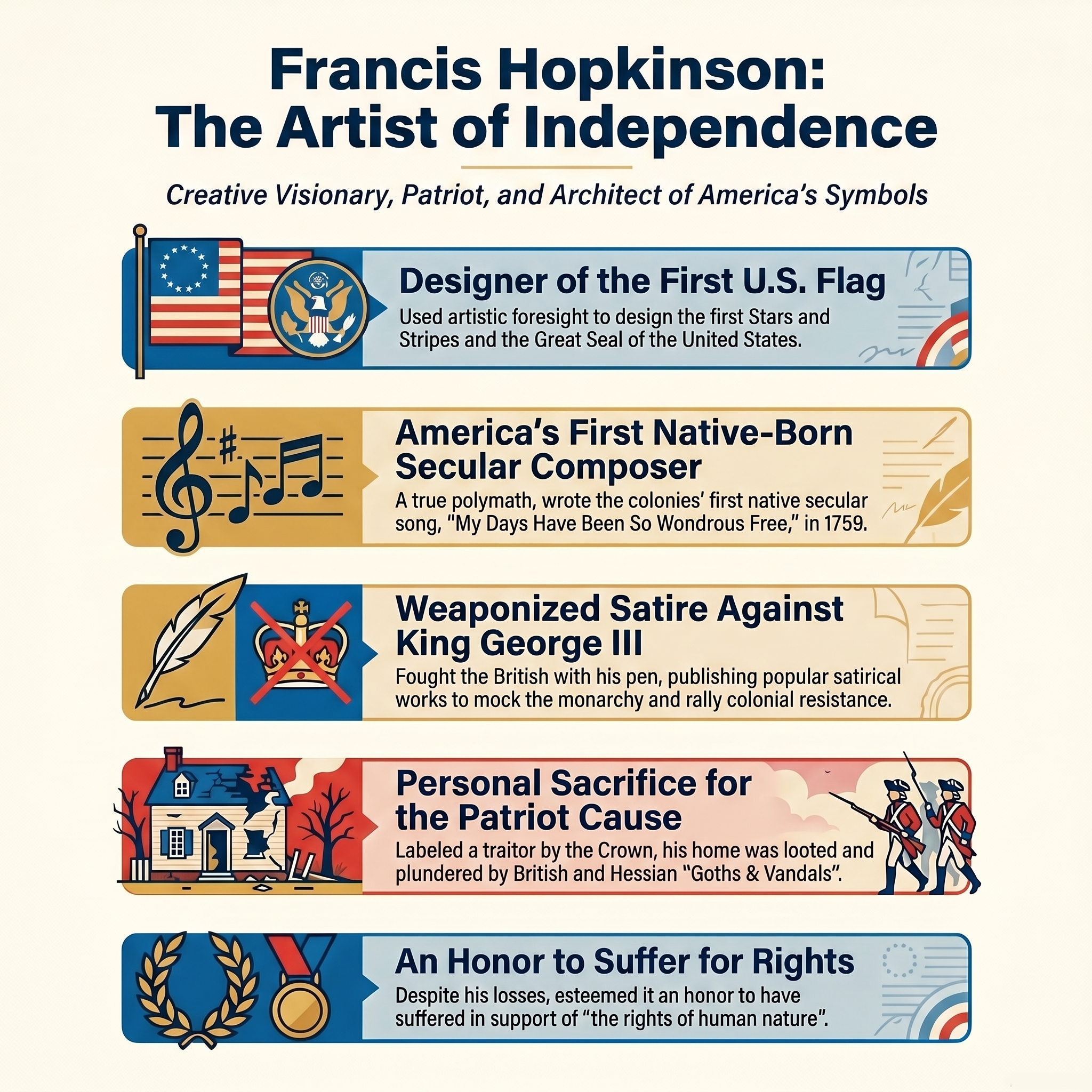
His interests ranged so widely that they occasionally appear disconnected when viewed from a distance. In 1759 he composed “My Days Have Been So Wondrous Free,” generally regarded as the first surviving secular song written by a native-born American composer. That fact alone would earn him a footnote in most histories, but the achievement becomes more interesting when viewed in context. Colonial Americans consumed British culture in enormous quantities. They read British books, wore British fashions, and performed British music. Original American artistic expression remained comparatively rare. Hopkinson belonged to a generation beginning to create rather than merely imitate, and that instinct would surface repeatedly throughout his life.
Law occupied part of his attention, but never all of it. Music continued to attract him. Public service interested him. Mechanical devices fascinated him. He experimented with inventions, sketched designs, and pursued new ideas with a level of enthusiasm that must have exhausted some of the people around him. Reading through his biography creates the impression of a man constantly leaning toward the next project. One almost expects him to arrive late for a meeting because he became distracted by a new idea halfway down the street.
None of this suggested that he would eventually become a revolutionary. If anything, the evidence pointed in the opposite direction. Like many educated colonists during the middle decades of the eighteenth century, Hopkinson viewed the British Empire as the framework within which success would occur. Britain dominated the Atlantic world. Imperial connections created opportunities. Political advancement often required patronage. For a talented young lawyer, the path forward seemed reasonably clear.
That assumption carried him across the Atlantic in 1766. Hopkinson traveled to England hoping to secure a royal appointment that would provide both status and financial security. The ambition itself was entirely unremarkable. Colonial leaders regularly sought advancement through imperial channels. Benjamin Franklin spent years cultivating relationships in London. Few Americans at the time imagined independence as a realistic possibility. Most still considered themselves loyal subjects of the Crown.
What Hopkinson encountered was not hostility so much as indifference. Meetings occurred. Conversations took place. Encouraging words were exchanged. Yet tangible results remained elusive. London proved full of influential men willing to offer polite attention and remarkably reluctant to offer actual appointments. The experience did not instantly convert Hopkinson into a critic of the Empire, but it left him with a clearer understanding of how colonial concerns appeared from the other side of the Atlantic. The lesson settled slowly. Such lessons usually do.
Over the following decade, relations between Britain and the colonies deteriorated steadily. New taxes generated protests. Parliamentary authority became a subject of fierce debate. Colonial resistance produced imperial retaliation, which in turn generated further resistance. Hopkinson watched the cycle unfold while gradually discovering that his greatest political talent had less to do with law than with satire. He possessed an unusual ability to expose the absurdities of power, and power rarely appreciates being laughed at.
His most famous work, A Pretty Story, appeared in 1774 and quickly found an audience throughout the colonies. Rather than presenting readers with a dense constitutional argument, Hopkinson transformed the imperial crisis into a family dispute. Readers immediately understood the allegory. More importantly, they enjoyed it. That detail mattered. Most colonists were not studying political theory. They were absorbing ideas through newspapers, pamphlets, sermons, and conversations. Hopkinson understood that people often change their minds because someone alters their perspective rather than because someone overwhelms them with facts.
The success of A Pretty Story established him as one of the most effective satirists in America. Through later works such as The Prophecy and numerous essays, he continued using humor as a political weapon. The transformation from aspiring imperial officeholder to revolutionary writer was not sudden. It emerged gradually through experience, observation, and growing disillusionment with British policy. By the time independence approached, the man who had once crossed the ocean seeking royal favor had become one of the Crown’s sharpest American critics.
Even then, Francis Hopkinson remained very much himself. He never abandoned his music. He never stopped experimenting with ideas. He never narrowed his interests to a single profession. The Revolution provided a cause worthy of his talents, but it did not fundamentally alter the personality that John Adams had described years earlier. Hopkinson remained curious, inventive, energetic, and slightly difficult to categorize. In many ways that may explain why he is less famous today than some of his contemporaries. History prefers simple labels. Francis Hopkinson stubbornly resisted them throughout his life, leaving behind the story of a man whose contributions reached into far more corners of the American founding than most people realize.
Francis Hopkinson arrived in Philadelphia during one of the strangest summers in American history. By July of 1776 the colonies were already fighting Britain. Men had died at Lexington and Concord more than a year earlier. Boston had endured occupation. The Continental Army existed. Blood had been shed. Yet independence itself remained something of an unfinished thought, discussed openly by some, resisted by others, and viewed with suspicion by many who feared the consequences of taking such an irreversible step.
By the first days of July, however, events had begun moving faster than caution could keep pace. On July 2 the Continental Congress approved Richard Henry Lee’s resolution declaring the colonies free and independent states. Hopkinson voted with the majority. The decision itself had been made. What remained was the task of explaining it, justifying it, and presenting it to the world in a form that would survive long after the arguments in Philadelphia had ended.
Modern Americans tend to merge July 2 and July 4 into a single event. The men sitting in Congress would have understood the distinction. One day established independence. The other announced it. The difference may seem technical now, but it would not have felt technical to the delegates who spent those days revising language, debating wording, and refining the document that Thomas Jefferson had drafted. Once approved, those words would cross oceans. They would be printed in newspapers. They would be read aloud in town squares. They would eventually reach London and the desk of King George III. After that, there would be no plausible way to describe the conflict as a misunderstanding among loyal subjects.
Hopkinson was not sitting in that chamber as a dreamer. He was a lawyer, a government official, and a man who had spent enough time observing politics to understand the difference between aspiration and reality. The Declaration would become one of the most celebrated documents in history, but no one in Philadelphia could know that. They were not composing a national scripture. They were issuing a challenge to the most powerful empire on earth, and the outcome remained very much in doubt.
It is difficult for modern Americans to recover that uncertainty because we know too much. Yorktown already sits in our past. Washington already occupies his place in the pantheon. The United States already exists. For Hopkinson and his colleagues, none of those things had happened. British armies remained in the field. British warships controlled vital waterways. The Continental Army struggled with enlistments, supplies, and discipline. Independence might succeed. It might fail. Men in Congress understood both possibilities.
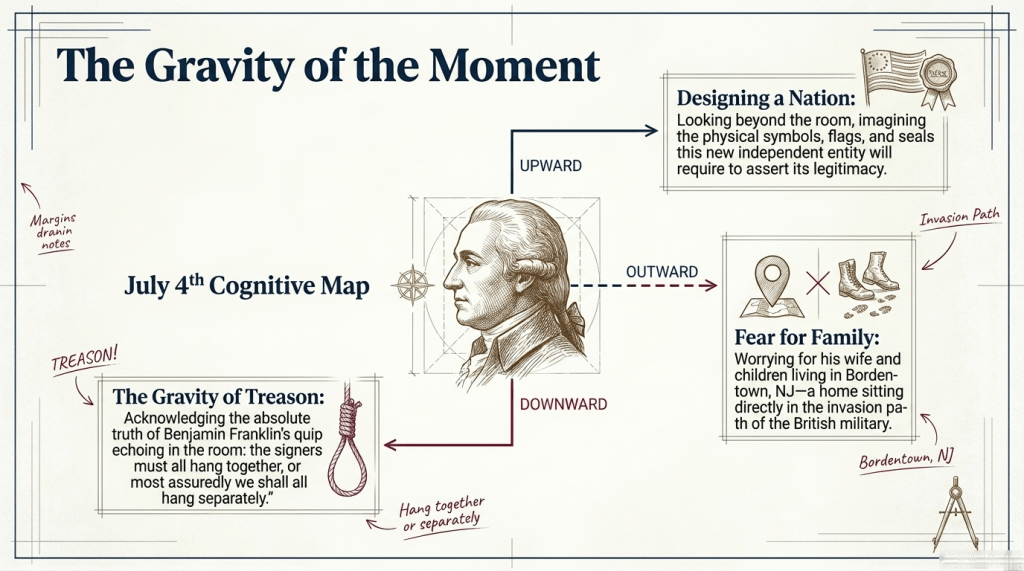
Benjamin Franklin’s famous remark that the delegates must all hang together or they would most assuredly hang separately survives because it captures that reality with characteristic wit. Franklin made jokes the way some men breathed, but beneath the humor lay a very practical observation. Treason was a real crime. Empires tended to take rebellion personally. If the Revolution collapsed, the men leading it could reasonably expect consequences far more serious than losing an election.
Hopkinson did not require Franklin to explain that fact. He had spent years studying law. He understood what it meant to challenge legitimate authority, at least from the perspective of the government being challenged. The men gathered in Philadelphia were not signing a petition. They were not filing a complaint. They were declaring that Parliament possessed no authority over them and that the Crown’s relationship with the colonies had been severed. History remembers the eloquence of the Declaration. The British government noticed the rebellion.
One suspects that Hopkinson spent at least part of that day thinking about consequences rather than celebrations. Courage is often portrayed as the absence of fear. Real courage usually looks different. It involves recognizing danger clearly and proceeding anyway. Looking around the room, Hopkinson would have seen merchants, lawyers, planters, and politicians from every corner of the colonies. They disagreed about religion, economics, and regional interests. Some probably disliked one another intensely. Yet every man present had crossed a line from which there could be no comfortable retreat.
The final paragraph of the Declaration reflected that reality. Modern readers sometimes rush through the closing pledge because the language has become familiar. To the delegates themselves, however, those words carried genuine weight. The reference to a “firm reliance on the protection of Divine Providence” was not ornamental. It reflected the uncomfortable truth that many of the things determining their future lay beyond their control. Armies would fight. Governments would react. Foreign powers would make calculations of their own. The delegates could commit themselves to the cause. They could not guarantee the outcome.
Hopkinson’s thoughts may also have wandered homeward. Historical paintings have conditioned us to see the founders only as statesmen, but most of them were husbands, fathers, sons, and business owners long before they became historical figures. Ann Borden Hopkinson and the couple’s children remained in Bordentown, New Jersey. Whatever happened next would affect them as surely as it affected him.
New Jersey’s position on the map made that reality impossible to ignore. Sitting between New York and Philadelphia, the colony occupied ground that any military campaign would find difficult to avoid. Armies do not consult property owners before selecting routes of march. They follow roads, rivers, supply lines, and strategic necessities. A glance at a map would have been enough to remind Hopkinson that if the war intensified, communities like Bordentown could easily find themselves in its path.
It would be surprising if such thoughts never entered his mind. Men carrying responsibilities rarely leave them at the door when they enter important meetings. The delegates arrived with private concerns alongside public duties. Some worried about businesses. Others worried about debts. Some worried about aging parents or vulnerable families. Hopkinson had every reason to worry about the people waiting for him at home.
Yet another side of his personality may have been active at the same time. Francis Hopkinson never stopped being a creator. Long before he became a signer of the Declaration, he had composed music, written satire, experimented with inventions, and pursued artistic projects. He possessed the habit of imagining things that did not yet exist. While military realities and political risks occupied everyone’s attention, it is not difficult to imagine Hopkinson wondering what sort of nation might emerge if the gamble succeeded.
A new nation would require more than independence. It would require identity. It would need symbols, seals, flags, and emblems capable of expressing a common purpose. The Declaration itself represented one attempt to define what Americans believed. Visual symbols would eventually be needed as well. That line of thought would have come naturally to a man who spent much of his life moving between politics and art.
The years that followed suggest that such questions interested him deeply. Hopkinson would become involved in designing official seals, contributing to the visual language of the new government, and later claiming credit for designing the first American flag. Historians continue debating the precise extent of some of those contributions, but the broader pattern is unmistakable. While other founders concentrated primarily on laws and institutions, Hopkinson devoted considerable energy to imagining how the nation would present itself to the world.
As the session moved toward its conclusion, the delegates could not know how posterity would remember the events unfolding around them. They could not know that schoolchildren would memorize passages from the Declaration or that artists would spend generations trying to recreate the scene. What they knew was far simpler and far more immediate. They had chosen a path that carried enormous risks and uncertain rewards. For Francis Hopkinson, the decision involved political danger, personal sacrifice, and concern for the family waiting in New Jersey. It also involved hope, which may have been the rarest commodity in the room. Hope required imagination, and imagination had always been one of Hopkinson’s strengths. On that July afternoon he placed his reputation, his future, and perhaps even his life upon a vision that existed only in possibility, trusting that the cause was worth the gamble and moving forward with a firm reliance that the future could justify the risk.
The men who approved the Declaration of Independence in the summer of 1776 understood something that later generations sometimes overlook. Drafting the document was only the beginning. The arguments had been made, the votes had been taken, and the signatures would eventually follow, but none of those actions settled the matter. Independence still had to survive. It had to survive British armies, British warships, political divisions, military defeats, shortages, disappointments, and eight long years of war. The Declaration occupies only a few pages. The struggle required to defend it consumed nearly a decade.
Francis Hopkinson knew he was assuming risks when he supported independence. He was a lawyer. He understood the meaning of treason. He understood that if the rebellion failed, the men whose names appeared beneath the Declaration would not be treated as misguided politicians. They would be treated as traitors. Yet even with that understanding, neither Hopkinson nor his colleagues could fully appreciate how deeply the war would intrude into their personal lives. The conflict would not remain confined to battlefields or congressional chambers. It would move into homes, businesses, farms, churches, and families. Political principles have a way of becoming intensely personal once soldiers begin arriving at the front gate.
For Hopkinson, geography guaranteed trouble. New Jersey occupied some of the most strategically important ground in North America. Positioned between New York and Philadelphia, it sat directly astride the routes armies needed to travel. Military campaigns repeatedly swept across the colony. Roads became military corridors. Farms became supply depots. Towns became temporary headquarters. Civilians often discovered that military necessity cared very little about private property. Historians would later call New Jersey the “Cockpit of the Revolution,” a vivid description that captured just how much of the war seemed determined to pass through its borders.
Hopkinson’s home in Bordentown stood squarely within that dangerous landscape. More importantly, the British knew exactly who he was. His political loyalties were no secret. His satirical writings had mocked royal authority for years. His support for independence was public and unmistakable. The Declaration itself had transformed him from a critic of British policy into one of the men publicly responsible for the rebellion. That distinction mattered. Armies do not always target ordinary citizens. Prominent political leaders often attract special attention.
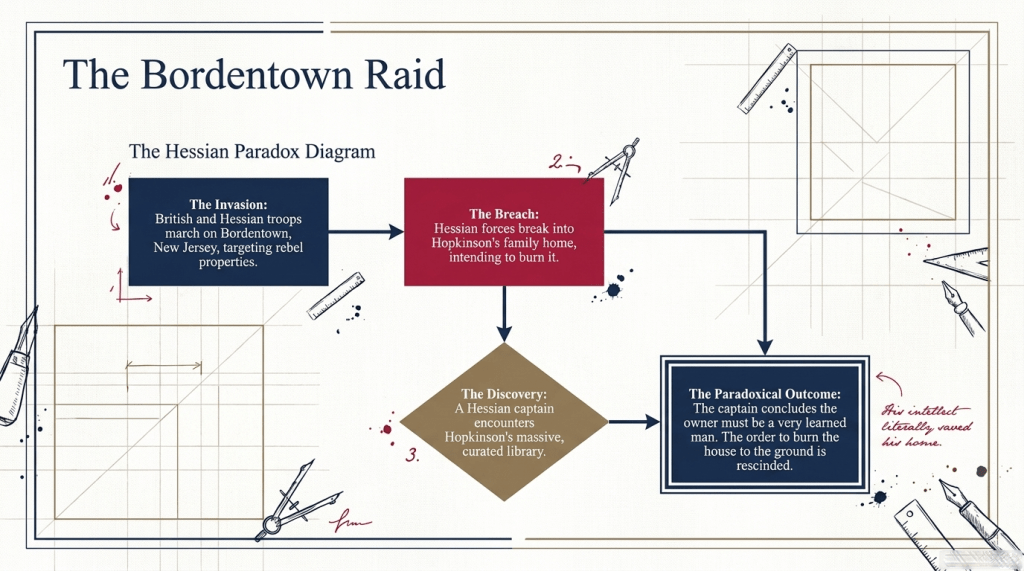
The consequences arrived soon enough. British and Hessian troops looted Hopkinson’s property more than once during the war. Furniture disappeared. Household goods vanished. Yet the losses that seem to have affected him most deeply were not necessarily the most valuable in monetary terms. Among the items taken or destroyed were books, scientific instruments, and equipment connected to the endless curiosity that had defined so much of his life. Hopkinson had spent decades building a world of ideas around himself. He collected books because he read them. He acquired instruments because he used them. The losses represented more than damaged property. They represented interrupted pursuits, abandoned projects, and years of accumulated intellectual effort scattered by men who likely had little interest in any of it.
Anyone who has ever built a personal library understands the difference. Books are rarely acquired all at once. They arrive one volume at a time, often attached to memories of particular moments, discoveries, and interests. Scientific instruments carried similar significance for a man like Hopkinson. To an outsider they may have appeared as odd pieces of brass, glass, and wood. To him they represented questions worth exploring. Their destruction was not merely financial. It was personal.
One of the more remarkable stories associated with Hopkinson’s wartime experiences concerns the survival of the house itself. According to accounts that circulated afterward, a Hessian officer inspecting the property became impressed by the size and quality of Hopkinson’s library. Concluding that the owner must be a learned man, the officer reportedly decided that the house should not be burned. Historians are generally wise to approach such stories with caution. Wartime recollections have a habit of improving with age. Yet the tale has endured because it feels plausible. One can easily imagine a European officer recognizing a fellow lover of books and hesitating before consigning an entire library to the flames.
Whether every detail occurred exactly as later generations described it is ultimately less important than the larger truth behind the story. Hopkinson’s house survived, though damaged. His library may well have played a role in that outcome. There is a certain irony in the possibility. The man who spent years using words to challenge imperial authority may have owed the survival of his home to another man’s respect for books.
Even so, survival should not be confused with preservation. The raids left their mark. Independence must have looked very different from Bordentown than it had from Philadelphia. Grand political principles tend to sound noble when debated in assembly halls. They become harder, heavier things when soldiers are carrying away possessions and overturning the contents of a family’s home. Hopkinson had helped create a nation. The war reminded him that creating nations is rarely a tidy process.
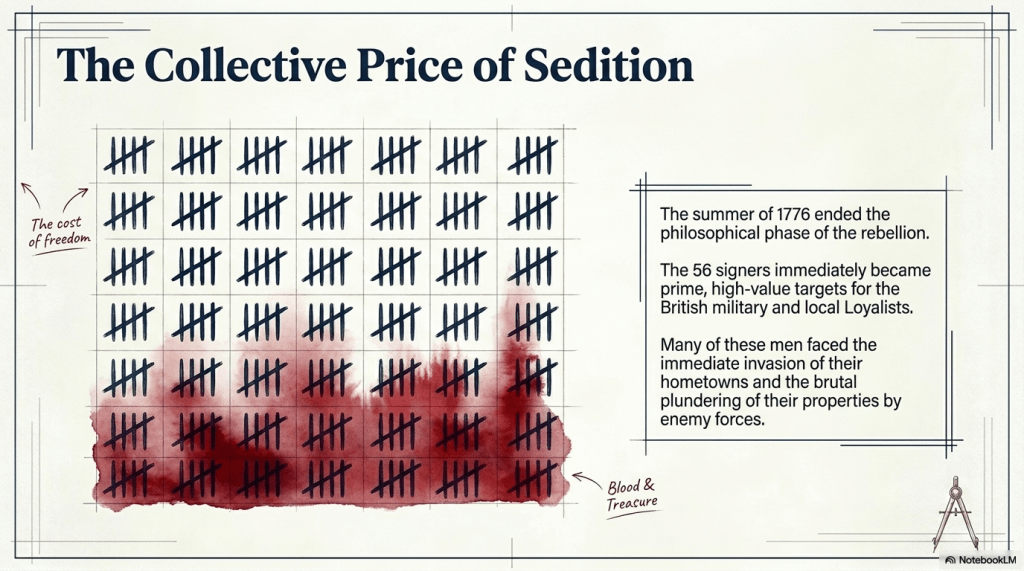
His experience was hardly unique. Americans often remember the fifty-six signers of the Declaration as though they were statues standing together on a pedestal. In reality, they were individuals with separate lives, separate worries, and separate vulnerabilities. Some were wealthy. Some were not. Some possessed extensive property. Others relied primarily upon professional careers. They came from different colonies and frequently disagreed with one another. What united them was not uniformity but commitment. Every one of them understood that supporting independence involved risks whose full dimensions remained unknown.
Those risks became painfully clear as the war progressed. Richard Stockton of New Jersey was captured by British forces and subjected to treatment that permanently damaged his health. Francis Lewis of New York watched British troops destroy property and endured the imprisonment of his wife. Thomas McKean spent years moving frequently to avoid capture. Carter Braxton’s fortune suffered severe losses as wartime disruptions transformed the economy. Thomas Nelson Jr. found his own property threatened during military operations. The details differed from man to man, but the pattern remains unmistakable. The Revolution extracted payment from many of the people who led it.
At the same time, history becomes distorted when hardship turns into legend. Popular stories sometimes claim that every signer lost everything he owned, died in poverty, or suffered complete ruin. The historical record simply does not support such claims. Several signers remained prosperous. Some enjoyed successful careers after independence. Others lived long enough to witness the growth and stabilization of the nation they had helped create. Reality occupies a more complicated space than mythology. Not every signer was ruined, but every signer accepted the possibility of ruin.
That distinction matters because it restores the uncertainty that later generations often lose sight of. We know how the story ends. They did not. We know that Washington survives the dark years of the war. We know that Yorktown eventually arrives. We know that independence endures. The men living through the Revolution possessed none of that knowledge. Every defeat created new doubts. Every winter produced fresh anxieties. Every military campaign carried the possibility that the entire project might collapse. The outcome appears inevitable only when viewed from the far side of victory.
Hopkinson lived through those years without abandoning the cause he had embraced. He continued serving the emerging nation in various capacities. He continued contributing his talents to public affairs. Most importantly, he continued believing that independence was worth the cost. The destruction of his property did not persuade him that the Revolution had been a mistake. The loss of his books did not convince him that the cause had been misguided. If anything, the hardships seem to have strengthened his conviction that some principles justified sacrifice.
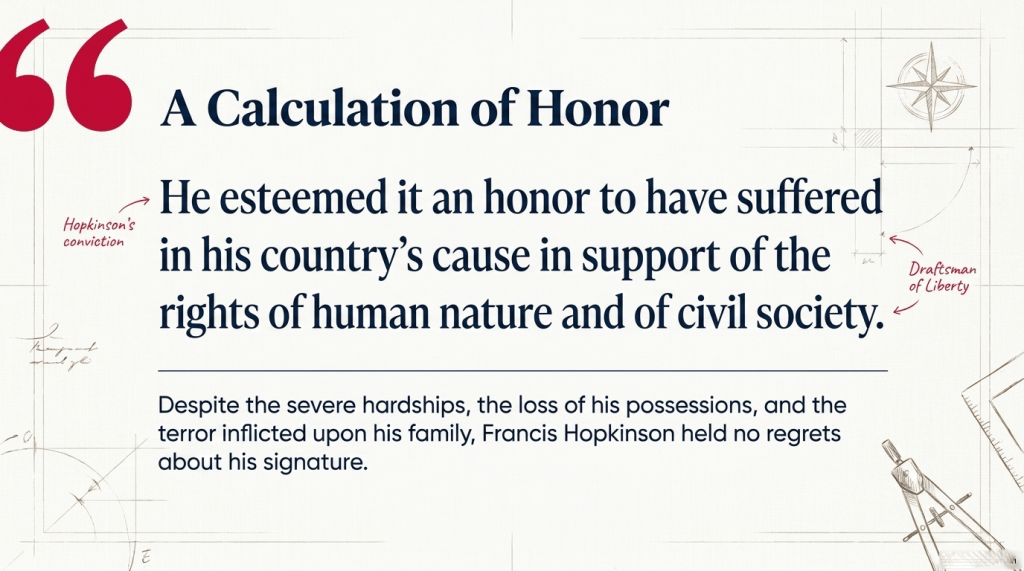
His own words provide perhaps the clearest window into his thinking. Writing about the soldiers who had looted his property, Hopkinson referred to them as the “Goths & Vandals,” invoking the ancient destroyers of civilization. The phrase carried unmistakable anger. It also carried a measure of educated contempt. Yet the most revealing part of his reflection came afterward. He did not dwell upon his losses. He did not present himself as a victim. Instead, he declared that he esteemed it an honor to have suffered in his country’s cause.
That statement tells us something important about Francis Hopkinson. He was not a soldier in the conventional sense. He did not achieve fame through battlefield heroics. His weapons had often been words, ideas, humor, and imagination. Yet when the consequences of revolution arrived at his own doorstep, he accepted them with the same determination displayed by men serving in the field. The destruction of a library may not resemble a battlefield wound, but both represent costs imposed by war. Both require sacrifice.
In many ways, Hopkinson’s experience serves as a window into the broader experience of the signers themselves. These men disagreed about politics, economics, religion, and regional interests. They argued constantly. They viewed the future through different lenses. Yet they shared a willingness to place uncertainty ahead of security. They accepted that liberty carried a price, even though none of them could know exactly how much they would ultimately be asked to pay.
Looking back across the years, Hopkinson offered words that speak not only for himself but for many of the men whose names appear beneath the Declaration of Independence. Despite the raids, the losses, and the hardships inflicted by what he called the “Goths & Vandals,” he declared that he esteemed it an honor to have suffered in his “country’s cause in support of the rights of human nature and of civil society.” Few quotations capture the spirit of the Revolutionary generation more clearly. The Declaration was never merely a statement of principles. It was a promise to accept the consequences that accompanied those principles. Francis Hopkinson counted the cost, endured it, and concluded that the cause had been worth the sacrifice.

 DAVE DOES HISTORY
Leave a comment