
Most Americans can tell you something about Saratoga. Many remember Yorktown. Even people who slept through high school history usually recognize the names of Washington, Cornwallis, and perhaps Benedict Arnold. Yet one of the most ambitious campaigns of the American Revolution has nearly vanished from popular memory. Before the Declaration of Independence was even signed, the Continental Congress attempted something extraordinary. The Americans tried to conquer Canada and bring it into the Revolution as the fourteenth colony.
At first, the idea did not seem entirely unreasonable. Many Patriot leaders believed that French-speaking Canadians, recently transferred from French to British rule after the Seven Years’ War, might welcome liberation from London. If Canada joined the rebellion, British forces would lose their principal base in the north. The colonies would gain strategic depth, control of vital waterways, and perhaps thousands of new allies. It was a gamble, but revolutions are often built on gambles.
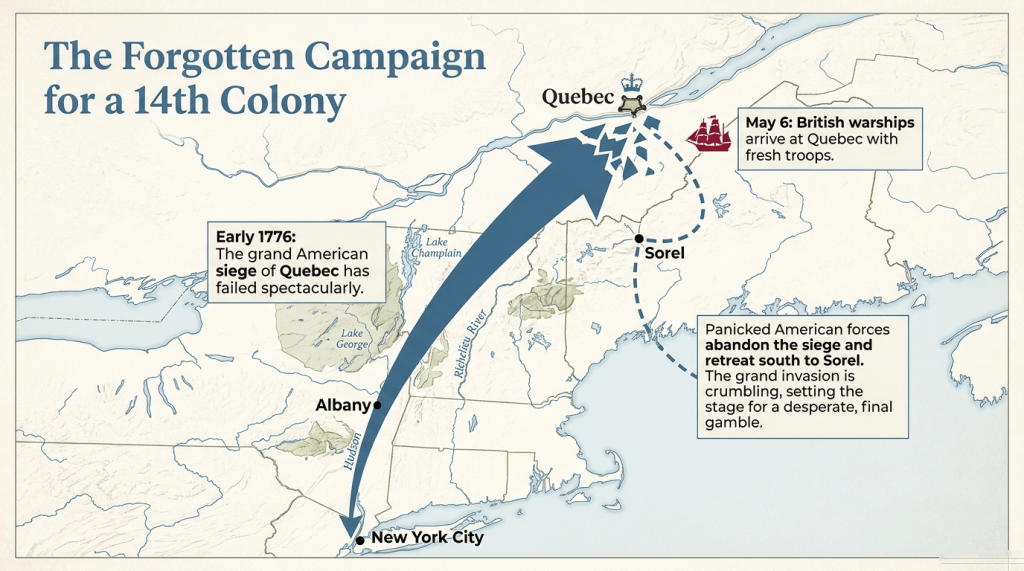
The campaign began with promise. American forces pushed north through difficult wilderness, captured Montreal, and laid siege to Quebec. Men endured bitter cold, disease, hunger, and exhaustion. Some marched through forests that seemed determined to swallow them whole. Others crossed frozen rivers beneath winter skies that cared very little about politics. They reached Quebec, but reaching the city proved easier than taking it.
The assault on Quebec during the final hours of 1775 ended in disaster. American commanders were killed or captured. The surviving soldiers settled into a grim siege that stretched through the winter and into the spring of 1776. Smallpox ravaged the ranks. Supplies dwindled. Reinforcements arrived too slowly. Hope became harder to find with each passing week.
Then came the moment that changed everything.
On May 6, 1776, British ships finally reached Quebec carrying desperately needed reinforcements. Fresh troops poured into the city while the exhausted Americans watched their chances disappear. The besiegers suddenly became the hunted. Unable to stand against the strengthened British garrison, the Continental Army abandoned its positions and retreated up the St. Lawrence River toward Sorel.
What followed was not merely another retreat. It was the beginning of the end of the American dream in Canada.
Desperate to regain the initiative, American leaders launched a risky operation against the British position at Trois-Rivières. Poor intelligence, confused planning, unfamiliar terrain, and simple bad luck combined to create a catastrophe. Soldiers became lost in swamps. Units lost contact with one another. British forces reacted quickly and decisively. By the time the fighting ended, the Americans had suffered a defeat that shattered any realistic hope of salvaging the campaign.
The Battle of Trois-Rivières was not one of the largest battles of the Revolution, nor one of the bloodiest. Yet its consequences were enormous. The defeat effectively ended the American invasion of Canada and ensured that the northern colonies would remain under British control. For the remainder of the war, Canada would serve as a base for British operations rather than a partner in American independence.
History often remembers the victories that created a nation. Sometimes it forgets the failures that shaped it just as profoundly. Trois-Rivières was one of those moments, a muddy, confusing battle fought far from Philadelphia, where the future narrowed and one possible version of North America quietly slipped away.
The American army that gathered around Sorel in early June of 1776 was not the same confident force that had marched into Canada the previous autumn. The grand dream of liberating Canada and welcoming it into the Revolution had collided with the hard realities of distance, disease, weather, and war. The siege of Quebec had failed. Smallpox had torn through the ranks. Hundreds of enlistments were expiring. Men who had once imagined themselves liberators now spent much of their time worrying about food, medicine, and whether they would survive another week.
Yet if the army was battered, its leaders were not prepared to admit defeat.
The retreat from Quebec after the arrival of British reinforcements had been rapid and humiliating. On May 6, sails appeared on the St. Lawrence carrying the very thing Governor Guy Carleton had prayed for during the long winter siege. Reinforcements from Britain had finally arrived. Veteran regiments stepped ashore. Fresh artillery followed. Supplies flowed into the city. Even more alarming for the Americans, German troops under Baron Friedrich Adolf Riedesel soon joined the growing British concentration. Every arriving ship shifted the balance of power a little further away from the struggling Continental Army.
Carleton understood exactly what was happening. For months he had survived by holding on. Now he could begin thinking about victory.
The Americans, meanwhile, were trapped inside a dangerous fog of uncertainty. Reliable intelligence in eighteenth century warfare was often little better than educated guesswork. Scouts reported one thing. Civilians reported another. Rumors traveled faster than facts. Information that reached headquarters was often several days old before anyone read it. By the time decisions were made, circumstances had frequently changed.
At Sorel, many American officers convinced themselves that the British position at Trois-Rivières remained weak and vulnerable. Reports suggested only a modest force occupied the town. There were warnings that British strength was growing, but those warnings were often discounted or explained away. After months of defeat and retreat, officers desperately wanted to believe there was still an opportunity to seize the initiative.
The temptation was understandable. Military commanders rarely enjoy admitting that a campaign has failed. They search for opportunities, sometimes long after those opportunities have disappeared. They convince themselves that one successful battle might restore momentum, revive morale, and change the course of events.
That was precisely the hope taking shape at Sorel.
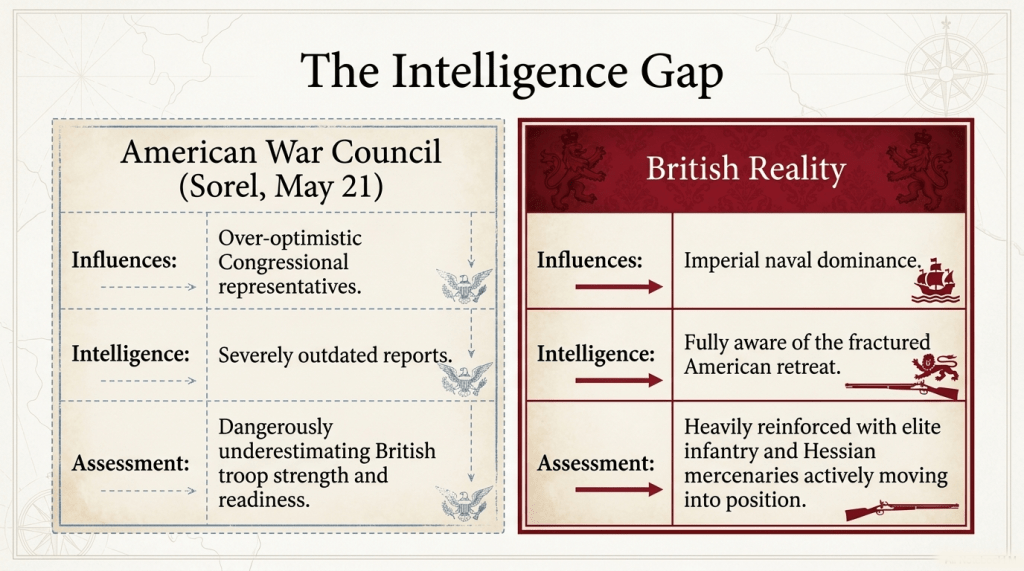
Brigadier General William Thompson received orders to lead an expedition against Trois-Rivières. Thompson was no reckless adventurer. He had earned a reputation as a capable officer and understood the risks involved. Working closely with him was Colonel Arthur St. Clair, another experienced soldier who shared the belief that aggressive action offered the best chance of salvaging something from the collapsing campaign.
The original plan called for a substantial strike against what was believed to be an isolated British force. If successful, the attack might disrupt British operations and buy valuable time for the Americans to reorganize. It was certainly a gamble, but in theory it was a gamble based upon attainable objectives.
Then General John Sullivan made the gamble larger.
Sullivan had recently assumed command in Canada and possessed a personality ill-suited for passive defense. Retreating armies tend to weigh heavily on the minds of energetic commanders. Sullivan wanted action. He wanted a victory. He wanted to demonstrate that the American cause in Canada was not yet lost. Rather than treating the operation as a limited strike, he expanded it into a major assault involving roughly two thousand men.
The decision reflected both courage and optimism. Unfortunately, optimism is not always the same thing as good judgment.
On the evening of June 7, American soldiers began crossing the St. Lawrence River. The operation itself was impressive. Hundreds of men crowded into boats and pushed into the darkness. Muskets, ammunition, and equipment were carefully loaded. Officers moved quietly among the ranks. Oars dipped into black water. The broad river carried them northward toward what many hoped would become a turning point in the campaign.
One can almost imagine the conversations whispered among the soldiers. They had spent weeks retreating. Now, at last, they were moving toward the enemy again. Perhaps they would strike a meaningful blow. Perhaps they would prove the campaign could still be saved.
Those hopes began unraveling almost as soon as the boats reached shore.
The American plan depended upon surprise, but surprise was remarkably difficult to achieve in a populated countryside. Loyalist inhabitants observed unusual movements. Word spread rapidly through nearby settlements. Messengers hurried toward British positions carrying news that enemy troops had crossed the river.
Before the Americans had properly organized their advance, Brigadier General Simon Fraser was already receiving reports of their approach.
Fraser reacted exactly as a competent commander should. He alerted his officers, strengthened defensive positions, and prepared for battle. Additional troops were summoned. Reinforcements were moved toward threatened areas. Every passing hour improved the British position while steadily eroding the Americans’ chances of success.
The Americans remained unaware of how quickly circumstances were changing.
As Thompson’s column moved inland, it encountered another problem, one that would become legendary in the history of the campaign. The region surrounding Trois-Rivières was unfamiliar to most of the invading soldiers. Roads were limited. Marshland stretched across significant portions of the countryside. Streams, thickets, and low ground created natural obstacles that complicated movement even during daylight.
To navigate the area, the Americans secured the services of a local farmer named Antoine Gautier. What happened next has fueled historical arguments ever since.
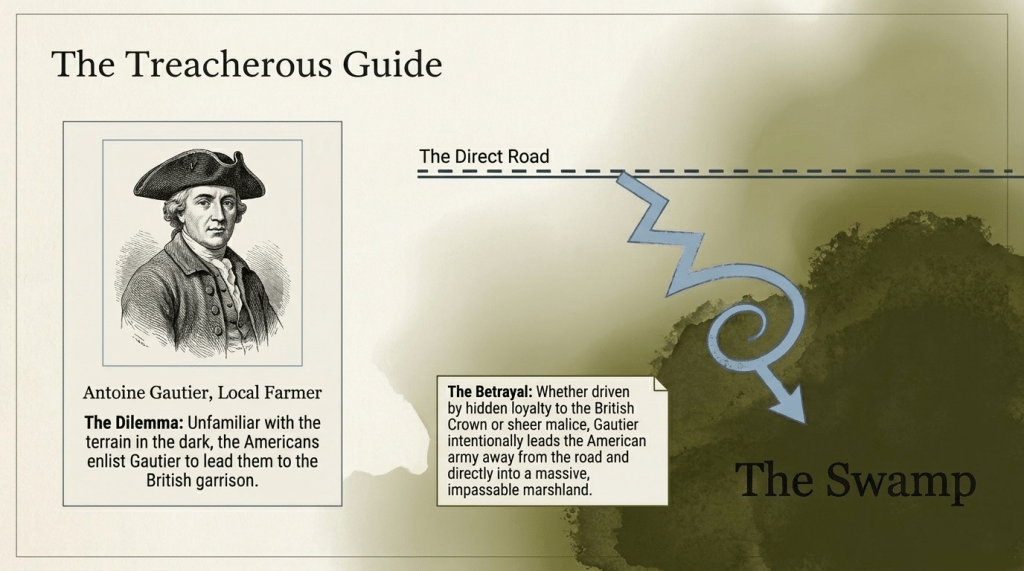
Some historians have concluded that Gautier deliberately betrayed the Americans and guided them into disaster. Others argue that he became confused in difficult terrain under difficult conditions. The evidence allows room for both interpretations, which is often the historian’s way of admitting that the truth remains stubbornly elusive.
Whatever Gautier intended, the result was catastrophic. Rather than moving directly toward Trois-Rivières, the American force found itself wandering into a vast swampy expanse. Columns became separated. Officers struggled to maintain control. Men stumbled through mud and standing water. Units lost track of one another in darkness and confusion. Valuable hours slipped away while commanders attempted to determine their location and recover some semblance of order.
The swamp seemed to consume not merely their movement but their entire plan. Messages arrived late. Guides disagreed. Officers issued conflicting instructions. Exhausted soldiers pushed through reeds and muck while trying to maintain formation. What had begun as a carefully organized offensive increasingly resembled a confused march through unfamiliar wilderness.
Back at Trois-Rivières, Simon Fraser could hardly have asked for a better development.
Every hour the Americans spent trapped in the wetlands gave the British more time to prepare. Additional troops arrived. Defensive positions improved. Confidence grew among officers who could see the enemy’s opportunity slipping away. The force that American intelligence had described as vulnerable was steadily becoming stronger.
As dawn approached, two very different scenes were unfolding across the countryside. In the British camp, officers prepared methodically for the coming fight. In the swamp, American soldiers struggled simply to find their way.
The battle had not yet begun, but the conditions that would determine its outcome were already taking shape in the darkness, among the reeds, the mud, and the costly consequences of believing intelligence that was no longer true.
When the American columns finally fought their way out of the swamp on the morning of June 8, they must have felt a certain measure of relief. The nightmare march through mud, reeds, stagnant water, and darkness was behind them. Men had spent hours stumbling through terrain that seemed determined to swallow both soldiers and plans alike. Officers had struggled to maintain direction. Units had become separated and reassembled more than once. The entire operation had already consumed precious time.
Yet many still believed success remained possible.
The intelligence carried from Sorel had painted a picture of opportunity. Trois-Rivières was supposedly held by a relatively small British force. If the Americans could strike quickly and aggressively, they might overwhelm the defenders before larger reinforcements could arrive. The gamble had seemed risky when conceived. After the ordeal of the night march, it seemed even riskier. Still, it remained a gamble some believed might pay off.
Then reality appeared through the morning haze.
Instead of a vulnerable outpost, the Americans found prepared British troops waiting for them. Simon Fraser had received warning of their approach hours earlier. Local Loyalists had carried news of the crossing almost as soon as American boats touched shore. Throughout the night Fraser had strengthened his position, concentrated his forces, and prepared for the attack he knew was coming. The surprise upon which the entire American plan depended had vanished before the first musket was fired.
What followed was less a battle plan unfolding than a battle plan unraveling.
American units entered the fight unevenly. Some formations arrived before others. Officers struggled to understand where neighboring commands were located. Messages moved slowly across a battlefield cluttered with woods, fields, waterways, and uncertainty. Instead of delivering a coordinated blow against a surprised enemy, the Americans found themselves colliding with an opponent that was alert, organized, and increasingly confident.
British musket fire tore into the advancing ranks. American soldiers attempted to deploy and press forward, but every movement seemed to encounter resistance. The ground remained difficult. Visibility was often limited. The confusion that had haunted the night march now spread across the battlefield itself.
As the fighting intensified, another problem announced itself with thunderous force.
The British were not fighting alone.
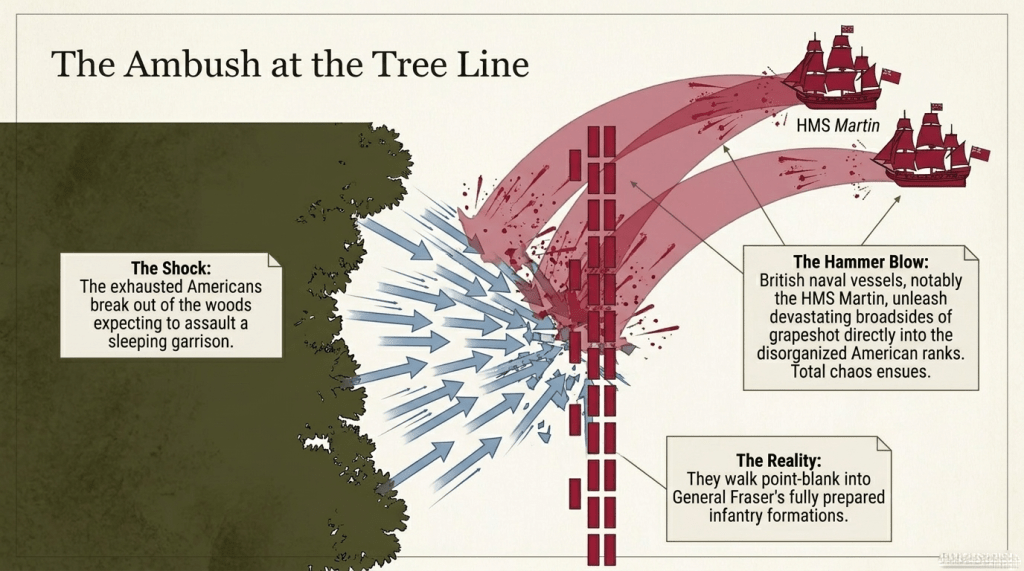
Anchored nearby was HMS Martin, whose guns brought the weight of the Royal Navy into the battle. The St. Lawrence had shaped every stage of the Canadian campaign, serving as a highway for armies, supplies, and reinforcements. On this day it also became a source of floating artillery. Naval gunfire crashed into areas where American troops attempted to maneuver, adding noise, destruction, and confusion to an already deteriorating situation.
The psychological effect was considerable. Men who had marched through darkness and swamps now found themselves facing disciplined infantry supported by heavy guns. Smoke drifted across the countryside. Officers shouted commands that disappeared into the roar of cannon and musketry. Formations lost cohesion. Efforts to organize a sustained assault gradually gave way to efforts simply to avoid disaster.
The truth was becoming impossible to ignore.
The Americans had not marched against a weak garrison.
They had marched into a trap of their own making.
Faulty intelligence had convinced them they possessed the advantage. In reality, the British possessed nearly every advantage that mattered. They knew the Americans were coming. They occupied favorable positions. Reinforcements had arrived throughout the night. Their commanders understood the battlefield. Their troops entered the fight rested and organized.
The Americans entered it exhausted.
As the morning wore on, the attack began to collapse. Brigadier General William Thompson attempted to rally his men and maintain pressure, but the opportunity for success had already slipped away. British resistance stiffened with every passing hour. What had begun as an offensive operation increasingly resembled a desperate struggle to avoid encirclement.
Eventually there was little choice left. The Americans had to retreat.
If advancing through the swamp had been difficult, retreating through it while pursued by a victorious enemy promised to be even worse. Units began pulling back in uneven stages. Some maintained discipline. Others dissolved into clusters of soldiers trying to find a route to safety. The danger was not merely defeat. The danger was complete destruction.
At this critical moment, one officer helped prevent the situation from becoming catastrophic.
Colonel Anthony Wayne understood exactly what was at stake. Years later his reputation would be built upon aggressive attacks and battlefield daring, but on this day his contribution lay in something less glamorous and perhaps more important. He organized a rear guard that stood between the retreating Americans and an increasingly confident British force.
Wayne’s men fought hard and fought well. They yielded ground when necessary, then turned and resisted again. Their purpose was not to win the battle. That possibility had already vanished. Their purpose was to buy time. Every minute gained allowed additional American soldiers to escape the battlefield and move toward the routes leading back to safety.
It was stubborn, disciplined work performed under immense pressure.
Without it, the defeat at Trois-Rivières might have become one of the most devastating disasters of the entire Revolution.
Even with Wayne’s efforts, the withdrawal remained chaotic. Soldiers wandered through unfamiliar terrain searching for crossing points and roads. Officers attempted to gather scattered commands. Small groups became separated from the main force. The retreat unfolded across miles of countryside, creating confusion that lingered long after the shooting ended.
The British recognized the opportunity before them.
If they moved quickly enough, they might transform victory into annihilation.
The key lay at the bridge spanning the Rivière-du-Loup. Major Grant acted decisively, moving to secure the crossing before the Americans could reach it. His objective was straightforward. If the bridge remained in British hands, large portions of the Continental force could be trapped between pursuing British troops and difficult terrain. Thousands of Americans might be forced to surrender.
For a brief period, exactly that outcome appeared possible. Then Guy Carleton intervened.
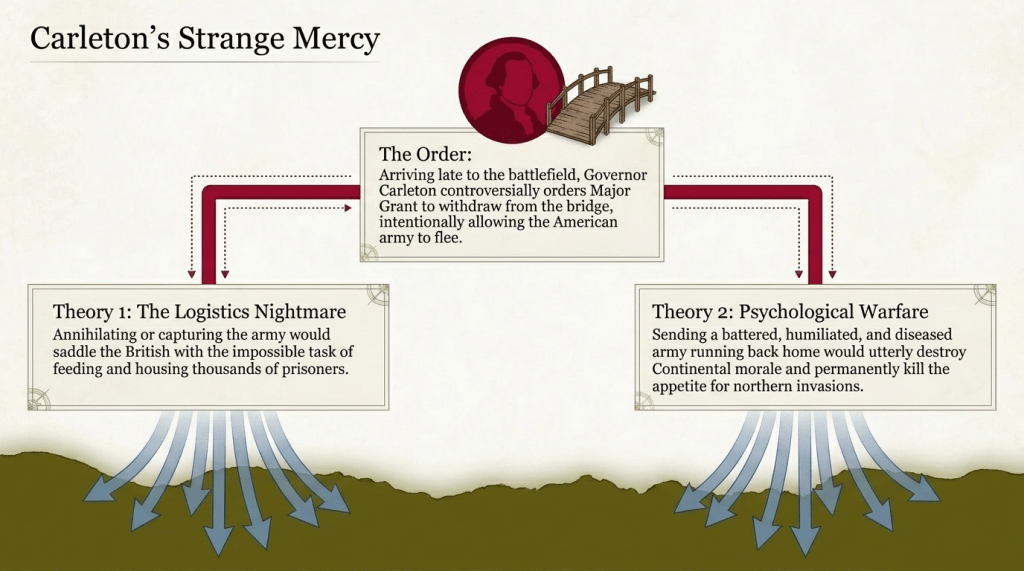
The British governor’s decision remains one of the most fascinating moments of the campaign. Rather than sealing the trap completely, Carleton ordered the bridge reopened. The decision allowed most of the defeated Americans to continue their retreat. Soldiers who only hours earlier had faced the prospect of capture suddenly found a path of escape.
Historians have argued about the reasoning ever since.
Some point to logistics. Capturing several thousand prisoners sounds impressive in theory, but prisoners must be fed, guarded, housed, and transported. British resources in Canada were improving, yet they were hardly unlimited. A massive influx of captives would create practical problems that Carleton may have preferred to avoid.
Others believe the decision reflected a broader strategic calculation. By June of 1776 the American invasion was already collapsing. The survivors would carry home stories of disease, defeat, confusion, and failure. A shattered army limping southward might discourage future invasions more effectively than a large collection of prisoners sitting behind British guards.
There is also the possibility that Carleton simply saw no reason to press for unnecessary severity. Throughout his career he often demonstrated a preference for restraint when restraint served British interests. Allowing a beaten enemy to retreat was not necessarily an act of mercy. It could also be an act of confidence.
Whatever his motives, the decision changed the scale of the disaster. Many Americans escaped. Not all did.
Roughly 236 prisoners fell into British hands, including General William Thompson himself. The commander who had led the expedition spent the remainder of the battle as a captive rather than a combatant. For him, the campaign ended in British custody.
British casualties remained remarkably light. The Americans had suffered far more heavily, not simply in men captured but in lost opportunities, lost confidence, and lost momentum. By the time the firing ceased, the outcome was unmistakable.
The Battle of Trois-Rivières had done more than defeat an American attack.
It had exposed the weakness of the entire Canadian campaign. The invasion that had begun with dreams of a fourteenth colony was now unraveling before everyone’s eyes, and no amount of optimism could hide that fact any longer.
The Battle of Trois-Rivières did not produce the enormous casualty lists associated with some of the Revolution’s more famous battles. It did not inspire a dramatic painting that would hang in classrooms for generations. It did not become a rallying cry repeated by schoolchildren. Yet its consequences were profound because the battle effectively ended the American invasion of Canada.
In the days that followed, the remaining hopes of establishing a fourteenth colony slipped away. The Continental Army was already struggling before the battle. Smallpox continued to ravage the ranks. Supplies remained scarce. Morale had suffered through months of retreat and disappointment. Enlistments expired. Desertion increased. The defeat at Trois-Rivières simply confirmed what many soldiers and officers had already begun to suspect. The campaign could not be saved.
General John Sullivan recognized the reality before him. The army abandoned its remaining positions and began withdrawing south. Boats, supplies, and military stores that could not be carried away were destroyed to prevent their capture. Fort after fort was abandoned. The long retreat carried the Americans back toward Lake Champlain and eventually toward Fort Ticonderoga. Less than a year after marching north with visions of liberation and expansion, the Continental Army had been driven completely out of Canada.
For the remainder of the war, Canada would remain firmly in British hands. Rather than becoming a partner in the Revolution, it became a base from which British armies could threaten New York and the northern frontier. The strategic map of North America had taken a different path than many Patriot leaders had imagined.
Today, the battle remains far better remembered in Trois-Rivières than in the United States. Visitors to the city can find commemorative plaques marking important locations associated with the fighting. Local memory has preserved a story that much of the American public gradually forgot. The battle occupies a place in the history of the city because it brought war directly to its streets, farms, and surrounding countryside.
One of those memorials honors Antoine Gautier, the farmer whose role in the battle remains a subject of debate nearly 250 years later. Was he a loyal subject of the Crown who intentionally misled the Americans into the swamp? Was he simply a local resident overwhelmed by confusing terrain and confused soldiers? Historians still argue about the answer. What is certain is that his name became permanently attached to one of the most consequential military misadventures of the Revolutionary War.
The most remarkable legacy of Trois-Rivières, however, may not involve soldiers at all.
After the battle ended, wounded men from both armies required care. The Ursuline Sisters of Trois-Rivières opened their convent and treated the injured without regard to which side they had fought for. British soldiers received treatment. American soldiers received treatment. In an era when warfare often produced bitterness and revenge, the sisters practiced a simpler and older tradition, caring for the suffering because they were suffering.
As one might expect, medicine, food, and lodging generated expenses. The Ursulines submitted a bill for the care provided to wounded American soldiers. Congress acknowledged the debt but never paid it. The years passed. Then the decades passed. Empires rose and fell. The Revolution became history. The unpaid account lingered in the records of the convent, transforming from a financial obligation into one of those charming historical footnotes that seem almost too perfect to be true.
By the early twenty-first century, the debt had become a local legend. Estimates of what the original bill might be worth with centuries of accumulated interest reached absurdly large figures, producing plenty of smiles on both sides of the border.
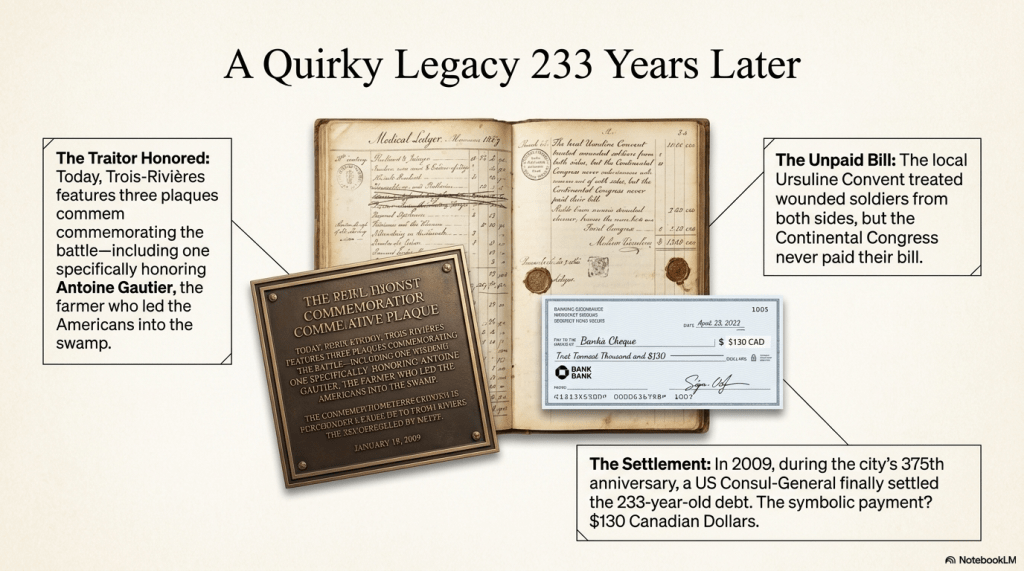
Finally, in 2009, during the 375th anniversary celebration of Trois-Rivières, the story received its ending. Representing the United States, an American diplomat made a symbolic payment of 130 Canadian dollars to settle the centuries-old account. Nobody seriously believed the amount reflected 233 years of accumulated interest. That was never the point. The payment acknowledged a shared history, a forgotten episode of the Revolution, and an act of compassion that had outlived the battle itself.
In the end, that may be the most fitting legacy of Trois-Rivières. The battle marked the failure of an invasion and the collapse of an ambitious dream. Yet long after the armies marched away, long after the gunfire faded across the St. Lawrence, people still remembered the farmer who led soldiers into a swamp and the nuns who cared for the wounded. History often remembers generals and governments. Sometimes it is the ordinary people who leave the longer shadow.
“American Retreat from Trois-Rivières: 8 July 1776 | 1764-1811.” The Loyal Edmonton Regiment Military Museum.
Battle of Saratoga: Path to British Surrender and Highlander General Simon Fraser.
“Battle of Trois-Rivières.” Wikipedia.
Saratoga: A Military History of the Decisive Campaign of the American Revolution.
The Canadian Campaign, 1775-1776. GovInfo.
The Swamp of Defeat: The Battle of Trois-Rivières.
Thompson’s Rifle Battalion: The Original Unit of the Army of the United Colonies (Now the United States Regular Army). Department of War.
“Trois-Rivières 1776: The American Disaster That Ended the Invasion of Canada | Revolutionary War.” YouTube.
With Zeal and With Bayonets Only: The British Army on Campaign in North America, 1775–1783 (Campaigns and Commanders Series).




Leave a Reply