
London in December of 1640 did not feel like the center of a stable kingdom. It felt like a boiler rattling somewhere below deck while everyone pretended not to hear the sound. The streets around Westminster were thick with mud, smoke, winter fog, and rumor. Apprentices shoved through crowds carrying bundles and baskets. Church bells echoed through cold air that smelled of wet wool, coal smoke, horse manure, and the river. Above it all sat Parliament, newly summoned after eleven years of silence, facing a kingdom that had spent more than a decade talking to itself because the King would not listen.
Then came the petition.
Not quietly either.
Groups of Londoners gathered first in knots and clusters, then in something larger and heavier, like weather moving in. Tradesmen, shopkeepers, apprentices, ministers, householders. Men who had spent years muttering complaints over ale mugs or whispering after sermons now carried parchment in their hands and anger in their chests. Some accounts estimated fifteen thousand signatures attached to the document. Whether the exact number was smaller hardly matters. It was large enough to frighten people who understood what public mobilization could become.
And this petition was not asking for minor repairs.
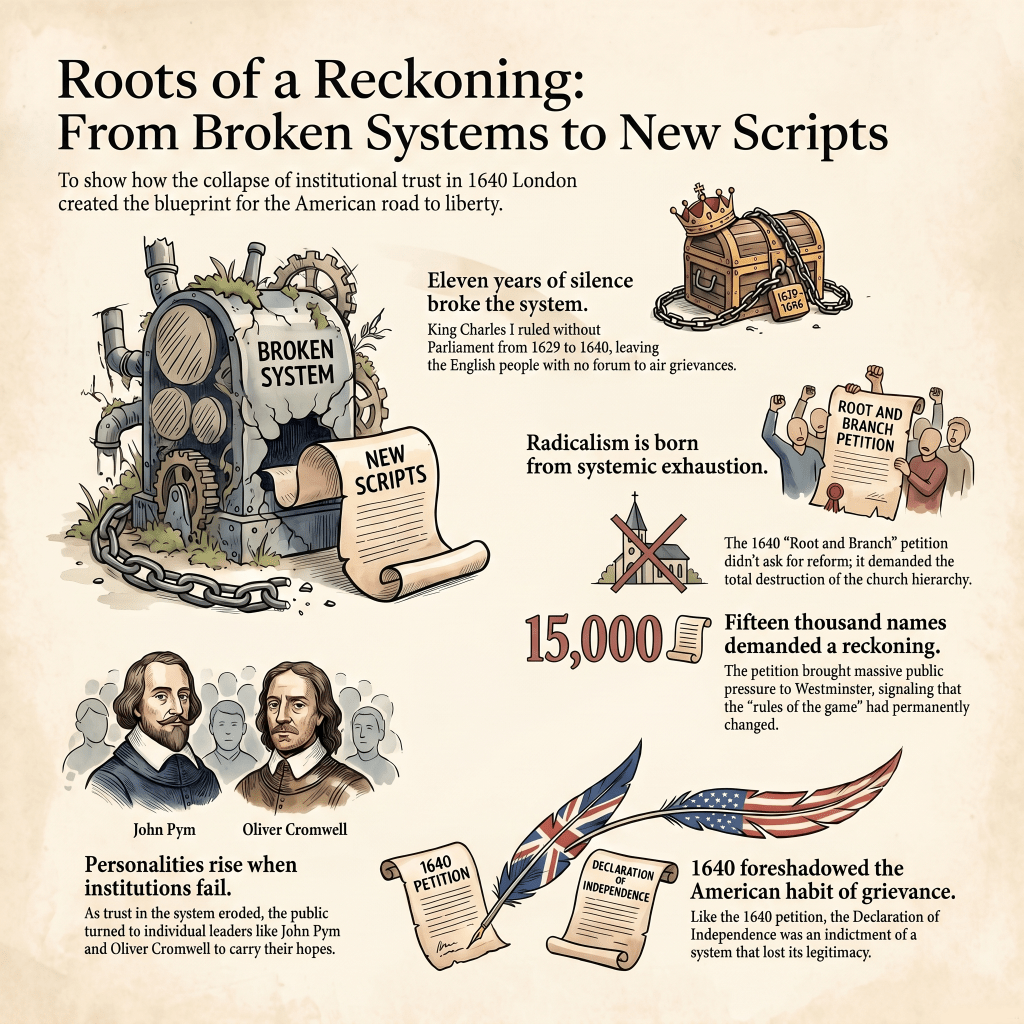
It demanded the complete abolition of bishops in England. Root and branch. Not reform. Not moderation. Not better behavior from church leadership. The whole episcopal structure had to go. Archbishops, bishops, deans, chapters, courts, offices, the entire machinery dismantled because the petitioners believed it had become corrupt beyond correction.
To modern ears, that can sound strangely technical. Bishops. Ecclesiastical hierarchy. Liturgical disputes. The sort of thing most Americans today would skim past while reaching for coffee. But in seventeenth century England, religion was not separated neatly from politics, law, culture, or national identity. Church structure was political structure. To challenge bishops was to challenge the architecture of authority itself.
The crowd knew it. Parliament knew it too.
This was not merely a theological disagreement wrapped in parchment. It was an accusation that the Church of England had become an engine of coercion tied directly to royal power. The petition declared openly that the existing system could no longer be trusted to reform itself. That is always a dangerous sentence in any society, even when nobody says it aloud directly.
And the remarkable thing is that these people were willing to risk mutilation, imprisonment, financial ruin, or death simply to carry this grievance publicly into the heart of English government. That sounds dramatic now, but the risks were very real. Critics of the regime had already been branded, pilloried, imprisoned, and physically mutilated. Ears had been cut off publicly. Faces had been marked. Men like William Prynne became living reminders that the government and the Church were perfectly willing to use terror in defense of conformity.
Yet people came anyway.
That tells you something important about the level of exhaustion already settling over England by 1640.
King Charles I had ruled without Parliament since 1629 in what became known as the Personal Rule. For eleven years there had been no national legislative forum where grievances could be aired, debated, corrected, or even acknowledged. Imagine trying to explain to Englishmen raised on constitutional traditions stretching back centuries that the representatives of the people simply would not meet anymore because the King found them inconvenient.
At first, many accepted it.
That part matters because populations almost always tolerate more concentration of power initially than later generations like admitting. People were tired of political conflict. Charles promised stability. He projected seriousness, order, certainty. Most assumed the arrangement was temporary and that the old constitutional balance would eventually return.
Instead, the system hardened.
Taxes like Ship Money, originally intended for emergencies, became routine revenue mechanisms imposed without parliamentary consent. Courts such as the Star Chamber and the High Commission increasingly operated without juries and without much patience for dissent. Institutions once expected to restrain arbitrary authority slowly transformed into instruments enforcing it.
That shift changed the emotional atmosphere of England.
Government no longer felt like something citizens participated in. It became something happening to them from above. That distinction sounds subtle until one realizes how quickly trust begins eroding once people feel permanently excluded from the mechanisms shaping their lives.
At the center of much of this stood Archbishop William Laud.
Laud believed England had become spiritually lax, fragmented, and dangerously disorderly. His solution was uniformity imposed from the top downward. He restored ceremony and ritual many Protestants associated with Catholicism. Communion tables were moved and fenced. Calvinist preaching was discouraged or suppressed. Ministers were ordered to conform rigidly to the Book of Common Prayer. Religious dissent increasingly became treated less as disagreement and more as disobedience.
Now, to modern Americans, these disputes can initially sound bizarrely intense. Communion rails. Liturgical forms. Vestments. Prayer books. One almost expects somebody eventually to declare war over the proper placement of hymnals. Yet to seventeenth century Protestants, these were not cosmetic issues. They believed deeply that England was drifting back toward Roman Catholic authoritarianism under the protection of royal power.
And Laud enforced compliance aggressively.
Critics were not debated politely across academic symposium tables while sipping imported coffee. They were punished publicly and deliberately. Prynne, Burton, Bastwick, these men became famous because the government mutilated them visibly. The intention was deterrence. The result was martyrdom. Ordinary people saw bleeding men standing in pillories and concluded something fundamental inside the system had broken.
That is where the pressure really began building.
Parliament was absent. Courts seemed compromised. The Church increasingly resembled an extension of executive power. The King appeared uninterested in compromise. Every institution designed to mediate conflict looked either paralyzed or captured. England still possessed the outward appearance of order, but beneath the surface legitimacy itself was beginning to crack.
Then Charles made the mistake that exposed his weakness.
He attempted to impose this same religious vision upon Scotland. The Scots resisted fiercely, signing the National Covenant and eventually raising armies. The resulting Bishops’ Wars humiliated the King financially and militarily. Charles suddenly needed money badly enough that he had to summon Parliament again in 1640. That Parliament became the Long Parliament, and almost immediately pent up frustration exploded into public action.
The Root and Branch Petition emerged from this exact moment.
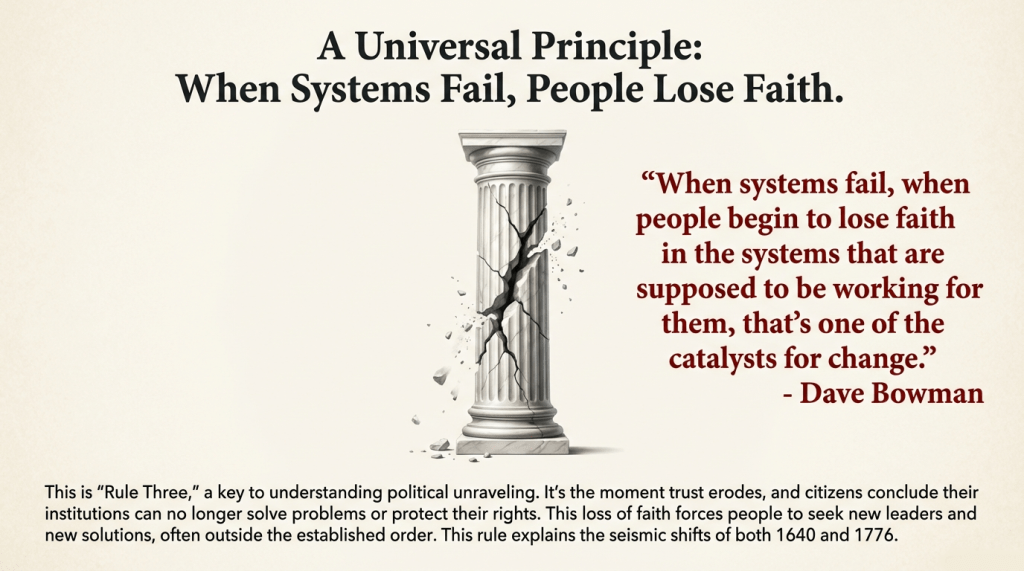
And here we begin hearing what might be called Rule 3 humming quietly beneath the floorboards of the story. When systems stop functioning properly, people begin searching elsewhere for authority, meaning, and action. They first try correction. Petitions. Appeals. Reform efforts. Public pressure. But underneath those attempts lies something more dangerous, the gradual collapse of confidence that institutions can solve problems internally anymore.
Once that confidence disappears, personalities start mattering more than structures.
England had not fully reached that point yet in December 1640, but the shift had begun. Men like John Pym were attracting attention because they seemed willing to confront realities others preferred avoiding. The public increasingly watched individuals rather than institutions because institutions themselves appeared incapable of self correction.
That transition is historically important because it marks the beginning of a dangerous political gravity.
Healthy systems absorb pressure. They channel conflict through recognized procedures. They frustrate people sometimes, certainly, but they still retain legitimacy. Once large numbers of citizens conclude those systems no longer function honestly, attention starts moving toward figures who appear decisive enough to break paralysis.
The crowd outside Parliament in December 1640 had not arrived at revolution yet.
They still believed Parliament might act.
That detail matters because the petition itself remained fundamentally constitutional. It did not call for overthrowing the monarchy. It did not reject English law or demand violent rebellion. The petitioners still spoke the language of English rights, English traditions, English accountability. They believed the kingdom could still be repaired if the corrupt structures were removed quickly enough.
But beneath that hope sat exhaustion.
The Root and Branch Petition did not appear suddenly like lightning from a clear sky. It emerged from years in which every institutional mechanism for correcting abuse seemed increasingly incapable of functioning. The Church protected itself. The courts enforced power. Parliament vanished. The King governed alone. People concluded, slowly and reluctantly, that ordinary remedies no longer worked.
And that is how societies begin drifting toward something larger and darker than reform.
Not usually through immediate revolutionary fervor, but through the quiet erosion of trust.
Once enough people stop believing institutions can restrain power internally, they begin looking elsewhere. Toward movements. Toward causes. Toward personalities. Toward leaders who seem to grasp the crisis clearly enough to act decisively.
England in December 1640 was standing precisely at that threshold.
The crowd carrying the Root and Branch Petition probably did not believe they were opening the road toward civil war. Most likely thought they were preventing one. History is cruel that way sometimes. People attempting desperately to save an old order often end up exposing just how broken it already is.
And once that realization becomes public, it rarely stays contained for very long.
Once the petition reached Parliament, it did what serious petitions are supposed to do and what comfortable institutions usually hate. It forced men to stop pretending that postponement was the same thing as policy. For years, England’s leaders had circled the religious question with the caution of men walking around a cracked floorboard in an old house. Everyone knew it was there. Everyone heard it creak. Nobody wanted to be the one who stepped hard enough to find out how rotten the beam had become.
The petition changed that because it did not ask Parliament to tidy up a few abuses or scold a few bishops for excessive enthusiasm in the persecution department. It demanded a decision about the entire system. If bishops were merely flawed officeholders, reform might be enough. If episcopacy itself had become fused with royal coercion, then trimming the branches would not do. The roots had to be pulled up as well, and once that argument entered the chamber, neutrality became harder to maintain. Men could no longer hide behind vague language about moderation, patience, and future consideration, which are often the favorite hiding places of political cowardice wearing a respectable hat.
The Commons split because the question cut deeper than church administration. On one side stood those who believed the episcopal structure had become permanently dangerous. Henry Vane the Younger brought intensity and sharp conviction to the abolitionist cause. Oliver Cromwell, still far from the towering figure he would later become, supported total removal because he believed partial reform would leave the machinery of oppression intact. John Pym, the coldest and most experienced political mind among them, understood the question not merely as theology but as power. If bishops remained tied to the Crown, then royal authority retained a lever inside the Church that could be used against Parliament whenever circumstances required it. In that light, episcopacy was not a church problem alone. It was a constitutional weapon.
On the other side stood the moderates, and they were not fools. Men like Lucius Cary, Viscount Falkland, understood quite clearly that Archbishop Laud and his allies had done enormous damage. They did not defend mutilations, coercive courts, or forced ceremonial uniformity as though these were cheerful little quirks of English life. Falkland’s argument was that the Church had been abused, not that the Church was inherently beyond saving. Reform the bishops, strip away their political power, curb the courts, correct the abuses, but do not destroy an ancient institution simply because bad men had turned it into a cudgel. That position had dignity, and more than a little wisdom. It also had the misfortune of arriving in a country where patience had become dangerously scarce.
This was the heart of the split. The abolitionists feared that compromise would preserve tyranny under a cleaner coat of paint. The moderates feared that abolition would open a door no one could close again. Each side had a point, which is one reason the crisis became so hard to solve. Civil wars often grow in the soil where both sides can point to something real and say, “There, that is what we are afraid of.”
The debates forced Parliament to confront problems it had avoided because they were not really about bishops alone. They were about who held authority in England. Was the Church governed by ancient tradition, royal command, Scripture, Parliament, or some combination fragile enough to shatter when pressed? If bishops claimed authority directly from Christ, then Parliament had limited room to restrain them. If bishops owed their power to the Crown, then the King possessed a spiritual instrument inside national life. If Parliament could abolish bishops entirely, then Parliament had asserted authority over one of the oldest pillars of the kingdom. Every answer threatened someone’s world.
Outside Westminster, the public did not follow these debates like neutral observers reading minutes from a committee meeting. London became a listening city. Pamphlets multiplied. Sermons hinted, warned, accused, and encouraged. Taverns became argument chambers with worse lighting and better ale. Every name began to gather symbolic weight. Pym was no longer only a member of Parliament. To supporters, he became the voice of lawful resistance. To enemies, he became the man tearing England apart one grievance at a time. Laud, already imprisoned, became less a human being than a symbol of everything many English Protestants hated about forced conformity and creeping absolutism. Cromwell, blunt and intense, began attracting attention precisely because he seemed allergic to half measures. Falkland became the conscience of moderation, admired even by men who believed moderation had outlived its usefulness.
This is where Rule 3 stops whispering and begins speaking in a normal indoor voice. When institutions falter, personalities rise. That does not happen because people wake up one morning and decide to become irrational. It happens because offices lose credibility, procedures appear helpless, and formal structures no longer seem capable of answering the crisis. The public begins asking different questions. Not what will Parliament do, but what will Pym do? Not what will the Church decide, but what does Laud represent? Not what can the old constitution absorb, but who seems willing to act?
That shift is dangerous because personalities concentrate hope and fear in ways institutions usually diffuse. Parliament is slow, argumentative, procedural, and often maddening. That is partly the point. Institutions absorb pressure by forcing conflict through forms, rules, and delays. Strong personalities do the opposite. They simplify. They embody. They promise motion. In a tired and frightened nation, that can feel like salvation. It can also become the first step toward something much darker.
The Root and Branch Bill, introduced in 1641, carried the petition’s demands into formal parliamentary action. It began as an effort to abolish bishops, but once the machinery started moving, complexity rushed in like floodwater through a broken door. What would replace episcopacy? Who would govern church discipline? How would doctrine be protected? What authority would local congregations possess? How would Parliament prevent religious chaos without recreating the same coercive system under a different name? Each question produced another argument, and each argument widened the crack.
By the summer of 1641, the bill stalled. That might have calmed things in a healthier political culture, but England was no longer healthy in that way. Failure did not restore confidence. It clarified positions. Everyone could now see who wanted abolition, who wanted reform, who feared disorder, and who believed delay itself had become betrayal. The debate had moved too far into public consciousness to disappear quietly back into committee rooms.
Meanwhile, people outside Parliament began acting as though the matter had already been settled. Images were torn from churches. Rails were ripped out. Ceremonial decorations vanished under the hands of men convinced they were purifying worship rather than vandalizing it. That distinction mattered greatly to them, though perhaps less to the poor fellow who had to repair the damage afterward. What mattered politically was that official action could no longer contain public momentum. When people lose faith in procedure, they begin treating their own convictions as authorization.
This is one of the quiet mechanisms by which debate slides toward conflict. War usually does not begin when everyone suddenly chooses violence. It begins earlier, when a society discovers that it no longer agrees on what is legitimate. Are bishops lawful guardians of church order or agents of tyranny? Is Parliament defending English liberty or undermining the kingdom? Is the King preserving order or destroying trust? Once those questions become moral identities rather than policy disputes, compromise begins to look like surrender.
The petition did not cause the English Civil War by itself. History is rarely that tidy, and anyone who tells you one document caused a war is probably trying to sell you a documentary with dramatic drum music. What the petition did was expose the depth of the fracture. It forced Parliament to address questions that had been gathering pressure for years. It made visible the breakdown between Crown, Church, Parliament, and people. It revealed that the institutions meant to mediate conflict had become objects of conflict themselves.
From there, the movement toward war became harder to stop. The Grand Remonstrance in 1641 would list the King’s abuses and tie religious grievances to political ones in language that left little room for polite reconciliation. Its narrow passage showed how evenly divided the nation’s representatives had become. Then, in January 1642, Charles entered the House of Commons to arrest five members, including Pym. That act confirmed the worst fears of his opponents and shattered what remained of ordinary trust. The King left London. Parliament claimed authority over the militia. The King answered with his own commissions. Two competing claims of lawful power now stood facing one another, and when that happens, gunpowder tends to get invited to the discussion.
By then the personalities had grown larger than the offices that supposedly contained them. Pym, Cromwell, Falkland, Laud, Charles, each had become more than a participant. Each had become a symbol onto which the public projected fear, loyalty, hope, and suspicion. England did not get a single Mule in the Asimov sense, one overwhelming figure bending history through sheer personal force. But it moved close enough to see the silhouette forming on the wall.
That is the lesson Rule 3 is trying to catch before it runs past us. When institutions fail, people do not simply become angry. They become hungry for human substitutes. They look for the one person who will speak clearly, act decisively, and make the confusion stop. Sometimes that person strengthens the system. Sometimes he devours it. England in 1641 and 1642 had not yet learned which way its crisis would go, but it had already crossed one of the most dangerous thresholds in political life. The old offices remained, the old words were still spoken, and the old forms still stood in place. Yet beneath them, trust had shifted from institutions to men, and once that happens, history begins moving with a harder, colder sound.
The Root and Branch Petition belonged to seventeenth century England, but its echoes traveled much farther than Westminster Hall. The men who drafted the Declaration of Independence in 1776 did not see the English Civil War as distant ancient history in the way modern Americans often do. To Jefferson, Adams, and their contemporaries, the struggles of the 1640s remained part of the living constitutional memory of the English speaking world. The distance between Charles I and George III felt shorter to them than the distance between Ronald Reagan and today feels to us, and unlike most modern Americans, the Founders actually knew that history in exhausting detail.
That matters because the Declaration did not emerge from nowhere.
Jefferson was not inventing the idea of cataloging grievances against authority and presenting them publicly as evidence that an existing structure had lost legitimacy. England had been practicing that political habit for generations. Petitions, remonstrances, declarations, public lists of abuses, all formed part of an old constitutional tradition in which subjects asserted that rulers remained accountable to law and custom. The Root and Branch Petition belonged squarely within that tradition, even as it pushed the tradition dangerously close to its breaking point.
That is one of the reasons the document matters so much historically.
It foreshadows an American instinct before America fully exists.
When the London petitioners declared that the episcopal hierarchy had become structurally dangerous, they were doing more than complaining about policy failures. They were arguing that the system itself could no longer be trusted to correct its own abuses. That distinction is crucial because societies can usually survive arguments over individual mistakes. They enter dangerous territory when large numbers of people conclude that the governing structure itself has become incapable of reform.
By 1776, the Americans had reached the same conclusion about the British Empire.
The similarities between the Root and Branch Petition and the Declaration of Independence are not perfect, of course. One sought to transform the kingdom from inside. The other severed political bonds entirely. One revolved around church governance and royal authority in seventeenth century England. The other addressed imperial sovereignty, representation, and colonial rights across the Atlantic. Yet the posture feels strikingly familiar because both documents emerge from the far side of disappointment.
That phrase matters.
People do not write these kinds of documents when they still believe gentle correction will solve the problem.
The Root and Branch Petition came after years of frustration in which ordinary Englishmen watched Parliament disappear, courts become instruments of executive pressure, and the Church increasingly fused itself with royal authority. The Declaration arrived after more than a decade of petitions, protests, assemblies, boycotts, and appeals that colonial leaders believed had been answered with force, contempt, or deliberate indifference. In both cases, the writers argued that the existing structure had lost credibility because it either could not or would not restrain abuses from within.
The tone reflects that shift.
Neither document reads like a negotiation.
The petitioners in 1640 did not ask politely for modest ecclesiastical adjustments. They demanded root and branch removal because they believed the hierarchy itself had become corrupted. Jefferson’s Declaration follows the same emotional trajectory. It does not present grievances as bargaining chips meant to secure a slightly improved arrangement within the empire. It presents them as evidence proving that the political relationship itself has become destructive and illegitimate.
There is a moment in political crises when reform language hardens into separation language.
That moment is psychologically important because it signals the collapse of trust. Once people conclude that institutions cannot correct themselves, they stop asking for repair and begin writing entirely new scripts. The old constitutional order becomes something to escape rather than restore.
The Root and Branch Petition stops just short of that threshold. The Declaration crosses it openly.
Yet both documents share the same underlying logic. They move from individual complaints toward structural indictment. The bishops are not merely mistaken, the petitioners argue, but dangerous to both church and commonwealth. George III is not simply pursuing bad policy, Jefferson insists, but establishing “an absolute Tyranny over these States.” In both cases, grievances become evidence supporting a larger claim that legitimacy itself has failed.
That transformation matters because legitimacy is one of those invisible forces holding political systems together until suddenly it is gone.
Governments survive unpopular decisions constantly. Citizens complain about taxes, regulations, wars, inflation, and politicians in quantities large enough to power several small nations. What systems cannot survive indefinitely is widespread belief that the institutions themselves no longer operate honestly, lawfully, or responsively. Once enough people reach that conclusion, every controversy begins acquiring existential weight.
England experienced that collapse in the 1640s.
The colonies experienced it in the 1770s.
In both cases, the crisis pushed society toward confrontation not necessarily because people desired violence, but because the logic of the documents left increasingly little room for reconciliation. The petitioners of 1640 still hoped Parliament could restore the kingdom, but their demands exposed how little shared constitutional ground remained. The Americans eventually abandoned even that hope. By July 1776, the Declaration openly announced that the imperial structure itself had become irreparable.
That is why both documents feel so dangerous when read in their own historical context.
They force decisions.
And once institutions fail to mediate those decisions successfully, Rule 3 begins operating with terrifying efficiency.
When systems stop functioning, people turn toward personalities who appear capable of grasping the moment clearly enough to act. That pattern connects the English crisis directly to the American founding. England’s constitutional breakdown elevated men like Pym and Cromwell because Parliament, Church, and Crown no longer inspired sufficient trust to contain the conflict peacefully. The public increasingly attached its hopes and fears to individuals rather than institutions.
The colonies experienced something similar.
As imperial authority weakened, personalities grew larger. Samuel Adams became the organizer who seemed willing to push resistance farther than cautious moderates preferred. Patrick Henry became the voice able to condense frustration into moral clarity sharp enough to ignite crowds. Thomas Paine transformed public opinion through sheer rhetorical force. Even Jefferson himself became symbolic, not merely as a politician but as the literary voice articulating the colonial case to the world.
And then there was Washington.
This is where the American story diverges sharply from the English one.
The same gravitational pull that produced Cromwell in England existed in America too. The colonies desperately needed leadership. Institutions were fragile. The Continental Congress possessed uncertain authority. The army suffered shortages, defeats, internal rivalries, and moments of near collapse. Americans feared chaos almost as much as they feared tyranny. Under those conditions, history often produces men who consolidate personal authority while promising stability.
Washington could have become that figure.
And in many ways, circumstances almost invited him to do so.
He commanded the army. He possessed enormous personal prestige. He was trusted across regional lines more than almost anyone else alive. Officers frustrated with Congress occasionally hinted at stronger solutions. During the Newburgh Crisis in 1783, some officers even discussed actions perilously close to military pressure against civilian government.
That is precisely the sort of moment when republics historically fail.
A weaker man might have accepted the role history seemed prepared to offer him. Cromwell had crossed that bridge in England after years of war and institutional collapse. Julius Caesar crossed it in Rome. Napoleon would later cross it in France. The pattern is painfully familiar. Institutions weaken, public exhaustion deepens, and eventually someone arrives promising order through concentrated personal authority.
Washington did something rarer. He stepped back.
Again and again, he reinforced institutional legitimacy rather than consuming it. He resigned his military commission after the Revolution. He presided over the Constitutional Convention rather than dominating it personally. As president, he consciously established precedents limiting executive behavior because he understood how fragile the new republic remained. Washington recognized that if Americans became loyal primarily to him rather than to constitutional structures, the republic would survive only until the wrong man inherited that loyalty.
That may be the single most important difference between Washington and the long line of historical strongmen stretching back through Cromwell, Caesar, and countless others.
He understood restraint as a form of patriotism.
The Founders knew how unusual that was because they knew their history. They understood that republics often die not merely because ambitious men exist, but because frightened populations eventually welcome them. When institutions fail repeatedly, citizens grow impatient with procedure. Deliberation starts looking weak. Constitutional limits feel inconvenient. The promise of decisive leadership becomes intoxicating.
That temptation did not begin in 1776.
It stretches backward through English history, Roman history, Greek history, probably all the way back to the first village argument over who should control the grain supply and whether the loud fellow with the spear might solve things faster if everyone simply obeyed him for a while.
The struggle between institutions and personalities is one of the oldest political stories human beings possess.
The Root and Branch Petition reveals one stage of that story. The Declaration of Independence reveals another. Both emerged from moments when people concluded the existing structures could no longer correct themselves peacefully. Both pushed their societies toward confrontation by exposing how deeply legitimacy had eroded. Both demonstrate how quickly public trust shifts away from institutions and toward individuals when systems appear broken.
And that tension never really disappears.
Modern societies still wrestle with the same gravitational pull. When governments feel unresponsive, when courts lose trust, when legislatures appear paralyzed, when bureaucracies seem detached from ordinary life, people begin searching again for personalities capable of cutting through the frustration. Sometimes they find leaders who strengthen constitutional order. Sometimes they find something darker.
History offers examples of both outcomes in terrifying abundance.
Which is perhaps why the Founders believed historical memory mattered so much. They understood that liberty survives partly through institutions, partly through character, and partly through public willingness to recognize old patterns before they harden into permanent crises.
The struggle did not begin in Philadelphia.
It began long before 1776, long before Westminster, long before Charles I or George III. It remains the same old human question dressed in different centuries and speaking through different accents.
When systems fail, what kind of leader will people choose next?
Bailyn, Bernard. The Ideological Origins of the American Revolution. Cambridge, MA: Belknap Press of Harvard University Press, 1967.
Carlton, Charles. Charles I: The Personal Monarch. 2nd ed. London: Routledge, 1995.
Clarendon, Edward Hyde, Earl of. The History of the Rebellion and Civil Wars in England. 6 vols. Oxford: Clarendon Press, 1888.
Conrad Russell. The Causes of the English Civil War. Oxford: Oxford University Press, 1990.
Coward, Barry. The Stuart Age: England, 1603–1714. 5th ed. London: Routledge, 2017.
Cromwell, Oliver. The Letters and Speeches of Oliver Cromwell. Edited by Thomas Carlyle. London: Chapman and Hall, 1887.
Declaration of Independence. July 4, 1776.
Falkland, Lucius Cary. The Speeches and Discourses of the Lord Falkland. London, 1641.
Gardiner, Samuel Rawson. History of England from the Accession of James I to the Outbreak of the Civil War, 1603–1642. 10 vols. London: Longmans, Green, and Co., 1883–1884.
Hallam, Henry. The Constitutional History of England. 3 vols. London: John Murray, 1827.
Hill, Christopher. The Century of Revolution, 1603–1714. New York: Norton, 1961.
Hobbes, Thomas. Leviathan. Edited by Richard Tuck. Cambridge: Cambridge University Press, 1996.
Hughes, Ann. The Causes of the English Civil War. 2nd ed. New York: Palgrave Macmillan, 1998.
Kishlansky, Mark. A Monarchy Transformed: Britain 1603–1714. London: Penguin Books, 1997.
Laud, William. The History of the Troubles and Trial of the Most Reverend Father in God and Blessed Martyr, William Laud. London, 1695.
Locke, John. Two Treatises of Government. Edited by Peter Laslett. Cambridge: Cambridge University Press, 1988.
Morrill, John. The Nature of the English Revolution. London: Longman, 1993.
Pym, John. Speeches and Parliamentary Addresses. London, 1641.
Russell, Conrad. Parliaments and English Politics, 1621–1629. Oxford: Oxford University Press, 1979.
The Root and Branch Petition, 1640. In Constitutional Documents of the Puritan Revolution 1625–1660. Edited by Samuel Rawson Gardiner. Oxford: Clarendon Press, 1906.
Tocqueville, Alexis de. Democracy in America. Translated by Harvey C. Mansfield and Delba Winthrop. Chicago: University of Chicago Press, 2000.
Trevelyan, George Macaulay. England Under the Stuarts. London: Methuen, 1904.
Worden, Blair. The English Civil Wars: 1640–1660. London: Weidenfeld & Nicolson, 2009.
Wood, Gordon S. The Creation of the American Republic, 1776–1787. Chapel Hill: University of North Carolina Press, 1969.
Wood, Neal. The Politics of Locke’s Philosophy. Berkeley: University of California Press, 1983.



 DAVE DOES HISTORY
Leave a comment