
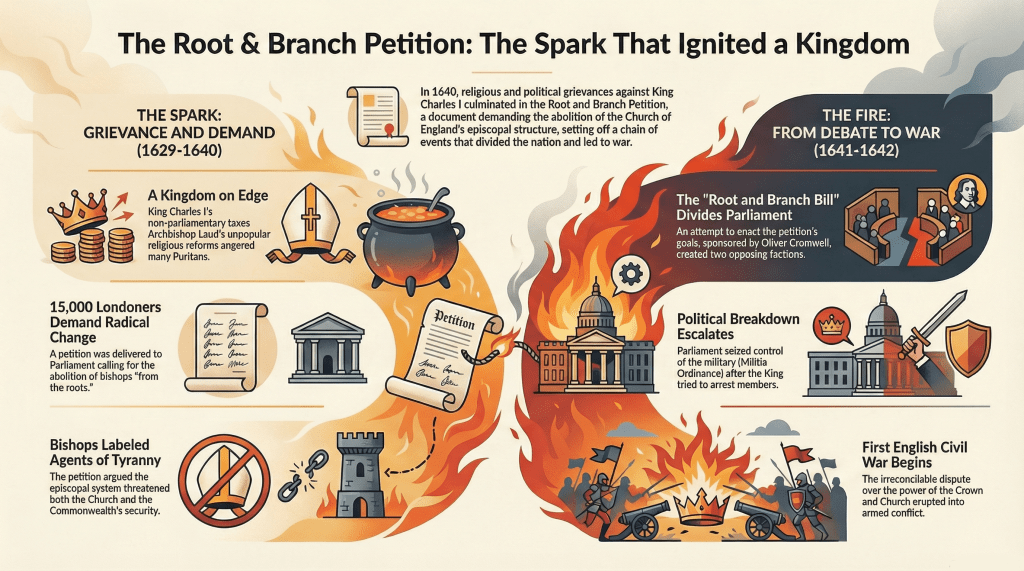
The Londoners who gathered on a cold December morning in 1640 were not trying to be symbolic. They were trying to be heard. They were tradesmen and merchants, apprentices and householders, everyday people who had grown tired of watching the country drift toward something they could barely describe but instinctively feared. They walked together toward Westminster with a petition in hand, and that petition made a demand that sounded as if it had escaped from a carpenter’s yard. They wanted the Church of England pulled up by the roots and chopped off in all its branches. They were not trimming shrubs. They wanted the whole thing gone. That kind of request tends to get attention. It certainly got Parliament’s.
The Root and Branch Petition arrived at the Long Parliament in December of 1640, and it landed with the weight of fifteen thousand signatures. In an age before online petitions and digital pressure campaigns, that number said something powerful. It said that London had reached its boiling point. It said that grievances that had been simmering for more than a decade had reached the surface. It said that King Charles I and his archbishop, William Laud, had pushed the kingdom into a corner. And it said, most of all, that the constitutional and religious crises of England were no longer separate storms. They had become one weather system, rolling in from every direction.
Everyone in Westminster understood this at once. They did not necessarily understand what to do about it, but they recognized the moment. Much like discovering a small passage in The Hitchhiker’s Guide to the Galaxy that warns readers that the universe is not only stranger than they imagine but stranger than they can imagine, the petition revealed that the England of 1640 had crossed into a different sort of landscape. The people were no longer complaining about bishops in the usual grumbling manner. They were demanding the extinction of a system that had stood, in one form or another, since the days before the Norman Conquest.
The wording was unambiguous. The petition called for the abolition of archbishops, bishops, deans, chapters, prebends, canons, and every ecclesiastical office that sprouted from the same root. It was a request for a religious system grounded not in the inherited structures of English custom but in something the petitioners described as government according to Gods Word. Most Parliament men knew what that implied. It was a quiet but unmistakable nod toward the Presbyterian model of Scotland, the same model Charles had tried and failed to impose upon the Scots only a short time earlier.
To understand why fifteen thousand Londoners were ready to swing an axe at the episcopal tree, one must step back into the uneasy decade that preceded the petition. Between 1629 and 1640, England lived under what Charles I called his Personal Rule and what his critics called something far less flattering. The King dissolved Parliament in 1629 and governed without it for eleven long years. During this period he discovered new ways to raise money without the troublesome business of summoning representatives. Ship Money, a medieval tax once limited to coastal emergencies, became an annual nationwide levy. Prerogative courts like the Star Chamber and High Commission became tools for enforcing royal policy. The machinery of government shifted from a cooperative constitutional framework toward a royal system that convinced many Englishmen that an absolute monarchy was quietly sliding into place.
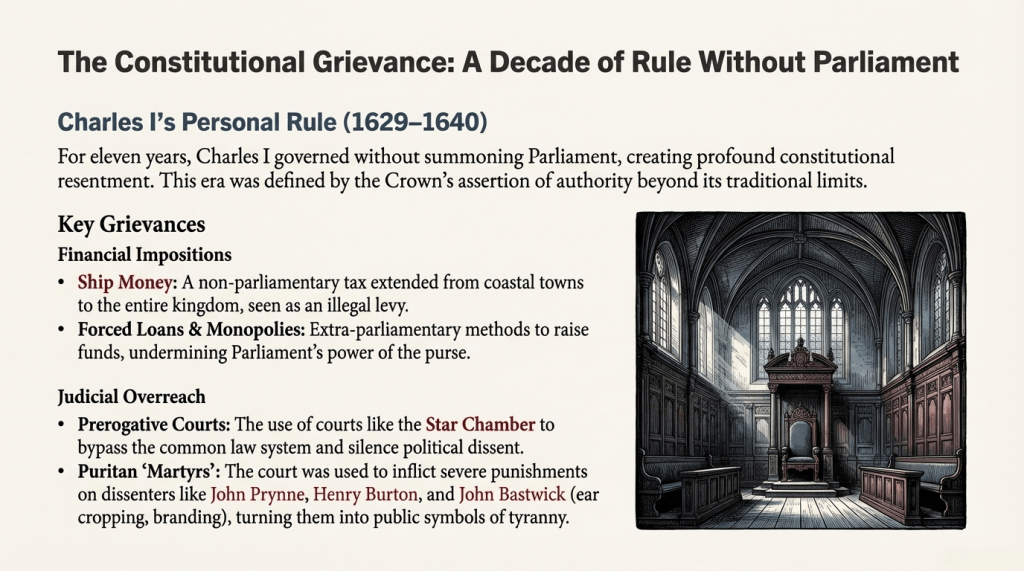
At the center of this transformation stood Archbishop William Laud, a man whose name Puritans pronounced with the same reluctance that some readers reserve for the author of the worst poetry in the universe. Laud believed that the English Reformation had gone too far. He wanted ceremony restored. He wanted the Church to look orderly, dignified, and unified. Communion tables were to be placed altar wise at the east end of churches. Predestination sermons, which had comforted Puritan congregations for decades, were discouraged or banned. The Book of Common Prayer was to be used with a firmness that felt to many like coercion. Lent was reintroduced. And everywhere Laud turned, he tightened the ceremonial screws in a way that infuriated both clergy and laity who favored a simpler, Calvinist faith.
Laud had authority and he used it. The Star Chamber became his preferred hammer, and those who opposed him discovered how much force that hammer could deliver. Three names became symbols of the regime. John Prynne, Henry Burton, and John Bastwick wrote against Laudian reforms and paid the price in the form of fines, imprisonment, ear cropping, and branding. England watched these punishments with a mixture of horror and fascination. The government created its martyrs, and martyrs have a habit of speaking loudly long after the courtroom doors are closed.
By the late 1630s the grievances were stacking up like an overfull shelf that everyone knew would collapse eventually. When Charles attempted to force the Book of Common Prayer on Scotland, the reaction was swift and fierce. The Scots signed the National Covenant, raised an army, and marched. Charles tried to meet them in the field and stumbled badly. His failures in the Bishops Wars left the Crown financially ruined and politically cornered. No money meant no army. No army meant no enforcement of royal will. With no alternatives left, Charles summoned the Long Parliament in November 1640. Once Parliament assembled, it did not require a telescope to spot where blame should fall. Archbishop Laud was impeached within weeks. So was Thomas Wentworth, Earl of Strafford, the King’s most formidable minister.
The Root and Branch Petition arrived into this atmosphere like a torch carried into a room full of dry timber. It made a sweeping claim that episcopacy was prejudicial and dangerous to both Church and Commonwealth. It accused bishops of claiming authority from Christ directly, a claim that seemed to elevate their office above the King. It listed grievances against doctrinal suppression and pointed out that the prelates had, in the petitioners view, dragged England into conflict with Scotland. The message was simple. If England wished to preserve the kingdom, the bishops had to go.
This petition became the foundation for a legislative effort that historians now call the Root and Branch Bill. Oliver St John drafted the basic text. Henry Vane the Younger and a rising Parliament member named Oliver Cromwell brought it forward in May 1641. The original bill was short. It said what it meant and meant what it said. It abolished bishops. That was the beginning and the end of it. But Parliament is seldom satisfied with simple beginnings. Amendments piled up. Alternatives were proposed, debated, withdrawn, rewritten, and argued all over again. Questions arose about what system might replace episcopacy and how quickly Parliament could reorganize a national church. What began as a short document quietly grew into more than forty pages of legislative effort that exhausted nearly everyone involved.
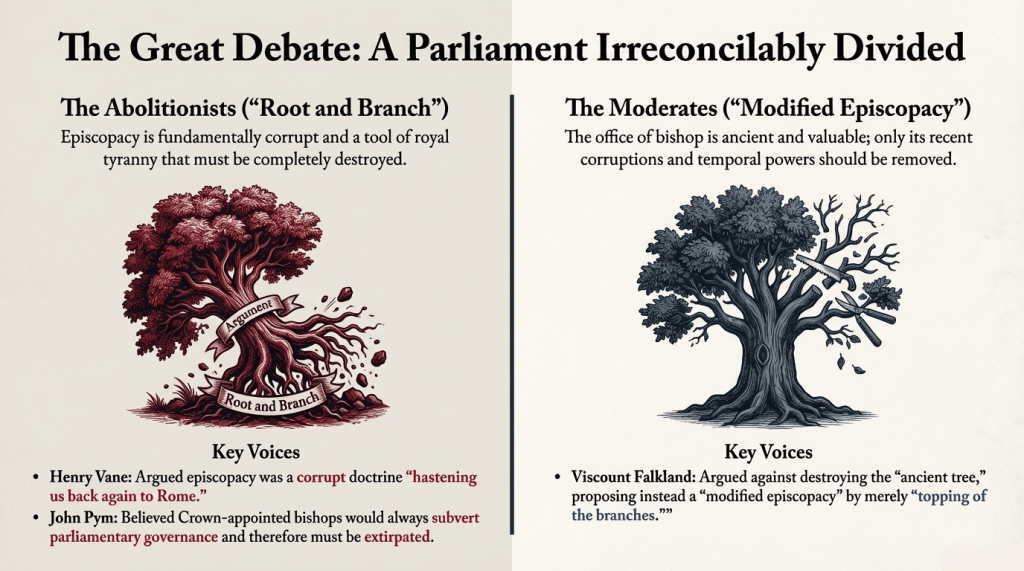
The debates that followed were fierce, and they revealed fault lines that had been developing for years. Some Parliament men supported abolition without hesitation. They believed bishops were agents of tyranny. They saw episcopacy as a system that brought England closer to Roman Catholicism and farther from the Protestant faith they cherished. Vane called the prelates corrupt and claimed their doctrine nudged England toward Rome. Cromwell, still early in his political ascent, stood firmly with the abolitionists. And John Pym, the subtle strategist of the opposition, came to believe that any system in which bishops were appointed by the Crown would always risk subverting parliamentary authority.
But not everyone in Parliament was ready to swing the axe. Sir Edward Dering, who introduced the bill, hoped to steer the discussion toward moderation. Viscount Falkland, one of the most respected voices in the Commons, argued that the Church needed pruning, not destruction. He described episcopacy as an ancient tree that could be trimmed of corruption without being uprooted. A modified episcopacy, stripped of political entanglements, seemed to him a wiser course than total abolition. It was a view grounded in English tradition, a belief that the old ways might be repaired rather than demolished.
The arguments spilled beyond Parliament and into the streets, shops, and bookstalls. England loved a pamphlet war, and this one did not disappoint. Bishop Joseph Hall defended episcopacy in a work titled An Humble Remonstrance. His opponents responded with a pamphlet written by five Puritan ministers whose initials formed the memorable pseudonym Smectymnuus. Their work argued that scripture supported a Presbyterian system and rejected the notion that bishops held authority by divine right. Even John Milton, who had not yet become the author of Paradise Lost, stepped into the fray. He wrote Of Reformation and argued that prelacy undermined liberty and monarchy alike. When Milton joined a debate, the language sharpened like a quill dipped in pure vinegar.
The Root and Branch Bill did not survive these storms. By August 1641, opposition from moderates and fierce resistance in the House of Lords ensured that the bill would die without a final vote. But the debates had changed England in ways no single bill could measure. The discussions split Parliament into two groups that would soon give themselves memorable nicknames. Royalists began calling themselves Cavaliers. Parliament supporters, many of them London apprentices, embraced the term Roundheads. The labels stuck because they captured something real. The argument over bishops had forced clarity on both sides. The old political alliances were gone. New identities had emerged. Everyone in England could sense that the country had stepped through a doorway and found no way back.
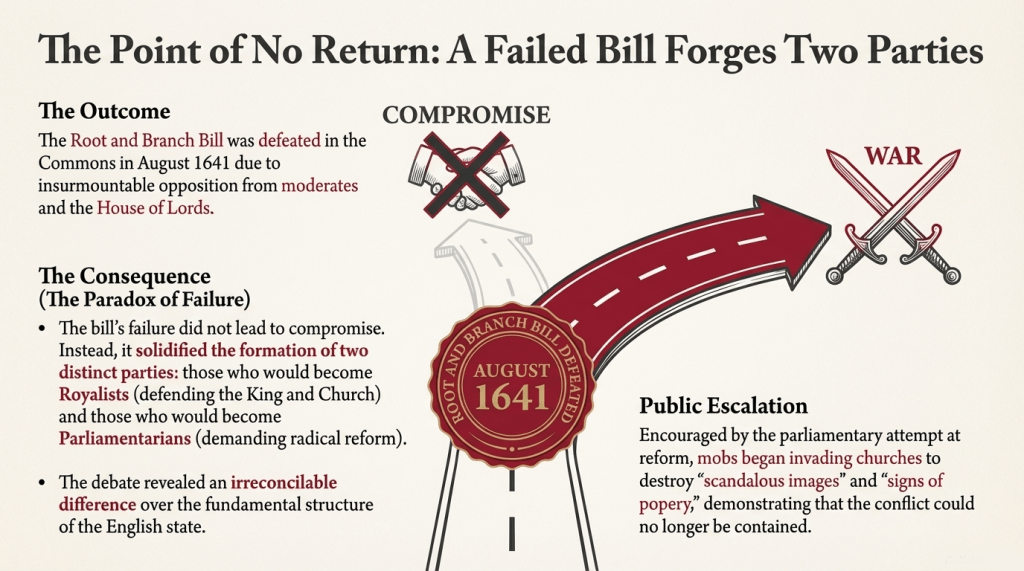
Even without legislative victory, the petition sparked public actions that worried the authorities. Crowds sacked churches, tearing down images that they considered popish or scandalous. Stained glass windows that had survived centuries shattered under stones thrown by apprentices who believed they were defending the purity of the Gospel. The energy released by the petition did not wait for Parliament to make up its mind. It moved on its own, as raw and unpredictable as any human force.
The issues raised by the petition reappeared later in 1641 in the Grand Remonstrance, a long list of grievances drafted by John Pym. The Remonstrance insisted that political and religious abuses were inseparable. This document narrowly passed in the Commons and provoked an uproar. Moderate members believed Pym had pushed too far. They accused him of dividing the nation at the very moment unity was needed. But for Pym and his allies, the division already existed and had been exposed by the debate over bishops. The votes simply acknowledged reality. England was no longer a kingdom with shared assumptions. It had become a kingdom at odds with itself.
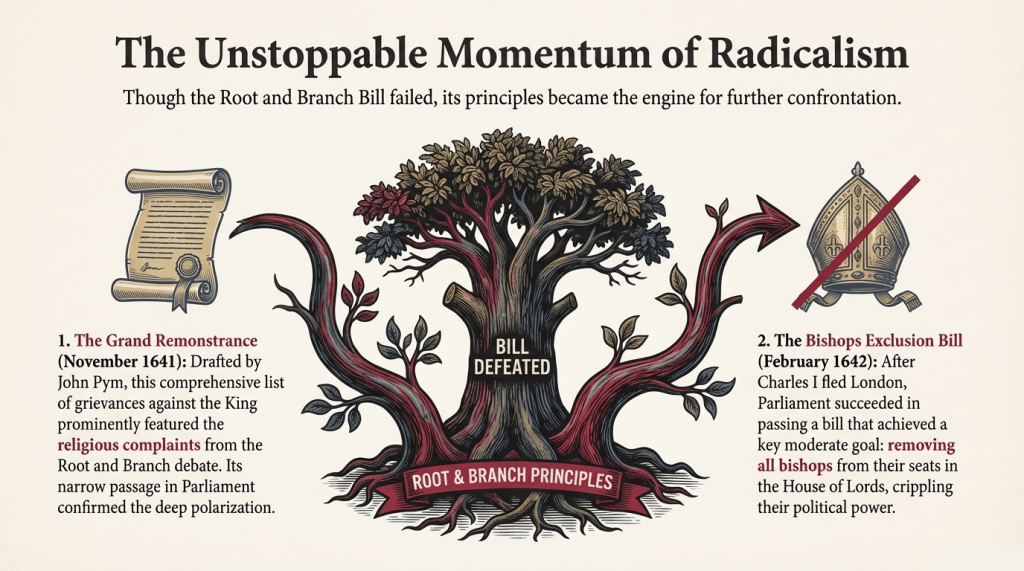
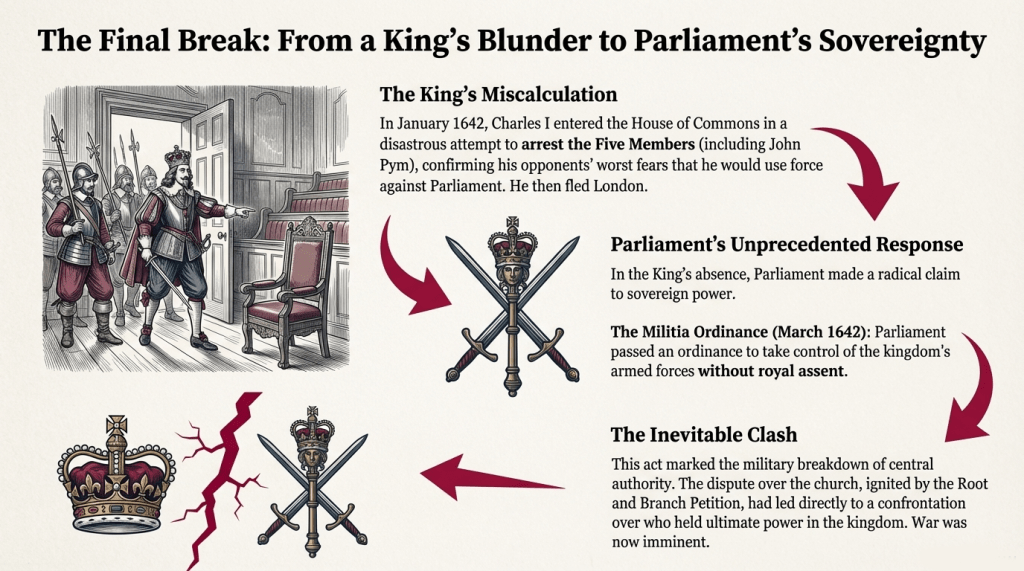
Events accelerated. In early 1642 Parliament passed the Bishops Exclusion Bill, removing bishops from the House of Lords. The King tried to arrest five members of Parliament, among them Pym, which turned London against him. Charles fled the city. Parliament claimed control of the militia without the royal assent. Constitutional order faltered, then shattered. What had begun as a debate over ecclesiastical structure had become a fight over sovereignty. The petitioners of December 1640 may not have imagined civil war, but they helped tug the thread that unraveled the garment.
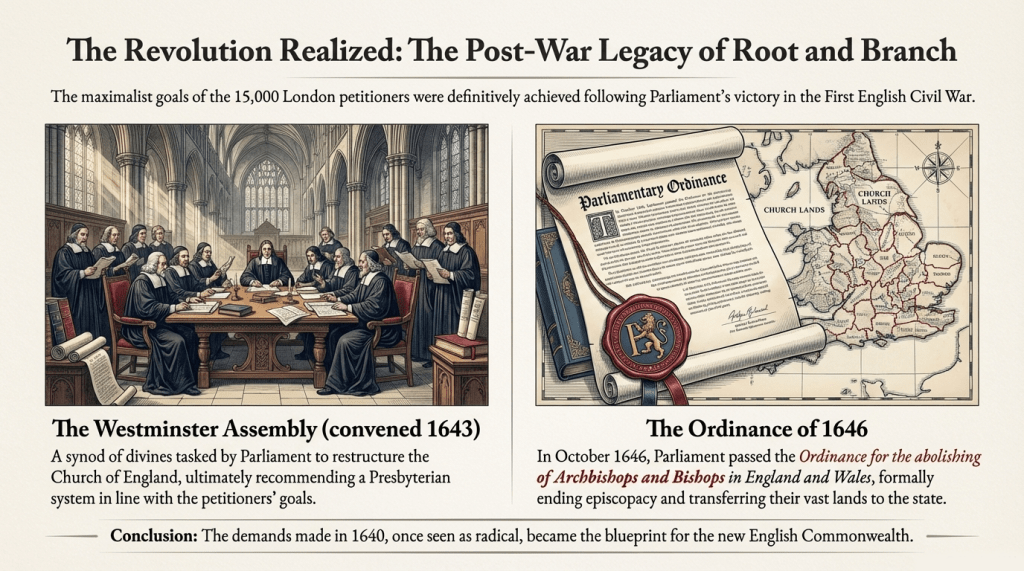
When that war finally erupted in August 1642, both sides carried the memory of the petition with them. The Parliamentarian cause now included an explicit religious aim. The episcopal system that had divided the kingdom was part of the conflict’s foundation. When Parliament convened the Westminster Assembly in 1643, it did so with the intention of building a new Church of England grounded in non episcopal governance. The Scots, who had entered an alliance with Parliament, encouraged a Presbyterian structure. Parliament moved slowly but steadily in that direction. In 1646, after the Royalist armies had collapsed, Parliament passed the Ordinance for the abolishing of Archbishops and Bishops in England and Wales. It confiscated episcopal lands for the Commonwealth. The petitioners had demanded the tree be uprooted. Parliament finally obliged.
It is tempting to treat the Root and Branch Petition as a footnote, a curious moment when a crowd made an extraordinary request and Parliament politely debated it. But that would miss the human stakes. The petition represented years of tension that had worn England thin. It revealed a public angry at arbitrary power, weary of forced ceremonies, and convinced that their religious identity was under threat. It showed Londoners who had squinted at the shifting shape of English governance and decided they no longer recognized the outline. They wanted clarity, and they believed clarity required removing the entire ecclesiastical structure that had grown under Laud and Charles.
It is also tempting to draw modern lessons from this episode. One could talk about polarization, public petitions, or the difficulty of reforming ancient institutions. But the seventeenth century rarely cooperates with easy moral conclusions. The people of 1640 acted within a world shaped by monarchy, divine right, and religious conviction that touched every aspect of life. Their fears were not abstractions. They believed their souls, their liberties, and their national survival were all woven together. In that kind of world, pulling up a tree by the roots felt less like an act of destruction and more like a necessary pruning to save the garden.
Yet there is something recognizable in their story. It sits quietly beneath the dust of centuries. A community saw a system that no longer worked. They watched a government pursue policies that offended their conscience. They believed their voices mattered. So they gathered signatures, walked together, and handed Parliament a petition that refused to be polite. It was a moment when ordinary people intervened in the trajectory of their nation. The consequences were vast, unpredictable, and in many cases tragic. But the act itself was unmistakably human.
History, like the Guide, occasionally reminds us that even the smallest handwritten request can change the course of events in ways no one expects. The Root and Branch Petition was one of those requests. It was not a blueprint for the future. It was a signal flare fired into a darkening sky. It revealed the storm that had already formed. And before long that storm broke across the entire kingdom, reshaping England in ways that the petitioners themselves could not have imagined.
The hallway of the past rarely offers easy explanations. It gives us worn floorboards and cracked plaster, the smell of old paper, and the quiet knowledge that every argument once felt as urgent as the ones we hear today. The men and women who signed the Root and Branch Petition did not set out to begin a revolution. They set out to stop one. In doing so, they helped start the greatest political crisis their kingdom had ever faced. They left behind a lesson that is not a lesson at all, only a reminder. Once a people begin to question the roots, the branches will not stand untouched for long.





Leave a comment