
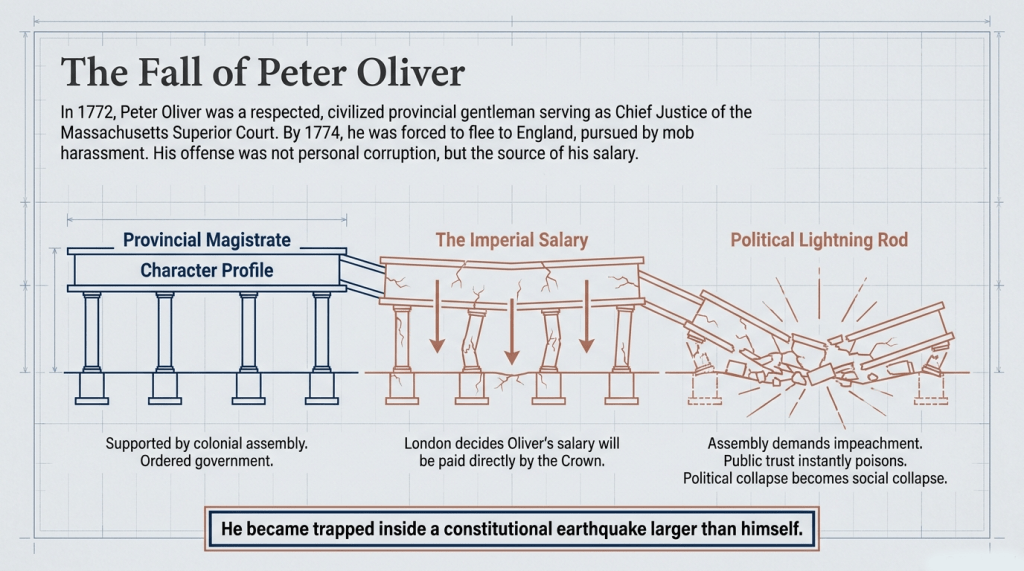
Peter Oliver is one of those colonial figures who steps onto the stage just long enough to become a symbol of everything his neighbors feared, then exits to the jeers of a furious crowd. He served as Chief Justice of the Massachusetts Superior Court of Judicature from 1772 until 1774, a short tenure defined less by his rulings and more by the firestorm over who paid his salary. In an age when Americans were already prickly about authority, Oliver managed to become the living proof of every suspicion the patriot movement held about imperial overreach. He was not a villain out of central casting, but he became one in the public imagination all the same.
He came from a prosperous Massachusetts family tied to commerce and politics, and by most accounts he was intelligent, serious, and entirely convinced that civilization depended upon orderly government and lawful authority. In calmer years he probably would have spent his life drafting opinions, writing legal commentary, attending dinners in Boston parlors, and quietly fading into the sort of respectable obscurity that swallows most judges. History had other plans. He rose to prominence at precisely the moment Britain decided that colonial courts needed to answer more directly to royal authority, and that timing turned him from provincial magistrate into political lightning rod almost overnight.
To modern ears, the dispute can initially sound technical. Salaries. Judicial tenure. Administrative structure. The sort of thing that causes eyes to glaze over during city council meetings. Yet the Founders understood something that modern Americans often forget. Whoever controls the courts eventually controls nearly everything else. A legal system that depends upon executive favor is not truly independent, no matter how elegant its language or how impressive the robes hanging in chambers happen to look.
That fear runs directly through the Declaration of Independence itself.
“He has obstructed the Administration of Justice, by refusing his Assent to Laws for establishing Judiciary powers.”
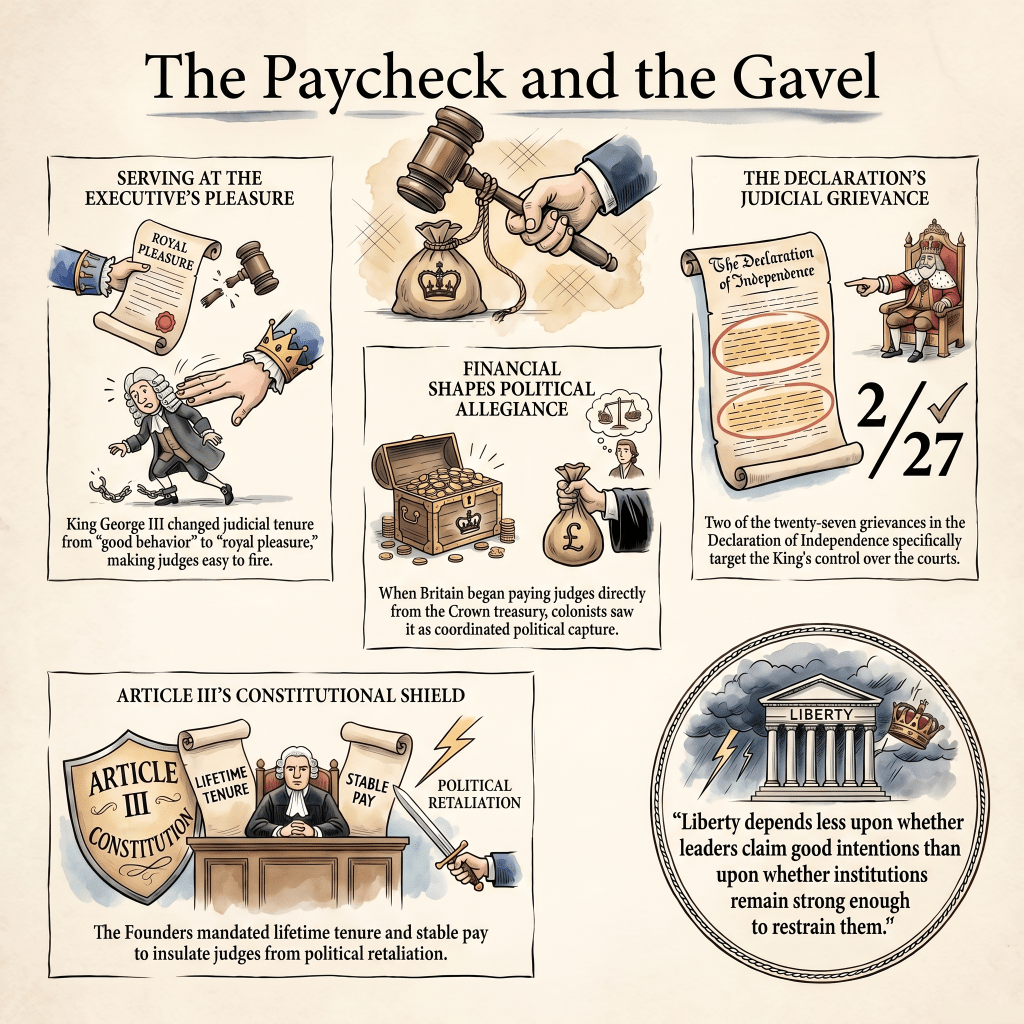
“He has made Judges dependent on his Will alone, for the tenure of their offices, and the amount and payment of their salaries.”
Modern readers tend to rush past those grievances because they lack the dramatic flavor of standing armies, burning towns, and revolution in the streets. Yet to Jefferson and the Continental Congress, these accusations cut to the heart of liberty itself. The Founders believed that if the machinery of justice became dependent upon political power, then every other right eventually became conditional as well. Freedom of speech, property rights, due process, trial by jury, all of it could collapse if judges ultimately answered not to law but to whoever signed their paycheck.
Peter Oliver became the embodiment of that fear.
The crisis surrounding him began when London decided that colonial judges and governors should receive their salaries directly from the Crown rather than from local colonial legislatures. From Whitehall’s perspective, this probably looked perfectly reasonable. Royal officials should answer to royal authority. Administrative consistency made imperial management easier. Britain had just emerged from the Seven Years’ War carrying staggering debt and attempting to tighten control across a sprawling empire that suddenly looked more fragile than triumphant.
In Massachusetts, however, the decision landed like somebody dropping a torch into a room full of gunpowder fumes.
Colonists already distrusted British intentions after years of new taxes, customs enforcement, standing armies, and parliamentary assertions of supremacy. A judiciary financially dependent upon the King seemed not merely suspicious but openly dangerous. The concern was not necessarily that Peter Oliver himself would become personally corrupt. The deeper fear involved structure. If judges served at royal pleasure and depended upon royal salaries, how likely were they to rule against royal interests in politically sensitive cases?
Human beings being what they are, the answer did not inspire confidence.
The Patriots argued that judges whose offices and income depended entirely upon executive favor could never truly function independently. Whatever personal honesty Oliver possessed, his livelihood now rested upon the same imperial authority colonists increasingly believed was violating their constitutional rights. That connection poisoned public trust almost immediately.
By 1774, the Massachusetts House demanded Oliver’s impeachment unless he rejected the royal salary arrangement. He refused. Whether that refusal reflected stubborn pride, constitutional principle, or simple unwillingness to surrender authority remains difficult to determine even now. History rarely provides neat moral clarity, despite the desperate wishes of modern internet debates. Oliver likely believed he was defending lawful order against dangerous radicals. The Patriots believed they were resisting creeping tyranny disguised as administrative reform.
Both sides thought they were protecting liberty. That is usually how constitutional crises work.
The Assembly moved toward impeachment anyway, though whether impeachment would have mattered practically remains doubtful. King George III had already asserted that colonial judges served according to royal pleasure. The Massachusetts legislature could protest, condemn, and vote dramatically beneath candlelight all it wanted, but London increasingly intended to centralize authority regardless of colonial outrage. The conflict escalated quickly after that.
General Thomas Gage dissolved the Massachusetts Assembly. Patriot committees began assuming effective control throughout the countryside. Public anger toward Loyalist officials intensified. Peter Oliver, once viewed as a respectable provincial gentleman, now appeared in Patriot eyes as an instrument of royal domination. Mob harassment followed. Threats multiplied. Political collapse became social collapse, which is another old historical pattern human beings never seem to outgrow.
Eventually Oliver fled to England alongside thousands of other Loyalists who discovered too late that revolutions tend to become deeply unpleasant places for the losing side.
He spent his remaining years in Devonshire writing bitterly about the rebellion and insisting the colonists had betrayed their own constitution. His massive work, Origin & Progress of the American Rebellion, remains fascinating precisely because it reveals how the Revolution looked from the opposite shore. Oliver did not see himself as defending tyranny. He saw himself defending lawful authority against mob passion, demagoguery, and political fanaticism.
History generally remembers winners more kindly than losers.
The Patriots turned Oliver into shorthand for judicial corruption and executive manipulation, yet his story also reveals something uncomfortable about revolutions themselves. They do not simply sweep away abstract systems. They uproot real people, many of whom sincerely believe they are acting honorably. Oliver became trapped inside a constitutional earthquake larger than himself.
The Founders drew enduring lessons from experiences like his.
They concluded that judicial independence could not survive if judges depended upon executive whim for either tenure or salary. That conviction shaped the United States Constitution directly. Article III therefore provides that federal judges “shall hold their Offices during good Behaviour” and receive compensation that cannot be diminished during their continuance in office. The language reflects hard learned colonial experience.
The goal was not to create judicial aristocrats floating above accountability. The goal was to insulate courts from political retaliation and executive pressure. Judges needed sufficient independence to rule according to law even when those rulings angered powerful politicians or popular majorities.
That principle mattered because the Founders understood something deeply unfashionable today. Liberty depends less upon whether leaders claim good intentions than upon whether institutions remain strong enough to restrain them when those intentions sour. Governments always insist they are acting reasonably. Executives nearly always claim necessity, efficiency, security, or public welfare. The question is whether independent courts still possess enough authority to say no.
The British imperial system increasingly failed that test in colonial eyes.
The attack on judicial independence extended beyond Massachusetts. After 1761, King George III ordered that colonial judges hold commissions “during Royal Pleasure” rather than during good behavior. That phrase carried enormous implications. Judges no longer enjoyed meaningful security against executive removal. Their continued service depended upon remaining acceptable to royal authority. The Crown also sought through measures like the Townshend Acts to fund governors and judges directly from imperial revenue rather than colonial appropriations.
To the colonists, this looked like coordinated political control.
The problem grew even worse when Britain interfered directly with colonial judicial systems themselves. North Carolina provided perhaps the clearest example. The colony’s legal structure required periodic renewal legislation. Included within those laws was a “foreign attachment” provision allowing colonial courts to seize property belonging to non resident debtors. Merchants relied heavily upon the measure because it gave them leverage in commercial disputes.
London disliked the arrangement and demanded its removal.
The colonial legislature refused. The Crown then withheld assent to the broader judicial legislation entirely. The result was astonishing. North Carolina effectively found itself without a functioning court system for years because imperial authorities used the veto power to dismantle local judicial administration.
That was the grievance Jefferson referenced when he accused the King of obstructing the administration of justice by refusing assent to laws establishing judiciary powers.
The complaint was not abstract theory. It reflected lived colonial experience.
Courts stalled. Legal disputes froze. Debt collection became chaotic. Civil order weakened. Colonists increasingly concluded that imperial authority no longer protected constitutional rights but instead manipulated legal structures for political leverage.
That realization carried enormous consequences. Once citizens lose confidence that courts operate independently and impartially, the legitimacy of the entire political order begins eroding rapidly. People may tolerate taxes they dislike. They may endure regulations, bureaucracy, and even temporary hardship. But when they conclude the justice system itself serves political power rather than law, trust begins collapsing at the foundation.
The Founders feared that collapse intensely because history taught them republics rarely survive long once legal institutions become openly subordinate to executive will.
That fear did not end in 1776.
In many ways, Americans still wrestle with the same questions today. Judges remain products of political systems. Presidents appoint them. Senates confirm them. State judges often run for election in openly partisan environments. Citizens routinely evaluate judicial decisions through political lenses rather than constitutional reasoning. Modern Americans speak constantly about whether judges are “Obama judges,” “Trump judges,” conservative judges, liberal judges, activist judges, or partisan judges.
The tension has never disappeared because human nature has never changed.
Judicial independence ultimately depends not only upon constitutional text but upon public willingness to believe courts should remain independent in the first place. That requires restraint from politicians, integrity from judges, and civic maturity from citizens, three resources history suggests are often scarcer than republics prefer admitting.
Peter Oliver learned what happens when those restraints begin failing.
So did the British Empire.
The deeper constitutional crisis facing the colonies was not simply that judges might favor the Crown. The real danger, at least as the Patriots understood it, was that the entire judicial structure itself was slowly being converted into an arm of executive authority. What had once been viewed as a system rooted in English constitutional tradition increasingly looked to Americans like a hierarchy of royal dependency where courts answered upward toward London rather than outward toward law and local self government.
That distinction mattered enormously in the eighteenth century because English liberty rested heavily upon the idea that judges should stand at least partially insulated from political retaliation. The principle had emerged painfully over centuries of constitutional struggle. English history had already demonstrated what happened when monarchs controlled courts directly. Kings could weaponize legal systems against political enemies, manipulate prosecutions, intimidate critics, and convert justice into little more than ceremonial approval for executive will. The English Civil War and the Glorious Revolution had both reinforced the growing conviction that judges needed security if liberty itself was going to survive.
The traditional phrase was quamdiu bene se gesserit, “during good behavior.”
It sounds wonderfully dignified in Latin, which is generally true of most dangerous constitutional arguments. Latin can make almost anything sound reasonable, including political arrangements that eventually end with somebody fleeing across borders in the rain carrying government records inside a wagon. Still, the principle behind the phrase was critically important. Judges serving during good behavior could not simply be removed because a king disliked their rulings. Their office possessed stability independent of immediate political pressure.
That protection formed one of the central pillars of judicial independence.
The colonists believed they inherited that protection as English subjects. They saw it not as some abstract philosophical luxury but as part of the constitutional birthright stretching back through generations of English legal tradition. If courts were to function honestly, judges needed enough security to rule against executive power when law required it. Otherwise the legal system gradually ceased functioning as law and became merely administration.
King George III changed that arrangement after 1761.
Colonial judges were now ordered to hold their commissions durante beneplacito regis, “during the royal pleasure.” The shift sounds technical at first glance, but the practical implications were staggering. A judge now effectively served at the discretion of the Crown. If royal officials became displeased, commissions could disappear. Careers could end. Security vanished.
The Founders immediately recognized the constitutional danger.
A judge whose office depends entirely upon executive favor will inevitably feel pressure to accommodate executive priorities. Human nature almost guarantees it. Few people willingly antagonize the authority determining whether they continue earning a salary next year. The colonists therefore concluded that royal judges could no longer truly function as impartial arbiters because their independence had been structurally compromised from the beginning.
The Declaration later captured that fear in a single devastating line.
“He has made Judges dependent on his Will alone, for the tenure of their offices…”
Jefferson was not complaining about isolated misconduct by individual judges. He was identifying systemic corruption built directly into the constitutional arrangement itself. Once judges depend personally upon executive pleasure for their office, every ruling involving executive power becomes suspect whether corruption actually exists or not. Trust begins collapsing long before tyranny fully arrives.
The Crown compounded the problem through financial coercion. Before the imperial reforms of the 1760s, colonial assemblies traditionally exercised substantial control over salaries for governors and judges. That arrangement provided local legislatures leverage over officials operating inside colonial governments. London increasingly disliked the arrangement because it limited imperial authority and gave assemblies influence over royal administration.
The Townshend Acts changed the equation dramatically.
Most Americans remember the Townshend Acts primarily as import taxes on goods like tea, glass, paper, and paint. Yet one of the most politically explosive aspects of the legislation involved where the resulting revenue would go. Britain intended to use imperial tax income to pay governors and judges directly from the Crown treasury rather than through colonial appropriations.
That shift transformed more than bookkeeping.
Colonists immediately recognized that financial allegiance shapes political allegiance. If judges depended financially upon local assemblies, they remained at least somewhat connected to local constitutional interests. If judges instead answered financially to London, their practical loyalty increasingly flowed toward imperial authority.
Again, the issue was structural.
Even perfectly honorable men become influenced by the systems sustaining them. The Patriots understood that institutions matter precisely because human beings remain vulnerable to pressure, ambition, fear, loyalty, and self preservation. The Crown appeared determined to create a judiciary insulated from colonial influence while simultaneously dependent upon royal power. To American eyes, that looked less like reform and more like deliberate political capture.
The fear was not paranoia.
The British government openly intended to tighten imperial control after the Seven Years’ War. Britain faced staggering debt, expanding territorial obligations, administrative disorder across the colonies, and growing frustration with colonial resistance to parliamentary authority. Imperial officials increasingly believed stronger centralized control was necessary to preserve the empire.
From London, these reforms likely appeared rational. From America, they looked ominous.
The crisis became even more dangerous when the Crown began obstructing judicial systems directly through royal veto power. This was the grievance Jefferson referenced when he wrote that George III “has obstructed the Administration of Justice, by refusing his Assent to Laws for establishing Judiciary powers.”
Modern readers often skim past that line because it sounds bureaucratic. In reality it referred to an astonishing constitutional weapon.
Several colonies required periodic renewal of judicial legislation in order for courts to continue functioning legally. The Crown could therefore pressure colonial assemblies by withholding assent to those renewal laws unless legislatures surrendered disputed provisions. The result was essentially constitutional hostage taking.
North Carolina provided the clearest example.
The colony’s judicial system depended upon periodic legislative renewal. Included within its court structure was something called “foreign attachment,” a legal mechanism allowing courts to seize property belonging to non resident defendants in order to establish jurisdiction or secure debt repayment. The provision mattered greatly to colonial merchants because commerce in the eighteenth century often involved long distances, uncertain communication, and debt disputes spanning multiple colonies or even the Atlantic itself.
British officials disliked the arrangement because it interfered with imperial commercial policy and potentially exposed British merchants to colonial court jurisdiction.
When renewal legislation came before the Crown, London demanded removal of the foreign attachment provision. North Carolina’s legislature refused. The King then withheld assent to the broader judicial bill entirely. The result was catastrophic. The colony effectively found itself without a functioning court system for more than three years.
Think about that for a moment.
Civil disputes stalled. Contracts became difficult to enforce. Debt recovery collapsed. Property claims lingered unresolved. Commercial confidence weakened. Ordinary legal administration slowed into paralysis because imperial officials chose to use judicial structure itself as leverage in a political dispute.
The colonists saw this as proof that the Crown no longer viewed colonial courts as instruments of justice but as tools of imperial discipline.
That realization mattered profoundly because legal systems occupy a peculiar role inside free societies. Citizens can tolerate many frustrations if they still believe disputes will ultimately receive fair hearing before neutral institutions. Once confidence in judicial impartiality begins eroding, however, political conflict intensifies rapidly because every disagreement starts looking existential.
The colonies increasingly believed exactly that.
If judges answered to the King politically, financially, and professionally, then courts themselves could no longer reliably protect colonial liberties against executive overreach. The mechanism designed to restrain arbitrary authority had instead become subordinate to it.
The Founders never forgot that lesson.
When the United States Constitution was later drafted, judicial independence became one of its defining structural principles. Federal judges would hold office during good behavior, not executive pleasure. Their compensation could not be reduced during their tenure. Congress could establish inferior courts, but neither presidents nor legislatures could simply dismiss judges because rulings proved politically inconvenient. The system was intentionally designed to prevent a repeat of the imperial crisis.
Of course, Americans still argue endlessly over whether judicial independence truly exists. Judges remain human beings shaped by ideology, upbringing, ambition, and political appointment processes. Presidents nominate them. Senates confirm them. Newspapers describe them constantly according to partisan categories. Americans today casually refer to “Republican judges,” “Democrat judges,” “conservative courts,” or “liberal benches” with the sort of exhausted cynicism that would probably depress the Founders, though perhaps not surprise them.
Yet the underlying constitutional principle remains enormously important.
Judicial independence was never designed for the comfort or prestige of judges themselves. It exists because free societies require institutions capable of applying law even when doing so angers powerful people. The Founders understood that liberty depends not upon the goodness of rulers but upon whether governments remain constrained by structures strong enough to resist personal will.
The colonists concluded that Britain had abandoned those restraints. Once they reached that conclusion, separation became increasingly difficult to avoid.
The Founders understood judicial independence as a structural necessity, but they were never naïve enough to believe judges somehow ceased being human the moment they put on black robes. The Constitution could protect courts from direct executive control. It could secure salaries, stabilize tenure, and insulate judges from immediate political retaliation. What it could not do was remove ambition, ideology, vanity, fear, ego, or tribal loyalty from the human heart. Those problems survived every constitutional convention ever held because they arrive attached permanently to the species itself.
That reality creates one of the enduring tensions inside any constitutional republic.
Americans are taught to imagine judges as neutral arbiters standing serenely above politics like marble statues somehow gifted with law degrees and perfect emotional balance. Real judges, of course, are flesh and blood human beings who read newspapers, absorb cultural assumptions, possess intellectual preferences, carry personal histories, and emerge from intensely political appointment systems. Judicial independence therefore exists not as some magical state of complete objectivity but as a constant institutional struggle against the pressures pulling courts toward partisanship and public distrust.
The Founders probably would not find that surprising. They distrusted concentrated power precisely because they distrusted human perfection. Federal judges are nominated by presidents and confirmed through political combat in the Senate, often after bruising ideological fights that look less like sober constitutional deliberation and more like two medieval armies discovering cable television. Presidents generally do not nominate people randomly selected from gardening clubs in Nebraska. They nominate individuals whose legal philosophies broadly align with their own constitutional vision.
Everyone understands this, even when everyone politely pretends otherwise.
Modern confirmation hearings have therefore become increasingly theatrical because the stakes are enormous. Supreme Court justices serve for life. Federal appellate judges may shape constitutional interpretation for decades. Entire political movements now organize around judicial appointments because both parties understand that courts increasingly decide issues legislatures either cannot or will not resolve politically.
This creates a paradox at the center of judicial independence itself.
Lifetime tenure was designed to maximize freedom from political pressure. Once appointed, judges theoretically no longer need to worry about elections, campaign fundraising, or retaliation from angry officials. In practice, however, insulation can sometimes intensify ideological confidence rather than moderate it. Judges who know they cannot easily be removed may become more willing to advance aggressive constitutional theories because institutional consequences remain limited.
Critics on both sides of the political spectrum therefore periodically accuse courts of behaving less like neutral interpreters of law and more like super legislatures wearing judicial robes. Some of those criticisms are unfair. Others are not entirely wrong.
Judging inevitably requires interpretation because laws rarely arrive as perfectly clear mathematical formulas. Constitutional language contains broad principles requiring application to changing circumstances. Judges therefore exercise discretion constantly, whether interpreting precedent, balancing competing rights, evaluating executive authority, or determining legislative intent. The line between interpretation and policymaking becomes blurry quickly, especially in controversial cases.
That tension has haunted American constitutionalism from the beginning.
Jefferson himself worried that courts might eventually become too powerful. Lincoln openly challenged aspects of judicial supremacy during the Dred Scott crisis. Franklin Roosevelt attempted to reshape the Supreme Court after repeated clashes over New Deal legislation. Modern Americans continue arguing endlessly over whether courts are faithfully applying law or imposing ideological preferences disguised as constitutional reasoning.
The uncomfortable truth is that both dangers exist simultaneously.
A judiciary too weak becomes subordinate to political power. A judiciary too confident risks drifting into policymaking untethered from democratic accountability. Constitutional republics therefore require judges capable of restraint, humility, and detachment even while possessing enough independence to resist public pressure when law demands unpopular decisions. That balance is extraordinarily difficult to maintain because judges remain human beings.
Studies consistently show correlations between judicial decisions and the political affiliations of appointing presidents. Conservative presidents generally appoint more conservative judges. Liberal presidents generally appoint more liberal judges. That reality does not necessarily prove corruption or dishonesty. Legal philosophy genuinely shapes constitutional interpretation. Different judges sincerely disagree about originalism, textualism, executive power, federal authority, administrative regulation, and the meaning of rights.
Still, public confidence erodes quickly when courts appear openly tribal.
Once citizens conclude judges function merely as political operatives with gavels, the legitimacy of the judiciary begins weakening at the foundation. Courts possess neither armies nor police forces of their own. Their authority ultimately depends heavily upon public belief that legal decisions deserve obedience even when people dislike them. That legitimacy becomes fragile once courts appear indistinguishable from ordinary partisan combat.
The problem grows even more complicated at the state and local level.
Unlike federal judges, most state judges must stand for election. Some run in explicitly partisan contests. Others participate in nominally nonpartisan races that nevertheless become saturated with money, endorsements, advertising campaigns, and ideological pressure. The Founders would likely find the arrangement deeply uncomfortable because judicial elections create incentives fundamentally different from judicial independence. Judges facing reelection know voters are watching.
That knowledge shapes behavior whether consciously or unconsciously. Research suggests judges in some jurisdictions impose harsher criminal sentences as elections approach because appearing “tough on crime” plays better politically than careful procedural nuance. Campaign fundraising creates additional concerns because attorneys, interest groups, unions, corporations, and political organizations often contribute financially to judicial campaigns.
The appearance of impartiality begins eroding almost immediately.
Imagine standing before a judge while knowing one side in your dispute helped finance that judge’s campaign advertisements six months earlier. Even if the judge behaves honorably, public confidence suffers because justice must not only exist but appear trustworthy. Courts depend heavily upon credibility, and credibility weakens whenever citizens begin viewing judges as ordinary politicians seeking office through electoral marketing.
Local court systems face another modern threat the Founders never fully anticipated.
In many jurisdictions, courts increasingly function as revenue generators rather than purely judicial institutions. Municipal governments dependent upon fines, fees, tickets, and court costs sometimes pressure local legal systems into becoming financial extraction mechanisms aimed disproportionately at poorer citizens.
The Ferguson investigations following the death of Michael Brown revealed some of these dynamics starkly.
Local authorities used aggressive ticketing, fines, warrants, and court fees to generate municipal revenue. Minor infractions spiraled into devastating financial burdens for struggling residents already living near economic collapse. Courts increasingly appeared less like neutral administrators of justice and more like extensions of municipal finance departments wearing judicial language as camouflage. That transformation is deeply dangerous for constitutional government.
Once courts become identified primarily with revenue extraction, they lose moral legitimacy rapidly. Citizens stop viewing judges as impartial arbiters and begin viewing them as participants in institutionalized predation. Communities lose trust not merely in individual courts but in the broader legal system itself.
The result becomes what some scholars now call a “destitution pipeline.”
People already struggling financially fall deeper into debt through fines, penalties, suspended licenses, missed court appearances, additional fees, and escalating legal consequences. Courts intended to administer justice instead become mechanisms pushing vulnerable citizens further toward instability and alienation.
The Founders would have recognized the danger immediately because they understood that liberty cannot survive long once citizens lose confidence in fair legal process.
Judicial independence therefore remains about far more than protecting judges personally. It exists to preserve public belief that disputes will receive impartial hearing under law rather than according to wealth, political influence, or executive pressure. The system fails the moment ordinary people conclude outcomes are predetermined by power rather than principle.
Protecting judicial culture requires constant restraint from everyone involved.
Judges themselves bear enormous responsibility here. Modern media environments tempt public officials constantly toward performative politics, social media combat, and ideological grandstanding. Courts function best, however, when judges explain rulings carefully through legal reasoning rather than partisan rhetoric. Public confidence strengthens when judges appear committed to constitutional principle even while rendering unpopular decisions.
That restraint matters because courts occupy a unique constitutional position.
Legislatures are supposed to reflect political passion. Presidents embody executive energy and national leadership. Courts exist partly to slow things down, to force constitutional reflection during moments when public anger, fear, or political momentum threaten legal stability.
The Supreme Court especially carries that burden. As the highest court in the land, it serves as the final constitutional referee between competing branches of government. The Court does not merely resolve individual disputes. It helps define the boundaries separating executive authority, legislative power, and constitutional rights. At its best, the judiciary reminds every branch that limits still exist.
That role becomes particularly important during national crises.
History repeatedly demonstrates that governments tend to expand authority during fear, war, unrest, or emergency. Sometimes expansion proves necessary. Sometimes it becomes dangerous. Independent courts therefore function as constitutional guardrails ensuring temporary necessity does not permanently consume liberty.
The Founders understood that danger because they had already lived through it under imperial rule.
They built judicial independence not because they trusted judges completely, but because they trusted unchecked political power even less. The system depends ultimately upon citizens believing courts remain capable of delivering fair hearings governed by law rather than faction.
That belief remains fragile.
It must be maintained generation after generation through institutional integrity, civic restraint, and public willingness to defend legal independence even when particular rulings produce frustration or anger. Once that trust collapses entirely, republics enter dangerous territory quickly because societies without trusted courts eventually settle disputes through raw political force instead.
History suggests that path rarely ends well.
Blackstone, William. Commentaries on the Laws of England. 4 vols. Oxford: Clarendon Press, 1765–1769.
Bailyn, Bernard. The Ideological Origins of the American Revolution. Cambridge, MA: Belknap Press of Harvard University Press, 1967.
Coke, Edward. The Second Part of the Institutes of the Laws of England. London, 1642.
Declaration of Independence. July 4, 1776.
Federalist No. 78. In The Federalist Papers, by Alexander Hamilton, James Madison, and John Jay. Edited by Clinton Rossiter. New York: Signet Classics, 2003.
Hamilton, Alexander, James Madison, and John Jay. The Federalist Papers. Edited by Clinton Rossiter. New York: Signet Classics, 2003.
Oliver, Peter. Origin & Progress of the American Rebellion: A Tory View. Edited by Douglass Adair and John A. Schutz. Stanford, CA: Stanford University Press, 1961.
Rakove, Jack N. Original Meanings: Politics and Ideas in the Making of the Constitution. New York: Vintage Books, 1997.
Reid, John Phillip. Constitutional History of the American Revolution: The Authority of Law. Madison: University of Wisconsin Press, 1993.
Story, Joseph. Commentaries on the Constitution of the United States. Boston: Hilliard, Gray, and Company, 1833.
The Massachusetts House of Representatives. Journal of the House of Representatives of Massachusetts Bay, 1773–1774.
The North Carolina Colonial Records Project. The Colonial Records of North Carolina. Edited by William L. Saunders. Raleigh: P. M. Hale, 1886–1890.
Wood, Gordon S. The Creation of the American Republic, 1776–1787. Chapel Hill: University of North Carolina Press, 1969.
Wood, Gordon S. The Radicalism of the American Revolution. New York: Vintage Books, 1993.
Zinn, Howard. A People’s History of the United States. New York: HarperCollins, 1980.
U.S. Constitution, art. III.
U.S. Supreme Court. Marbury v. Madison, 5 U.S. (1 Cranch) 137 (1803).
U.S. Supreme Court. Federalist Society Symposium on Judicial Independence and the Rule of Law. Washington, DC, various proceedings and publications.
Tocqueville, Alexis de. Democracy in America. Translated by Harvey C. Mansfield and Delba Winthrop. Chicago: University of Chicago Press, 2000.




 DAVE DOES HISTORY
Leave a comment