
When Americans talk about the causes of the Revolution, the conversation almost always narrows itself to taxes. The Stamp Act. The Tea Act. “No taxation without representation.” Those issues mattered enormously, but the habit of reducing the imperial crisis to a dispute over taxes flattens a much larger struggle already unfolding beneath the surface. By the 1760s and 1770s, some of the most powerful tensions between Britain and her colonies centered not on tea or stamps but on land, migration, and control of the American frontier.
The issue struck directly at wealth, political influence, and the future shape of the colonies themselves.
In the eighteenth century, land was not simply property. Land represented independence in the most literal sense imaginable. A landholder possessed economic security, political standing, and the ability to provide for a family without depending upon aristocratic patrons or urban employers. In a world where inheritance, agriculture, and local political participation formed the backbone of society, land ownership meant freedom. A man without land lived under the shadow of dependence. A man with land stood on his own feet.
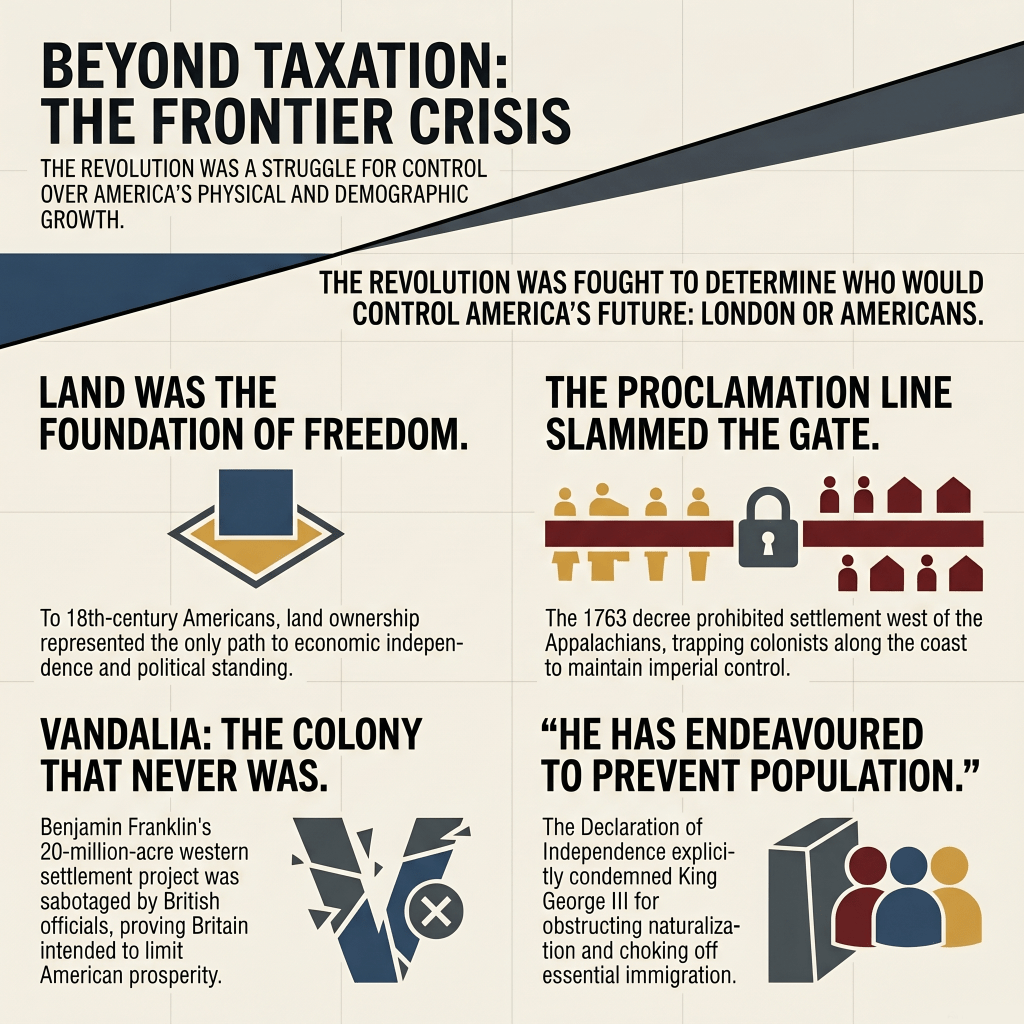
That reality made western expansion extraordinarily important to colonial Americans.
When Britain defeated France during the Seven Years’ War, the geopolitical map of North America changed dramatically. French power collapsed across Canada and the Ohio Valley. Suddenly enormous western territories appeared open to British settlement. Colonists looked westward and saw possibility stretching across forests, rivers, and valleys beyond the Appalachian Mountains. Veterans expected land grants for military service. Speculators imagined fortunes. Farmers envisioned sons and daughters establishing independent households on cheap frontier acreage. The removal of French power in 1760 effectively opened the floodgates for westward migration and speculation.
Then Britain attempted to slow the flood.
On October 7, 1763, the Crown issued the Royal Proclamation through the Privy Council. The proclamation prohibited settlement west of a line running roughly along the Appalachian crest. Colonial governors could not grant western lands. Private purchases from Native nations were forbidden. Settlement beyond the mountains required explicit Crown authorization. To many Americans, it felt as though the empire had suddenly slammed a gate shut across the continent itself.
From London’s perspective, however, the decision possessed considerable logic.
Britain emerged from the Seven Years’ War deeply in debt after financing a global conflict fought across Europe, India, the Caribbean, and North America. Maintaining military stability along the frontier threatened to become enormously expensive, particularly after Pontiac’s Rebellion demonstrated how volatile western relations remained. British officials had little desire to continue fighting Native nations indefinitely simply because colonial settlers kept pushing farther westward. The Crown also hoped to preserve the lucrative fur trade and maintain tighter imperial control over western development rather than surrendering it entirely to colonial speculation companies.
The proclamation line therefore served several purposes at once. It reduced immediate military pressure. It slowed uncontrolled settlement. It protected imperial trade interests. It also kept western lands under Crown supervision rather than allowing colonial elites to dominate the process independently.
Most colonists initially assumed the restriction would prove temporary. George Washington certainly believed so. Like many Americans, he interpreted the proclamation as a practical short term measure designed to calm frontier tensions after the war. Few colonists imagined Britain intended permanently to bar western settlement after fighting such an expensive conflict to secure those territories in the first place. Americans largely expected the line to move gradually westward as imperial authorities stabilized relations with Native nations.
But temporary restrictions have a way of becoming politically dangerous when they reveal deeper conflicts underneath them.
The proclamation line quickly became symbolic because it exposed a growing divergence between imperial priorities and colonial ambitions. Britain increasingly viewed western expansion as a military and administrative problem requiring restraint. Many colonists viewed the same expansion as the natural future of American prosperity and liberty. The question ceased being merely geographical. It became constitutional and political. Who would decide how North America developed? Imperial officials in London or Americans themselves?
No story captures that growing tension more vividly than the strange and largely forgotten saga of Vandalia.
The proposed colony of Vandalia emerged during the early 1770s as one of the largest and most ambitious land speculation projects in colonial history. At the center of the effort stood Benjamin Franklin, serving as Pennsylvania’s colonial agent in London. Franklin strongly supported trans Appalachian settlement and believed western expansion represented both economic opportunity and political necessity for the colonies. Opposing him stood Wills Hill, Earl of Hillsborough, Secretary of State for the Colonies and one of the fiercest critics of western migration within the British government.
Franklin and his partners initially requested approximately two million acres for the proposed colony. Hillsborough believed he could sabotage the effort through excess. He encouraged the speculators to ask for even more land, assuming the Privy Council would reject a petition so massive that it appeared openly greedy and politically impossible.
Instead, Franklin turned the tactic against him.
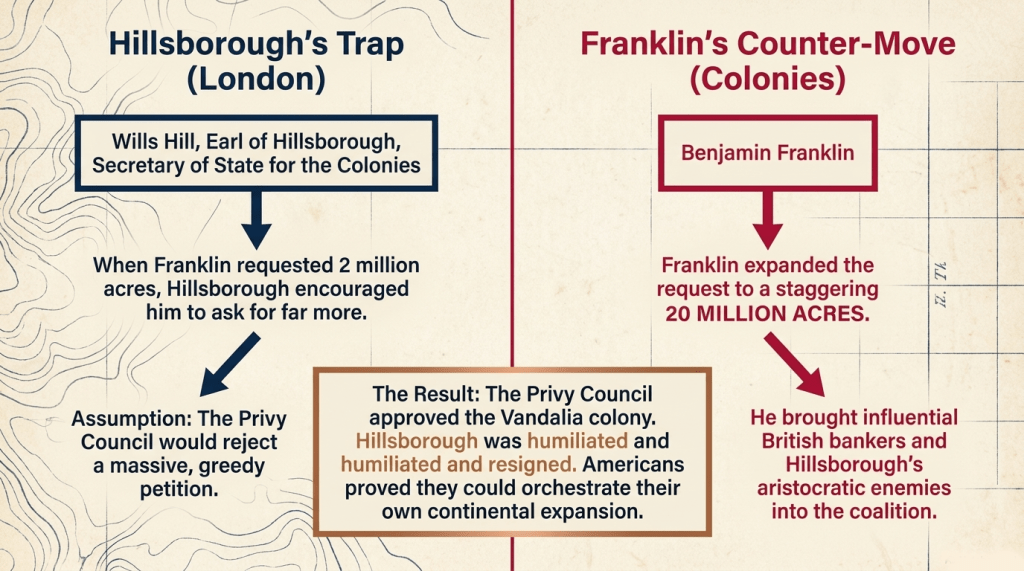
Rather than retreating, Franklin dramatically expanded the request from two million acres to twenty million acres. He then broadened the partnership itself, bringing influential British bankers and aristocrats into the project, many of whom happened to be political enemies of Hillsborough. What Hillsborough intended as a trap became a coalition powerful enough to push the proposal forward through imperial politics.
Remarkably, the Privy Council approved the proposed colony.
The decision humiliated Hillsborough so thoroughly that he resigned rather than oversee implementation of the project. For a brief moment, it appeared that a vast new colony beyond the Appalachians would emerge under speculative leadership closely tied to influential colonial and British investors alike. Vandalia represented more than a real estate venture. It symbolized the colonial belief that America’s future lay westward and that Americans themselves should direct that expansion.
Then imperial events overtook everything.
The Boston Tea Party in 1773 intensified tensions throughout the empire. Parliament responded with the Coercive Acts. Relations between Britain and the colonies deteriorated rapidly. Most damaging for Vandalia itself, Parliament passed the Quebec Act in 1774, extending Quebec’s southern boundary to the Ohio River. The territory expected for Vandalia suddenly fell under Quebec’s jurisdiction instead.
To colonial Americans, the symbolism could hardly have been worse. Land they expected to open for British American settlement now appeared attached administratively to Quebec under imperial authority. For Protestant colonists already suspicious of centralized British control and deeply uneasy about the Quebec Act’s accommodation of French Catholic institutions, the decision looked almost deliberately hostile. Once again, the Crown appeared willing to block American expansion whenever imperial priorities demanded it.
The collapse of Vandalia therefore carried significance far beyond the failure of a speculative project. It reinforced a growing colonial suspicion that Britain no longer viewed the colonies as partners in a shared empire but as dependencies whose growth, migration, and future development could be controlled from London according to imperial interests.
That suspicion fed directly into the Declaration of Independence itself. Jefferson later accused George III of obstructing “the Laws for Naturalization of Foreigners,” refusing measures “to encourage their migrations hither,” and “raising the conditions of new Appropriations of Lands.” Modern readers often skim past those grievances because they lack the dramatic simplicity of tea taxes or marching soldiers. To eighteenth century Americans, however, the meaning was unmistakable. The Crown had interfered with the colonies’ ability to grow, expand, settle, and shape their own future.
The struggle over the frontier therefore became part of a much larger constitutional crisis.
Who controlled America’s future? Who controlled migration, settlement, opportunity, and expansion? Could the colonies govern their own development, or would imperial authorities impose limits according to distant priorities and global calculations?
Once those questions entered the imperial debate, the conflict became about far more than taxation alone. It became a struggle over whether Americans would inherit a continent or remain tenants within an empire that increasingly treated their ambitions as something to be restrained rather than fulfilled.
One of the most overlooked grievances in the Declaration of Independence concerns immigration.
Modern Americans tend to read the Declaration through the lens of taxation, representation, standing armies, and political liberty, which is understandable because those themes dominate popular memory of the Revolution. Yet buried among Jefferson’s accusations against George III sits a complaint that sounds strikingly contemporary: the king had attempted to prevent the population growth of the colonies by obstructing immigration and restricting naturalization.
At first glance, the grievance can seem oddly technical compared to the more dramatic charges elsewhere in the document. Troops in the streets. Dissolved legislatures. Burned towns. Those feel revolutionary. Immigration policy sounds more like something argued over in a congressional subcommittee hearing while exhausted interns refill coffee cups. But to eighteenth century Americans, the issue struck at the heart of colonial growth, economic power, political autonomy, and even survival itself.
Population meant strength. And the colonies believed Britain was deliberately trying to limit it. That belief becomes especially important because for much of the colonial period, Britain had actively encouraged immigration to North America. The colonies needed laborers, farmers, merchants, craftsmen, and settlers. Expanding population meant expanding commerce, stronger frontier settlement, larger markets for British goods, and increased imperial wealth. During the first half of the eighteenth century, British policy generally viewed immigration as beneficial to the empire as a whole.
The clearest example came with the Plantation Act of 1740, also known as the Naturalization Act of 1740. Parliament passed the law specifically to simplify and standardize naturalization procedures within the American colonies. The act allowed Protestant immigrants who had resided in a colony for seven years to become naturalized British subjects. In practice, it opened the door for large numbers of German, Swiss, Scots-Irish, Huguenot, and other European immigrants to settle permanently in British North America.
The law reflected something fundamental about colonial America during the mid eighteenth century. The colonies increasingly viewed themselves as lands of opportunity defined less by rigid birth hierarchies than by expansion, labor, and settlement. Britain itself remained deeply tied to class structures, inherited estates, and old social systems. America felt different. A poor immigrant arriving in Pennsylvania or Virginia might realistically hope to own land within a generation. Economic mobility existed in ways much of Europe struggled to match.
Benjamin Franklin recognized this clearly. Franklin argued repeatedly that immigration strengthened the colonies economically because new settlers created demand for goods, expanded trade networks, and supplied skilled labor desperately needed in growing colonial communities. Artisans, craftsmen, farmers, and merchants did not weaken America. They strengthened it. Population growth fueled prosperity.
That point mattered enormously because the colonies remained underpopulated compared to the vast territories surrounding them. Americans understood instinctively that expansion and security required people. Empty land solved nothing unless families settled it, cultivated it, defended it, and tied it economically to colonial society. Immigration therefore was not viewed merely as humanitarian generosity or demographic curiosity. It was strategic.
A populated America would become a stronger America. By the 1760s and early 1770s, however, imperial attitudes toward immigration began shifting.
King George III’s advisors increasingly worried about the rapid diversification and expansion of the colonies. Non-English immigrants particularly drew suspicion within imperial circles. Many officials feared these populations lacked sufficient loyalty to the Crown or attachment to traditional English political structures. German settlers in Pennsylvania, Scots-Irish communities on the frontier, and other immigrant groups often appeared culturally distinct from the English establishment London preferred to govern.
There was also a larger strategic concern underneath these anxieties.
As the colonies expanded rapidly in both territory and population, they became more difficult to control. Population growth meant greater economic independence, larger militias, broader political influence, and stronger regional identities increasingly disconnected from Britain itself. Colonial self-confidence grew alongside colonial numbers. The empire that once consisted of scattered settlements hugging the Atlantic coast was evolving into something much larger and potentially far less manageable.
London noticed.
Imperial officials increasingly began viewing unrestricted colonial growth not simply as an advantage but as a possible threat to British political and economic supremacy within the empire. The same immigration policies once encouraged for imperial expansion now appeared dangerous because they strengthened colonial autonomy.
Then came the turning point.
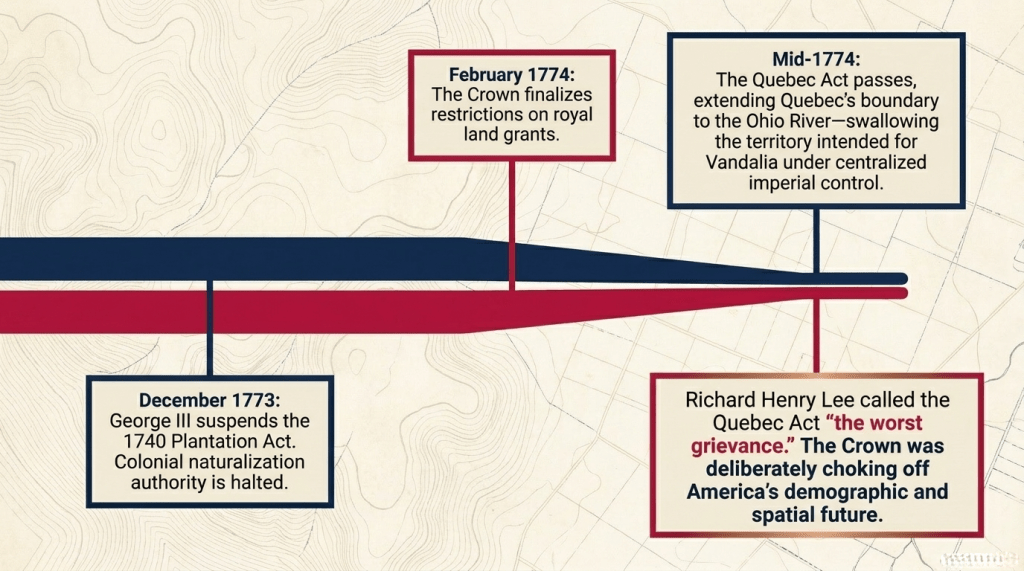
In December 1773, King George III suspended the Plantation Act of 1740. Colonial naturalization authority was effectively halted. Colonies could no longer freely naturalize immigrants under the earlier system. The change represented more than administrative adjustment. Colonial naturalization of aliens became outright forbidden under the existing framework. Then, in February 1774, the Crown finalized restrictions on royal land grants as well.
To many Americans, the implications looked enormous. The colonies believed they possessed the right to shape their own demographic and economic future. Naturalization had become part of colonial self government itself. Colonial assemblies passed local laws encouraging settlement because expanding population strengthened local economies and frontier security. Suddenly London appeared to be reclaiming direct control over who could become part of colonial society and under what conditions.
The issue therefore became constitutional as much as demographic. If Parliament and the Crown could override colonial authority over immigration and settlement, what areas of self-government remained secure at all?
Colonial leaders reacted furiously because they saw the policy as an attack on both prosperity and autonomy. High levels of immigration were viewed as essential to national security, economic development, and frontier stability. More settlers meant stronger colonies. Restricting immigration therefore looked not merely inconvenient but actively hostile to American interests.
This frustration flowed directly into the Declaration of Independence itself. Jefferson’s grievance reads with remarkable clarity once placed in this context: “He has endeavoured to prevent the population of these States; for that purpose obstructing the Laws for Naturalization of Foreigners; refusing to pass others to encourage their migrations hither, and raising the conditions of new Appropriations of Lands.”
Modern readers sometimes overlook the significance of that passage because the Revolution is so often framed primarily around political liberty and taxation. Yet the signers considered immigration restrictions serious enough to include among the defining acts of British tyranny. They believed the Crown had deliberately attempted to weaken colonial growth and interfere with the colonies’ ability to govern themselves.
That accusation reveals something profoundly important about early American identity.
The Revolution was not born from an isolated, closed society trying to protect itself from newcomers. Colonial America largely viewed immigration as strength. New settlers meant labor, commerce, defense, expansion, and opportunity. The colonies saw themselves increasingly as places where people from across Europe could build independent lives through land ownership and economic participation. Britain’s restrictions therefore felt like an attempt to choke off America’s future development before it could fully mature.
The grievance also reveals how deeply population and liberty were connected in colonial thinking.
A growing population strengthened local institutions. It filled militias. It expanded trade. It settled frontier regions. Most importantly, it increased the colonies’ capacity to act independently of Britain itself. Americans increasingly believed they could build a thriving continental society if left free to govern migration, settlement, and expansion according to their own needs.
The Crown’s interference suggested London no longer trusted the colonies to shape that future for themselves.
And once Americans concluded that Britain intended to limit not merely their trade or taxes but their very growth as a people, the imperial relationship began collapsing at its roots.
By the autumn of 1774, the imperial crisis had become about far more than taxes.
That reality emerges clearly in one of the more revealing comments made during the First Continental Congress. Richard Henry Lee of Virginia, himself deeply involved in western land speculation, reportedly described the Quebec Act as “the worst grievance” suffered by the colonies. That statement tends to surprise modern readers because the Quebec Act rarely occupies the same dramatic space in popular memory as the Stamp Act or the Tea Party. Yet to many colonial leaders, the struggle over western lands, migration, and settlement struck at the very future of America itself.
The issue was not isolated from the broader constitutional conflict. Historians increasingly recognize that taxation disputes and frontier policy represented two sides of the same imperial argument. Parliament sought to assert sovereign authority across the empire. Americans increasingly resisted that claim wherever it appeared, whether in taxation, trade regulation, western settlement, immigration policy, or naturalization law. The argument always circled back to the same central question: who would govern America’s future, the colonies themselves or distant imperial authorities in London?
The collapse of projects like Vandalia widened that divide dramatically.
For colonial elites involved in land speculation, British frontier restrictions increasingly looked like direct assaults on economic opportunity and political independence. Men such as George Washington, Benjamin Franklin, Patrick Henry, Richard Henry Lee, and countless others possessed personal financial interests tied to western expansion. But their frustration extended beyond simple profit. The western territories represented the future growth of the colonies themselves. Land meant population, commerce, agriculture, security, and political strength. Restricting western settlement therefore appeared to many Americans as an attempt to keep the colonies dependent, crowded along the coast, and subordinate to imperial control.
That frustration helped hasten the rupture between Britain and America because it convinced many influential colonists that the empire no longer viewed American growth as desirable. Britain increasingly sought regulation, restraint, and imperial oversight. Americans increasingly wanted movement, expansion, and local control. The same continent inspired two completely different visions of the future.
The Revolution itself quickly revealed just how central land had become to the American project.
Very early in the war, Continental leaders recognized that western territory might become the young nation’s greatest financial resource. The colonies possessed little hard currency, weak centralized authority, and enormous war expenses. But they did possess something else: vast claims to western land stretching beyond the Appalachians. Delegates began discussing the sale of frontier territory as one of the best methods for financing independence itself.
That solution, however, created another problem.
Several states, particularly Virginia, claimed enormous western territories under their colonial charters. Other states without comparable claims feared being economically overshadowed inside the new union. The dispute became serious enough to delay ratification of the Articles of Confederation because smaller states demanded that western lands become national rather than purely state assets. Eventually Virginia and six other states agreed to cede massive tracts of territory to the federal government between 1781 and 1802, amounting to roughly 222 million acres of potentially saleable land.
The significance of that transfer can hardly be overstated.
The United States federal government was, quite literally, born land rich. The republic inherited a continental future before it possessed stable finances, mature institutions, or even clear constitutional authority. Western lands became the economic foundation supporting national expansion, territorial organization, debt management, and eventually the admission of new states. In many respects, the United States survived its fragile early years because it possessed room to grow.
That growth depended heavily upon immigration.
The Founders never envisioned America as a closed society frozen around a single ancestral population. They expected immigration to continue because expansion required settlers, laborers, artisans, merchants, and farmers. The same logic that had shaped the Plantation Act of 1740 continued influencing early American policy after independence. The Naturalization Act of 1790 drew heavily from earlier British colonial practices encouraging immigration and incorporation into political society. The young republic actively sought population growth because population meant economic development, frontier stability, military strength, and national expansion.
That does not mean the Founders favored completely unrestricted migration detached from cultural expectations or civic responsibility. They expected immigrants to embrace the political principles of the republic itself, including property rights, self government, and constitutional liberty. Immigration was valued because it strengthened the existing civic culture rather than replacing it. Americans believed newcomers should join the republic, not fundamentally transform its constitutional character.
Which makes the rise of the Know Nothing movement during the 1850s especially fascinating.
By the mid nineteenth century, massive waves of immigration from Ireland and Germany triggered growing anxiety among many native-born Americans. Economic competition, religious tensions, and cultural fears combined into a powerful nativist reaction. The Know Nothings argued that immigration threatened American identity and political stability. Their proposed solutions included obstructing naturalization procedures, dramatically extending residency requirements, and potentially repealing naturalization laws entirely.
The irony was extraordinary.
The Know Nothing position closely resembled the very policy King George III had pursued before the Revolution, the same policy Jefferson condemned directly in the Declaration of Independence. The Crown had attempted to obstruct naturalization, restrict migration, and limit colonial population growth. Now, less than a century later, Americans themselves debated adopting similar restrictions against new immigrants arriving in the republic.
Critics of the Know Nothings recognized the contradiction immediately.
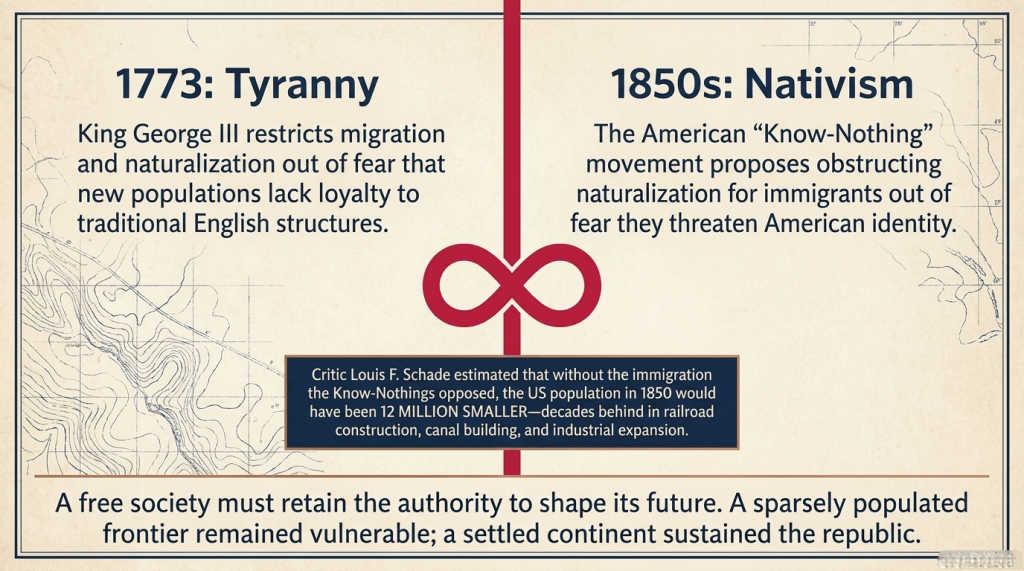
Louis F. Schade argued that had such restrictive policies existed earlier, the United States would have lagged dramatically behind its actual development. He estimated the nation’s population by 1850 might have been more than twelve million smaller, effectively placing the country decades behind economically and politically. Immigration, he argued, had fueled railroad construction, canal building, western settlement, industrial expansion, and the rapid admission of new states into the Union. The transformation of the frontier into productive American territory depended heavily upon immigrants willing to build lives there.
That debate still echoes today because the underlying questions never truly disappeared.
The story of Vandalia and the Declaration’s grievance concerning immigration and population growth continues carrying lessons about sovereignty, self government, and national identity. The Founders believed a free society must retain the authority to shape its own future, including control over settlement, migration, and expansion. Their objection to George III was not simply that he regulated immigration. It was that he did so arbitrarily, from afar, and against what the colonies believed were their own economic and political interests.
At the same time, the colonial experience demonstrates that immigration itself was widely understood as a source of national strength when tied to productive settlement, economic opportunity, and civic integration. The Founders wanted growth because they believed population, land ownership, and local self-government reinforced liberty rather than threatening it. A sparsely populated frontier remained vulnerable. A settled continent could sustain a republic.
Vandalia symbolized that larger aspiration.
The proposed colony represented the belief that Americans should possess the freedom to build communities, expand westward, govern local development, and shape the future according to their own needs rather than distant imperial calculations. British restrictions convinced many colonists that the Crown increasingly viewed American growth itself as something to be controlled and restrained. Once that suspicion took hold, the imperial relationship became extraordinarily difficult to preserve.
The larger lesson reaches beyond the eighteenth century.
Free societies depend upon balancing growth with cohesion, opportunity with order, and expansion with civic continuity. The Founders understood that immigration and settlement could strengthen a nation when integrated into a stable constitutional culture grounded in property rights, self-government, and shared political principles. They also understood that distant centralized authority often misunderstands local realities and can suffocate development through excessive control.
That is why the grievance about naturalization and migration belonged in the Declaration alongside taxes and standing armies.
It was never merely about paperwork or immigration quotas. It was about who possessed the right to shape America’s future.
Bailyn, Bernard. The Ideological Origins of the American Revolution. Cambridge, MA: Belknap Press of Harvard University Press, 1967.
Billington, Ray Allen. Westward Expansion: A History of the American Frontier. New York: Macmillan, 1967.
Ellis, Joseph J. American Creation: Triumphs and Tragedies at the Founding of the Republic. New York: Alfred A. Knopf, 2007.
Franklin, Benjamin. The Papers of Benjamin Franklin. Edited by Leonard W. Labaree et al. New Haven, CT: Yale University Press, 1959–.
Horsman, Reginald. Expansion and American Indian Policy, 1783–1812. East Lansing: Michigan State University Press, 1967.
Jefferson, Thomas. The Papers of Thomas Jefferson. Edited by Julian P. Boyd et al. Princeton, NJ: Princeton University Press, 1950–.
Lee, Richard Henry. The Letters of Richard Henry Lee. Edited by James Curtis Ballagh. 2 vols. New York: Macmillan, 1911–1914.
Middlekauff, Robert. The Glorious Cause: The American Revolution, 1763–1789. New York: Oxford University Press, 1982.
Morgan, Edmund S., and Helen M. Morgan. The Stamp Act Crisis: Prologue to Revolution. Chapel Hill: University of North Carolina Press, 1953.
Schade, Louis F. The Foreign Element in Our Population. Philadelphia, 1854.
United States. Declaration of Independence. July 4, 1776.
Warden, G. M. “The Vandalia Land Company and the Imperial Crisis.” The Pennsylvania Magazine of History and Biography 93, no. 1 (1969): 3–28.
Wood, Gordon S. The Creation of the American Republic, 1776–1787. Chapel Hill: University of North Carolina Press, 1969.
Wood, Gordon S. The Radicalism of the American Revolution. New York: Alfred A. Knopf, 1992.




 DAVE DOES HISTORY
Leave a comment