
Dave Does History Returns: How an Ancient Epic Shaped American Liberty
When Thomas Jefferson sat down to draft the Declaration of Independence, he was not trying to invent freedom from scratch. That is one of the great misunderstandings of modern America. We tend to imagine the Founders as men standing at the edge of history, flinging lightning bolts into the future while shouting about liberty like some eighteenth century version of a movie trailer voice-over. We picture rebellion. Defiance. Emotion. We hear drums in the background and somebody waving a flag in slow motion while an eagle circles overhead because apparently that is legally required in every modern interpretation of the American founding.
The reality was far more disciplined, and in many ways far more profound.
The men who wrote the Declaration understood liberty not as the absence of restraint but as obedience to something higher than themselves. Freedom, to them, did not mean the right to indulge every appetite or pursue every passing desire. It meant living within a moral order that existed before kings, before parliaments, before constitutions, and certainly before opinion polls. Their understanding of liberty came not primarily from London or Paris, but from Rome, and behind Rome, from the long memory of the classical world itself.
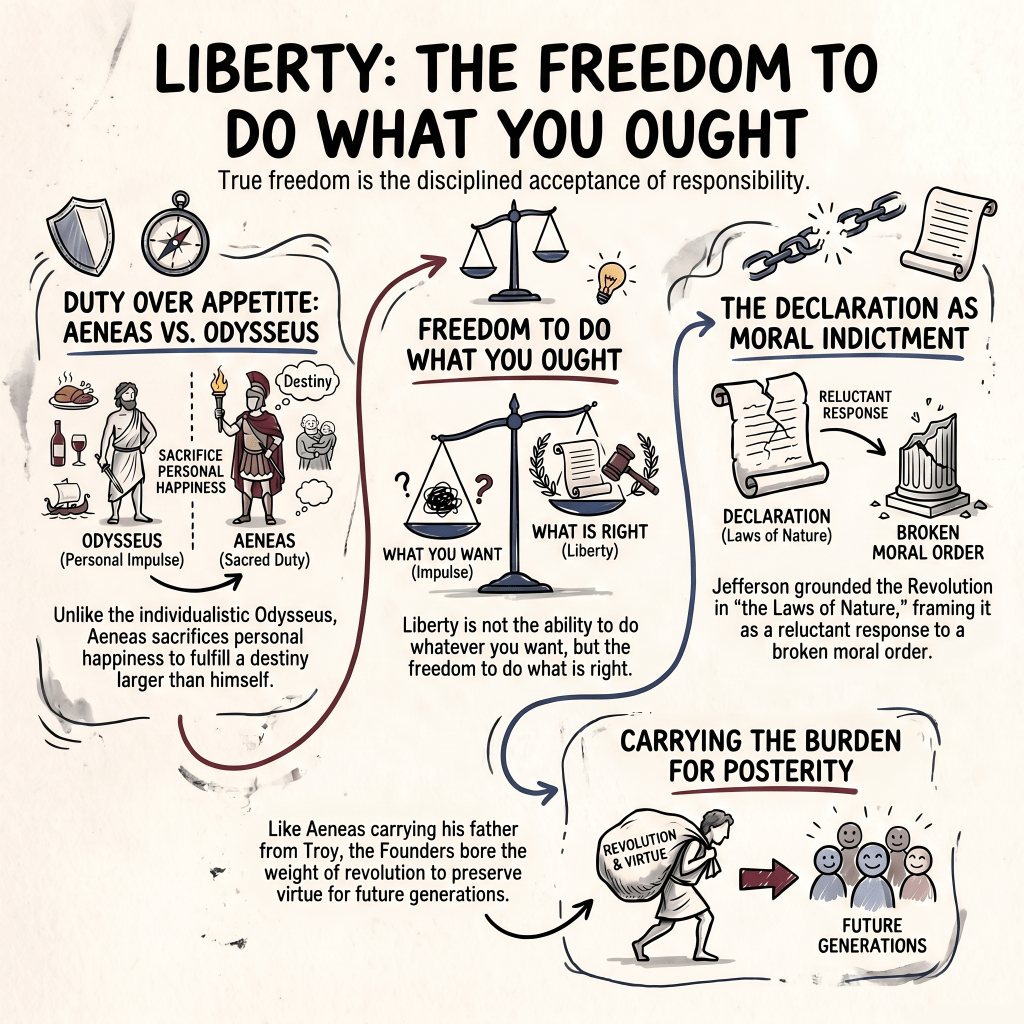
For two thousand years educated men had been raised on the story of Aeneas, the Trojan exile who escaped the burning ruins of Troy carrying his aged father Anchises upon his shoulders while leading his son by the hand. It remains one of the most powerful images in all of Western civilization because it captures a truth modern culture struggles to comprehend. Aeneas is not carrying treasure. He is not carrying weapons. He is not even carrying himself toward pleasure or comfort. He is carrying duty. The old world rests on his back while the future walks beside him.
That mattered enormously to the Founders because they knew Virgil’s Aeneid intimately. This was not obscure literature sitting unread on a shelf somewhere between calculus textbooks and old yearbooks. Jefferson, Adams, Madison, Hamilton, and countless others had memorized passages from Virgil as boys. They learned Latin through these stories. They discussed them endlessly. Dave made this point repeatedly during the broadcast, and rightly so. To the Founders, these stories were not “myths” in the dismissive modern sense of the word. They were moral history, designed to inculcate values into the civilization inheriting them.
The purpose of studying the ancient world was not merely to memorize names and dates. It was to shape character. Stories carried moral weight. Civilizations transmitted virtues through narrative. Young men learned not simply how governments functioned, but why duty mattered more than appetite.
And no classical figure embodied that ideal more completely than Aeneas.
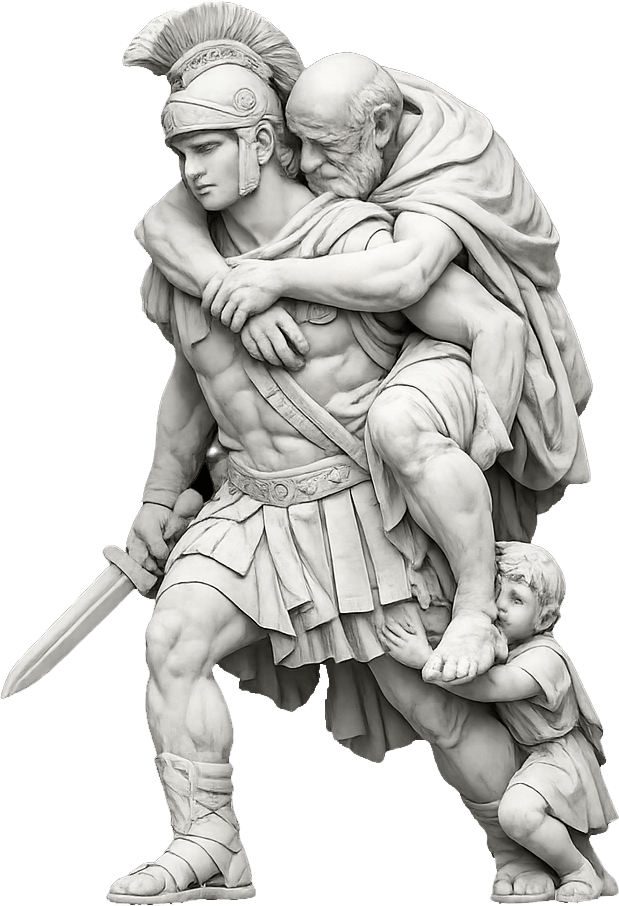
The modern world tends to admire Odysseus more because he is clever, rebellious, witty, and individualistic. He talks his way through problems. He bends rules. He improvises constantly. Americans love that sort of personality because we often confuse charisma with virtue. Aeneas is different. Aeneas obeys. Again and again in the Aeneid, he sacrifices what he personally desires because he believes he has been entrusted with a destiny larger than himself.
That becomes painfully clear during his relationship with Dido, queen of Carthage. Virgil describes them as deeply and genuinely in love. Dido offers him stability, affection, power, even happiness. Stay here, she tells him. Rule beside me. Build a life instead of chasing prophecy across dangerous seas. Modern storytelling practically trains us to expect that outcome. The hero chooses love. The audience applauds. Roll credits.
Aeneas leaves anyway.
Not because he does not love her, but because duty demands sacrifice. The gods have charged him with founding a future civilization, and he cannot abandon that responsibility for personal fulfillment. It is one of the coldest and most heartbreaking decisions in classical literature precisely because Virgil does not pretend duty feels pleasant. Aeneas obeys not because it makes him happy, but because he believes civilization itself depends upon such obedience.
That idea would have sounded deeply familiar to Jefferson and Adams.
When Jefferson begins the Declaration with the words, “When in the Course of human events,” he is not writing like a modern revolutionary demanding self expression. He is writing almost liturgically. The phrase carries the tone of solemn obligation rather than emotional rebellion. The colonies are not portrayed as impulsive mobs throwing off restraint. They are portrayed as a people reluctantly accepting a burden imposed by moral necessity.
The key phrase comes immediately afterward: “the Laws of Nature and of Nature’s God.”
Modern Americans quote that line so casually that we often fail to hear its weight. Jefferson is grounding the entire Revolution in a universal moral order that exists independently of government itself. Kings do not create justice. Parliaments do not invent morality. Human law must remain accountable to a higher law or it loses legitimacy altogether.
That is pure Aeneas.
Virgil’s hero survives storms, wars, temptations, betrayals, and despair because he believes he serves an order larger than himself. Jefferson frames the American cause in exactly the same way. The colonies are not rebelling because they dislike taxes or regulations or royal personalities. They are responding to violations of a moral order that makes legitimate liberty possible.
Seen through Roman eyes, the Revolution becomes something very different from the caricature often presented today. It is not the liberation of passion. It is the disciplined acceptance of responsibility. The colonies are leaving behind what they increasingly view as a corrupt and collapsing imperial order much the way Aeneas leaves the burning ruins of Troy. The goal is not chaos. The goal is the founding of a lawful republic rooted in virtue and justice.
In that sense, the American founding becomes profoundly conservative in the older meaning of the word. The Revolution is not trying to destroy civilization. It is trying to preserve its moral foundations against corruption and abuse. The Founders believed liberty could survive only when restrained by virtue, law, duty, and self government. Freedom detached from moral order eventually collapses into either anarchy or despotism. Dave touched on this repeatedly during the episode when discussing how the grievances of the Declaration functioned not as emotional complaints but as moral arguments proving that George III had violated the conditions necessary for ordered liberty itself.
That distinction matters because modern America often speaks about freedom as though it means unlimited self assertion. “I should be able to do whatever I want” has gradually replaced “I should do what is right.” Bill Mick captured the contrast beautifully when recalling his father’s definition of liberty. Freedom is not the ability to do whatever one desires. It is the freedom to do what one ought to do.
That is an Aenean idea. It is also an American founding idea.
The Declaration therefore functions almost like an invocation before a voyage. Much as Aeneas appeals constantly to divine guidance while carrying the burden of founding Rome, Jefferson appeals to “divine Providence” as the colonies prepare to sever themselves from the British Crown. The signers understand exactly what they are risking. Failure means execution for treason. Economic ruin. War. The destruction of families and communities. Yet they proceed because they believe duty requires it.
And that is perhaps the most important thing modern Americans have forgotten.
The Founders did not believe liberty was easy.
They believed liberty required sacrifice, restraint, courage, discipline, and moral seriousness. They did not seek freedom in order to escape obligation. They sought freedom because they believed only a virtuous people governing themselves under higher law could remain truly free.
Two thousand years separate Aeneas carrying Anchises from the flames of Troy and Jefferson putting pen to parchment in Philadelphia, yet the moral structure underneath both acts remains strikingly similar. Civilization survives because somebody chooses duty over desire. Somebody carries the burden instead of dropping it. Somebody accepts responsibility for a future they themselves may never fully see.
Aeneas carried his father through fire so Rome might someday exist. Jefferson and the signers carried the moral weight of revolution so that ordered liberty might survive in America. Neither act was rebellion for its own sake. Both were obedience to something higher.
The grievances in the Declaration of Independence are often read today the way modern people read online complaint forums. The king did this. Parliament did that. Taxes were unfair. Troops were annoying. Trade restrictions hurt business. Somewhere along the line, Americans began hearing the Declaration as though Jefferson were simply compiling the eighteenth century version of angry customer service reviews. One almost expects the document to conclude with, “One star. Would not recommend monarchy.”
That is not what the Founders believed they were doing.
To Jefferson, Adams, Franklin, and the others, every grievance represented evidence in a moral argument. Each accusation measured whether George III had violated the natural order that made legitimate liberty possible. The Declaration is not a tantrum. It is an indictment. More importantly, it is an indictment written by men steeped in the Aenean understanding of duty, justice, virtue, and lawful order.
“Every grievance is a test, a measure of whether the king has broken the natural order that makes freedom possible.” That matters because it changes how one reads the document entirely. The grievances are not random complaints stacked together emotionally. They form a moral progression, almost like stations along a legal and philosophical journey toward unavoidable separation.
Seen through Roman eyes, the Declaration begins sounding less like rebellion and more like a tragic conclusion reluctantly reached after repeated violations of sacred duty.
Take Jefferson’s grievance that “He has refused his Assent to Laws, the most wholesome and necessary for the public good.” Modern readers often rush past that line because it sounds procedural, almost bureaucratic. One imagines colonial paperwork sitting unsigned on a royal desk somewhere while powdered officials sip tea and misplace documents under stacks of parchment. But to the Founders, this was not administrative irritation. It struck directly at the Roman and classical understanding of lawful order itself.
Aeneas obeys law constantly throughout the Aeneid, even when that obedience wounds him personally. Divine order matters more than individual desire. The ruler who rejects lawful order ceases to govern justly because he places his own will above the moral structure sustaining civilization. Jefferson’s accusation therefore is not merely that George III blocked legislation. The accusation is that the king disrupted the lawful functioning of society itself. Tyranny begins when rulers no longer submit themselves to the obligations of justice and instead treat law as whatever preserves their own authority.
That idea would have resonated deeply with educated eighteenth century Americans because classical education had trained them to think in terms of virtue and corruption rather than merely policy disagreement. Rome fell, in their understanding, because virtue decayed and rulers ceased respecting the laws binding society together. The Revolution therefore was not about inventing freedom from nothing. It was about preserving lawful liberty against corruption.
The grievance concerning justice carries the same moral structure. Jefferson writes that George III “has obstructed the Administration of Justice.” Again, the modern tendency is to flatten the statement into procedural annoyance. Courts delayed. Judges manipulated. Bureaucracy mismanaged. Yet in the Roman framework, justice is the foundation upon which civilization rests. Aeneas’s future Rome is envisioned not simply as powerful but as just. Without justice, freedom collapses into either anarchy or despotism because citizens lose confidence that law restrains power equally.
In the Aenean understanding, justice is not the destruction of standards or the flattening of all distinctions into ideological slogans. Justice means rightful order, where law applies consistently and protects the moral structure necessary for liberty to survive. Once rulers manipulate justice for political convenience, freedom itself becomes unstable. Americans increasingly believed British authority had crossed precisely that line.
The grievances concerning representative government become even more revealing when viewed through this classical lens. Jefferson accuses the king of dissolving representative houses repeatedly and refusing to permit meaningful legislative voice within the colonies. Modern readers sometimes miss how radical that accusation actually was because we live inside representative systems so thoroughly that they feel almost automatic. The Founders did not see representation merely as a procedural mechanism. They saw it as a moral necessity rooted in the Roman belief that voice and duty must coexist.
Aeneas listens constantly to his followers. He leads, certainly, but leadership in the classical sense does not mean arbitrary domination detached from those being governed. The ruler who silences legitimate civic voice loses moral legitimacy because he ceases acting for the common good and begins acting solely for himself. Jefferson therefore is not arguing merely for political convenience. He is arguing that George III violated one of the core obligations of lawful authority itself.
This becomes particularly important because the colonists still considered themselves heirs to English constitutional tradition. They believed representative assemblies formed part of the inherited moral order protecting liberty. When Parliament and the Crown dissolved legislatures or ignored colonial petitions, Americans interpreted those actions not as isolated political disagreements but as evidence that lawful balance itself was collapsing.
The grievance concerning standing armies reveals the Roman influence perhaps more clearly than any other. Jefferson writes that George III “has kept among us, in times of peace, Standing Armies without the Consent of our legislatures.” That fear came directly from both English constitutional history and Roman republican memory. Rome itself feared armies detached from civil law because military force unconstrained by virtue inevitably threatens liberty. The Roman Republic survived only so long as military authority remained subordinate to civic order. Once generals began treating armies as personal instruments of power, the republic decayed into empire.
The Founders saw the same danger emerging in British policy after 1763. Redcoats stationed permanently in colonial cities did not appear as guardians of liberty. They appeared as instruments of occupation enforcing authority through intimidation. Dave phrased it memorably during the broadcast: “Liberty is armed with virtue, not occupation.” That distinction mattered enormously. Americans were not anti military. They admired courage, discipline, and sacrifice deeply. George Washington himself embodied military leadership. What they feared was military power detached from lawful civic restraint.
The grievance therefore becomes moral rather than emotional. A ruler relying increasingly on military enforcement rather than lawful consent reveals that legitimate authority is failing. Bayonets become substitutes for virtue. Occupation replaces civic trust.
Then Jefferson moves toward grievances involving destruction itself. “He has plundered our seas, ravaged our coasts, burnt our towns, and destroyed the lives of our people.” Read casually, the line sounds like wartime outrage. Read classically, it becomes something deeper. Aeneas himself endures storm, exile, suffering, and ruin because he believes future generations depend upon his perseverance. The colonies increasingly viewed themselves through a similar lens. They were enduring sacrifice not merely for present grievances but for the preservation of liberty itself for posterity.
That word, posterity, carried enormous weight for the Founders. Modern culture often struggles to think beyond immediate satisfaction, which perhaps explains why so much contemporary politics resembles toddlers fighting over the last chicken nugget in the bag. The Founders thought generationally. They believed they were custodians of an inheritance stretching backward through England, Rome, Greece, and ultimately natural law itself. Their duty involved preserving liberty for future citizens not yet born.
That is profoundly Aenean.
Aeneas suffers for a city he will never fully see. The Founders risked their lives for a republic they knew might collapse entirely. Neither acted because success was guaranteed. They acted because duty demanded obedience regardless of outcome.
And that is the crucial thing modern Americans often miss about the Declaration.
The document does not celebrate rebellion for its own sake. It mourns the necessity of separation while arguing that moral order itself requires it. The colonies repeatedly petitioned, appealed, negotiated, and endured. Only after concluding that the king had systematically violated the conditions necessary for lawful liberty did they sever political ties.
Seen through Roman eyes, the grievances form something like a voyage themselves. Each violation pushes the colonies farther from reconciliation and closer toward reluctant independence. Like Aeneas leaving the burning ruins of Troy, Americans increasingly believe they must depart from a corrupted order in order to preserve civilization’s deeper principles.
The Revolution therefore becomes not an escape from duty but an acceptance of it. Jefferson and the signers are not throwing off morality in the name of freedom. They are insisting that freedom survives only inside morality. The king’s failure is not merely political. It is ethical. He has violated the obligations that make authority legitimate at all.
And so the grievances march forward not as angry shouting, but as evidence. A moral case. A Roman argument.
An Aenean reckoning with power, justice, and the dangerous fragility of ordered liberty itself.
The Declaration of Independence does not end with rage.
That is one of the most revealing things about the document once one stops reading it like a modern political slogan and starts reading it the way the Founders themselves would have understood it. The grievances build steadily, carefully, almost like a legal argument climbing toward unavoidable judgment. Jefferson lays out violation after violation, abuse after abuse, until the separation from Britain appears not impulsive but morally necessary. Yet after all of that, after the accusations, after the philosophical preamble, after the long catalog of injuries and usurpations, the document concludes not with vengeance or triumphalism but with a pledge.
A covenant.
“We mutually pledge to each other our Lives, our Fortunes, and our sacred Honor.”
That sentence is pure pietas.
Modern Americans often hear it romantically because we have spent generations wrapping the Founders in marble and turning them into permanent residents of monuments. We hear the phrase as inspirational rhetoric delivered by men who somehow already knew history would vindicate them. But in July of 1776, there was nothing safe or sentimental about those words. The signers were pledging not abstract ideals but actual lives, actual fortunes, actual reputations. Failure meant execution for treason. Hanging. Confiscation of property. Ruined families. Oblivion. Benjamin Franklin joked darkly that they must all hang together or they would assuredly hang separately, which remains one of the finest examples of gallows humor ever produced by a man wearing bifocals.
And yet they signed.
They signed because, in the Roman and Aenean understanding of liberty, duty outweighs personal safety. The self exists within a larger moral order. One sacrifices immediate comfort for enduring civilization. That is why, as Dave observed during the broadcast, the Founders would have viewed radical individualism with deep suspicion. The modern libertarian instinct, the idea that freedom means liberation from all obligation except personal choice, would have struck many of them as dangerously incomplete. Liberty detached from duty eventually collapses because civilization itself depends upon shared sacrifice.
That is the crucial distinction.
Aeneas does not carry Anchises from burning Troy because it benefits him personally. In many ways, it ruins his life. The voyage costs him comfort, certainty, companionship, and peace. He loses friends. He loses his homeland. He loses Dido. He endures storm after storm while pursuing a future he himself may never fully possess. Yet he continues because he believes the survival of civilization requires obedience to something higher than personal appetite.
The Founders thought similarly.
Jefferson’s Declaration therefore does not lead toward chaos. It leads toward order. That is one of the most profoundly misunderstood aspects of the American Revolution. Modern revolutions often celebrate destruction for its own sake. Tear down institutions. Smash systems. Burn away restraint. Begin again from zero. The French Revolution eventually devoured itself precisely because it untethered liberty from inherited moral order and attempted to rebuild society entirely around abstract ideological will. The American Revolution took a very different path because its intellectual roots were profoundly classical and deeply conservative in the older sense of the word.
The grievances against George III did not justify permanent rebellion. They justified the restoration of lawful order rooted in virtue, representation, justice, and natural law. The colonies separated from Britain not to abolish moral authority but to preserve it. Jefferson’s argument throughout the Declaration is that the king himself has violated the conditions necessary for legitimate government. Separation therefore becomes not an act of nihilism but an act of moral necessity.
That is profoundly Roman.
Virgil’s Aeneid ends not with endless wandering but with foundation. The suffering exists for the sake of creating something enduring. Aeneas’s hardships become meaningful because they plant the seed of Rome itself. Likewise, the Revolution only makes sense to the Founders if it leads toward stable republican order. Liberty without structure would have terrified them almost as much as tyranny itself.
We return to this repeatedly because modern Americans increasingly struggle to hold liberty and restraint together in the same sentence. We quote “all men are created equal” constantly, but we skip past “the Laws of Nature and of Nature’s God” because that language carries obligations modern culture finds uncomfortable. Rights are celebrated enthusiastically. Duties much less so. Americans love the promise of freedom while often resenting the disciplines necessary to sustain it.
The Founders would have considered that imbalance dangerous.
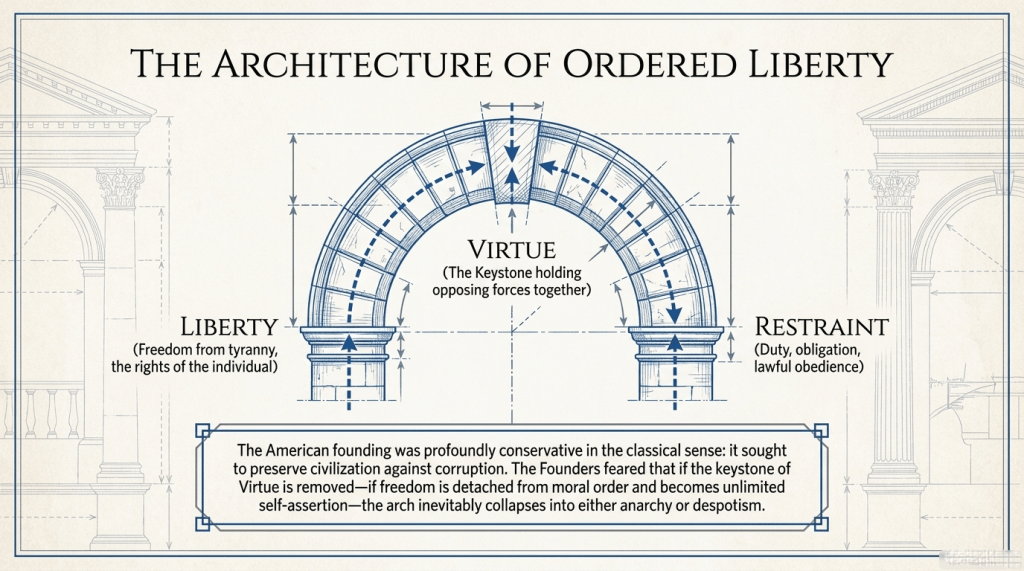
For them, liberty required virtue because self government demanded self restraint. A republic could survive only if citizens governed their own appetites before attempting to govern society. John Adams warned repeatedly that the Constitution was made only for a moral and religious people and was wholly inadequate to the government of any other. Modern ears sometimes hear that as pious sermonizing. The Founders heard it as political realism grounded in centuries of classical and biblical history.
Rome itself served as the warning.
The Founders admired the Roman Republic intensely while simultaneously fearing the corruption that destroyed it. They read Livy, Sallust, Tacitus, and Virgil not as detached historians but as guides to civic survival. Rome fell, in their understanding, when virtue gave way to appetite, when public duty collapsed beneath private ambition, and when citizens desired comfort more than responsibility. Caesar crossed the Rubicon because republican discipline had already decayed long before his legions marched.
That fear haunted the American founding generation constantly. And perhaps it should haunt us a bit more than it currently does.
Modern Americans often speak about freedom as though it exists automatically, like indoor plumbing or wireless internet. One simply possesses it by being born here. The Founders would have found that assumption astonishing. To them, liberty was fragile precisely because human nature itself remained flawed. Freedom required maintenance. Sacrifice. Civic seriousness. The willingness to subordinate immediate desire to enduring principles.
That is the burden hidden inside the Declaration.
When Jefferson appeals to “divine Providence,” he is not sprinkling decorative religious language over a political document to make everybody feel spiritual before lunch. He is acknowledging that the Revolution itself stands accountable to a moral order beyond human power. The colonies do not declare independence because they desire unlimited autonomy. They declare independence because they believe lawful liberty itself has been violated. The distinction matters enormously.
And it remains relevant.
Because the central question raised by the Declaration did not disappear in 1776. Have we maintained the balance between liberty and virtue? Between rights and duties? Between freedom and restraint? Or have we gradually transformed freedom into mere self assertion detached from any larger moral framework?
The modern tendency is to assume obligation itself threatens liberty. The Founders believed the opposite. They believed liberty collapsed without obligation because self government requires disciplined citizens capable of placing the common good above immediate impulse. Aeneas carries his father because civilization demands continuity between generations. The Founders pledged their sacred honor because republican government demands sacrifice from those entrusted with preserving it.
And now the burden passes forward again.
That is the image lingering beneath both Virgil and Jefferson. The voyage is never entirely finished. Aeneas reaches Italy, but Rome itself still lies generations in the future. The Founders establish a republic, but ordered liberty remains perpetually unfinished work requiring renewal by every generation inheriting it.
Which means, in a very real sense, America is still at sea. Still tested. Still moving uncertainly through storms while carrying fragile things that can easily be lost.
The classical world understood this deeply. Civilization survives not because history naturally bends toward justice, but because human beings choose repeatedly to carry its burdens forward despite exhaustion, temptation, and fear. Someone must preserve law when power becomes seductive. Someone must defend liberty when comfort encourages surrender. Someone must remember that freedom without virtue eventually destroys itself.
That is the Aenean legacy hidden inside the Declaration of Independence.
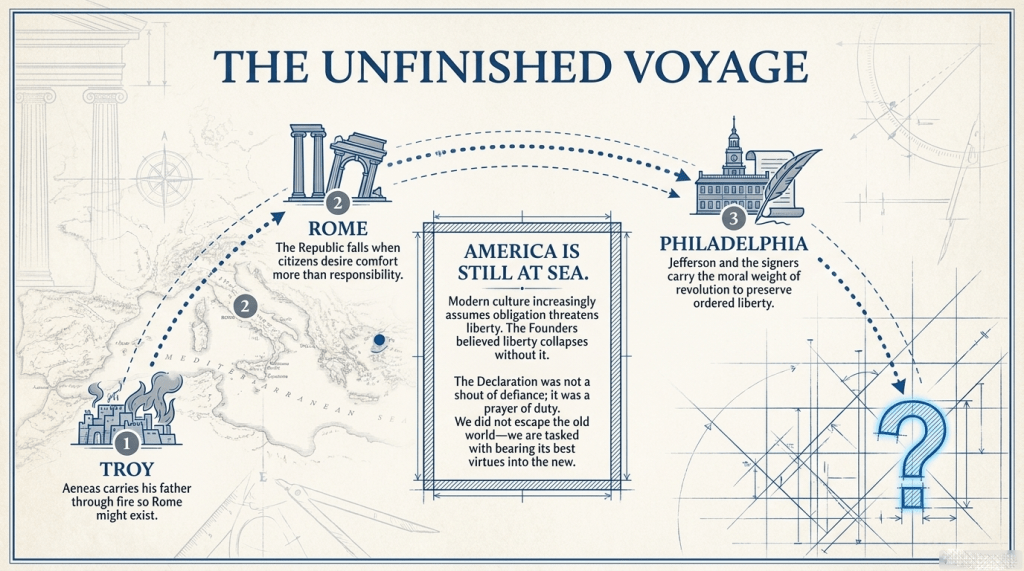
The document was never merely a shout of rebellion. It was an act of moral inheritance. The Founders did not believe they were escaping the old world entirely. They believed they were carrying its highest virtues into a new one. Rome, England, Christianity, classical philosophy, natural law, civic duty, republican virtue, all of it traveled with them across the Atlantic much the way Anchises traveled upon the shoulders of Aeneas through the flames of Troy.
And perhaps that is the final truth modern Americans most need to recover.
The Declaration was not written by men trying to liberate themselves from duty.
It was written by men willing to sacrifice themselves to preserve it. The Declaration was not a shout of defiance. It was a prayer of duty.
Like Aeneas, they were not escaping the old world. They were bearing its best virtues into the new.
Adams, John. The Works of John Adams, Second President of the United States. Edited by Charles Francis Adams. 10 vols. Boston: Little, Brown and Company, 1850–1856.
Addison, Joseph. Cato: A Tragedy. London, 1713.
Bailyn, Bernard. The Ideological Origins of the American Revolution. Cambridge, MA: Belknap Press of Harvard University Press, 1967.
Cicero, Marcus Tullius. On Duties (De Officiis). Translated by Walter Miller. Cambridge, MA: Harvard University Press, 1913.
Declaration of Independence. July 4, 1776.
Ellis, Joseph J. American Creation: Triumphs and Tragedies at the Founding of the Republic. New York: Alfred A. Knopf, 2007.
Jefferson, Thomas. The Papers of Thomas Jefferson. Edited by Julian P. Boyd et al. Princeton, NJ: Princeton University Press, 1950–.
Livy. The History of Rome. Translated by B. O. Foster et al. Cambridge, MA: Harvard University Press, 1919–1959.
McCoy, Drew R. The Elusive Republic: Political Economy in Jeffersonian America. Chapel Hill: University of North Carolina Press, 1980.
Pangle, Thomas L. The Spirit of Modern Republicanism: The Moral Vision of the American Founders and the Philosophy of Locke. Chicago: University of Chicago Press, 1988.
Sallust. The Conspiracy of Catiline and The Jugurthine War. Translated by J. C. Rolfe. Cambridge, MA: Harvard University Press, 1921.
Tacitus. The Annals of Imperial Rome. Translated by Michael Grant. London: Penguin Books, 1956.
Virgil. The Aeneid. Translated by Robert Fitzgerald. New York: Vintage Books, 1990.
Wood, Gordon S. The Creation of the American Republic, 1776–1787. Chapel Hill: University of North Carolina Press, 1969.
Wood, Gordon S. The Radicalism of the American Revolution. New York: Alfred A. Knopf, 1992.



 DAVE DOES HISTORY
Leave a comment