
Back during my American History before 1865 course at Arizona State, I found myself tumbling down a rabbit hole I hadn’t expected. What started as a passing mention of Cortés and the Aztecs turned into a full-on obsession with Mesoamerican history. You think you know the story: European conquistadors show up in shiny armor, stomp over the so-called savages, and plant their flag in the name of king and cross. But once you dig even an inch below the surface, you find something far messier, far more human, and far more dramatic. And smack in the center of that drama is the Battle of Otumba.
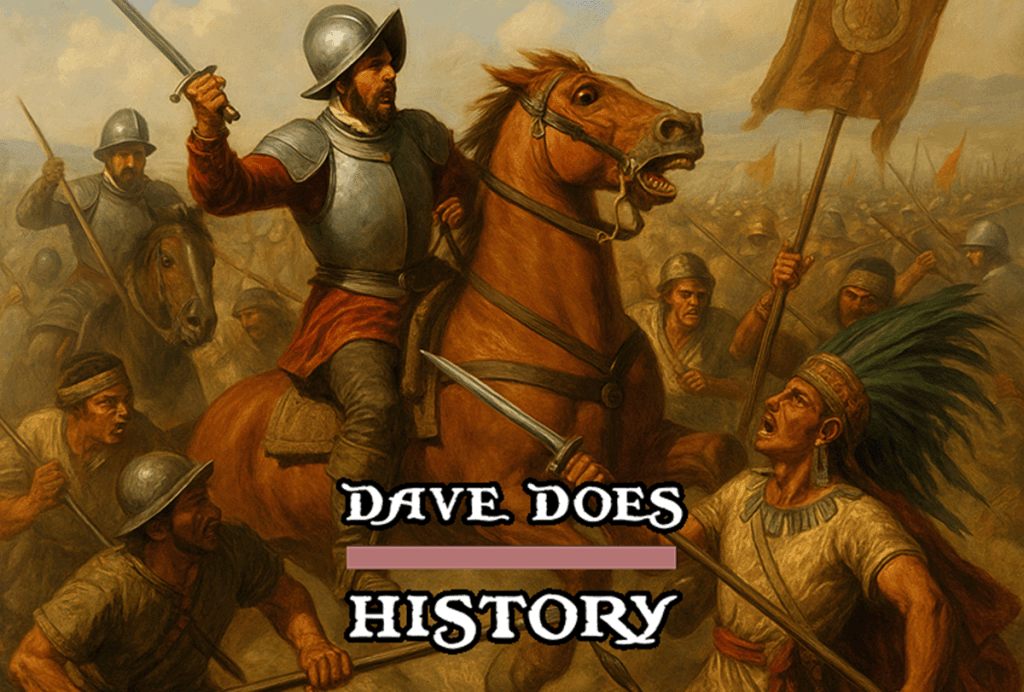
Most folks think the Spanish steamrolled their way through Mexico. What they forget, or were never taught, is that in the summer of 1520, Cortés and his men were beaten, bloodied, and on the run. Their conquest had all but collapsed. They were starving, limping through unfamiliar land, and being hunted by tens of thousands of warriors who were justifiably furious. In short, this was not the story of an inevitable European triumph. This was a desperate, near-suicidal retreat across the valley floor.
The Aztecs, for their part, were no backward tribe. They were empire builders, fierce and organized, and they had ruled central Mexico for generations. But they hadn’t always lived there. The Aztecs, or Mexica as they called themselves, came from the north, probably from somewhere around modern-day northern Mexico or the American Southwest. They migrated down and made a name for themselves as brutal warriors and savvy politicians. They eventually settled on an island in the middle of Lake Texcoco, where they built one of the most astonishing cities of the ancient world: Tenochtitlan. By the time Cortés showed up in 1519, this was a city of temples, canals, markets, and palaces that put most European cities to shame.
Cortés didn’t just march in and take over. He was a rogue commander who defied his orders, burned his ships to prevent retreat, and threw his lot in with the enemies of the Aztecs, most importantly, the Tlaxcalans, who had been at war with the Mexica for generations. He was part soldier, part politician, and all-in gambler. When Montezuma welcomed him into Tenochtitlan, Cortés repaid the hospitality by seizing the emperor and holding him hostage. Then, while Cortés was away fighting off a rival Spanish expedition, his hotheaded lieutenant Pedro de Alvarado triggered a massacre during a religious ceremony. That lit the match.
The city rose in rebellion. Montezuma, now a puppet in his own palace, was killed by his own people, or the Spaniards, depending on who you ask. Cortés returned to a boiling cauldron and barely escaped with his life. On June 30, 1520, he and his forces tried to sneak out under cover of darkness. The Aztecs caught them on the causeways and unleashed hell. It became known as the Noche Triste, the Night of Sorrows. Hundreds of Spaniards and thousands of their allies were killed, and most of the treasure they had stolen sank into the lake. Cortés himself nearly drowned.
Now picture this. A ragtag band of maybe 500 Spaniards, along with a few hundred Tlaxcalans, wounded, hungry, missing their artillery, down to their last bit of gunpowder, limping across the valley floor. And chasing them, an army of somewhere between 10,000 and 20,000 Aztec warriors, determined to wipe them out once and for all. That’s where we find ourselves on July 7, 1520, at a place called Otumba.
Cortés knew he didn’t have the manpower to fight a traditional battle. So he gambled, as he often did. He rallied his remaining cavalry, less than a dozen horses, and launched a direct assault on the Aztec command. This was a decapitation strike, not metaphorical but literal. The Aztecs weren’t just following a general. They followed the standard, a flag-like banner that directed troop movements. Kill the leader, take the banner, and you might break the will of the army.
So Cortés and his captains, men like Pedro de Alvarado, Cristóbal de Olid, Gonzalo de Sandoval, and Juan de Salamanca, charged. Salamanca speared the Aztec commander, Matlatzincatl, and seized the standard. That one act shattered the Aztec ranks. Their army collapsed. The Spanish survivors were able to flee to the safety of Tlaxcala.
Let that sink in. This wasn’t a triumph of superior weapons or divine right. It was a last-ditch cavalry charge by starving, wounded men who had no business surviving. And yet they did. Otumba wasn’t just a battle. It was the moment when the conquest could have ended. If the Aztecs had held their ground, if they had pressed their advantage, Cortés would have been a footnote. But they faltered.
In the months that followed, Cortés licked his wounds, rebuilt his army, and came back with a vengeance. With Tlaxcalan and other native allies, and a small navy built from scratch, he besieged Tenochtitlan. By August 1521, the city fell. The Aztec Empire was no more. New Spain was born on its ruins.
The Battle of Otumba has long been romanticized as a miracle, a sign of providence, or sheer European superiority. But the truth is far more compelling. Cortés was not invincible. The Aztecs were not helpless. This was a turning point forged in desperation, rage, and sheer audacity.
Looking back on it now, I don’t see Otumba as a story of destiny. I see it as a gamble that paid off, barely. I see Cortés for what he was: clever, charismatic, brutal, and lucky. I see the Aztecs not as a vanished people, but as proud warriors who nearly changed the course of history on a dusty plain. And I see the echoes of that battle in the way we still talk about power, conquest, and resistance today.
History isn’t clean. It isn’t fair. But if you listen closely, battles like Otumba still have something to say.



 DAVE DOES HISTORY
Leave a comment