
On a warm morning in early June 1918, somewhere amid the rolling farmland and wooded clearings of northern France, a handful of American Marines fixed bayonets, whispered prayers, and stepped into the wheat. It was June 6, 1918 and the woods they faced were called Belleau. Before sunset that day, more United States Marines would be killed or wounded than had fallen in every battle of the Corps’ previous 143-year history combined. That stretch of land would soon become sacred ground, known not just to historians and veterans but to anyone who believes liberty is bought with blood.
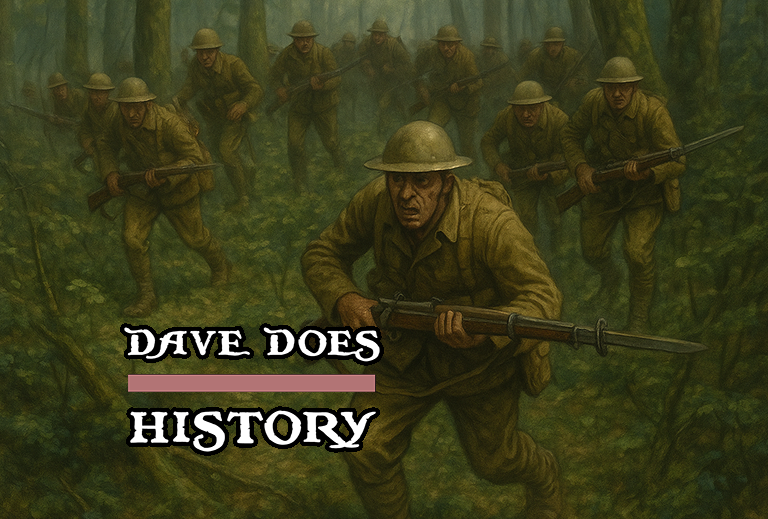
The Battle of Belleau Wood was part of a much larger German spring offensive. The Germans had gambled on a desperate push to break the stalemate and win the war before fresh American troops could tip the balance. By late May, they had broken through the French lines at the Aisne River. The road to Paris was open. Only twenty-five miles remained between the Kaiser’s army and the French capital. Panic was in the air. The French were pulling back. British troops were worn thin. And into this breach, with barely any time to prepare, came the Americans.
Specifically, the U.S. 2nd Division, including the 3rd Infantry Brigade and the 4th Marine Brigade, was rushed forward and ordered to dig in. For the Marines, this was more than another battlefield. It was their first large-scale engagement in the Great War. Their orders were to halt the German advance and, if possible, push them back. Their sector included the now-famous Belleau Wood, a dense tangle of trees, ravines, and rocky outcroppings that had once been a hunting preserve. Now it was crawling with German machine gun nests, well-prepared positions, and soldiers who knew exactly what they were doing. Major Bischoff of the German 461st Regiment had spent three days fortifying the woods and would later receive one of Germany’s highest military honors for his work. To put it bluntly, the Marines were walking into a meat grinder.
And yet they went.
On June 6, just before dawn, the first real offensive began. Major Julius Turrill and his 1st Battalion of the 5th Marines were tasked with seizing Hill 142 to protect the flank of an advancing French division. At 0345, Turrill’s men pushed across an open wheat field. The sun was low, the air was still, and the field was silent. Then the machine guns opened up. German fire chewed through the grass and Marines alike, cutting men down by the dozens. A line of soldiers vanished into the golden wheat like quail under fire, some hit, some crawling, some praying. Lieutenant Vic Bleasdale watched as the first wave was nearly wiped out before the second could even reach the halfway mark. The wounded stumbled back, while the living pressed forward. There were no tanks. There was no surprise. Only courage. And the price for Hill 142 was 333 Marines dead or wounded in just a few hours.
And that was only the morning.
Later that day, around 3:45 in the afternoon, a motorcycle tore into the Marine command post. A lieutenant from Brigadier General Harbord’s staff brought new orders. The 3rd Battalion, 5th Marines under Major Benjamin Berry would attack the northern edge of Belleau Wood. The 3rd Battalion, 6th Marines under Major Berton Sibley would strike the southern lobe. Support? None. Artillery was not available, the French had deemed the sector “quiet.” There would be no preparatory bombardment. No coordinated artillery fire. Just whistles, boots, rifles, and guts.
At 5:00 p.m., the whistles blew. The Marines rose from the grass in lines spaced five yards apart and fifteen yards deep, a parade-ground formation better suited for textbook drills than modern war. Ahead of them lay 400 yards of open wheat. Behind the trees at the edge of the field, German guns waited. What followed was carnage.
Berry’s men were obliterated. Major Berry himself was shot early in the advance, a bullet ripping through his arm and into his hand. Before long, he would be dragged off the field, still trying to issue orders. A journalist with the battalion, Floyd Gibbons of the Chicago Tribune, caught bullets to his arm, shoulder, and face. One round tore through his left eye and out his forehead. He lived, barely, and his dispatches made front-page news across the United States. The New York Times celebrated a Marine advance. The Chicago Tribune announced a glorious victory. But the real story wasn’t glory. It was agony. Berry’s battalion was shattered. One company entered the field with three platoons. Only a few men came back.
At the same time, Sibley’s battalion hit the southern edge of the woods. They moved out in parade formation as well, beautifully spaced and perfectly aligned, marching into hell. The left flank made some headway, even taking an unoccupied ridge briefly. But the dense underbrush quickly broke up the formations, turning ordered lines into chaotic skirmishes. Then they met the German defenses. Machine guns hidden in trees. Mortar fire from concealed positions. It was a wall of death. Lieutenant Timmerman of the 83rd Company managed to push through with a small group before being hit in the face. His men fell all around him. Some cried out for help. Others simply vanished into the brush.
On the right, the 2nd Battalion, 6th Marines under Major Thomas Holcomb tried to cover the advance but were drawn into the fight themselves. Private Bob Benedict, pinned under fire, remembered the desperation of that moment. “My God, we tried,” he said, “but the machine guns were just too much. They just cut us to pieces.” Marines begged to be put out of their misery. Runners tried to deliver messages through firestorms. Wounded men lay bleeding in the wheat, their cries carrying through the trees into the night.
By sundown, five of the Marine Brigade’s seven battalions had been in action. Turrill’s men held Hill 142, barely. Berry’s survivors had pulled back, unable to hold their ground. Sibley’s battalion had a tenuous foothold in the southern woods, but it had cost dearly. Altogether, 1,087 Marines were killed or wounded in that single day. Thirty-one officers, over a thousand enlisted men. That day alone marked the bloodiest in Marine Corps history until Tarawa in 1943.
And still, they kept fighting.
The leadership that day was, at times, heroic and at other times woefully inadequate. General Harbord bypassed the chain of command, issuing orders directly to battalion commanders. That added to the confusion. Intelligence was poor. Patrols were limited. Some Marine leaders believed they had taken the woods by June 10. They were wrong. And when bad information was reported upward, it was often believed without question. As one Marine put it, they were fighting blind.
Communications were another mess. With phone lines shredded by shellfire, most units relied on runners. Brave men carrying messages across fields of fire. Sometimes they made it. Sometimes they didn’t. Lieutenant Colonel Logan Feland, frustrated by the chaos, started insisting that all reports include time stamps. It was a simple fix. But in war, the simple things save lives.
Even the logistics fell short. The Marines went into battle with only what they carried. Food was scarce. Ammunition ran low. Medics were few. The field trains were bogged down behind them on narrow roads filled with refugees. Some wounded were hauled back using stretchers carried by prisoners and marching band members. Marines stole wine from abandoned cellars and slaughtered stray cattle when they could. They were improvising. They were enduring. And they were learning on the fly.
It took three more weeks to finish the job. Six more assaults. One final push on June 26 cleared the woods for good. By then, the Marines had figured out how to use artillery support. They understood the terrain, the enemy, and the nature of the fight. The lessons they learned at Belleau Wood would follow them into the Pacific a generation later.
In the end, Belleau Wood was not just a battle. It was a crucible. The French renamed the forest Bois de la Brigade de Marine in honor of the Marines who fought there. They awarded the unit the Croix de Guerre. The Germans, stunned by the ferocity of these “raw” Americans, gave them a new nickname: Teufel Hunden, Devil Dogs.
It was at Belleau Wood that the Marine Corps earned a reputation it still carries today. Fierce. Determined. Unbreakable.
But none of that came without cost. It never does.
The war continued. The Germans would fall back. Paris would be spared. The war would end, eventually. But for the men who crossed that wheat field on June 6, 1918, victory was not measured in headlines or medals. It was measured in inches gained, friends lost, and nights spent staring into the dark, listening to the cries of the dying.
So when we talk about liberty, we’d better mean it. When we throw around words like “freedom” and “sacrifice,” we owe it to those Marines to understand what they paid so we could speak those words freely. The price was Hill 142. The price was a field of wheat turned red. The price was a quiet forest now lined with crosses.
Liberty isn’t free. It never was. And Belleau Wood is there to remind us.


 DAVE DOES HISTORY
Leave a comment