
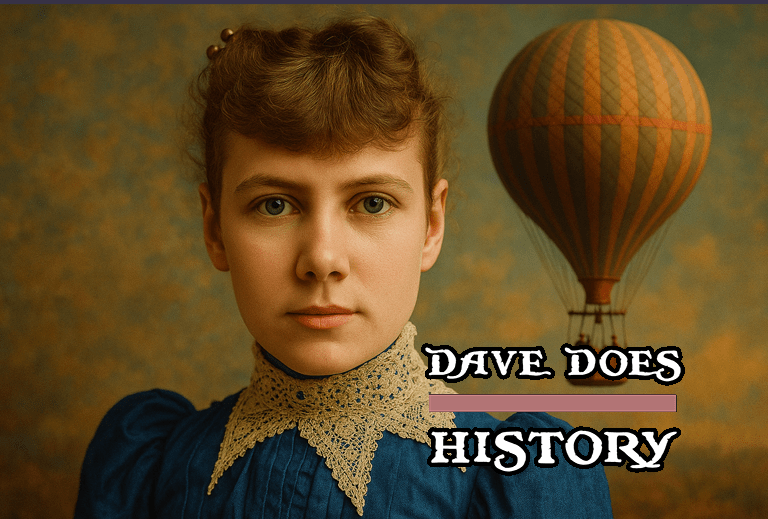
On a spring day in 1864, in the small Pennsylvania village of Cochran’s Mills, a girl was born who would grow up to challenge institutions, defy expectations, and travel around the world faster than any woman or man ever had. Elizabeth Jane Cochran, who later adopted the name Nellie Bly, was no ordinary child. She was born into a family that would soon be shattered by tragedy. Her father, Michael Cochran, a respected mill owner and judge, died when she was only six. Without his financial support, the family faced hardship, and young Elizabeth grew up quickly.
Listen to the Article:
Even as a teenager, she chafed at society’s expectations. She was nicknamed “Pink” because of her preference for the color, but as she matured, she shed the name and added an “e” to her last name, becoming Cochrane. She enrolled briefly at the Indiana Normal School, but her education was cut short due to lack of money. Her mother relocated the family to Allegheny City, now part of Pittsburgh. It was there that Nellie Bly’s fiery spirit found its first outlet.
In 1885, the Pittsburgh Dispatch ran a column titled “What Girls Are Good For,” suggesting that women belonged in the home and nowhere else. Elizabeth, incensed, fired off a letter to the editor under the pseudonym “Lonely Orphan Girl.” The editor, George Madden, was so struck by her eloquence and passion that he printed a reply asking the mystery writer to identify herself. When Elizabeth showed up in person, he offered her a chance to write an article. She accepted, and her first piece, “The Girl Puzzle,” argued for better employment opportunities for women. A second article, “Mad Marriages,” tackled the injustices women faced in divorce. For these and future articles, Madden gave her the pen name Nellie Bly, borrowed from a popular Stephen Foster song. A typo replaced “Nelly” with “Nellie,” and it stuck.
Her early work in Pittsburgh saw her go undercover as a factory worker, revealing the harsh conditions women faced in industrial labor. Readers loved her reporting, but factory owners did not. Under pressure, the Dispatch reassigned her to the women’s pages. At only twenty-one, Bly declared that she wanted to do something no girl had done before. She set off for Mexico and filed dispatches as a foreign correspondent, writing on culture, poverty, and censorship under the dictatorship of Porfirio Diaz. After she criticized the government, she was threatened with arrest and fled the country. The series became her first book, “Six Months in Mexico.”
Unsatisfied with being relegated to fluff reporting, Bly moved to New York in 1887. For months she pounded the pavement, trying to get hired by any major paper. Editors refused to give her a chance. Penniless and determined, she talked her way into the offices of Joseph Pulitzer’s New York World. They were intrigued. Could she infiltrate the Women’s Lunatic Asylum on Blackwell’s Island by pretending to be insane? She said she could. And she did.
“I said I could and I would. And I did.”
– Nellie Bly
Her plan was both bold and dangerous. She first checked into a boarding house for women, stayed up all night to look deranged, and frightened the other tenants until they called the police. Examined by doctors, a judge, and a police officer, she was committed to the asylum. What she found there shocked even her. Filthy conditions, rotten food, freezing baths, brutal nurses, and women who were not insane but simply poor or foreign filled the institution. For ten days she endured this treatment until the World secured her release.
Her exposé, published as “Ten Days in a Mad-House,” was a sensation. It led to a grand jury investigation, increased funding for mental health institutions, and reforms in patient care. Bly became the prototype for what would be called “stunt journalism” or immersive reporting. She was no longer just writing about injustice. She was walking into it, living it, and making America see it. Her fame grew. She went undercover in jails, in factories, and exposed bribery in the New York State Legislature.
Then came the adventure that would make her an international celebrity. In 1888, Bly proposed to her editor that she try to turn Jules Verne’s novel “Around the World in Eighty Days” into real life. A year later, on November 14, 1889, she boarded the Augusta Victoria with only two days’ notice. She carried a single bag and wore the same dress for the entire trip. Her route took her from New York to England, France, Egypt, Ceylon, Singapore, Hong Kong, and Japan. In Amiens, France, she met Jules Verne himself, who expressed doubt but admiration.
Back home, the New York World ran daily stories about her trip and launched a contest encouraging readers to guess her return time. Nearly a million entries poured in. Bly, riding steamers, rickshaws, and trains, returned to New York on January 25, 1890. Her final time: seventy-two days, six hours, eleven minutes, fourteen seconds. She had beaten the fictional Phileas Fogg, and she had done it alone.
After the whirlwind, she stepped away from journalism and wrote serial novels for publisher Norman Munro. Between 1889 and 1895, she penned a dozen stories, thought lost for decades until their rediscovery in 2021. But real life was about to change everything.
In 1895, she married millionaire Robert Seaman. He was seventy-three. She was thirty-one. When he died nine years later, she took over his company, the Iron Clad Manufacturing Co., which produced steel containers, including what would become the fifty-five-gallon oil drum. She received patents of her own for improved milk and garbage cans. She ran the business as a model of worker welfare, with health benefits and recreation. But while her social instincts were sound, her business acumen was not. Embezzlement and financial missteps led to bankruptcy.
She returned to journalism, reporting for the New York Evening Journal. She covered the suffragist parade in 1913 and wrote that women were superior to men, predicting they would soon win the vote. She was right. In 1920, the Nineteenth Amendment was ratified. Bly also traveled to Europe and reported from the Eastern Front during the First World War. She was one of the first women—and foreigners—to visit the war zone. Mistaken for a British spy, she was arrested and eventually released.
On January 27, 1922, Nellie Bly died of pneumonia at St. Mark’s Hospital in New York City. She was fifty-seven. Her grave lies in Woodlawn Cemetery in the Bronx. She left behind more than just a body of work. She left a standard.
Her name lives on. She was honored by the National Women’s Hall of Fame in 1998. The United States Postal Service issued a stamp in her likeness in 2002. Her asylum exposé inspired films, plays, operas, and a monument called “The Girl Puzzle” on Roosevelt Island. A children’s book, a Google Doodle, a Doctor Who audio drama, and even a species of tarantula bear her name. She was the subject of Broadway shows and comic books. There was once a Nellie Bly train, amusement park, and fireboat.
She was not just a journalist. She was a woman who saw walls and decided to walk through them. She spoke when others could not. She dared when others stayed quiet. And she made it impossible to ignore the truth. That is her legacy. That is Nellie Bly.



 DAVE DOES HISTORY
Leave a comment