
In the year 188 CE, the Roman Empire stood tall, its borders sprawling from the misty moors of Britannia to the sands of Syria, girded by the might of legions and the rule of emperors. But beneath the grandeur, the cracks were beginning to show. The economy strained under the weight of endless wars and state-sponsored spectacles. Coinage was being debased, inflation loomed, and the machinery of empire, though impressive, groaned under its own size. Politically, Rome was becoming more about dynasty than democracy, and imperial succession was looking more like a lottery played with daggers.
Listen to the Article (appx 9:52)
This was the world into which Lucius Septimius Bassianus was born on April 4, 188, in the city of Lugdunum—modern-day Lyon, France. His father was Septimius Severus, a general of Libyan descent who would soon claw his way to the purple by sheer force. His mother, Julia Domna, was a cultured Syrian noblewoman whose family were priests of the sun god Elagabalus. Between them, young Bassianus inherited a heady mix of ambition, charisma, and, eventually, absolute power.
As a boy, he was bright and appealing. The Historia Augusta even describes him as generous and kind during his early years, recounting stories of him crying when condemned men faced wild beasts in the arena. But that boy would vanish, replaced by a ruler who would carve his name in stone and blood alike.
In 195, he was granted the title of Caesar, and in 198, he became Augustus, technically equal in rank to his father. To strengthen his dynastic appeal, he was renamed Marcus Aurelius Antoninus—linking him to the beloved Antonine dynasty and especially to the philosopher-emperor Marcus Aurelius. His nickname “Caracalla” came later, from a hooded Gallic cloak he often wore and popularized. The name stuck, and so did his scowl.
By 209, Caracalla was co-emperor along with his younger brother, Geta. The two loathed each other from the start. Even their father recognized the tension, warning them to cooperate or perish. When Septimius Severus died in 211 in Eboracum (modern-day York), the empire passed jointly to his sons. Julia Domna tried to mediate between them, even as they reportedly considered dividing the empire into eastern and western halves.
That arrangement never materialized. In December of 211, Caracalla arranged for Geta to be murdered during a supposed peace meeting orchestrated by their mother. Dio Cassius tells us Geta was cut down while fleeing to his mother’s arms. Afterward, Caracalla ordered a brutal purge of Geta’s supporters—by some accounts, up to 20,000 people. Those who had once smiled at Geta’s image were executed. His name was struck from inscriptions, his face scratched off frescoes, his statues broken. It was the classic Roman damnatio memoriae—erasure by imperial decree.
Caracalla ruled alone from that day forward, finding Roman administration tedious and the Senate untrustworthy. He preferred the company of soldiers and lived among them in the field. He raised their pay significantly and cultivated the image of a warrior-emperor, walking, eating, and marching beside the men.
In 212, he issued what may be his most enduring act—the Constitutio Antoniniana, or Edict of Caracalla. This sweeping decree granted Roman citizenship to virtually all free men within the empire. It sounded magnanimous, but Dio Cassius and other sources argue it was driven less by idealism and more by revenue. Roman citizens paid more taxes, especially the inheritance and manumission taxes. The edict expanded the tax base and provided a broader pool for military recruitment.
Caracalla spent little time in Rome. He was constantly on campaign or traveling through the provinces. In 213, he launched operations in Germania, earning the title Germanicus Maximus, although modern scholars suggest the campaign had more to do with maintaining discipline than conquering territory.
By 214, Caracalla had moved eastward and arrived in Alexandria in late 215. There, according to Dio and Herodian, he was mocked by the locals—possibly for claiming to be a second Alexander the Great. Caracalla responded with one of the most infamous massacres of his reign. He invited the city’s youth to a parade and then ordered the legions to butcher them. He reportedly also revoked the privileges of Alexandrian philosophers, particularly those affiliated with the Museum, due to his belief that Aristotle had conspired in Alexander’s death. Some scholars argue that this action weakened the Library of Alexandria irreparably.
Caracalla’s religious sensibilities were unusual. He revered Serapis, the Greco-Egyptian god of healing and the underworld. This may have been part of his broader effort to unify the Eastern and Western halves of the empire under shared symbols. He also adopted elements of Macedonian kingship, even dressing as Alexander the Great and encouraging the comparison.
But even amidst this carnage and chaos, Caracalla left behind cultural monuments of astonishing beauty. Chief among them was the Baths of Caracalla. Begun under his father and completed in 216, these sprawling public baths were more than plumbing and steam—they were a statement of imperial glory. Covering 25 hectares and able to accommodate more than 1,600 bathers at once, the baths included libraries, gardens, art galleries, and even a natatio—an open-air swimming pool. Mosaics adorned the floors, marble lined the walls, and statues of gods and heroes watched over the bathers. These were not just baths—they were temples to Roman identity, propaganda carved in stone, and the last great architectural gift of a dying dynasty.
To pay for all this grandeur—and for his loyal legions—Caracalla debased the currency. He introduced the antoninianus, a coin that nominally valued at two denarii but contained far less silver. It sparked inflation and devalued the currency. His short-term generosity to the troops had long-term effects that would destabilize Roman finance for decades.
In 216, Caracalla turned his sights east once more, planning a full-scale invasion of the Parthian Empire. He tried first to arrange a royal marriage to a Parthian princess—a move perhaps intended to emulate Alexander’s merging of empires. When rebuffed, Caracalla responded with force, launching attacks along the frontier. The campaign saw mixed success but no decisive results.
In April 217, as Caracalla was en route to visit a temple near Carrhae, he stopped to relieve himself on the roadside. There, a soldier named Martialis—either personally aggrieved or acting under orders from the Praetorian Prefect Macrinus—stabbed the emperor to death. He was 29 years old. Macrinus, who had feared for his own life after falling out of favor, was proclaimed emperor days later.
Caracalla’s reign was over. His body was cremated, his ashes placed in the Mausoleum of Hadrian. His mother, Julia Domna, unable to bear the disgrace of Macrinus’s rise, took her own life soon afterward.
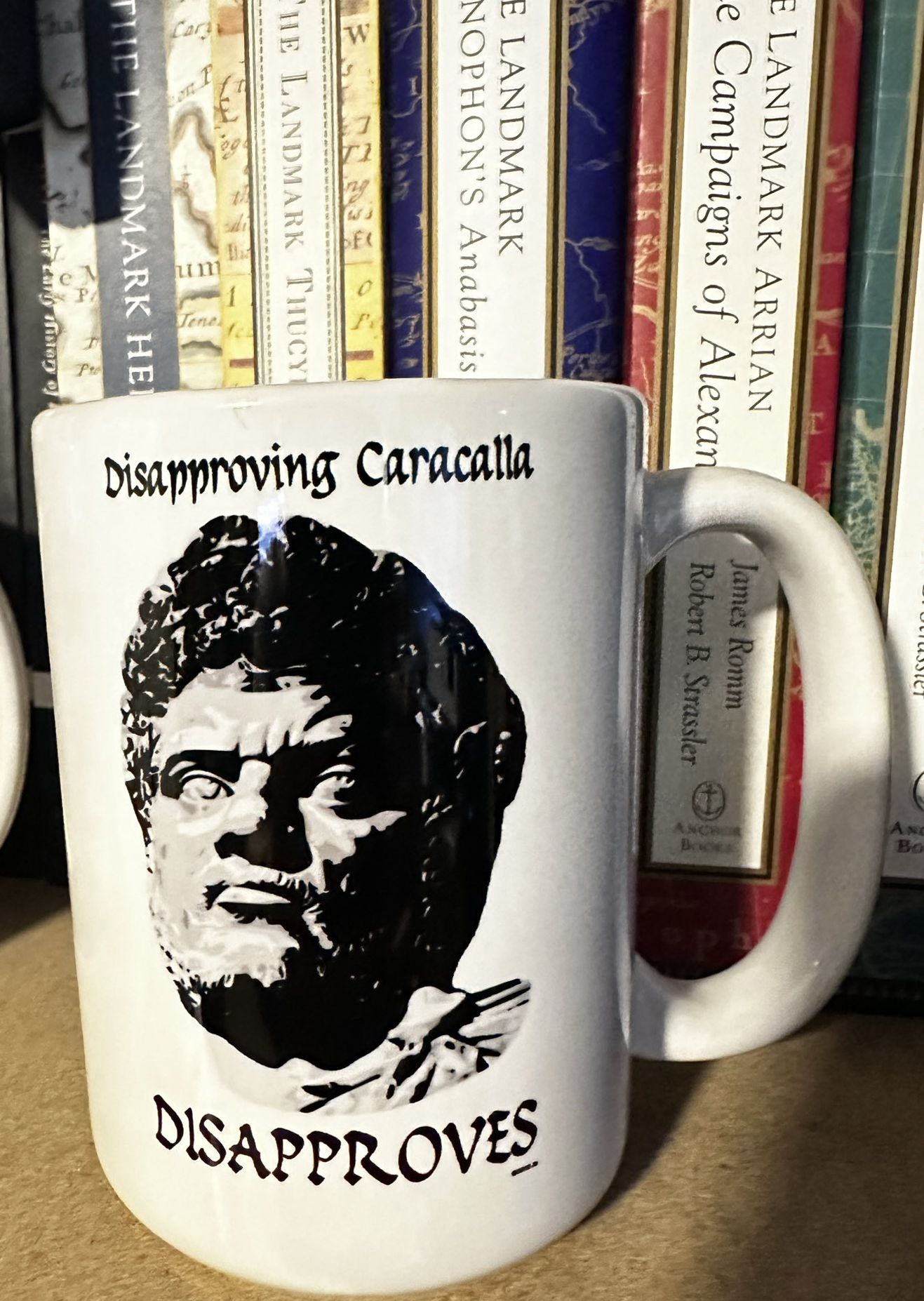
And so ends the tale of Marcus Aurelius Antoninus, called Caracalla. His busts show a man forever frowning, locked in marble with the weight of empire pressed into his brow. That scowl has inspired humor in modern times—“Disapproving Caracalla Disapproves”—but behind it lies a ruler who blended military grit with megalomania, civic grandeur with personal cruelty.
Was he a success? In the narrowest terms, perhaps. He kept the empire intact. He strengthened the army. He left monuments that still awe visitors today. But he also wrecked the economy, terrorized the political elite, and ruled through fear and force. Even in a long line of emperors known for ruthlessness, Caracalla stood apart.
His memory remains complicated. He was no philosopher, no statesman, and no reformer. But he was a force—raw, dangerous, and unforgettable. Rome has seen better men. But it has also seen worse. And in the end, Caracalla’s greatest monument may be not the baths or the edicts, but the unshakable fact that we are still telling his story.





Leave a comment