
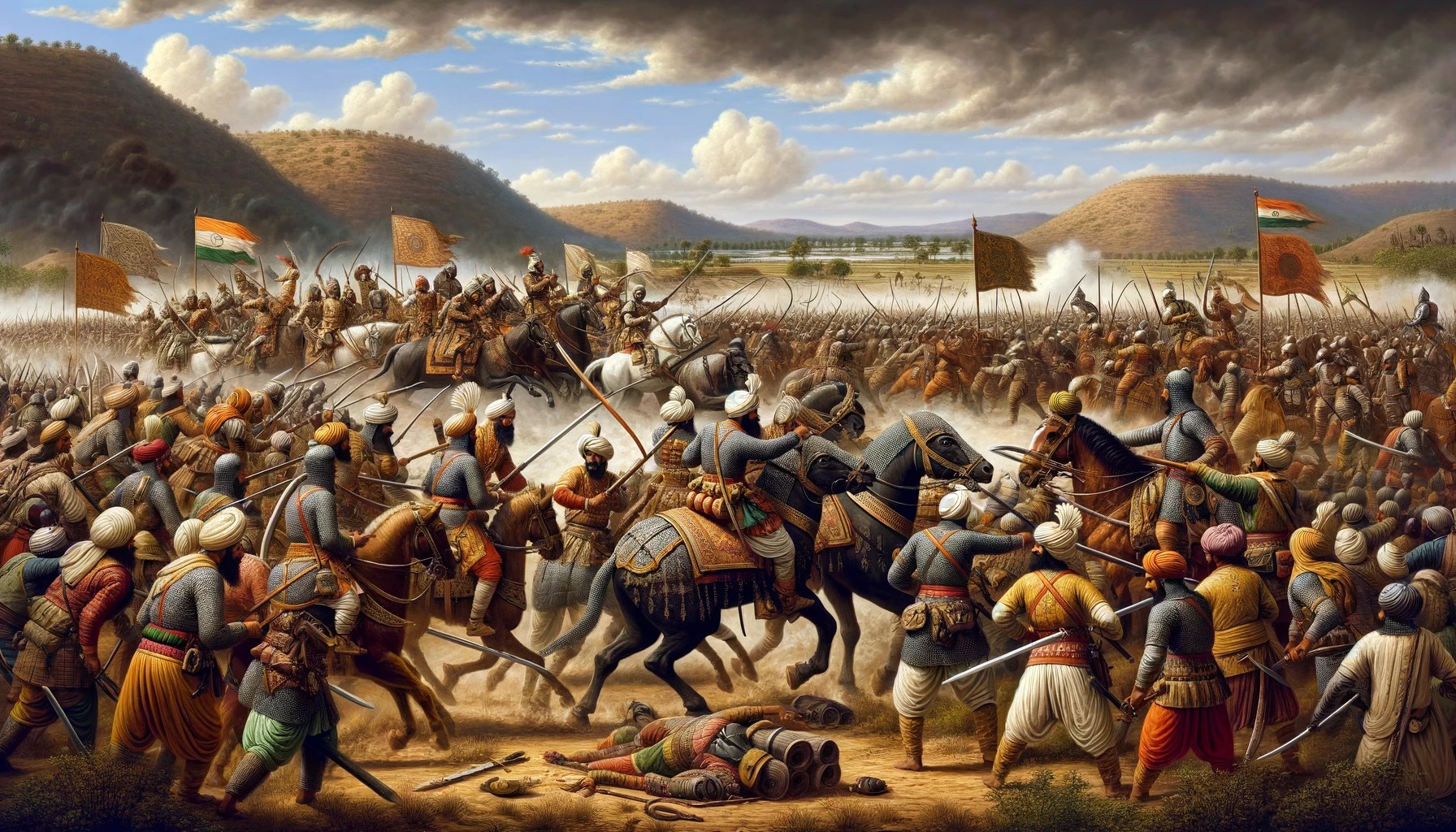
The Battle of Tukaroi, fought on March 3, 1575, marked a pivotal moment in the extensive and complex history of the Indian subcontinent, particularly in the ongoing struggle for supremacy between the Mughal Empire and the Sultanate of Bengal. This confrontation stemmed from the Mughal Emperor Akbar’s ambition to expand his dominion eastward into Bengal, a region rich in resources and strategically significant for the consolidation of Mughal power in India. The Sultanate of Bengal, under Daud Khan Karrani, resisted this expansion, leading to a series of conflicts that culminated in the battle at Tukaroi. The backdrop of this battle was set against a broader canvas of political maneuvering, military campaigns, and the Mughal Empire’s quest for unification and dominance over the Indian subcontinent.
Prior to the Battle of Tukaroi, the Mughal forces, under the command of Munim Khan, laid siege to Patna, a strategic stronghold of the Bengal Sultanate. The siege was a critical episode in Akbar’s eastern campaign, aimed at securing a foothold in Bihar before advancing into Bengal. The prolonged siege highlighted the challenges faced by the Mughal army in conquering well-fortified positions but also demonstrated their perseverance and strategic acumen. The fall of Patna to Mughal forces not only opened the gates to Bengal but also served as a testament to the expanding reach of Akbar’s empire and his resolve to bring the entire region under Mughal suzerainty.
Following the successful campaigns in the east, Akbar returned to Fatehpur Sikri, his capital, where he focused on consolidating his rule and implementing administrative reforms. His return was not a retreat from the battlefield but a strategic move to ensure the stability of his empire, which now stretched across a vast expanse of the Indian subcontinent. Akbar’s administration, known for its policy of Sulh-i-Kul or “peace to all,” was instrumental in integrating the newly conquered territories and fostering an era of prosperity and cultural synthesis.
The actual battle of Tukaroi unfolded on the plains near the town of Tukaroi, located in present-day Odisha. The Mughal forces, led by Akbar’s generals, faced the Bengal army commanded by Daud Khan Karrani. The Mughals employed a combination of cavalry charges and archery volleys, a tactic that had served them well in previous engagements. The Bengal forces, on the other hand, relied heavily on their infantry and war elephants. The battle was marked by fierce combat, strategic maneuvering, and considerable casualties on both sides.
As the day progressed, the discipline and firepower of the Mughal forces began to turn the tide in their favor. The decisive moment came when a contingent of Mughal cavalry executed a flanking maneuver, breaking the Bengal ranks and sowing chaos among their forces. Daud Khan Karrani was forced to retreat, leaving the field and much of his territory to the victors. The battle significantly weakened the Sultanate of Bengal, leading to further Mughal advances in the region.
The aftermath of the battle saw the negotiation of the Treaty of Katak, wherein Daud Khan Karrani ceded vast territories to the Mughal Empire, including Odisha and parts of Bengal. The treaty marked a significant shift in the balance of power in favor of the Mughals, paving the way for their eventual annexation of the entire Bengal region. The concessions made in the treaty reflected the weakened state of the Bengal Sultanate and solidified Mughal dominance in the eastern part of the Indian subcontinent.
The Battle of Tukaroi and its aftermath had lasting implications for the Mughal Empire and the Indian subcontinent. It exemplified Akbar’s military prowess and strategic vision, contributing to the expansion and consolidation of the Mughal Empire. The battle also underscored the importance of mobility, firepower, and tactical flexibility in early modern warfare. Moreover, the incorporation of Bengal into the Mughal Empire brought significant economic benefits, as the region was a major center of trade and agriculture.
The legacy of the battle extends beyond military conquests; it also reflects Akbar’s approach to governance, characterized by religious tolerance, administrative efficiency, and cultural patronage. The Mughal Empire under Akbar became a symbol of unity in diversity, integrating various cultures, religions, and ethnic groups into a cohesive administrative framework. The Battle of Tukaroi, therefore, not only shaped the geopolitical landscape of the Indian subcontinent but also contributed to the rich tapestry of its history, culture, and society.





Leave a comment