
Benjamin Franklin did not set out to become a revolutionary. If anything, he spent a good portion of his life trying very hard not to be one. That tends to get lost somewhere between the kite and the key and the powdered wig in Paris, but it matters. Because if you want to understand how the Revolution really took shape, you have to start with the people who were trying to avoid it.
Franklin was, by any reasonable measure, a success story inside the British system. He was not standing outside throwing rocks. He was inside, wearing the coat, attending the dinners, and speaking the language of empire with a fluency that made him welcome in places most colonials never saw. He served as deputy postmaster general, which meant he helped knit the colonies together in a way Parliament probably did not fully appreciate at the time. He was a scientist of international reputation, the sort of man who could walk into a room in London and be treated not as a colonial curiosity, but as a colleague. He was, for lack of a better phrase, a good Brit.
And he liked it that way.
Franklin believed the colonies were part of something larger, something worth preserving. He did not see Americans as a separate people waiting to break free. He saw them as British subjects who deserved British rights. That distinction is not small. It meant that when tensions began to rise, Franklin did not reach for independence. He reached for compromise.
For years, that was his job, whether anyone officially gave it to him or not. He moved between London and the colonies, explaining each side to the other like a man translating between two languages that should have been the same but somehow were not. He argued that the colonists were not rebels. They were reacting. He tried to convince British officials that a little flexibility would go a long way, and he tried to convince colonists that patience might still pay off.
It is the sort of position that sounds wise until you realize it depends entirely on both sides wanting the same outcome.
Franklin assumed they did. That was the problem.
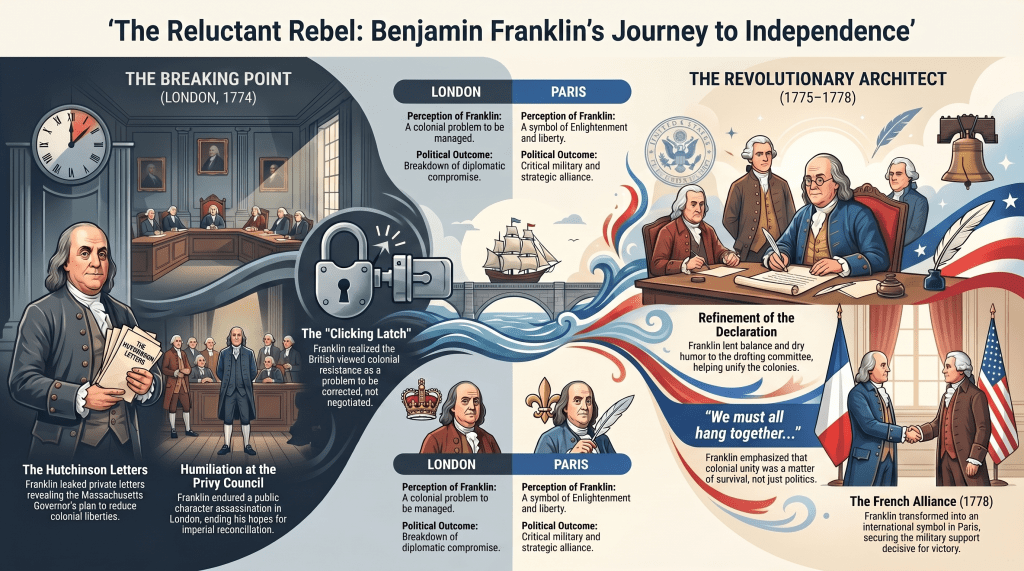
Then came the Hutchinson letters, and here is where the story takes a turn that feels almost too perfect, if it were not so thoroughly documented. Franklin came into possession of private correspondence written by Thomas Hutchinson, the royal governor of Massachusetts, along with others in similar positions. These were not public statements polished for effect. These were candid letters, the kind men write when they believe no one outside a small circle will ever read them.
In those letters, Hutchinson suggested that colonial liberties might need to be, let us say, adjusted. Reduced might be the more honest word. The implication was clear enough. Self government in the colonies was not a right to be respected. It was a problem to be managed.
Franklin read those letters and made a decision that tells you a great deal about the man he was at that moment. He did not publish them in London. He did not turn them into a public scandal on his own initiative. He sent them quietly to Massachusetts, with instructions that they be shared discreetly among a few trusted figures.
That plan lasted about as long as most plans do once they involve human beings.
The letters became public, and when they did, they landed in the colonies like a thunderclap. Colonists who had been arguing about taxes suddenly had something more concrete in front of them. It was no longer just policy they objected to. It was the attitude behind it. Seeing your own governor suggest that your rights are inconvenient has a way of clarifying things.
Franklin, meanwhile, found himself in a position that can best be described as deeply uncomfortable and rapidly worsening.
By January of 1774, his role in transmitting the letters was known in London, and the response was not subtle. He was called before the Privy Council, which sounds dignified until you understand what actually happened. Franklin stood there while the Solicitor General, Alexander Wedderburn, delivered what can only be described as a public dressing down. It was not a legal argument so much as a character assassination performed with an audience.
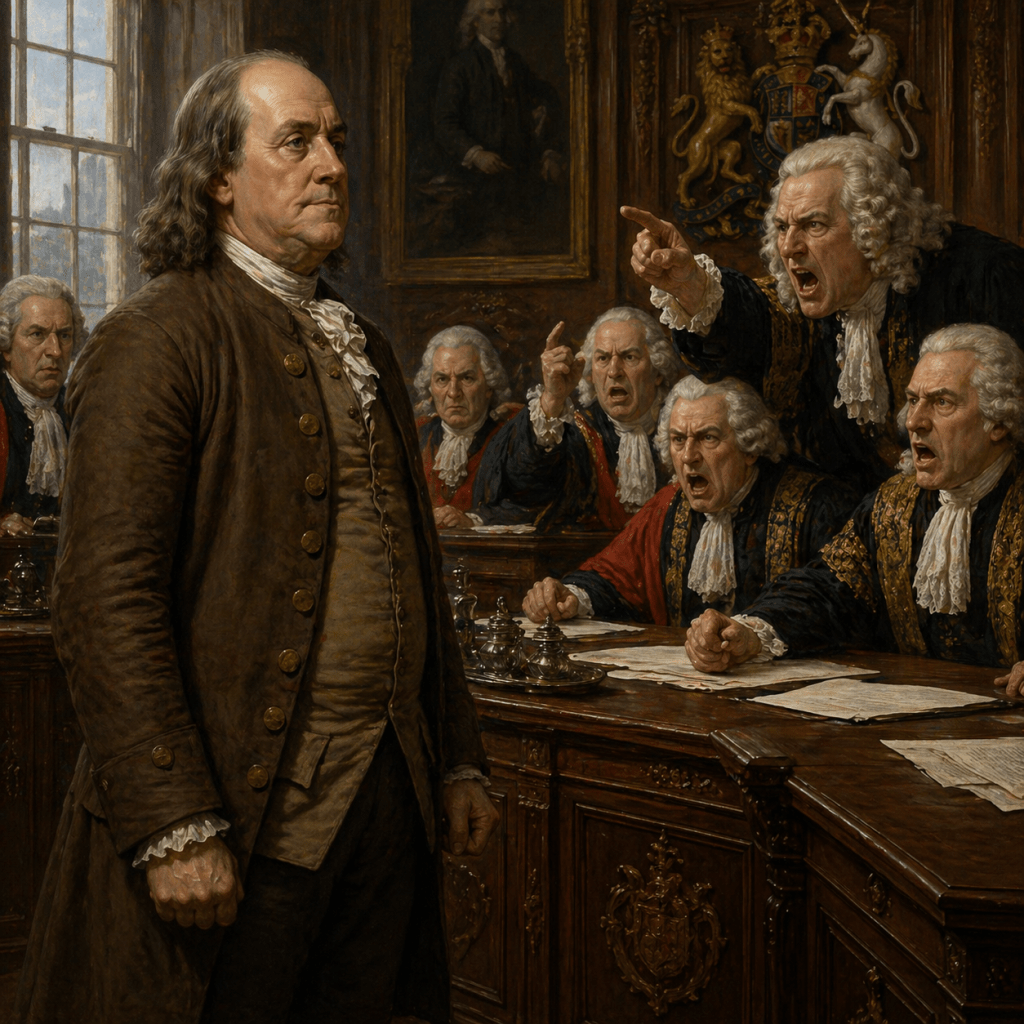
Wedderburn accused him of dishonesty, of manipulation, of betraying trust. The tone was not one of disagreement. It was one of contempt. And Franklin, who had spent years trying to hold this relationship together, stood there and took it.
He did not argue. He did not interrupt. He listened.
There is a particular kind of clarity that comes from being told, in a very public way, exactly what the other side thinks of you. It strips away the polite language and the hopeful assumptions. It leaves you with something harder and, in some ways, more useful.
That moment did not turn Franklin into a revolutionary overnight. History is rarely that tidy. What it did was close a door he had been trying to keep open. The idea that the empire could be adjusted, that misunderstandings could be resolved with enough patience and reason, began to look less like a plan and more like a wish.
Franklin had believed that both sides were working toward the same end, a stable empire in which the colonies had their place and their rights. What he saw in London was something else. A government that viewed colonial resistance not as a signal to reconsider, but as a problem to correct.
That is not a disagreement you negotiate. That is a disagreement you eventually choose.
When Franklin left London, he did so without the illusions he had carried in with him. He was still the same man in many ways, still practical, still cautious, still inclined to think before he leapt. But he was no longer convinced that the path he had been walking led anywhere useful.
The reluctant rebel was beginning to take shape, not out of sudden anger, but out of accumulated evidence. And if you are looking for the moment when that shift began, you will not find it in a battlefield or a declaration.
You will find it in a quiet room in London, where a man who believed in the empire realized the empire did not believe in him.
When Franklin left London in 1775, he did not slam the door behind him. He was not the type. But if you listened closely, you could hear the latch click. The man who stepped onto that ship was not the same one who had spent years trying to make the empire work. He was older, certainly. Wiser, without question. And just skeptical enough to be dangerous.
He returned to Philadelphia in March of that year, carrying more than luggage. He carried the memory of that Privy Council humiliation, the tone of it, the unmistakable message that compromise was not on the table. Franklin did not come home waving a flag and shouting for independence. That would have been too simple, and Franklin was rarely simple. What he brought back was something quieter and, in the long run, far more powerful. He brought certainty that the old path was closed.
He took his seat in the Second Continental Congress with the same measured demeanor that had served him well for decades. If anyone expected fireworks, they were disappointed. Franklin still leaned, at least initially, toward reconciliation. Old habits have a way of lingering, especially when they have once made sense. But there is a difference between hoping for compromise and believing in it, and Franklin had crossed that line somewhere between London and the American coast.
It did not take long for him to find himself in the company of men who had already reached the conclusions he was just beginning to accept. John Adams and Thomas Jefferson were not interested in patching things up with Parliament. They were looking ahead, sometimes cautiously, sometimes boldly, toward something else entirely. Franklin, who had spent years trying to bridge a gap, began to see that there was no bridge left to build.
The shift was not dramatic. It was steady. He listened. He observed. He spoke when it mattered. And gradually, he moved.
By the time the Committee of Five was formed to draft what would become the Declaration of Independence, Franklin was no longer the mediator trying to keep the empire intact. He was part of the group preparing to explain why it could not be saved. His role in that committee was not to dominate the writing. That task fell largely to Jefferson. Franklin’s contribution was something more subtle and, in its way, just as important. He refined, suggested, trimmed where needed, and lent the document a kind of balance that comes from long experience with words and with people.
He also brought something else to the room, something that does not always show up in formal accounts. He brought humor, the dry, well timed sort that can ease tension without undercutting seriousness. In a gathering of strong personalities, that mattered. It is easier to agree on difficult things when someone in the room knows when to puncture the tension without breaking it.
Franklin had always understood people, and now he put that understanding to work in a new context. The colonies were not a single voice. They were a chorus, and not always a harmonious one. Regional interests, personal ambitions, differing views on how far to go and how fast, all of it had to be managed if anything resembling unity was to emerge. Franklin moved through those differences with a kind of practiced ease, not by forcing agreement, but by making it easier for others to find common ground.
At the same time, he did not abandon the tools that had served him well in earlier years. If anything, he sharpened them.
Franklin the scientist and diplomat was now joined by Franklin the propagandist, though he would have preferred a more polite term. He wrote essays, letters, and satirical pieces that cut at British policy with a blade that was both sharp and, at times, surprisingly funny. He had a knack for exposing hypocrisy by letting it speak for itself, or by nudging it just far enough that others could see it clearly. It is one thing to argue that a policy is unjust. It is another to make that policy look ridiculous.
He did both.
And while much of Congress was focused on immediate concerns, how to organize resistance, how to respond to British actions, how to keep the colonies aligned, Franklin was already looking beyond the horizon. He understood something that would prove critical. If the colonies were going to break from Britain, they would not survive on determination alone. They would need allies.
France was the obvious candidate, though “obvious” does not mean easy. The French had their own interests, their own reasons for considering involvement, and their own doubts about whether these colonies could succeed. Franklin began, even before independence was formally declared, to think about how to present the American cause in a way that would appeal to French sensibilities and strategic goals.
He was, in other words, already thinking globally while others were still thinking regionally.
That is the thread that runs through this phase of Franklin’s life. He did not transform into a revolutionary by abandoning who he had been. He transformed by applying the same skills, the same instincts, to a different reality. The empire he had once tried to preserve was no longer an option. The question was what would replace it, and how.
Franklin’s answer was not shouted. It was constructed, piece by piece, through conversation, persuasion, and the careful use of words. The reluctant rebel had arrived in Philadelphia with doubts. He found, in the company of other men with their own convictions, a direction.
And once he began moving in that direction, he did not look back.
By the spring of 1776, Benjamin Franklin had crossed a line he had spent years trying to avoid. Not in a burst of anger, not in a dramatic moment of defiance, but in a way that felt almost inevitable once all the alternatives had been exhausted. The man who had once argued for the preservation of the empire now stood ready to help dismantle it.
He was there in Philadelphia as Congress debated, revised and finally approved the Declaration of Independence. Age had slowed him somewhat, but not his mind, and certainly not his sense of timing. When the moment came to sign, Franklin added his name alongside men who, only a few years earlier, might have been considered his political opposites. It was not just a signature. It was a statement, one that carried the weight of everything he had seen and experienced on both sides of the Atlantic.
He is said to have remarked, with that familiar dry tone, that “we must all hang together, or most assuredly we shall all hang separately.” It is a line that has survived because it captures something essential. There was humor in it, certainly, but also a clear understanding of the stakes. This was not an abstract debate about governance. It was a decision with consequences that could not be undone.
If Franklin had stopped there, he would still occupy a comfortable place in the story. Signer of the Declaration, respected elder, a man who had come around when it mattered. But Franklin rarely did only what was expected of him.
Almost immediately, he was sent abroad, not as a tourist, not as a curiosity, but as a representative of a fragile new nation that needed help. France was the target, and Franklin was the instrument. It was a role that required more than intelligence. It required an understanding of people, of perception, of how to present a cause in a way that others would find not only acceptable, but appealing.
In London, Franklin had been treated as a problem, a colonial figure who had overstepped his place. In Paris, he became something else entirely. Benjamin Franklin arrived not as a supplicant, but as a symbol. The plain dress, the simple manner, the air of thoughtful independence, all of it was noticed and, in many cases, admired. The French court, which had its own reasons for opposing Britain, found in Franklin a figure who embodied the ideals they found intriguing.
It is worth pausing here to appreciate the contrast. The same man who had stood silently in London while being publicly criticized now moved through Paris as a celebrated figure. The difference was not in Franklin himself, at least not entirely. It was in the audience. London had seen him as a challenge. Paris saw him as an opportunity.
Franklin understood that difference and used it well.
Securing French support was not a matter of a single conversation or a clever remark. It required patience, negotiation, and a careful balancing of interests. France did not assist the American cause out of pure admiration for liberty. It acted out of strategy, out of a desire to weaken Britain and regain influence. Franklin navigated that reality with a steady hand, presenting the American struggle in terms that aligned with French interests without losing sight of its own goals.
The alliance that followed in 1778 would prove decisive. Without it, the outcome of the war might have been very different. With it, the colonies gained not only military support, but legitimacy on the international stage. Franklin’s role in that process cannot be overstated. He was not alone, but he was central, the right man in the right place, shaped by years of experience that had prepared him for exactly this kind of work.
By this point, the transformation was complete.
The loyal Briton who had once believed in the empire had become something else, a representative of a new nation, a figure who embodied the intellectual and political currents of the age. He did not abandon reason in favor of passion. He carried reason with him into a new context, applying it to a different set of problems.
It is tempting to look at Franklin’s journey and see a straight line, as though he had always been moving toward this end. That is not how it happened. His path was shaped by events, by choices, by moments that forced him to reconsider what he believed and what was possible. The man who stood in Paris was the product of London as much as Philadelphia, of disappointment as much as conviction.
And that is why his story matters.
If you want to understand how the colonies moved from resistance to independence, you could do worse than to follow Franklin’s example. He did not begin as a radical. He did not seek conflict. He tried, for as long as he could, to make the existing system work. When that system proved unwilling to accommodate what he believed were basic rights, he adapted.
There is a lesson in that, though it is not a simple one.
Do we sometimes overlook Franklin’s moderation when we tell this story, focusing instead on the version of him that fits more comfortably into the narrative of revolution? It is a fair question. Can you imagine a world in which he remained loyal to the Crown, continuing his work in London, never making that final turn? It is possible, though the events of the time make it increasingly unlikely as the years pass.
And then there is the broader question. Among the Founders, who changed the most? Who traveled the greatest distance between where they began and where they ended? Franklin makes a strong case, not because he was inconsistent, but because he was willing to adjust when the evidence demanded it.
That willingness, more than any single act, may be what defines him.
It is worth remembering that revolutions are not only made by those who start out ready for them. They are also shaped by those who arrive reluctantly, who bring with them the weight of what they have seen and the understanding that comes from having tried another way first.
Franklin did not ignite the fire. But by the time it was burning, he knew exactly how to tend it.
Originally published, June 24, 2026
Republished April 28, 2026
Adams, John. The Works of John Adams, Second President of the United States. Vol. 2–3. Boston: Little, Brown and Company, 1851.
Brands, H. W. The First American: The Life and Times of Benjamin Franklin. New York: Doubleday, 2000.
Franklin, Benjamin. The Autobiography of Benjamin Franklin. Edited by Leonard W. Labaree et al. New Haven: Yale University Press, 1964.
Isaacson, Walter. Benjamin Franklin: An American Life. New York: Simon & Schuster, 2003.
Ketcham, Ralph. Benjamin Franklin. New York: Oxford University Press, 1966.
Morgan, Edmund S. Benjamin Franklin. New Haven: Yale University Press, 2002.
Schiff, Stacy. A Great Improvisation: Franklin, France, and the Birth of America. New York: Henry Holt and Company, 2005.
“Franklin before the Privy Council, January 29, 1774.” In The Papers of Benjamin Franklin. Yale University Digital Edition.
“Treaty of Alliance (1778).” Avalon Project, Yale Law School.
Wood, Gordon S. The Americanization of Benjamin Franklin. New York: Penguin Press, 2004.



 DAVE DOES HISTORY
Leave a reply to 41 Cold War Sentinels – USS Benjamin Franklin SSBN-640 – Patrol Reports Cancel reply