
The British Send Troops to Try and Control the Colonies
The grievance sits there in the Declaration almost quietly compared to some of the others. Jefferson’s language does not thunder in outrage the way certain passages do. There is no soaring rhetoric attached to it, no poetic flourish designed to echo through centuries. Instead, it appears with cold precision: “He has kept among us, in times of peace, Standing Armies without the Consent of our legislatures.” The modern eye often glides right past it because modern Americans are accustomed to standing armies. We have grown up with military bases, permanent deployments, uniforms at airports, recruitment commercials during football games, and a defense structure so enormous that most people barely stop to think about its existence. To eighteenth century Americans, however, the idea carried an entirely different emotional weight. It was not merely controversial. It was frightening in a deeply historical way.



That fear was not paranoia. It was memory.
One of the easiest mistakes modern Americans make when studying the Revolution is assuming the colonists believed they were inventing entirely new rights out of thin air. They did not see themselves that way at all. Again and again, colonial leaders insisted they were defending old rights, inherited rights, the ancient liberties of Englishmen that they believed had been secured over centuries of struggle. When Parliament and the Crown stationed troops throughout the colonies after the French and Indian War, Americans did not react as though some unprecedented evil had suddenly appeared. They reacted as people who believed they had seen this story before.
To understand that reaction, one has to step backward into the long and frequently ugly constitutional history of England itself. The English distrust of standing armies had been written in blood long before George III ever sat on the throne. Americans in 1775 knew that history intimately because classical and constitutional history formed the backbone of their education. The average colonial political leader could discuss Charles I, Oliver Cromwell, James II, Magna Carta, and the English Civil War with the same familiarity modern sports fans discuss quarterbacks and playoff statistics. It was part of their mental furniture. They carried those examples around constantly because they believed history repeated itself whenever people forgot its warnings.
The fear began in earnest under Charles I during the seventeenth century. Charles faced endless financial problems, many of them caused by military adventures and political conflicts that drained the royal treasury. Parliament resisted his demands for money. Charles responded in ways that alarmed the English public deeply. Troops were quartered among civilians. Soldiers were used not simply for defense, but for coercion. Communities suddenly found armed men living among them, enforcing royal policies and pressuring subjects into compliance with taxes and forced loans. What disturbed people was not merely the expense. It was the realization that military power could become a direct instrument of domestic control.
That fear helped produce the Petition of Right in 1628. Modern Americans rarely read the document anymore, which is unfortunate because its language forms part of the direct intellectual ancestry of the Revolution. The Petition objected specifically to forced quartering and the abuse of military authority against civilians. Parliament essentially warned the king that England could not remain free if armed force became the mechanism for enforcing political will. Americans later looked back on that document not as ancient trivia, but as proof that their own resistance stood firmly within established English constitutional tradition.
Then matters became even worse.
Charles I lost his head, literally, during the English Civil War. One might assume that eliminating the king solved the problem. Instead, Oliver Cromwell’s New Model Army demonstrated that military power could become even more dangerous when disconnected from traditional constitutional limits. Cromwell had initially appeared to many Englishmen as a defender of liberty against royal abuse. What emerged instead was effectively military rule. The army became a political force unto itself, enforcing order and suppressing opposition while England drifted toward dictatorship under a different name. Dave captured this perfectly in the broadcast when he observed that Cromwell “did a good thing that we liked, but he did it in a way that was really not in the best interest of the people.”
That lesson mattered enormously because it convinced generations of English political thinkers that concentrated military power itself posed the danger regardless of who controlled it. Kings could abuse armies. Revolutionary leaders could abuse armies. The mechanism remained equally threatening. John Trenchard later warned bluntly that the English Constitution must either destroy the army or the army would eventually destroy the Constitution. Such warnings circulated constantly through Whig political writing during the late seventeenth and early eighteenth centuries. Americans absorbed those arguments thoroughly.
The Glorious Revolution of 1688 reinforced the point further. James II attempted to maintain a large peacetime army loyal directly to himself while bypassing Parliament whenever possible. To many Englishmen, this looked terrifyingly familiar. Parliament responded by driving James from the throne and establishing new constitutional limits on royal authority. Out of that crisis came the English Bill of Rights in 1689, which explicitly declared that standing armies in peacetime were illegal without parliamentary consent. This was not a side issue buried in obscure legal language. It was central to how the English believed liberty survived.
The Americans never forgot that principle.
In fact, they repeated it constantly. Colonial leaders argued again and again that they were not demanding special treatment. They were demanding the same constitutional protections Englishmen had already fought for during the previous century. When Jefferson later accused George III of maintaining standing armies without consent, he was deliberately invoking this older constitutional memory. To the colonists, the king appeared to be repeating the exact behavior earlier generations of Englishmen had resisted under Charles I and James II.
This understanding blended naturally into Radical Whig political ideology, which profoundly shaped colonial thought during the eighteenth century. Radical Whigs viewed standing armies as engines of despotism because professional soldiers gradually became separated from the civilian society around them. Samuel Adams warned that soldiers maintained permanently under arms would begin seeing themselves as a distinct order of men, disconnected from ordinary citizens and loyal primarily to those who commanded them. William Blackstone voiced similar concerns, cautioning against permanent professions of arms because they created institutions capable of overwhelming civil liberty.
The preferred alternative was the militia.
Militias were seen not simply as military organizations, but as civic institutions rooted in local communities, property ownership, and shared responsibility. A militia man defended his own town, his own farm, his own neighbors. He returned home afterward. The idealized citizen soldier remained tied to civil society rather than separated from it. Americans understood perfectly well that militias had weaknesses. They could be disorganized, inconsistent, poorly trained, and occasionally more interested in going home than following orders. Yet those flaws seemed preferable to creating a permanent military class detached from the population itself.
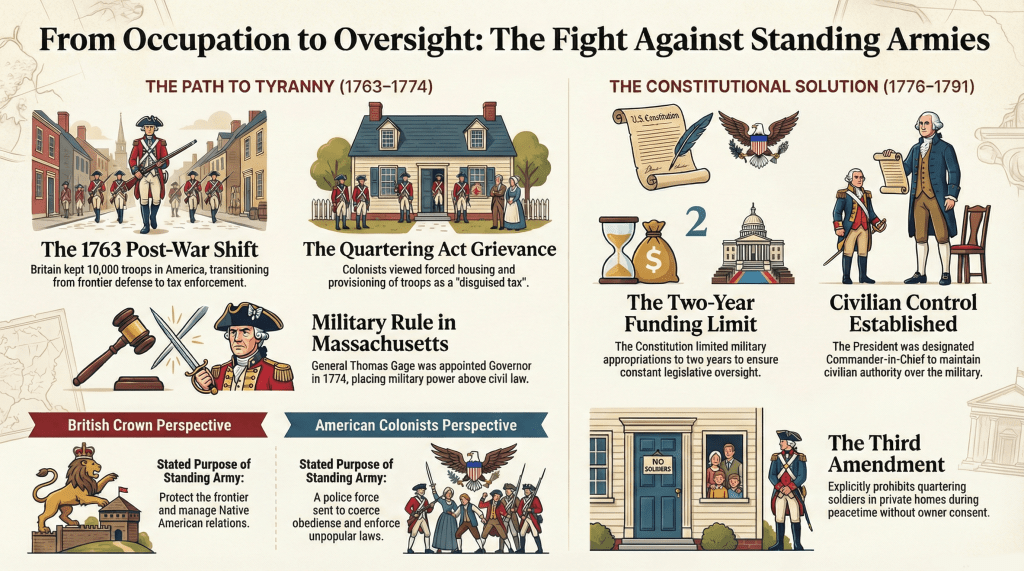
What made the colonial situation especially explosive was the question of consent. The English Bill of Rights allowed standing armies with parliamentary approval. Americans adapted that principle differently. They insisted consent must come from their own legislatures, not from Parliament three thousand miles away. That distinction became absolutely critical after 1763 when Britain stationed roughly ten thousand troops in North America following the French and Indian War. British officials viewed the force as necessary for frontier defense and imperial administration. Americans saw something else entirely.
To colonial eyes, redcoats stationed permanently among civilians looked less like protection and more like occupation. Troops enforced customs laws. Troops backed tax collection. Troops supported royal governors against colonial assemblies. Quartering laws forced legislatures to provide supplies, housing, firewood, and provisions for soldiers. In New York, refusal to comply even led Parliament to suspend portions of colonial self government. Americans absorbed a simple and frightening lesson from all this. Where armies establish themselves permanently, legislatures eventually grow quiet.
That realization transformed the grievance from political disagreement into something much darker. Colonists increasingly believed military force itself was becoming the mechanism through which constitutional liberties would be dismantled. Jefferson’s complaint in the Declaration therefore was not about soldiers personally. Americans respected military service deeply. The complaint concerned unchecked power backed by bayonets.
That distinction matters.
The Revolution was never fundamentally anti soldier. It was anti coercion. Americans believed liberty depended upon keeping military power subordinate to civil authority and rooted in consent. The entire constitutional structure that later emerged, civilian control of the military, congressional funding limits, the Second Amendment, the Third Amendment, all grew directly from this historical fear. The founders were not inventing those concerns from scratch. They were carrying forward lessons they believed English liberty had already learned through centuries of painful experience.
And in their minds, one truth stood above all the rest.
Liberty had learned, the hard way, that bayonets and freedom do not share a bunk.
The fear of standing armies might have remained an old English constitutional memory if the British government had simply packed up its troops after the French and Indian War and sent them home. History would probably remember the debate as one more inherited political argument from the seventeenth century, something discussed by lawyers, pamphleteers, and men wearing powdered wigs while drinking terrible coffee in London. Instead, the army stayed. That changed everything because abstract constitutional anxiety suddenly became lived daily experience for the American colonies. What had once been a philosophical concern rooted in English history transformed into something colonists could physically see standing at street corners with muskets on their shoulders.
From the British perspective, keeping troops in North America after 1763 seemed entirely reasonable. The Seven Years’ War had been enormously expensive, leaving Britain buried under roughly 122 million pounds of debt. Dave joked during the broadcast that while that number may not sound terrifying by modern standards, in today’s terms one is talking about sums approaching twenty billion dollars or more. Britain had just fought a global conflict stretching from Europe to India to North America. The French threat in Canada had been removed, but imperial administrators still worried about frontier security, Native American resistance, smuggling, colonial unrest, and the basic challenge of governing an empire spread across oceans. Maintaining troops in America looked practical, necessary, and perhaps even restrained compared to what some imperial officials preferred.
To many ordinary Britons, the colonies themselves appeared spoiled and ungrateful. Taxes in England were significantly higher than those paid in America. British soldiers had fought and died defending colonial territory from France. Parliament genuinely believed the empire had protected the colonies and now expected those colonies to contribute financially to imperial maintenance. London policymakers did not imagine themselves plotting tyranny in smoke-filled rooms while twirling villainous mustaches. They believed they were administering a vast empire responsibly.
The colonists saw something very different.
The moment British regulars remained stationed permanently in North America during peacetime, Americans began interpreting the situation through the constitutional memory discussed earlier. Standing armies were not viewed as neutral institutions. They carried historical baggage attached to Charles I, James II, Cromwell, and every previous example of military coercion against civilians. The issue was not simply that soldiers existed. The issue was why they existed, who controlled them, and what role they increasingly played in colonial life.
To colonial eyes, the army no longer looked defensive. It looked supervisory.
That distinction mattered enormously. Americans noticed quickly that these troops were not primarily guarding distant frontiers from foreign invasion. Instead, they enforced customs laws, supported tax collection, backed royal governors against colonial legislatures, and reinforced imperial authority in places where political resistance was growing. The redcoats became visible reminders that Parliament increasingly intended to govern through pressure backed by military force.
Dave captured the colonial reaction bluntly during the broadcast. “This isn’t protection. This is coercion.”
That perception intensified after the Proclamation of 1763. Britain drew a line along the crest of the Appalachian Mountains forbidding western settlement beyond it. From London, the policy made practical sense. Frontier wars were expensive. Native alliances remained fragile. Uncontrolled expansion threatened imperial stability. From the colonial perspective, however, the proclamation looked like betrayal. Americans had just participated in a costly war partly justified by access to western territory, and now the Crown informed them they could not occupy much of the land Britain had just won.
George Washington himself lost money because of the policy. Land speculators lost opportunities. Settlers lost access. Investors saw fortunes evaporate. Worse still, the army became the mechanism for enforcing the restriction. Soldiers were no longer protecting colonial prosperity. They were blocking it.
The Quartering Act of 1765 pushed tensions further toward outright confrontation. Modern Americans often imagine quartering solely as soldiers sleeping in private homes, but the reality involved something broader and politically more dangerous. Colonial legislatures were required to provide barracks, supplies, bedding, candles, firewood, transportation, salt, vinegar, beer, cider, and rum for British troops stationed among them. In other words, Americans were expected to finance the military presence enforcing imperial authority over them.
To Parliament, this arrangement seemed practical. Armies required support. Colonies benefited from imperial defense. Therefore colonies should contribute materially to maintaining troops. To Americans, however, the policy looked like taxation without consent wearing a red coat and carrying a musket.
The key issue remained representation and control. Colonial assemblies had long managed local taxation internally. They built roads, funded projects, regulated local affairs, and raised money according to local priorities. Suddenly Parliament was compelling them to support standing troops they had not requested and often deeply distrusted. The constitutional danger appeared obvious to colonial leaders. If Parliament could force assemblies to fund military occupation, then local self government itself was becoming conditional.
No colony felt this pressure more intensely than New York.
Because of its strategic location, New York carried a disproportionate share of the burden for quartering British troops. The colonial assembly resisted compliance with the Quartering Act, arguing that Parliament lacked the authority to compel such expenditures without colonial consent. From the American perspective, this was a defense of constitutional liberty. From Parliament’s perspective, it looked like outright defiance during a time requiring imperial discipline.
Parliament responded harshly. In 1767, the British government passed the New York Restraining Act, effectively suspending portions of New York’s self government until the colony complied with military provisioning requirements. The message was unmistakable. Military necessity now overrode representative government whenever imperial authorities deemed it necessary.
Colonists absorbed the lesson immediately.
This was the moment many Americans stopped viewing the standing army merely as a theoretical constitutional danger and began seeing it as an active political weapon. Troops were not simply occupying physical territory. They were occupying authority itself. Legislatures that resisted imperial demands could now be suspended, bypassed, or pressured under the shadow of military enforcement.
Jefferson later reflected this fear throughout the Declaration of Independence. The grievance concerning standing armies appears beside complaints about dissolved legislatures, military authority made superior to civil power, mock trials protecting soldiers from accountability, and swarms of officers harassing the people. None of these grievances stood alone. Americans saw them as interconnected parts of a single pattern. Military force was becoming the mechanism through which constitutional liberties were gradually dismantled.
That fear deepened further because colonial society increasingly experienced direct friction with British troops in daily life. Soldiers competed with civilians for work because military pay alone was often insufficient. Off duty troops sought extra income, undercutting local laborers already struggling economically. Civilians viewed many soldiers as crude outsiders disconnected from the communities surrounding them. Soldiers, meanwhile, often regarded colonists as unruly provincials who lacked proper respect for imperial authority. Mutual resentment grew steadily.
Street confrontations became common. Insults flew regularly between civilians and “lobster backs,” the popular colonial insult for redcoats. Brawls erupted. Bayonet fights occurred often enough that they stopped feeling extraordinary. The social atmosphere in cities like Boston grew increasingly toxic because the army’s mere presence transformed political disagreement into visible occupation. Americans no longer argued abstractly about whether standing armies threatened liberty. They could see armed soldiers patrolling their streets every day.
Thomas Jefferson later warned that such concentrated military authority possessed the ability to swallow up all other rights if left unchecked. That phrase captures the deeper colonial fear perfectly. Americans believed that once military force became the routine instrument of governance, every other constitutional protection eventually weakened beside it. Legislatures became less independent. Civil courts lost authority. Taxation escaped local control. Political dissent faced intimidation. Liberty itself began shrinking under the shadow of armed enforcement.
And then came the realization that terrified them most. The British government did not seem to recognize the danger at all.
To Parliament, these measures represented administration. To the colonists, they represented the oldest warning in English constitutional history unfolding all over again. Charles I had used troops to enforce loans and quarter soldiers among civilians. James II had maintained standing armies to bypass representative institutions. Cromwell had transformed military authority into political dominance. Americans believed they were watching the same pattern repeat itself under George III, only this time across the Atlantic.
That is why the presence of redcoats became psychologically transformative after 1763. The army changed from symbol to experience. The constitutional fear inherited from English history became part of daily colonial life. Troops guarded customs houses. Troops enforced unpopular laws. Troops reminded colonists constantly that imperial authority rested ultimately upon force.
And the lesson Americans drew from all of it became dangerously simple. Where armies go, legislatures soon fall silent. The redcoats did not merely occupy colonial streets. They occupied authority itself.
By the late 1760s, the argument over standing armies had moved beyond pamphlets, constitutional theory, and inherited English memory. Americans were no longer debating hypothetical dangers drawn from the age of Charles I or James II. They were living beside armed soldiers in crowded colonial cities, watching military authority expand into ordinary civic life, and discovering exactly how quickly tension could turn into bloodshed when political power rested visibly on bayonets.
Experience itself was writing the lesson now.
The turning point came in 1768 when British troops were redeployed from frontier posts into Boston to enforce the Townshend Acts. That decision changed the emotional atmosphere of the colonies almost overnight. A soldier guarding a frontier fort against foreign attack looked one way in the colonial imagination. A soldier standing outside a customs office in the middle of Boston looked very different. The mission itself had changed. These troops were no longer primarily defending settlements from external enemies. They were enforcing parliamentary policy against British subjects who increasingly believed their constitutional rights were under assault.
Boston reacted badly from the beginning.
The city already simmered with political agitation, economic frustration, and resentment toward imperial authority. Smuggling was widespread. Resistance to customs enforcement was growing. Crowds regularly harassed British officials. Pamphlets circulated constantly accusing Parliament of attempting to reduce Americans to slavery through taxation and military coercion. Into this atmosphere marched red-coated regulars with fixed bayonets, drums beating through narrow colonial streets while civilians watched from windows and tavern doors in furious silence.
One can almost feel the tension tightening like rope.
The British believed troops would restore order through visible authority. Many colonists interpreted the same display as proof that military intimidation had replaced constitutional government. Every sentry post, every patrol, every armed guard outside a government building reinforced the colonial suspicion that civil power was being subordinated to force.
The friction spread beyond Boston almost immediately. In New York, where quartering disputes and political tensions had already poisoned relations between civilians and soldiers, violence erupted in what became known as the Battle of Golden Hill. The event lacks the famous reputation of Lexington or Concord largely because nobody produced an immortal engraving afterward, but contemporaries understood its significance clearly enough. British troops and civilians fought openly in the streets over anti British liberty poles and political agitation. Blood was spilled. Several men were injured seriously. The confrontation became an early warning that military occupation inside colonial cities carried dangers neither side could fully control.
Americans absorbed a grim conclusion from incidents like Golden Hill. Standing armies stationed among civilians inevitably produced confrontation because soldiers and citizens occupied fundamentally incompatible roles. Civilians expected rights, debate, local representation, and negotiation. Armies expected obedience, discipline, hierarchy, and order. Those impulses could coexist temporarily, but over time they rubbed against each other like flint and steel.
Boston finally exploded in March 1770.
The Boston Massacre did not begin as a grand revolutionary battle. It began the way many urban confrontations do, through insults, anger, confusion, and escalating tension. Colonists taunted British sentries. Crowds gathered. Snowballs flew, some packed with ice and debris. Soldiers panicked amid the shouting and chaos. Then came gunfire.
Five colonists died.
That number sounds small to modern ears conditioned by industrial warfare and twentieth century casualty figures, but contemporaries experienced the event differently. For the colonists, the significance did not rest solely in the body count. The significance lay in the symbolism. Armed troops stationed in a civilian city had fired into a crowd of civilians. Exactly the kind of event English constitutional memory had warned against for generations had now occurred in Boston streets.
Patriot leaders understood immediately how powerful the event would become politically. Paul Revere’s famous engraving transformed the chaotic confrontation into an image of disciplined British soldiers deliberately executing innocent civilians. The engraving simplified reality dramatically, but propaganda works because it captures emotional truth even while compressing factual complexity. Americans already feared standing armies. The Boston Massacre seemed to confirm every warning they believed history had taught them.
Dave put it bluntly during the broadcast. “Once the army becomes the police force, blood is only a matter of time.”
The British, of course, saw matters differently. The soldiers involved were defended successfully in court by John Adams himself, who insisted that rule of law required fair trials even for hated redcoats. Adams understood something crucial that later generations sometimes forget. Fear of military power did not justify abandoning justice itself. Most of the soldiers were acquitted because evidence showed confusion and panic rather than organized murder.
Yet politically, the damage was done.
The colonists no longer viewed standing armies merely as a constitutional concern inherited from English history. They now possessed living examples from their own streets. The army had become associated directly with coercion, occupation, and bloodshed. Every future imperial action would be interpreted through that lens.
The final rupture came under General Thomas Gage.
Gage initially appeared moderate compared to some British officials. He understood the colonies better than many officers because he had served in North America for years. Yet London increasingly demanded stronger enforcement after the Boston Tea Party and mounting colonial resistance. In 1774, Gage was appointed Royal Governor of Massachusetts while simultaneously commanding British military forces. That combination terrified colonists because it merged military authority and civil government into the same hands.
To Americans, this looked like the constitutional nightmare their political tradition had warned about for generations. Civil authority no longer merely cooperated with military force. Military leadership itself now governed the colony. The distinction between soldier and magistrate began collapsing entirely.
At the same time, Parliament expanded quartering powers through a revised Quartering Act in 1774. Although popular mythology exaggerates British troops barging routinely into private homes, the colonists saw the expansion itself as ominous. The issue was not simply where soldiers slept. The issue was whether military necessity could override property rights and local legislative authority whenever imperial officials desired it. Americans increasingly believed the answer coming from London was yes.
When Jefferson later drafted the Declaration of Independence, these experiences flowed directly into the grievances against George III. The complaints were not random political talking points. They reflected lived colonial memory. “He has kept among us, in times of peace, Standing Armies without the Consent of our legislatures.” “He has affected to render the Military independent of and superior to the Civil power.” “For quartering large bodies of armed troops among us.” These accusations formed part of a single coherent fear. Americans believed military force had gradually escaped constitutional restraint and begun consuming civil liberty itself.
The Revolution therefore did not simply produce independence. It produced constitutional safeguards specifically designed to prevent the same pattern from emerging again.
That reality explains several features of the Constitution that modern Americans often take for granted without understanding their origin. The President became civilian Commander in Chief rather than a military strongman emerging independently from the army itself. Congress received authority over military funding, and crucially, appropriations for the army could not extend beyond two years at a time. That limitation was deliberate. The founders wanted the legislature forced repeatedly to reconsider military support rather than allowing permanent unchecked funding to drift forward automatically.
Then came the Third Amendment, perhaps the least discussed portion of the Bill of Rights and one of the clearest windows into revolutionary memory. Modern Americans rarely think about quartering soldiers because the amendment worked so effectively that the issue vanished from ordinary life. To the founding generation, however, it represented a permanent constitutional firewall between military power and civilian homes. The amendment declared that soldiers could not be quartered in private houses during peacetime without the owner’s consent. That protection emerged directly from colonial experience under British occupation.
The broader principle underneath all these safeguards remained remarkably simple. Civil authority must stand above military force.
That does not mean the founders distrusted soldiers personally. George Washington himself embodied military leadership. Many revolutionary leaders possessed military experience. Americans admired courage, discipline, and sacrifice deeply. The Constitution was not designed out of hostility toward the armed forces. It was designed out of fear of unchecked power, regardless of who wielded it.
That distinction matters enormously.
The founders understood armies were necessary. They also understood that concentrated military authority, detached from civilian oversight, eventually threatens liberty almost everywhere it emerges. History had taught them that lesson repeatedly, from Charles I to Cromwell to Boston itself. The constitutional system they built therefore attempted something difficult but essential. It sought to maintain military strength while preventing military supremacy.
And that is the real legacy of the grievance against standing armies.
The Constitution did not distrust soldiers.
It distrusted unchecked power.
Adams, John. The Works of John Adams, Second President of the United States. Edited by Charles Francis Adams. 10 vols. Boston: Little, Brown and Company, 1850–1856.
Blackstone, William. Commentaries on the Laws of England. 4 vols. Oxford, 1765–1769.
Bailyn, Bernard. The Ideological Origins of the American Revolution. Cambridge, MA: Belknap Press of Harvard University Press, 1967.
Declaration of Rights and Grievances. Stamp Act Congress, October 19, 1765.
Dickinson, John. Letters from a Farmer in Pennsylvania. Philadelphia, 1768.
England and Wales. Petition of Right. 1628.
England and Wales. English Bill of Rights. 1689.
Hyneman, Charles S., and Donald S. Lutz, eds. American Political Writing During the Founding Era, 1760–1805. 2 vols. Indianapolis: Liberty Press, 1983.
Jefferson, Thomas. The Papers of Thomas Jefferson. Edited by Julian P. Boyd et al. Princeton, NJ: Princeton University Press, 1950–.
Maier, Pauline. From Resistance to Revolution: Colonial Radicals and the Development of American Opposition to Britain, 1765–1776. New York: Alfred A. Knopf, 1972.
Middlekauff, Robert. The Glorious Cause: The American Revolution, 1763–1789. New York: Oxford University Press, 1982.
Morgan, Edmund S., and Helen M. Morgan. The Stamp Act Crisis: Prologue to Revolution. Chapel Hill: University of North Carolina Press, 1953.
Revere, Paul. The Bloody Massacre Perpetrated in King Street. Boston, 1770.
Trenchard, John, and Thomas Gordon. Cato’s Letters. London, 1720–1723.
United States. Declaration of Independence. July 4, 1776.
United States Constitution. Amend. III.
Wood, Gordon S. The Creation of the American Republic, 1776–1787. Chapel Hill: University of North Carolina Press, 1969.
Wood, Gordon S. The Radicalism of the American Revolution. New York: Alfred A. Knopf, 1992.
“Standing In Our Streets”
Liberty250 – The Music(al)
Words and Music by David Ray Bowman
© 2006 by Slippery Fish Entertainment



Leave a comment