
The morning of November 11, 1919, dawned with flags fluttering and veterans standing tall in Centralia, Washington. It was the first anniversary of the Great War’s end, a day meant for solemn remembrance and celebration of peace hard-won. By sundown, that small lumber town had become the stage of one of America’s bloodiest labor conflicts. Four veterans lay dead, a radical hanged by a mob, and a community—and a nation—torn apart between two irreconcilable visions of America. To some, it was a massacre of innocent patriots. To others, it was the tragic climax of years of persecution and paranoia. Yet through the lens of law, order, and fidelity to the Republic, the events in Centralia stand as a chilling warning about what happens when revolutionists mistake their hate for freedom.
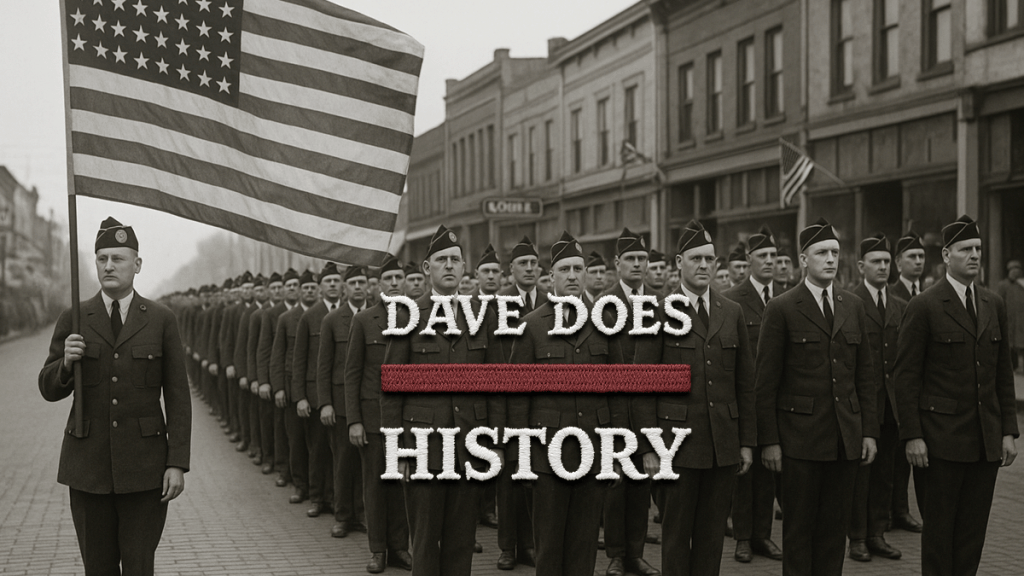
The so-called “Centralia Tragedy” or “Centralia Massacre” unfolded as members of the Industrial Workers of the World, a radical labor organization bent on the destruction of capitalism, opened fire on an unarmed Armistice Day parade led by the American Legion. The Legionnaires, war veterans united by loyalty and patriotism, were gunned down in their uniforms by men who called themselves “Wobblies.” The clash exposed more than class tension, it revealed a struggle for the soul of America itself.
The Industrial Workers of the World had, from its birth, declared war on the American system. Founded in Chicago in 1905, its constitution rejected negotiation, moderation, or faith in the ballot box. Its mission was nothing short of revolution: the abolition of the wage system and the overthrow of capitalism. Its rhetoric dripped with the language of violence, bullets, dynamite, and “class war.” They saw themselves as soldiers, not citizens. Their leaders invoked Marx and Darwin while scorning the American ideal of individual liberty earned through honest labor. The group’s slogan, “One Big Union,” appealed to the disaffected, the itinerant, and the embittered. Its true purpose was not industrial fairness but social upheaval.
By 1917, the Wobblies had spread their creed into the logging camps of the Pacific Northwest, recruiting among transient laborers. The lumber industry, vital to the wartime economy, was paralyzed by IWW-led strikes that officials equated to sabotage. Even after the Armistice, while America tried to heal, the Wobblies kept agitating. Across the country, patriotic veterans looked upon them not as reformers but as domestic enemies—the “enemy within” that General John J. Pershing warned must be crushed without mercy.
In the years just after the war, America faced a wave of strikes, bomb plots, and radical rhetoric imported from Europe. Lenin’s revolution in Russia had turned chaos into a creed, and American imitators tried to do the same. The “Red Scare” was not hysteria without cause, it was the natural reaction of a nation that had just buried 100,000 of its sons fighting tyranny abroad, only to see its own institutions threatened by radicals at home. The IWW, with its open calls for the abolition of private property, its talk of class warfare, and its sympathy for Bolshevik ideals, became the lightning rod of that fear.
Centralia had endured its share of radical violence long before the fateful parade. The town’s sawmills and lumberyards were the backbone of its economy. Loggers worked hard, long hours in dangerous conditions. But they were also fiercely independent, bound by a pioneer ethic that rejected outside agitators. When the IWW opened a hall there in 1918, local citizens saw it as a provocation. That year, during a Red Cross parade, townspeople stormed the hall, destroyed its furnishings, and ran its occupants out of town. To the IWW, it was proof of persecution. To Centralia’s citizens, it was simple self-defense.
The Wobblies responded with vengeance disguised as self-righteousness. In September 1919, they opened a new hall in the Roderick Hotel, right on Tower Avenue, in the heart of Centralia’s business district. It was no accident. The veterans of the newly formed American Legion, especially Grant Hodge Post No. 17, saw the hall as a direct challenge to their community and their service. The Legion had been founded that very year by returning soldiers who sought to preserve the values they had fought for: loyalty, discipline, and patriotism. They were determined to resist every “ism” that threatened those ideals.
The Wobblies, however, had other plans. Claiming they feared another raid, they began to stockpile weapons and ammunition. They were advised by a local radical attorney, Elmer Smith, that they had a right to “self-defense.” What they prepared, though, was not defense but an ambush. They posted riflemen in the IWW hall, in two hotels across the street, the Avalon and the Arnold, and on the slope of Seminary Hill, a quarter mile away. These positions formed a deadly triangle aimed directly at the parade route.
The parade began at two o’clock. Centralia’s main street was lined with flags, banners, and cheering families. Bands played patriotic tunes. Red Cross nurses rode in automobiles. Boy Scouts marched with American flags. The Centralia Legion contingent, led by Lieutenant Warren O. Grimm, a decorated veteran of the Siberian campaign and beloved town figure, marched proudly at the head of the local column. At the intersection of Tower and Second, Grimm ordered the men to “Close up!” The platoons were tightening ranks, marking time, waiting for the signal to move forward.
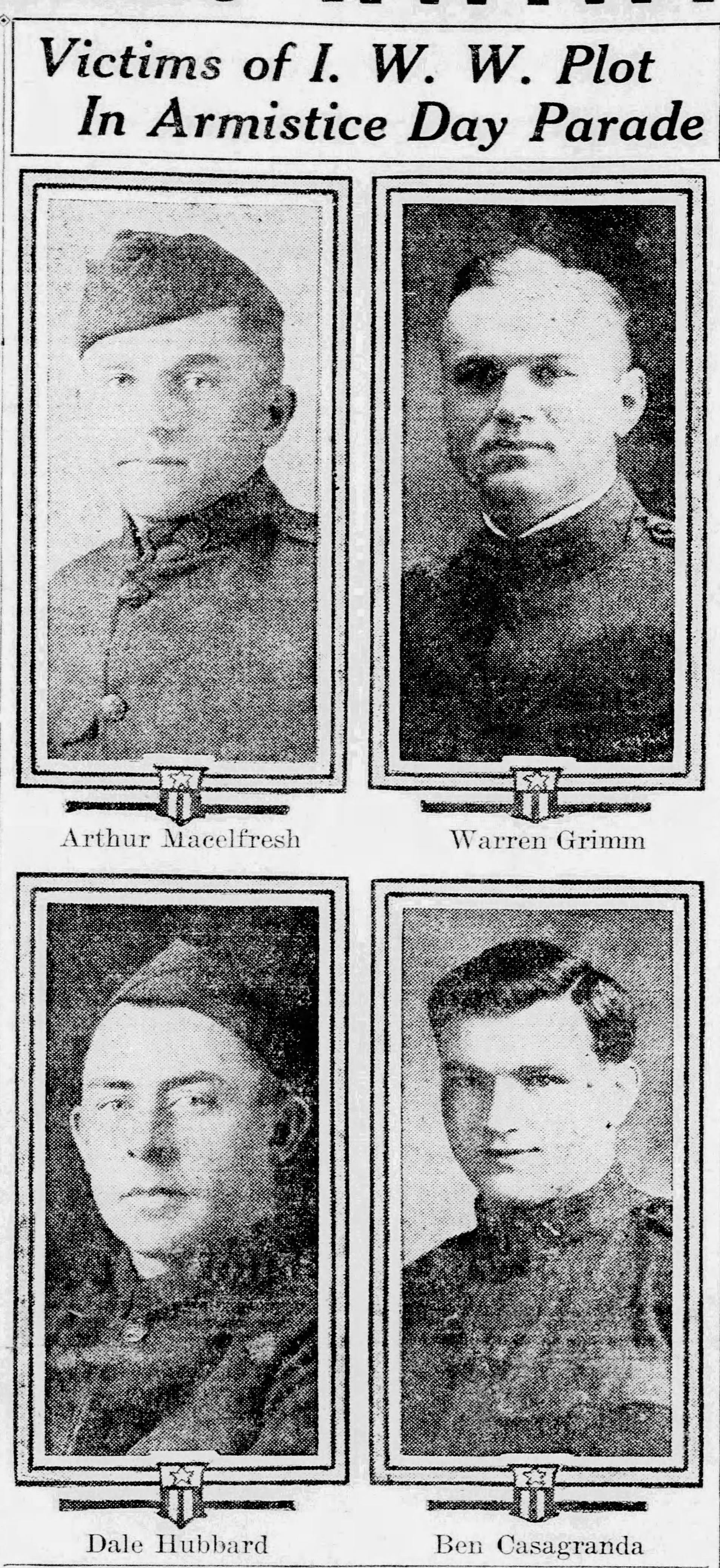
The first shot came from the Avalon Hotel. Grimm, standing erect and unarmed, fell instantly, struck by a rifle bullet to the chest. Seconds later, more shots erupted—from the IWW hall, from the Arnold Hotel, and from the hill above. Arthur McElfresh was killed by a high-powered bullet to the head. Ben Cassagranda fell while retreating for cover. A dozen others were hit. Unarmed men, in uniform, were cut down in the streets they had fought to protect.
The attack was not spontaneous. Testimony later showed that the IWW had agreed upon a signal: the first shot from the hall would unleash a coordinated fusillade from all positions. They called it “defending the hall.” But defense requires provocation, and none came. The Legionnaires never attacked the building. They were standing in formation when the slaughter began.
In the chaos, veterans stormed the hall, breaking through the doors and subduing the gunmen inside. The building was quickly destroyed, its contents dragged into the street and burned. One of the Wobblies, Wesley Everest, a veteran himself who had turned radical, fled out the back, armed with a pistol. As he ran, he shot and wounded one man, then killed another, Dale Hubbard, who had chased him to the Skookumchuck River. Everest was captured and taken to the city jail, where that night he would meet a violent end.
The lynching of Wesley Everest remains one of the darker footnotes to the Centralia story. Sometime after midnight, with the power cut and tempers raging, a group of masked men broke into the jail, dragged him to a bridge, and hanged him. His body was found the next day. No one was charged. The law failed twice, first to protect him, and second to punish those who murdered in the name of justice. Yet the community’s fury was understandable. The veterans had seen comrades murdered in the streets; their patience had limits.
The state moved quickly to restore order. Eleven Wobblies and their lawyer, Elmer Smith, were indicted for murder. Their trial began in Montesano, a nearby town, in January 1920. The atmosphere was tense. Hundreds of Legionnaires filled the courtroom as a show of solidarity. Uniformed soldiers camped nearby to maintain peace. The prosecution, led by Herman Allen and C. D. Cunningham, presented a clear case of conspiracy: the defendants had premeditated an ambush, fortified their positions, and fired on unarmed men.
The defense was led by George Vanderveer, a well-known radical lawyer from Seattle. Vanderveer was no friend of law and order. He had defended anarchists, socialists, and saboteurs for years, often turning trials into political theater. In Montesano, he tried the same tactic—painting the IWW as persecuted heroes and accusing the Legion of being tools of capitalism. He called the dead men aggressors and claimed the shooting was “self-defense.” His arguments outraged the courtroom but found sympathy among those predisposed to distrust authority.
The prosecution countered with forensic evidence, eyewitness accounts, and even confessions. Ballistic analysis confirmed that shots came from all three positions. Testimony from an IWW insider, Loren Roberts, detailed the plan to station men with rifles along the route. It was not a defense, it was an execution. The state argued that Elmer Smith’s legal advice amounted to conspiracy, since he knew the men were armed and anticipating violence.
After weeks of testimony, the jury retired. When they returned, they delivered a verdict that satisfied no one: seven Wobblies were convicted of second-degree murder instead of first. Four were acquitted. Judge John M. Wilson, unwilling to let leniency undermine justice, imposed sentences of twenty-five to forty years. It was one of the harshest possible penalties under the law, but far less than what many believed the crime deserved.
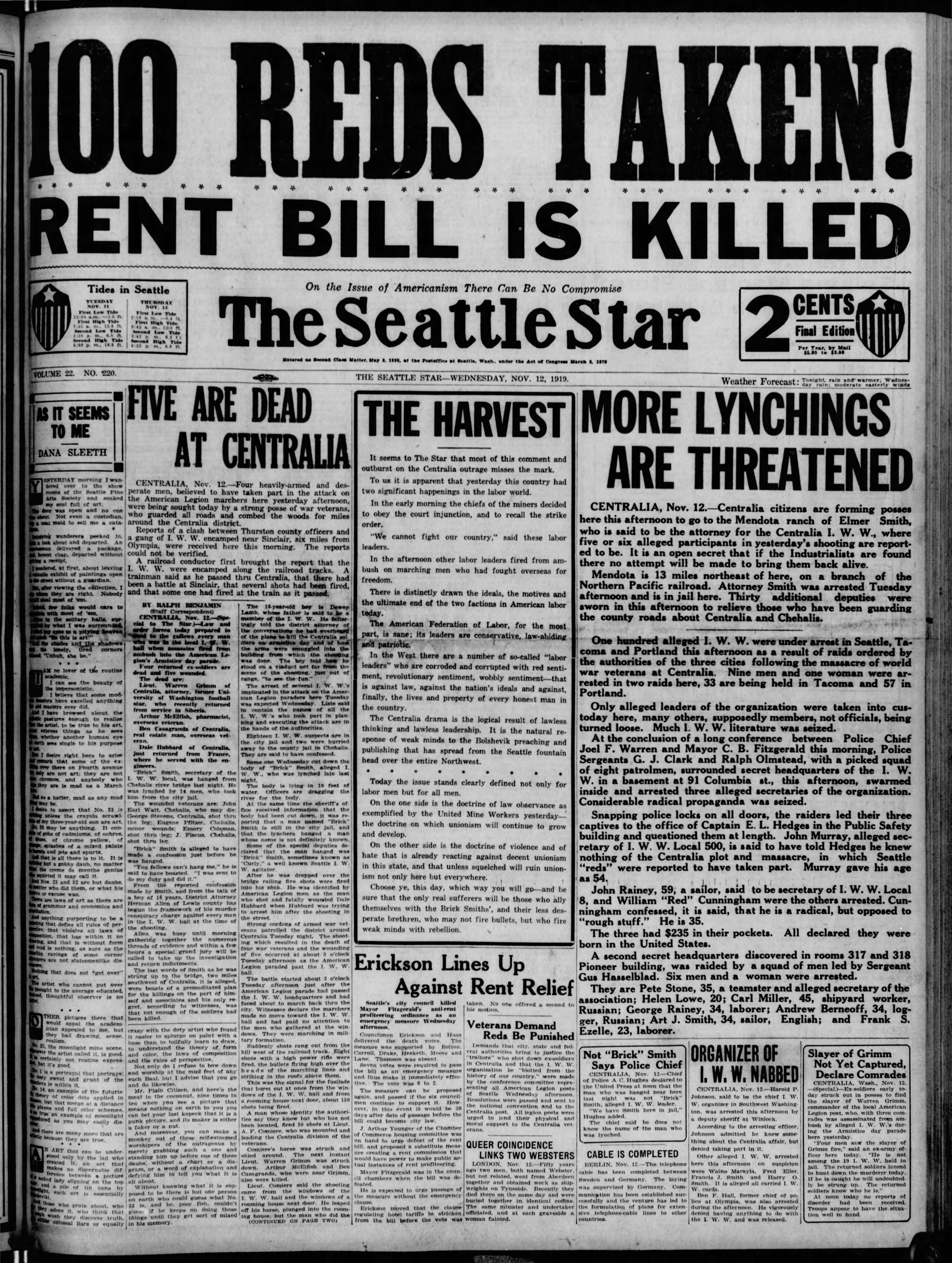
Across America, the trial was front-page news. The New York Times, the Chicago Tribune, and dozens of regional papers portrayed the Centralia killings as a symptom of the radical disease infecting postwar America. The Seattle Times called it “an outrage upon civilization.” President Woodrow Wilson, though careful not to comment directly, urged the Justice Department to continue its suppression of radical groups. General Leonard Wood praised the Legion’s restraint, saying that “the true soldier stands for law and order even when faced with chaos.”
On the opposite end of the spectrum, socialist and labor papers screamed injustice. Pamphlets bearing titles like The Centralia Conspiracy and Who Killed Wesley Everest? circulated widely. They claimed the IWW men were victims of mob violence and political persecution. Within a few years, radical historians and labor activists would rewrite the narrative entirely, portraying the Legionnaires not as martyrs but as aggressors. In their version, the Wobblies were peaceful unionists defending themselves from a murderous mob. It was a lie that found fertile ground in academia decades later.
Over time, the memory of Centralia faded, replaced by selective remembrance. The radical left held annual vigils for Wesley Everest, calling him a martyr to labor. In 1997, they even commissioned a mural titled The Resurrection of Wesley Everest, which still faces the Legion’s monument downtown, a visual reminder that history remains contested. Yet the facts endure. The IWW fired first. Four unarmed veterans died. And the people of Centralia, whatever their faults, acted out of loyalty to a country they loved.
In 1924, the American Legion erected The Sentinel, a bronze soldier standing guard in George Washington Park. National Commander Franklin D’Olier declared Centralia “the shrine of the American Legion, hallowed by our first martyrs.” President Warren G. Harding later spoke of their sacrifice, reminding Americans that “freedom must be defended in every generation against those who mistake license for liberty.” For nearly a century, the statue has stood silent but unyielding, facing forward, as if watching for the next storm.
Centralia’s lesson is simple and sobering. Freedom without order collapses into anarchy. Rights without responsibility decay into chaos. The men who died on Tower Avenue were not victims of misunderstanding; they were soldiers murdered by revolutionaries who despised everything they represented. Their killers sought to destroy faith in law, religion, property, and country. The Legionnaires stood for all of it.
Today, in a time when patriotism is too often mistaken for extremism, and law and order are dismissed as relics of a harsher age, the Centralia story should remind us that civilization is fragile. The Wobblies believed they were striking a blow for equality; what they struck instead was a wound upon the conscience of a nation. The Legionnaires of Centralia, Grimm, McElfresh, Hubbard, and Cassagranda, proved that courage is not confined to battlefields abroad. It is also found on the home front, when citizens stand together against the enemies of their own Republic.
Their sacrifice reminds us that vigilance is not cruelty, and the defense of law is not tyranny. It is the condition of freedom itself.
Sources
- Ben Hur Lampman, Centralia: Tragedy and Trial (The American Legion, 1920) – Official Legion account detailing the events, trial proceedings, and community response following the Armistice Day massacre.
- National Park Service, Properties Associated with Centralia Armistice Day, 1919 (1991) – Federal historic context document outlining the incident, the Centralia sites involved, and its national significance.
- “The Centralia Tragedy Brief” (Historical Summary, 2024) – Concise overview of the event, the ideological clash between the IWW and the American Legion, and its long-term historical interpretations.
- “The Centralia Tragedy Outline” (Dave Does History, 2025) – Structured conservative outline emphasizing the ideological and patriotic dimensions of the conflict and the narrative of the Legionnaires’ sacrifice.
- State of Washington v. Britt Smith et al. (Superior Court, Montesano, WA, 1920) – Trial records and testimony excerpts from the prosecution and defense, documenting the evidence of conspiracy and eyewitness accounts.
- The Seattle Times Archives (1919–1920) – Contemporary newspaper reports describing the Armistice Day parade, aftermath, and trial coverage in Montesano.
- United States Department of Justice, Bureau of Investigation Reports (1919) – Internal reports summarizing eyewitness statements and forensic evidence gathered after the shooting, portions of which corroborated the IWW’s preparations for armed resistance.
- Franklin D’Olier, Address at the Dedication of The Sentinel Monument (American Legion Proceedings, 1924) – Primary speech dedicating the Centralia monument and articulating its symbolic importance to the Legion’s mission.
- Warren G. Harding, Presidential Remarks on the Centralia Martyrs (1924) – Statements honoring the fallen Legionnaires and linking the event to broader national themes of law, order, and patriotism.
- Library of Congress, Prints & Photographs Division – Veterans and Labor Movements, 1919–1920 Collection – Period images of the Armistice Day parade, American Legion posts, and IWW gatherings providing visual context for the event.


 DAVE DOES HISTORY
Leave a comment