
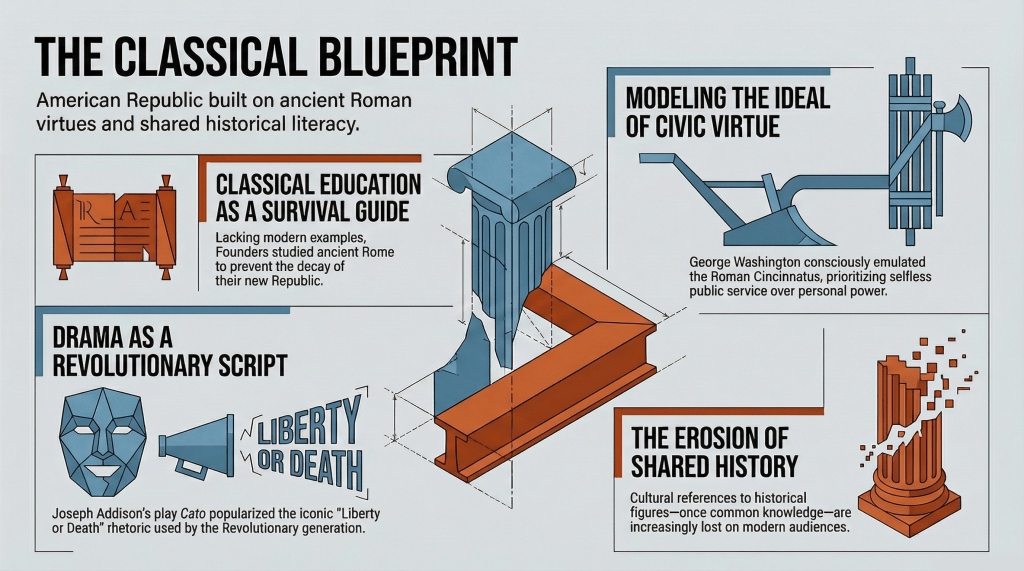
For the Founders, history was not simply an academic subject. It was a guidebook. They searched the rise and fall of the Roman Republic to understand how free governments prospered, why they declined, and how ambition, corruption, and tyranny could destroy even the strongest republic. Ancient historians such as Livy, Sallust, and Tacitus were as familiar to educated Americans as modern political commentators are today. Their lessons were reinforced not only through books, but through plays, sermons, speeches, and public debate, creating a shared civic culture that united the colonies long before independence.
This installment of Liberty 250 explores how the Founders translated the lessons of antiquity into American institutions and values. From Washington’s deliberate imitation of Cincinnatus to the Constitution’s carefully balanced system of checks and balances, the American Republic was built upon centuries of historical reflection. Understanding that intellectual inheritance is essential to understanding not only how the United States was founded, but why its preservation still depends upon an informed and historically grounded citizenry.




Let me begin with something that seems almost ridiculously simple.
Mary Ann or Ginger?
For decades, that has been one of those classic pop culture debates. If you ever served in the military, especially on a submarine during long patrols, you’ve probably heard it argued more than once. After enough weeks at sea, conversations have a way of wandering into questions like that. Someone inevitably votes for Mary Ann. Someone else insists on Ginger. Then there is always the fellow who decides to be different and says, “Mrs. Howell. She’s rich.”
It is all harmless fun. Or at least it appears to be.
Over the years, psychologists have even claimed that your choice says something about your personality. Pick Ginger, and perhaps you value glamour and appearance. Pick Mary Ann, and maybe you value wholesomeness, honesty, and character. Whether those studies hold up is beside the point. What interests me is something much deeper that is hidden inside Gilligan’s Island itself.
I’ve always enjoyed that show, particularly the first season. It is fascinating television history. The original pilot looked very different from the series we remember. The Professor wasn’t there. Ginger wasn’t there. Mary Ann wasn’t there. Even the opening sequence carries history within it. If you watch carefully, the flags are flying at half-staff because the pilot was filmed only days after President Kennedy’s assassination. Even before the comedy begins, history has already left its mark on the production.
One of the early episodes was directed by Ida Lupino, an extraordinary actress and director whose career stretched from starring alongside Humphrey Bogart in High Sierra to directing episodes of Gilligan’s Island. That alone tells you something about the remarkable people working in early television.
During that episode, the radio begins describing the missing passengers from the Minnow. One by one, we learn little details about the castaways. We hear about Jonas Grumby, the World War II veteran better known as the Skipper. We hear about Roy Hinkley, the Professor. We hear about Ginger, the glamorous movie star.
Then, almost as an afterthought, the announcer mentions Mary Ann from Kansas and casually identifies the aunt and uncle who raised her.
Their names are George and Martha.
It is a throwaway line. But it is also the entire point.
When audiences heard those names in 1964, they instantly understood what the writers were telling them. Nobody needed an explanation. George and Martha meant George and Martha Washington. Mary Ann was being presented as the wholesome, all-American girl. The reference quietly reinforced everything the audience already believed about her character.
Today, most viewers never even notice it. That difference matters. It tells us something important about our culture.
There was once a time when television writers assumed their audience possessed a shared historical vocabulary. They could insert a subtle reference to George and Martha Washington without stopping to explain it because they knew millions of Americans would immediately recognize the connection.
Today, that same reference often disappears into the background unnoticed. That is not simply a matter of forgotten trivia. It is evidence of something much larger.
We have gradually lost the shared historical memory that once connected Americans across generations. We no longer recognize many of the references that earlier generations considered obvious. The language of history has become unfamiliar.
That loss becomes even more significant when we turn our attention to the Founding generation.
The men who established the United States lived in a world where history and culture were inseparable. They did not think of history as an academic subject tucked away in classrooms while entertainment occupied an entirely different world. Theater, books, sermons, speeches, newspapers, and public celebrations all reinforced the same ideas.
History was not merely something they studied. It was something they lived. When they watched a play, they were learning history. When they listened to a sermon, they were learning history.
When they attended a public gathering or read a newspaper essay, they encountered historical examples that reinforced ideas about liberty, virtue, tyranny, and citizenship. Their culture continually reminded them where those ideas came from.
To us, Greek and Roman stories are often dismissed as mythology, as little more than fictional tales meant to entertain. We tend to use the word “mythology” as though it means something unimportant.
The Founders did not see it that way.
For them, the stories of Greece, Rome, Troy, and Carthage were part of the historical experience of civilization. Whether they were reading Homer, Livy, Sallust, or Tacitus, they believed these works preserved lessons about human nature, political power, and the rise and fall of republics.
Those stories appeared repeatedly in the culture around them. The theater presented them. Books explained them. Public speakers quoted them. People immediately understood the references because everyone had encountered them again and again.
Liberty itself was taught this way.
It was debated in legislatures and pamphlets, certainly, but it was also performed on stages and absorbed through stories that became part of the common culture. Historical examples were repeated so often that they became second nature.
We no longer have that shared experience. When a culture forgets its historical references, it does not merely lose the joke. It loses the meaning carried by the joke.
Think about Rocky and Bullwinkle. Much of the humor depended on references the audience was expected to recognize. Once those references disappear, the jokes still exist, but the deeper meaning behind them has vanished.
The same thing has happened to our understanding of the Founders.
Modern critics often approach them as though they were simply making things up as they went along or reacting only to the politics of their own moment.
Nothing could be further from the truth.
The Founders were steeped in history. They learned Latin and Greek. They read Livy, Sallust, and Tacitus. More importantly, this knowledge was not confined to a tiny intellectual elite. Americans generally were readers. Many lacked formal education, but they nevertheless shared a broad familiarity with the historical ideas circulating throughout the colonies.
They understood that republics could rise. They understood that republics could decay. They understood that liberty depended upon virtue. Those lessons were reinforced constantly by the culture in which they lived.
That is precisely why they would have recognized the George and Martha reference in Gilligan’s Island without hesitation had they somehow been transported two centuries into the future. They were accustomed to a culture that expected historical literacy rather than apologizing for its absence.
The real question for us is not whether Mary Ann or Ginger was the better choice. The real question is why so many Americans no longer recognize what Mary Ann was intended to represent.
That is the warning.
Because when a civilization loses its shared historical memory, it eventually loses the ability to understand the ideas that memory once carried. And that is exactly why we must begin our examination of the Founders by recognizing that they were not operating in ignorance.
They were saturated in history.
If we’re going to understand the American Founders, we have to do something that modern historians often fail to do. We have to enter their world instead of forcing them into ours.
One of the great mistakes we make is assuming that because we know what happened afterward, we know what they knew beforehand. We read history backwards. They lived it forwards.
Think about the situation they faced.
They were attempting something almost no one thought could succeed. They wanted to establish a republic over an enormous territory populated by people with different economies, different religious traditions, different interests, and different loyalties.
Where do you find a blueprint for that?
Today, if someone wanted to establish a constitutional republic, they could study the United States. They could examine Canada, Australia, Switzerland, or dozens of other constitutional governments around the world. There are centuries of experience available.
The Founders had none of that.
There were no successful large republics in the modern world. There were monarchies. There were empires. There were kingdoms. There were principalities.
But there was no American example because America did not yet exist.
So where do you go?
You go backwards.
More than two thousand years backwards.
You go to Rome.
That is one of the things that is hardest for modern Americans to appreciate. The Founders did not read Roman history because they thought it was interesting. They read it because they believed their lives depended on it.
From childhood, many of them received an education that today feels almost unimaginable. Latin was not an exotic language. It was expected. Greek was not reserved for specialists. It was the language of educated men. Students translated classical authors, memorized passages, debated historical events, and compared ancient governments with the problems of their own day. Classical education was not an elective. It was the foundation upon which higher education rested.
Now, before somebody says, “Well, that was only true of the wealthy,” let’s slow down.
Yes, not every American attended Harvard or William and Mary. Not every farmer could quote Tacitus in the original Latin.
But literacy in colonial America was remarkably high, newspapers circulated widely, sermons quoted classical authors, and ideas spread far beyond college campuses. The educated elite absorbed these lessons formally, while ordinary Americans encountered many of the same themes through pamphlets, speeches, newspapers, almanacs, and public conversation. This wasn’t confined to ivory towers. It was part of the culture.
And if you wanted to understand republics, there were three names that kept appearing.
Livy.
Sallust.
Tacitus.
Livy told the story of Rome’s rise. His history celebrated civic virtue, sacrifice, and the willingness of ordinary citizens to place the republic ahead of themselves. Again and again his stories asked the same question: what kind of people are capable of remaining free?
Sallust examined something different. He wanted to know why Rome changed. What happens when wealth replaces virtue? What happens when ambition overwhelms duty? What happens when citizens begin pursuing personal advancement instead of the common good?
Those questions fascinated the Founders because they weren’t reading ancient history. They were reading what they believed was their future.
Then came Tacitus.
Tacitus looked directly into the machinery of empire. His writings explored corruption, political manipulation, tyranny, and the quiet destruction of liberty. He wasn’t interested in glorious victories. He wanted to understand how free societies slowly surrendered freedom without always realizing what they were losing.
Do you notice the pattern? These weren’t books about military campaigns. They were books about human nature. That’s what the Founders were really studying.
How do republics survive? Why do republics fail?
Because Rome didn’t collapse in a single afternoon. It decayed. The institutions remained. The buildings remained. The Senate still met. The laws still existed. But the character of the people slowly changed until the republic could no longer sustain itself. That lesson haunted the eighteenth century. It should probably haunt ours.
But books alone weren’t enough. Facts rarely change people. Stories do.
The Founders understood that long before modern psychologists began talking about narrative and memory.
Which brings us to one of the most influential works you’ve probably never read.
Cato: A Tragedy.
Today it’s almost forgotten. In the eighteenth century, it was a blockbuster.
The play was written by Joseph Addison and first performed in London in 1713. It told the story of Cato the Younger, the Roman statesman who refused to surrender to Julius Caesar after the collapse of the Roman Republic.
Now, let’s be clear about something. Cato was not the winner. Caesar won. Cato died.
If Hollywood made this movie today, executives would probably reject the ending because the hero loses. But that’s precisely why the Founders admired him. Cato represented something larger than victory.
He represented fidelity to principle. He refused to compromise with tyranny, even when resistance appeared hopeless. His death became a declaration that some principles are worth more than life itself. That idea electrified the English-speaking world.
Addison’s play wasn’t simply entertainment. It became civic education.
It was performed throughout Britain. It crossed the Atlantic. It was staged in the American colonies. Its lines were memorized. Its speeches were quoted. Its characters became familiar companions to an entire generation.
Imagine if every American today could instantly recognize quotations from the same movie. That’s roughly what Cato meant to the eighteenth century.
George Washington admired it deeply. Benjamin Franklin printed it. Colleges assigned it. Public audiences packed theaters to watch it. This wasn’t obscure literature appreciated by professors.
It was shared culture. Like Gilligan’s Island.
And that’s important because the play taught a lesson that history books alone could never communicate.
Look closely at the story. Cato himself hardly changes. Everyone else does. Around him swirling ambition. Fear. Romantic obsession. Political compromise. Betrayal. The desire for power. Personal emotion colliding with public responsibility.
Addison deliberately constructs the drama so that Cato becomes the fixed point against which every other character is measured.
He is not merely the hero. He is the standard.
The question isn’t whether Cato succeeds. The question is whether everyone else will live up to him. That’s an entirely different kind of storytelling. And the lesson is unmistakable.
Republics aren’t destroyed first by invading armies. They’re destroyed when private desires begin outweighing public duty. When ambition becomes more important than service. When personal advancement replaces civic responsibility.
Those ideas landed with extraordinary force among the Founders because they already believed Roman history was warning them about exactly those dangers.
Then something remarkable happened. The play escaped the theater. Its words entered everyday political life.
Patrick Henry’s speeches echo Addison’s language. Nathan Hale’s famous final words bear striking resemblance to passages audiences already knew from Cato. Washington repeatedly quoted the play in conversation and correspondence.
Its influence appears in sermons, pamphlets, newspaper essays, and political debates. This wasn’t plagiarism. This was shared language.
Everyone knew the source. Everyone understood the reference. It was like quoting Scripture to a Biblically literate audience. The quotation carried authority because everyone already knew the story behind it.
Perhaps the most powerful example came during one of the darkest moments of the Revolution.
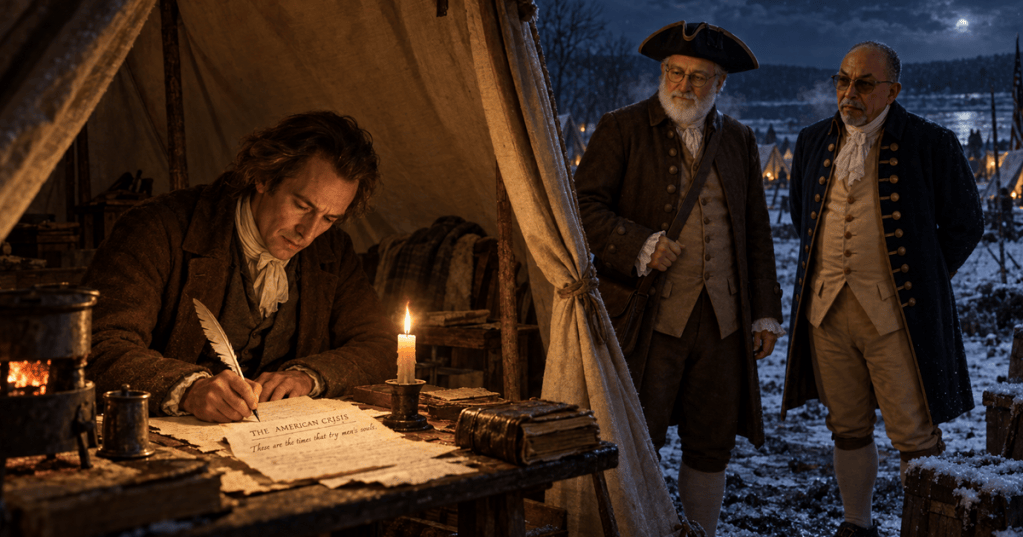
Valley Forge. The winter of 1777-1778. The army was freezing. Hungry. Poorly clothed. Disease spread through the camp. Desertions mounted. Many believed the Revolution itself might not survive.
At that moment, Washington did something extraordinary. He ordered Cato to be performed for the troops.
Think about that.
He could have ordered another military drill. He could have delivered another speech. Instead, he gave exhausted soldiers a story.
Why?
Because stories remind people they are not alone.
Washington was saying, in effect, “Others have stood where you stand. Others have faced overwhelming odds. Others have chosen principle over comfort, liberty over safety, duty over despair.”
The army wasn’t merely watching a play. They were seeing themselves. Valley Forge became their Utica. Cato’s struggle became their struggle.
History reached across nearly eighteen centuries to remind Americans that they were participating in a story far larger than themselves.
That’s leadership.
Not leadership rooted merely in tactics or logistics. Leadership rooted in memory. Leadership rooted in history. And that tells us something profound about the generation that founded this country.
Rome wasn’t an academic subject. It wasn’t a hobby. It wasn’t something discussed only inside universities. It became the framework through which they interpreted the world around them.
They looked backward in order to see forward. They searched the failures of ancient republics so they might avoid repeating them. They immersed themselves in the stories of Rome because they believed those stories contained timeless truths about liberty, power, ambition, virtue, and the fragile nature of self-government.
By this point, Rome is no longer an ancient civilization sitting quietly in the pages of a history book. It has become a living framework. And once you understand that, you begin to understand the next question the Founders faced.
How do you take those lessons… and build a republic designed to survive them?
Throughout Liberty 250 we’ve talked about ideas. We’ve talked about philosophy, the Declaration of Independence, and the ancient world. But eventually every philosophy has to answer one simple question: Now what? Ideas are only valuable if they change the way people live.
The Founders understood that. They were not content simply to admire Rome. They intended to learn from it. More importantly, they intended to imitate it where it had succeeded and avoid it where it had failed.
That distinction matters.
Too often we imagine the Founders as men sitting in libraries surrounded by dusty books, quoting Latin while the real world passed them by. Nothing could be further from the truth. History was practical. It was a laboratory. Rome wasn’t simply something they admired. Rome was a case study. Every triumph, every mistake, every success, and every collapse became evidence. The question they continually asked was remarkably simple: What should we copy? And what must we never repeat?
Perhaps no example illustrates that better than the man George Washington consciously chose as his model: Cincinnatus.
If you’ve never heard of him, you’re in good company today. In the eighteenth century, however, his story was almost universally known. Lucius Quinctius Cincinnatus was a Roman farmer. He wasn’t a professional politician, a king, or an emperor. According to Roman tradition, he was literally working his fields when messengers arrived from Rome. The Republic was in crisis. An enemy army threatened the city, and the Senate asked him to accept extraordinary authority as dictator, a constitutional office granted only during emergencies.
He accepted the responsibility. He led Rome’s armies. He defeated the enemy. He saved the Republic.
Then he did something almost unimaginable.
He resigned. He surrendered absolute power and returned to his farm.
That’s the part modern audiences often overlook. The military victory mattered, but the resignation mattered even more. History remembers Cincinnatus not because he accepted power, but because he willingly laid it down. He proved that the purpose of authority was service, not self-preservation.
That story captivated George Washington.
After the Revolution, Washington possessed something no American had ever held before. He commanded the only national army. He enjoyed immense public confidence. Many officers believed he should become something more than commander. Some openly discussed making him king.
It sounds absurd to us because we know how the story ends. The men living through it did not. Throughout history, republics had repeatedly died this way. Successful generals became permanent rulers. Julius Caesar crossed the Rubicon. Oliver Cromwell became Lord Protector. Napoleon crowned himself emperor. History offered no shortage of examples, and Washington knew every one of them.
So in December 1783, before Congress assembled at Annapolis, Washington resigned his commission and returned to Mount Vernon.
King George III reportedly remarked that if Washington truly surrendered power and returned to private life, he would be “the greatest man in the world.” The king understood what Washington had done.
Washington wasn’t improvising. He was consciously following the example of Cincinnatus. History wasn’t merely being admired. It was being copied.
The same principle appeared again after Washington’s presidency. There was no constitutional amendment limiting Presidents to two terms. If Washington had chosen to remain in office for life, there was probably no one capable of removing him. Instead, after eight years, he stepped away once again. His example became one of the unwritten foundations of the Republic.
We often think America’s traditions began with laws. Many of them actually began with examples. Washington understood that people imitate what they admire. If the first President refused to surrender power, future Presidents might do the same. By walking away, he established a precedent that endured for nearly a century and a half before it was finally written into the Constitution.
Now step back from Washington himself and consider the government the Founders designed.
It’s tempting to imagine they approached the Constitution primarily as lawyers. In reality, they approached it as students of history. When you examine the Constitution carefully, you begin to see Rome everywhere. Not in the language, but in the assumptions that shaped the document.
The Founders believed something that sounds almost cynical today. Human beings are flawed. Power is seductive. Ambition corrupts. Fear distorts judgment. Passion often overwhelms reason.
These weren’t abstract theological observations. They were historical conclusions drawn from centuries of experience. They believed Rome had demonstrated those truths beyond any reasonable doubt.
Remember what we discussed about Cato. Every character confronts the same choice. Public duty or private desire. Service or ambition. Principle or convenience. The tragedy unfolds because too many people choose themselves over the Republic.
The Founders concluded that republics rarely die because constitutions are poorly written. They die because human nature eventually overwhelms good institutions.
That’s a sobering conclusion.
Today we often assume that if we could simply write the perfect law, we could solve every political problem. The Founders disagreed. No document, however brilliant, could permanently fix human nature. Government itself had to acknowledge that reality.
That’s why power was divided among separate branches. Congress. The Presidency. The Courts. Each checking the others. Each limiting the others. Federal authority balanced against state authority. Large states balanced against small states. The House representing population. The Senate representing the states. Even elections occurring at different intervals reflected the same principle.
None of that happened by accident.
Every safeguard reflects one fundamental conviction: never assume people will always do the right thing. Design institutions that make it difficult for anyone to accumulate too much power.
James Madison expressed the idea perfectly in Federalist No. 51: “If men were angels, no government would be necessary.” Since those who govern are themselves human, ambition must be made to counteract ambition.
That sentence could almost have been written by Livy, Sallust, Tacitus, or even Joseph Addison. The Founders were translating centuries of historical experience into constitutional design. They weren’t creating a government for perfect citizens. They were creating one for ordinary human beings.
That is one of the reasons the Constitution has endured. It succeeds not because it assumes people are virtuous, but because it assumes they are not always.
When you step back and look at everything we’ve covered, an extraordinary picture begins to emerge.
On one side stands classical history. Livy, Sallust, Tacitus, Cicero, and the long experience of the Roman Republic provide the evidence. They supply the historical record and the raw material from which the Founders drew their conclusions.
On the other side stands Joseph Addison’s Cato. Not as history, but as drama. Not as information, but as inspiration. History teaches the mind. Theater reaches the heart. The Founders embraced both because they understood that facts alone rarely shape character.
When crisis came, they did not have to invent a new language. They already shared one. Washington could stage Cato at Valley Forge because everyone understood its message. Patrick Henry could echo its language because his audience recognized the reference. Nathan Hale’s famous final words resonated because Americans shared a common civic vocabulary.
That may be one of the greatest differences between their world and ours. We’ve separated information from imagination. Facts from stories. Education from culture. The Founders never did.
They believed that a free people had to cultivate both intellect and character. That’s what civic virtue meant. It wasn’t merely obeying the law. It meant placing the public good ahead of private advantage. It meant doing the right thing when no one could force you to do it. It meant walking away from power when every temptation encouraged you to keep it.
That kind of virtue cannot be legislated. Congress cannot pass a law creating wisdom. The Supreme Court cannot issue an opinion producing integrity. No Constitution, however brilliantly written, can manufacture character. Character has to come from somewhere else.
Which brings us to the uncomfortable conclusion.
The Constitution is one of the greatest governing documents ever written. The Declaration of Independence remains one of history’s greatest statements of political philosophy. Our institutions are remarkable.
But none of them sustain themselves.
They require citizens who understand why they exist. They require leaders willing to imitate Washington rather than Caesar. They require a people who remember the lessons that produced them.
Without that memory, the institutions remain. The buildings remain. The offices remain. Elections continue to be held. Yet something essential slowly drains away.
Rome didn’t collapse because one day everyone suddenly abandoned the Republic. It eroded. Generation after generation. Compromise after compromise. Ambition after ambition. Eventually people accepted what earlier generations would never have tolerated.
Civilizations seldom collapse with a dramatic crash. More often, they simply forget who they are. Quietly.
Almost politely.
And that brings us back to where we began.
Mary Ann… or Ginger?
It seemed like a silly question. A harmless debate about an old television show. But hidden inside that little joke was an assumption. The writers believed Americans shared enough historical memory that they could mention George and Martha without explanation.
In 1963 millions of viewers would understand the reference. Today, many, I would dare say most, would not.
If we no longer recognize those references, we are not simply missing an old joke from a television sitcom. We are losing the shared historical language that once united Americans across generations.
The Founders built this Republic upon ideas. Those ideas came from history. History became culture. Culture shaped character. Character sustained liberty.
Break that chain, and the Constitution becomes little more than words on parchment. Keep it alive, and the Republic still has a fighting chance.
That, ultimately, is why history matters. Not because the past is interesting.
Because the future depends upon whether we remember it.


 DAVE DOES HISTORY
Leave a comment