
The Americans Win at Boston
March 17, 1776, was not celebrated with fireworks when it happened. There were no bands playing in the streets and no immortal parchment waiting for signatures. Yet for the people living through the Revolution, the significance of that day was unmistakable. Before there could be a Declaration of Independence, before there could be a United States struggling toward nationhood, there first had to be proof that the British Empire could actually be forced backward. On that cold gray morning in Boston Harbor, the Americans achieved exactly that. The largest and most dramatic evacuation in North American history unfolded not through a crushing battlefield victory, but through patience, engineering, logistics, endurance, and one extraordinary gamble that left British officers staring at the hills above Boston in disbelief.



The siege itself had begun almost by accident. When British troops marched to Lexington and Concord in April 1775, the operation was supposed to be a quick strike to seize colonial military supplies and reassert royal authority. Instead, the regulars found themselves harassed mile after mile by militia firing from behind trees, fences, houses, and stone walls. By the time the battered British column staggered back into Boston, New England militia forces had effectively trapped them inside the city. What followed became one of the strangest military situations of the eighteenth century. A loose collection of colonial militia, farmers, tradesmen, laborers, and volunteers somehow managed to bottle up one of the finest professional armies on earth. Militarily speaking, it should not have worked at all.
George Washington arrived outside Boston in July 1775 to assume command of what barely qualified as an army. He found enthusiasm everywhere and organization almost nowhere. Powder was scarce. Muskets varied wildly in quality. Enlistments expired constantly. Men came and went with alarming regularity. Some soldiers lacked shoes. Others lacked blankets. Washington himself quickly realized that if the British launched a determined offensive at the right moment, the entire American position might collapse in spectacular fashion. At several points during the siege, he privately confessed that had he fully understood the condition of the army beforehand, he might never have accepted command in the first place. The man who would eventually become the symbol of steady leadership spent much of 1775 wondering how everything had not already fallen apart.
The British position inside Boston looked stronger, but appearances were deceptive. General William Howe commanded experienced regulars backed by the power of the Royal Navy, yet his army was increasingly trapped inside a city that could not comfortably sustain it. Boston itself had become overcrowded with soldiers, sailors, loyalist refugees, and civilians trying to survive the uncertainty surrounding them. Food supplies dwindled. Firewood became precious. Soldiers tore down fences, barns, and even buildings to feed campfires through the brutal winter. Disease spread through the crowded conditions while officers attempted to preserve some sense of normality through dinners, theater productions, gambling, and endless military routine. The city became a strange contradiction, part military prison, part occupied capital, and part exhausted refugee camp.
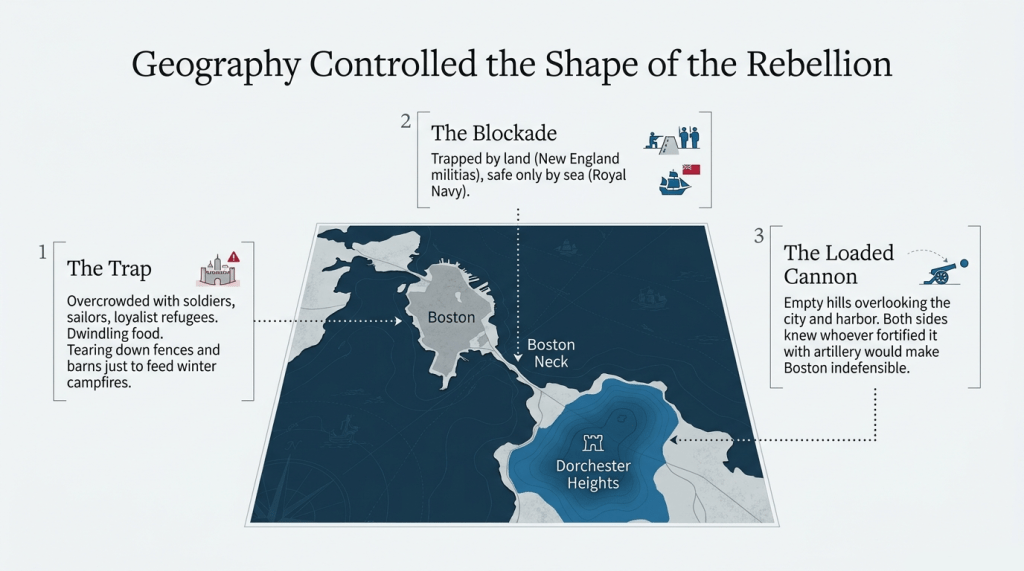
Geography controlled everything. Boston in 1775 was not the sprawling modern city Americans know today. It sat on a narrow peninsula surrounded by water and connected to the mainland through slender necks of land vulnerable to blockade and attack. Surrounding heights overlooked both the city and the harbor, and everyone involved understood how dangerous that reality could become. Bunker Hill had already demonstrated the importance of high ground during the bloody fighting of June 1775. Yet looming over all of it stood the one position that mattered most: Dorchester Heights.
The strange thing about Dorchester Heights is that both sides recognized its importance almost immediately, yet neither acted decisively for months. British officers repeatedly acknowledged that if rebels ever fortified the heights with artillery, Boston would become indefensible. Henry Clinton later admitted as much openly. Washington understood it too, but understanding a problem and solving it are very different things. Occupying the heights required heavy artillery, engineering skill, manpower, and timing that the Americans simply did not possess during much of the siege. So month after month passed with both armies staring uneasily at the empty hills as though they were a loaded cannon sitting in the middle of the room that nobody wanted to touch first.
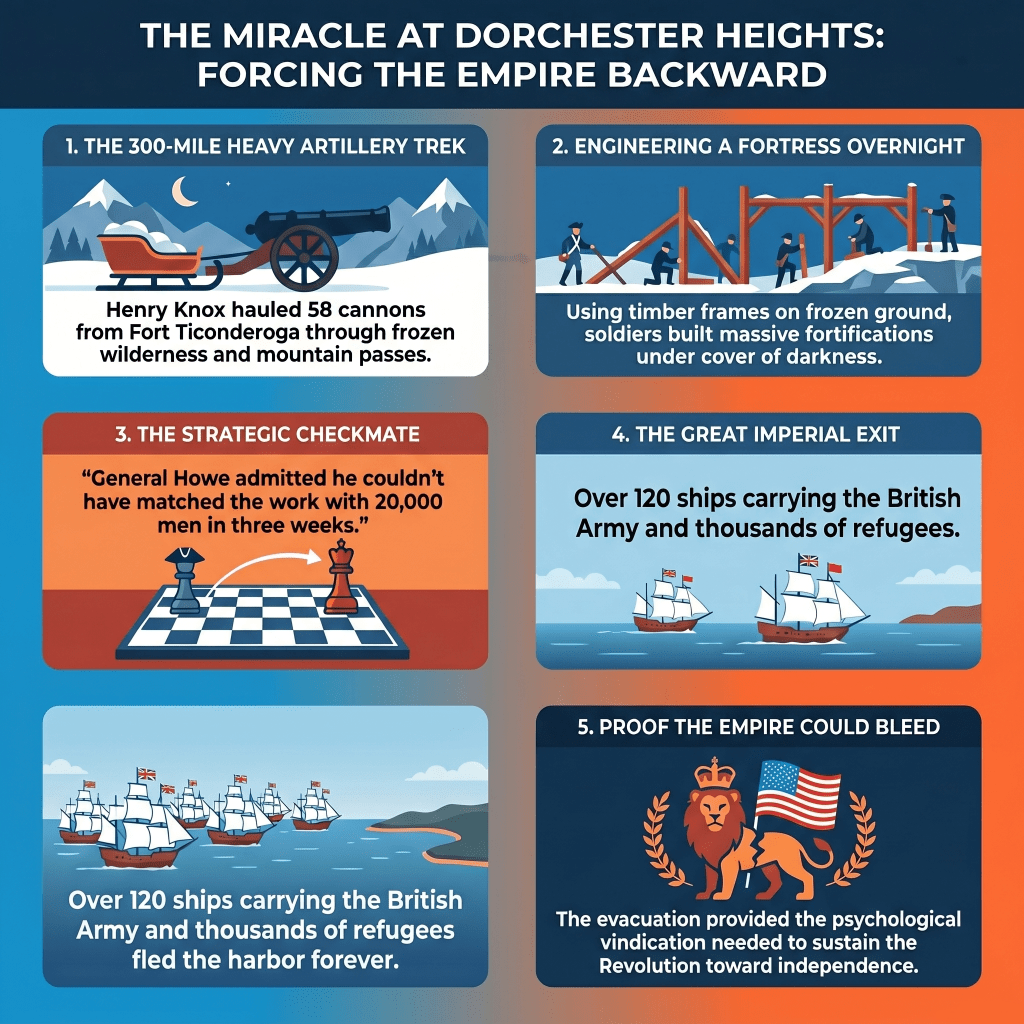
The siege dragged through autumn and into winter while Washington searched desperately for a solution. That solution eventually arrived from the north wearing a heavy coat and dragging cannon behind him through the snow. Henry Knox, still astonishingly young and possessing the kind of cheerful determination normally associated with men who have not yet learned what should be impossible, had undertaken one of the most extraordinary logistical operations of the war. Knox transported fifty-eight cannon and mortars from Fort Ticonderoga across nearly three hundred miles of frozen wilderness to Boston. The operation bordered on insanity. Cannons crashed through river ice. Ox teams struggled through mountain passes. Snowstorms buried roads that barely existed in the first place. One gun plunged through the Hudson River and had to be hauled back from the freezing water. Lesser men would have abandoned the mission and invented excuses afterward. Knox simply kept moving.
When the artillery finally arrived near Boston, the entire strategic equation changed overnight. Washington immediately recognized that he now possessed the means to force the British into an impossible position. The problem remained how to place those guns on Dorchester Heights without triggering immediate British intervention. Hauling heavy artillery uphill under enemy observation should have taken days or even weeks. British commanders assumed such an operation was impossible under wartime conditions. That assumption became one of the great intelligence failures of the Revolution.
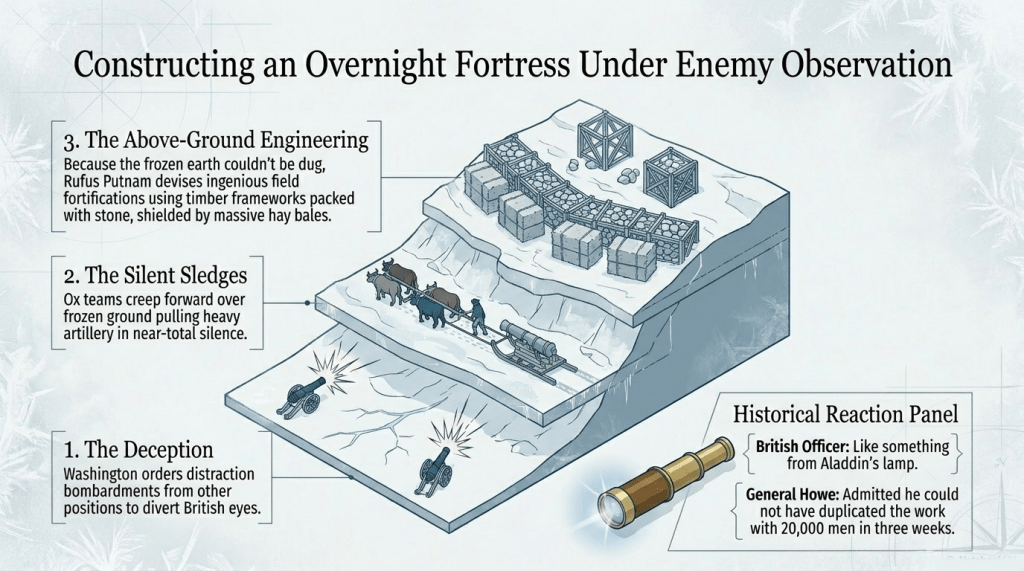
The American plan combined deception, engineering, timing, and nerve. Washington ordered bombardments against Boston from other positions to distract British attention while thousands of men prepared the heights under cover of darkness. Rufus Putnam devised ingenious field fortifications using timber frameworks packed with earth and stone because the frozen ground itself could not easily be dug. Hay bales formed protective walls. Ox teams crept forward through the darkness pulling sledges loaded with cannon. Soldiers worked in near silence through the freezing night, hauling artillery uphill while British officers watched cannon fire elsewhere and convinced themselves that no major movement was occurring.
By dawn on March 5, 1776, British officers climbed rooftops and stared through spyglasses in disbelief. Where empty hills had stood the previous evening, there now rose an armed fortress overlooking both Boston and the harbor. Cannon pointed directly toward British ships below. Earthworks stretched across the heights. Defensive positions appeared almost magically in place. One British officer reportedly compared the feat to something from Aladdin’s lamp, as though supernatural forces had constructed an entire military installation overnight. Howe himself supposedly admitted that he could not have duplicated the same work with twenty thousand men in three weeks.
The strategic implications were immediate and terrifying. The cannon on Dorchester Heights dominated the harbor. British ships could not effectively elevate their guns high enough to silence the American batteries. If Washington maintained control of the heights, Boston itself became indefensible. Howe understood the danger instantly and prepared an assault to seize the position before the Americans could strengthen it further. Thousands of British troops boarded transports for what threatened to become another Bunker Hill, only this time with even greater stakes. Washington anticipated the move and quietly prepared a secondary attack into Boston itself while British attention focused on Dorchester Heights. Both armies stood poised on the edge of a battle that might have reshaped the entire Revolution before independence had even been declared.
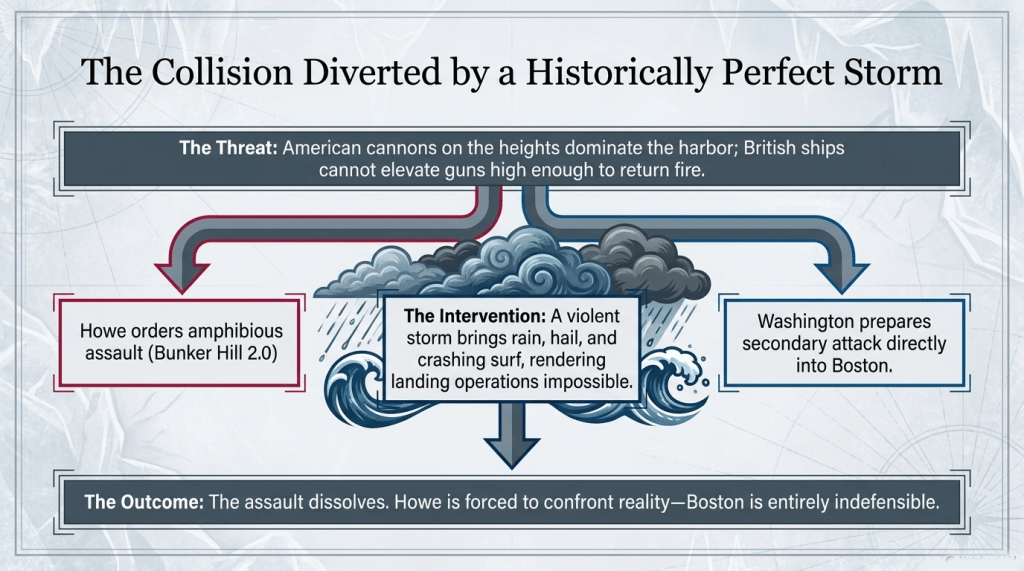
Then nature intervened with the kind of timing historians would reject as unrealistic if it appeared in a novel. A violent storm swept across the harbor bringing rain, hail, crashing surf, and fierce winds that made landing operations impossible. British boats struggled simply to remain afloat in the rough water. The planned assault dissolved into chaos and postponement. Washington later remarked that the storm had likely saved Howe’s army from destruction, though historians continue debating whether he was entirely correct in that assessment. In any case, the storm forced Howe to confront the reality he had avoided for months.
Boston could no longer be held.
Food supplies were running dangerously low. The harbor itself was threatened. Loyalists crowded desperately into the city fearing abandonment and retaliation. Howe finally made the decision that circumstances had been pushing him toward since the previous summer. The British army would evacuate Boston, regroup at Halifax, and shift operations elsewhere. There would be no climactic destruction of the city and no final desperate stand. The siege that began with gunfire at Lexington and Concord would end quietly, with ships gathering in the harbor.
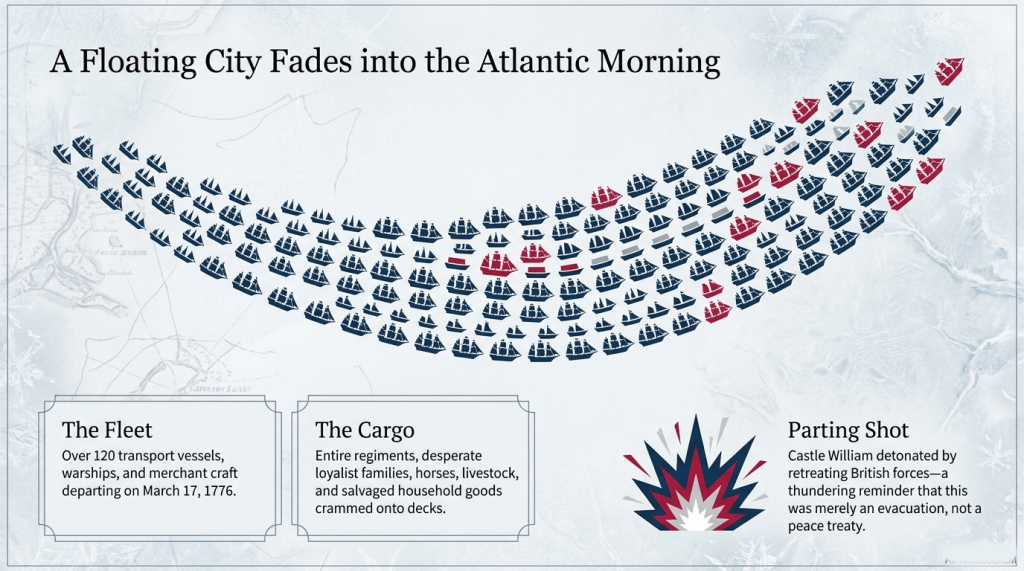
On March 17, 1776, British troops, loyalists, and civilians boarded vessels and sailed away from Boston while American forces watched from the heights above. Washington entered the city cautiously afterward, determined to maintain order and prevent revenge attacks against remaining loyalists. The moment mattered not simply because the British had withdrawn, but because the Americans had proven something essential to themselves and to the wider world. The Empire could be beaten. Not annihilated perhaps, not yet, but forced backward through discipline, ingenuity, and determination.
Washington learned something equally important during the siege. Victory did not always belong to the side that charged hardest or fought most dramatically. Sometimes victory came from patience, positioning, logistics, and forcing an opponent into impossible choices. That lesson would shape the rest of the war, because the next battlefield would not be Boston.
It would be New York, where the stakes would become far larger and the struggle far more dangerous than anyone yet fully understood.
What happened after the British decision to evacuate Boston is often overshadowed by the military triumph itself, and that is understandable to a point. Americans love battlefield moments. Cannon on Dorchester Heights makes for a clean story. Washington forcing the mighty British army to withdraw carries the kind of dramatic simplicity that history textbooks adore. Yet underneath the victory sat a far messier and deeply human reality, one that revealed just how fractured the colonies had already become by March of 1776.
Because when the British left Boston, they did not leave alone. They carried an entire fleeing society with them.
There was, for a brief moment, an unspoken truce hanging over the city. Washington understood perfectly well that Howe still possessed the ability to destroy Boston if pushed too far. British warships remained dangerous. The harbor remained under Royal Navy control. One reckless move by either side could still turn the city into a burning ruin. Washington therefore moved cautiously, deliberately, almost carefully polite under the circumstances. Howe responded in kind. Neither commander trusted the other completely, but both understood that escalation in those final days served no useful purpose. The British wanted out. The Americans wanted them gone. For once, the goals aligned just enough to prevent catastrophe.
That fragile understanding created one of the strangest military withdrawals in modern history. Two hostile armies stood practically within sight of each other while an enormous evacuation unfolded between them, each side quietly pretending not to notice how vulnerable the other truly was. Had Washington attacked recklessly, the British might have burned the city before sailing. Had Howe lashed out in frustration, the evacuation could have dissolved into slaughter. Instead, both commanders exercised restraint, though probably through clenched teeth.
The scale of the problem facing the British was staggering. Moving an army out of Boston was difficult enough. Moving the thousands of loyalist civilians attached to that army made the operation borderline chaotic. By early March, loyalists throughout the city had already realized what evacuation meant. If the British sailed away and left them behind, many believed they would face mob violence, imprisonment, confiscation of property, or outright revenge from neighbors who now viewed them as traitors to the American cause.
Some of those fears were exaggerated. Others were entirely justified.
The Revolution had already begun tearing communities apart long before independence was formally declared. Families split politically. Churches fractured. Business partnerships collapsed. Men who had traded together for years suddenly viewed one another with suspicion. Boston had lived under military occupation for months, and resentment simmered constantly beneath the surface. Loyalists understood perfectly well that when British authority disappeared, their protection vanished with it.
Panic spread quickly. People scrambled desperately for passage aboard overcrowded ships. Families packed belongings into crates and bundles with no certainty about where they were going or whether they would ever return. Furniture, silverware, books, business records, family portraits, clothing, tools, and keepsakes all became part of the frantic effort to salvage a life before departure. Some loyalists attempted to carry entire households with them. Others had room only for what could be carried in their arms.
Boston descended into confusion. Wagons rattled through crowded streets carrying trunks and furniture toward the docks. Soldiers attempted to maintain order while civilians shouted, bargained, pleaded, and fought for space aboard departing vessels. Livestock wandered through portions of the city. Children cried. Sailors cursed. Officers barked instructions nobody entirely followed. The harbor itself filled with transports, warships, merchant vessels, and improvised craft all struggling to prepare for departure before weather or American interference complicated matters further.
There was desperation in the air because many loyalists genuinely believed they were watching their world collapse around them.
And in many ways, they were.
It is easy to flatten loyalists into caricatures, powdered wigs clinging stubbornly to the Crown while history rolled past them. Reality was more complicated. Some remained loyal to Britain out of economic interest. Others feared mob rule more than royal authority. Many genuinely believed the colonies were plunging recklessly toward disaster. Quite a few considered themselves loyal not because they hated America, but because they still considered themselves Englishmen defending lawful order against rebellion.
History rarely grants much sympathy to the losing side of a revolution, but the loyalists of Boston paid a severe price for being on the wrong side of events. Families abandoned homes they had spent decades building. Merchants lost businesses overnight. Professionals saw entire careers evaporate. Some would spend the rest of their lives wandering through other parts of the British Empire trying unsuccessfully to reconstruct what had been lost.
And through all of this, sabotage simmered beneath the surface. Not every British officer accepted evacuation quietly. Not every loyalist departed peacefully. As preparations intensified, damage began appearing across the city. Cannons were spiked. Equipment was destroyed. Supplies unusable to the British were abandoned or ruined. Harbor facilities suffered damage. Some buildings associated with patriot leaders were vandalized. There were also fears that departing British troops might burn parts of the city before leaving, a tactic already seen elsewhere during the war.
Washington worried about this constantly. He moved carefully not simply because he wanted Boston intact, but because he understood how emotionally unstable the situation had become. One drunken brawl, one accidental musket shot, one fire breaking out near the waterfront could ignite total chaos. Thousands of armed men, frightened civilians, crowded ships, and political hatred formed a dangerous combination.
Yet somehow the city held together.
The final night before evacuation carried an almost ghostlike quality. Boston had spent nearly a year under siege, surrounded by enemy forces, frozen by winter, exhausted by shortages and uncertainty. Now suddenly the entire British military establishment was preparing to disappear into the darkness before dawn. Soldiers packed equipment in near silence. Officers reviewed embarkation plans repeatedly. Loyalist families crowded wharves waiting anxiously for transport assignments while sailors struggled to organize the confusion.
Then came the morning itself. March 17, 1776. Four o’clock in the morning.
British troops began marching silently through the dark streets toward the waterfront. Veteran officers later remarked that they had never seen an army move so quietly. No drums sounded. No shouted commands echoed through the city. Boots struck frozen ground in careful rhythm while long columns of redcoats moved through sleeping streets illuminated only by scattered lantern light and the dim gray edge of approaching dawn.
The silence itself feels eerie even now. Armies are not naturally quiet things. They creak, clatter, curse, stumble, and mutter. Yet on that morning the British army moved with remarkable discipline because everyone involved understood the danger. A single spark could still set the city ablaze figuratively or literally. The evacuation depended on speed, coordination, and restraint.
So they marched silently toward the harbor.
One can only imagine what passed through the minds of those soldiers during those final hours. Many had arrived believing the rebellion would collapse quickly. Instead, they were leaving the city entirely. Some likely felt humiliation. Others probably felt relief. Quite a few must have wondered how a force of colonial militia and volunteers had managed to force the British army out of Boston at all.
Meanwhile, loyalist civilians crowded the docks in terrified uncertainty. Families huddled beside trunks and crates while children clung to exhausted parents. Wealthy merchants stood beside laborers. Clerks beside craftsmen. All distinctions blurred somewhat by the shared reality that they were becoming refugees. Some ships were so overcrowded that people could barely move once aboard. Others waited desperately on shore fearing they might be left behind after all.
The harbor itself became a forest of masts.
Transport ships drifted beside warships while sailors shouted quietly through the darkness trying to complete embarkation before daylight fully exposed the operation. Horses screamed from below decks. Crates crashed against gangplanks. Officers counted units repeatedly. Small boats darted back and forth carrying final passengers and supplies.
And above all of it, on the heights surrounding Boston, American forces watched.
Washington maintained discipline carefully. His troops were eager, excited, and more than a little stunned by what they were witnessing. The mighty British army was leaving. Yet Washington understood perfectly well that a cornered enemy remained dangerous. He forbade reckless attacks or provocations. The evacuation would proceed peacefully if possible.
As dawn finally broke over Boston Harbor, the British fleet began moving outward.
Ships slipped away carrying soldiers, sailors, loyalists, government officials, and the remnants of royal authority in Massachusetts. The Union Jack still flew above the fleet, but for the first time since the crisis began, Boston itself no longer belonged to the British Empire.
And what remained behind was not simply a liberated city. It was proof.
Proof that resistance could succeed. Proof that the British army could be outmaneuvered. Proof that the rebellion was becoming something larger and far more dangerous than London had imagined.
The siege had ended quietly, with ships fading into the Atlantic morning.
But the Revolution itself was only beginning.
By the morning of March 17, 1776, Boston Harbor no longer looked like the proud imperial anchorage it had been for generations. It looked like an empire packing in haste. Ships crowded the water in every direction, transport vessels jammed alongside warships while sailors shouted orders across the freezing wind. Masts rose so densely across the harbor that from a distance they resembled a dead forest growing from the sea itself. More than one observer later described the fleet stretching in a giant crescent across the harbor, over one hundred and twenty vessels preparing to depart with soldiers, loyalists, supplies, families, and the last meaningful remains of British authority in Massachusetts.
The scale of the evacuation was staggering. Entire regiments embarked alongside terrified civilian refugees carrying whatever fragments of their former lives they could salvage. Horses were forced aboard transports. Cannons were secured below decks. Crates of ammunition, barrels of flour, military records, personal possessions, furniture, silverware, clothing, and hastily bundled household goods crowded every available inch of space. The harbor became a floating city of confusion and exhaustion.
What makes the scene extraordinary is how close violence remained at every moment. Washington’s army occupied the heights overlooking both Boston and the harbor. American artillery now commanded the city. If Washington had chosen to open fire recklessly, portions of the evacuation might have dissolved into chaos. Likewise, British warships still possessed enough firepower to devastate Boston itself if Howe decided to leave destruction behind him. Both commanders understood how fragile the situation remained. One accidental cannon shot, one nervous soldier firing into a crowd, one panicked misunderstanding could still ignite disaster.
And yet the evacuation continued in eerie discipline.
The British fleet began moving outward carefully, almost cautiously, as though the entire harbor itself had become unstable beneath them. Ships maneuvered through narrow channels crowded with transport vessels and naval escorts while thousands of anxious eyes watched from the shore. Loyalist civilians stood shoulder to shoulder along crowded decks staring back at the city they were abandoning, many already understanding they would probably never return.
For the Americans watching from the heights, the sight carried an emotional weight almost impossible to overstate. Less than a year earlier, British regulars had marched through these same streets with confidence born from generations of imperial power. The Royal Navy had dominated the harbor. British authority had appeared permanent, immovable, almost inevitable. Now the same empire was retreating under pressure from what much of Europe still dismissed as an armed rebellion of farmers and merchants.
Dr. James Thacher later described the scene with what he called “unspeakable satisfaction.” That phrase captures something important because the moment transcended military success alone. This was psychological vindication. Americans had spent months enduring defeat, uncertainty, shortages, disease, freezing weather, and constant fear that the British army might break out of Boston and crush the rebellion in a single decisive blow. Instead, they now watched that same army withdraw entirely. The fleet shrinking into the harbor represented proof that the Revolution could survive.
It is difficult for modern Americans, raised inside the certainty of an existing nation, to fully grasp how uncertain everything still felt in March 1776. Independence had not yet been declared. Many colonists still hoped reconciliation might somehow remain possible. Washington himself understood how fragile the rebellion truly was. One catastrophic defeat could still collapse the entire revolutionary effort. Yet Boston provided something precious that no pamphlet or speech could offer.
Confidence.
Not arrogance. Not certainty. But proof that resistance was possible.
Washington, however, refused to let celebration overwhelm discipline. One of his greatest strengths during the Revolution was his ability to recognize when enthusiasm itself could become dangerous. His troops desperately wanted to rush into Boston immediately, cheering victory while pursuing remaining loyalists through the streets. Washington prohibited it. He delayed the formal American entry into the city until he was certain the British had fully departed and no traps remained behind.
That caution proved wise.
The British had already damaged or destroyed military supplies they could not remove. Cannons were spiked. Equipment sabotaged. Rumors circulated constantly that portions of the city might still be burned or mined before final withdrawal. Washington approached Boston carefully because he understood something many revolutionaries often forgot in moments of triumph. Victories can still become disasters if discipline collapses afterward.
There was also disease to consider. Smallpox had haunted Boston throughout the siege, terrifying both armies almost as much as each other. Washington feared allowing his men to flood recklessly into the city might spread infection throughout the Continental Army. His caution frustrated some officers and soldiers who wanted immediate celebration, but Washington had already begun thinking like the commander of a long war rather than the victor of a single campaign.
Finally, once the British fleet moved fully out into the harbor and immediate danger passed, Washington entered Boston.
The moment carried enormous symbolic importance. Crowds cheered wildly as Continental troops marched through streets that had lived under British military occupation for years. Church bells rang. Citizens embraced soldiers openly. Flags appeared from windows. Washington himself rode into the city beneath roaring public celebration, though even here he maintained restraint. He understood the victory mattered enormously, but he also understood the war itself remained far from finished.
And then, because history occasionally possesses a dark sense of timing, came one final explosion.
As American troops secured parts of the city, British forces departing the harbor detonated Castle William in Boston Harbor to prevent military supplies and fortifications from falling into American hands. The explosion thundered across the water, sending smoke and debris rising into the sky behind the departing fleet. It served almost as the Empire’s final punctuation mark upon Boston. The British were leaving, but not quietly enough to let anyone forget they remained dangerous.
Even in departure, they reminded the Americans that this was not peace.
For the loyalists sailing away aboard the fleet, the scene carried an entirely different emotional meaning. While patriots celebrated liberation, thousands of loyalist refugees stared back toward a city they would likely never see again. Some had been born there. Others had built businesses, families, and entire lives there. Now they watched the shoreline fade behind them while facing a future of uncertainty somewhere else within the British Empire.
One reported farewell captured the mood with painful clarity. “Gentlemen, not one of you will ever see that place again.”
The statement proved tragically accurate for many of them. Loyalist exile became one of the least discussed but most consequential human stories of the Revolution. Families scattered across Nova Scotia, England, the Caribbean, and other British territories trying to rebuild lives from fragments. Some succeeded. Many did not. The Revolution created American patriots, but it also created American refugees.
The departure of the fleet also transformed the strategic shape of the war itself. Boston had dominated the first year of conflict because both sides instinctively focused on New England, the birthplace of the rebellion. Yet by the spring of 1776 British leadership increasingly recognized that Boston was strategically limited. The city’s geography trapped armies as easily as it protected them. Supplying the army there remained difficult. More importantly, British planners believed the true key to crushing the rebellion lay elsewhere.
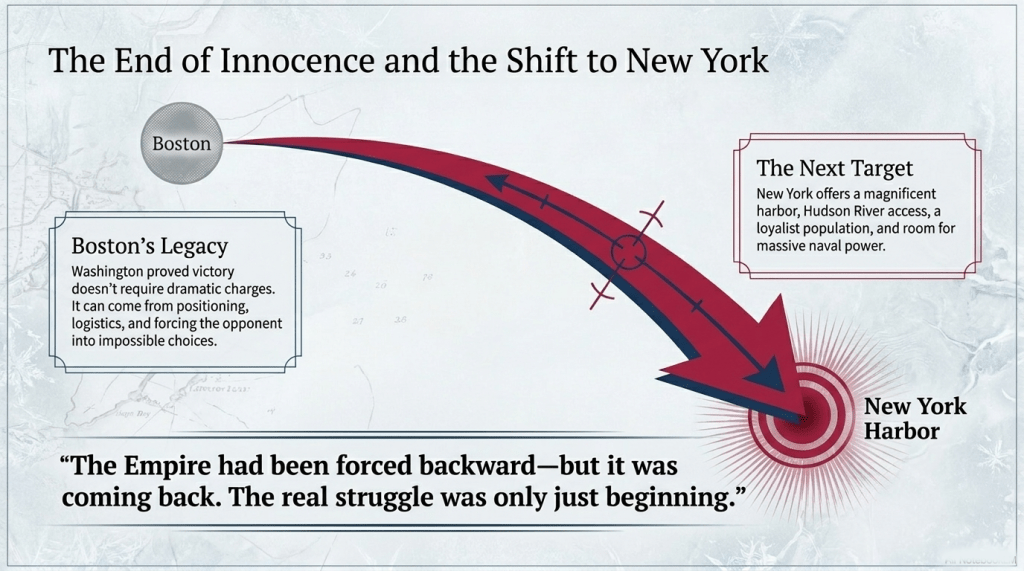
New York.
Even as celebrations unfolded in Boston, both Washington and Howe already understood where the war was heading next. New York possessed everything Boston lacked. A magnificent harbor. Central location among the colonies. Access to the Hudson River corridor. A large loyalist population. Strategic flexibility for naval operations. If Britain could seize and hold New York effectively, it might split New England from the southern colonies and isolate the heart of the rebellion.
Washington understood the danger immediately.
In fact, even during the celebrations surrounding Evacuation Day, he spent much of his attention focused not backward at Boston, but southward toward Manhattan. He knew the British would return in force somewhere. He also knew that the army which had struggled through the siege outside Boston was still inexperienced, undersupplied, and dangerously fragile despite recent success.
The victory at Boston therefore carried a strange dual nature. On one level it was a triumph beyond anything the Revolution had yet achieved. The British army had been forced to abandon a major colonial city under American pressure. The psychological impact alone was enormous. Yet on another level, the evacuation marked merely the end of the opening act.
The real struggle was still ahead.
Boston gave the Americans confidence, but New York would test whether that confidence could survive contact with the full military power of the British Empire. Howe would arrive there with overwhelming force. Massive fleets. Tens of thousands of troops. German auxiliaries. Professional soldiers supported by the greatest naval power on earth.
And Washington would have to stand against all of it.
That is why Evacuation Day matters so deeply in the larger story of the Revolution. It was not the end of danger. It was the end of innocence. After Boston, nobody could dismiss the rebellion as a temporary disturbance. The Empire had sailed away from one of its oldest colonial capitals.
But it was coming back.
And the next battlefield would decide far more than the last one ever could.
Alden, John R. A History of the American Revolution. New York: Alfred A. Knopf, 1969.
Fischer, David Hackett. Washington’s Crossing. New York: Oxford University Press, 2004.
Frothingham, Richard. History of the Siege of Boston and of the Battles of Lexington, Concord, and Bunker Hill. 6th ed. Boston: Little, Brown, and Company, 1903.
Howe, William. The Narrative of Lieutenant-General Sir William Howe in a Committee of the House of Commons on the 29th of April, 1779. London, 1780.
Knox, Henry. “Journal of the March from Fort Ticonderoga to Cambridge, 1775–1776.” In Life and Correspondence of Henry Knox, edited by Francis S. Drake. Boston: Samuel G. Drake, 1873.
McCullough, David. 1776. New York: Simon & Schuster, 2005.
Middlekauff, Robert. The Glorious Cause: The American Revolution, 1763–1789. New York: Oxford University Press, 1982.
Thacher, James. A Military Journal during the American Revolutionary War. Boston: Richardson & Lord, 1823.
Washington, George. The Papers of George Washington, Revolutionary War Series. Edited by Philander D. Chase et al. Charlottesville: University of Virginia Press, 1985–.
Winsor, Justin, ed. Narrative and Critical History of America. Vol. 6, The United States of North America, Part I. Boston: Houghton, Mifflin and Company, 1888.
Wood, Gordon S. The Radicalism of the American Revolution. New York: Alfred A. Knopf, 1992.
“Evacuation Day“
Liberty 250 – The Music(al)
Words & Music by David Ray Bowman
©2026 by Slippery Fish Entertainment



 DAVE DOES HISTORY
Leave a comment