
Oudewater, 1560. The Low Countries are roiling under the weight of empire and faith, and amid this turmoil a child was born whose conscience would one day trouble theologians across Europe. His name was Jacobus Arminius. To the hardened Reformed establishment, he would become a nuisance, a whisper of dissent in an age that prized certainty. But to those who feared the tyranny of dogma, he would stand as proof that even the most pious mind could wrestle honestly with the mysteries of God.
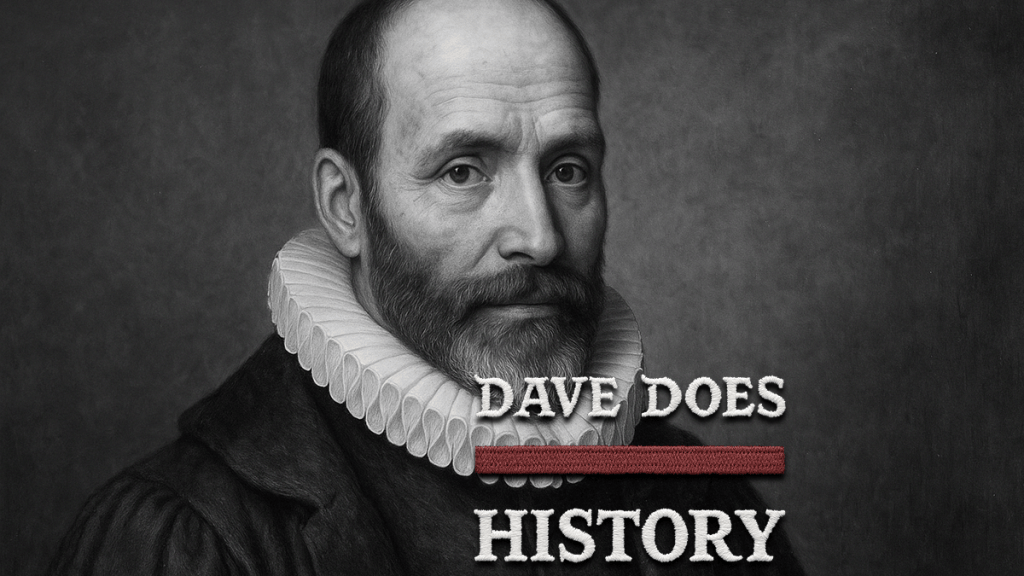
He entered the world as Jacob Harmenszoon—Latinized later to Arminius, on October 10, 1560. His father, Harmen Jacobszoon, was a cutler by trade, a craftsman of knives and tools, not of books or creeds. Misfortune came early. His father died when he was still a child, and by 1575 his hometown of Oudewater was caught in the Spanish onslaught that became infamous for its cruelty. His mother perished in that massacre, leaving young Jacob orphaned and adrift in a world gone mad. A compassionate clergyman named Theodorus Aemilius took him in, and when Aemilius died, a scholar named Rudolph Snellius took over the boy’s education. It was Snellius who recognized that this boy, raised among blades, had the mind of a philosopher.
He studied in Utrecht and later entered the new University of Leiden in 1576. Leiden, like the Dutch Republic itself, was still being built from the ruins of revolt. There, Arminius learned under men of gravity and intellect—Daneau, Drusius, Feuguereius, and Kolmann, each with a different scent of Reformation about them. He was a sponge for ideas, though he had not yet found his own voice. In 1582, he went to Geneva, the city that Calvin had shaped and Beza now ruled. Geneva, however, was not the haven of free thought he had hoped for. His habit of reasoning by logic and method rather than inherited formulas earned him a reprimand, and so he moved again, this time to Basel. The faculty there offered him a doctorate, which he refused, too young, he said, though the truth may be that he distrusted pomp. He returned home without title but full of conviction.
By 1588, Arminius was ordained as a minister in Amsterdam. His sermons drew attention for their careful exegesis and intellectual precision. He spoke on the Epistle to the Romans, always a dangerous choice for a preacher inclined to question the machinery of grace. In Romans 7, he read Paul’s struggle not as the cry of a sanctified believer, but as the experience of an unregenerate man trying and failing to keep the Law. In Romans 9, he resisted the conclusion that God’s election was arbitrary and unconditional. The idea that God would create souls solely to damn them offended his sense of divine justice. He said as much from the pulpit, and whispers began to spread that Arminius was soft on Pelagianism. He denied it. He was not rebelling against Calvin, he said, only clarifying him. The difference was theological, but in those days theology and treason could look very much alike.
The city fathers of Amsterdam, sensing both his genius and his troublemaking potential, sent him to Leiden in 1603 to take up a chair in theology. There, he met his intellectual counterpart and eventual nemesis, Franciscus Gomarus, a rigid Calvinist who saw the divine decrees as immovable fate. Gomarus preached that God had chosen some to salvation and others to damnation before the world began, and that human freedom was a polite illusion. Arminius, now a professor, could not stomach it. The two men clashed repeatedly, their debates spreading beyond the classroom into the political arena. Every sermon, every lecture, every line of exegesis became a battlefield between two visions of God, one absolute and inscrutable, the other personal and just.
In 1608, Arminius was accused of heresy before the States of Holland. They ordered both him and Gomarus to set forth their positions in writing. Arminius responded with a careful, sometimes painful defense titled Declaration of Sentiments. It was part confession, part legal brief, and part theological plea. In it, he affirmed his allegiance to the Reformed confessions but warned that certain doctrines, particularly those on predestination, had become distorted into fatalism. He laid out his beliefs with deliberate caution. God, he wrote, elects those whom He foreknows will believe. Christ died for all men, though only believers receive the benefit. Grace can be resisted, and perseverance depends upon continued faith. Salvation is an ongoing relationship, not a mechanical decree. He insisted that this was not novelty but recovery—that he sought not innovation but balance. It was the statement of a man who wished to stay inside the house of faith even as he challenged the foundations.
The strain broke him. He fell ill and died the next year, in 1609, only forty-nine years old. He never saw the storm that followed. His followers, the so-called Remonstrants, published in 1610 a document summarizing their beliefs in five articles. Their opponents answered with the Synod of Dort in 1618 and 1619, which condemned the Remonstrants, exiled their leaders, and codified the now-famous “Five Points of Calvinism.” Out of one man’s conscience grew an entire theological war.
It is tempting to see Arminius as simply the anti-Calvin, but that would be lazy history. He was not a revolutionary. He did not burn the Institutes or deny the sovereignty of God. What he did, rather quietly, was to insist that divine sovereignty does not make human responsibility meaningless. He believed that love, by its nature, must be freely given and freely received. That idea, so simple on the tongue, upended the logic of his age. In a century still echoing with the hammer of determinism, he dared to say that grace invites but does not coerce. For that, his name became a byword of rebellion in Calvinist pulpits from Leiden to London.
His influence would outlive the century and spread across the ocean. Two hundred years later, John Wesley and the early Methodists embraced Arminius’s theology of free grace. Across Protestantism, from Baptists to Nazarenes to Pentecostals, his ghost continues to speak. The debate over predestination and free will has not ended; it has only changed accents. Even those who disagree with him cannot ignore him. Every preacher who tells his congregation that “God offers salvation to all” is, knowingly or not, speaking with an Arminian accent.
The tragedy of Jacobus Arminius is that he never wanted a movement. He wanted a conversation. His Declaration of Sentiments is not the cry of a revolutionary but the confession of a man cornered by his own integrity. He feared that theology had grown cold, that the mystery of God’s love had been traded for the mathematics of election. His answer was not rebellion but appeal, to reason, to Scripture, and to conscience. That was his undoing. For in every age, the guardians of certainty fear the man who begins his sentence with “But what if…”
He stands today as a figure both revered and reviled. His opponents built a system that bears his name, though he never would have claimed it. His supporters sanctified him as the champion of free will, though he would have said that all freedom is meaningless without grace. Somewhere between those two distortions lies the real Arminius: a scholar who believed that truth should make room for mercy, that the mind of God cannot be boxed by human logic, and that theology, at its best, should make men humble rather than proud.
So we remember him, not as a destroyer of doctrine, but as a man who looked at the scaffolding of faith and asked if perhaps it had been built too tight for the God who made heaven and earth. He was a reformer within the Reformation, a conscience within orthodoxy, and a reminder that even the most devout church can drift into cruelty when it confuses certainty with faith. In an age of fire and creed, Jacobus Arminius chose the hard road of doubt, and in so doing, proved that doubt, in the service of love, can be a form of devotion.
His life began amid war and loss, and ended in controversy, yet his name endures wherever men and women insist that love must be free. His story, like his theology, refuses easy conclusions. It is the story of one man standing in the narrow space between God’s will and man’s choice, trying to make sense of both, and daring to believe that divine justice and human compassion might still speak the same language.





Leave a comment