
In 1963,The Twilight Zone first aired its episode “He’s Alive.” The idea was that as long as the age old evils exist, he is alive. The episode was referring to Adolf Hitler and his spittle spouting band of merry men. It is a disturbing episode that confronts the fact that hatred never really dies as long as there are those who are willing and able to keep it alive.
Four years and seven months later, almost to the day, fiction became reality…
On August 25, 1967, the U.S. witnessed the assassination of one of its most controversial figures – George Lincoln Rockwell, the founder and leader of the American Nazi Party. His assassination marked the end of his polarizing journey, but the shadow of his influence, and that of his party, continues to loom large in the annals of American history.
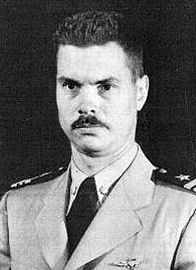
Public Domain
Founded in 1959 by Rockwell, the American Nazi Party (ANP) was modeled after Adolf Hitler’s National Socialist German Workers’ Party. Rockwell’s vision was steeped in anti-Semitism, white supremacy, and vehement anti-communism. The ANP stood in stark contrast to the burgeoning civil rights movement, and it sought to preserve what Rockwell believed to be the diminishing status of the white race in America.
Rockwell’s extremist views were cultivated over time. Having served in the U.S. Navy during WWII, Rockwell ironically fought against the Nazis. Post-war, his deep-seated paranoia about communism and disdain for the civil rights movement led him to far-right ideologies. He believed that Jews were behind both movements and saw the ANP as a necessary counterforce to preserve white dominance in America.
Although Rockwell began his naval career in good standing, his overt extremist views and political activities eventually caught up with him. By the early 1960s, he had become a highly divisive figure. Concerns over his extremist affiliations and the potential embarrassment he could cause the U.S. military led to his discharge in 1960, on grounds of mental instability.
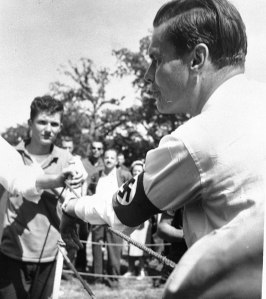
Public Domain
Rockwell was a master at capturing media attention. He organized rallies, marches, and public speeches that often took place in highly visible and symbolic locations, such as in front of the White House. Rockwell also displayed the swastika openly, drawing both outrage and attention. His activities consistently sparked protests and counter-protests, which sometimes turned violent.
On August 25, 1967, Rockwell was shot and killed in the parking lot of a shopping center in Arlington, Virginia. The assassin, John Patler, was a former member of the ANP. While the exact motive remains a subject of debate, many believe internal party disagreements and personal enmity played pivotal roles.
Rockwell’s death did not signal the end of the American Nazi Party, but it did fracture it. The ANP splintered into various offshoots, none of which have achieved the same notoriety. However, Rockwell’s influence on American white supremacist and far-right movements cannot be denied. While most view him as a symbol of hate and bigotry, some fringe elements regard him as a martyr and champion of white rights.
In the broader context of American history, Rockwell stands as a testament to the First Amendment’s reach, which protects even the most abhorrent speech. He also serves as a reminder that the battle for the nation’s soul, between the forces of inclusion and exclusion, has deep roots.
In understanding Rockwell’s legacy, it’s essential to acknowledge the dangers of unchecked extremism and the importance of continuously striving for a more inclusive, equitable society.




 DAVE DOES HISTORY
Leave a reply to GP Cancel reply