
What I most recall about August 8, 1974 was having a long conversation with my mother about what kind of cake I wanted for my birthday next month. I wanted a coconut Bundt cake, for anybody that might be interested. That and the fact that everything on television – and I do mean everything – was coverage of Nixon’s resignation.
It was weird because in those days there was no wall-to-wall 24 hour news cycle. We were used to the morning news, outside to play until Gilligan’s Island and Star Trek came on at 4pm. Not that day, though…
Richard Nixon, the 37th President of the United States, resigned from office on August 8, 1974, due to the impending impeachment process resulting from the Watergate scandal. The Watergate scandal was a political scandal that involved the break-in at the Democratic National Committee headquarters in the Watergate office complex in 1972 and subsequent efforts to cover up the involvement of the Nixon administration. Here’s why Nixon decided to resign:
The Watergate scandal began with the break-in at the Democratic National Committee headquarters, which was initially portrayed as a simple burglary. However, it was later revealed that the break-in was orchestrated by members of Nixon’s re-election campaign team, who were attempting to gather information on Nixon’s political opponents.
As investigations into the break-in progressed, it became evident that the Nixon administration was involved in a cover-up to conceal the extent of its knowledge and involvement in the break-in. A series of revelations, including the existence of secret White House tapes recording conversations, implicated Nixon and his closest advisors in the cover-up.
The scandal led to a series of investigations by Congress and legal proceedings. The House Judiciary Committee initiated impeachment proceedings against President Nixon, accusing him of obstruction of justice, abuse of power, and contempt of Congress. As evidence continued to mount, it became increasingly likely that the House of Representatives would pass articles of impeachment against Nixon.
By mid-1974, the public’s trust in Nixon had eroded significantly due to the scandal. Nixon’s approval ratings plummeted, and key political allies began to distance themselves from him. The release of the “Smoking Gun” tape, which revealed that Nixon had been involved in efforts to cover up the Watergate break-in, was particularly damaging.
In July 1974, the U.S. Supreme Court ruled unanimously that Nixon must release the subpoenaed White House tapes, which contained potentially incriminating evidence. This ruling further weakened Nixon’s position and increased pressure on him to resign.
Faced with the prospect of impeachment and the growing realization that his political support had crumbled, Richard Nixon announced his resignation on the evening of August 8, 1974. In a televised address to the nation, he stated that he was resigning in the best interests of the country and to avoid a long and divisive impeachment process.
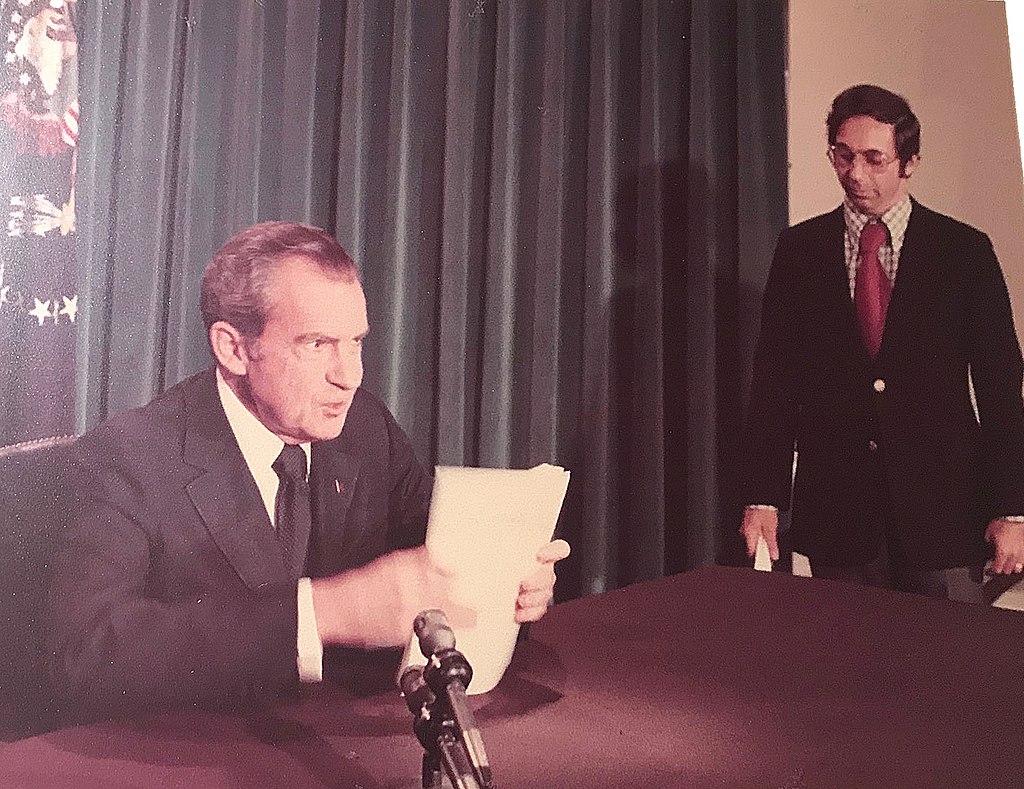
By Oliver Atkins Public Domain
Nixon’s Vice President, Gerald Ford, assumed the presidency after Nixon’s resignation. Ford famously stated, “Our long national nightmare is over,” referring to the toll the Watergate scandal had taken on the nation’s trust in government. Ford later pardoned Nixon for any crimes he might have committed while in office.
Nixon’s resignation marked a historic moment in American history, underscoring the importance of accountability, the rule of law, and the checks and balances inherent in the U.S. political system. The Watergate scandal and Nixon’s resignation also had a lasting impact on public perceptions of government and politics in the United States.
And, for the record, I got my Bundt cake next month. And it was still the most delicious thing I ever ate.




 DAVE DOES HISTORY
Leave a comment