
There are places in early American history where the promise sounds almost too good to be true, and Maryland is one of them. It did not begin as a rebellion or a restless outpost looking for independence, but as an idea. A Catholic nobleman, George Calvert, the first Lord Baltimore, looked across the Atlantic and imagined a colony where men like him could live without having to apologize for their faith. That alone would have been remarkable in the seventeenth century. Europe was still tangled in the aftershocks of the Reformation, and religious difference was not treated as a matter of private conscience. It was treated as a problem, and problems were usually solved by force.
Maryland was meant to be different. It was chartered as a proprietary colony, which meant the Calvert family held sweeping authority over its governance. That authority came with both opportunity and risk. If the colony was to survive, it could not remain a narrow Catholic enclave. It needed settlers, farmers, merchants, and families of all kinds, and most of those potential settlers were Protestant. So the Calverts did what practical men tend to do. They opened the door.
The Maryland Assembly passed what became known as the Toleration Act in 1649, building on earlier efforts toward religious accommodation. These laws did not create modern religious freedom, not in the way later generations would understand it, but they did something important. They extended protection to all Christians, Catholic and Protestant alike, and attempted to separate civil governance from sectarian control. It was not a perfect arrangement. It did not include everyone, and it did not erase suspicion. But in a world where difference often led to persecution, it offered a kind of uneasy peace.
For a time, that peace held. Catholics, backed by the authority of the proprietor, occupied many of the colony’s upper positions. They governed with a careful awareness that their security depended on maintaining balance. Too much favoritism would provoke resentment. Too little would risk losing the refuge they had set out to build. It was a delicate arrangement, and like most delicate arrangements in history, it depended on conditions that could not be controlled forever.
Those conditions shifted in 1689. Across the Atlantic, England had undergone its own transformation. The Glorious Revolution placed William and Mary, Protestant monarchs, on the throne, and with them came a renewed assertion of Protestant identity in imperial governance. That change did not remain confined to London. It echoed outward, carried by news, rumor, and the ambitions of men who saw an opportunity.
In Maryland, that opportunity took the form of Coode’s Rebellion. Led by Protestant agitators, the uprising was not simply a spontaneous expression of local grievance. It was a calculated move to align the colony with the new order in England. The proprietary government of Lord Baltimore was overthrown, and Maryland was transformed into a royal colony. The shift was swift, but its consequences were lasting.
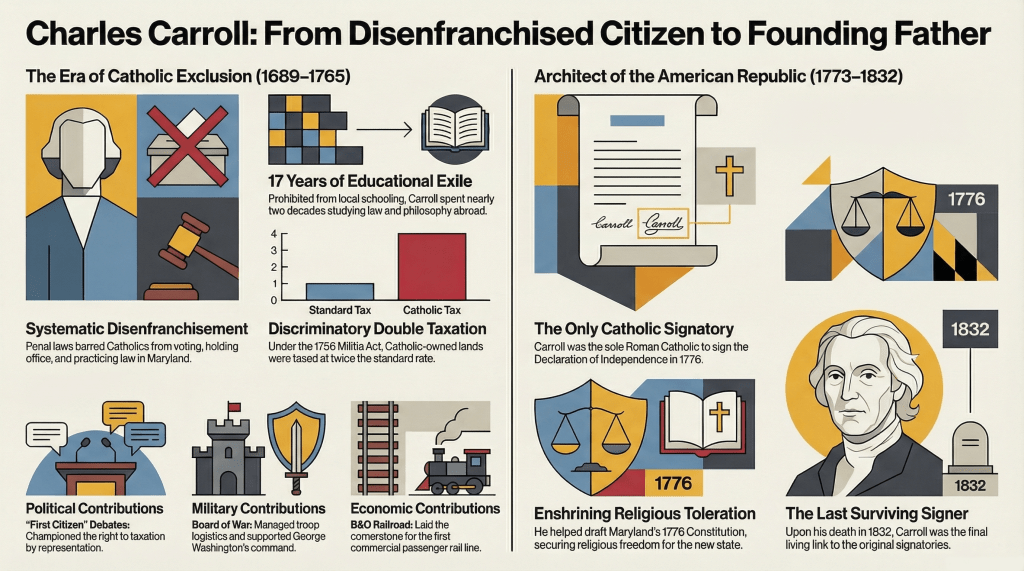
What had been a refuge became something else. Catholic leadership was pushed aside. Laws followed, not all at once, but steadily, each one narrowing the space in which Catholics could operate. Political participation was curtailed. Public office became inaccessible. The practice of law, a path to influence and stability, was closed. Even education, the quiet means by which a community sustains itself, came under pressure.
It is tempting, from a distance, to see this as a clean reversal, as if one group simply replaced another and the story moved on. It was not so simple. The earlier period of toleration had left its mark. Protestants and Catholics had lived side by side, traded with one another, and built relationships that were more intertwined than the laws would later admit. The shift in power did not erase those connections overnight. What it did was introduce a new layer of tension, a sense that the rules had changed and could change again.
Into that world, decades later, Charles Carroll of Carrollton would be born. He did not witness the founding of Maryland, nor the passage of the Toleration Act, nor the rebellion that altered the colony’s course. But he inherited their consequences. He grew up in a place that had once promised inclusion and now practiced exclusion with legal precision. That contrast, between what Maryland claimed to be and what it had become, would shape his understanding of liberty long before he put pen to paper in its defense.
There is a habit in telling early American history to focus on grand statements, declarations that seem to arrive fully formed. But those statements did not appear out of nothing. They were built from lived experience, from the accumulation of smaller injustices and quiet observations. Maryland’s story, with its early experiment in toleration and its later retreat into restriction, provided one of those foundations.
If you want to understand a man like Charles Carroll, you do not begin with his signature. You begin with his name, because in his case the name itself carried history, memory, and a certain quiet defiance.
His grandfather, Charles Carroll the Settler, arrived in Maryland in 1688, just as the ground was beginning to shift beneath the colony. He came from Ireland, not as a romantic exile, but as a man who understood the limits placed on Catholics in the British world. Ireland had taught him that lesson well enough. Maryland, at least at first glance, offered something different. Land could be acquired. Influence could be built. A future could be shaped rather than endured.
He did not waste the opportunity. The elder Carroll moved quickly into the upper ranks of colonial society, acquiring land, building wealth, and eventually serving as Attorney General under the proprietary government. He was not merely surviving. He was establishing something durable, something that could outlast the uncertainties of politics and religion. Land, after all, had a way of anchoring a family when laws did not.
There is a tendency to think of these early colonial figures as distant, almost abstract, but the elder Carroll was a practical man. He understood that wealth was not simply about comfort. It was about insulation. It provided a measure of protection in a world where legal rights could be withdrawn as easily as they were granted. By the time his grandson was born, that foundation was firmly in place.
Charles Carroll of Carrollton entered that world on September 19, 1737, in Annapolis. His birth, however, came with a complication that says more about the times than about the family itself. He was born out of wedlock, a decision made deliberately to protect the family estate. Under the legal framework of the era, inheritance could become tangled in ways that threatened to break apart even the most carefully assembled fortunes. By delaying the formal marriage of his parents, Charles Carroll of Annapolis and Elizabeth Brooke, the family ensured that their holdings would remain intact.
It is a detail that feels almost clinical, but it reveals something important. This was a family that navigated the law not as an abstract system, but as terrain to be crossed carefully. They knew where the pitfalls were, and they adjusted their steps accordingly. When Charles’s parents finally married in 1757, the matter was resolved, but the lesson remained. Law could protect, but it could also endanger, depending on how it was written and who controlled it.
For young Charles, the world into which he was born was one of privilege and limitation, often existing side by side in ways that did not immediately make sense. He lived in a household of considerable means. He had access to resources that most colonists could not imagine. Yet there were doors that remained closed, not because of his abilities, but because of his faith. That tension was not always visible in childhood, but it was always present, like a rule that did not need to be spoken aloud.
His early education began in secrecy. Maryland law did not permit Catholics to operate schools openly, so his first instruction took place at Bohemia Manor, a Jesuit mission where learning was conducted discreetly. It was not a formal academy with public standing. It was something closer to a refuge for education, a place where knowledge was passed carefully, almost cautiously, as if too much attention might invite trouble.
One can imagine the atmosphere. A small group of students studying Latin, philosophy, and theology under instructors who understood that their work existed within a legal gray area. That kind of environment shapes more than intellect. It teaches awareness. It teaches restraint. It teaches that knowledge itself can carry risk.
By the time Charles reached the age of ten or eleven, it was clear that this arrangement would not be enough. If he was to receive the education his family expected, he would have to leave. And so he did, beginning a journey that would keep him abroad for seventeen years.
France became his classroom. At the College of St. Omer and later at the Lycée Louis-le-Grand in Paris, he was immersed in the liberal arts, philosophy, and civil law. These were not provincial institutions. They were among the finest centers of learning available, places where ideas were examined seriously and debated with precision. For a young man from Maryland, the experience must have been both exhilarating and disorienting. Europe offered a scale and depth that the colonies could not match, and it exposed him to intellectual traditions far removed from the constraints of his home.
In France, Carroll was not defined primarily by the legal limitations placed upon him in Maryland. He was a student among other students, judged by his ability rather than his religious status within a colonial system. That distinction matters. It is one thing to understand limitation. It is another to experience its absence.
That kind of experience leaves its mark. It broadens the frame through which a person sees the world. It introduces comparisons, some favorable, some not, and it raises questions that do not always have easy answers. When Carroll later spoke about rights and governance, he did so with the perspective of someone who had seen alternative systems, not simply imagined them.
After completing his studies in France, he moved to London, where he entered the Inner Temple to study law. This represented another step, not just in education, but in understanding the structure of authority itself. The Inner Temple was not merely a place of instruction. It was part of the institutional framework of British legal culture, where the principles of common law were shaped, refined, and applied.
Here, Carroll encountered the law in its most formal expression. He studied precedent, procedure, and the reasoning that underpinned the British system. He learned how arguments were constructed, how authority justified itself, and how legal language could be used to support or challenge power.
There is a certain irony in this stage of his life. A man who would later be barred from practicing law in his own colony was receiving one of the finest legal educations available in the British world. He was mastering a system that, upon his return, would not fully recognize him as a participant.
That irony was not lost on him. It could not have been. Seventeen years abroad had given him not only knowledge, but perspective, and with that perspective came an awareness of what was possible under different conditions. When he returned to Maryland in 1765, he did so as a fully formed intellectual, equipped with tools that his society was not entirely prepared to accept.
The return itself marked a transition. He was no longer the child sent away for education. He was a man stepping back into a world that had not changed as much as he had. The same restrictions remained. The same limitations on Catholic participation in public life were still in place. What had changed was his understanding of them.
He had seen societies where law functioned differently, where the relationship between authority and individual rights took on different forms. He had studied the principles that justified governance and the arguments that challenged it. He had been trained, in effect, to think beyond the boundaries of his immediate environment.
That kind of preparation does not guarantee action. Many men have been well educated and have chosen quiet lives. But in Carroll’s case, the combination of personal experience and intellectual formation created a tension that would not remain dormant. He had lived under restriction, studied systems that claimed to balance power and liberty, and returned to a place where that balance was, at best, uneven.
There is a moment, often invisible in the record, when a man decides what to do with that tension. It does not arrive with ceremony. It builds gradually, as observation accumulates and patience wears thin. For Carroll, that moment would reveal itself in his writings and later in his actions, but its roots lay here, in these formative years.
The family he belonged to had given him stability and resources. His education had given him perspective and skill. The world he returned to provided the friction. Taken together, those elements formed the foundation of the man who would later step into the political arena, not as a novice, but as someone who had spent a lifetime preparing for the arguments he would eventually make.
There is something that feels inevitable when viewed in retrospect, but it did not feel inevitable at the time. It felt, no doubt, like a series of choices, each shaped by circumstance and guided by a sense of what was possible. The boy who left Maryland in secrecy returned as a man who could no longer ignore the contradictions around him.
And in that quiet transformation, the groundwork was laid for everything that followed.
By the time Charles Carroll reached adulthood, the rules of the game in Maryland had long since been rewritten, and not in subtle ways. The shift that followed the Protestant uprising at the end of the seventeenth century had hardened into a legal structure that left little room for ambiguity. Catholics were no longer simply out of favor. They were defined, in statute and in practice, as a problem to be managed.
The Church of England was established as the official religion of the colony, and with that establishment came a familiar pattern. Civil rights narrowed. Catholics could not vote. They could not hold public office. They could not practice law in the courts that governed their own affairs. It is one thing to be excluded from power. It is another to be excluded from the very mechanisms by which power is understood and contested. That distinction mattered, and it was not lost on those who lived under it.
The law, in this case, did not shout. It did not need to. It operated with the quiet confidence of authority that assumes its own legitimacy. A requirement here, a restriction there, each one justified in the language of order and loyalty. Over time, those measures formed a system that was difficult to challenge precisely because it presented itself as normal. For those outside its boundaries, it felt anything but normal.
Religious life, which might have offered some refuge, was itself constrained. Public worship for Catholics was forbidden. Churches, where they existed, operated discreetly, often in private homes or in remote locations. The act of gathering for prayer carried with it a sense of risk, not always immediate, but always present. Faith became something practiced quietly, sustained rather than proclaimed.
Education followed the same pattern. Catholic schools were not permitted to operate openly. Instruction had to be arranged discreetly or pursued abroad, as Carroll himself had experienced. The intent was clear enough. Limit education, and you limit influence. Restrict the transmission of belief, and you weaken the community over time.
Some of the measures went further, crossing from restriction into intrusion. A law passed in 1715 allowed Catholic children to be removed from their families and raised as Protestants, with inheritance incentives offered to those who renounced their faith. That kind of policy does not simply regulate behavior. It reaches into the structure of family itself, attempting to reshape identity at its most personal level.
It is easy, from a distance, to treat such measures as relics of a harsher age, to assume they were applied unevenly or ignored in practice. There is some truth to that. Enforcement was not always consistent, and local relationships sometimes softened the edges of the law. But the existence of the law mattered. It set the boundaries. It defined what was permissible and what was not, and it reminded those affected that their position was contingent.
Economic life was not immune. In 1756, the Maryland legislature passed the Militia Act, which imposed a double tax on Catholic-owned lands to fund the militia, a force that Catholics were legally forbidden to join. The logic of the measure was administrative. The effect was unmistakable. Catholics were required to support a system that excluded them.
This was not an isolated policy. It reflected a broader approach in which economic pressure reinforced legal restriction. Wealth could still be accumulated, as the Carroll family demonstrated, but it came with additional burdens. Ownership did not translate into equality. It translated into a different kind of vulnerability, one that could be adjusted by legislation as circumstances required.
Taken together, these measures created a world in which Catholics lived with a constant awareness of their status. They were part of the colony, but not fully of it. They could build, trade, and raise families, but always within a framework that marked them as different. That awareness did not always produce open resistance. More often, it produced adaptation, caution, and a careful reading of the limits imposed.
For a man like Charles Carroll, this environment was not an abstraction. It was the backdrop of his life. It shaped his understanding of law, not as a neutral set of rules, but as an instrument that could be used to include or exclude, to protect or to constrain. When he later spoke about rights, about representation, and about the legitimacy of authority, he did so with the memory of these constraints close at hand.
There is a tendency to treat the American Revolution as a sudden awakening, as if the language of liberty appeared fully formed in the 1770s. In Maryland, at least for its Catholic population, the conversation had been underway for decades. It had been conducted quietly, often without the benefit of public voice, but it was present in the lived experience of those who understood what it meant to stand just outside the circle of power.
That experience did not guarantee agreement on every issue that followed. It did, however, leave an imprint. It taught that rights could be granted and withdrawn. It showed that law could be shaped by those who held authority, and that its fairness was not always assured. Those lessons, learned over time and often at a cost, would find their way into the arguments that shaped the next chapter of the colony’s history.
When Charles Carroll returned to Maryland in 1765, he stepped back into a world that had not made room for him, at least not in any official sense. He was educated, wealthy, and by any reasonable measure capable, yet the law still placed him outside the formal structures of power. He could not hold office. He could not vote. The system had already decided where he belonged. The quiet expectation, one suspects, was that he would accept it.
He did not. Not directly at first, but in a way that proved more effective than simple defiance. He began to write.
In 1773, under the pseudonym “First Citizen,” Carroll entered into a public exchange in the Maryland Gazette with Daniel Dulany, a respected loyalist voice writing under the name “Antilon.” Dulany defended the authority of the colonial governor to impose fees and regulations that many in Maryland viewed as arbitrary. It was the kind of argument that leaned on precedent and administrative necessity, reasoning that often carries weight in calmer times.
Carroll approached it differently. He did not argue as a partisan. He argued as a man who had spent years studying the foundations of law and had come to distrust how easily authority could justify itself. The issue, as he framed it, was not the fee itself or the inconvenience it caused. It was the principle beneath it. If the governor could impose such measures without the consent of the governed, then the structure of authority itself was compromised.
“The right of taxation,” he wrote, “is the very essence of government.”
It was a simple line, almost understated, but it cut directly to the core of the issue. If that right did not rest with the people or their representatives, then it rested somewhere else, and wherever it rested would define the limits of liberty.
The exchange did more than settle a local dispute. It established Carroll as a voice that could not be easily dismissed. He could not sit in the assembly, but he could shape the conversation around it. In a colony where Catholics were expected to remain on the margins, he had found a way to step into the center without formally crossing the line.
Words, however, have a way of leading to action, especially when events begin to accelerate.
In 1774, the British ship Peggy Stewart arrived in Annapolis carrying a cargo of taxed tea. The situation was volatile from the moment it entered the harbor. The memory of Boston was fresh, and the presence of taxed goods was no longer treated as a routine matter of commerce. It was a provocation.
The ship’s owner, Anthony Stewart, had complied with British regulations and paid the required duties. In doing so, he placed himself in direct conflict with a population that had grown increasingly unwilling to accept those terms. The crowd gathered. The tension rose. The question was no longer whether something would happen, but what form it would take.
Carroll’s advice was direct. Burn the ship.
It was not a suggestion offered lightly. It was a recognition that the moment required something more than argument. By advising the destruction of the Peggy Stewart and its cargo, Carroll aligned himself with a course of action that could not be mistaken for moderation. The ship was burned on October 19, 1774, its flames marking a clear line between protest and commitment.
From that point forward, there was no ambiguity.
By 1776, Carroll had moved beyond the confines of Maryland politics. The Continental Congress recognized both his abilities and his usefulness. His fluency in French and his Catholic faith made him a logical choice for a diplomatic mission to Canada, alongside Benjamin Franklin and Samuel Chase. The objective was straightforward, if ambitious, to persuade the French Canadians to join the American cause.
The mission failed. Quebec did not rise in support, and the hoped-for alliance never materialized. Yet failure in such efforts does not always diminish a man’s standing. Carroll’s participation demonstrated that the revolution was not narrowly defined, and it elevated his position within the broader movement. He was no longer simply a colonial figure. He was operating on a continental stage.
Back in Maryland, the question of independence remained unsettled. The colony was cautious, perhaps more so than others, and not easily carried along by enthusiasm alone. Carroll played a significant role in shifting that position. He worked to persuade the Maryland Convention to authorize its delegates to support independence, arguing that events had already moved beyond reconciliation, whether the colony formally acknowledged it or not.
When that authorization came, Carroll was elected to the Continental Congress. He arrived after the vote for independence had taken place, but in time to participate in what followed. On August 2, 1776, he signed the Declaration of Independence.
He did not sign it simply as Charles Carroll. He signed it as “Charles Carroll of Carrollton,” ensuring there would be no confusion about who had taken that step. It was a deliberate choice. There were other men with similar names in Maryland, and he intended to distinguish himself clearly.
He understood the risk. He was among the wealthiest men in the colonies. His property could be seized. His status could be stripped away. His life could be taken. Signing the Declaration was not a symbolic act. It was a commitment with consequences that were both immediate and potentially severe.
He made that commitment without hesitation.
During the war, Carroll served in roles that were less visible but no less important. As a member of the Board of War, he was involved in the administration of military logistics, overseeing supplies, organization, and support for the Continental Army. It was work that lacked the drama of the battlefield, but without it, the battlefield itself would have been impossible to sustain.
He also supported George Washington at a moment when Washington’s leadership was not entirely secure. The Conway Cabal, a loose effort by critics within the army and Congress, sought to undermine Washington’s command. Carroll’s support helped counter that movement, reinforcing the leadership that would carry the army through its most difficult periods.
There is a tendency to focus on the visible moments of the Revolution, the battles, the declarations, the turning points that lend themselves to narrative. Carroll’s role reminds us that outcomes are often determined by quieter forms of commitment, by the steady work of individuals who support decisions that are not always popular or dramatic.
By the end of the war, Carroll had moved from the margins of colonial society to the center of a new national story. He had begun as a man excluded from formal participation and had become one of the signers of the document that defined the American cause.
The path between those points was neither straight nor inevitable. It was shaped by argument, by action, and by a willingness to accept risk when the moment required it.
When the war ended, the sound of conflict faded, but the work did not. If anything, it became more demanding. Independence had been declared. Now it had to be defined.
Carroll did not step away from that responsibility. He moved into it with the same steady seriousness that had marked his earlier actions. Maryland required a government that would not simply replace one system of authority with another. It required structure, and it required restraint.
Carroll played a role in shaping that structure. In drafting Maryland’s 1776 constitution, he helped ensure that religious toleration would be embedded in the legal framework of the new state. This was not an abstract principle for him. It was drawn from lived experience. He had seen what it meant to be excluded, and he understood the importance of preventing that exclusion from becoming law again.
He also supported the creation of an independently elected state senate. The reasoning behind this was practical. Power, if left unchecked, tends to concentrate. By distributing authority across institutions, the new government sought to avoid the patterns that had defined the colonial system it replaced.
From 1781 to 1800, Carroll served in the Maryland State Senate. It was a long tenure, one that reflected not ambition alone, but persistence. Governance is rarely dramatic. It is often slow, sometimes frustrating, and filled with decisions that do not draw attention. Carroll remained engaged, contributing to the steady development of the state’s political structure.
His influence extended to the national level. In 1789, he became one of Maryland’s first United States Senators, serving until 1792. There, he aligned with Federalist principles, supporting a stronger central government and advocating for the adoption of the Bill of Rights. His support for these measures reflects a consistency in his thinking. Having lived under a system that restricted participation based on identity, he recognized the necessity of placing clear limits on governmental authority.
The Bill of Rights was not an abstract addition to the Constitution. It was a safeguard, a recognition that power, once established, must be constrained.
Yet for all his clarity in matters of governance and religious liberty, Carroll’s life after the Revolution carried a contradiction that cannot be ignored. He remained one of the largest slaveholders in America, owning hundreds of enslaved people even as he publicly acknowledged slavery as a moral problem. He referred to it as a “great evil,” a phrase that recognizes injustice without resolving it.
In 1797, he introduced a bill in the Maryland Senate for gradual abolition. It failed. The failure does not erase the effort, but it does highlight the limits of reform within the context of the time. Carroll recognized the problem, yet he remained within the system that sustained it.
He later served as president of the American Colonization Society, an organization that sought to address the consequences of slavery by encouraging the migration of free Black Americans to Africa. To modern readers, this approach may appear insufficient or evasive. In its own time, it was seen by some as a practical solution. Either way, it reflects the difficulty of confronting a system that was deeply embedded in both economic and social structures.
After retiring from politics in 1801, Carroll turned his attention to business and development. Retirement, in his case, did not mean withdrawal. He remained active, investing in banks, canals, and infrastructure projects that contributed to the growth of the young nation. The country he had helped bring into existence was changing, expanding, and connecting in ways that would have been difficult to imagine a generation earlier.
On July 4, 1828, he took part in a moment that carried both symbolic and practical significance. At over ninety years of age, he laid the cornerstone for the Baltimore and Ohio Railroad. The date was not accidental. The act linked the revolutionary past to a developing future. The railroad would become the first commercial passenger line in the United States, a step toward a more connected and industrial nation.
There is something fitting in that image. A man who had helped declare independence now helping to build the infrastructure that would sustain it.
By 1826, following the deaths of John Adams and Thomas Jefferson, Carroll became the last surviving signer of the Declaration of Independence. He occupied a unique position, a living connection to a moment that was already passing into history.
He lived another six years, witnessing a nation that continued to evolve, to expand, and to wrestle with questions that had not been fully resolved in his lifetime. When he died on November 14, 1832, at the age of ninety-five, he left behind a life that spanned from colonial restriction to national identity.
His legacy resists simplicity. He was a champion of religious liberty, a man who helped ensure that faith would not serve as a barrier to participation in the republic he helped create. That contribution is clear and lasting. The gradual acceptance of Catholics within American public life owes something to the path he helped establish.
At the same time, his life reflects the limitations of his era. His relationship to slavery stands as a reminder that the expansion of liberty was neither complete nor consistent. He moved the line in some places and left it unchanged in others.
That does not diminish his role. It defines it.
History rarely offers figures who align perfectly with modern expectations. It offers individuals shaped by their circumstances, acting within those circumstances, sometimes pushing beyond them and sometimes remaining within their limits. Carroll’s life reflects that pattern.
He helped build a framework that expanded liberty, even as it remained incomplete. He stood at the intersection of principle and practice, contributing to both, and leaving behind a record that invites examination rather than simple judgment.
And that, in the end, is what makes his story worth telling. Not because it is perfect, but because it is real.



 DAVE DOES HISTORY
Leave a comment